- Bank of Canada to deliver one-two punch of policy decisions Wednesday (financial post)
- King confronts triple-dip risk as snow freezes U.K. economy (Bloomberg)
- Prasern says capital flows remain key risk for Thailand economy (Bloomberg)
- Analysis: No respite for euro zone in long rebalancing slog (Reuters)
- www.CentralBankNews.info
BOJ sets 2% inflation target, open-ended asset purchases
By www.CentralBankNews.info The Bank of Japan (BOJ) has adopted a 2 percent inflation target and an open-ended asset purchase program in its latest effort to boost economic growth and wrest the country from almost two decades of a deflationary slump.
The BOJ’s additional monetary easing, along with a joint statement with the government, was widely expected following intense pressure from the new government under Prime Minister Shinzo Abe which has approved fresh stimulus spending of more than 20 trillion yen.
Under the new “open-ended asset purchasing method,” which starts January 2014 when the current 101 trillion yen asset purchase program expires, the BOJ will buy some 13 trillion yen of assets every month: About 10 trillion of treasury bills and about 2 trillion of JGBs, or Japanese government bonds.
The BOJ’s new 2 percent inflation target is in line with most other major central banks, including the Federal Reserve and the European Central Bank, and replaces its previous “goal” of 1 percent inflation with a “target,” a move it hopes will raise the inflationary expectations of households and firms.
“The Bank will pursue aggressive monetary easing, aiming to achieve the above-mentioned price stability target, through a virtually zero interest rate policy and purchases of financial assets, as long as the Bank judges it appropriate to continue with each policy measure respectively,”the BOJ said.
“Going forward, as prices are expected to rise moderately, it is judged appropriate to clearly indicate the target of 2 percent in order to anchor the sustainable rate of inflation,” it added.
Another reason for switching to a “target” from a “goal” is the growing awareness of the need for flexible monetary policy that also takes into account the risks of financial imbalances, BOJ said.
“Such understanding has been widely shared around the globe; particularly, in the aftermath of the global financial crises, major economies of the world have come to emphasize flexibility in the conduct of monetary policy – by, for example, publicly articulating the importance of paying due attention to financial system stability,” the BOJ said.
The BOJ’s reference to financial system stability reflects the emergence of a new paradigm for monetary policy worldwide. Instead of purely relying on inflation targets to determine interest rates, central banks are starting to look at other measures, such as household debt, to help set policy.
“Taking into consideration that it will take considerable time before the effects of monetary policy permeate the economy, the Bank will ascertain whether there is any significant risk to the sustainability of economic growth, including from the accumulation of financial imbalances,”the BOJ said.
As part of its operational guidelines for money market operations, the BOJ also held its benchmark overnight call rate steady at 0-0.1 percent, unchanged since 2010 when it launched its asset purchase program and lowered the call rate from a previous goal from 2008 of 0.1 percent.
The need for aggressive easing was illustrated by the BOJ’s economic assessment in which growth forecasts were lowered for fiscal 2012 from last October’s economic outlook. For fiscal 2013 forecasts were raised slightly due to the government’s stimulus measures while 2014 forecasts were steady.
“Regarding risks, there remains a high degree of uncertainty concerning Japan’s economy, including the prospects for the European debt problem, the momentum toward recovery for the U.S. economy, the possibility of emerging and commodity-exporting economies making a smooth transition to the sustainable growth patch, and the effects of the recent bilateral relationship between Japan and China,” the BOJ said.
The Joint Statement that was issued by the BOJ and the Japanese government underscored the renewed efforts to overcome deflation as fast as possible. While the BOJ is responsible for price stability, including hitting the new 2 percent inflation target, the government will take action to strengthen the country’s competitiveness and growth potential.
“Those measures include all possible decisive policy actions for reforming the economic structure, such as concentrating resources on innovative research and development, strengthening the foundation for innovation, carrying out bold regulatory and institutional reforms and better utilizing the tax system,” the joint statement said.
Japan’s inflation rate turned negative in the mid-1990s and consumer prices have largely remained negative since then despite repeated efforts by governments and the BOJ to ignite inflation.
In November, Japan’s inflation rate was minus 0.2 percent, the sixth month in a row of deflation, while Gross Domestic Product only expanded by an annual rate of 0.5 percent in the third quarter, down from the second quarter’s growth rate of 3.9 percent.
How to Find Stocks for Troubled Times: Keep Scalable Businesses in Mind
Which company would you rather invest in? One that will continue to make a million dollars in profit, or one that is only just breaking even, but has the chance of making billions?
The right answer depends on what you’re trying to achieve with your investment. But there’s a factor which many people overlook when trying to pick the companies that have a bundle of potential. How quickly, easily and cheaply could they get to that billion dollar mark?
BHP didn’t just go from being a small cap stock to making tens of billions in profit overnight. It took vast amounts of capital investment, costly acquisitions, painstaking exploration and more to get at each ton of iron ore. The more iron ore they wanted, the more they had to spend, explore and dig.
That meant BHP’s owners got rich the hard way. There’s nothing wrong with that. It just takes time and money to do it.
Other companies can do things differently. Take Microsoft as an example. It also has great initial expense when it designs its software. But from that point on the company can sell the software an infinite number of times at very little cost…especially now that you can download the software over the internet instead of buying a disk.
What separates Microsoft from BHP is something called scalability. It’s the ability to scale up sales without adding significantly to costs or effort. And that’s what allows scalable businesses to grow profits remarkably quickly. So the next time you pick a stock for its potential to make you rich, you’ll want to keep scalability in mind…
The Risks of Scalability
Companies that are set to take advantage of scalability aren’t necessarily good investments though. They tend to come with unique risks. For example, it’s easy for an up and coming competitor to take over quickly.
Social networking websites are the ultimate scalable businesses. They design their websites at a cost and then have an infinite number of members join at almost no additional cost. But the war between the social networking companies showed how quickly a business empire can disappear in scalable industries. MySpace was outpaced by Facebook and now Google Plus is on the move.
If you invest in a scalable business, keep in mind that competitors can very suddenly and quickly rise.
Of course, scalable businesses are inherently risky and speculative. They will either take off, or fail. That’s different to investing in a company like BHP with a proven track record.
Given these risks and the potential for enormous profits, you should at least be conscious of scalability, whether you want to avoid it or make the most of it.
Scalable Businesses for Troubled Times
Scalable companies can make good investments during tough economic times. Their success depends less on the wider economy than for unscaleable companies. At least, they still have the potential to grow dramatically during those times. Facebook probably did just fine as a company during the financial crisis (when it was still privately owned).
So what are some examples of budding Aussie scalable businesses? The best place to start looking is for companies that operate online. The internet is the scalable business’ best friend because it allows vast volume at low cost.
Carsales.com (ASX:CRZ), the hotel booking website Wotif.com (ASX:WTF) and Flight Centre (ASX:FLT) are great examples of this…they are scalable businesses. (Please note, these aren’t recommendations, just examples of scalable businesses.) The number of people that use their sites doesn’t affect their cost base significantly compared to other companies. They could double their business without increasing their costs nearly as much.
If you enjoy punting on small-cap companies for big gains, perhaps think about using scalability to your advantage. Far too many investors see the potential revenue stream a company has and they forget that generating that revenue comes at a cost. The secret to a scalable business’s success is that these future costs are very low…
And that means more profit at the end of the day.
Nick Hubble
Editor, Money for Life Letter
PS. By the way, Kris Sayce’s Australian Small-Cap Investigator portfolio includes an obvious scalable investment. It’s turned a truly unscaleable business model into a completely scalable one. The concept is pretty much the same as what email did to the post office. You can find out more here.
From the Port Phillip Publishing Library
Special Report: The Big Money Secret of Ironstone Mountain
Daily Reckoning: A North Korean Investment Opportunity
Money Morning: How Central Banks Are Letting Inflation Get Out of Control
Pursuit of Happiness: Are You Brave Enough to Break From Technology?
Investors are Feeling Cheerful – Time to Batten Down the Hatches
Last week, I got a rather worrying phone call.
I was asked to talk to BBC Radio Scotland about whether it was time for listeners to think about ‘getting back into the stock market’. It wasn’t for a financial show either – it was a general magazine programme.
Why is that worrying? There’s a saying in the markets: ‘if it’s in the press, it’s in the price.’ In other words, if a financial trend is hitting the headlines, it’s probably nearing the end of its life.
So when the BBC phones up and asks if it’s time to ‘take a punt’ on the markets again, just as the FTSE 100 is nearing its all-time high, you can see why I might start to fear for the staying power of this bull market…
Investors – as a group – are awful at timing the stock market. They buy just as the market is about to tumble. They watch it drop all the way. When they can bear the pain of loss no longer, they bail out. Then it recovers.
I’m sure anyone with any experience of investment recognises this mistake from bitter experience – I know I do. ‘Retail’ or small investors are often seen as being the most prone to this error. But that’s unfair – institutional investors are terrible at timing the stock market too.
A recent academic paper has provided yet more evidence of just how terrible. It’s a study by Harvard behavioural economists, Robin Greenwood and Andre Shleifer.
They looked at surveys of investor sentiment – ways to measure how optimistic (bullish) or pessimistic (bearish) investors are feeling. These surveys reflect investors’ actions pretty well. In other words, when investors are feeling upbeat, they put more money in stocks.
But what is it that makes investors feel optimistic about stocks in the first place? Is it because they’re cheap? After all, history shows that in the long run, if you buy markets when they’re cheap, you’ll make more money.
As Warren Buffett didn’t quite put it, you want to buy beefburgers when they’re doing a BOGOF (buy one, get one free) deal at the supermarket, not when they’re full price. (Of course, you also want to make sure you’re actually getting beef. We could stretch out into a whole metaphor on balance sheet due diligence, but I’ll leave that for now.)
So if we lived in a ‘rational’ world, it would make sense for investors to become more bullish as share prices fall.
Of course, that’s not the way it works. When share prices fall, people panic and worry that they’re never going to stop. So they sell. And when they rise, people panic and think that they’ll never be cheap again. So they buy.
And this is just what Greenwood and Shleifer found. As Greenwood told the Wall Street Journal: ‘Find any survey you can get your hands on, and they will all tell you the same thing. When prices are high and stock markets perform well, investors expect it to continue going up.’
As Gavyn Davies describes it on his FT blog, investors ‘chase rising stock prices and vice versa.’ This is known as ‘trend-following’ when it’s done deliberately by share traders, and ‘lemming-like herding activity’ when it’s done by unwary small investors.
In other words, investors buy high and sell low. So when everyone else is optimistic, you should be pessimistic. Indeed ‘bullish sentiment [predicted] abnormally low stock market returns over one and, especially, three years ahead,’ notes Davies.
Given that investors are currently very optimistic, this suggests you should be wary.
Stick with your plan, but take profits on speculative punts
So what can you do? I’m not for a minute saying that you should pull all your money out of stocks. Apart from anything else, you don’t know exactly when or how far stocks will correct. Markets could easily see a 10-15% drop from here without it being too significant in the longer run.
But what I am saying is that you should be wary of getting carried away by everyone else’s optimism. When all around you are screaming ‘buy’ and talking of the great returns to be made on this or that investment, it’s hard to keep your eye on the prize.
You should already have a plan for your investing. So stick to it. Keep drip-feeding your money into cheap markets such as Europe and Japan. Keep reinvesting your dividends. Don’t worry too much about what everyone else is thinking – regular rebalancing of your portfolio will stop you from being caught out too badly by the swings and roundabouts of the market. (If you don’t know what rebalancing is, read this piece by my colleague Phil Oakley: How to buy low and sell high.)
All I would say is that if you have made any short-term bets with the more speculative portion of your portfolio recently, and you’re sitting on some nice gains, you might want to think about taking profits. (You know what I’m talking about – the pot of money you keep aside for following ‘make or break’ share tips and the like.)
And one last point – trend-following (chasing existing trends) can and does work, as long as you get in and out on time. As Davies notes on his FT blog, they have struggled over the past couple of years, but their long-term track record is good.
However, you shouldn’t try to time the stock market in this way yourself – it’s incredibly difficult and time-consuming and if you have a full-time job, you won’t be able to do it. This is one area where I’d let the experts do it for you.
John Stepek
Contributing Writer, Money Morning
Publisher’s Note: This article first appeared in MoneyWeek
From the Archives…
Here’s Another Reason to Buy Gold at the ‘Bottom’
18-1-2013 – Kris Sayce
CBA Shares Priced for Perfection
17-1-2013 – Kris Sayce
Will Germany’s ‘Gold Grab’ Send the Gold Price Higher?
16-1-2013 – Murray Dawes
Why Coking Coal Could Out Perform Iron Ore
15-1-2013 – Dr Alex Cowie
This Blue-Chip ‘Secret Signal’ Says Buy Resource Stocks Now
14-1-2013 – Dr Alex Cowie
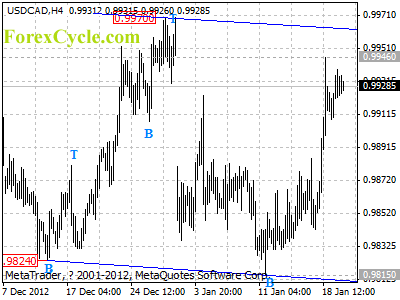
USDCAD is facing channel resistance
USDCAD is facing the resistance of the upper line of the price channel on 4-hour chart. As long as the channel resistance holds, the price action from 0.9824 is treated as consolidation of the downtrend from 1.0055 (Nov 16, 2012 high), and the downtrend could be expected to resume after touching the channel resistance. Support is at 0.9900, a breakdown below this level will indicate that a cycle top has been formed at 0.9946, and the downtrend from 1.0055 has resumed, then further decline towards 0.9700 could be seen. On the upside, a clear break above the channel resistance will indicate that the downtrend from 1.0055 had completed at 0.9815 already, then the following upward movement could bring price to 1.0200 zone.

Nigeria holds rate, but mulled rate cut on benign inflation
By www.CentralBankNews.info Nigeria’s central bank held its benchmark Monetary Policy Rate (MPR) steady at 12.0 percent, as expected, but said two of its 10 committee members had voted for a 25 basis point rate cut in light of the benign outlook for inflation.
The Central Bank of Nigeria (CBN) said the monetary policy committee had considered the calls for a rate cut but decided the current level was “just about right” because the outlook for inflation “may be undermined by the increased sub-national government spending and Federal Government high expenditure in 2013, the higher benchmark oil price in the 2013 budget and the U.S. debt ceiling with possible impact on commodity prices.”
The central bank, which said at its last meeting in November 2012 that a rate cut would send the wrong signal that the tightening cycle was over, noted the drop in headline inflation in December but also recognized that core inflation had risen, mainly due to cost-push factors in the face of sluggish growth in the monetary aggregates.
Nigeria’s central bank, which started tightening policy in September 2010 and last raised rates by 275 basis points in October 2011, said inflationary pressure was elevated in 2012 with the annual average at 12.24 percent while the average core was 13.87 percent and food inflation was 11.32 percent.
The CBN targets inflation of 10 percent and said earlier this month that it was working towards achieving a 6 percent inflation rate.
The central bank said the global economy remained largely subdued and characterized by uncertainty and contraction in the euro zone and Japan, as well as lower than expected growth in the large emerging and developing economies. A partial resolution of the fiscal cliff in the U.S. offers some hope for gradual global economic recovery.
Although the central bank was satisfied with the federal government’s efforts to keep deficits within the threshold prescribed, it said the increase in the oil price benchmark to $79 from $75 in the budget may pose a risk to the inflation objective and constituted a pressure point for the low inflation objective and effective monetary policy.
“The Committee reaffirmed its commitment to respond appropriately if panic spending in 2013 ultimately adds to inflationary pressures,” the central bank said, adding that one of the choices facing the policy committee was to raise the MPR.
The committee also considered a rate reduction in light of lower growth and headline inflation, and keeping the rate steady in light of conflicting price signals and global uncertainties.
Nigeria’s Gross Domestic Product rose by an annual rate of 6.48 percent in the third quarter, up from a rate of 6.28 percent in the second and 6.17 percent in the first.
Global Q3 lending stable, euro area banks retreating-BIS
A Free 40-Page Download: The Most Important Investment Report You’ll Read for 2013
Exclusive invitation: Our friends at Elliott Wave International have just released their new 40-page independent investor report, The State of the Global Markets — 2013 Edition: The Most Important Investment Report You’ll Read This Year. On an exclusive, limited-time basis, they’ve allowed us to share it with you for FREE.
Learn more and download your 40-page report now >>
Dear investor,
Consider yourself warned.
The global market outlook is far less rosy than the emperors-minus-their-clothes would have you believe.
- Global stocks are near multi-decade, technical price junctures.
- Regional economies recently said to be “recovering” are now slipping back into recession.
- Despite a multi-year rally in stocks, the AP reported on Dec. 27 that mainstream investors are selling shares at breakneck pace. “It’s the first time ordinary folks have sold during a sustained bull market since relevant records were first kept during World War II.”
Politicians and central bankers worldwide reassure investors that the credit crisis of 2007-2009 will turn out to be nothing more than a footnote in market history — despite the compelling proof that it never truly ended.
Meanwhile, U.S. Congress made a final-hour fiscal cliff deal to delay addressing its gargantuan budget woes, Europe remains in turmoil, and Asia-Pacific regions and emerging markets are charting surprising courses of their own.
Just as the timeless fable warns, sometimes it takes a single voice in a crowd to tell everyone the emperor wears no clothes. EWI’s new report, The State of the Global Markets — 2013 Edition, is that voice.
Packed with timely charts and analysis, this 40-page tour de force tears down the popular investment myths of today and replaces them with hardcore reality.
- It tells you what’s really going on in the global marketplace.
- It reveals market pitfalls no one else sees coming.
- It uncovers once-in-a-lifetime investment opportunities.
To get ahead of the markets in 2013, you must think independently. This 40-page report gives you the tools and the direction you need to gain a competitive edge.
Download The State of the Global Markets — 2013 Edition now (for FREE), and enjoy dozens of independent global market insights that will prepare you to survive and prosper in 2013 and beyond.
IMPORTANT: Please don’t buy or sell a single share of stock — anywhere in the world — without reading this report first.
With our best wishes for a prosperous New Year.
P.S. This report is available to you for free for a limited time, exclusively from EWI. Please download it now while its valuable year-in-preview advice can help your portfolio in the New Year. Download the 40-page report now.
About the Publisher, Elliott Wave International
Founded in 1979 by Robert R. Prechter Jr., Elliott Wave International (EWI) is the world’s largest market forecasting firm. Its staff of full-time analysts provides 24-hour-a-day market analysis to institutional and private investors around the world.
Weekly Metals, Oil, Dollar and Index Price Analysis
Chris Vermeulen – www.TheGoldAndOilGuy.com
US stock market is closed today for Martin Luther King, Jr. Day. I do not expect much price action to take place on the Canadian or futures market today.
Pre-Market Analysis Points:
– Dollar index is giving mixed signals this week. Short term chart looks bullish for another couple of days but overall it is trading within a large bear flag and near resistance.

– Crude oil is trading lower by -0.50% but remains in a strong uptrend and bull flag. $97-$98 looks like the next upward thrust target.

– Natural gas is trading higher 0.87% touching our upside target of $3.60 this morning. It could keep climbing to $3.70 which is the next target but it looks as though its ready for a pause.

– Gold and Silver are trading flat. Last week they held up at resistance but have yet to breakout. They could do it this week but until we the trend shifts with volume to support the move and miners to also show strength I will remain on the sideline.

– Bonds are trading flat and giving off mixed signals much. The 60 minute chart is bullish with a bull flag, while the daily chart is bearish.

– SP500 index remains in a bull market grinding its way higher each week without a decent pausepullback to get long. Technically we could see a 3-4% pullback any day and the market would remain in an uptrend.

Chris Vermeulen – www.TheGoldAndOilGuy.com
The Senior Strategist: No obvious stumbling blocks this week
Equities grinding higher – also last week. This week Jyske Bank Senior Strategist Ib Fredslund Madsen sees no obvious stumbling blocks for the market.
See more in this weeks edition of ‘The Week Ahead’.
Video by en.jyskebank.tv