Simple Tips to Reduce MT4 Memory Usage

By Martin Yerfo

Most active traders usually have more than one MetaTrader 4 terminal open at the time for different reasons, either have multiple accounts, demo trading in several brokers, comparing strategies, etc.

But the limiting factor to how many Metatraders you can run on a computer is based on the CPU speed and available memory. This can be a big problem when running MetaTrader on a VPS where you have to pay more if you need more resources like memory, speed or space.

Here are a few simple configuration changes you can make to reduce MetaTrader’s memory footprint.

=> The most important change is to open the option screen by pressing CTL + O, go to the Charts Tab and reduce the “Max bars in history” and “Max bars in chart” to 5000, this will limit how many bars are displayed on the chart and in the history making this installation unsuitable for back testing but it will use less memory on live or demo trading.

=> Also disable every feature you do not use on the Email, Publisher and Events Tabs.

=> Disable the News on the Server Tab

=> Close all charts that you are not using, each chart uses memory.

=> Open Market Watch (CTL + M) > right click and Hide All, deleting all pairs that are not in use

=> Remove any Indicator you do not need.

=> On expert Advisors if possible disable logging, the less you write to the Hard Drive, the faster your MetaTrader will run on a VPS.

=> Restart your MetaTrader so the changes will take effect

=> restart MetaTrader regularly to maintain memory usage low, MetaTrader keeps all the history data for the opened charts in RAM and only writes it to disk into the History folder when MetaTrader closes.

=> You should also reboot you machine often and exit any programs that you are not using, on a VPS machine you could also disable many services that you do not need.

About the Author

Full time Metatrader developer, programer, forex trader and marketing director

Professional http://4xtrader.net/forex-tools/ and http://4xtrader.net


BlackBerry 10 Will Not Save RIMM

By The Sizemore Letter

With a little more than a week to go before BB10 hits the stores, Research in Motion (Nasdaq:$RIMM) has become a hot stock again.  The company that invented the smartphone may be reestablishing itself as a major player in mobile.  Or, we could be watching the biggest dead-cat bounce in history.
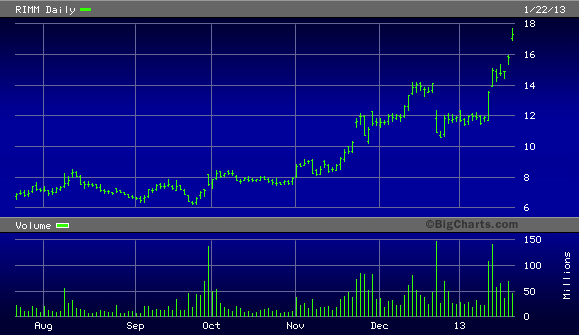
RIMM

As recently as this past September, RIMM was left for dead, trading for barely $6 per share.  As this article is going to press, it has nearly tripled from those levels.  A rally that large and over that long a stretch cannot be dismissed as short covering.  Clearly, a lot of investors believe that the BlackBerry is making a comeback.

We’ll see about that.

If you’re a nimble trader with a short time horizon, RIMM might be worth a gamble.  Given the current level of speculation in the stock, there should be some great trading opportunities over the next few weeks, long and short.

But if you’re an investor with a longer time horizon, you should view the rally in RIMM’s shares with a healthy dose of skepticism.  RIMM is not Apple (Nasdaq: $AAPL), Google (Nasdaq:$GOOG) or Microsoft (Nasdaq:$MSFT).    Any of these tech giants can afford to make a colossal mistake or two or to have a new product bomb.  Microsoft and Google have both proven this; with the exception of the Android operating system, neither company has come out with a hit product in years, yet both continue to generate gobs of cash.  Even the infallible Apple had its Maps public relations disaster last year, yet it hardly slowed the company down (stock price crater aside).

But RIMM?  For the erstwhile mobile leader, BB10 is do or die.  If the operating system fails to inspire consumers, then the company is finished.  This is a binary set of outcomes.  Either BB10 is a hit, and RIMM matters again, or it is a bomb and it is time to sell off the company’s assets and close up shop.  Given the competitiveness of the smartphone race, no prudent investor would make that bet.

Let’s pick apart some of the bullish arguments.

RIMM’s messaging and secure email system is a competitive advantage that keeps customers—and particularly enterprises—loyal.  Wrong.  I used to think I would miss my BlackBerry messenger and inbox…right up until I bought an Android.

But beyond this, one anecdotal bit of news late last year made me realize that BlackBerry was finished.  Fannie Mae—the quintessential enterprise customer with overzealous security requirements—was allowing their portfolio managers to turn in their company-issued BlackBerries and instead access their company email via their own iPhones and Androids using a custom app.

I had been skeptical that the “bring your own device” trend would ever expand beyond small businesses.  Big business and government would never tolerate the loss of control or security risks.  Well, never say never.  When government-sponsored entities allow it, it’s hard to imagine who won’t.

BB10’s new features are a “game changer.” Really?  Because everything I see looks a lot like something I’ve seen somewhere else.  The new BlackBerry Messenger (BBM) has voice calling, so you can call friends internationally from wifi or your data plan and not use mobile minute.

It seems like I’ve seen this before.  Oh yeah, it’s called Skype, and it’s already available on every other mobile platform except the BlackBerry.

Rumor has it that BB10 has the fastest browser.  Ok.  For lack of better information at the moment, I’ll concede that point.  But given that mobile devices tend to be app-driven and not browser-driven, that’s a small victory at best.

Rumor also has it that BB10 will have the best auto-correct and word prediction, which are valid selling points for a touchscreen phone.  But will that compel a customer to choose a BlackBerry over the newest, snazziest Samsung Galaxy?  I’m thinking no.

There is huge pent-up demand for the BB10 after months of delays.  This is laughable.  Yes, plenty of current BlackBerry users will upgrade.  But given the poor experience with the brand in recent years, I don’t see too many former users who defected to the iPhone or Android going back.  They’ve moved on, and whatever they found appealing about the BlackBerry ecosystem in the past—such as BBM, which is still the best texting program out there—they have found they can live without.

A related issue here is cost.   I was poking around the T-Mobile store a few weeks ago (shopping for a Windows phone, incidentally) when I picked up the current generation BlackBerry Bold.  Buying it outside of contract, it costs over $600.

Seriously?   $600…for the old, clunky non-BB10 edition?  What will a new one cost? For consumers to give BB10 a chance, it will have to be aggressively subsidized and pushed by the carriers.  Will they?  All major carriers have pledged “support.”  We’ll see what that means in practice.

RIMM’s share price is soaring today on comments from CEO Thorsten Heins that the company’s strategic review could include selling off its hardware production or licensing its software.  I argued a year ago that RIMM could have a bright future as a services company by building on Mobile Fusion.  It could essential follow the path of IBM and become a high-end services company rather than a gadget maker.

But a year later, it’s still nothing more than speculation. And with RIMM no longer dictating terms, carriers have started to push back on the licensing fees for BlackBerry Internet Service and Enterprise Server.

And who, pray tell, would buy RIMM’s hardware business?  Or more importantly, license BB10 as a manufacturer?  Samsung?  Nokia?  Probably not; both have made large commitments to Android and Windows.

RIMM doesn’t have a lot of time.  It’s bleeding cash, and it isn’t expected to turn a profit this year.  For RIMM, BB10 must be a rip-roaring success.  Failure means irrelevance and death.

And let’s not forget one last point.  RIMM is not really competing with Apple or Google right now.  It’s competing with Microsoft to be the third platform.

It is in everyone’s best interest to avoid an Apple-Google duopoly.  Consumers, manufacturers, and carriers all stand to benefit from more competition.  But I’m betting that it is Microsoft that pushes its way in, not Research in Motion.  Microsoft is starting with a clean slate and a fine operating system that any manufacturer can license.  There is no baggage and no cumbersome technology arrangements (think BIS and BES) with which to contend.

Samsung is set to launch its ATIV Windows phone (essentially a Galaxy that runs Windows instead of Android) in the United States about a week before BB10 hits the market.   We’ll see which ends up making a bigger splash.

I wouldn’t be too quick to short RIMM at the moment.  It’s simply too hot to touch.  But once the new release hype has run its course, RIMM could be an absolute feast for bears.

Disclosure: Sizemore Capital is long MSFT.

SUBSCRIBE to Sizemore Insights via e-mail today.

The post BlackBerry 10 Will Not Save RIMM appeared first on Sizemore Insights.

Latest Forex News: Dollar is under pressure, Yen is trying to develop correction once again

Dollar is under pressure, yen is trying to develop correction once again


eurusd22.01.2013

For the whole day yesterday EUR/USD did not move anywhere. The pair was traded in a narrow range between 1.3300 and 1.3332 levels. During Asian session, euro rose sharply to 1.3357, but the pair could not go any higher. In general, there were not any changes in the overall picture. However, support in the 33rd figure continues to keep the euro from falling, which is a good factor for the bulls on it, well, drawing of a double top did not work. But, still one should not exclude falling to 1.3180-1.3160, unless, of course, the pair is not be able to overcome the 34th figure.


Kenyan Oil, Hot and Getting Hotter: Interview with Taipan’s Maxwell Birley


globe-oil-balance-grey

Kenya has become the hottest oil and gas venue in East Africa since big discoveries were made in the country’s virgin oilfields last April. All eyes are on Kenya in 2013 to see how quickly–and economically they can develop those discoveries into production.


Currency Speculators increased bets against the US Dollar. Euro at best level since July 2011

Non-commercial large futures traders, including hedge funds and large speculators, registered a US dollar short position total of $12.897 billion on January 15th after totaling a short position of $6.96 billion on January 8th, according to the CFTC COT data and calculations by Reuters which calculates the dollar positions against the euro, British pound, Japanese yen, Australian dollar, Canadian dollar and the Swiss franc.

US dollar overall short positions are now at their highest level since October 2nd 2012 when total short positions registered $16.31 billion.


Free 40-Page Download: The Most Important Investment Report You’ll Read for 2013


Exclusive invitation: Our friends at Elliott Wave International have just released their new 40-page independent investor report, The State of the Global Markets — 2013 Edition: The Most Important Investment Report You’ll Read This Year. On an exclusive, limited-time basis, they’ve allowed us to share it with you for FREE.

Learn more and download your 40-page report now >>


Latest Headlines:


More Featured Articles:

Options Trading – How to Trade Options Around Company Earnings

Options-Big

The hallmark of a professional option trader is the ability to use a wide variety of trade structures in order to exploit opportunities to profit from specific situations the market presents…


Interviews –  Risk Management for Technical Traders [Interview Excerpt]

By Elliott Wave International

Risk management is all about consistency. It is all about longevity. It is like going back to the story about the tortoise and the hare. You want slow or small consistent profits…


Guest Post – Self Confidence is a derivative of Knowledge; know more worry less.

By Tanmay, Founder/Chief Market Strategist, www.chartingtoday.com

I’ve been trading the spot fx markets for more than half a decade, and running charting today for a few years. During this time I’ve mentored/provided signals to a lot of traders in real time through webinars and also over voice, and I get all sorts of emails enquiries from all levels of traders. Only a small minority of traders with good money management skills, patience, and a market niche go on to be successful. Here is my insight based on my personal experience as to why most people are unable to succeed at this business..…


See more News, Analysis & Featured Articles at CountingPips Forex News


How to Trade Options Around Company Earnings

By JW Jones – www.OptionsTradingSignals.com

The hallmark of a professional option trader is the ability to use a wide variety of trade structures in order to exploit opportunities to profit from specific situations the market presents. One of the opportunities routinely presented multiple times yearly is the impending release of earnings.

Underlying the logic of earnings trades is the stereotypic pattern of increasing implied volatility of options as earnings approach. This pattern is so reliably present that experienced options traders can recognize the approximate date of an impending earnings release by simply perusing the implied volatility of the various series of upcoming options.

As a real time example of this phenomenon, consider the current option chain of AAPL which will report earnings after the market closes on Wednesday, January 23.

Chart1

As can clearly be seen, the front weekly options, the first series in time following the impending earnings release, has dramatically elevated implied volatility as compared to the series expiring later.

It is because the release of earnings routinely causes reversion of the elevated implied volatility toward its historic mean value that a number of high probability trades can often be constructed surrounding earnings.

I thought it would be instructive to review a recent earnings trade I made in order to see how this consistently observed collapse of implied volatility works in practical terms.

EBAY was scheduled to report earnings after the market closed on Wednesday, January 16. As the price chart below reflects, EBAY had recently rallied and was trading in the price range circled in red.

Chart2

At the time of the upcoming earnings release, there were only a few days of life left in the

January options which would expire the following Friday afternoon. The then current implied volatility situation can be seen in the option chain displayed below.

Chart3

Note the elevated implied volatility in the January options as compared to the February options. The value is around twice that of the February options and clearly demonstrates this routinely observed spike as we also have seen above in the case of AAPL options.

My operating assumption was that EBAY would trade down slightly following earnings. This was wrong. As we will see however, proper trade construction resulted in a nicely profitable trade despite incorrect price prediction.

After considering a number of potential trades, I decided to use a short strangle in an attempt to capture the collapse of implied volatility. As a brief review, remember that a short strangle is a two legged position and consists of both a short out-of-the-money call and short out-of-the-money put.

Because my price hypothesis was that EBAY would sell off a bit, I weighted the strangle to the downside slightly by selling different quantities of puts and calls. The P&L graph of the position I took late Wednesday afternoon is displayed below.

Chart4

The earnings were a bit better than anticipated and resulted in a modest price increase. I was able to exit the position shortly following the market open on Thursday morning for a profit of 6.45% based on the margin encumbrance required to maintain the position under Regulation T rules.

The results of this trade illustrate two critically important points for the new options trader to

understand clearly. First, my price assumption was wrong but the trade was still profitable. For those used to trading stock this may be almost an unbelievable result since in the world of stock trading there is no margin of error for an incorrect price assumption.

The second point is closely linked to the first. The second assumption in this trade was that

implied volatility would decrease substantially. This did in fact happen, the implied volatility of the 55 strike calls decreased from the 69.9% shown above to a post earnings release of 23%.

It was this volatility collapse in both the puts and calls that resulted in the profitability of the trade. Had I used my same price assumptions and constructed the trade using stock, the trade would have been a loser. We invite you to try our service to see how proper trade construction and position sizing can result in a high probability of success.

Simple ONE Trade Per Week Trading Strategy?
Join www.OptionsTradingSignals.com today with our 14 Day Trial

JW Jones

This material should not be considered investment advice. J.W. Jones is not a registered investment advisor. Under no circumstances should any content from this article or theOptionsTradingSignals.com website be used or interpreted as a recommendation to buy or sell any type of security or commodity contract. This material is not a solicitation for a tradingapproach to financial markets. Any investment decisions must in all cases be made by the reader or by his or her registered investment advisor. This information is for educational purposes only.


Dollar is under pressure, yen is trying to develop correction once again

EURUSD

eurusd22.01.2013

For the whole day yesterday EUR/USD did not move anywhere. The pair was traded in a narrow range between 1.3300 and 1.3332 levels. During Asian session, euro rose sharply to 1.3357, but the pair could not go any higher. In general, there were not any changes in the overall picture. However, support in the 33rd figure continues to keep the euro from falling, which is a good factor for the bulls on it, well, drawing of a double top did not work. But, still one should not exclude falling to 1.3180-1.3160, unless, of course, the pair is not be able to overcome the 34th figure.

GBPUSD

gbpusd22.01.2013

Euro/pound did not develop a downward correction and pound did not strengthened against the U.S. Dollar either. Its achievements were limited by 1.5893 level, from which pound/dollar fell again, this time to 1.5805, and then fell back to 1.5854. Pressure on the pair remains as well as selling on rebounds, but pound begins to show signs of being oversold, it may create some difficulties in further decline. Therefore, one should be extra careful with sales at current levels. Growth and ability to consolidate above the 59th figure somewhat ease pressure on the pair, but only the ability to develop upward momentum above 1.6170 will give reason to suppose ending of the British downward trend.

USDCHF

usdchf22.01.2013

Trading in the dollar/franc also took place in a narrow range, which was limited by 0.9348 and 0.9307 levels. Franc, at the moment is trying to win back lost positions, putting pressure on the support around 0.9290, where on daily chart the 100-day moving average is. If it is passed, then dollar will fall to 0.9240-0.9200. Falling and the ability to consolidate below 02nd figure would mean resumption of the downtrend in the pair.

USDJPY

usdjpy22.01.2013

In anticipation of the announcement of results from Bank of Japan meeting dollar/yen is trading with a downward bias, falling to 89.33 support. Attempts to growth were limited by 89.87 level. After results were published the pair tested 90.14 and 88.89 levels. When markets calmed down, dollar began declining towards the 89th figure. In case it is overcome the pair will be in bears’ hands, the immediate goal of them will be 88.40-88.00. Returning to 90th figure will weaken bearish pressure on the dollar.

Provided by IAFT


5 MORE of the Best Stocks for 2013

By The Sizemore Letter

InvestorPlace has compiled a list of 10 best stocks for 2013 by asking 10 different experts to each pick an investment they expect to outperform from Jan. 1 to Dec. 31 this year.  Jeff Reeves of InvestorPlace and Charles Sizemore of Sizemore Capital Management broke down half of the picks last week (listen to that podcast here) and take on the second half of the list in today’s podcast.

The entire list is full of strong picks, but this is admittedly a “swing for the fences” feature trying for big gains in a horizon of just 12 months. So don’t let any bullishness or bearishness for the purpose of your contest influence you if you’re looking for a quick swing trade or a buy-and-hold play in any of these stocks that lasts well beyond our Dec. 31 deadline.

The picks we cover here include:

Read more about the 10 best stocks for 2013 on InvestorPlace.com for details on the full list and to follow the contest across the year.  And listen to Charles and Jeff riff on the first five picks of this series, including Charles’ own selection of Daimler (PINK:DDAIF).

The post 5 MORE of the Best Stocks for 2013 appeared first on Sizemore Insights.

Gold “Needs to Break $1700 for Momentum”, Japan’s “Bold” Policies Could “Threaten Central Bank Independence”

London Gold Market Report
from Ben Traynor
BullionVault
Tuesday 22 January 2013, 08:00 EST

U.S. DOLLAR gold prices  hovered above $1690 an ounce Tuesday morning in London, close to one-month highs, while prices in Yen quoted on Tokyo’s gold futures market set a new record, following an announcement of open-ended asset purchases and a new, higher inflation target by Japan’s central bank.

“[Gold] is struggling along the 55-day moving average at $1695.96 and just below the downtrend channel resistance line at $1704.89,” says Commerzbank senior technical analyst Axel Rudolph.

“We would like to see a daily close above the latter being made before we become medium term bullish again.”

“Gold really needs to break above $1700,” agrees Scotia Mocatta director Peter Tse, “and close above that level to attract short-term buyers, but the momentum has not built up that much, even when we are right before the [Chinese] Lunar New Year and physical demand is steady.”

Silver meantime hovered above $32 an ounce for much of this morning, before dipping back to where it started the week, as other commodities were also little changed.

European stock markets opened lower Tuesday morning, reversing yesterday’s gains, before regaining some ground by lunchtime.

Germany’s DAX index was down more than 1% on the day at one point, before recovering some losses after ZEW surveys showed better-than-expected improvement in German and Eurozone-wide economic sentiment.

US markets reopen today after a holiday on Monday.

At its policy meeting Tuesday, the Bank of Japan announced it will adopt a 2% inflation target, double the previous goal of 1%, a move that had previously been suggested by the new government of prime minister Shinzo Abe, who was elected last month.

The BoJ also announced an open-ended program of buying ¥13 trillion ($146 billion) of mainly short-term government debt a month starting in January 2014, when its current quantitative easing program is due to end, as part of efforts to raise inflation to the 2% target.

“This is a step toward bold monetary easing,” Abe said in response to the BoJ announcement.

Following the BoJ’s announcement, gold prices in Yen for gold contracts traded on the Tokyo Commodity Exchange (Tocom) hit an all-time high Tuesday.

Last week, the Yen spot gold price touched its highest level since 1980 – two years before the founding of the Tokyo Gold Exchange, which became part of the Tocom when that was created in 1984.

The Yen meantime added to yesterday’s gains against the Dollar this morning, having started the week by touching a two-and-a-half-year low at the start of Monday’s session.

“The weakness of the [Yen]…may reflect the possibility that efforts to revive inflation succeed too well, that the inflation genie will be let loose and will not stop at 2%,” says a note from HSBC.

“Inflation in Japan has not sustained a 2% handle since the early 1990s, so we are talking about a pretty aggressive target for the BoJ. Will they really be able to micro-manage it higher without a blowout?”

Japan’s government is “threatening an end to central bank autonomy,” according to Jens Wedimann, president of Germany’s Bundesbank.

“A consequence, whether intentional or unintentional, could moreover be an increased politicization of exchange rates,” Weidmann warned in a speech last night.

“So far the international currency system has come through the crisis without a devaluation competition, and I hope very much that remains the case.”

Over in India, the world’s biggest gold buying nation, the government has raised import duties on gold from 4% to 6%, economic affairs secretary Arvind Mayaram told reporters late Monday.

“Consumption and imports will fall definitely,” says Bachhraj Bamalwa, chairman of the All India Gems & Jewellery Trade Federation, who last week warned that such a duty hike could cause a drop in imports of up to 25%.

“This will also help the government reduce the current account deficit.”

Several Indian policymakers have recently cited gold imports as a contributing factor India’s trade deficit, which they say undermines the Rupee exchange rate.

Ben Traynor
BullionVault

Gold value calculator   |   Buy gold online at live prices

Editor of Gold News, the analysis and investment research site from world-leading gold ownership service BullionVault, Ben Traynor was formerly editor of the Fleet Street Letter, the UK’s longest-running investment letter. A Cambridge economics graduate, he is a professional writer and editor with a specialist interest in monetary economics. Ben writes and presents BullionVault’s weekly gold market summary on YouTube and can be found on Google+

(c) BullionVault 2013

Please Note: This article is to inform your thinking, not lead it. Only you can decide the best place for your money, and any decision you make will put your money at risk. Information or data included here may have already been overtaken by events – and must be verified elsewhere – should you choose to act on it.


Turkey shift rate corridor down, but holds benchmark rate

By www.CentralBankNews.info     Turkey’s central bank cut its overnight lending and borrowing rates by 25 basis points but kept its benchmark one-week repo rate steady at 5.50 percent, moves that were expected by markets, and said this would give it flexibility in light of ongoing uncertainties in the global economy.
    The move by the Central Bank of the Republic of Turkey continues last year’s policy of adjusting its interest rate corridor, which it can vary daily to control exchange rates and capital flows.
   The overnight lending rate, which forms the ceiling of the corridor, was cut to 8.75 percent from 9.0 and the borrowing rate, which forms the bottom, was cut to 4.75 percent from 5.0 percent.
    Last year the central bank kept the benchmark repo rate steady until the last meeting of the year in December, when it cut it by 25 basis points, the first change in the repo rate since August 2011.
    A drop in inflation paved the way for the central bank to trim its overnight rates with inflation hitting a year low of 6.16 percent in December, evidence that inflation is trending downward, the central bank said. At the end of 2011, inflation hit 10.45 percent.

    However, the central bank has said that it expects inflation to remain above its 5.0 percent target for some time due to higher administered prices.
    Turkey’s Gross Domestic Product expanded by only 0.2 percent in the third quarter from the second for annual growth of 1.6 percent, the lowest quarterly growth rate since third quarter 2009.
    For 2013 the central bank is expecting growth of 4 percent or above.

    www.CentralBankNews.info

The Turkish economy recorded spectacular expansion in 2010 and 2011, with 8.9 and 8.5 percent growth, to rank among the world’s fastest-growing economies.
But its expansion started slowing down in late 2011, with a growth rate of 5.2 percent — which was painted as a healthy easing of business activity.
The Turkish economy posted markedly slower growth of 1.6 percent in the third quarter of 2012 from the same period a year earlier, official statistics revealed early this month.
The third quarter official result pulled down nine-month growth in Turkish gross domestic product to 2.6 percent, which was well below the official forecast of 3.2 percent.
Government forecasts expect 4 percent yearly growth in 2013 and 5 percent each in 2014 and 2015.


Turkey Central Bank Unveils New Tool to Limit Bank Debt Risk

Turkey’s central bank announced a new policy tool today to limit risks of excessive debt in the banking system by placing higher reserve requirements on banks that fail to meet specified leverage ratios.
The bank will begin relying on a new leverage ratio together with the capital adequacy ratio to guard against an expansion in debt, central bank Governor Erdem Basci said at a press conference in Ankara today. The measure will require banks with leverage levels below 3.5 percent to hold additional reserve requirements that will increase as the leverage ratio decreases.
The leverage ratio is a measure of a bank’s equity divided by its liabilities plus off-balance sheet items, the central bank said in a report on its website today. Banks with a leverage ratio of less than 3.5 percent will be subject to additional reserve requirements of as much as two percentage points starting in 2014, Basci said.
The move shows the bank’s determination in preventing systemic risk in the banking system and will have little impact because banks are not excessively leveraged, according to Emre Tekmen, an Istanbul-based economist at Turk Ekonomi Bankasi, BNP Paribas SA’s Turkish unit.

Signaling Effect

“It has some signaling effect,” Tekmen said in response to e-mailed questions today. “The market already knows that macro-prudential measures will be more active in 2013.”
Only three banks in Turkey have a leverage ratio below 5 percent, Basci said, and none have a ratio below 3.5 percent. He said that at the end of 2014, the threshold would be increased to 4 percent and by the end of 2015, it would increase to 5 percent. Most banks’ ratios are above 7 percent, he said.
The chances of the new leverage ratio being used are “quite slim,” Cevdet Akcay, chief economist at Yapi & Kredi Bankasi AS, the bank part-owned by Italy’s UniCredit SpA (UCG), said in a phone interview from Istanbul today. “It’s a new policy tool, but it’s not going to be extremely significant.”
These measures are part of a broader global trend in which “macro-prudential measures will be used more,” Aksay said. “In the past, monetary and fiscal policies were applied, now it’s going to be the new tool kit with monetary, fiscal and macro- prudential policies.”

Preventive Measures

The loans-to-deposit ratio among Turkish banks was 104 percent, Banks Association of Turkey General Secretary Ekrem Keskin told reporters in Ankara on Dec. 14. A ratio of above 100 percent means banks rely on foreign funding to finance loan growth.
“In Turkey, when banks expand their assets they do so by increasing indebtedness,” Basci said today. “An excessive risk-taking scenario in which the leverage ratio of many banks would decline rapidly confirms the need to take preventive measures.”
Last year, rapid consumer credit expansion helped widen Turkey’s current-account deficit to about 10 percent of gross domestic product. That contributed to an 18 percent loss in the value of the lira and an inflation rate of 10.5 percent. Basci said today that preventing loan growth from exceeding 15 percent would “support price and financial stability.”

Inflation

The bank will remain committed to inflation targeting, while monitoring the so-called real exchange rate index and credit expansion as key ingredients in price stability, Basci said.
The real exchange rate index measures the lira against the currencies of its main trading partners. A reading of 130 or above would signify “extreme volatility,” Basci said today. Last month, Basci said that a reading above 120 would be cause for concern as it suggested the lira was becoming overvalued. The measure was at 119.2 in November.
The central bank’s new announcement is consistent with a monetary policy stance that will “continue to be characterized by short-term interest rates and tight macro-prudential measures,”Inan Demir, chief economist at Finansbank AS, the Istanbul-based lender owned by NationalBank of Greece (TELL), said in an e-mailed report today.
“We foresee domestic demand accelerating in the upcoming period, which would translate into excessive loan growth and external balance deterioration in the absence of policy response,” he said.

IMF Says Turkey’s Central Bank Should Focus on Inflation Control

By David Neylan and Sandrine Rastello on December 21, 2012

The Turkish central bank should be more focused on meeting its inflation target because its multiple monetary policy tools are “blurring signals,” the International Monetary Fund staff said.

Businessweek

More About “imf turkey”

Greece Can Learn IMF Austerity from Turkey

Thu May 27, 2010, 11:00am EDT

Is Christine Lagarde Right for the IMF?

Thu June 09, 2011, 5:00pm EDT

While the monetary policy framework put into place by Central Bank Governor Erdem Basci aims to achieve both price and financial stability, inflation has remained “well above target,” IMF economists said in an annual assessment of the country’s economic policy dated Oct. 31 and released yesterday. It recommended a return to “a more conventional framework.”
“The new framework, relying on a battery of novel instruments to gain degrees of freedom in segmenting domestic and international interest rates, has not yet proved its superiority,” the IMF wrote.
Monetary policy in Turkey has been led in a way the IMF said in the report is “unconventional,” relying on a variety of instruments instead of one interest rate in an attempt to stem capital inflows. The bank forecast Oct. 24 that inflation will reach 7.4 percent by the end of the year. Its target is 5 percent.
“It is the ability to achieve the inflation target and anchor expectations that ultimately determines the success of monetary policy, and so far inflation has remained well above the target,” the report said. “While the new instruments may each seem appealing, as a whole, they are blurring policy signals and may be weakening the monetary transmission mechanism.”

Turkey Yields Jump Most in 3 Months on Interest-Rate Corridor

By Selcuk Gokoluk on December 19, 2012

Turkey’s bond yields jumped the most in more than three months after the central bank left its overnight borrowing rate unchanged, signaling a less dovish monetary policy than investors’ expected.
Yields on two-year benchmark debt rose 10 basis points, or 0.1 percentage point, to 5.91 percent, the biggest advance since Sept. 3, by the 5:00 p.m. close in Istanbul, paring this year’s gain to 510 basis points. The lira weakened 0.2 percent against the dollar at 1.7814, reducing its gain this year to 6.1 percent, the third-largest among 10 emerging markets in Europe, the Middle East and Africa.
The central bank, led by Governor Erdem Basci, kept the bottom end of its so-called rates corridor unchanged at 5 percent yesterday. The median estimate of seven economists surveyed by Bloomberg was for a 25 basis-point cut. Basci maintained the overnight lending rate at 9 percent and lowered the one-week repurchase rate by 25 basis points to 5.5 percent, in line with estimates.
“‘The central bank was not as dovish as expected at yesterday’s Monetary Policy Committee meeting,” Cengiz Erguen, a director of local markets trading at Commerzbank AG, said in e-mailed comments from London. “The 25 basis-point cut at the benchmark rate was very cautious and everyone had been betting on a 25 basis cut at the lower end of the band and people got slightly nervous when this did not come.”

Economic Growth

Turkey’s economic growth fell to 1.6 percent in the third quarter, the slowest pace since the 2009 recession.
Credit growth showed “a marked increase” and the contribution of domestic demand to economic growth “is expected to increase in the forthcoming period,” the bank said yesterday.
“The market saw the text from the central bank as very hawkish,” said Sercan Kiliclar, a fixed-income trader at Akbank TAS (AKBNK) in Istanbul, said in e-mailed comments. “There will be no interest-rate reductions driven by economic growth.”
Turkey’s economic growth may slow to 3 percent this year from 8.5 percent in 2011, according to the median estimate of 24 analysts on Bloomberg.
Basci introduced the rates band in October of last year that allows him to adjust interest rates on a daily basis. It was created to balance above-target inflation, slowing economic growth and high volatility of the lira.

EU, US News Forecasted to Create Market Volatility Today

Source: ForexYard

The yen came off a recent 2 ½ year low against the US dollar yesterday, as investors spent the day speculating about the possible steps the Bank of Japan was willing to take to increase inflation. Meanwhile, a lack of significant international economic news led to relatively little movement for most other currencies and commodities over the course of day. Today, traders can anticipate significantly more volatility in the marketplace following the release of the German ZEW Economic Sentiment figure at 10:00 GMT, the US Existing Home Sales at 15:00, and a speech from ECB President Draghi at 18:00.

Economic News

USD – Home Sales Data Set to Impact Dollar

The US dollar saw relatively little movement against its higher-yielding currency rivals yesterday, largely due to a lack of significant international economic news. The USD/CHF dropped slightly more than 30 pips during early morning trading, eventually trading as low as 0.9311, before bouncing back to 0.9320 toward the end of the European session. Against the Japanese yen, the dollar fell some 34 pips during the morning session before staging an upward correction later in the day. By the beginning of afternoon trading, the USD/JPY was at 89.70, not far from a recent 2 ½ year high.

The main piece of US news today is likely to be the Existing Home Sales figure, set to be released at 15:00 GMT. Analysts are expecting the figure to come in at 5.09M, slightly higher than last month’s 5.04M. If today’s news comes in at or above the expected level, confidence in the US economic recovery could give the greenback a boost against its higher yielding currency rivals, including the euro, Swiss franc and Australian dollar.

EUR – German Data, Draghi Speech Expected to Generate Market Volatilty

The euro began the week largely range trading against its main currency rivals, as investors were hesitant to open large positions before potentially significant news this week. The EUR/USD fell some 29 pips during the morning session, eventually reaching as low as 1.3299 before bouncing back to 1.3315 during the afternoon session. Against the British pound, the common-currency lost close to 20 pips during the first part of the day before gaining 25 during afternoon trading. The EUR/GBP was trading at 0.8400 by the end of the European session.

Today, euro traders will want to pay close attention to the German ZEW Economic Sentiment, scheduled to be released at 10:00 GMT. Analysts expect the indicator to come in at 12.2, a significant increase over last month’s 6.9. If today’s news comes in at or above the expected value, investor confidence in the euro-zone economic recovery could result in the euro turning bullish during mid-day trading. Later in the day, a speech from ECB President Draghi also has the potential to generate market volatility. Should Draghi voice optimism in the euro-zone economic recovery, the euro could see upward movement.

Gold – Euro-Zone Data May Result in Gains for Gold Today

While gold saw minor downward correction during European trading yesterday, prices were able to remain within reach of a recent one-month high. The precious metal fell close to $5 an ounce during morning trading, eventually reaching as low as $1685.65, before bouncing back to the $1688 level during the afternoon session.

Today, gold traders will want to pay attention to the German ZEW Economic Sentiment figure, set to be released at 10:00 GMT. A better than expected result will likely generate risk taking among investors, which could boost gold prices during the mid-day session.

Crude Oil – Crude Oil Remains within Reach of 4-Month High

The price of crude oil saw very little movement yesterday, largely due to a bank holiday in the US and a lack of significant international economic indicators. The commodity spent most of the day trading around the $95.65 level, within reach of a recent four-month high of $96.01.

Today, US housing data could result in volatility for oil prices. If the Existing Home Sales figure comes in above the forecasted 5.09M, speculations that an improved US economy will lead to increased demand for crude could lead to an increase in oil prices.

Technical News

EUR/USD

A bearish cross has formed on the daily chart’s MACD/OsMA, indicating that a downward correction could occur in the near future. This theory is supported by the Williams Percent Range on the weekly chart, which is currently in overbought territory. Opening short positions may be the smart choice for this pair.

GBP/USD

The Williams Percent Range on the weekly chart has crossed into oversold territory, indicating that an upward correction could occur in the near future. Furthermore, the Slow Stochastic on the daily chart has formed a bullish cross. Traders may want to open long positions for this pair.

USD/JPY

The Relative Strength Index on the weekly chart has crossed into overbought territory, indicating that a downward correction could occur in the near future. This theory is supported by the Williams Percent Range on the same chart, which has formed a bearish cross. Opening short positions may be the wise choice for this pair.

USD/CHF

While the MACD/OsMA on the weekly chart has formed a bullish cross, most other long-term technical indicators show this pair trading in neutral territory. Traders may want to take a wait and see approach for this pair, as a clearer trend may present itself in the coming days.

The Wild Card

EUR/SEK

A bearish cross has formed on the daily chart’s Slow Stochastic, indicating that a downward correction could occur in the near future. This theory is supported by the Williams Percent Range on the same chart, which is currently in overbought territory. Opening short positions may be the best choice for forex traders today.

Forex Market Analysis provided by ForexYard.

© 2006 by FxYard Ltd

Disclaimer: Trading Foreign Exchange carries a high level of risk and may not be suitable for all investors. There is a possibility that you could sustain a loss of all of your investment and therefore you should not invest money that you cannot afford to lose. You should be aware of all the risks associated with Foreign Exchange trading.

Malawi holds rate steady to let past policy tightening work

By www.CentralBankNews.info     Malawi’s central bank kept its benchmark bank rate unchanged at 25.0 percent, saying inflation was in line with recent forecast and it wanted to allow more time for the recent monetary tightening to work its way through the economy.
   But the Reserve Bank of Malawi (RBM) said the “risks in the financial system remained elevated due to the high inflation and interest rates” with the ratio of non-performing loans rising to 8.2 percent in November from 7.8 percent in the previous month.
     Malawi’s central bank had the dubious honor of being the top rate-raiser in 2012, increasing rates by 1200 basis points, bringing its rate to the second highest in the world after Belarus’ 30.0 percent.
    Malawi’s inflation rate rose to a new year-high of 33.30 percent in November from 30.6 percent in October but average prime lending rates in the money markets were 31.4 percent and thus “marginally negative,” the bank said in a statement following a policy committee meeting on Jan. 10.
    Money market conditions remain tight, the RBM said, noting that some banks have resorted to the central bank’s collateralized discount window and the average Treasury bill yield rose to 23.14 percent from 22.0 percent the previous month.

    Money supply growth eased to an annual 18 percent in November from 22.7 percent in October and gross credit to the private sector dropped to 200.4 billion kwacha from 208.2 billion. Foreign exchange reserves also dropped to US$ 126.5 million, about 0.7 months of import cover, as a result of continued intervention in the foreign exchange market, the RBM said.
    Malawi is one of the world’s poorest countries and heavily dependent on tobacco exports, which account for almost half of its export earnings. But it was hit by a poor maize crop due to drought and by a halving of its tobacco crop – and thus foreign exchange shortages – due to lower planting during a period of currency overvaluation.
    Shortly after taking office last year, Malawi’s new president,  Joyce Banda, devalued Malawi’s kwacha currency by 50 percent and moved to a flexible, market-based exchange rate system. She also removed restrictions on foreign exchange transactions, which helped stop the overvaluation of the currency, according to the International Monetary Fund.

    www.CentralBankNews.info