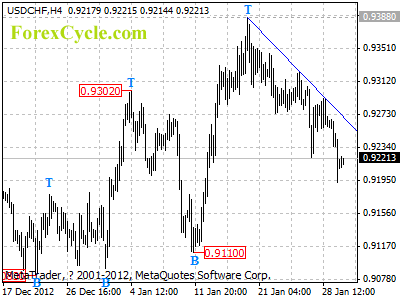
USDCHF stays below a downward trend line

USDCHF stays below a downward trend line on 4-hour chart, and remains in downtrend from 0.9388, and the fall extends to as low as 0.9193. Resistance is at the trend line, as long as the trend line resistance holds, further decline is still possible after a minor consolidation, and next target would be at 0.9100 area. On the upside, a clear break above the trend line resistance will indicate that a cycle bottom is being formed and consolidation of the downtrend is underway.

usdchf

Daily Forex Forecast

Hungary to consider rate cuts if inflation in line with target

By www.CentralBankNews.info     Hungary’s central bank, which earlier today cut its base rate by another 25 basis points to 5.50 percent, said it would only consider further rate cuts if the outlook for inflation remains in line with the bank’s 3 percent target and the improved sentiment in financial markets is sustained.
    The National Bank of Hungary, which began cutting rates last August, said the short-term outlook for inflation had recently improved and it expects inflation to return to around the target as the impact of last year’s tax rises wanes and domestic demand remains weak.
    However, the bank also warned that if companies pass on higher production costs in response to government measures that affected the prices of non-core items, “it may pose an upside risk to the medium-term outlook for inflation” and it would closely monitor underlying inflation.
    Since August last year, the central bank has cut rates by 150 basis points to stimulate growth and this month’s guidance is largely similar to last month when it also said it would only consider further rate cuts if good financial market sentiment continues and the inflation target is achievable.
    Hungary’s inflation rate eased further to 5.0 percent in December from November’s 5.2 percent, with lower prices of durable goods, processed foods and fuels the major factor.

    Hungary’s inflation rate jumped last year due to higher indirect taxes, which triggered price hikes, a depreciation of the forint plus higher food prices from bad weather.
    “Hungarian economic growth is likely to resume following last year’s recession as the country’s export markets recover,” the central bank said, adding that output is significantly below its potential level and the labour market remains loose.
    It added that global risk appetite had continued to improve in the past month but the “contrast between buoyant sentiment in international financial markets and the subdued outlook for growth continues to pose a risk.”
    Hungary’s Gross Domestic Product fell by 0.2 percent in the third quarter from the second quarter, the third quarterly contraction in a row. Year-to-year, the economy shrank by 1.5 percent in the third quarter, up from second quarter decline of 1.3 percent and first quarter contraction of 1.2 percent.
    In 2011 Hungary’s economy expanded by 1.7 percent and the International Monetary Fund said in its annual review this month that the economy was projected to have shrunk by 1.5 percent this year, up from its October forecast of 1.0 percent.
    This year the IMF expects Hungary’s economy to stagnate with any rise in exports offset by weak domestic demand. Inflation in 2013 is projected to have eased to 3.5 percent from 5.6 percent in 2012, but the IMF said inflation expectations were still not well anchored.
    The IMF said further rate cuts by Hungary’s central bank should be “considered very cautiously” as rate cuts are unlikely to have a material impact on aggregate demand, given the difficult operational environment for banks, and the foreign currency exposure of private and public balance sheets remains significant so any sizable currency depreciation could be destabilizing.
    The central bank said its policy tools allowed it enough room to maintain a policy stance that is consistent with its inflation outlook and any expansion of its range of “unconventional policy tools may provide effective support only during times of acute financial market stress.”

    www.CentralBankNews.info

Central Bank News Link List – Jan. 29, 2013: Bernanke seen buying $1.14 trillion in assets in 2014

By www.CentralBankNews.info

Here’s today’s Central Bank News link list, click through if you missed the previous link list. The list comprises news about central banks that is not covered by Central Bank News. The list is updated during the day with the latest developments so readers don’t miss any important news.

Hungary cuts base rate another 25 bps to 5.50 pct

By www.CentralBankNews.info     Hungary’s central bank cut its benchmark base rate by another 25 basis points to 5.50 percent, as expected, and said it would provide details of its decision later.
    The National Bank of Hungary cut its rate by 125 basis points in 2012 and said last month that it would consider further rate cuts but only if sentiment in financial markets continued to improve and there was evidence that the inflation target was achievable.
    In December Hungary’s inflation rate fell to 5.0 percent in December from 5.2 percent in November, still considerably above the bank’s 3.0 percent inflation target.
    Hungary’s Gross Domestic Product contracted by 0.2 percent in the third quarter from the second quarter, the third quarterly contraction, pushing down the annual rate of shrinkage to 1.5 percent from the second quarter’s 1.3 percent drop and the first quarter’s 1.2 percent contraction.
    The recession and high level of excess capacity is expected to keep downward pressure on inflation.

    www.CentralBankNews.info
 

India cuts rate, CRR on easing inflation, subdued growth

By www.CentralBankNews.info     India’s central bank cut its policy repo rate by 25 basis points to 7.75 percent and reduced the cash reserve ratio (CRR) for banks by the same amount to 4.0 percent, citing tight liquidity conditions, saying inflationary pressures appear to have peaked and economic activity remains subdued.
    The Reserve Bank of India (RBI), which cut its benchmark repurchase rate by 50 basis points in 2012, said it was likely that inflation would remain range-bound around the current level in 2013-14 and this would allow it to focus on supporting growth. The growth forecast was revised downward.
    “This provides space, albeit limited, for monetary policy to give greater emphasis to growth risks,” the RBI said in its third quarter policy review, citing the bank’s governor Dr. D. Subbarao.
    “This policy guidance will, however, be conditioned by the evolving growth-inflation dynamic and the management of risks from the twin deficits,” he added.
    Financial markets had expected the RBI to cut its repo rate due to weak growth, waning inflationary pressures and the bank’s statement in December that lower inflation would allow it to support growth. 
    The cut in the CRR should inject around 180 billion rupees into the banking system, RBI said. Other key rates, such as the reverse repo rates was cut to 6.75 percent, the marginal standing facility and the bank rate to 8.75 percent.

    The RBI already trimmed the cash reserve ratio in September and October last year and injected 470 billion rupees of liquidity into the banking system during December and January, but the bank said average borrowing from the its liquidity adjustment facility (LAF) of 910 billion in January have been above the bank’s comfort level.
    “This tightness could potentially hurt credit flow to productive sectors of the economy,” Subbarao said.
    In July the RBI projected Gross Domestic Product growth of 6.5 percent for the current 2012-13 year of 6.5 percent, but this was revised down to 5.8 percent in October and has now been revised further down to 5.5 percent as investment activity has been weak and policy initiatives by the government will take some time to reverse the investment slowdown and reinvigorate growth.
    Globally, sluggish global economic conditions prevail but “overall, global economic prospects have improved modestly since the Reserve Bank’s last review in October 2012 even as significant risks remain,” the bank said.
    In the third quarter of 2012, India’s GDP expanded by only 0.6 percent from the previous quarter for annual growth of 5.3 percent, down from a 5.5 percent growth rate in the second quarter.
    India’s main measure of inflation, the wholesale price index, eased to 7.18 percent in December from 7.24 percent in November due to the a sharp drop in the prices of non-food manufactured products. The bank’s survey also pointed to a softening of industrial output prices, suggesting that the pricing power of corporates has weakened.
    Food inflation, however, was contrary, moving into double digits, reflecting cyclical and structural factors, which will keep the headline inflation rate around current levels. 
    With demand pressures ebbing, the RBI called for an urgent solution to remove supply constraints and tackle India’s inflation which accelerated in late 2009 to over 10 percent in mid-2010 and remains over the central bank’s 4-5 percent comfort zone.
    “In the absence of an effective supply response, inflationary pressures may return and persist with adverse implications for macroeconomic stability,” the RBI said.
    The bank revised downward its March forecast for WPI inflation to 6.8 percent from October’s 7.5 percent.
    
    www.CentralBankNews.info

Gold Outlook “Bearish in Short Term” as Fed Meeting Looms, But “Growing Global Liquidity Makes Long Term Outlook Bullish”

London Gold Market Report
from Ben Traynor
BullionVault
Tuesday 29 January 2013, 07:00 EST

WHOLESALE Gold Bullion prices climbed back above $1660 an ounce Tuesday morning, broadly in line with where they ended last week, as stocks and commodities fell slightly and the Dollar ticked higher against the Euro ahead of tomorrow’s interest rate decision from the US Federal Reserve.

“We are seeing a technical rebound following a few days of price decline,” one trader in Shanghai told newswire Reuters this morning.

“In the short run, gold is still going to drift without much conviction, though over the longer term it is still facing very heavy pressure on the upside.”

“We have neutralized our medium term forecast and also now have a short term bearish outlook,” says Commerzbank senior technical analyst Axel Rudolph, citing gold’s failure to breach its 55-day moving average at $1696 an ounce.

“The $1625.77 level is still key for the medium term trend. Failure here could provoke a sell-off to below the $1600 level.”

Like gold, silver regained some ground this morning after losses in recent days, climbing back above $31 an ounce.

Here in London, the FTSE 100 retreated from five-year highs this morning, as other European stock markets also dipped slightly.

In the US, the Federal Open Market Committee begins its two-day meeting today ahead of the Fed’s latest policy decision tomorrow.

“This week’s FOMC meeting and US non-farm payrolls [on Friday] will be key in setting gold’s price trajectory,” says a note from Barclays Capital.

“[Minutes from last month’s] FOMC meeting [show] that some FOMC members are looking for an exit to further asset purchases before the end of 2013,” says the quarterly preview from Standard Bank’s commodities desk.

“If the Fed stops its quantitative easing program, it should temper some of the upside for gold and silver – at least in US Dollar terms – relative to an environment where the Fed still expands its balance sheet…but to us, the Fed’s balance sheet is only one piece in a bigger puzzle of growing liquidity and negative real interest rates.”

The Fed will continue with $85 billion a month of asset purchases – comprising $40 billion of mortgage-backed securities and $45 billion of government bonds – until the first quarter of 2014, by which time it will have bought $1.14 trillion worth, according to the median estimate in a survey of economists conducted by news agency Bloomberg.

“To get to the point where Bernanke would be comfortable letting up, you have to have a good solid string of economic reports [this year] that you’re just not going to get,” says Eric Green, global head of rates and FX research at TD Securities in New York.

“The Fed is resuming rapid expansion of the monetary base,” says Don Coxe, former strategy advisor at BMO Financial Group, in his final issue of his monthly BMO strategy journal ‘Basic Points’.

“Japan will soon be flooding the currency markets with Yen. The European Central Bank remains expansionary…it is almost impossible to conceive of a more bullish long-term backdrop for gold.”

Coxe also sees demand from India and China, two countries that account for around half of world gold demand, continuing to support gold prices.

Indian exports of gems and jewelry are expected to rise by 15% this year to more than $44 billion, with silver exports seen jumping 30%, according to Pankaj Kumar Parekh, vice chairman of India’s Gems and Jewellery Export Promotion Council.

“At such high prices, gold is going out of budget for many youngsters,” says Parekh.

“A wrist bracelet of white gold is now replaced with sterling silver as it is cheaper.”

Ben Traynor
BullionVault

Gold value calculator   |   Buy gold online at live prices

Editor of Gold News, the analysis and investment research site from world-leading gold ownership service BullionVault, Ben Traynor was formerly editor of the Fleet Street Letter, the UK’s longest-running investment letter. A Cambridge economics graduate, he is a professional writer and editor with a specialist interest in monetary economics. Ben can be found on Google+

(c) BullionVault 2013

Please Note: This article is to inform your thinking, not lead it. Only you can decide the best place for your money, and any decision you make will put your money at risk. Information or data included here may have already been overtaken by events – and must be verified elsewhere – should you choose to act on it.
 

EUR/GBP: BOE Expectations Keeping Bearish Pressure on the Pound

The British pound is foreseen to extend its losses alongside the Euro today on expectations that the Bank of England is preparing to take more aggressive action to boost the UK economy, which is teetering close to a triple-dip recession. Meanwhile, the Euro is deemed to be supported by positive signs that the German economy is rebounding quickly from a contraction in the fourth quarter.

Economic indicators have ominously pointed to the UK economy entering its third recession since 2008. The Office for National Statistics reported last week that Gross Domestic Product fell 0.3 percent in the December quarter as a North Sea oil production slump, weaker factory output and a hangover from the London Olympics dented output. Yesterday, Hometrack revealed that UK house prices stagnated in January and fell by 0.3 percent on an annual basis, painting another bleak picture of the housing market. With the harsh weather, economists are wary that the economy will enter another recession if it shrinks yet again this quarter.

With the economy at risk of entering an unprecedented triple-dip recession, the markets are increasingly speculating that Mark Carney, who takes over a chief of the Bank of England in July, will unveil new policies aimed at stimulating growth. In a newspaper interview, Carney said he was more focused on boosting growth than on tackling inflation, likely raising the odds of the central bank taking steps to increase the money supply. Speaking at the World Economic Forum over the weekend, he also said that central bankers need to be prepared to take aggressive measures to help economies achieve an “escape velocity,” likely an indication of things to come when he takes over the BOE.

In contrast, views that the Germany is gaining steam after contracting in Q4 of 2012 are seen to buoy the common currency today. The GfK Consumer Climate index is estimated to rise from 5.6 points to 5.8 points this month, suggesting that consumer activity is apt to boost growth in the current quarter. The report follows data last week which showed business sentiment climbed to its best reading since June and business activity surged to its fastest rate of growth in a year in January. Recent stabilization in the financial markets have likely translated into improving prospects for the Germany economy, suggesting that the country is once again seen to lead region in its economic recovery. Considering these, a long position is then recommended for the EUR/GBP trades.

For more news, analysis, technical charts and candlestick analysis, visit AlgosysFx Forex Trading Solutions

The Euro Bulls Fight for the Continuation of the Uptrend

EURUSD

eurusd29.01.2013

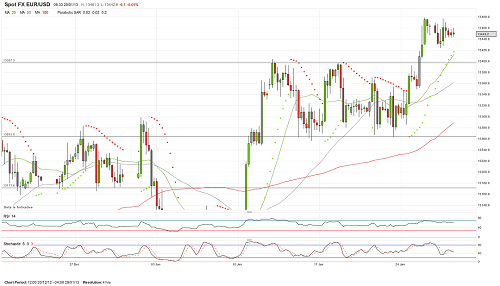
After its increase to the current high of 1.3479, the EUR/USD entered the consolidation phase. Drops down to 1.3425 continue to attract customers, and the growth is limited by the resistance near the level of 1.3480. Apparently, Bulls are going to break through the 35th figure, but it is possible that it will happen after a deeper decrease. The 34th figure will now act as the support and in theory, it should limit all the bears’ attempts to seize the initiative. Even if this level has been broken-through, the bulls have no reason to worry about it until the pair holds above 1.3300. Thus, the level of 1.3400 looks attractive for purchases, and the bulls’ ability to hold above will be the evidence for maintaining the growth potential towards the 35th figure.


GBPUSD

gbpusd29.01.2013

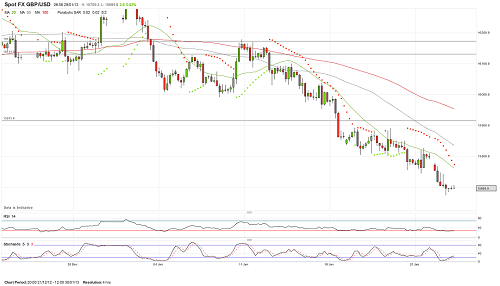
As for the overall picture in the GBP/USD pair, it is unlikely that Bulls will see something good. The pound was loosing its positions through the whole day yesterday, then it overcame the support at 1.5745 and dropped to 1.5674. The increasing attempts are still unsuccessful and they only attract a fresh wave of sellers. However the pair’s oversold condition increases, as well as the overbought condition in the EUR/GBP pair, and every decrease increases the risk of the upward correction. The rise to 1.5900 — 1.6000 can be used to open short positions.


USDCHF

usdchf29.01.2013

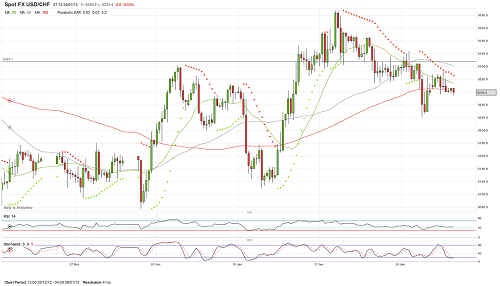
The USD/CHF returned to the level of 0.9288, which acted as the resistance, and it constrains the attempts to increase. The dollar’s drops face the bids near 0.9255. Thus, the pair was trading within the narrow range, limited by levels. High volatility in the EUR/CHF cross-rate complicates forecasting of USD/CHF pair’s dynamics, thus at this stage, it is still better to refrain from trading this pair.


USDJPY

usdjpy29.01.2013

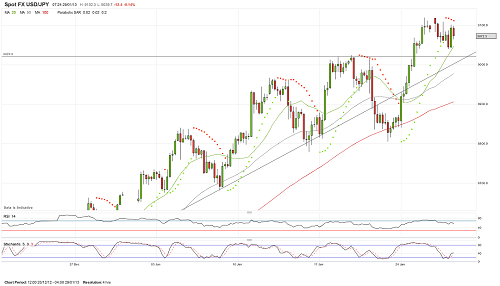
The yen has been decreasing, thus the dollar being in pair with it is not able to overcome the current high of 91.25, but its attempts to correct below are limited by the support at 90.40. If Bears manage to pass the support, the consolidation phase may turn into the correction one, and in this case we can expect the depreciation to 90.00 — 89.35. The Japanese currency’s state of being oversold may cause a deeper correction to 88.00 — 87.00, where customers expect the Dollar/Yen pair’s activation.

provided by IAFT


US Consumer Confidence Figure may lead to Risk Taking Today

Source: ForexYard

Increased confidence in the euro-zone economic recovery, largely due to a strengthened banking sector, helped keep the euro within reach of its recent 11-month high against the US dollar yesterday. Meanwhile, a better than expected US Core Durable Goods Orders figure helped the USD/JPY come within reach of a 2 ½ year high during afternoon trading. Today, the main piece of economic news is likely to be the US CB Consumer Confidence figure, set to be released at 15:00 GMT. A better than expected figure could lead to risk taking in the marketplace, which would boost the euro further.

Economic News

USD – Dollar Maintains Upward Movement vs. Yen

After taking minor losses against the Japanese yen during the first half of the day, the US dollar received a boost following a better than expected Core Durable Goods Orders figure. The USD/JPY gained more than 20 pips after the news was released, eventually reaching 91.08, just below a recent 2 ½ year high of 91.24. Against the Swiss franc, the greenback saw relatively little movement throughout the day. The USD/CHF fell close to 30 pips during early morning trading, before recouping virtually all of its losses later in the day. The pair was trading at 0.9285 by the end of the European session.

Today, all eyes will likely be on the US CB Consumer Confidence figure, set to be released at 15:00 GMT. Following worse than expected consumer confidence data last month, investors shifted their funds to safe-haven assets, which boosted currencies like the US dollar and Japanese yen. If today’s news comes in below the forecasted 64.5, the dollar could see bullish movement against several of its main rivals, including the Swiss franc, British pound and euro.

EUR – Confidence in EU Economic Recovery Keeps Euro Bullish

The EUR/USD gained close to 50 pips to trade as high as 1.3476 during European trading yesterday, just below an 11-month high, as a strengthened EU banking sector combined with positive US economic news led to risk taking in the marketplace. The EUR/GBP saw bullish movement throughout the day, as signs of weak economic growth in England weighed down on the pound. The pair advanced close to 30 pips during the European session to eventually trade as high as 0.8563.

While US consumer confidence data is likely to have the biggest impact on the euro today, traders will not want to forget to pay attention to several potentially significant euro-zone economic indicators in the coming days. An Italian debt auction, German retail sales data and manufacturing figures out of both Spain and Italy, all have the potential to boost the euro further if they show additional growth in the euro-zone economic recovery.

Gold – Gold Takes Additional Losses amid Positive Global Economic News

Gold prices decreased further when markets opened for the week yesterday, as confidence in the global economic recovery encouraged investors to shift their funds to riskier assets. The precious metal fell close to $10 an ounce during European trading, eventually reaching as low as $1651.64, before bouncing back to $1658 after a disappointing US Pending Home Sales figure.

Turning to today, gold traders will want to pay attention to consumer confidence data out of the US. A worse than expected figure may cause investors to shift their funds back to safe-haven assets, which could help gold recover some of yesterday’s losses during the afternoon session.

Crude Oil – Oil Prices Tumble Following US Home Sales Figure

After gaining more than a $1 a barrel during mid-day trading yesterday to trade as high as $96.78, crude oil prices tumbled following a disappointing US Pending Home Sales figure. Worse than expected US news typically leads to speculations that American demand for oil will go down, which typically leads to a drop in prices. By the beginning of the afternoon session, prices had stabilized just above the $95.50 level.

Today, oil prices could decrease further if the US Consumer Confidence figure comes in below the forecasted 64.5. Worse than expected data is likely to result in concerns about the pace of the global economic recovery, which could turn higher-yielding assets, like oil, bearish as a result.

Technical News

EUR/USD

A bearish cross is close to forming on the weekly chart’s Slow Stochastic, indicating that a downward correction could occur in the near future. This theory is supported by the Williams Percent Range on the same chart, which is currently in overbought territory. Opening short positions may be the best option for this pair.

GBP/USD

The Williams Percent Range on the weekly chart has fallen in into oversold territory, signaling that an upward correction could occur in the near future. This theory is supported by the Relative Strength Index on the daily chart, which is currently just below 30. Opening long positions may be the best choice for traders.

USD/JPY

The Relative Strength Index on the weekly chart is currently overbought territory, indicating that a downward correction could occur in the near future. Furthermore, the Slow Stochastic on the same chart has formed a bearish cross. Opening short positions may be the best choice for traders.

USD/CHF

Most long-term technical indicators show this pair trading in neutral territory, meaning a definitive trend is difficult to predict at this time. Traders may want to take a wait and see approach for this pair, as a clearer picture is likely to present itself in the near future.

The Wild Card

Platinum

The MACD/OsMA on the daily chart has formed a bearish cross, indicating that a downward correction could occur in the near future. This theory is supported by the Williams Percent Range on the same chart, which is currently in overbought territory. Opening short positions may be the smart choice for forex traders today.

Forex Market Analysis provided by ForexYard.

© 2006 by FxYard Ltd

Disclaimer: Trading Foreign Exchange carries a high level of risk and may not be suitable for all investors. There is a possibility that you could sustain a loss of all of your investment and therefore you should not invest money that you cannot afford to lose. You should be aware of all the risks associated with Foreign Exchange trading.


Market trends 29.01.2013

Source: ForexYard

printprofile

Hey Everyone,

Below are some market trends for today.

Good luck!

-Dan

Gold- May see upward movement today
Support- 1651.45
Resistance- 1671.31

Silver- May see upward movement today
Support- 30.22
Resistance- 31.74

Crude Oil- May see downward movement today
Support- 95.85
Resistance-98.17

Dax 30- May see upward movement today
Support- 7744.91
Resistance- 7900.00

EUR/USD May see downward movement today
Support- 1.3355
Resistance- 1. 3478

Read more forex news on our forex blog

Forex Market Analysis provided by ForexYard.

© 2006 by FxYard Ltd

Disclaimer: Trading Foreign Exchange carries a high level of risk and may not be suitable for all investors. There is a possibility that you could sustain a loss of all of your investment and therefore you should not invest money that you cannot afford to lose. You should be aware of all the risks associated with Foreign Exchange trading.