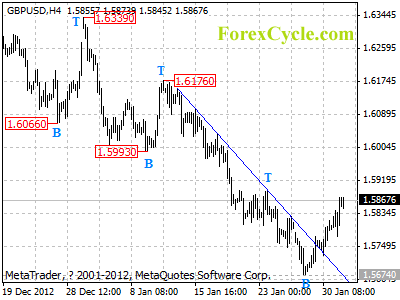
GBPUSD’s rise extends to 1.5875

GBPUSD’s rise from 1.5674 extends to as high as 1.5875. The pair is now facing 1.5900 key resistance, a break above this level will indicate that the downtrend from 1.6339 has completed, then another rise towards 1.6500 could be seen. However, as long as 1.5900 resistance holds, the rise from 1.5674 would possibly be consolidation of the downtrend, and another fall to 1.5500 to complete the downward movement is still possible.

gbpusd

Forex Signals

Central Bank News Link List – Jan. 30, 2013: Yamaguchi: BoJ may ease monetary policy further, if needed

By www.CentralBankNews.info Here’s today’s Central Bank News link list, click through if you missed the previous link list. The list comprises news about central banks that is not covered by Central Bank News. The list is updated during the day with the latest developments so readers don’t miss any important news.

Albania cuts rate 25 bps to historic low as inflation falls

By www.CentralBankNews.info
    Albania’s central bank cut its benchmark refinancing rate by 25 basis points to a historic low of 3.75 percent, saying the rate reduction should help ensure that inflation meet the bank’s target as inflationary pressures are low and have been declining in recent months.

    The Bank of Albania, which cut rates by 75 basis points in 2012, said economic activity this year is positive and similar to 2012 but growth is expected to remain below potential and demand-side inflationary pressures are expected to remain low.

    The central bank forecasts annual inflation this year between 0.8 and 3.8 percent compared with 2012’s average inflation rate of 2.0 percent, following December’s 2.4 percent inflation rate.

    The central bank targets inflation of 3 percent, plus/minus 1 percentage point. 

    Albania’s central bank governor, Ardian Fullani, said foreign demand had been the main driver of economic growth this year and data show this trend continuing in the fourth quarter. In the third quarter, 

Albania’s Gross Domestic Product rose by 2.4 percent from the second quarter for annual growth of 2.7 percent, up from 2.1 percent in the second quarter and the first quarter’s contraction of 0.2 percent.

    “On the other hand, domestic demand remains sluggish, due to the lack of fiscal stimulus and the performance of slow consumption and private investment,” Fullani said in a speech after the central bank’s council approved the semi-annual statement on January 30.


    www.CentralBankNews.info  

Moving Averages Can Identify a Trade – FREE Lesson

These 3 charts help you understand how moving averages work

By Elliott Wave International

Moving averages are a popular tool for technical traders because they can “smooth” price fluctuations in any chart. EWI Senior Analyst Jeffrey Kennedy gives a clear definition:

“A moving average is simply the average value of data over a specified time period, and it is used to figure out whether the price of a stock or commodity is trending up or down… one way to think of a moving average is that it’s an automated trend line.”

Moving averages are both easy to create and extraordinarily dynamic. You can choose which time frame to study as well as which data points to use (open, high, low, close or midpoint of a trading range).

Jeffrey Kennedy shares 3 of the most popular moving averages in this excerpt is from his 10-page eBook: How to Trade the Highest Probability Opportunities: Moving Averages. Learn how you can download the entire eBook here >>


Let’s begin with the most commonly-used moving averages among market technicians: the 50- and 200-day simple moving averages. These two trend lines often serve as areas of resistance or support.

For example, the chart below shows the circled areas where the 200-period SMA provided resistance in an April-to-May upward move in the DJIA (top circle on the heavy black line), and the 50-period SMA provided support (lower circle on the blue line).

The 13-period SMA is a widely used simple moving average that works equally well in commodities, currencies, and stocks. In the sugar chart below, prices crossed the line (marked by the short, red vertical line), and that cross led to a substantial rally. This chart also shows a whipsaw in the market, which is circled:

Another popular moving average setting that many people work with is the 13- and the 26-period moving averages in tandem. The figure below shows a crossover system, using a 13-week and a 26-week simple moving average of the close on a 2004 stock chart of Johnson & Johnson. Obviously, the number 26 is two times 13:

During this four-year period, the range in this stock was a little over $20.00, which is not much price appreciation. This dual moving average system worked well in a relatively bad market by identifying a number of buyside and sellside trading opportunities.


How to Trade the Highest Probability Opportunities: Moving Averages

Moving averages are one of the most widely-used methods of technical analysis because they are simple to use, and they work. Now you can learn how to apply them to your trading and investing in this free 10-page eBook. Learn step-by-step how moving averages can help you find high-probability trading opportunities.

Improve your trading and investing with Moving Averages! Download Your Free eBook Now >>

This article was syndicated by Elliott Wave International and was originally published under the headline Moving Averages Can Identify a Trade – FREE Lesson. EWI is the world’s largest market forecasting firm. Its staff of full-time analysts led by Chartered Market Technician Robert Prechter provides 24-hour-a-day market analysis to institutional and private investors around the world.


Forex Metatrader 4 Demo and Backtesting- Performance and Limitations

By Warren Seah

Back testing and demo-ing are a key component for evaluating effective trading system. The theory is any strategy that work well in the past is likely to work well in the future. Conversely, any strategy that performed poorly is most unlikely to perform good results in the future.

Advantages for Performing Demo and Back-testing Evaluation

1. History repeats itself. Repeated patterns can be identified from the back-test.

2. Investors can be educated with key ratios like max draw-down so that they know what to expect when using the systems.

3. Increases investors’ confidence to rely on the systems during the draw-down period. Thus, investors know when to stick to the trading rules and when to discard the trading system.

4. Provides an estimate of the probability and magnitude of the potential trade profits and losses because the performance statistics can be reproduced by back-testing.

Limitations of Demo Testing and Back-testing

1. Spreads

Liquidity conditions during certain news hour may narrow the spreads. GMT day spread and night spread may differ due to liquidity conditions. All of this widening and narrowing of spreads may not be accurately accounted for in the bid and ask price.

Strategy that requires certain max spread conditions would not have perform as well in live trading compared to a back-test.

2. GMT OffSet

The server time may change at certain time of the year in UK and US due to summer and winter daylight saving hour. The price and history feeds may not correspond to the specified chart timing. This will mean that certain strategies that only trade at certain hours may get prices mismatch figures.

3. Brokers’ Manipulation

Certain brokers’ will offer close to ideal trading conditions in the back-test and demo test. This ideal conditions certainly do not happen when trading live. The idea doing this is to attract as many potential traders to use their services. You can find out more information on some of the popular forex forums online.

4. Trade Entry Method

Systems that use market order for entries may face difficulty in getting in at the right price you want in the live conditions. The fact is during live conditions, the market price will be very volatile and getting in at the right price manually will be a problem. There will be a difference in the entry prices between back-test or demo with live conditions.

Summary

Having to recognise the limitations of backtests and demo test, it will help us in understanding more about how the trading systems work and how to evaluate and analyse a system better. It does not mean that backtest results do not work, the fact is, it still works.

About the Author

Warren Seah

Warren examines commercial trading systems and has since started researching and analysing systems to uncover good systems which bring in consistent profits.

Click Here To Read More On Forex Robot EA

http://www.FxEAReview.com


Forex Metatrader 4 Back-Testing Advantages and Techniques

By Danielle Franklin

Back-testing via your forex demo account is the way to check whether your trading strategy is successful or not. The general idea behind back-testing is to find an effective strategy that worked well in the past and is most likely to produce the same winning results now.

Back-Testing Advantages

1. Recognition of the patterns that tend to repeat itself within a certain course of time.

2. Deeper understanding of the trading system and more precise decision making during the draw-down period.

3. Estimation of the potential profits and losses based on historical performance data.

Back-Testing Drawbacks

1. Some strategies require a specific spread conditions, meaning that those strategies might not be as effective during live trading compared to demo.

2. Summer and winter time changes may cause the confusion and mismatch price and history figures for specific charts.

3. Trading live means dealing with volatile market prices. Strategies based on order for entries may not work very well in live trading, since the entry prices between demo and live account might differ.

How to Back-Test?

1. Download MetaTrader 4 platform and Expert Advisor from your forex broker.

2. Open MetaTrader 4 platform and click on VIEW.

3. Click on Stategy Tester – a new window will pop up.

4. Choose the Expert Advisor you wish to test.

5. Select the currency pairs (EUR/USD, USD/JPY etc).

6. The field “Model” is the accuracy options. Using every tick is advisable.

7. Check the date box and choose the period of testing – the beginning and the end date.

8. Visual mode will show a chart with the actual trades. The disadvantage of the visual mode option is the significant delay in the back-testing process, therefore you might consider giving it up.

9. Period drop down menu shows the time frame of the chart.

10. At Expert Properties you can choose the initial deposit.

11. At Expert Properties choose the Inputs options. You might want to start with default settings for now and change in needed with time.

12. You are all done – click on start button and see your back- testing in action.

About the Author

Danielle Franklin writes for ForexExplore where you can find more information on: Forex Brokers – Forex brokers reviews and rating, comprehensive forex tutorials and articles, latest forex news and forex blog.


Securing Forex Profits with Partial Close EA

By Warren Seah

Forex traders make use of partial close ea in the scaling out of their trade positions based on profit levels that had been fixed prior to the start of trading. This is how the ea work: Once the market trading price gets to a stipulated take profit level, the trader would collect his initial profit by exiting a proportion of the total contract. The trader can then proceed to move the stop loss to the entry price in order to ensure that no matter what happens to the market trend, a loss will not be incurred.

Partial close ea is very easy to manage since they are only concerned with taking out part of a contract while letting the remaining positions to ride the trend till it dies out. The ea ensures that the worst case scenario that could result is a no win and no loss situation whenever there is trend exhaustion and the stop loss level is hit at the breakeven level. This is termed Pip protection Mechanism.

Partial close ea is particularly good for day trading or short term trading. It is very easy to take up several contracts in such a setting; part of which could be taken off the market once profit has been realized as determined by the short term market behavior and market structure.

Longer term market behavior also makes for a balance. A trader can trade on the short term and also benefit from longer term trend riding as well as its accompanying profit. But there is also the danger of a trader exposing himself to too much risk by trading several contracts. Caution is advised in terms of practicing money management by not risking more than 2% per trade and not more than 5% per day or month. The efforts that professional traders put in the management of their equity is what keeps them going on in forex trading; without the management of equity, most of them would have retired from the market long time ago.

More advanced exit strategies will have partial close method incorporates with trailing stop strategies for the management of trades, and it also spells out the price level at which portions of a contract can be exited. In short, partial-close strategies serve as guide to a trader on how best to approach his trade for him to be successful.

It would be so much easier to have more winning trades, and to make more profit when the partial close method is used in exiting a trade. Partial close ea is also capable of helping traders leverage from the behavior of the market in the short term and the longer term. Prior specification of trade exit strategies helps to eliminate emotional indecisions that could ruin a trade. The proper use of the ea helps a trader in his quest to be successful in trading.

About the Author

Warren Seah

What if you just couldn’t trade forex effectively with a day time job?

I know how hard it can be to trade forex manually, but if you want to really be successfully trading your own unique manual system, you need to learn a single method that works amazingly well.

This method is simple to pick up and it works like an automated trade exit tool. Yes, you can now select the forex exit strategy and the tool will manage your trade and exit with profit. You can read how to do it in my free report here: Trailing Stop EA

Don’t give up hope, it’s NOT impossible. Partial Close EA will expand your trading capabilities to greater trading success learn more by clicking the link.


SuperTrend Technical Trading Indicator for Metatrader 4

By Zac, CountingPips.com

An interesting Metatrader Indicator that I have come across and have been experimenting lately with is the SuperTrend Indicator.

This is very straight forward visual indicator based on support and resistance levels. SuperTrend shows an uptrend in green and a downtrend in red. The trend changes when the established support or resistance level is breached.

supertrend forex indicator

The default input settings are for 10 periods and a multiplier of 3.0 but you can experiment with these settings to make the support/resistance levels tighter or looser.

James from theforexarticles.com has written a lot about this indicator and uses it in his 4-Hour Trading System (he gives away the 4-H system for free in his email newsletter).

To play around with this indicator, see the MT4 SuperTrend download link from theforexarticles.com and at TradeWays for a Metatrader5 indicator download.


Models, supervision determine banks’ risk weights – report

By www.CentralBankNews.info
    Investors have a hard time comparing the riskiness of the major global banks because there are differences in how each bank calculates the potential danger of their assets, according to a report by the Basel Committee on Banking Supervision.
    Based on tests of how 15 major banks assign risks to a simple, hypothetical portfolio of financial instruments, the Basel Committee found differences, either due to supervisory decisions or due to the in-house models that banks use to calculate risk.
    “While some variation in risk weightings should be expected, excessive variation arising from bank modelling choices is undesirable when it does not reflect actual risk-taking,” said Stefan Ingves, Chairman of the Basel Committee and governor of Sveriges Riksbank.
    The Swiss-based Basel Committee, which includes banking supervisors from almost 30 countries, sets global standards and has been tightening its rules in recent years in an effort to prevent another global financial crises.
    The Committee’s analysis of how banks assess the risks from financial instruments is important because the global financial crises in 2007-2009 was largely triggered by major losses on banks’ investments in housing related securities that were held in their trading books.

    Banks assign risks to their investments, known as risk weightings, and the riskier the investment, the more capital banks have to set aside – the capital ratio – in case the investment turns sour.
    But the financial crises showed that banks completely underestimated the risk of the mortgage-backed securities on their books and banking supervisors have now tightened their rules, telling banks to set aside more and higher quality capital.
    The review of banks’ risk weighting is part of the Basel Committee’s fundamental review of banks’ trading book with the aim to ensure that the new Basel III rules, which are currently being phased in, are applied consistently across the world.
    A similar study of risk weightings in banks’ banking book by the Basel Committee is also underway. 
    Banks differentiate between trading and banking books with their trading books holding securities and instruments that are used in trading, either for the bank’s own profit or on behalf of its customers. Banks value those securities based on market prices.
   The banking book typically comprises securities that are not actively traded but held to maturity and therefore accounted for differently.
    “The analysis used to compile this report provides national supervisors with a much clearer understanding of how the risk models of their banks compare with those of international peers. This will allow national supervisors to take action where needed,” the Basel Committee’s Ingves said.
    In their review, the banking supervisors found that differences in banks’ trading positions were reflected in risk weightings but it was difficult for investors “to assess how much of the variation reflects differing levels of actual risk and how much is a result of other factors.”
    One reason for the variation in risk weightings was due to decisions by local banking supervisors that were applied to all banks in one country or to individual banks.
     An example of such a difference is a restriction by supervisors on banks assigning varying risks to different types of assets, a factor that accounted for around one-fourth of the total variation in the hypothetical portfolio used in the review.
    These local decisions typically resulted in higher capital requirements and differences in risk weightings across jurisdictions, the Basel Committee said.
   Another important reason for different risk weightings was the models used by banks.
    “The exercise found that a small number of key modelling choices are the main drivers of the remaining model-driven variability,” the review said.
    Banking rules allow for some flexibility in how banks measure risks so the Committee was not surprised to find some variation, and the aim of the study was not determine optimal variation.
    Using the hypothetical portfolio of securities in a test was a way for supervisors get a better understanding of what elements in banks’ models lead to different risk weightings.

    www.CentralBankNews.info

Investors “In Great Danger” If They Don’t Own Gold, Warns Faber, as GDP Drop Sees US Fed Press On with QE

London Gold Market Report
from Adrian Ash
BullionVault
Thurs 31 Jan, 08:00 EST

The PRICE of GOLD held onto most of yesterday’s $15 jump at $1676 per ounce Thursday morning in London, ticking back as Asian and European stock markets fell after Wednesday’s surprise drop in US economic output figures.

Silver also eased back, but held at 1-week highs above $32 per ounce after rising yesterday in gold’s “slipstream” as one bullion-bank analyst put it.

“This Friday’s [non-farm US payroll] report remains crucial,” says a note from Swiss bank UBS – currently encouraging its institutional clients to buy gold outright rather than as a credit-risk deposit.

“Some adjustments to [gold] positioning are likely to emerge” after Wednesday’s ‘no change’ decision from the US Federal Reserve on zero interest rates and quantitative easing.

“But overall, the gold market should resume subdued trading,” says UBS, “as is typical ahead of a key event” such as the monthly jobs report.

Russia’s foreign ministry meantime condemned a reported Israeli air-strike on a military research unit inside Syria, saying Thursday that – if confirmed – this “unprovoked attack [would] blatantly violate the UN Charter.”

Shares in Italy’s struggling Banca Monte dei Paschi di Siena – founded in 1472 – steadied as the Italian central bank weighed MPS’s second bail-out request in four years after it hid losses of €500 million on a 2008 derivatives deal.

German banking giant Deutsche Bank lost €2.2bn ($3.0bn) for the last 3 months of 2012, it said today.

“A year ago, the mood in Europe was horrible and nobody could see how on earth stocks could go up,” says Gloom, Boom & Doom author and money-manager Marc Faber, who urged CNBC anchor Maria Bartiromo to buy gold earlier this week.

“Now since May 2012, less than a year ago, Portugal, Spain, Italy, France, are up between 30 and 40% and Greece has doubled…!”

Factory-gate prices across France and Italy fell in December from November, new data showed today.

House prices in the year to October fell 2.5% across the 17-nation Eurozone, with Spain’s home-price drop accelerating to 15.2%.

“For the first time in four years,” Faber continued Wednesday, pointing to the US stock market, “since the lows in March 2009, I love this market. Because the higher it goes the more likely we will have a nice crash, a big time crash.

“You are in great danger if you don’t own any gold,” Faber had earlier told Bartiromo.

Near-term, reckons Deutsche Bank analyst Xiao Fu – and despite Wednesday’s $15 rise on poor US growth data and the Federal Reserve’s no-change decision on zero rates and QE – “Gold lacks a convincing catalyst near term to take it convincingly higher and instead remains susceptible to opportunistic selling.”

But “Any thought given to reining in some of the Fed’s buying power will now be shelved,” counters Ed Meir in his daily note for INTL FCStone.

“[Wednesday’s] GDP number clearly shows that the US economy is still far from capable to muster its own momentum without key fiscal and monetary stimulus.

“In the least, this should provide an element of support to the precious metals group, at least over the short term.”

After creating and spending first $1.4 trillion on mortgage and Treasury bonds in 2008, and then a further $600 of T-bonds starting in 2010, the US Fed will likely acquire a further $1.1 trillion of US government debt with its current program of quantitative easing, according to a Bloomberg survey of analysts.

“Given the sluggish [US] economy,” says precious metals strategist Eugen Weinberg at Commerzbank, “it would be premature to discuss [the Fed] abandoning the quantitative easing programme.

“Despite the noticeably higher risk appetite displayed by market players of late, gold demand is thus unlikely to ebb away completely. On the contrary, high sales of US gold coins in January, and renewed inflows into the gold ETFs recently, point to relatively robust demand for gold.”

Over in India – most likely the world’s #2 gold consumer market in 2012 behind China – the economic affairs secretary contradicted the finance minister yesterday over plans to raise gold import duties again, in a bid to curb household appetite to buy gold, widely blamed for India’s yawning trade deficit.

Two days after Palaniappan Chidambaram told the Financial Times that New Delhi is considering “some other steps to moderate the import of gold” further, Arvind Mayaram told Reuters that “I don’t think there is any plan as of now.”

Adrian Ash
BullionVault

Gold price chart, no delay   |   Buy gold online

Adrian Ash is head of research at BullionVault, the secure, low-cost gold and silver market for private investors online, where you can buy gold and silver in Zurich, Switzerland for just 0.5% commission.

(c) BullionVault 2013

Please Note: This article is to inform your thinking, not lead it. Only you can decide the best place for your money, and any decision you make will put your money at risk. Information or data included here may have already been overtaken by events – and must be verified elsewhere – should you choose to act on it.