Why Jim Chanos is Still Short on China and Aussie Iron Ore

By MoneyMorning.com.au

The name of infamous Wall Street investor Jim Chanos’s firm is Kynikos Associates.

Kynikos is a Greek word. It means cynic.

Chanos is a short seller. He tries to make money off stocks that go down in price. So he’s always on the lookout for businesses and industries heading for trouble, before that trouble is factored into share prices.

Chanos started his firm in 1985. He’s been shorting stocks for almost thirty years. So when he speaks, it’s worthwhile tuning in.

In 2009, Chanos warned of China’s credit-fuelled construction boom. He was shorting the companies in and around it.

It’s now 2013, and he isn’t changing his mind. Today’s Money Weekend will explore why…

Rumbles in China’s Economy

The Financial Times put the spotlight on China this week when it reported Chinese banks avoided a default by rolling over loans made to local governments. Here’s an excerpt:


‘Local governments borrowed heavily from banks to fuel China’s stimulus programme during the global financial crisis and are now struggling to generate the revenue to pay them back, a shortfall that could cast a shadow over Chinese economic growth.’

The ratings firm Standard & Poor’s also came out this week after finishing a study about investment spending. Think airports, highways and other infrastructure projects. They concluded China had the highest risk in the world of a severe correction.

China’s investment as a percentage of GDP is near 50%, much higher than in countries like Japan and the United Sates during their years of high growth. Like anything, you can have too much of a good thing.

The economics behind some of these projects are highly dubious, but they show up in GDP. They also fuel demand for commodities such as iron ore and therefore have a big impact on Australia.

Now this is interesting because it’s probably fair to say the market has turned much more bullish on Chinese growth in early 2013 than it was in the second half of last year.

You might remember there was a lot of political uncertainty around the change of Chinese leadership and confusion about whether the slowdown in China was ‘managed’ or not.

Here we are today and the S&P/ASX 200 is rallying close to 5000 points. And there has been nothing to rock the boat from official Chinese statistics release either.

But beyond the headline GDP figures in China lies a murky link between the central and local governments, the banking system and the big state-owned firms. China built its economy through this based on exports and investment.

That model has stopped working. The idea now is for China’s central planners to shift the economy away from this model and rebalance it towards consumption.

New Boss Same as Old Boss

That’s the idea, but has anything changed?

Since the global financial crisis China’s economy has been hanging on thanks to huge amounts of credit being pumped into the system. And so far the new leadership transition hasn’t changed anything.

The FT Alphaville blog headlined an article last week ‘China’s massive credit dependency’.

Here’ an excerpt:


‘China’s credit growth has been extraordinarily high in the past year – the government’s aggregate or “total social financing” measure, which includes some forms of non-bank finance, showed 23 per cent growth in 2012, compared to an 8.5 per cent contraction in 2011…When you compare it to the size and growth rate of the economy as a whole, the growth in credit is even more astounding. China now needs nearly 3Rmb of credit to generate 1Rmb of growth.’

If you were looking for a reason behind the 80% rally in iron ore since it dropped below US$100 in 2012, this is probably it. Why? Greg Canavan, editor of Sound Money. Sound Investments, says it’s mostly to do with the shadow banking system.

This is why he’s so wary of China’s economy right now. In his words:


‘It was the shadow banking system providing the credit for the boom. These are ‘wealth management products’, often distributed by the banks, which offer Chinese savers high rates of interest.

‘The funds are used to build railways or other forms of infrastructure. The underlying asset doesn’t produce enough income to pay the promised high interest, so the promoters use later investors funds’ to meet earlier investors’ demands. If that sounds like a Ponzi scheme it’s because it is. And at some point, it will all go pear shaped.’

Maybe it already is. The FT ran a story yesterday about ‘cash-strapped’ local governments asking the big steel mills for tax in advance! One problem: according to the article, last year profits at the steel mills dropped 98% from the previous year and losses reported by unprofitable mills increased more than sevenfold.

That’s one reason why Jim Chanos is still ‘short China’.

Still Leery on This Commodity

To be clear, Jim Chanos is not a ‘macro’ investor. He’s not making predictions about China as a whole.

According to this interview, he’s short the construction equipment companies, cement companies and property developers feeding the coastal real estate boom and the banks who have financed it. These are Chinese companies listed on the Hong Kong Stock Exchange.

But the catch for Aussie investors is the second way he says you can play this idea: the companies that ship raw materials into China for the construction industry.

This is not a new idea for him. Back in 2012 at the Grant’s Investment Conference in New York he said Aussie iron ore miner Fortescue Metals [ASX: FMG] was a ‘value trap’. In April 2012, Fortescue shares traded around $6.

This was before the big drop in the iron ore price that spooked the market and sent Fortescue shares down 50%. At that time, Chanos looked like he had nailed another big call.

Today, things look very different, especially for Fortescue Metals. It’s rallied strongly since September last year alongside iron ore to trade around $4.80.

But for investors Jim Chanos, at least, is still raising the red flag on iron ore.

Callum Newman
Editor, Money Weekend

PS. Don’t forget if you want to keep track of the latest things we’re reading and brief commentary on events that happen through the day, check out our Google+ page here or Kris Sayce’s here.

From the Port Phillip Publishing Library

Special Report: The Big Money Secret of Ironstone Mountain

Daily Reckoning: Economic News Just In: Ben Bernanke Linked to Global Warming

Money Morning: Make Sure You’ve Updated Your ‘Stock Insurance’ Policy

Pursuit of Happiness: The Bad Joke That Saved Your Freedom of Speech

Kris Sayce’s Money Weekend Market Digest: 02 February 2013

By MoneyMorning.com.au

ENERGY

The shale gas boom has transformed the US economy. By 2030, integrated energy giant BP says the US will be energy independent and even a net exporter of energy.

But it’s not just the US where the shale story is taking off. We’ve followed the shale gas story on the Aussie market for the past two years in Australian Small-Cap Investigator. And the whole thing is now kicking off in earnest in the UK. In our Australian Small-Cap Investigator weekly update on Wednesday we referenced an article in the Register:


‘The government has given the go-ahead for further exploration of the UK’s shale gas reserves. Independent surveys suggest these reserves may yield more energy for the nation than North Sea oil.’

That’s a pretty big claim. But hold on there. Don’t write off North Sea oil just yet. PennEnergy reported this week:


‘Britain’s estimates of untapped resources in the North Sea have increased, leading to the approval of more offshore projects for 2013…

‘The source reported British Secretary of State for Energy and Climate Change, Ed Davey, announced the country could meet 70 percent of oil and gas demands until 2040 by exploring new offshore developments.’

Add together the resources from shale and North Sea oil and the UK could soon become energy independent again. So much for the claim that it will be an economic disaster if the UK leaves the European Union.

GOLD

It won’t surprise you to know that we work in an office full of gold bugs. Heck, we’re fond of gold too…although we don’t consider ourselves a gold bug.

Our old pal Dan Denning sent a chart around the office yesterday. It shows the ratio of gold to the S&P 500 index:

Source: StockCharts.com


With the recent stock rally and the steady gold price, the S&P 500 is now nearing a ratio of 1:1. The high gold price and low stocks means the ratio has been low since 2008. But is it possible that we’ll see a breakout? Dan has overlaid a 200-day moving average (blue line). To our eye it looks as though that line is about to turn upwards.

That could be good news for stocks. If investors believe the economic recovery has arrived it could serve to push stocks even higher while the gold price stays relatively flat or even falls.

TECHNOLOGY

Earlier this week we placed a link on our Google+ page to what we can only describe as an extraordinary story. Yes, we know, people bandy around the word ‘extraordinary’ too much these days. But, this really is extraordinary. Here’s a clip from the article in the Wall Street Journal:


‘Scientists have stored audio and text on fragments of DNA and then retrieved them with near-perfect fidelity – a technique that eventually may provide a way to handle the overwhelming data of the digital age.

‘The scientists encoded in DNA – the recipe of life – an audio clip of Martin Luther King Jr.’s “I have a Dream” speech, a photograph, a copy of Francis Crick and James Watson’s famous “double helix” scientific paper on DNA from 1953 and Shakespeare’s 154 sonnets. They later were able to retrieve them with 99.99% accuracy.’

You can read the whole article here.

Those two paragraphs don’t do this technology justice. It’s mind blowing to think of the possibilities. And if you think this is pie-in-the-sky stuff with no commercial purpose, the scientist in charge of the project says that using DNA to store data could be economically viable within 10 years.

HEALTH

Eat more wild fish.

Or, grab a handful of Astaxanthin. According to Silicon Republic, Astaxanthin ‘has an antioxidant effect of 550 times that of vitamin E.’

Astaxanthin occurs naturally in fish. It’s the element in wild fish that gives it the pinkish colour. However, due to fish farming where Astaxanthin is absent, humans don’t get the benefit of this natural antioxidant.

Irish company Algae Health has received €1 million from AB Seed Fund to finance a project to produce Astaxanthin for sale to the consumer market as a supplement.

The article states:


‘Algae Health was set up in late 2009 and, following three years of R&D, developed its proprietary cultivation technology (patent pending). This technology enables the optimal control of the cultivation conditions, maximising yield, and allowing the process to happen at a far lower cost than traditional methods.’

We don’t know for sure, but we assume this is similar to spirulina. On a recent episode of Doomsday Preppers, a prepper (someone preparing to survive a specific catastrophic event) was cultivating spirulina as an emergency food source.

However, according to Wikipedia:


‘The U.S. National Library of Medicine stated that spirulina was no better than milk or meat as a protein source, and was approximately 30 times more expensive per gram.’

Arguably, cultivating spirulina in fish tanks is less labour intensive than rearing cattle for meat and milk. And you only need a vial of spirulina in order to cultivate a new supply. That makes it easier for preppers to transport, too.

But anyway, it just goes to show you that there’s always a lot happening in the health industry. It’s not just about cancer cures and diabetes treatments. It’s also about alternative medicines and treatments. If scientists can get these to work they can have just as important an impact on someone’s life as the drugs created by the big pharmaceutical companies.

MINING

It still pays to be in mining.

According to Australian Mining:


‘Despite falling commodity prices wiping close to $1 billion from Gina Rinehart’s fortune, new estimates show the mining magnate easily remains Australia’s richest person.’

The Forbes rich list values Ms Rinehart’s wealth at $16 billion.

Meanwhile, even though Fortescue Metals [ASX: FMG] chairman Andrew Forrest’s wealth dropped $480 million last year, he still has $4.6 billion to his name.

But the mining industry hasn’t been kind to everyone. As Australian Mining reports:


‘Nathan Tinkler was one of the hardest hit, with his position falling off the rich-list entirely after coming in at number 26 in 2011.

‘In 2011 Tinkler’s fortune was estimated to be worth around $800 million, but he is now being pursued by a range of creditors who claim he owes around $700 million.’

The Nathan Tinkler story appears to be a classic example of why we advise investors against over-borrowing. Using leverage is great when the market is going your way; it can magnify your returns. But it’s not so great when the market turns against you.

Use leverage, but use it carefully.

Cheers,
Kris

From the Archives…

Why the News Could Get Worse for Apple Shareholders
25-01-2013 – Kris Sayce

How to Play the EU Referendum for Profit
24-01-2013 – Kris Sayce

Here’s Why I’m Proudly Bullish About China’s Economy
23-01-2013 – Dr. Alex Cowie

How to Find Stocks for Troubled Times: Keep Scalable Businesses in Mind
22-01-2013 – Nick Hubble

Why It’s Still Not time to Buy the Japanese Stock Market
21-01-2013 – Murray Dawes

Whiskey and Beer Still Better Long-Term Bets than Wine

By The Sizemore Letter

Constellation Brands (NYSE:$STZ), the world’s largest publically-trading winery, took an absolute beating yesterday when the U.S. Department of Justice torpedoed the Grupo Modelo (OTC:$GPMCF)Anheuser-Busch InBev (NYSE:$BUD) merger on anti-competitive grounds.

Kruk: Switched to whiskey.

Kruk: Switched to whiskey.

Given the wide variety of alcoholic beverage choices, the government’s move seems a little absurd.  Yes, roughly 80% of all beer drunk in the United States is sold by just four mega-brewers.  But I hardly see this as being risky or detrimental to the wellbeing of American consumers.  It reminds me of a (perhaps apocryphal) quote from the baseball player John Kruk.  When told by his doctor that he needed to stop drinking so much beer, Kruk smiled and said he would switch to whiskey.

If beer became too expensive due to monopolistic pricing, U.S. consumers might do the same.

But whatever you think of the government’s decision, Constellation was the biggest loser here.  Under the planned merger, Constellation would have had exclusive distribution and marketing rights for Corona and Modelo’s other beer brands in the United States (Anheuser-Busch InBev would have acted as the supplier).

Constellation needed this.  As I wrote in July of last year when the deal was initially announced, Whiskey and Beer are Better Long-Term Bets than Wine.

While wine is more popular than ever among American drinkers, it’s not the best business to be in at the mass-market level.  Think about it.  Off the top of your head, how many beer brands can you name?  A dozen or more without even having to strain?

Now…how many wine labels can you name?

Unless you are a true connoisseur, you would have a hard time naming more than one or two.  Outside of the elite Château Lafite Rothschilds of the world, the vast majority of wines have very little in the way of name recognition.

As I wrote in July,“Outside of, say, Coca-Cola (NYSE: $KO), beer and spirits are probably the most recognizable and valuable brand names in existence.  Not surprisingly, premium beer and spirits businesses tend to enjoy high margins and high returns on equity relative to their peers. [As a case in point, Diageo (NYSE:$DEO) enjoys a return on equity roughly double that of Constellation.]

“Wine is a different story.  The attractiveness of a given vineyard varies from year to year, and few have national or international brand awareness.  Wine connoisseurs know their favorite vintages, but there is little brand loyalty at the mass-market level.  For a company of Constellation’s size, wine is a much harder business to operate.”

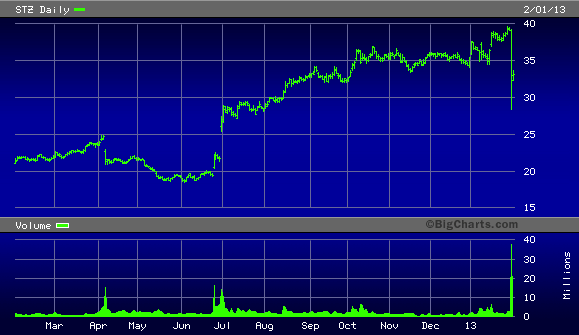
After yesterday’s 17% drubbing, Constellation trades for 15 times earnings and 2 times sales.  This is not expensive by today’s market standards, but it’s far from cheap.

Constellation Brands (NYSE:STZ)

Constellation Brands (NYSE:STZ)

Before the Modelo-Bud merger was announced last summer, Constellation was a $20 stock.  The merger announcement caused the stock to nearly double in the six months that followed.  So without Modelo, is Constellation a $20 stock again?

Probably not.  But without Modelo, it’s certainly not a $40 stock either.

I would recommend avoiding Constellation for now.   In the world of booze stocks, there are better values out there.  My favorite today?  Dutch megabrewer Heineken (OTC:$HEINY).

At 20 times earnings, Heineken is far from cheap.  But it’s one of the best options today for getting exposure to the rise of the emerging market consumer, and particularly the rise of the up-and-coming African middle class.

Disclosures: Sizemore Capital is long HEINY.

SUBSCRIBE to Sizemore Insights via e-mail today.

The post Whiskey and Beer Still Better Long-Term Bets than Wine appeared first on Sizemore Insights.

Central Bank News Link List – Feb.1, 2013: Central bank of Egypt leaves benchmark rates unchanged

By www.CentralBankNews.info Here’s today’s Central Bank News link list, click through if you missed the previous link list. The list comprises news about central banks that is not covered by Central Bank News. The list is updated during the day with the latest developments so readers don’t miss any important news.

Dominican Republic holds rate, inflation in target ’13, ’14

By www.CentralBankNews.info      The Central Bank of the Dominican Republic (BCRD) held its key interest unchanged at 5.0 percent as inflation is forecast to remain within the central bank’s target range this year and in 2014.
    BCRD, which cut it benchmark Monetary Policy Reference (MPR) rate by 175 basis points in 2012, said its inflation target for 2013 is 5.0 percent, plus/minus one percentage point, and 4.5 percent for 2014, also with a one percentage point band.
    The economy of the Dominican Republic expanded by around 4 percent in 2012, above the average for Latin America, based on a moderate recovery in the second half of the year but still below trend, the central bank said.
    The Dominican Republic’s Gross Domestic Product rose by 3.9 percent in the third quarter, compared with a 3.8 percent growth rate in both the first and second quarters.
    The central bank said it expects the country’s production to remain below potential this year and then expand further in 2014 “supported by an improvement in private consumption and investment, as total credit recovers and boosts economic activity,” the bank said in a statement from Jan. 31.
    The inflation rate in the Dominican Republic rose slightly to 3.9 percent in December from November’s 3.7 percent and the impact on inflation from tax reform is estimated to be temporary so inflation will remain around the bank’s goal this year.

    www.CentralBankNews.info


“End of an Era” for Gold as S&P 500 Records Best January Since 1997

London Gold Market Report
from Ben Traynor
BullionVault
Friday 1 February 2013, 07:00 EST

THE U.S. DOLLAR gold price recovered some of its losses from the previous day Friday, edging higher to $1666 an ounce by the end of the morning in London, while most stock markets also edged higher ahead of US nonfarm payrolls data due out 08.30 Washington, DC time.

A day earlier, gold dropped 1% during Thursday’s US session, in what one analyst describes as “a remarkable display of schizophrenic volatility”.

A few hours later there was “little buying on the physical side” in Friday’s Asian session according to one Hong Kong dealer quoted by newswire Reuters.

“There’s some buying from mainland China…but I think gold is a bit tired after it failed to break $1700 an ounce.”

European stock markets edged higher this morning, with exceptions in Italy and Spain. Spain’s IBEX 35 index extended recent losses and was down 1.4% on the day by lunchtime today, the first day of trading after a ban on short selling dating from last July came to an end yesterday. Spanish stocks have now erased their gains from January.

The S&P 500 by contrast has seen its best start to a year since 1997, rising 5.2% last month.

“Earnings are strong, the economies around the world are bottoming and valuations are attractive,” reckons Paul Zemsky, head of asset allocation at ING Investment Management in New York.

BNP Paribas today became the fifth big bank to follow Goldman Sachs and cut its 2013 gold price forecast by up to $100 per ounce.

The French bank’s analysts now believe gold will average $1790 per ounce this year.

Credit Suisse meantime published a note today entitled ‘Gold: The Beginning of the End of an Era’, arguing that the 2011 gold price peak could prove to have been the high “in this cycle” as the financial crisis grows less acute.

Like gold, silver also edged higher this morning, ticking above $31.40 an ounce, while other commodities were broadly flat.

China’s manufacturing sector meantime continued to expand in January, though at a slower rate than the month before, according to official purchasing managers’ index data published by Beijing Friday.

China’s official manufacturing PMI fell to 50.4 last month, down from 50.6 in December, with a figure above 50 indicating sector expansion.

HSBC’s manufacturing PMI by contrast rose to 52.3, up from 51.9 a month earlier, implying an accelerated growth rate. The HSBC PMI is more heavily weighted towards small and medium enterprises than the official PMI, which places greater emphasis on the views of purchasing managers at larger state-owned enterprises.

“Overall, I will put more weight on today’s official PMI, largely because the current recovery is still rather narrowly based,” says Li-Gang Liu, chief China economist at ANZ.

“We believe the state sector tends to benefit from this round recovery much more than the SME sector, a sector that tends to dominate the HSBC sample. The HSBC PMI also has a pattern of pro-cyclicality. When the markets are optimistic, the HSBC often becomes more so, and vice versa.”

Over in Europe, Germany’s manufacturing PMI rose from 46.0 in December to 49.8 last month, while for the Eurozone as a whole the manufacturing PMI rose from 46.1 to 47.9.

“Providing there are no further setbacks to the region’s debt crisis, these data add to the expectation that the Eurozone is on course to return to growth by mid-2013,” says Chris Williamson, chief economist at Markit, which produces the European PMI data.

In the UK meantime, manufacturing PMI fell last month to 50.8, down from 51.2 a month earlier. Similar PMI data for the US are released later today.

The US Senate Thursday approved legislation to extend the federal debt ceiling until May 19. The legislation now needs to be signed into law by President Obama.

The US Mint meantime reported a record monthly volume of silver American Eagle bullion coin sales for January. Just under 7.5 million ounces of the silver coins – which are produced specifically for investment purposes – were sold last month. Sales of gold American Eagle coins were their highest since July 2010 at 150,000 ounces.

Ben Traynor
BullionVault

Gold value calculator   |   Buy gold online at live prices

Editor of Gold News, the analysis and investment research site from world-leading gold ownership service BullionVault, Ben Traynor was formerly editor of the Fleet Street Letter, the UK’s longest-running investment letter. A Cambridge economics graduate, he is a professional writer and editor with a specialist interest in monetary economics. Ben can be found on Google+

(c) BullionVault 2013

Please Note: This article is to inform your thinking, not lead it. Only you can decide the best place for your money, and any decision you make will put your money at risk. Information or data included here may have already been overtaken by events – and must be verified elsewhere – should you choose to act on it.


All Eyes on US Employment Data Today

Source: ForexYard

The euro saw a temporary downward correction during morning trading yesterday, following a worse than expected German retail sales figure that caused investors to shift their funds to safe-haven assets. That being said, the bearish movement was only temporary, and by the common currency had recouped virtually all of its losses by the afternoon session. As markets get ready to close for the weekend, all eyes are likely to be on today’s US Non-Farm Payrolls (NFP) figure, scheduled to be released at 13:30 GMT. As the most significant indicator on the forex calendar, traders can be sure that the NFP will generate significant market volatility.

Economic News

USD – Non-Farms Report Set to Generate Dollar Volatility

The US dollar saw temporary gains against its higher-yielding currency rivals yesterday, following the release of worse than expected euro-zone economic data. The GBP/USD fell more than 60 pips during early morning trading, eventually reaching as low as 1.5774, before bouncing back to the 1.5820 level during afternoon trading. Against the Japanese yen, the greenback advanced close to 30 pips during afternoon trading before peaking at 91.22, slightly below a recent 2 ½ year high.

Today, all eyes are likely to be on the US Non-Farm Employment Change figure, arguably the most important economic indicator on the forex calendar. Analysts expect today’s news to come in at 161K, slightly higher than last month’s 155K. A higher than expected result today is likely result in increased confidence in the US economic recovery, which may lead to gains for the dollar before markets close for the weekend. Conversely, if today’s news comes in below the forecasted level, the greenback could reverse its bullish trend against the JPY.

EUR – After Morning Losses, Euro Stages Bullish Recovery

The euro took losses during early morning trading yesterday, following a worse than expected German retail sales figure which led to doubts about the strength of the euro-zone economic recovery. The EUR/USD fell more than 40 pips during the first part of the day, eventually reaching as low as 1.3540, before an upward correction brought the pair back to the 1.3570 level, just below a 14-month high. Against the British pound, the common-currency spent the day fluctuating between 0.8557 and 0.887.

In addition to US employment data today, euro traders will also want to pay attention to several potentially significant EU economic indicators. Spanish and Italian manufacturing data, followed by the euro-zone unemployment rate, could all boost the euro during morning trading if they signal additional economic growth in the EU. Furthermore, the EUR/USD could see additional gains during afternoon trading if today’s NFP figure comes in below expectations.

Gold – Gold Prices Tumble amid Signs of Economic Growth

Signs of global economic growth yesterday, including a better than expected German Unemployment Change figure, caused investors to shift their funds away from safe-haven assets during European trading yesterday. As a result, gold prices tumbled more than $18 an ounce, eventually reaching as low as $1661.19, before bouncing back to the $1664 level.

Today, gold traders will want to pay careful attention to the US Non-Farm Payrolls figure, set to be released at 13:30 GMT. A better than expected figure is likely to generate further optimism in the global economic recovery, which may lead to additional losses for gold during afternoon trading.

Crude Oil – Crude Oil Takes Losses Following US Unemployment Data

The price of crude oil turned bearish during afternoon trading yesterday, following the release of a higher than expected US Unemployment Claims figure which led to concerns that American demand for oil could decrease in the near future. The commodity fell slightly less than $1 a barrel, eventually reaching as low as $96.82 before bouncing back to $97.25.

Turning to today, the US Non-Farm Payrolls figure is likely to have the biggest impact on oil prices before markets close for the weekend. A worse than expected figure is likely to lead to additional concerns regarding future American demand for oil, which may lead to another drop in prices.

Technical News

EUR/USD

A bearish cross is close to forming on the weekly chart’s Slow Stochastic, indicating that a downward correction could occur in the near future. This theory is supported by the Relative Strength Index on the same chart, which is currently approaching overbought territory. Opening short positions may be the best option for this pair.

GBP/USD

The Williams Percent Range on the weekly chart has fallen in into oversold territory, signaling that an upward correction could occur in the near future. This theory is supported by the Slow Stochastic on the daily chart, which is close to forming a bullish cross. Opening long positions may be the best choice for traders.

USD/JPY

The Relative Strength Index on the weekly chart is currently overbought territory, indicating that a downward correction could occur in the near future. Furthermore, the Slow Stochastic on the same chart has formed a bearish cross. Opening short positions may be the best choice for traders.

USD/CHF

Most long-term technical indicators show this pair trading in neutral territory, meaning a definitive trend is difficult to predict at this time. Traders may want to take a wait and see approach for this pair, as a clearer picture is likely to present itself in the near future.

The Wild Card

EUR/NOK

The Bollinger Bands on the daily chart are narrowing, signaling that a price shift could occur in the near future. Furthermore, a bearish cross has formed on the same chart’s MACD/OsMA, indicating that the shift could be downward. This may be a good time for forex traders to open short positions ahead of possible bearish movement.

Forex Market Analysis provided by ForexYard.

© 2006 by FxYard Ltd

Disclaimer: Trading Foreign Exchange carries a high level of risk and may not be suitable for all investors. There is a possibility that you could sustain a loss of all of your investment and therefore you should not invest money that you cannot afford to lose. You should be aware of all the risks associated with Foreign Exchange trading.


Market Review 01.02.2013

Source: ForexYard

printprofile

The EUR/USD shot up to a 15-month high during the Asian session last night, as confidence in the euro-zone economic recovery continued to generate risk taking among investors. Meanwhile, the Japanese yen extended its bearish trend amid speculations regarding future aggressive monetary easing from the Bank of Japan. The USD/JPY gained close to 60 pips to trade as high as 92.28.

Gold and crude oil were largely range trading throughout the overnight session, ahead of key US employment data today.

Main News for Today

US Non-Farm Employment Change- 13:30 GMT
• The Non-Farm figure is widely considered the most important economic indicator on the forex calendar
• If today’s news comes in below the forecasted 161K, investor confidence in the US economic recovery may go down, which would result in losses for the US dollar
• Additionally, if today’s news disappoints, gold prices may be able to stage a bullish correction before markets close for the weekend

Read more forex news on our forex blog

Forex Market Analysis provided by ForexYard.

© 2006 by FxYard Ltd

Disclaimer: Trading Foreign Exchange carries a high level of risk and may not be suitable for all investors. There is a possibility that you could sustain a loss of all of your investment and therefore you should not invest money that you cannot afford to lose. You should be aware of all the risks associated with Foreign Exchange trading.

Make Sure You’ve Updated Your ‘Stock Insurance’ Policy

By MoneyMorning.com.au

You’ve probably worked out by now that we’re bullish on this market.

We’ve had this view for over a year. Things didn’t look too good at first when we put our neck on the line.

But we stuck with it. We know it’s tough to time the market, but unlike the mainstream dinosaurs, we believe it’s crucial to be an active investor.

And because we believe it’s crucial to be active, we also believe you should look at ‘insuring’ your share portfolio after a strong rally.

With the main Aussie stock index up 15.5% since last August, it now makes sense to look at ‘stock insurance‘…

Before we go on, we’ll make one thing clear: we’re still banking on stocks going higher. And if you think talk is cheap, we’ll point out that we have more stocks on our recommended buy list than we’ve had in more than two years.

So as we say, we’re putting our neck and reputation on the line by going all-in with this stock market.

However, we’ve been in this game a long time. We’re not dumb enough to think that stocks will keep going up in a straight line. That never happens. Yesterday you saw the S&P/ASX 200 fall 18 points.

And when we see stories like this in the Age…


‘Economic spending levels are reaching similar proportions to those typically seen before major financial crises, prompting warnings that over-investment could lead to a significant correction.

‘And Australia, as a major commodities exporter, could be one of the most at risk, according to a new report from credit rating agency Standard & Poor’s.

‘S&P singled out China as the biggest risk factor…’

…we’ll admit we get a bit edgy.

That’s why when we see stocks rally hard and fast, we start looking around for ideas for you to protect the gains you’ve built in recent months.

We Do This and So Should You

The good news is you’ve got a few options. The first option is the obvious – sell your stocks.

Now, this could be famous last words, but we don’t advise that option. And it’s not a strategy we’re personally using.

Your second option is something we’ve banged on about for nearly two years. That is to allocate your wealth across different asset classes. For instance, a few dividend-paying shares, gold, silver, cash, term deposits, fixed interest, and small-cap growth stocks.

That’s our personal strategy, we’re more than happy with it, and we actively suggest you put a similar plan in place if you haven’t already done so.

The way it works for us is that once we buy an asset we rarely sell it. Rather than selling, what we tend to do is use current cash flow to change the weighting of assets in our investment portfolio. E.g. in recent months we haven’t added to our cash exposure; as the cash flows in it is quickly invested in stocks and gold.

There’s a third option. It’s to use what we call ‘stock insurance’. There are a few ways you can do this. One way is to use exchange traded options.

We won’t go into this in too much detail because once we start going into ‘calls’ and ‘puts’ we could be here all day. It’s complicated to learn, but once you get the hang of it, it can be an effective way to protect your wealth, grow your investments, and even provide a reliable income.

But we’ll leave options there for now.

How to Short Sell the Market Without Short Selling the Market

Another option with ‘stock insurance’ is to short sell stocks. That is, if you think the stock market is overpriced, you can short sell a stock (or the index), which means betting on prices falling. If you’re right and the share price falls, you stand to profit.

Like options, short selling has its own set of risks. And it’s not for everyone. But if you’re a serious investor and you want the chance to make money in any market condition, then you should at least look at adding short selling to your repertoire.

But there is one more option. It has the best elements of short selling (profiting from falling shares) without the need to short sell.

We’re talking about the Betashares Australian Equities Bear Hedge Fund [ASX: BEAR]. It’s an exchange traded fund (ETF) that trades on the Australian Securities Exchange. It allows you to buy and sell the ETF just as you would any other share.

The difference with this ETF is that it performs inversely to the broader market. If the stock market goes up the BEAR ETF goes down, and vice versa.

We can best show you by using this chart:

Source: CMC Markets Stockbroking

The BEAR ETF is the blue line. The S&P/ASX 200 is the pink line. You can see that as the stock market has taken off in recent months the BEAR ETF has fallen.

So if you want a way to protect some of your investment portfolio, the BEAR ETF is a pretty good way to hedge your portfolio, even if it’s just for a short time.

It means you don’t have to sell any of your share portfolio, which could trigger capital gains tax or cause you to miss out on dividends.

Of course, the BEAR ETF may not be a perfect hedge for you. For instance, if your shares fall more than the BEAR ETF rises. But even so, it’s something to think about.

Australian stocks are at a two-year high, and the index is only a couple of hundred points from a four-year high. So while we’re banking on stocks continuing to rise this year, it makes complete sense to start thinking about ways you can insure your share portfolio if the worst happens and the market hits another rough patch.

Cheers,
Kris

PS. If you want to keep track of the latest things we’re reading and brief commentary on events that happen through the day, check out our Google+ page here. Whenever we come across a story we think could interest you we post a link and a brief comment. Check it out, we think you’ll find it useful.

From the Port Phillip Publishing Library

Special Report: The Big Money Secret of Ironstone Mountain

Daily Reckoning: Economic News Just In: Ben Bernanke Linked to Global Warming

Money Morning: Here’s Why We’re Still Buying This Stock Market

Pursuit of Happiness: The Bad Joke That Saved Your Freedom of Speech
Paul Krugman May Be the World’s Last Flat Earth Economist

By MoneyMorning.com.au

Nobel Prize-winning economist and New York Times columnist Dr. Paul Krugman is at it again.

A favorite of the Keynesian crowd, he claimed earlier this week that fixing the [US] deficit is important but added that ‘doing it now would be disastrous’. He also observed that the 10-year U.S. debt situation isn’t really all that bad.

At least he’s consistent. I’ll give him that.

For five years now Dr. Krugman has argued that increasing U.S. government spending is vital to the US economy’s recovery. And for five years he’s been dead wrong.

Since this crisis began, the United States has spent trillions…more money than any nation in history. In the process, it’s gone from being the world’s biggest creditor to the biggest debtor of all time.

In fact, our national debt is now so high that people literally can’t count the zeros. So most have thrown up their hands in exasperation and given up trying.

Now, to be perfectly clear, I don’t believe Dr. Krugman is stupid. Far from it – you don’t win Nobel Prizes for being an idiot.

However, I do believe that he’s trapped in the past-an acolyte of sorts to failed economic policies and doctrine that dates to the 1930s.

Some people, like University of Chicago Finance Professor John H. Cochrane, are more pointed, noting that if Krugman were a scientist, he’d be akin to a ‘flat-earther’, an ‘AIDS-HIV disbeliever’ or somebody who believes the continents don’t actually move.

This makes him very dangerous in the scheme of things because Dr. Krugman’s solution is that ‘we’ just haven’t spent enough money…yet.

I don’t know how he can make that argument with a straight face.

Where Krugman Gets It Wrong

Here’s the thing. If Dr. Krugman’s ideas and his understanding of modern finance were accurate, the US economy would be screaming along at 6%-8% a year, and the debt we’ve accumulated already would have led to some sort of government-spending utopia.

That obviously hasn’t happened. Our nation hasn’t had a balanced budget for years, and doesn’t look set to come up with one any time soon.

Unemployment remains chronically high and we haven’t created a fraction of the jobs actually lost since this crisis began. Various studies suggest there are 15 million-20 million people who are underemployed.

Manufacturing has cratered and confidence is slipping. Our financial markets are still appallingly overleveraged and the risks associated with them are more concentrated than ever.

It’s no wonder, under the circumstances, that the economy recently slipped back a notch and that GDP contracted by 1% for the first time since Q2 2009, according to the government’s latest data.

Krugman has got to understand this, so there’s something else driving the man. But what?

I think what Krugman’s really hammering on is the implied belief that the government should take charge of all capital markets because private business is incapable of effectively investing for society’s good.

In other words, he’s dismissing the science of empirical economic data and proof for the fallacy of imperfect information and social engineering. At the same time, he’s completely ignoring the dangers of easy money.

In as much as he subscribes to Keynesian economics and its 1930s roots, he’s either forgetting or deliberately dismissing another view from the pages of history, that of NY Senator Elihu Root, who warned against the dangers of easy money in 1913, the year the Fed was created.

Root correctly observed 100 years ago that the ‘expansive’ policies of his time would ‘enlarge business with easy money’ but ultimately lead to a crash when ‘credit exceeds the legitimate demands of the country.’

And he pointed to the panics of 1837, 1857, 1873, 1893 and 1907 as examples. I can only imagine what he’d say today.

So Why Can’t Krugman Make the Same Jump?

I don’t know, but I find it absolutely galling that he cites treasury markets, low interest rates and Japan as evidence that he’s correct in his thinking.

Apparently he’s willing to overlook the fact that the only reason our treasury markets haven’t gone crazy is that Team Bernanke has them on life support with no plans to pull the proverbial plug. If anything, spending more money as Dr. Krugman advocates would accelerate the madness.

Bloomberg reports the latest round of bond buying will top $1.14 trillion by the end of 2014. There’s a reason why the global derivatives industry is now valued at as much as $1.5 quadrillion.

It’s because no amount of spending can compensate for the cumulative failure of decades of bad fiscal policy. The markets know this even if, evidently, policy makers don’t.

They also know that stimulus spending never works on anything other than a short-term basis. No nation in recorded history has ever bailed itself out by doing what our leaders are doing today.

Spending even more money now would be like giving an addict more drugs on the assumption that it will help him kick the habit later. The private markets have always been and will always be more effective ‘investors’ than central government planners.

As for low interest rates, bear out the presumption that more spending is okay, that notion too is badly flawed.

Stimulative spending depends on the government’s ability to convince people to involuntarily reallocate their capital from one bubble to another.

By keeping rates artificially low, the Fed is forcing money from bonds and cash into stocks which is why the markets have rallied. Don’t get me wrong, I like rallies just as much as everybody else does. It’s what happens ‘next’ that I have a problem with.

Spending more money perpetuates the illusion of wealth by fueling borrowing. Borrowing, particularly at the government level, in turn strips capital from private markets and further bloats the public sector.

Krugman has noted this isn’t bad for the dollar. No, it isn’t, but it’s not exactly great, either. The reality of the situation isn’t so much that Dr. Krugman’s policies are working, but rather our leaders don’t have the political willpower to make the right decisions.

Being wrong in consensus is easier than being right. That’s why it’s easier to put off difficult decisions even when doing so means higher consequences in the future.

But, back to the issue at hand. The dollar has survived the most inflationary assault in modern financial history relatively unscathed to date because there is no alternative currency on the planet.

The Euro is a great big question mark. The Swiss Franc isn’t liquid enough, and the Yen is an unmitigated disaster.

So far the Chinese haven’t let the Yuan take on the burden, knowing full well that they don’t want to play this game which, I think, is the ultimate irony considering how capitalist the world’s biggest communists have become.

As for his insistence that Japan is an example of why policies like his and yet more spending is the answer, I can’t imagine that Dr. Krugman truly believes that.

The Nikkei has fallen 71.5% from its peak, its domestic economy is in tatters and China recently brought that nation to its knees in a buyer’s strike that crippled already fragile exports without even trying.

Japan’s combined public, private and corporate debt is approaching 500% of GDP. To my way of thinking, Japan’s ‘success’ is hardly worth emulating.

Here’s How to Really Fix the Problems with the US Economy

Instead of spending more money on the assumption we’ll deal with the problems for having done so later, as Dr. Krugman advocates, what we need to do is cut spending radically.

Our government needs to get out of the way and free up the true capital needed for growth. We need to let dead financial institutions die, including, if necessary, parts of our nanny state itself.

At the same time, we need desperately to return to a strong, fixed-value dollar. From 1790 to 1970 we had one, and the U.S. economy grew at an average annual rate of 3.94% according to Louis Woodhill, who noted as much in Forbes last August.

That stands in stark contrast to the 2.81% average annual growth rate for the “fiat” period of 1970 to the present, when our dollar has been allowed to float freely against other currencies and the Fed has been able to print money at will.

Krugman, like other classic Keynesians, has argued for a weak dollar on the assumption that it helps exports and thereby strengthens the economy.

Here, too, the data suggests otherwise. Woodhill noted that dating back to 1950 when the Bureau of Economic Analysis began tracking such things, presidential terms that coincide with strong rising dollar periods reflect average real GDP growth of 3.21% a year.

Presidential terms when the dollar is stable produced average real GDP growth of 3.58% a year, while presidential terms when the dollar was falling chalked up a much lower 2.23% average real GDP growth.

And finally, Krugman has argued that the rising inequality of wealth and the irrationality of the markets are primary causal factors behind the mess we’re in. So, logically, he wants to spend more money as a means of equalizing both.

He should know better. Higher capital risks equal higher capital returns.

If the government seizes capital, which is effectively what it is doing by printing and diverting expenditures, it lowers both the return on investment and, not coincidentally, the incentive to invest in the first place.

This is why businesses are not spending money and the government cannot kick-start lending at the consumer level, no matter how hard it tries. People have been so badly scarred by the financial crisis that they don’t want more debt – even if it’s free.

The other flaw in Dr. Krugman’s argument is that cheap capital and government spending does not constitute effective investment. In fact, it creates ‘malinvestment’.

This is a term from the Austrian school of economics that refers to pricing distortions caused by unstable money that actually causes businesses to invest in the wrong assets at the wrong time.

The housing bubble is perhaps the best example in modern times of what I am talking about in this instance.

Fueled by an orgy of debt, unregulated derivatives and congressional leaders who determined that housing was a right not a privilege, billions in capital was diverted. For lack of a better term, it was ‘malinvested’ and the results should not have been surprising in the least.

Imagine what would have happened if that money had been appropriately invested in real manufacturing, with real products and real jobs?

The truth of the matter is that more spending would be tremendously counterproductive and our deficits are already a problem. The 10-year picture is not okay…it’s terrible. We crossed the point of marginal gain a long time ago.

Then again, there’s always the little green men.

As Dr. Krugman noted on CNN August 8, 2011, defense against space aliens via ditch digging and bulwark building would create a viable economic build-up that would end ‘this slump [in] 18 months’. If they never arrive, he posited, we’d still be better off economically for having prepared.

I’m not so sure.

Keith Fitz-Gerald
Contributing Editor, Money Morning

Publisher’s Note: This article originally appeared in Money Morning (USA)

From the Archives…

Why the News Could Get Worse for Apple Shareholders
25-01-2013 – Kris Sayce

How to Play the EU Referendum for Profit
24-01-2013 – Kris Sayce

Here’s Why I’m Proudly Bullish About China’s Economy
23-01-2013 – Dr. Alex Cowie

How to Find Stocks for Troubled Times: Keep Scalable Businesses in Mind
22-01-2013 – Nick Hubble

Why It’s Still Not time to Buy the Japanese Stock Market
21-01-2013 – Murray Dawes