This Could Cause a 1987-Style Crash Before the End of the Year

By Justice Litle

What are the odds of a 1987-style stock market crash before the year is out?

Higher than you may think…

First, let’s look at why U.S. markets have been so strong. Then I’ll
explain why I believe the party could be about to end violently.

So far this year, U.S. stocks have handily outpaced the MSCI World
(ex-U.S.) Index. And the major U.S. indexes — the Dow Industrials, the
Dow Transports and the S&P 500 — have been at or close to multiyear highs… even in the face of eurozone member Cyprus’ near meltdown.

There have been four important factors supporting stocks:

  1. A surprisingly strong housing recovery
  2. Evidence of accelerating consumer spending
  3. Increasing pressure from retail investors to own more stocks
  4. Confirmation the Fed will stay on “hold” with its monetary easing.

But the fourth reason for stocks’ recent highs is the strongest:
confidence that the Fed will stay on “hold.” In other words, that it
will keep interest rates ultra low… and keep the printing presses
whirring… for years to come. That’s because much of the cheap credit
is flowing into stocks.

The problem is that interest rates can’t stay ultra low
forever. Nor can the Fed keep its foot on the stimulus pedal
indefinitely.

This is critically important. Because when it comes to stock market expectations, investors pay too much attention to the broad economy and not enough attention to credit conditions.

Stocks can tread water even when the economy is weak, if credit
conditions are loose enough. And they can fall even when the economy is
strong, if credit conditions are transitioning from loose to tight.

But they can really shoot up, if the economy is growing and the Fed
is easing, as this chart courtesy of Gluskin Sheff shows. In fact, the
average annual gain for the S&P 500 when the economy has been
growing (no matter how anemic that growth is) and the Fed has been
easing has been 11%.

Gluskin Sheff Chart
View Larger Chart

The problem is the Fed must tighten credit conditions eventually. And the stronger the economy looks, the sooner it will have to do so.

But bullish stock market investors do not want to see the Fed
tightening. And any sign that the Fed is about to turn off the money
spigots could trigger a 1987-style crash.

Don’t forget that 1987 was great for stocks — up until the weekend
of the October crash. Euphoria had broken out, with excellent credit
conditions fueling the party.

Then a giant needle scratched across the record… with no
forewarning other than general observations as to how dangerously
overextended markets had become.

A stock market crash is a bit like an avalanche in wait. With tons
of loose rock in precarious position, it becomes increasingly possible
for a random pebble or loud noise to kick off the disaster.

The irony is that accelerating U.S. domestic strength could encourage investors to pile harder into the market and trigger the coming avalanche (when mass realization that interest rates will be forced higher hits).

For your own portfolio, there are at least three ways to prepare: mentally, financially and strategically.

Mentally — Steel yourself. Be aware that the
higher euphoria rises, the higher the odds of an unexpected crash event
(or violent downside dislocation), which could come with little
warning.

Financially — Maintain a war chest of cash
reserves. Not only does cash provide stability in times of turmoil, its
value increases dramatically in the aftermath of a crash (via fire
sales on high-quality assets).

Strategically — Consider adding a mix of shorts in
overbought and overhyped companies with weak fundamentals to your
portfolio alongside longs.

Carpe Divitiae,

Justice

Editor’s note: In the portfolio of my new service, Strategic Wealth Report,
I will be preparing for a potential crash through a mix of bullish and
bearish positions. Offset against our long-side moneymaking
opportunities, I will seek out safe ways of taking bearish positions in
select areas of the market. These positions could return hundreds —
even thousands — of percent in the event of a full-on crash. Stay tuned
for details on how to subscribe…

Disclaimer

Article brought to you by Inside Investing Daily. Republish
without charge. Required: Author attribution, links back to original
content or www.insideinvestingdaily.com. Any investment contains risk. Please see our disclaimer.


What’s Driving Daimler’s Recent Underperformance?

By The Sizemore Letter

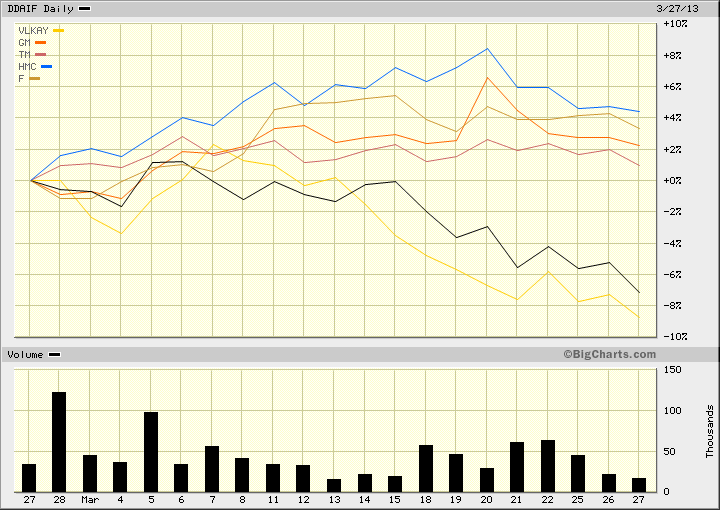
Auto stocks have had a nice run over the past month, the present Cyprus jitters notwithstanding.  Before the recent sell-off, most global automakers were up 5-8% for the month, with two notable exceptions: German automakers Daimler AG (Pink: DDAIF) and Volkswagen AG (Pink:VLKAY).  And though it’s not included in the stock chart, rival German luxury automaker BMW (Pink: BAMXY) has had a similarly rough ride.

      cars

What gives?  Why have German engines been sputtering when American and Japanese continue to purr?

I take particular interest in this because Daimler is an open recommendation of the Sizemore Investment Letter and my pick in InvestorPlace’s Best Stocks of 2013 contest. The stock’s recent underperformance has caused me to fall from as high as third place to my current lowly spot in seventh.  Ouch.

There are a handful of factors at work here.  First, Japanese stocks have massive momentum right now due to the perceived bullishness of Prime Minister Shinzo Abe’s reflation policies, and this is benefitting Toyota (NYSE:$TM) and Honda (NYSE:$HMC).  I see this ending badly—see Japan is Running Out of Time—and I would not recommend having any long-term positions in Japanese stocks.  But for the time being Japanese equities are hot, and I expect Toyota and Honda to follow the broader Japanese market.

Secondly, with the U.S. economy showing signs of life, General Motors (NYSE:$GM) and Ford (NYSE:$F) have been rallying in hopes that this will translate into a sustained rise in domestic auto sales.  It also helps that GM and Ford are two of the cheapest stocks in America at the moment, trading at 6.4 and 7.8 times expected forward earnings, respectively.  And their recent outperformance has come after a year in which both had pretty modest returns relative to the S&P 500.

Company

Ticker

Recent Price

P/E (forward)

Div Yield

52-Week Return

General Motors

$GM

$28.12

6.4

N/A

11.93%

Ford

$F

$13.21

7.8

3.0%

8.04%

Toyota

$TM

$102.66

13.4

1.3%

19.49%

Honda

$HMC

$38.47

13.0

2.5%

-0.59%

Daimler

DDAIF

$55.60

12.0

5.3%

-6.49%

Volkswagen

VLKAY

$37.72

3.5

2.4%

17.53%


But the biggest reason for Daimler’s underperformance of late is that the maker of the iconic Mercedes Benz has the misfortune of being domiciled in Europe. The past month and a half have not been kind to investors in European stocks.  The inconclusive Italian election—which saw anti-austerity parties make massive gains in the polls—raised the possibility that all of Mario Monti’s progress over the past year was about to be reversed.

Spanish Prime Minister Mariano Rajoy is embroiled in a corruption scandal that is weakening his government at exactly the time when strong leadership is needed most, and Spanish growth forecasts released this week were worse than investors had hoped.

And to top it all off, the Cyprus bailout—which should have been simple and straightforward—turned into a confidence-crushing publicity disaster that has sent European stocks into a tailspin.

Right now, the “Draghi Put” is being tested.  European Central Bank President Mario Draghi promised nearly a year ago to “do whatever it takes” to save the euro, and this did wonders for market confidence.   As bad as the recent sell-off has been, without the Draghi Put in place it would have been orders of magnitude worse.

But what does it mean going forward?  If the bank runs spread from Cyprus to other crisis-hit countries, the ECB will provide whatever emergency liquidity is needed.  And concerns that deposits at weaker banks might be at risk of confiscation in the event of a bailout should actually help larger, more stable banks such as Spain’s Banco Santander (NYSE:$SAN).

I have some concerns that fear of asset seizures will cause higher-income European drivers to postpone buying a new Mercedes for a few months.  But in the case of Daimler, this is a relatively minor concern.  Western Europe accounts for only about a third of sales, and sales have remained remarkably steady throughout the turmoil of the past few years.  If the chaos of last year didn’t run Daimler off the road, then neither will the fallout over Cyprus.

The key to Daimler’s success lies further east.  If Chinese and emerging market demand remains strong, Daimler could easily post another year of record sales.  Yes, I said “another.”  Despite all of the Eurozone-related drama last year, Daimler enjoyed a record year for sales in 2012.

At this stage, investors face the risk of short-term, sentiment-driven volatility in Daimler, but the risk permanent or long-term loss is miniscule at current prices.  Use today’s volatility as an opportunity to accumulate more shares.

To track Daimler’s performance, follow the InvestorPlace Best Stocks of 2013 contest.

Disclosures: Sizemore Capital is long DDAIF

SUBSCRIBE to Sizemore Insights via e-mail today.

The post What’s Driving Daimler’s Recent Underperformance? appeared first on Sizemore Insights.

Georgia cuts key rate 25 bps, inflation seen below target

By www.CentralBankNews.info     Georgia’s central bank cut its benchmark refinancing rate by 25 basis points to 4.50 percent, its second rate cut this year, saying it had cut its inflation projection and now forecasts inflation to remain below the bank’s target throughout this year and first approach it in the second half of 2014.
    The National Bank of Georgia, which started its monetary easing cycle in July 2011, said economic activity weakened at the end of last year, and lower demand is pushing the price level downwards.
    A slowdown in the growth of imports in January and February is another indication of a slowdown in domestic demand, the bank said.
    Georgia’s consumer price inflation continued to drop in February as deflation maintained its grip on Georgia. Inflation was minus 2.12 percent in February, slightly up from January’s minus 1.6 percent.
     Since February 2012, the inflation rate has only been positive in two months, October and July, with inflation rates of 0.56 percent and 0.1 percent, respectively.
    The central bank said its forecasts for inflation had dropped since the last meeting of its monetary policy committee, which targets inflation of 6 percent.
     Georgia’s central bank cut rates by 150 basis points in 2012 and has now cut by 75 basis points this year following a 50 basis point reduction in February.
     The central bank said the economy expanded by an annual 2.8 percent in the fourth quarter and credit activity remains weak due to low demand for loans, leading to a slowdown in demand.
    “Low credit activity also weakens the interest rate channel of monetary transmission,” the central bank said.

    www.CentralBankNews.info

13 Reasons You Should Attend the 2013 Social Mood Conference

13 Reasons You Should Attend the 2013 Social Mood Conference

Are you an entrepreneur, investor, trader, finance professional, researcher, professor, social scientist, behavioral economist or an expert in a related field?

If so, there are dozens of reasons to attend The 2013 Social Mood Conference. Here’s our “best of” list of those reasons, titled “13 Reasons to Attend the Social Mood Conference.” Click here to read the PDF brochure

Reason 1: YOU.

The first and foremost reason to attend The 2013 Social Mood Conference is you.

That’s right! You play a crucial role in our exciting event. “What do I have to offer?” you may wonder. The answer is: A LOT! Learn more

Reason 2: Mingle with the best and brightest in social mood research.

From Robert Prechter, the founder of social mood research, to finance professionals, such as Kevin Armstrong, a former investment manager of more than $8 billion in assets, Todd Harrison, the Emmy Award-winning founder of Minyanville.com, and Murray Gunn, the head of technical analysis for HSBC Bank, to enterprising researcher Jon Clifton, the man responsible for Gallup’s groundbreaking World Poll, you’ll rub shoulders with some of the most accomplished personalities in finance, big data and social science — today’s torchbearers of social mood research. Learn more

Reason 3: Understand the world.

Like our heliocentric solar system, evidence for socionomics — the reality that social mood drives social action (not the other way around) — has always been in place. Yet only now is it being explored and understood.

Have we figured it all out? Not even close. But like other breakthrough fields that have come before it, socionomics today is a train that is just leaving the station. Hence your extraordinary opportunity to get on board. Learn more

Reason 4: It’s your Golden Ticket to discovering the “next big things” — for an incredibly reasonable price.

Ask yourself this: What would I have paid to get in on the ground floor of lucrative trends — in big data, mobile technology, Internet search, personal computers — if I had the chance to turn back time to five, 10, 20 years ago? $1,000, $10,000, more?

The 2013 Social Mood Conference is your Golden Ticket to identify the “next big things.” When you attend this event, you will be equipped to pinpoint the developing trends — still in their infancy today — that will shape the future. Learn more

Reason 5: Don’t be left behind.

Social mood research is rapidly expanding its reach into governments, businesses and technologies around the globe.

Some of the biggest and fastest-growing organizations worldwide have discovered that social mood research is an invaluable tool that informs nearly every major decision they make. Learn more

Reason 6: Identify what people want — before they know they want it.

Understanding why people do what they do is only half the benefit of socionomics. Social mood research also helps you make precise forecasts about what people want — before they themselves know it. Learn more

Reason 7: Learn how the Emmy-winning founder of Minyanville.com uses “Social Mood as a Leading Indicator to the Stock Market.”

As a group, the 14 speakers at The 2013 Social Mood Conference offer a one-of-a-kind meeting of the minds. Yet many of the individuals alone provide enough reason to attend.

One such speaker is Todd Harrison, founder and CEO of MinyanvilleMedia, Inc., who will discuss how he uses “Social Mood as a Leading Indicator to the Stock Market.”

Recognize the name? Harrison, a Wall Street veteran and a consummate student of the markets, was featured in the 20th anniversary documentary of Oliver Stone’s hit film, Wall Street, and he’s a go-to expert for the major financial news outlets and periodicals. Learn more

Reason 8: Hear from the world-renowned poll researchers at Gallup.

A window into the minds of six billion people, Gallup’s World Poll tracks what many thought was immeasurable, including key states of mind around the world, such as fear, hope and attachment to one’s community.

Jon Clifton and Joe Daly will detail the World Poll’s most significant findings, and what all leaders in any organization, industry or government need to know about what people are thinking right now. Learn more

For the next five reasons, plus three bonus reasons, download the free PDF brochure, “13 Reasons to Attend the 2013 Social Mood Conference.”

If you would like to receive the free socionomics content each week, sign up here.

Gold Falls with Euro as Cyprus Imposes “Flexible” Capital Controls

London Gold Market Report
from Ben Traynor
BullionVault
Wednesday 27 March 2013, 08:15 EST

WHOLESALE gold bullion prices fell as low as $1591 an ounce Wednesday morning, extending losses from a day earlier following news of Cyprus’s bailout as well as positive US economic data.

Data published Tuesday showed better-than-expected growth in US durable goods orders for February, as well as 8.1% year-on-year house price growth for January as measured by the Case-Shiller Indices – the strongest year-on-year house price growth since 2006.

US consumer confidence however has dipped this month, according to figures from the Conference Board.

“The [safe haven] Cyprus support is not there anymore and the US data, which on balance has been quite good today, is also being a drag for the [gold] market,” said HSBC precious metals analyst James Steel last night.

Silver hit a four-week low at $28.25 an ounce, while stock markets also sold off along with the Euro, which hit a four-month low against the Dollar.

Cypriot authorities are expected to announce details of capital controls later today, with early reports saying they limit foreign transactions but not movements of money within Cyprus.

The controls will be “very differentiated” according to a particular bank’s circumstances, finance minister Michael Sarris said yesterday, and will be in place for seven days before being reviewed.

“Our intention is to limit it as much as possible,” Sarris told the Financial Times.

“We are trying to figure out a sensible set of measures that is flexible enough to allow the functioning of the economy.”

Cyprus’s central bank said it still expects banks to reopen tomorrow with restrictions.

“If Joe Sixpack in Spain or Italy or wherever is thinking the troika are circling their country in the future, it is entirely rational, as Mervyn King suggests, to panic,” says Societe Generale analyst Albert Edwards, referring to comments the Bank of England governor once made saying that it was rational to join in a bank run once one was underway.

The governor of Malta’s central bank meantime has rejected reports that his country, along with Luxembourg, could face a similar fate to Cyprus.

“The problems facing Cypriot banks include losses made on their holdings of Greek bonds,” Josef Bonnici said, “whereas Maltese domestic banks have limited exposure to securities issued by the [Eurozone bailout] program countries.”

Yields on Spanish 10-Year government bonds ticked back above 5% this morning, while market yields on Italian bonds also rose. At an auction of Italian government debt this morning, yields on 5-Year bonds rose compared to a similar auction last month while those on 10-Year bonds fell.

Pier Luigi Bersani, whose political bloc came first in last month’s Italian elections, met with leaders of the Five Star Movement (M5S) this morning, the party that got the biggest single share of the popular vote, for talks on forming a government. M5S said it will not support a Bersani government but would “provide maximum support on specific acts”.

Bersani is expected to tell Italy’s president today or tomorrow whether or not he can form a government.

“If Bersani says he can’t form a government the mantle could pass to [former prime minister Silvio] Berlusconi or [M5S leader Beppe] Grillo to try,” says a note from Standard Bank currency analysts.

“That would probably un-nerve the markets although their ability to form a workable government would be doubtful and this route may well end up taking Italy to new elections in a very short space of time…Perhaps we should say that if Bersani manages to form a government it will be less bad than if he does not. “

Britain’s economy shrank by 0.3% in the final three months of 2012, gross domestic product figures published this morning confirmed. A second consecutive contraction registered in the current quarter would mean a so-called ‘triple-dip’ recession.

Japan’s central bank “will consider every policy option to implement effective monetary easing” its new governor Haruhiko Kuroda said Wednesday.

“There’s no going back now,” says Masaaki Kanno, chief economist at JPMorgan in Tokyo.

“This means they won’t think about anything else until they reach the 2% inflation target.”


Ben Traynor

BullionVault

Gold value calculator   |   Buy gold online at live prices


Editor of Gold News, the analysis and investment research site from world-leading gold ownership service BullionVault, Ben Traynor was formerly editor of the Fleet Street Letter, the UK’s longest-running investment letter. A Cambridge economics graduate, he is a professional writer and editor with a specialist interest in monetary economics. Ben can be found on Google+


(c) BullionVault 2013

Please Note: This article is to inform your thinking, not lead it. Only you can decide the best place for your money, and any decision you make will put your money at risk. Information or data included here may have already been overtaken by events – and must be verified elsewhere – should you choose to act on it.


Central Bank News Link List – Mar 27, 2013: Cyprus capital controls first in EU could last years

By www.CentralBankNews.info Here’s today’s Central Bank News link list, click through if you missed the previous link list. The list comprises news about central banks that is not covered by Central Bank News. The list is updated during the day with the latest developments so readers don’t miss any important news.

Silver ‘$100 Within Two Years’

By MoneyMorning.com.au

You could say that buying gold is like drinking vintage Grange wine.

In which case buying silver is like doing double shots of Bundaberg rum.

They both have the desired effect – the latter does it more effectively, but at the risk of a bigger hangover. Silver’s volatility means it swings wildly between the buy and the sell zone.

The good news is that Aussie dollar denominated silver is in the buy zone right now. And if history is any guide, it could take off like a rocket from here.

Last year it bounced 35% in two months from the buy zone. The time before that was as far back as 2010, when it soared 182% in a year.

So what could be in store from here?

In yesterday’s Money Morning, I gave a sneak preview of my recent interview with Eric Sprott, CEO of Sprott Asset Management, who manages $11 billion in the precious metals market.

His views on gold were very bullish. But today I’d like to show you just how bullish he is on silver…

But first let’s back up a second.

The Long Rise of Silver

I’d like to show you where we are in the decade plus bull run in silver, and why this should be an ideal time to buy it.

Below is a weekly chart for Aussie dollar denominated silver since 2003. It’s an incredibly strong chart. The first thing to notice is that the 200-week moving average (red line) shows a strong and completely intact uptrend.

Silver Bull Run Alive and Well – and the Price is Back in the Buy Zone

Source: StockCharts

After the wild move in 2011 that saw silver almost triple, it has now almost finished a painful, two-year long hangover. Most importantly the price has now come back to rest on the ‘buy zone’ – the 200-week simple moving average.

Silver has tested this level just seven times in the last ten years, and bounced off it each time. In some cases, like last year, it was a move of 35% lasting just a few months. In other cases the price can increase in multiples. It almost tripled after it hit this 200 week moving average in 2010; and more than doubled after its 2005 skirmish.

So what will we see from silver this time? I’m confident at the very least of a move as big as last year’s. After all, that would only require hitting $37, where it has been several times in the recent past.

But really we’re looking for the Big Kahuna: when silver increases in multiples to reach a new high.

Will we have to endure any more false starts before this happens? It’s possible. The big moves of 2005 and 2010 both had two practice runs before taking off.

You can see in the chart that in both cases, it was eighteen months between the first bounce off the 200-week moving average, and the bounce that turned into the big one. If this historical pattern repeats, we’d need one more short-term move on this bounce, before we get the big one from late 2013.

At the very least buying now should be a profit opportunity for the short-term trader, but more importantly, it should be a cheaper buy-in for the long-term silver investor.

Very few investors have taken a bigger stake in the silver market than Eric Sprott. So when I had his ear for 25 minutes in Hong Kong last week, I was sure to ask his view on silver – as well as silver stocks too.

Q+A with Eric Sprott – Full Transcript on Monday

I’ll save the whole transcript for Easter Monday, but here are a few sneak preview quotes from the world famous portfolio manager, running $11 billion in the precious metals markets, and one who calls silver the ‘investment of the decade’.

Alex: …Now silver as I know is something that is very close to your heart as well. I’ve been recommending silver for some time, and I own some. It’s been very frustrating for silver investors for more than eighteen months. But that is the nature of the beast with silver. You have a very disappointing period, and then it will suddenly double in a period of months.

Eric: Well I think the same thing goes on in the silver market that goes on in the gold market, except it is more obvious. When silver got to $49.50 not that long ago, it traded over a billion ounces of paper silver in a day, and we only produce 800 million ounces of silver in the mines a year. I always ask people to think about the guy who sold a billion ounces of silver that day – what’s he thinking? There’s no way he can supply it. And therefore it must be somebody who thinks that by selling the billion ounces he can dampen the enthusiasm, which they did, of course they had the changes in the Comex rules all at the same time which helped them.

But I think that silver will triple the performance of gold, because ultimately we will go from a 55 to 1 ratio which we’re at today, down to 16 to 1 which was the typical ratio. And we see lots of signs in the silver market for incredible demand. I’m just awestruck that in the US, the US mint sells as many dollars of silver as they sell of gold, which means they are selling 55 times as many ounces of silver as gold. And yet the mines only produce 11 times more. I mean something’s got to give here. We can’t have the world buying 55 times more silver than gold, when quite frankly for investment its only available three ounces of silver for every ounce of gold, as most silver is used for industrial purposes.

So I’m pretty upbeat about silver!

Alex: So you think $100 silver is realistic in the next year or two?

Eric: Well I think obviously with gold at $1600, I would believe that silver should be at a hundred. Does it happen in one to two years? Maybe not, but I would certainly say in two to five years it happens. And that’s just with gold staying still!

Fortifying stuff indeed! And based on silver’s history, is quite realistic too.

But if you’re buying silver, a few key things to recall are:

  • To buy as low as possible (like now), and with as low a margin as possible
  • Hold with a long-term view, and
  • Expect any number of swings and roundabouts in the interim!

Don’t Forget Silver Stocks

In yesterday’s Money Morning I quoted Eric saying that, in the case of gold stocks, they outperform the metal price at least two to three times when the metal rallies. So, given that he thinks silver could triple from here, what does this mean for silver stocks?

This chart shows the global silver stocks index since 2010. You can see that that silver stocks have underperformed the metal by 28%! It’s not quite as poor a performance as in the gold space, but there’s clearly room for improvement too!

Silver Stocks Badly Underperform Silver in the Last Few Years

Source: StockCharts


So from these depressed levels, I was curious to know what Eric thought about silver stocks, particularly if he could see silver price tripling:


Alex: …So how do you feel about silver equities? Could we transplant the same argument from gold and gold equities, to silver and silver equities?

Eric: Well I have a very disproportionate amount in silver equities. Just on the bet that silver far outperforms gold, and I want to be where the action will be, so I obviously favour silver equities over gold equities.

Alex: Producers, developers?

Eric: Producers, developers, even guys who just have deposits. We’ve all lost interest in the deposits these days. But if we start to see the price of silver go up, believe me, the interest will come back for the guys with deposits.

Alex: And from extremely oversold levels too.

Eric: Extremely oversold levels yes!

So there you have it. Silver stocks could even outdo silver, which Eric calls the investment of the decade.

So if you’re the type of investor that can hold your nose and buy, then it sounds as though over the next few years silver equities could deliver more fun than a whole case of Bundaberg rum!

There was far more to this exceptional interview, so don’t forget to tune in on Monday for the full transcript…

Dr Alex Cowie
Editor, Diggers & Drillers

Join me on Google+

From the Port Phillip Publishing Library

Special Report: Australia’s Energy Stock BLOWOUT

Daily Reckoning: Why Watching Europe is Paramount

Money Morning: 11 Billion Reasons to Expect a 200% Move in Gold Stocks Within Months

Pursuit of Happiness: Learn This Lesson from Cyprus Before it’s Too Late

Diggers and Drillers:
How You Can Use a Bottomed-Out Silver Price to Quadruple Your Returns

Why The Federal Reserve and Central Banks Should Be Abolished

By MoneyMorning.com.au

Last week I spent two days speaking to senior government officials and business leaders in Bermuda, which is one of the world’s leading international insurance and reinsurance hubs. The men and women in the room are responsible for hundreds of millions in assets worldwide.

I spoke for over an hour on the implications and opportunities of the financial crisis.

As I was finishing up, I received one of the most provocative questions I’ve gotten in a long time from the darkness beyond the stage lights: ‘Does any nation really need a ‘Fed’?’ asked one of the directors.

The answer is, unequivocally, no. Especially if it’s modelled after the United States Federal Reserve.

The individual depositors who were the protected class when the Fed was originally formed are little more than cannon fodder today. Instead, the banks the Federal Reserve supports have become the protected few.

To be honest, I didn’t always think this way. For much of my career, I took the Federal Reserve for granted, believing like millions of Americans that it was acting in our country’s best interest.

Then I sat down with legendary investor Jim Rogers in Singapore a few years back at the onset of the current financial crisis. During our discussion, he pointed out several things that really made me think about the Fed and its role in not only creating this crisis, but making it worse.

A 100 Year-Old Affront to Freedom

The American Federal Reserve as it operates today is an insult to anybody who believes in economic and political freedom. In an era of globally-linked finance, the very concept of a Fed is an abomination.

I realize that this may not sit well with you if this is the first time you’ve thought about the issue.

So let’s walk you through a few things that will challenge your thinking…

The Federal Reserve was established in 1913. It’s only 100 years old. And it’s anything but an original part of America’s economic machine.

Its original purpose was simple: To prevent banking failures.

At the time, the United States had just gone through the vicious bank panic of 1907. That crisis was significant because it saw the failure of Knickerbocker Trust, which sought – but failed – to receive financial support from its peers. Unable to obtain liquidity from any source, Knickerbocker Trust collapsed.

This affected public psychology deeply because Knickerbocker’s peers not only chose not to rescue Knickerbocker, but also suspended payments to each other.

This boomeranged through the system and came to roost at the retail level when the public figured out that they didn’t have access to their money, especially in ‘specie’, meaning in gold. Bank runs and closures became the norm.

The New York Stock Exchange fell 50% before financier J.P. Morgan famously locked banking executives in his personal library and formulated a liquidity injection that ultimately calmed everything down.

Loath to waste a good crisis, legislators stepped up to the plate by agitating for centralized banking as a means of restoring public confidence while providing the banking system with a source of liquidity that would prevent their wholesale collapse.

And they got it a few years later…in spades.

What’s really interesting to me looking back using today’s lens is how sophisticated the machinery of the time was. Powerful public and private figures worked together, often in great secrecy like they did at Jekyll Island, Georgia, to build the framework for the Fed. The Wall Street Journal published a 14-part series highlighting the need for a central bank. Citizen groups and trade organizations piled on.

And voilà…the Fed was born under the guise of a politically independent institution that would stabilize the financial system, protect the monetary supply against inflation, and maintain credit as needed by injecting stimulus when the economy flagged and withdrawing it when things were overheated.

In the terminology of the day, this was viewed as giving elasticity to the dollar which would, in turn, establish more effective control over the banking system.

None other than the Comptroller of the Currency observed that the Fed would supply a circulating medium that is ‘absolutely safe’. What irony.

Fast forward to today.

Every 1913 dollar is now worth US$0.04 cents. Goods and services that cost a buck back then now will set you back $21. Where’s the stability in that?

If that’s not practical enough, consider wages.

According to the US Census Bureau, the median income of male workers in 2010 was $32,137 while the median income of male workers in 1968 was $5,980. On the surface this isn’t too shabby. It’s a 437.4% increase over 42 years – or an average income gain of 10.41% a year, over the same time period.

However, if you run the numbers the other way, using 2010 dollars, a very different picture emerges. You quickly see that median earning male workers actually have less purchasing power today than they did 42 years ago ($32,844 vs. $32,137).

That’s your Federal Reserve at work. It’s robbing America by gradually sucking the life out of the financial system. Over time, it will cause the system to collapse – just ask anybody in the former Soviet Union. They had a ‘Fed’ and no Soviet bank ever failed per se. However, the state eventually took so much wealth from the people that the entire system broke.

Taxation Courtesy of the Printing Press

Legions of spend-it-while-you-can politicians and economists don’t see it this way. And neither, perhaps more importantly, does sitting Federal Reserve Chairman Dr. Ben Bernanke.

He said explicitly on November 21st, 2002, in remarks to the National Economists Club that, ‘by increasing the number of dollars in circulation, or even by credibly threatening to do so, the U.S. government can also reduce the value of the dollar in terms of goods and services, which is equivalent to raising the prices in dollars of those goods and services.’

In other words, he believes he can create economic value merely by printing money. It’s no wonder that he continues to print money today (euphemistically calling it ‘quantitative easing’) knowing full well that he is eviscerating the dollar. He believes that doing so is the same thing as raising prices by managing inflation.

In fact, inflation is actually defined as the artificial increase in the supply of money and credit. It’s a tax by any other name. So what Bernanke is really doing is artificially taxing the American public by debasing its currency. It’s no wonder that more people have less. But here’s where it really hits home for me.

When the Federal Reserve was created, it was envisioned as a source of liquidity for the banking system. The presumption was that any specific failure in the banking system subject to the Fed’s oversight would be offset by the available cash from the government because it had centralised the credit risks associated with their lending portfolios.

In today’s environment, credit is diffused globally far beyond the Fed’s reach. What’s more, there’s too much of it and the banking system is now so big that the risks it holds dwarf the Fed’s liquidity capacity.

For example, there are an estimated $600 trillion to $1.5 quadrillion in derivatives products worldwide at the moment. Global gross world product is approximately $79 trillion by comparison.

Contrary to what Bernanke and others who are so tightly involved in the system believe, this crisis was not caused by a lack of liquidity. Rather, it was caused by too much money sloshing around in some sort of unregulated mosh pit with inadequate supervision and inadequate regulatory oversight.

The real villain here is that excess liquidity is leveraged. This lets big banks buy derivatives for pennies on the dollar yet exposes them to hundreds of billions in market risk.

The sad reality is that Bernanke and his central banking buddies in ‘Feds’ around the world could print money until the end of time and they still wouldn’t be able to print enough to guarantee liquidity. Yet they will continue to try because that’s the only way they keep the illusion going.

It’s also the only way they keep a handle on their version of risk…to the system. And that brings us full circle.

Success by its very definition includes failure. People forget that the discipline of failure is integral to capitalism. When the Fed creates money out of thin air, the risk of failure does not exist. Without the risk of failure, the big banks know they can place one way bets and not worry about losses because they are literally ‘too big to fail’.

In fact, management and traders are paid to do exactly this. If the monstrous one-way bets pay off, they get up to 50% of the profits. If the bets go bad, the stockholders, the Federal Reserve, and now the public eat the losses.

So they have every incentive to act in their own interests while reinforcing incompetent management, improper risk taking and inefficient operations. Politicians and regulators are incentivized the same way, since the Fed also makes it possible for them to skirt the issue of responsibility.

The Fallacy of Free Money

Which brings me to the last sacred cow I want to barbeque today: interest rates.

The Fed spends a good deal of its time and our money promoting and maintaining low interest rates. It’s doing so on the assumption that low rates prompt everyone to put money to work by making savings less appealing. But ask Japan how much demand there was when money was free – the answer is next to none.

The trillion-dollar problem is that this economic assumption presumes the savings are there in the first place. In reality, America and other ‘Fed’ nations are flat broke. There is no savings pool to draw upon, which means the foregone assumption is a bust.

At some point, people who do not have cash cannot pay for the goods and services they need – no matter how much liquidity is in the system.

International capital markets actually exacerbate the problem because other governments and major trading firms purchase that very same excess liquidity which they, in turn, then begin using as collateral for their own expansion.

Congressman Ron Paul, a staunch Fed opponent, summed it up much more eloquently than I ever could in his book, End the Fed, noting that ‘those who suffer [rarely] see the connection between Federal Reserve monetary policy and the suffering that comes as a consequence of financing big government and big banking.’

Under the circumstances, is it any wonder that almost every currency in recorded history that is controlled by a central bank has failed or is failing?

The Federal Reserve

No. We do not need a Fed because dissolving it would:

  • Force any government that has one to live within its means;
  • Restore the appropriate level of risk to the global financial community; and,
  • Nullify the risks involuntarily forced upon the public in the name of political priorities.

As for how we dissolve this mess, that’s a subject for another time and another email.

Keith Fitz-Gerald
Contributing Editor, Money Morning

Publisher’s Note: This article originally appeared in Money Morning (USA)

From the Archives…

Why You Should Buy This Falling Stock Market
22-03-2013 – Kris Sayce

Stock Market Warning: Part II
21-03-2013 – Murray Dawes

New Developments on Whether You Can Get Your Mortgage Cancelled
20-03-2013 – Nick Hubble

Your Retirement or Your Mortgage?
19-03-2013 – Nick Hubble

Get Used to This Stock Market Action, It’s Set to Last…
18-03-2013 – Kris Sayce

Join Money Morning on Google+

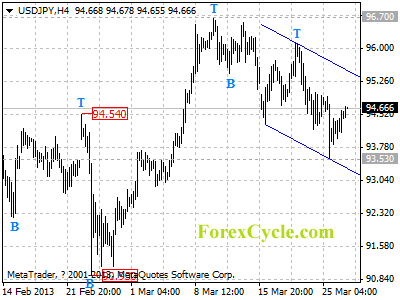
USDJPY remains in downtrend from 96.70

USDJPY remains in downtrend from 96.70, the rise from 93.53 is likely consolidation of the downtrend. Key resistance is now located at the upper line of the price channel on 4-hour chart. As long as the channel resistance holds, the downtrend could be expected to resume, and another fall to 92.00 – 93.00 area to complete to downward movement is possible. On the upside, a clear break above the channel resistance will indicate that the downtrend had completed, then the following upward movement could bring price to 100.00 zone.

usdjpy

Daily Forex Forecast