Gold Forecasts Split at $10,000 and $1000 as ETFs Sell, Central Banks Buy, Indian Dealers Cleaned Out

London Gold Market Report
from Adrian Ash
BullionVault
Thurs 25 Apr, 07:45 EST

WHOLESALE GOLD rose to an 8-session high just shy of $1450 per ounce in London trade Thursday morning, recovering 45% of this month’s near-record slump.

Asian stock markets also ticked higher, but European shares were flat while commodities extended their rally.

Silver prices were unchanged for the week so far at $23.30 per ounce.

Gold priced in Sterling fell £10 per ounce from an 8-session high of £946 as the Pound jump on news that the UK avoided recession – growing just 0.3% – in the first quarter of 2013.

“Gold is continuing [its] recovery,” says the daily comment from the commodities team at Germany’s Commerzbank.

“Rate-cut speculation ahead of next week’s [Eurozone central bank] meeting – and the prospect of continued ultra-loose US monetary policy following more weak economic figures – are lending buoyancy to the gold price.”

Investors who buy gold, writes Société Générale’s global strategist Albert Edwards in a new report, are making “a bet against central banks’ competency.”

Given central banks’ track record, he adds – repeating his team’s forecast of $10,000 gold – “that’s certainly a bet I’d be happy to still take.”

Money-creation leading to a surge in inflation is also the forecast from billionaire hedge-fund manager John Paulson, who reportedly told clients on a webinar Wednesday that he and his chief precious metals strategist – the highly respected former UBS analyst John Reade – are also “holding course” despite last week’s price crash.

Dutch bank ABN Amro however – which this month said “the demise of gold [was] still at an early stage” – today revised its $1000 gold forecast from end-2015 to the end of 2014.

“ETF [trust funds] still see sellers, but physical demand remains very strong,” says Moudi Raad at Swiss refining and finance group MKS.

New York’s giant SPDR Gold Trust yesterday shed another 4 tonnes of gold, taking the bullion held to back its shares down to the lowest level since the start of September 2009 at 1093 tonnes.

Over in India however – the world’s heaviest gold-buying nation – “We are unable to get supply,” Reuters quotes a state-bank dealer.

“Refiners have sold out till second or third week of May. Gold for immediate delivery is quoted at $10 on London prices.”

Latest data from the International Monetary Fund meantime show that emerging-market central banks again chose to buy gold for their reserves in March.

Russia led central-bank gold buying, adding 4.7 tonnes to reach 981 tonnes, while Turkey continued to pull in metal from its commercial banks, adding a further 33 tonnes to reach 409.

“I think physical and central banks…those buyers are supporting the market,” Reuters quotes Yuichi Ikemizu at Standard Bank in Tokyo.

“With this sharp decline in the price,” he adds, “I think South Korea is buying gold too. [It] always buys gold when the price comes off.”

Adrian Ash

BullionVault

Gold price chart, no delay   |   Buy gold online


Adrian Ash is head of research at BullionVault, the secure, low-cost gold and silver market for private investors online, where you can buy gold and silver in Zurich, Switzerland for just 0.5% commission.


(c) BullionVault 2013


Please Note: This article is to inform your thinking, not lead it. Only you can decide the best place for your money, and any decision you make will put your money at risk. Information or data included here may have already been overtaken by events – and must be verified elsewhere – should you choose to act on it.
Philippines cuts SDA rate by 50 bps but holds policy rate

By www.CentralBankNews.info     The Philippine central bank kept its main policy rates steady but again cut the interest rate on its Special Deposit Account (SDA) facility by 50 basis points to 2.0 percent for all maturities, moves that were expected, and said it would “deploy macroprudential measures as needed to pre-emptively address any potential misalignment in asset prices.”
    The Central Bank of the Philippines (BSP) said its decision to maintain the benchmark overnight borrowing rate at 3.50 percent and the overnight lending rate at 5.50 percent was based on its assessment that inflation is “likely to remain manageable over the bank’s policy horizon” and in the lower half of its target range for 4.0 percent, plus/minus one percentage point.
    The central bank has been using the SDA facility, which has now been cut by 150 basis points this year, to make it less attractive for foreign funds to park their money in the Philippines which tends to put upward pressure on the peso and fuel local asset prices.
    But by keeping the overnight borrowing and lending rates steady, the central bank is trying to ensure that there is enough liquidity to stimulate economic activity. The bank also maintained its reserve requirement ratios.
    The reductions in the SDA rate is part of the central bank’s shift toward a corridor system for its interest rates, a system that has been used by other central banks, such as Turkey, to handle the “wall of liquidity” that is attracted to fast-growing economies from investors in many advanced economies where interest rates have been ultra-low since the global financial crises.
    Last year the Philippine peso appreciated by 6.8 percent against the U.S. dollar but since March the peso has been easing and portfolio investment data show a net outflow, which economists attribute to the central bank’s move to cut the SDA rate.

    The bank’s monetary board said the current benign inflation environment and robust domestic growth is providing its scope to absorb liquidity through the SDA facility, helping it fine-tune and gain flexibility in its monetary policy instruments and operations.

    Inflation in the Philippines eased to 3.2 percent in March, down from 3.4 percent, and last month the central bank raised its forecasts for full-year inflation to 3.3 percent from 3.0 percent.
    The risks to the central bank’s inflation outlook are evenly balanced with downside risks from the strength of the global economy and the “relative firmness of the peso” while the upside risks stem from power rate adjustments and the “possibility of a sustained surge in liquidity owing to strong capital inflows,” the bank’s monetary board said.
    The country’s Gross Domestic Product expanded by 1.5 percent in the fourth quarter from the third for annual growth of 6.8 percent, down from 7.2 percent in the third quarter.
    The Philippine economy expanded by 6.6 percent in 2012 and the government forecasts growth of 6-7 percent this year. Last month the central bank’s governor said the economy was still in an expansion phase in the first quarter of this year.
    Last year the BSP cut its benchmark overnight borrowing, or reverse purchase facility (RRP) rate by 100 basis points, most recently in October in light of low inflation. Since then it has kept the rate steady to allow the lower rate to work its way through the economy and stimulate activity.

    www.CentralBankNews.info

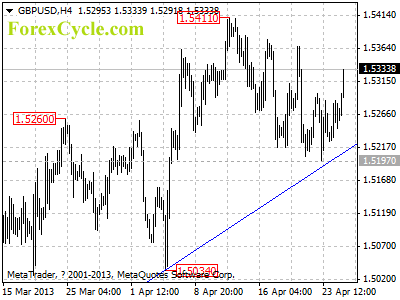
GBPUSD rebounded from 1.5197

Being contained by the support of upward trend line from 1.4831 to 1.5034, GBPUSD rebounded from 1.5197, suggesting that the downward movement from 1.5411 has completed. Further rise to test 1.5411 resistance would likely be seen, a break above this level will indicate that the uptrend from 1.4831 has resumed, then next target would be at 1.5600 area. Key support is now at 1.5197, only break below this level will suggest that the uptrend from 1.4831 had completed at 1.5411 already, then the following downward move could bring price to 1.4500 zone.

gbpusd

Daily Forex Forecast

Jim Rogers Exclusive: Once Gold Bottoms, We’re Looking at ‘A Multi-Year Bull Market’

By MoneyMorning.com.au

Gold soared 650% from August 1999 to August 2011.

But it’s down 24% from the $1,885 peak and in recent days has whipsawed gold investors in a way they haven’t experienced in 30 years.

The bear market has gold bugs reaching for the Dramamine. But we reached for the telephone instead and dialed Singapore — and legendary investment guru Jim Rogers.

Many of Wall Street’s biggest investment banks are calling for additional blood-letting — meaning gold prices have a lot more room to fall. But in his usual contrarian manner, Rogers dismissed the consensus.

Indeed, the former hedge-fund manager and best-selling author believes this is a badly needed — even healthy — price correction.

And that will set the stage for a new bull market in gold — and a run to record prices that are sure to come in an era of cheap-money policies by the world’s central banks.

Gold was setting us up for some kind of correction,’ Rogers said in a Sunday night telephone interview from his home. ‘Gold needed a correction — it still needs a correction — and I hope this is the proper correction which gold needs. Then gold — somewhere along the way — will make a bottom and we can all join in the bull market as [it] goes higher and higher.’

And make no mistake: The shiny metal is going higher — much higher.

Gold has to go a lot higher over the next decade or so, because [the world’s central banks] keep printing money,’ he said.

Of course, it was just one week ago when gold suffered its worst two-day rout in 30 years. And even though that’s been followed by a five-day winning streak, gold is still in bear-market territory.

Gold is going to shake out the mystics — there are still a lot of mystics in the market,’ Rogers said. ‘I have guys writing me saying this couldn’t be happening. I say, ‘Well, get out your quote machines, it is happening’.’

Pundits have identified a litany of catalysts for the metal’s decline.

An Old Hand on the Gold Market

One was Cyprus. When reports surfaced that the tiny country was planning to sell some of its gold reserves to help finance its bailout, they immediately sparked fears that the similarly troubled Portugal, Ireland, Greece, Spain and Italy might follow suit and dump their own gold holdings — no small worry given that those five countries have an aggregate $145 billion in reserves.

Wall Street was also identified as a culprit. Big investment banks such as Goldman Sachs Group Inc. were already forecasting much-lower gold prices, and had even urged customers to ‘short’ the metal. When the sell-off strengthened, many of those institutions slashed their target prices anew — and intensified the decline, the pundits said.

While those were certainly contributing factors, they weren’t the root cause, Rogers told Money Morning.

With the advent of exchange-traded funds (ETFs), it’s become much easier for individual investors to ‘buy’ gold. As Rogers noted, ‘people just switched from the miners to the real stuff, [creating] another reason it went up so much [and] set the base for what’s happening now.’

Exacerbating the situation was the fact that the run-up hasn’t been offset by any type of pressure-relieving correction.

Gold was up 12 years in a row, which is extremely unusual,’ Rogers said. ‘I don’t know of any asset that’s gone up 12 years in a row without a down year … equally important is the fact that gold has one correction of 30% — as much as 30% — in 12 years. Now that’s very strange. Most [assets] correct 30% every year or two. That’s just the way markets work. The peculiar action in gold has been the 12 years [without that correction]. So it was certainly setting us all up for some kind of correction.’

The last down year for gold was 2000, when the yellow metal fell 2.8%. The last correction of any magnitude before this one was in Sept. 2011, when it declined 14.7%. That followed a July–September rally of 28.4%, — and was less than half of the 30% correction that Rogers quantified as being meaningful.

There’s obviously no way to predict where gold will bottom, Rogers has said. He’s often cited $1,200 an ounce since that would represent a 30% decline. But even if it’s more, investors need to keep in mind the inflation-fuelling policies the world’s central banks seem intent on pursuing. They’re bullish for long-term gold prices.

When the Gold Hits Bottom, Buy

At some point, then, gold becomes too cheap to ignore, Rogers said — displaying the mix of wit, analysis and insight that results in a steady flood of interview requests.

If it gets to $1,200, I hope that I’m smart enough to buy even more,’ he said. ‘If it gets to $1,100, I hope I’m smart enough to buy even more. Speak to the chartists … the technicians … and [look at] the retracements, or whatever they call them. A 50% retracement is not unusual. A 60% retracement is not unusual. You can do the same math that I can. You can figure out what a 40%, 50% or 60% retracement would mean for someone.’

Here’s his key point. With declines that steep — taking gold prices down to $1,150, $950 or $750 an ounce — a lot of would-be gold investors will literally throw in the towel, and will abandon gold. That’s when negative sentiment will have been maximized, and gold will have bottomed.

Until people start accepting reality instead of denying reality, we’re not going to make the bottom,’ he said. ‘Until a lot of people just pack it in and throw gold out the window…then gold will make a beautiful bottom and we can all participate in a multi-year bull market.’

One of the allures of gold as an investment is that there are so many available options.

There’s ETFs, there’s coins, there’s bars,’ Rogers said. ‘There are many, many ways to invest. But please don’t do so unless you’ve done your homework.’

That’s especially true of some of the other investment vehicles — including futures contracts and miners.

Some of the gold-mining stocks are extraordinarily beaten down,’ he said. ‘Many of them deserve to be beaten down. I think more money has been lost in buying gold-mining shares over the past 100, 150 years than any other sector, including airlines and railroads. If you know the right ones, or right one, buy it, or them — because somebody will make a lot of money.’

William Patalon
Contributing Editor, Money Morning

Publisher’s Note: This article originally appeared in Money Morning (USA)

Join Money Morning on Google+

From the Archives…

Why Waste Your Time on Gold When You Can Invest in Dividend Stocks?
19-04-2013 – Kris Sayce

A Trader’s Eye View of Gold’s Frightening Collapse
18-04-2013 – Murray Dawes

Why You Should Buy ‘Dirty, Grimy’ Gold Stocks
17-04-2013 – Dr. Alex Cowie

Why this Historic Fall in the Gold Price Equates to a Historic Opportunity
16-04-2013 – Dr. Alex Cowie

Beware the ‘Safety Bubble’, But Don’t Sell Dividend Stocks Yet
15-04-2013 – Kris Sayce

Is This the Last Hurrah for the Australian Dollar?

By MoneyMorning.com.au

Some big cracks are finally starting to appear in the Australian dollar.

I’ve been ignoring the Australian dollar for months because it has been caught in a tight range, going nowhere fast.

The buying forces of offshore money coming into Australia in search of yield have been neatly balanced by the selling forces from our weakening terms of trade. The result has been an Aussie dollar seeming to defy gravity and holding steady around US$1.03–$1.05.

But the dumping of commodities over the past week has finally started to apply some extreme pressure to that balance…

The Technical Picture for the Australian Dollar

The chart below shows the widening divergence between the Australian dollar and the Commodity Research Bureau (CRB) index. This makes it quite clear that the Aussie dollar has been dancing to its own tune for the past couple of years:

CRB Index vs AUDUSD

Commodities have had an influence but they have not had their usual effect. If the above divergence were to disappear we could see the Australian dollar heading below the mid-90’s.

Of course the reverse could happen and commodities could bounce from here. But I strongly doubt it the way the data worldwide is currently rolling over.

AUDUSD Daily Chart

A close up of the Australian dollar over the past three years shows that it has been caught in a symmetrical triangle. Symmetrical triangles are often seen as continuation patterns in classical technical analysis but there is no reason why this won’t be a reversal pattern, meaning that it could break out of the triangle to the downside.

You can see that the recent rally to US$1.06 saw prices poke their nose out above the top of the triangle and then be quickly rejected from there, collapsing to US$1.03 in a couple of days.

The next stop for the Australian dollar is of course the last major line of support around US$1.015–1.02. I would expect to see some buying around that level but I don’t think it will be enough to turn things around.  If that last line of support gives way then you could expect to see the Aussie heading towards parity in short order.

From there the Aussie dollar would be testing parity as well as the lower edge of the symmetrical triangle.  If that can’t hold the Australian dollar would run out of friends pretty fast.

If you have another look at the chart above you will see a lot of black circles.  They show you when the 10 day moving average has crossed under the 35 day moving average, signifying a shift to what I call the intermediate downtrend.

In seven out of the eight previous occurrences the Aussie dollar fell from this point. In a few of them admittedly the downtrend didn’t last long. But there was definitely an impulsive move to the downside after the trend shifted.

You can see that the trend did shift back down into intermediate downtrend last week so we may be in the early stages of an impulsive decline.

From where I sit there is a set of dominoes piled up from here to around US$0.98, and it could happen quicker than most expect once it gets going.

I have been thinking about all of this money hitting Aussie shores from Japan and wondering whether they are jumping out of the frying pan and into the fire. If they pile into the Australian dollar just before it does a swan dive on the back of our weak terms of trade will that hot money stick around or will it run for the exits? My feeling is that they may dump their positions if the currency has a substantial move.

So the force that has caused our dollar to hold up against all odds could turn and start to head in the other direction if the Aussie has a big move to the downside from here.  All of a sudden I can make a case for seeing the Aussie dollar moving 10c or more to the downside in a worst case scenario.

Yikes.

The Driving Factor Behind the Australian Dollar

I thought the selloff from early 2012 would continue but was amazed by the resiliency of our currency. Perhaps there will be so much money heading to our shores due to the low yields world-wide that this theme of the Australian dollar being stronger for longer will continue for many more months to come.

But I always come back to the idea that the terms of trade will end up driving the value of our dollar as it always has in the past, and at the moment the Aussie dollar looks expensive in a world economy that is coming off the boil at a rapid pace.

Though, the fact that the world economy is coming off the boil doesn’t seem to matter to the markets one bit at the moment. Take yesterday’s huge rally as an example. We saw PMI figures released by China and Europe. They were basically terrible across the board, but what did the world’s equity markets do in response? They shot higher by 2–4% in one day.

The markets have now entered the twilight zone. Up is down, down is up, good news is good news and bad news is better. Attempting to analyse anything other than the flow of funds is becoming increasingly difficult.

So the fundamentals for the Australian dollar don’t look good. The technicals say that there could be trouble under US$1.015–1.02, but the flood of money hitting our shores looking for a safe harbour will be the deciding factor in the direction of our currency going forward.

Murray Dawes
Editor, Slipstream Trader

Join me on Google Plus

Ed Note: Picking the right time to sell stocks is one of the hardest things to do. You’ll always worry that you’ve sold too soon and missed out on further gains. In today’s Money Morning Premium, Kris shows investors a way to ‘insure’ a share portfolio against a falling stock market. It’s simple and anyone can do it. Click here to upgrade now.

From the Port Phillip Publishing Library

Special Report: TORRENT SIGNAL 3

Daily Reckoning: Wasting the Mining Boom

Money Morning: Statistically, Almost Impossible: The Mystery of Gold’s Sudden Collapse

Pursuit of Happiness: Booze, Watches and Fancy Pens — the Alternative Retirement Plan

(Video) Top 3 Technical Tools Part 2: Relative Strength Index (RSI)

EWI senior analyst Jeffrey Kennedy shows you how to identify quality trade setups with supporting technical indicators.

By Elliott Wave International

“There are many different forms of technical analysis. A completed Elliott wave pattern supported by additional evidence allows for more confident forecasts and higher probability trades.”

-Jeffrey Kennedy

Trader and technical analyst Jeffrey Kennedy has more than 25 years of experience using with the Elliott Wave Principle. To support his Elliott wave analysis, Jeffrey says that his 3 favorite technical tools are Relative Strength Index (RSI), MACD, and Japanese candlesticks.

This 3-part series includes Jeffrey’s practical lessons and proven techniques to support his wave counts (read Part 1 here >>). Today’s video clip shows you how RSI and range rules can help identify trading opportunities: Part 3 will cover MACD.

Jeffrey’s second lesson, excerpted from his Elliott Wave Junctures educational service, gives an overview of RSI followed by a video example.


Buying pullbacks in uptrends and selling bounces in downtrends are great ways to trade trending markets.


Developed by J. Welles Wilder, Jr. and presented in his 1978 book, “New Concepts in Technical Trading Systems,” RSI measures the strength of a trading vehicle by monitoring changes in closing prices and is considered a leading or coincident indicator. Andrew Cardwell popularized RSI as a trading tool by introducing the concept of range rules.


The theory behind range rules is that countertrend price action in trending markets has specific momentum signatures. RSI, for example will find support within roughly the 50-40 region when pullbacks in uptrends occur. Conversely, when bounces develop in downtrends, RSI will meet resistance in the 50-60 area.


Taking the path of least resistance is a benefit of trading in the direction of the trend. Moreover, the use of RSI and application of Andrew Cardwell’s range rules help identify when a trader can rejoin the trend.


Learn the Best Technical Indicators for Successful TradingThis free report from Elliott Wave International will teach you how to incorporate technical indicators into your analysis to improve your trading decisions.You’ll learn which technical indicators are best for analyzing chart patterns, which are best for anticipating price action, and which are best for spotting high-confidence trade setups. You’ll also learn how technical indicators can be used to complement Elliott wave and other technical methods.

Get your technical indicators report now >>

This article was syndicated by Elliott Wave International and was originally published under the headline (Video) Top 3 Technical Tools Part 2: Relative Strength Index (RSI). EWI is the world’s largest market forecasting firm. Its staff of full-time analysts led by Chartered Market Technician Robert Prechter provides 24-hour-a-day market analysis to institutional and private investors around the world.


Ignore the “Goldfrueders”… Gold Remains a Great Store of Value

By Justice Litle

Conventional wisdom on Wall Street is often worth the price paid (i.e., nothing). But some hoary nuggets have value.

“Sell in May and go away,” for example, is based on a true and powerful phenomenon.

As Mark Hulbert reports on MarketWatch:

Over the past 50 years, the Dow, on
average, has produced a gain of 7.5% during the winter months and lost
0.1% during the summer months.

The “sell in May pattern also exists
in other countries besides the US. Ben Jacobsen, a finance professor at
Massey University in New Zealand, reached that conclusion after studying
all available historical evidence from each of 108 separate stock
markets around the world. For example, his statistical tests detected
the seasonal pattern in the British stock market as far back as 1694.

Any pattern with that kind of staying power is driven by very
powerful forces. That the pattern is global is further evidence it is
worth paying attention to.

And in 2013, something more ominous lurks. Commodities, Treasurys and
recent economic data readings are openly telegraphing deflation and the
failure of central banks in the developed world to revive flagging.

You don’t have to look too hard for telltale signs of deflation.
Prices for crude oil and copper – two of the most growth-sensitive
commodities – are falling, not rising.

Treasury bond yields are falling, not rising (despite no changes in Fed buying). Falling yields are a classic deflation omen.

In the US, recent manufacturing and jobs data have disappointed. So have retail sales and consumer confidence readings.

New fears of deflation and global slowdown also help explain gold’s recent price declines.

If the world is slowing in spite of massive debt monetization by
developed-world central banks… and if European leaders can strong-arm
bankrupt governments in Cyprus and Portugal into selling their gold…
investors are starting to question gold’s value as a hedge against
inflation and further fallout from the ongoing European crisis.

But to write off gold’s long-term value would be myopic.

A period of price adversity, coupled with a flushing out of “weak
hands and hot money holders, is a far different thing than permanently
dismissing the value of gold or declaring the decade-plus gold bull
market to be “over.

For that to happen, you would have to see the macroeconomic drivers
behind gold’s 13-year bull market change… and change significantly.
And that clearly isn’t the case.

Have central banks in the US, Japan and Britain stopped deliberately debasing their currencies?
No. Have the deadly serious economic issues plaguing Europe, the US,
China and Japan tied themselves up with a neat little bow? No. Has there
been a swing from negative real interest rates in the developed world
(and China) to positive real interest rates? No.

This hasn’t stopped an outbreak of joy at the sharp decline of gold
prices – what you might call “goldenfreude – in the mainstream press.
Most of this, of course, comes from neo-Keynesians such as Paul Krugman.
But it has nevertheless rattled the nerves of many individual gold
investors.

If you own gold… or are thinking of buying some following recent
price declines, you must first understand that gold’s recent sellers
fear deflation.
You must also grasp two important things about deflation:

  1. Modern central bankers loathe and fear deflation more than anything.
    They will do anything to stave off the threat of a deflationary downward
    spiral.
  2. The “first deflation, then inflation scenario still ultimately
    manifests inflation 100% of the time. This happens either by way of late
    withdrawal of monetary stimulus by central bankers in the case of a
    genuine recovery… or because central banks go “all out to defeat
    deflation and end up severely debasing fiat currencies as a result.

In this light, drivers of the gold sell-off make sense. It has
nothing to do with the false narrative painted by the “goldenfreuders.

Understanding this allows us to foresee the endgame. One way or
another, gold’s status as a store in a time of central bank folly will
be confirmed.

Carpe Divitiae,

Justice

Disclaimer

Article brought to you by Inside Investing Daily. Republish
without charge. Required: Author attribution, links back to original
content or www.insideinvestingdaily.com. Any investment contains risk. Please see our disclaimer.


Global interbank lending falls to historical low in Q4 – BIS

By www.CentralBankNews.info
    Lending between banks, especially to those in the euro area and the United States, shrank further in the fourth quarter of 2012 while credit to non-banks rose, accelerating the recent trend toward a retreat in interbank activity, the Bank for International Settlements (BIS) said.
    Cross-border claims on banks and related offices contracted by $405 billion in the fourth quarter of 2012 while credit extended to non-bank borrowers, which includes governments and non-bank financial intermediaries, rose by $132 billion, according to preliminary global banking data.
    “Owing to this divergence, the share of outstanding international claims on a consolidated basis accounted for by interbank claims declined to a historical low of 38% at end-December, 2012,” said BIS, known as the central bank to the world’s central banks.
    Total cross-border lending to borrowers in all countries fell by $274 billion in the fourth quarter to total outstanding claims of $29.31 trillion at the end of 2012.
    The decline was fueled by a $407 billion fall in lending to borrowers in developed countries while lending to emerging countries rose by $49 billion, driven by a $40 billion rise in lending to Asian countries, BIS data showed.  
    The share of interbank lending as a proportion of total international lending has now fallen from 40 percent at the end of 2011 and 46 percent end-2007, illustrating the shrinking role of banking since the global financial crises.
    “In most periods, interbank activity and credit to non-bank counterparties tend to rise and fall in tandem,” the BIS said, noting that during 2012 lending to banks and non-banks moved in the opposite direction.

     The retreat in global interbank credit is especially significant in Europe and the United States. After moderating in 2010 and 2011, the pace of decline accelerated in 2012 with cross-border claims on banks in Europe down by 8.0 percent in 2012 after a 4.0 percent drop in 2011.
    In the United States and the U.K., cross-border interbank activity shrank by 16.0 percent and 5.0 percent, respectively, in 2012.
    Most of the rise in lending to emerging markets was to banks and while the pace of expansion accelerated in the fourth quarter from earlier in 2012, BIS said it remained well below the trend of 2010 and 2011.
    Claims on emerging markets grew by only 3.0 percent in 2012 compared with an 8.0 percent rise in 2011 and 17 percent rise in 2010.
    Lending to Latin American borrowers rose by $16 billion in the fourth quarter, the bulk of which was lent to Mexican residents followed by those in Brazil and Colombia.
    While non-Latin American banks still dominate international banking activity, BIS said banks headquartered in the region were expanding.
    Brazilian, Chilean, Mexican and Panamanian banks together accounted for only 3.0 percent of outstanding foreign claims on Latin America at the end of 2012, but this was up from 2.3 percent at the end of 2011 and 1.8 percent end-2010.
    Cross-border lending to the emerging economies of Europe rose by $5 billion in the fourth quarter, reversing a decline seen in the last five quarters, led by higher claims to borrowers in Poland and the Czech Republic while the upward trend in lending continued to borrowers in Russia and Turkey.
    Hungary, however, suffered a fall of 21 percent in international lending in 2012, second only to the 31 percent plunge in lending to Greek borrowers.

    www.CentralBankNews.info

Why I’m Praying for Government Incompetance

By Bill Bonner

“You Americans don’t understand anything. You have to come to Argentina and live here for a few years. Then you’ll understand America.

We had to ask, “Huh?”

“When you’re here, you can see more clearly how things really
work… and don’t work. You see the real nature of things… especially
government. Believe me, you Americans have all sorts of delusions.

“A government ‘by, for and of the people’? Or, as Hillary Clinton
put it, ‘The government is all of us.’ Not quite. And when you’ve been
here for a while, you’ll see your own institutions more clearly.”

Our Man in Argentina

The speaker was a friend of ours. An American from Alabama who has lived in Argentina for 30 years. He lived through the hyperinflation of the 1980s… the boom of the 1990s… and the crash of the 2000s.

He saw corrupt presidents. Honest presidents. Competent presidents.
Bumbling presidents. Lots of presidents. In a two-week period in 2001,
Argentina had four different presidents. Each one tried to stop the
financial meltdown. None could.

“Hey, that’s nothing,”; continued our friend. “During the military regime we had four de facto presidents in a single day.

“I remember when I got here. I felt so superior. Because our system
in the United States worked so much better. But now I see it
differently. Because I now know that there are some things that are
better when they don’t work so well. I’ll tell you a story to
illustrate.

“Two guys die. A German and an Argentine. Both of them go to hell.
But after they’ve been there for a couple of weeks, the German guy is
in a gutter… all bruised… with sores and burns all over his body.

“The Argentine still looks pretty good. When the German sees him, he
says, ‘Hey… how come you’re still in good shape? They get us up at 5
a.m…. and the little devils start to torture us by beating us with
iron rods. Then, at 8 a.m., they turn us over to the real devils. They
whip us with barbed wire and then put cattle prods to our private
parts. Then they throw buckets of sh*t on us… and waterboard us all
afternoon. Aren’t you getting the same treatment?’

“‘Well, yes,’ says the Argentine, ‘but you’re in the German section
of hell. We’re in the Argentine section. The rules are the same. But
they’re not applied in the same way.

“‘The little devils are supposed to get us up at 5 a.m. so they can
begin torturing us. But they don’t get up that early. And they don’t
come to work very often. They’re all unionized. So they go on strike
all the time. And then the real devils are meant to whip us with barbed
wire. But there’s a shortage of metal… so they don’t have any whips.

“‘They put the cattle prods on us sometimes too… but the power
doesn’t work. Or the cattle prods are missing. Nobody seems to know
why. And they’re also supposed to throw buckets of sh*t on us too. But
sometimes they’re out of sh*t… and other times they can’t find the
buckets.

“‘As for waterboarding, the plumbing isn’t working. So they strap us
to the rack and pretend to dunk us… and warn us that when they get
the plumbing working, we’re not going to like it very much.

“‘But so far, it isn’t bad.'”

Some Things Are Best Done Badly

The Japanese faced huge logistical challenges when they bombed Pearl Harbor. Who thanks the staff officers who overcame them?

Imagine what a feat of monetary engineering was accomplished by
Gideon Gono when he flooded the Zimbabwe economy with 100 quadrillion
dollars. But does anyone stop him in the street and commend him?

Some things are best done badly or not at all, we conclude. If
you’re sent to the gallows, you hope that the rope maker was having a
really bad day.

And if your central banks have their hearts set on a program of
financial doomsday… you pray they’re incompetent, not just stupid.

Regards,

Bill Bonner

Bill

To learn more about Bill visit his Google+ page or Bill Bonner’s Diary


My Favorite Unloved, Overlooked Dividend-Paying Sector in 2013…

By Jim Nelson

You don’t typically see investors rally behind a type of investment
that just had its tax rates rise. But 2013 is not a typical year.

In January, Congress and President Obama agreed to raise taxes on
dividends and capital gains for the top bracket from 15% to 20%.

But instead of big sell-offs and dividend cuts, US stocks had a
tremendous first quarter. The S&P 500 rose 10%. And S&P 500
companies raised their dividend payments by 12%, compared with the
fourth quarter of 2012.

The reason stocks did so well, of course, is because of the lack of
decent alternatives (near record low interest rates for bonds, savings
accounts and bank CDs). Investors have no choice but to pay 5% more in taxes and take whatever yield they can get in the stock market.

From the viewpoint of publicly traded companies, there’s huge value
in offering large dividends. That’s been the trick to attracting
investor money so far this year.

But not all sectors are the same…

Take consumer staples, utilities and telecoms
– traditionally, the big three sectors, in terms of dividend yields.
Year to date, they are up 15.5%, 14.7% and 12.7%, respectively. If
you’ve been buying up these kinds of lucrative dividend-paying sectors
through stocks such as The Procter & Gamble Co. (NYSE:PG), Duke Energy Corp. (NYSE:DUK) and AT&T Inc. (NYSE:T), you’re probably doing great right now.

But there is one high dividend-paying sector that’s ignored by the vast majority of investors. And that’s because no one would ever suspect it of being a great dividend payer.

I’m talking about the technology sector…

Historically, tech has been one of the weakest sectors terms of
dividend yields. After all, technologies take a lot of research and
development investment to produce… often leaving little left over for
shareholders.

But that’s changing. In today’s environment, although big tech
companies still have to plow funds into R&D, there are enough major
tech companies that can now afford to fund R&D and pay out dividends to shareholders.

Last year, the tech sector paid more in dividends than any other
sector in the S&P 500 for the first time ever. Many tech stocks
still have relatively low dividend yields… and much of this dividend
growth is still coming from only a handful of the biggest tech names.

But there are opportunities out there. Investors just haven’t caught
on that this could be the only major dividend-paying industry left.

Take a look at this chart from Bespoke Investment Group. It shows the
returns for each of the major sectors of the S&P year to date.

S&P 500 Sector Performance

Besides health care, sectors known for their massive dividends top
the list of returns. Investors are out of love with tech stocks.

The implications seem obvious to me. And soon they will become
obvious to everyone else. If traditionally high dividend-paying sectors
are overbought… and the unloved the tech sector is now the best-paying
sector for dividends… that’s what you should be buying.

And there are plenty of specific opportunities here…

Take Cisco Systems Inc. (NASDAQ:CSCO),
a world-leading business technology provider. If you work in an office,
there’s a good chance you have a Cisco phone on your desk. Cisco may be
the most important company to modern-day business.

As you can imagine, Cisco’s R&D budget is big – about $5.5
billion per year. But because of its size, market share and focus on
profit margins, the company has enough left over to reward shareholders
in the form of dividend payment.

So in 2011, it paid its first quarterly dividend of 6 cents per
share. Last year, Cisco raised its dividend payments – twice. And so far
this year, it increased them once again.

Right now, Cisco pays a quarterly dividend of 17 cents. This gives it
a 3.3% dividend yield. Compare that to yields on dividend payers
everyone seems to be jumping on right now such as the Colgate-Palmolive Co. (NYSE:CL), which yields 2.3%, and The Coca-Cola Co. (NYSE:KO), which yields 2.6%.

Cisco’s years of dividend payments are hardly a long track record. But if you’re looking for dividend income in the current year, it’s one of your best bets – and one of the only ones left.

Sincerely,

Jim

Disclaimer

Article brought to you by Inside Investing Daily. Republish
without charge. Required: Author attribution, links back to original
content or www.insideinvestingdaily.com. Any investment contains risk. Please see our disclaimer.