Time to Cash in Your Chips?

By Bill Bonner

We don’t like the looks of it…

Advisors are too bullish. Investors are too complacent. The financial authorities are too confident.

All up and down Wall Street… in central banks and in Washington…
the stuff that goeth before the fall is thick, sticky and stinky.

The economy is recovering, they say. The Fed has the situation in hand, they add. Don’t worry… we know what we’re doing, they assure us.

Barron’s magazine says the Dow is going to 16,000, illustrated with a picture of a bull on a pogo stick.


View Larger Image

Prime Minister Abe says he’ll revive the Japanese economy by printing
yen to buy Japanese bonds. And speculators take each hint from the Fed
as though it were a whisper from God Himself.

And all around them, the real economy struggles to stay even. Here’s
David Rosenberg of Gluskin Sheff with 12 signs that the economy is
weaker than we think:

  • Household employment (-206,000 in March, the steepest decline in well over a year).
  • Real retail sales (-0.3% in March, down for the second time in three months).
  • Manufacturing production (-0.1% and also down in two of the past three months).
  • Core capex orders (-3.2% in February and, again, down in two of the past three months).
  • Single-family housing starts (-4.8% in March and negative for two of the past three months, as well).
  • New home sales (-4.6% in February).
  • Philly Fed for April down to 1.3 from 2 .
  • NY Fed Empire manufacturing index down to 3.05 from 9.24.
  • NAHB Housing Market I ndex down to a six-month low of 42 in April from 44.
  • Conference Board C onsumer C onfidence I ndex down to 59.7 in March from 68.
  • University of Michigan consumer sentiment down to 72.3 for April from 78.6, the lowest in over a year.
  • Conference Board leading indicators down 0.1% in March, first decline in seven months.

Markets Make Opinions

Facts, figures, statistics…

Do you believe them, dear reader? We don’t. We’re just giving the dreamers a little taste of their own medicine.

“Markets make the opinions,” say the old timers. When prices are up,
people share the opinion that they are going up. When prices go down,
opinions change with falling prices.

And when prices rise, the opinion mongers look for reasons to explain
why they have become so bullish. They find indexes, statistics, numbers
– all the “facts” confirm their opinion. When prices fall, their
opinions grow dark and they need to find new facts that they can use to
justify a counter view.

Get a feeling. Form an opinion. Find a fact and pretend that you are a
rational, reasonable investor. That’s the name of the game.

But are we any different?

Not at all. We’re just crankier. More cynical. And less impressed by authority in all its forms. Besides, we’ve been living in Argentina.

If a Nobel Prize-winning economist tells us that the economy is improving, what do we really know? We know he can talk!

If the president tells us that he and his friends are making the world a better place, what do we do? We laugh!

If a leading financial magazine tells us that the “Big Money” firmly believes the Dow is headed higher, what do we do?

We seriously consider selling!

From bearish fund manager John Hussman: “Rule o’ Thumb: When the
cover of a major financial magazine features a cartoon of a bull leaping
through the air on a pogo stick, it’s probably about time to cash in
the chips.”

Regards,

Bill Bonner
Bill


“Gold Shortage” Seen in Asia with “Physical Market Still Tight”

London Gold Market Report
from Ben Traynor
BullionVault
Friday 26 April 2013, 07:45 EST

GOLD drifted lower towards $1460 an ounce Friday morning in London, having climbed to its highest level since last week’s price drop at $1485 during Asian trading.

“The next resistance level is $1487,” says a note from technical analysts at Scotia Mocatta published late Thursday.

“Should we trade through that, we believe it will open up a full retracement to the $1522 lows…support is at $1322.”

Silver meantime rose as high as $24.86 an ounce in Friday’s Asian trading before falling back, while stocks and commodities fell and US Treasuries gained ahead of the release of provisional first quarter US GDP figures.

Heading into the weekend, gold in Dollars was up around 4% on the week by Friday lunchtime in London, set for its biggest weekly gain since early September 2012. Silver meantime was up 2.9%.

Over in Asia, “there’s panic buying [of physical gold products],” says Ronald Leung, chief dealer at Hong Kong’s Lee Cheong Gold Dealers.

“Everybody is buying gold…the physical market is still tight. The thing is that there are no immediate stocks.”

Wholesale dealers have this week reported premiums over the spot gold price of around $3 an ounce in Hong Kong and Singapore, and as high as $10 in Mumbai.

“You must be prepared to pay up,” one Singapore dealer told newswire Reuters this morning.

“I would think premiums will remain high in the short-term because of a shortage in immediate stocks. You have to wait for three days if you want to get gold now.”

According to a senior bullion bank executive speaking to BullionVault Thursday, Swiss capacity for producing kilo bars – the preferred form of gold bullion amongst private investors in Asia – is currently booked out until the end of May.

The US Mint meantime has sold 306,500 ounces of American Eagle gold coins so far this month, almost three times the volume sold in March.

“Although impressive in its scale,” says the latest commodities note from investment bank Natixis, “this retail demand will need to be sustained for a prolonged period if it is to offset not just the absence of [institutional investment] demand, but also potentially new investor sales in the coming weeks.”

As of Thursday, the world’s biggest gold exchange traded fund SPDR Gold Trust (ticker: GLD) has seen outflows of 42.7 tonnes from a week earlier, taking total holdings to just under 1090.3 tonnes, their lowest level since September 2009.

“Heavy disinvestment from ETF investors is being offset by strong physical demand in key markets such as India and China,” says a note from Australian bank Macquarie, “but neither of these is likely to continue indefinitely, and which runs its course first could determine whether the price moves $100 an ounce higher or lower.”

On the currency markets, the Euro drifted lower against the Dollar but remained above $1.30. The Euro gold price meantime looked set for a 4.7% weekly gain at €1126 an ounce. By comparison, gold in Sterling was up only 2.8% on the week at £947 an ounce after the Pound rallied yesterday following news that the UK avoided recession in Q1.

In Switzerland meantime, the chairman of the country’s central bank today criticized proposals that would prevent his institution from selling any of its gold reserves, arguing it could hinder monetary policy.

Consumer price deflation accelerated in Japan last month, with the consumer price index down -0.9% year-on-year compared to -0.8% for February, official data published Friday show.

Bank of Japan governor Haruhiko Kuroda told a press conference that “there were no calls…for further monetary easing” at today’s central bank policy meeting, where policymakers decided to leave interest rates at 0.1%.

“For the time being,” said Kuroda, “the BOJ will be buying 50 trillion Yen of government bonds annually to expand the monetary base by 60 trillion to 70 trillion Yen each year.”

Two BOJ board members dissented from the central bank’s projection that inflation will reach 2% over the next three years, Kuroda revealed.

Ben Traynor

BullionVault

Gold value calculator   |   Buy gold online at live prices


Editor of Gold News, the analysis and investment research site from world-leading gold ownership service BullionVault, Ben Traynor was formerly editor of the Fleet Street Letter, the UK’s longest-running investment letter. A Cambridge economics graduate, he is a professional writer and editor with a specialist interest in monetary economics. Ben can be found on Google+


(c) BullionVault 2013

Please Note: This article is to inform your thinking, not lead it. Only you can decide the best place for your money, and any decision you make will put your money at risk. Information or data included here may have already been overtaken by events – and must be verified elsewhere – should you choose to act on it.


BOJ sees inflation topping 2.0 percent target in fiscal 2014

By www.CentralBankNews.info     The Bank of Japan (BOJ) expects inflation to rise to an average 0.7 percent in the current 2013 fiscal year and then accelerate to 3.4 percent in the next fiscal year, which begins April 1, 2014, easily exceeding the central bank’s new 2.0 percent price stability target.
    For the following year, fiscal 2015, inflation is forecast to ease slightly to 2.6 percent, according to the BOJ’s latest economic outlook. In the 2012 fiscal year, that ended March 31, consumer prices excluding fresh food, dropped 0.2 percent.
    “Comparing the current projection for the period through fiscal 2014 with that in the January 2013 interim assessment, the projected rates of change in the CPI are higher,” the BOJ said.
    In January the median forecast of a majority of the BOJ’s board members was for inflation to rise to 0.4 percent in the current fiscal year and then to 2.9 percent in fiscal 2014.
    The BOJ’s launch of a new, more aggressive phase of monetary easing last month has lead to fall in the value of the yen and thus improved the international competitiveness of Japanese exporters.
    Japan’s Gross Domestic Product is now forecast to expand by 2.9 percent in the current 2013 fiscal year, up from 1.0 percent in fiscal 2012, as consumers front-load spending ahead of planned tax hikes.


    Growth is then forecast to ease to 1.4 percent in fiscal 2014 before rebounding the following fiscal year and expand by 1.6 percent.
    The forecast is based on the assumption of stable global financial markets, a moderate rise in the growth of overseas economies and higher exports due to the yen’s depreciation.

   “Comparing the current projection for the period through fiscal 2014 with that in January 2013 interim assessment, the growth rates are expected to be higher than the ones presented in January, mainly due to the introduction of quantitative and qualitative monetary easing, and improvement in financial market conditions, and an increase in public investment,” the BOJ said.

    The inflation and growth forecasts take into account planned tax increases in April 2014 and fiscal 2015.
    Excluding the effect of the consumption tax hikes, inflation is forecast to hit 1.4 percent in fiscal 2014, up from January’s forecast of 0.9 percent, and then rise to 1.9 percent in fiscal 2015.

     The economic outlook repeated last month’s statement from the BOJ that Japan’s economy had stopped weakening and was showing signs of picking up.
    “Looking ahead, it is expected to return to a moderate recovery path around mid-2013, mainly against the background that domestic demand remains resilient due to the effects of monetary easing as well as economic measures, and that growth rates of overseas economies gradually pick up,” the BOJ said in its latest forecast.
    Two scheduled consumption tax hikes in 2014 and 2015 will hit demand but the BOJ expects growth in fiscal 2013 to continue to grow at a pace above its potential, “as a trend, as a virtuous cycle among production, income and spending is maintained,” the BOJ said, adding the country’s potential growth rate is estimated at an average of around 0.5 percent during the forecast period, with the rate growing gradually toward the end of fiscal 2015.
    The BOJ said upside and downside risks to its forecast for economic activity were seen as balanced, although there is high uncertainty regarding growth in overseas economies.
   The risk to the its inflation forecast is also judged to be balanced, “although considerable uncertainty surrounds developments in medium- to long-term inflation expectations,” the BOJ said, acknowledging that it faces an major challenge in shifting the expectations of consumers and businesses after almost 15 years of deflation.

    www.CentralBankNews.info


Japan confirms plan to boost monetary base 60-70 trln yen

By www.CentralBankNews.info     The Bank of Japan (BOJ) confirmed that it plans to boost the country’s monetary base – the combination of cash in circulation and banks reserves at the central bank – by 60-70 trillion yen annually.
    Last month the BOJ launched a new aggressive policy of “quantitative and qualitative monetary easing” to rid the country of 15 years of deflation by doubling the monetary base and buying over 7 trillion yen of Japanese government bonds a month along with purchases of real estate investment trusts (J-REITs) and Exchange Traded Funds (ETFs).
    “At the Monetary Policy Meeting held today, the Policy Board of the Bank of Japan decided, by a unanimous vote, to set the following guideline for money market operations for the intermeeting period: 
   “The Bank of Japan will conduct money market operations so that the monetary base will increase at an annual pace of about 60-70 trillion yen,” the bank said in a brief statement.


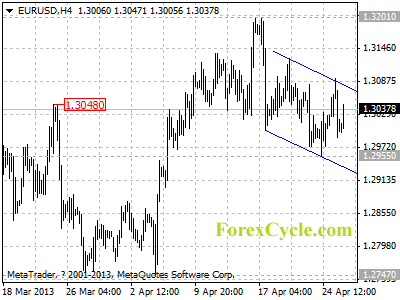
EURUSD stays within a downward price channel

EURUSD stays within a downward price channel on 4-hour chart, and remains in downtrend from 1.3201. Resistance is at the upper line of the channel, as long as the channel resistance holds, the downward movement could be expected to continue, and deeper decline to 1.2900 are is still possible. On the upside, a clear break above the channel resistance will suggest that the fall from 1.3201 has completed, then another rise towards 1.3500 could be seen.

eurusd

Forex Signals

The Market Rebounds, but We’re Still Not Selling…

By MoneyMorning.com.au

The S&P/ASX 200 closed on Wednesday within a sniff of the March high. It was just 44 points short.

Does that mean you should dump your stocks before the market falls again?

No. As we’ve noted over the past two months, this isn’t a market for selling stocks (with one exception that we’ll explain in a moment). Rather, it’s a market for buying stocks.

In other words, over the past month and for the rest of this year you should either be a buyer, or a non-buyer…

But not a seller. Here’s why…

The RBA figures that if it can use subtle messages to steer the market rather than actually cutting or raising interest rates, then it will leave itself with something in its arsenal if the economy really hits the skids.

Last week the market rallied on news of lower than expected inflation. Investors believed this could allow the Reserve Bank of Australia (RBA) to cut interest rates.

The RBA will be quite happy for the market to think that…for now anyway.

But with the market getting close to the recent high again, don’t be surprised if the RBA starts making noises in the opposite direction. The report from property spruikers RPData, claiming that house prices are set to double over the next 10 years could be just the excuse the RBA needs to talk up the prospects of a rate increase.

That would see the market slip again, towards the bottom of the trading range. At that point the RBA would allow talk of an interest rate cut to push the market back up again.

And so on, and so on. If you don’t think this is likely, just look at the RBA statements. And look at what central bankers have done overseas. It follows exactly the same pattern.

That’s why we don’t believe you should sell this market, with one exception…

If Your Strategy is Wrong, Change it and Move On

That one exception is where you’ve followed the wrong strategy. We admitted that with a small number of stocks in our monthly investment advisory, Australian Small-Cap Investigator.

We had made a few energy sector picks between 2011 and 2012. One to two years later and it had become apparent the strategy wasn’t working. As much as we’re excited about the prospects for the energy sector, the market isn’t. So three weeks ago we advised our subscribers to halve their exposure to energy by selling five of the stocks.

It’s hard to admit when you’re wrong. But sometimes you just have to bite the bullet and move on to better opportunities. We’ve done that. Besides, we still have some exposure to the energy sector, so if the market regains interest then our subscribers can reap the rewards.

But aside from that kind of portfolio restructuring, we still say this is a great time to own stocks. Do we think you should add to your share portfolio today?

It depends which stocks you’re talking about. Dividend stocks have rallied since the start of the week. We hope you already have a good exposure to dividend stocks. You should, because we’ve told you for more than two years to own them.

But buying them now as the market nears the March top may mean you’re not buying at the best value. And if we’re right about the RBA manipulating the market lower, you’ll get to buy them a bit cheaper in a few weeks anyway.

We can’t say the same for growth stocks. They keep getting a beating. And when many growth stocks are closer to their 52-week low than their 52-week high, it’s hard to say they’re expensive. In fact, growth stocks have taken a double beating. Not only did they miss out on the recent rally, but they’ve fallen the most as the market falls.

That doesn’t mean you can’t make money from growth stocks now. Our old pal, Murray Dawes reckons you can ‘slipstream’ profits from growth stocks in any market. Find out how here.

Just be aware that if you’re a longer term investor, the market still doesn’t favour growth stocks. That will change at some point. But right now, investors still want yield. There’s no telling when the demand for yield will end.

Don’t Miss the Growth Rally When it Comes

Our bet is that it could last until the end of this year. At that point the big institutional investors will get bored of 5% or 6% dividend returns. That’s when you’ll see a return to growth.

And that’s why we’re sticking by our medium term forecast of the Australian market hitting 7,000 points and the Dow Jones Industrial Average rising to 20,000 points by 2015. Dividend stocks can help the index get part of the way there, but not the whole way. In order for the market to get to that key level growth stocks will need to pull their weight.

While we don’t believe the growth rally will take off for another few months, we’re positioning Australian Small-Cap Investigator subscribers for it now. Because like the dividend stock rally, it’s likely the growth stock rally will happen in the blink of an eye.

So if you don’t prepare for it in advance, you’ll likely miss out on the best gains.

Cheers,
Kris

Join me on Google+

PS: Many investors lack two crucial things. They want to aim for the big prize without doing the hard yards first. That’s no way to build wealth. In today’s Money Morning Premium I explain the two key traits all investors need, and some simple advice on how to grow your nest-egg with minimal risk…click here to upgrade now.

From the Port Phillip Publishing Library

Special Report: TORRENT SIGNAL 3

Daily Reckoning: Lest We Forget

Money Morning: Is This the Last Hurrah for the Australian Dollar?

Pursuit of Happiness: Booze, Watches and Fancy Pens — the Alternative Retirement Plan

Australian Small-Cap Investigator:
How to Make Money From Small-Cap Stocks

After the Oil Pull Back, Now What?

By MoneyMorning.com.au

Precious metals, energy and commodities recently hit a rough patch.

But will these low ‘pullback’ prices last forever? Even in the face of what seems (to me) as an extreme wave of inflation rushing over us?

Today we’ll cover all the bases. Starting with crude oil

West Texas Intermediate (WTI) crude oil is in the low-US$90s per barrel, while the iconic Brent Crude price just over US$100. That’s low, by recent standards, for two reasons.

One reason is that global oil demand growth is moderate, due to the creeping worldwide lack of economic confidence. China has slowed. Japan is moribund. Europe is a mess. The North American economy is iffy, on the best of days.

This widespread lack of confidence may or may not morph into the next recession (pleasant thought, eh?). But the global economy is a big, arm-waving subject, and let’s not go there just now.

Another reason for declining oil prices is US fracking. Let’s discuss that. As I’ve written before, the fracking revolution has changed the rules of the global energy game. Every new barrel of ‘fracked’ US crude displaces a barrel of imported oil.

Even five years back, nobody really saw the ‘shale gale’ coming. Yes, a lot of people were leasing land and planning drilling programs. But the overall impact of widespread fracking was entirely speculative.

Certainly, at high political levels, US policymakers have been taken by surprise by the fracking revolution. Large, new supplies of affordable oil and gas were not part of the political script.

Overseas, the fracking effect has confounded many a foreign potentate who grew used to having his way with oil prices, via twisting a few valves. And as to the potentates? Well, screw ‘em. Let’s frack away!

In the US, the sweet spots are known. Leases are in place. Fracking tech is out there. The system for drilling multiple wells, staging logistics and completing the holes is quite developed. The barrels are coming — for the near and medium future, at least.

Large oil exporting countries — Saudi Arabia, Venezuela, Russia, etc. — have reason to sweat. Their traditional flow of petro-lucre is tightening, if not drying up as their own internal consumption rises.

That is, many big oil exporters are called ‘petro-states’ for a reason. They need ever higher oil prices, from net exports, to pay the national bills. Without higher and higher oil prices, they can’t balance accounts. Tough luck.

Meanwhile, lower oil prices are like a global tax cut. And if you’re an airline, railroad, shipping company, trucking company, farmer or fisherman — let alone running a mining operation — stable or declining energy prices means that a key part of your cost structure is moderating. Whew!

To be sure, I do NOT believe that oil prices will crash down into the $30s and $40s per barrel, like in late 2008 or early 2009. I’m not in that school of thought — unless we have another huge market and economic rout, again. In which case, all bets are off.

So what’s the ‘right’ price for oil? I’d say about where it is now. The recent price for oil is low enough to allow large energy-users run their businesses and still make money. Yet the energy price is high enough to encourage people to drill wells and produce more oil and gas. Win-win, all around.

Byron King
Contributing Writer, Money Morning

Join Money Morning on Google+

From the Archives…

Why Waste Your Time on Gold When You Can Invest in Dividend Stocks?
19-04-2013 – Kris Sayce

A Trader’s Eye View of Gold’s Frightening Collapse
18-04-2013 – Murray Dawes

Why You Should Buy ‘Dirty, Grimy’ Gold Stocks
17-04-2013 – Dr. Alex Cowie

Why this Historic Fall in the Gold Price Equates to a Historic Opportunity
16-04-2013 – Dr. Alex Cowie

Beware the ‘Safety Bubble’, But Don’t Sell Dividend Stocks Yet
15-04-2013 – Kris Sayce

Addictive and Irreversible: Destructive Policies Worldwide

By MoneyMorning.com.au

After months of being under central bank-administered anaesthesia, many investors are pondering outside the repeated mantra of, ‘Money printing equals higher stocks.’

The question they’re asking now? How, exactly, swapping overvalued shares back and forth will create wealth for everybody — including those unfortunate enough to be buying late?

Masking symptoms of troubled economies with oceans of fresh money is not a good prescription for ‘wealth creation’.

But the Federal Reserve and other central banks have gone down that road, and there is no going back, even after the uglier symptoms of inflation emerge.

In the wake of the chaotic break in gold futures market, all gold mining stocks have been smashed. After two dreadful years, it looked like a final, cathartic purge. I haven’t seen sentiment and price moves like this since the depths of the 2008 crash.

Let’s examine the question of whether or not the gold bull market is over…

After spending much time re-examining gold’s fundamental drivers, my own assumptions and the views of a few dozen top analysts, I’ve come to the following conclusion: Ignore Wall Street’s clueless, half-baked opinions of the gold futures market.

Most of the banks’ opinions, including Goldman Sachs’ famous ‘short gold’ report, are based on an extremely speculative forecast: that the global economy can thrive after central banks stop printing. This cannot happen.

The only drivers of the US economy in recent years — rebounded stocks, housing and autos — owe their strength almost entirely to the Fed’s policy. Take away the policy, and all three would collapse. So the Fed simply cannot remove the policy. If it attempts to remove easy money, and the economy crashes, it will reinstate printing in a heartbeat.
 
The fundamental facts have not changed, so the underpinnings of gold’s bull market are intact.

The Number You Need to Know

The number you need to remember is zero.

Zero is where central banks will peg interest rates for several years into the future. Zero is also the number of times in recorded history that the “QE/ZIRP” policies in place worldwide have boosted any economy to ‘escape velocity’ (as economists say).

Such radical policies always result in destruction of the currency being printed. In other words, stagflation — not sustained economic recovery. Japan will discover that history rhymes once its financial market sugar high wears off. It offers a preview for the US.

As inflation expectations rise — the great hope of Bank of Japan governor Kuroda — Japanese investors will discover that money printing schemes are addictive, with no practical exit.

Here’s why: Once consumers buy tomorrow’s products today (ahead of expected price rises), what will they buy when tomorrow arrives? When tomorrow arrives, the howls for another round of printing will be louder than ever! We keep bringing up this question because thus far, there is no indication that any policymakers know (or admit) that Japan’s new policy is addictive and irreversible.

The real world isn’t nearly so simple and easily modelled as the professors running central banks believe. Trying to ‘boost inflation expectations’ will only trap central banks into permanent cycles of easing — both in the US and Japan. And the bigger government debts get, the harder it will be for central banks to tighten policy.

Raising interest rates a few years from now would result in interest expenses consuming an unacceptable amount of government tax revenue; so higher short-term interest rates — which would really put the brakes on gold prices — will not happen.

Finally, zero happens to be the number of fiat currencies in history that held their value.
The [US] dollar’s value isn’t going to zero anytime soon, but debasement continues, and stopping the growth federal entitlement spending — the real driver of federal budget deficits — is politically impossible.

The guardians of the paper dollar’s sanctity, rather than preserving its value with positive real interest rates and balanced budgets, are aggressively pushing it toward its ultimate destination: zero.

I’m waiting to see a strong rebuttal from the defenders of the paper money system. Thus far, I haven’t seen any cases for a strong dollar — a case that proves central banks have not trapped themselves into permanent cycles of easy money.

The gold bull market lives on…

Dan Amoss
Contributing Writer, Money Morning

Join Money Morning on Google+

From the Archives…

Why Waste Your Time on Gold When You Can Invest in Dividend Stocks?
19-04-2013 – Kris Sayce

A Trader’s Eye View of Gold’s Frightening Collapse
18-04-2013 – Murray Dawes

Why You Should Buy ‘Dirty, Grimy’ Gold Stocks
17-04-2013 – Dr. Alex Cowie

Why this Historic Fall in the Gold Price Equates to a Historic Opportunity
16-04-2013 – Dr. Alex Cowie

Beware the ‘Safety Bubble’, But Don’t Sell Dividend Stocks Yet
15-04-2013 – Kris Sayce

About that Gold Price Crash..

By MoneyMorning.com.au

‘Gold Plunges as Fears of Inflation Fade,’ noted the Wall Street Journal last week. And yes, the gold-silver decline was nasty, taking down nominal precious metal prices, as well as the share price for many a mining firm, large, medium and small.
 

So, why are ‘Fears of Inflation’ fading? It helps that oil prices are moderating and likely will stay moderate for a time. Control over energy costs is good for many a business. No complaints from me, on that point.

Then again, for all the moderation in energy prices, we still see wild immoderation — call it utter profligacy — in government spending across the globe. That’s raw inflation, being cooked into the books.

Governments everywhere — certainly in the US — spend more than they take in, and run up future obligations that they’ll never be able to pay, no matter how many Cyprus-like haircuts governments give to savers and investors.

So can someone explain to me why the fading fear of inflation? I don’t get that. Indeed, as governments spend, spend and spend some more, many investors still buy all manner of government bonds — which as one wag notes, are the latest form of ‘return-free risk’.

Really, when the government can’t repay you, it won’t repay you. If governments can nick your savings accounts, what else can they do to ‘their’ bonds that you were kind enough to buy? What did P.T. Barnum say? ‘There’s a sucker born every minute.

My point is: why are currencies — dollars, pounds, yen, euros, etc. — not still at risk for inflation? Why are people selling gold and silver down? Well…are people really doing that? Or is it paper gold and paper silver that sold down? Because from what I hear out in the trading pits, the ‘physical’ metal is still scarce, especially in large weights.

The Junior Resource Space

The overall downward situation, with gold and silver, reminds me of what Rick Rule told me in an e-mail, not long ago. We’re in a ‘capitulation’ phase of the market. That, and he advised, ‘Many of your readers will hate you.’

Well, I’m truly sorry that many junior mining plays are ‘down’ in share price, in this overall tough market. Small mining companies carry a boatload of risk — that much you should know. Yes, you can make ‘big’ money with some of those plays, under the right circumstances. But they’re NOT the kind of things on which to bank your retirement wad, if you know what I mean.

I hate vicious, stock market roller-coaster rides as much as anybody, but in my view there’s something there and I’m willing to be patient. Why be patient? Why not take the money off the table and sit on the sidelines for a spell?

Looking Ahead…to the Next Phase

Looking around, the global economy is pouring more metal than the mines and pits can deliver, certainly into the future. Old mines are declining in grade, such as we’ve seen with the recent knocks against copper mining in Chile, for example. Most new mines are horrendously expensive, such that even big guys are cutting back, like BHP Billiton.

Meanwhile, new and significant discoveries are few and far between.

In other words, the ‘long-term’ investment paradigm for exploration and mining is still valid. We have to navigate the shoals, and live through the up and down metal and share markets, which are a disaster, and which may be so for a while.

Through it all, many companies have consistently, as the saying goes, ‘over-promised and under-delivered.’

So what lies ahead? Darwinian selection.

The slow and stupid management teams will fall away. The better thinkers — the true ‘warfighters’ — will come to the forefront, and realize that Big Mining Company XYZ cannot stay in business, let alone get its share price up, by merely laying off secretaries, cutting maintenance on equipment, scaling back exploration and somehow digging ‘deeper’.

No, the intermediate and large guys will have to — perish the thought — go out and BUY something that’s worth a crap. They’ll have to find strong plays, with solid resource numbers, in predictable and safe jurisdictions, with the prospect (so to speak) of turning brown-stained dirt into an economic ore body and mine — with hallmarked ingots coming out the back end.

When that time comes, I have a few ideas if anyone is interested.

Byron King
Contributing Writer, Money Morning

Join Money Morning on Google+

From the Archives…

Why Waste Your Time on Gold When You Can Invest in Dividend Stocks?
19-04-2013 – Kris Sayce

A Trader’s Eye View of Gold’s Frightening Collapse
18-04-2013 – Murray Dawes

Why You Should Buy ‘Dirty, Grimy’ Gold Stocks
17-04-2013 – Dr. Alex Cowie

Why this Historic Fall in the Gold Price Equates to a Historic Opportunity
16-04-2013 – Dr. Alex Cowie

Beware the ‘Safety Bubble’, But Don’t Sell Dividend Stocks Yet
15-04-2013 – Kris Sayce

Central Bank News Link List – Apr 25, 2013: ECB seen cutting rates, even if it won’t boost economy: Reuters poll

By www.CentralBankNews.info

Here’s today’s Central Bank News link list, click through if you missed the previous link list. The list comprises news about central banks that is not covered by Central Bank News. The list is updated during the day with the latest developments so readers don’t miss any important news.