Central Bank News Link List – Apr 29, 2013: Asian officials must respond early to overheating risk, IMF says

By www.CentralBankNews.info Here’s today’s Central Bank News link list, click through if you missed the previous link list. The list comprises news about central banks that is not covered by Central Bank News. The list is updated during the day with the latest developments so readers don’t miss any important news.

Gold “Getting Key Support” from Retail Demand, But Investor Confidence “Has Been Dealt Severe Blow”

London Gold Market Report
from Ben Traynor
BullionVault
Monday 29 April 2013, 07:45 EST

GOLD started the week by edging higher Monday, trading around $1475 per ounce by lunchtime in London, as stocks also gained, US Treasuries were broadly flat and the Euro edged higher against the Dollar following news that Italy’s borrowing costs have fallen.

Strong demand for physical gold from private households meantime continues to cause bottlenecks and price premiums.

“The increased physical demand seen since the price correction supports the metal and affects the trading premiums,” says a note from German refining group Heraeus.

Gold traders in Dubai meantime continue to report premiums over the spot gold price of up to $10 an ounce for physical bullion.

“Retail demand…will be the key support for gold and is the main reason we expect prices to stabilize and move slowly higher,” says a note from HSBC, which this morning cut its 2013 average gold price forecast to $1542 an ounce, down from $1700 an ounce, while cutting its silver forecast from $33 an ounce to $26 an ounce.

“The capitulation in the gold price dealt a severe blow to investor confidence, which may take many months restore. Unless significant institutional demand returns to the market, we believe prices will struggle to get over the top end of our range of $1625.”

The world’s biggest gold exchange traded fund SPDR Gold Trust (ticker: GLD) saw a further 7.2 tonnes of outflows Friday, taking the total holding of bullion to back its shares to 1083.1 tonnes.

Since the starts of the year the GLD’s holdings have shrunk by nearly a fifth.

“In the past two weeks, as global economic data have generally underwhelmed, the ETF selling actually increased in velocity,” says a note from Nomura.

“This does not bode well for the remainder of 2013 for the ETF demand category…the recent downward move in inflation expectations and the lack of price reaction to both the Cypriot bailout and the changes in the Japanese monetary base have put gold’s investment rationale somewhat under pressure.”

On the New York Comex meantime, the so-called speculative net long position of gold futures and options traders fell to its lowest level since November 2008 in the week ended last Tuesday, weekly data published by the Commodity Futures Trading Commission show.

The spec net long – calculated as the difference between the number of ‘bullish’ long and ‘bearish’ short contracts held by traders classified by the CFTC as noncommercial – fell by 21% to the equivalent of 260.3 tonnes.

“The preceding week’s fall in net speculative length appeared relatively mild, so perhaps this past week’s decline was a catch-up,” says Standard Bank commodities strategist Marc Ground.

“Clearly, the futures market was not convinced that gold could sustain its upward momentum.”

The reported size of noncommercial futures and options positioning rose above 90,000 contracts for the first time since mid-February, only the second time this has happened since at least 2004.

Looking just at the CFTC’s Managed Money category, which includes players such as hedge funds, the Tuesday- reported number of short futures contracts in 2013 has averaged more than 50,000.

Between June 2006 and the end of 2012 the average was less than 16000 contracts.

“The key question in the near term is whether retail and jewelry demand can continue to counter [exchange traded fund] outflows and the rise in [Comex] gross shorts,” says a note from Barclays.

Silver meantime rose above $23.30 an ounce while the picture was mixed for other industrial commodities, with copper gaining but Brent crude oil down.

“We feel we are due for some sideways consolidation,” says the latest technical analysis note from bullion bank Scotia Mocatta.

“Resistance is at $24.25…[while] support is at the recent low of $22.07. If we breach support, the risk is an eventual target of $17.73, a full retracement back to August 2010.”

Italy saw its borrowing costs fall to their lowest level since October 2010 at an auction of 5 and 10-Year bonds this morning. The yield on 5-Year debt fell to 2.84%, down from 3.65% at a similar auction last month, while 10-Year yields fell from 4.66% to 3.94%.

Since last month, Italy’s parliament has re-elected Giorgio Napolitano as president, who in turn has nominated Enrico Letta as prime minister. Letta reached agreement on forming a government over the weekend, following a two-month deadlock after February’s inconclusive general election.

Any decision by Cyprus meantime to sell some of its gold bullion reserve would not necessarily be “the thin end of the wedge” that led to gold sales by other Euro members, according to  Rhona O’Connell, senior analyst at metals consultancy Thomson Reuters GFMS.

Ben Traynor

BullionVault

Gold value calculator   |   Buy gold online at live prices


Editor of Gold News, the analysis and investment research site from world-leading gold ownership service BullionVault, Ben Traynor was formerly editor of the Fleet Street Letter, the UK’s longest-running investment letter. A Cambridge economics graduate, he is a professional writer and editor with a specialist interest in monetary economics. Ben can be found on Google+


(c) BullionVault 2013


Please Note: This article is to inform your thinking, not lead it. Only you can decide the best place for your money, and any decision you make will put your money at risk. Information or data included here may have already been overtaken by events – and must be verified elsewhere – should you choose to act on it.


The Senior Strategist: Potential market moving events this week

This week will be big for macro with focus on especiallly the US jobrapport, ECB and Fed meeting. The Senior Strategist Ib Fredslund Madsen believes these many important events might turn the market around.

The big issue is still the nervousness about growth. But we saw a positive performances for equities last week.

This week we are going into the month of May. Normally you can talk about the saying “sell in May and go away” – but not this time.

Legal information

Video by en.jyskebank.tv


How the Rich make Money from the Stock Market

By MoneyMorning.com.au

Here’s something that won’t surprise you.

It’s expensive to live in Australia.

The median house price in Australia’s eight capital cities is $465,000. For areas outside the capitals it’s $328,000.

But it’s not just housing that’s burning a hole in the average Aussie’s pocket. Everyday purchases are pricey too.

So pricey that the cost of living in Australia is higher than in New Zealand, Canada, France, Japan, the UK, the US and Hong Kong…

According to a report in the Age over the weekend:

This week, a Deutsche Bank report illustrated what many suspect – whether catching public transport, ordering a beer or buying medicine to battle a cold, Australians pay among the highest prices on the planet.

The report, which tracks the prices of an array of goods and services in cities and countries around the world, found that Melburnians and Sydneysiders pay almost 40 per cent more for movie tickets than Manhattanites and Parisians, for example, with cinephiles in Wellington and London paying only slightly more.

High prices make it tough for everyone. And contrary to belief, it’s not just those on a fixed income. It’s tough on wage earners too.

Remember, even if you get a pay rise, you only get it once a year. And that — if you’re lucky — will only cover price increases for the previous year. In other words, with price inflation, you’re always playing catch-up.

That’s why it pays to think about your future income streams as soon as you can. Because like it or not, with the way the economy is going, prices aren’t about to come down anytime soon…

The Rich are Getting Richer

In fact, it’s likely to get worse as monetary inflation favours those who get the newly printed money first (governments and banks), and penalises those who get the newly printed money last — or not at all.

And think about it. The Reserve Bank of Australia hasn’t even started the money-printing experiment they’re trying overseas.

It’s already playing out in the UK and US. There money printing has been in full flow for four years. As we’ve explained before, the returns on a UK annuity today are less than half of what they were 20 years ago.

It means investors get a lower income with which to pay for higher priced goods. It’s a double whammy.

How did that happen? Simple, it’s a direct result of the Bank of England’s low interest rate policy.

Meanwhile in the US, as Bloomberg News reports:

Wealthy households boosted their net worth by 21.2 percent in the aftermath of the recession, according to the study released today by the Pew Research Center. The rest of America lost 4.9 percent of household wealth from 2009 to 2011.

Pew attributed the disparity to gains during that period in the stock and bond markets, benefiting affluent households, while the housing market’s decline hit others harder. The report underscores the nation’s growing income inequality, with the top 13 percent of households recovering their losses from the 18-month recession that ended in June 2009, and the rest of the country continuing to hemorrhage wealth.

We won’t waste your time debating whether the US recession really ended in 2009. My colleagues will tell you the US is really still in a recession and probably in a depression.

But that doesn’t really interest us here. We’re more interested in the most important message from the Pew Research study: ‘Pew attributed the disparity to gains during that period in the stock and bond markets, benefiting affluent households…

It’s a simple message: do what the rich do. And what do the rich do? Easy, they ignore the irrelevant, and instead use the market to make as much money as they can…

The Stock Market: Still the Best Place to Build Wealth

Over the past four-and-a-half years we’ve encouraged you to invest in dividend stocks, small-cap stocks, and gold. We knew (and still know) the financial system is rigged. But we also knew that refusing to take part in it was (and still is) the worst thing an investor can do.

Our old pal, Nick Hubble, takes the same stand in The Money for Life Letter. While many investors put all their money into gold and silver as they thought the financial system would collapse, Nick told his subscribers to invest in a select few ‘cash out’ companies.

These are companies Nick believes are fundamentally sound and will provide investors with a reliable income stream over many years.

This brings us back to our point about the rich. This is how the world’s wealthiest people make money. Granted, they aren’t just using the stock market. They’re doing it through private businesses, positive cash flow property, and private equity firms.

For most investors (especially new investors), the simplest way to follow this approach is through the stock market. That’s because you can buy into a profitable business with as little as $500. Try offering a businessman or woman $500 to buy a stake in their business; they’ll tell you where to go.

That’s why the stock market is the best place to build wealth. You’re investing in businesses. And when it comes down to it, that’s exactly what the world’s richest people do. And they do it regardless of what’s going on in the broader economy.

What’s happening in the US and UK economies right now will inevitably hit the Aussie economy. So if you think things are expensive now, if you aren’t investing things will become even worse.

But if you’ve planned ahead and you’re investing in good businesses that can pay you a stable and reliable cash flow, it can help you keep one step ahead of the game.

Cheers,
Kris

Join me on Google+

PS: Taking cash from a profitable company is a great way to earn passive income. But believe it or not, it’s not always the best approach for every investor. In today’s Money Morning Premium I explain how you can boost your share returns by telling dividend paying companies to keep their cash…click here to upgrade now.

From the Port Phillip Publishing Library

Special Report: TORRENT SIGNAL 3

Daily Reckoning: Is this: Inflation or Deflation?

Money Morning: Money Weekend’s FutureWatch

Pursuit of Happiness: Booze, Watches and Fancy Pens — the Alternative Retirement Plan

Australian Small-Cap Investigator:
How to Make Money From Small-Cap Stocks

There’s a New Energy Crisis Brewing in the Middle East

By MoneyMorning.com.au

Don’t look now, but there are some problems developing in the global energy network. The US may be basking in the prospect of ample unconventional oil and gas substantially transforming the country from an importer to an exporter. But elsewhere, constrictions and outright shortages are developing more quickly than anticipated.

It’s hardly reassuring that the epicentre of all this is the Middle East…

Pakistan on the Energy Brink

The primary problem is hardly new. Actually, calling it an ‘old’ problem is more accurate because the culprit is a collapsing network of delivery and storage that has been deteriorating for decades.

Unfortunately, this is hitting hardest those areas already beset by broad, accelerating economic shortfalls. That they also happen to be areas of significant unrest hardly improves the situation.

The latest is Pakistan. There a combination of lower-than-expected water availability and a government powerless to provide the diesel fuel essential for the planting season means a population already on the brink is staring at food shortages.

The picture is very grim.

The main difficulty here remains the energy crisis that has locked this country in a downward spiral. Pakistan has some of the worst energy prospects on the globe, accentuated by low levels of domestic production and alternative importing possibilities charged with politics.

Take an essential natural gas pipeline from Iran, for example. The transfer of gas across the common border between the two countries would be an immediate relief for this beleaguered nation. But that project is in no-man’s land.

The Western pressure against Tehran to end its nuclear program prevents any new projects because the sanctions are targeting Iranian hydrocarbons. Islamabad has attempted to kick-start a liquefied natural gas (LNG) import plan to offset the political impasse.

Unfortunately, that alternative involves a considerable cost that the government cannot afford. It has started a domestic war among potential corporate participants, and is likely to take too long to develop.

As an aging electrical grid begins to break down, rolling blackouts have become a daily routine. Major cities are often able to provide less than eight hours of reliable power. That, in turn, is wreaking havoc on industrial production, food distribution, local revenue, and the manufacture of goods necessary for money-making exports.

In addition, the increasing energy plight is undermining the thin veneer of political stability. Already, the central government has lost control over wide expanses of territory inside the country now effectively controlled by local warlords and terrorist groups bent on toppling Islamabad’s ability to govern.

The situation is becoming worse. Opposition politicians are beginning to demand government action, associating themselves for the first time more directly with demands made by more radical groups. The situation is deteriorating.

The collapse of an overburdened energy delivery network is now becoming a likely cause of a domestic insurrection. And as the energy picture worsens, so does employment prospects in a country where the median age is 21.5 years. The rising number of unemployed youth in this region is a fertile breeding ground for terrorism.

The Potential for a Middle East Conflict

However, Pakistan is hardly the only nation in this unsettled region experiencing an energy crisis. Its neighbour, and frequent adversary, India has similar problems. There, one of the leading engines in the international development drive is experiencing its own energy crunch.

Once again the source is an inability to procure and deliver adequate energy. India is experiencing a disturbing rise in brownouts and blackouts, while its requirements for imported energy continue to grow. Its population is 6.5 times the size of Pakistan, making the demand even stronger.  

India is also feeling the pressure from Iranian sanctions. The country is the second-leading importer of Iranian crude (after China). New Delhi has received a reprieve from Washington — the US has granted it a temporary exemption from the sanction penalties.

Saudi exports have helped some, but India is again paying an ‘Asian premium’ for that oil, a price higher than the same oil bound for other places like Europe. And with its refineries built to operate on Iranian-grade crude, even finding continuing (not to mention affordable) alternatives will still create problems.

Elsewhere, Egypt is facing an absolute energy shutdown. As the problems in Cairo streets heat up again, government officials now speak openly of massive power deficiencies. One suggested earlier this month that the delivery infrastructure could shut down altogether.

This week in Jordan, blackouts have hit, with the prospect of more frequent shortfalls coming. Jordan has been a bastion of relative stability during the Arab Spring, but there are signs of unrest developing there as well.

Then there is Turkey. What happens in this country may well end up being the lynchpin for the entire Middle East. Turkey’s energy needs are the fastest growing in the world, with prospects forming to transform the country into the de facto regional leader as internal disorder blunts the influence of Egypt and Syria.

Turkey is also poised to be the primary new throughput nation for gas and oil coming into Europe from rising production in the Caspian basin. The gas future looks very strong with competing pipeline projects contesting to deliver energy west by traversing the country.

Increasing oil exports, on the other hand, are limited to what additional volume can be moved safely through the Bosporus and the Dardanelles — the Turkish Straits. This is a major chokepoint in international oil trade and an accident would subject large and congested populations to an outright disaster.               

Yet these days the government in Ankara is becoming more concerned about its ability to feed the growing domestic demand requirements. Turkey’s internal stability will depend on solving its own energy distribution situation.

As the picture darkens, a region thought for some time to be ripe for competition over energy production is morphing into one where the next wave of conflict may well result from the lack of energy availability.

That becomes far more dangerous for everybody.

Dr. Kent Moors
Contributing Writer, Money Morning 

Join Money Morning on Google+

From the Archives…

The Market Rebounds, but We’re Still Not Selling…
26-04-2013 – Kris Sayce

Is This the Last Hurrah for the Australian Dollar?
25-04-2013 – Murray Dawes

Here’s Proof the Silver Bullion Market is Alive and Well
24-04-2013 – Dr. Alex Cowie

Stand By for the Recession Rally in Resource Stocks: Take Two
23-04-2013 – Dr. Alex Cowie

Blueseed: The New Pirates of Silicon Valley

By MoneyMorning.com.au

To invest in the best batches of tech start-ups, there’s naturally no better place to look in the USA other than Silicon Valley.

It’s the technology nerve centre where ideas, capital and culture find chemistry and generate more venture capital and filed patents than anywhere else in the United States.

Those opportunities can be difficult to invest in, and I’m talking about before their inflated IPO prices. And the best start-ups that don’t make it to IPO status are intercepted by quick and quiet acquisitions. Google, for example, since 2009 has been acquiring one company per week.

But two extraordinary entrepreneurs have founded a company with a novel solution.

It’s called Blueseed.

It was inspired by those who’ve experienced even more difficulty investing and/or founding start-ups in Silicon Valley. That is, it was inspired by immigrants. Why?

Blueseed, A Long Story Short

There are simply no US visas available for entrepreneurs, the alternatives are inadequate, and progress on legislation like the Visa Startup Act isn’t happening. But the demand is there.

According to Time, ‘tech executives often talk about a shortage of highly-skilled workers and the need to make it easier for immigrants with such skills to come to the US.

Mid-way through 2012, the cap on H-1B visas — which allow educated foreign workers to get a job in the US — had been reached. This year is so far following suit.

But back to the solution!

Blueseed’s idea is this…

You may have heard of sea steading, the concept of creating permanent dwellings at sea outside territory claimed by the government of any standing nation.

Well, Blueseed is the first commercial sea steading venture.

Strategically positioned 12 miles off the California coast, it would bring in the world’s top 1000 entrepreneurs closer to Silicon Valley without being subject to the same immigration laws.

The plan is to remodel a cruise ship or barge, equipped with all the high-tech amenities expected of a start-up incubator. Internet connectivity would be provided via submarine communications cable, a laser link, point-to-point microwave link, or a mesh network of wireless routers placed on buoys.

The Idea May Sound Crazy…

But giant cruise liners and offshore oil platforms already prove such maritime structures can be orchestrated. And while true sea steads may still be a distant dream, the seasteading movement is producing some novel ideas for ocean-based businesses that could act as stepping stones towards their ultimate goal…cities in the sea around the world.

So far, over 700 start-ups expressed interest in working from the boat, which will also offer housing and recreational services. They now have more than 1100 individuals from 336 companies and 64 countries who have officially applied, with several committed legal and venture capital partners.

As far as we can tell, as long as all the productive work is done on the ship and entrepreneurs are only coming onto the mainland for meetings and such, it’s perfectly legal.

But of course, they plan on using this seed investment to work out all of the nitty-gritty policy details needed to be tackled before leasing or buying a ship. Once they get to that stage, they will seek a much larger round of financing. The team continues to raise capital, build logistics and infrastructure and waitlist a deluge of interested start-ups.

Target date for the Blueseed launch is the second quarter of 2014, provided that $18M more is raised. Given that Blueseed plans to have accelerator programs that take equity in start-ups, which have the option of then going back to Silicon Valley to set up camp…now may be the time to invest in Blueseed.

Josh Grasmick
Contributing Editor, Money Morning

Join Money Morning on Google+

From the Archives…

The Market Rebounds, but We’re Still Not Selling…
26-04-2013 – Kris Sayce

Is This the Last Hurrah for the Australian Dollar?
25-04-2013 – Murray Dawes

Here’s Proof the Silver Bullion Market is Alive and Well
24-04-2013 – Dr. Alex Cowie

Stand By for the Recession Rally in Resource Stocks: Take Two
23-04-2013 – Dr. Alex Cowie

A New Take on Hard Asset Investing
22-04-2013 – Kris Sayce

EURUSD is facing channel resistance

EURUSD is facing the resistance of the upper line of the price channel on 4-hour chart, a clear break above the channel resistance will indicate that the fall from 1.3201 had completed at 1.2955 already, then the following upward movement could bring price to 1.3500 area. However, as long as the channel resistance holds, the downtrend from 1.3201 could be expected to resume, and one more fall to 1.2900 area to complete the downward movement is still possible.

eurusd

Daily Forex Forecast

Large Speculative Traders decreased US Dollar Long Positions last week

Weekly Commitment of Traders Data by CFTC shows which way Large Traders and Hedge Funds were leaning the previous week in the Futures Market

By CountingPips.com


cot-values


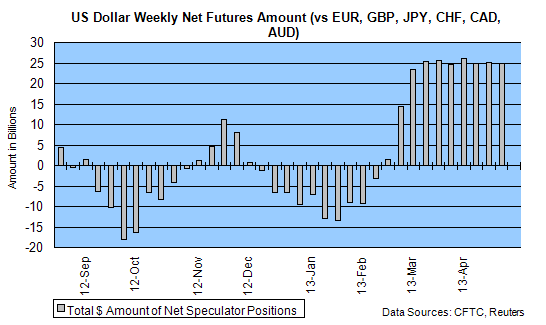
The latest weekly Commitments of Traders (COT) report, released on Friday by the Commodity Futures Trading Commission (CFTC), showed that large futures traders trimmed their total bullish bets of the US dollar last week against the other major foreign currencies after slightly increasing their bets the previous week. Total speculator positions have continued to show little movement in the past few months, as can be seen from the chart above.

Non-commercial large futures traders, including hedge funds and large International Monetary Market speculators, registered an overall US dollar long position of $24.94 billion as of Tuesday April 23rd. This was a small decline from the total long position of $25.18 billion on April 16th, according to position calculations by Reuters (US dollar positions against the total positions of eurofx, British pound, Japanese yen, Australian dollar, Canadian dollar and the Swiss franc).


Individual Currencies Large Speculators Positions in Futures:

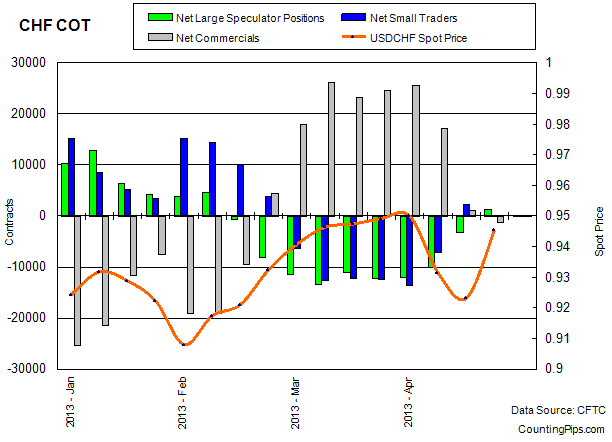
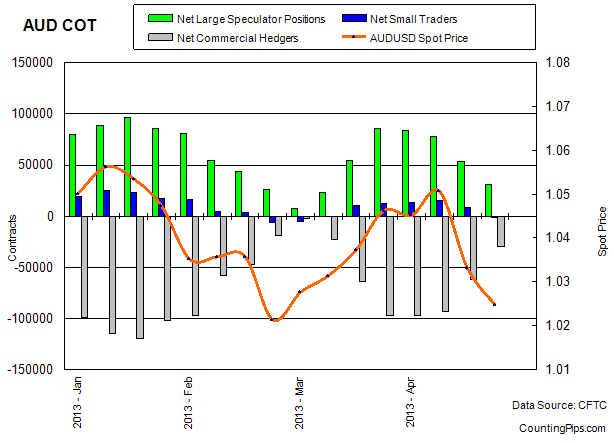
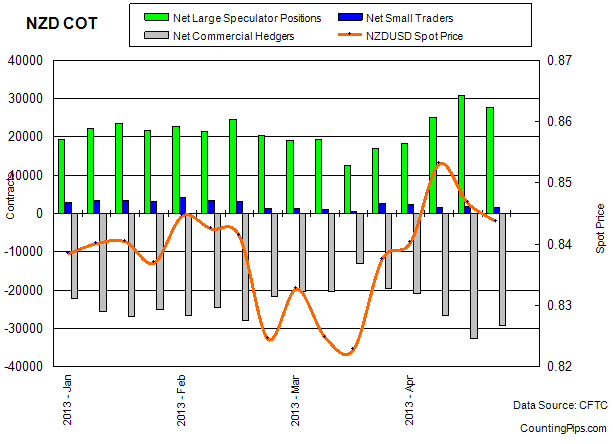
The individual currency contracts quoted directly against the US dollar last week saw increases for the Japanese yen, British pound sterling, Swiss franc and the Canadian dollar while the euro, Australian dollar, Mexican peso and the New Zealand dollar all had a declining number of net contracts for the week.


Individual Currency Charts: (Please Click on Chart to Enlarge)


EuroFX: Weekly change of -4,511

EUR


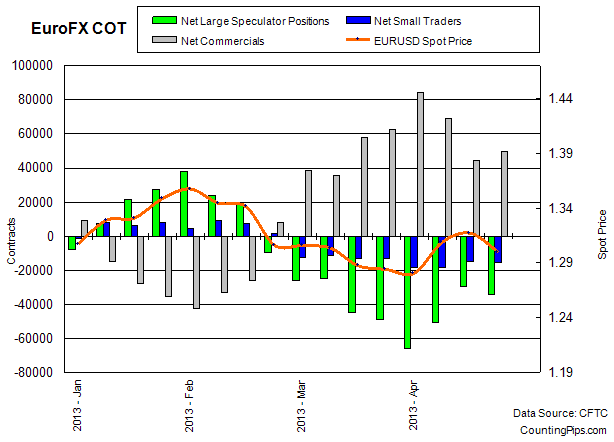
EuroFX: Large trader positions for the euro decreased last week after rising for two consecutive weeks. Euro contracts fell to a total net position of -34,275 contracts in the data reported for April 23rd following the previous week’s total of -29,764 net contracts on April 16th.


Last Five Weeks of Large Trader Positions: EURO

DateLg Trader NetChange
03/26/2013-49095-4211
04/02/2013-65701-16606
04/09/2013-50858+14843
04/16/2013-29764+21094
04/23/2013-34275-4511


British Pound Sterling: Weekly change of +1,863

GBP


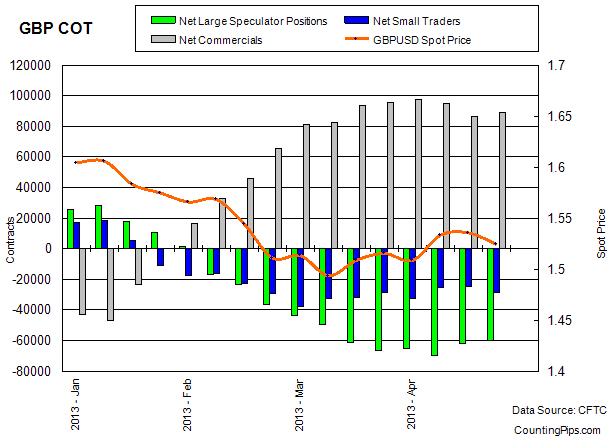
GBP: British pound spec positions improved last week to increase for a second consecutive week. British pound speculative positions rose last week to a total of -60,112 net contracts on April 23rd following a total of -61,975 net contracts reported for April 16th.


Last Five Weeks of Large Trader Positions: Pound Sterling

dateLg Trader NetChange Weekly
03/26/2013-66555-5075
04/02/2013-65020+1535
04/09/2013-69969-4949
04/16/2013-61975+7994
04/23/2013-60112+1863

Japanese Yen: Weekly change of +13,681

JPY


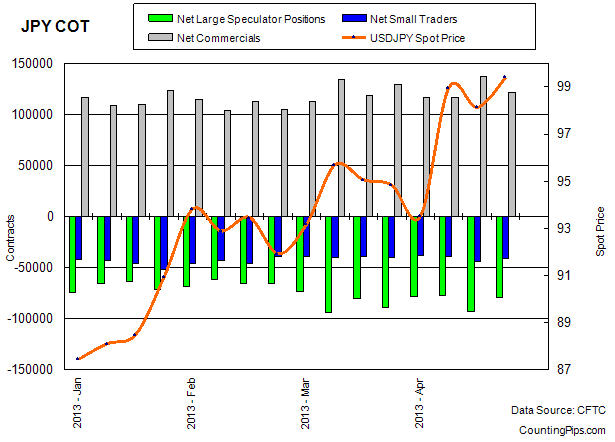
JPY: Japanese yen net speculative contracts rose last week after falling to the lowest level since March 12th the previous week. Japanese yen positions improved to a total of -79,730 net contracts on April 23rd following a total of -93,411 net short contracts on April 16th.


Last Five Weeks of Large Trader Positions: Yen

dateLg Trader NetChange Weekly
03/26/2013-89149-9156
04/02/2013-78171+10978
04/09/2013-77697+474
04/16/2013-93411-15714
04/23/2013-79730+13681

Swiss Franc: Weekly change of +4,432

CHF


CHF: Swiss franc speculator positions improved last week for a fourth consecutive week and to the best position since February 12th. Net positions for the Swiss currency futures improved to a total of +1,179  contracts on April 23rd following a total of -3,253 net contracts reported for April 16th.


Last Five Weeks of Large Trader Positions: Franc

dateLg Trader NetChange Weekly
03/26/2013-12198-1202
04/02/2013-12015+183
04/09/2013-10014+2001
04/16/2013-3253+6761
04/23/20131179+4432

Canadian Dollar: Weekly change of +4,234

CAD

CAD: Canadian dollar positions improved slightly last week after falling for three straight weeks and to a new low level in 2013. Canadian dollar positions edged higher to a total of -71,679 contracts as of April 23rd following a total of -75,913 net contracts that were reported for April 16th.


Last Five Weeks of Large Trader Positions: CAD

dateLg Trader NetChange Weekly
03/26/2013-62645+2686
04/02/2013-64544-1899
04/09/2013-71133-6589
04/16/2013-75913-4780
04/23/2013-71679+4234

Australian Dollar: Weekly change of -21,918

AUD


AUD: The Australian dollar large spec positions declined last week for a fourth consecutive week and to the lowest level since March 12th. Aussie speculative futures positions fell to a total net amount of +31,257 contracts on April 23rd after totaling +53,175 net contracts as of April 16th.


Last Five Weeks of Large Trader Positions: AUD

dateLg Trader NetChange Weekly
03/26/201385515+31460
04/02/201383971-1544
04/09/201377879-6092
04/16/201353175-24704
04/23/201331257-21918

New Zealand Dollar: Weekly change of -3103

NZD


NZD: New Zealand dollar speculator positions declined last week after advancing for the previous four weeks and to a new 2013 high level. NZD contracts fell to a total of +27,705 net long contracts as of April 23rd following a total of +30,808 net long contracts on April 16th.


Last Five Weeks of Large Trader Positions: NZD

dateLg Trader NetChange Weekly
03/26/201316916+4439
04/02/201318387+1471
04/09/201325150+6763
04/16/201330808+5658
04/23/201327705-3103

Mexican Peso: Weekly change of -4377

MXN


MXN:Mexican peso speculative contracts edged lower last week after rising the previous week. Peso positions fell to a total of +146,911 net speculative positions as of April 23rd following a total of +151,288 contracts that were reported for April 16th.


Last Five Weeks of Euro Fx Large Trader Positions: MXN

dateLg Trader NetChange Weekly
03/26/2013128162+18786
04/02/2013142755+14593
04/09/2013142542-213
04/16/2013151288+8746
04/23/2013146911-4377


The Commitment of Traders report is published every Friday by the Commodity Futures Trading Commission (CFTC) and shows futures positions data that was reported as of the previous Tuesday (3 days behind).

Each currency contract is a quote for that currency directly against the U.S. dollar, a net short amount of contracts means that more speculators are betting that currency to fall against the dollar and a net long position expect that currency to rise versus the dollar.

(The graphs overlay the forex spot closing price of each Tuesday when COT trader positions are reported for each corresponding spot currency pair.)

See more information and explanation on the weekly COT report from the CFTC website.


Article by CountingPips.comForex News & Market Analysis


Monetary Policy Week in Review – Apr 27, 2013: One central bank cuts, pressure grows on Europe’s politicians

By www.CentralBankNews.info
    Last week nine central banks took policy decisions, with Hungary continuing its rate-cutting spree and the other eight banks (Namibia, New Zealand, Philippines, Fiji, Japan, Mexico, Colombia and Trinidad & Tobago) keeping rates unchanged as pressure mounted on euro zone policy makers to get serious about reforms and speed up growth.
    A quiet exasperation over the lack of action by Europe’s policy makers turned into more forceful criticism during the annual meeting of the International Monetary Fund in Washington D.C. with signs that the dogged belief in austerity as a growth strategy is starting to break down.
    The other theme dominating central banking last week was the continuing fallout from Japan’s aggressive policy easing, which has lead to a weaker yen and upward pressure on other currencies as some of the Bank of Japan’s money looks for higher yield outside the country.
    The Bank of Korea’s governor expressed his concern over the impact of the weaker yen on the competitiveness of his country’s industry; the Bank of Thailand is considering how to reduce the upward pressure on the bath; the Reserve Bank of New Zealand said upward pressure on the overvalued kiwi dollar was growing and the Bank of Israel said money was flowing into its bonds.
    Last year’s warning by Mervyn King, the outgoing governor of the Bank of England, that 2013 could feature “actively managed exchange rates as an alternative to the use of domestic monetary policy” was prescient and slightly ominous.

    Through the first 17 weeks of this year, the overwhelming majority of the world’s central banks have kept their rates on hold: 78 percent of the 156 policy decisions taken so far by the 90 central banks followed by Central Bank News have lead to unchanged rates, slightly up from 77 percent after 16 weeks.
    Globally, 19 percent of policy decisions this year have lead to rate cuts – largely by central banks in emerging economies – unchanged from last week.
    Rate rises are still rare – there have only been six so far this year – but this number is likely to rise in the second half of the year as global growth slowly strengthens and inflationary pressures rise, especially in Southeast Asia.

    The only real sinkhole in global growth remains Europe and policy makers from around the world appear to be losing their patience with the euro zone’s lack of progress in solving its problems.
    Through the barrage of statements and communiqués from the IMF and G20 meetings, it is clear that global policy makers have decided that Europe’s experiment with harsh austerity has gone far enough. Recession, popular dissatisfaction and growing unemployment bear witness to the strategy’s failure.
    There was a remarkable confluence of criticism of austerity last week: The validity of the academic work used to underpin pro-austerity policies was questioned; the IMF stressed that fiscal tightening should only occur at a pace that economic recovery can handle – underlining the shift away from its traditional position as an advocate of austerity – while African finance ministers insisted euro zone politicians “work harder and faster” so growth in their own economies isn’t undermined.
    The bottom line is that the fragile global economic recovery may falter without growth in Europe and this year it’s economy is set to contract for the second year in a row.
    And the criticism, all too often shouted through the streets of Athens, Madrid, Rome and Lisbon, is finally being heard by a growing number of top policy makers.
    Christine Lagarde, IMF managing director, talked of  “adjustment fatigue” and growing tensions over the fairness of public policy, while European Commission President Jose Manuel Barroso said the combination of lower spending and higher taxes may have hit the limits of public acceptance and was now contributing to the recession.
    But so far the austerity camp seems unbowed and one its leading proponents, German Chancellor Angela Merkel, even had the audacity to up the ante, saying the European Central Bank would have to raise interest rates if its policy was based purely on German conditions.
    Although Germany is doing better than many of its euro zone brethren, it’s economy is hardly in need of cooling. The German economy shrank by 0.6 percent in the fourth quarter of 2012 from the third quarter and is forecast to grow a mere 0.5 percent in 2013, it’s inflation rate fell to 1.4 percent in March, below the ECB’s target, and the unemployment rate is 5.4 percent.

LAST WEEK’S (WEEK 17) MONETARY POLICY DECISIONS:

COUNTRYMSCI    NEW RATE          OLD RATE       1 YEAR AGO
HUNGARYEM4.75%5.00%7.00%
NAMIBIA5.50%5.50%6.00%
NEW ZEALANDDM2.50%2.50%2.50%
PHILIPPINESEM3.50%3.50%4.00%
FIJI0.50%0.50%0.50%
JAPANDM0.00%0.00%0.10%
TRINIDAD & TOBAGO2.75%2.75%3.00%
MEXICOEM4.00%4.00%4.50%
COLOMBIAEM3.25%3.25%5.25%
Next week (week 18) features seven central bank policy decisions, including heavyweights the United States, the European Central Bank and India, plus Angola, the Czech Republic, Romania and Uganda.

COUNTRYMSCI             DATE              RATE       1 YEAR AGO
ANGOLA29-Apr10.00%10.25%
UNITED STATESDM1-May0.25%0.25%
EURO AREADM2-May0.75%1.00%
CZECH REPUBLICEM2-May0.05%0.75%
ROMANIAFM2-May5.25%5.25%
UGANDA3-May12.00%20.00%
INDIAEM3-May7.50%8.00%

Money Weekend’s FutureWatch

By MoneyMorning.com.au

TECHNOLOGY: Free Internet for Everyone in Sight

One of the biggest things about our ever-connected world is that we’re speed freaks. And what we mean by that is we want our connected world to be instantaneous.

Have you tried to stream a TV show or load a YouTube clip and been greeted by one of these pesky symbols?

If you have, you know you end up waiting almost as long as the length of the clip for it to load.

Or even worse, in the middle of a clip…the…pic…ture…and aud…io stutt…er and p…ause.

And what makes things worse is leaders of industry and government think we don’t want fast internet! Apparently we have no need for lighting fast internet connections. Looks like Australia just isn’t interested in staying competitive in the future.

Maybe we should follow the lead from the world’s most forward thinking company, Google [NASDAQ: GOOG]. The way Google sees it, everyone should have super fast internet. And in fact, basic internet speeds should be free.

For any technology company it’s better if users have faster internet connections. It means searches work faster, hardware works better, connectivity and innovation move forward.

‘Google Fibre’ rolled into Kansas City late last year. It’s Google as an Internet Service Provider. And over the last few weeks, they’ve tripled that to cover Austin, Texas and Provo, Utah.

Here’s the slam dunk…it’s Gigabit speed. To give you an idea of how fast that is compared the average Australian internet speed. It’s about 232 times faster.

And to make things even more appealing, if you want free internet at current speeds with Google, you can have that too. Let me just clarify that point. Free internet, at current internet speeds. You pay a one off connection fee, then no more internet bills.

We like this concept of free internet for everyone. If everyone had basic free internet we’d all stop getting ripped off by crazy data prices from the major telcos. Then if we wanted it faster, we could have it faster and pay for it as needed.

It’s like going to a park and using the water fountain, it’s free. It’s not purified and filtered and flavoured or anything like that. It’s just basic water.

So why isn’t the internet like that? In today’s world if you want the basic, non-flavoured internet down at the park, then you should have it, free.

If you want the Evian version, then sure, pay for it accordingly. But the foundation and basic right to simple internet should be free for everyone. Particularly if as a nation we want to stay internationally competitive and relevant in the future.

If you’re wondering who would pay for it. The telcos. The incentive to do this would be the potential for people to upgrade to an even faster service, or for the telco to sell other bells and whistles.

With Google Fibre and the track they’re heading down it could just be the start of the internet being as free as the air you breathe.

HEALTH: Happy Birthday DNA

The 25th of April was DNA Day. It’s the annual celebration of the discovery of the double helix structure of our fundamental building blocks. And this year it’s the 60th anniversary. So happy 60th James Watson and Francis Crick.

We’re pretty excited here about DNA. We love the idea that in today’s age of cutting edge technologies we can delve deep into the atomic structures that makes us who we are. What also exictes us is the ability to read our DNA like a story book. That is, we can have our DNA analysed and looked at. And it tells us our own story.

The story it tells is where we came from, why parts of us are the way they are, and potentially what our future could be like. It’s our own personal biological information laid out before our eyes. Now it can’t tell us when our expiry date is, nor can it tell us when we’ll get the flu. But it can tell us if we’re at an increased risk of bowel cancer, or male pattern baldness.

Source: zmescience.com
And with this in mind a few of us here at Port Phillip Publishing are getting our DNA analysed. A couple of weeks ago we signed up on 23andme.com and ordered some DNA kits.

They arrived last week and we’ve sent them away for analysis. All it required from us was a bit of hard earned cash and some saliva. All in all a pretty easy process.

The email came in over the weekend that the lab has our samples. It’ll take 6-8 weeks for analysis.

We know it doesn’t actually take this long to process the DNA. Because we know 23andme uses a DNA analyser called the Illumina OmniExpress Plus. And the company that makes it, Illumina [NASDAQ: ILMN] says one machine can do thousands of samples per week.

But we guess that 23and me have to prepare the data and put the results together in a nice looking package for us. So it’ll do for now.

In 6-8 weeks’ time when the DNA analysis comes in, we’ll tell you all about it. Assuming it doesn’t show markers of some sort of mutant super-powered abilities, you’ll be able to read about our DNA as we see it.

ENERGY: How Human Blood Supply Inspired a Giant Solar Disc

Here we were thinking that IBM [NYSE: IBM] was predominately interested in computing and innovation. But we were wrong.

As it turns out, IBM is getting into the business of solar. And not just whacking together a bunch of Photovoltaic (PV) cells and linking them up to a computer. In collaboration with a number of Swiss scientists they’ve produced a prototype PV System capable of harnessing the power of…2,000 suns! It’s called the High Concentration Photovoltaic Thermal system (HCPVT).

We thought that if we could harness the full power of the sun that we orbit that’d be great. Not necessarily 2,000 of them.

Now the reality of it is it’s not 2,000 suns worth of power. Otherwise we’d really only need one of these discs to power the rest of the world, forever. It’s actually the power of our only sun concentrated at the surface of the PV cells over 2,000 times. Hundreds of little 1cm x 1cm PV cells make up the total solar disc.

Source: IBM Research

Underneath every little PV cell is a liquid cooling system which allows the disc to maintain safe temperatures of a solar concentration of 2,000 times. Their inspiration for this cooling technique came from the human blood supply system. IBM used this type of cooling in their supercomputers (Aquasar Computer) so now they’re simply applying their technology to other forms of innovation.

There are two key points that suggest the HCPVT has real potential to contribute to future power;

  1. It can safely and efficiently harness over 80% of the energy coming in from the sun,
  2. They can make the system at low cost.

Here’s part of the IBM press release;


‘With such a high concentration and a radically low cost design scientists believe they can achieve a cost per aperture area below $250 per square meter, which is three times lower than comparable systems. The levelized cost of energy will be less than 10 cents per kilowatt hour (KWh). For comparison feed in tariffs for electrical energy in Germany are currently still larger than 25 cents per KWh and production cost at coal power stations are around 5-10 cents per KWh.’

We don’t necessarily think that homes across the globe are going to have a giant IBM built solar disc in the backyard. But it’s not too farfetched to see an array of these discs in an uninhabited area. Maybe put several of them in a spot with lots of sun? Somewhere like…Australia.

It begs the question, with this kind of technology as reality, is the possibility of free power in our future? We like to think that if we can use the elements (sun, wind, water) to provide us with efficient power, then yes we might have a future of free power.

Sam Volkering
Technology Analyst, Money Weekend

From the Archives…

Why Waste Your Time on Gold When You Can Invest in Dividend Stocks?
19-04-2013 – Kris Sayce

A Trader’s Eye View of Gold’s Frightening Collapse
18-04-2013 – Murray Dawes

Why You Should Buy ‘Dirty, Grimy’ Gold Stocks
17-04-2013 – Dr. Alex Cowie

Why this Historic Fall in the Gold Price Equates to a Historic Opportunity
16-04-2013 – Dr. Alex Cowie

Beware the ‘Safety Bubble’, But Don’t Sell Dividend Stocks Yet
15-04-2013 – Kris Sayce