Shareholders in Gold Miners are in Revolt — It’s Time to Buy

By MoneyMorning.com.au

As a sector, gold mining stocks have taken some beating in recent years.

Frankly, it’s been justified. When the price of your key product just keeps on rising, it really shouldn’t be that hard to make money off the back of it. But somehow, the management teams of many gold miners have proven more than capable of squandering their good fortune.

Shareholders are fuming. And with the gold price faltering, and the future less certain, miners can no longer rely on an ever-rising product price to keep them afloat.

But the good news is that this squeeze could be just the thing that gold miners need to kick them into shape.

Here’s why now could be the time to buy

Gold Miners: Engineers, Not Entrepreneurs

One consistent complaint about mining stocks in general, and gold miners in particular, relates to the standard of management in the sector. Put politely, it’s not very good.

Those who found and run mines have a tendency to fall in love with the process. That might seem odd to those of us who don’t have much interest in geo-engineering. But it’s a good thing they do. Otherwise mines would never get built.

Mining is risky, and it involves lots of travel to remote and largely inhospitable locations. If you’re going to spend months or years in the Canadian wilderness, or a South American jungle, you need to really enjoy what you’re doing.

The problem is that, as Evy Hambro of BlackRock’s Gold & General Fund points out, this passion for the job can go too far. Making money ends up taking a back seat to the process of mining.

As a result, mines have failed to control costs and have been all too willing to splash out too much money on the latest equipment. At the same time, the quality of seams is in general decline – which means you get less ore out of each seam.

So despite the rapid gains in the gold price from 2001 to 2011, costs have kept pace, squeezing profit margins.

As well as poor cost control, badly timed sales decisions haven’t helped the industry. In 2001 – around the bottom of the market – many gold miners chose to sell their future gold production to raise revenue (this is called ‘hedging’).

You can see why they did it, having suffered a horribly long bear market. But while it meant the big miners secured a guaranteed income, it also meant they could only watch from the sidelines as the gold price surged.

Finally, the industry experienced a wave of mergers and takeovers. Some of this was sensible, enabling companies to take advantage of economies of scale.

However, in many cases it was simply a case of one miner trying to boost its reserves by buying a rival. And in most of these cases, the acquirer paid too much. Miners have also abused their shareholders by constantly issuing new shares to raise money, thus diluting existing holders.

Gold Shareholders are Striking Back

The good news is that shareholders are now fed up enough to do something about it.

Shareholder activism has been a bit of a dud, by and large. The much-heralded ‘shareholder spring’ has so far resulted in few victories in the quest to rein in high pay and punish poor performance in most industries, but the gold mining sector looks like it might be an exception.

Investors in Centamin and Central Rand have both forced their boards to scrap pay rises. And most of the major companies have seen top executives lose their jobs this year.

Thanks to this, things are starting to change. Hambro notes that gold miners are taking more of a hard-nosed approach to technology. They are asking for, and getting, large discounts from suppliers. Given the slowdown throughout the mining sector, this should continue as demand for equipment falls, putting buyers in a far better negotiating position.

Firms have also started to increase dividends and share buybacks. In some cases this is simply about protecting the share price. But other companies are finally starting to recognise that investment can destroy value if it doesn’t deliver returns that are above the cost of capital. Again, the need to keep paying a dividend should help maintain this spending discipline.

Finally, the last of the disastrous hedging contracts expired, meaning that gold firms can fully benefit from higher prices (although it also means that they are more exposed to drops).

Matthew Partridge
Contributing Editor, Money Morning

Join Money Morning on Google+

Publisher’s Note: This article originally appeared in MoneyWeek

From the Archives…

Why Small-Cap Resource Stocks Beat Blue Chips Hands Down
10-05-2013 – Dr Alex Cowie

Can Australian Stocks Defy Gravity if The Australian Dollar Falls?
9-05-2013 – Murray Dawes

Build Wealth Fast through the Resource Sector
8-05-2013 – Dr Alex Cowie

36% Potential Upside for Australian Stocks Over the Next Two Years
7-05-2013 – Kris Sayce

The Key to Becoming a Successful Investor
6-05-2013 – Kris Sayce
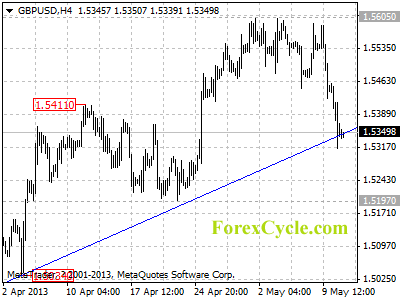
GBPUSD is testing trend line support

GBPUSD is testing the support of the upward trend line from 1.4831 to 1.5034, a clear break below the trend line support will indicate that the uptrend from 1.4831 (Mar 12 low) had completed at 1.5605 already, then the following downward movement could being price to 1.5000 zone. On the upside, as long as the trend line support holds, the fall from 1.5605 would possibly be consolidation of the uptrend from 1.4831, one more rise towards 1.5800 is still possible after consolidation.

gbpusd

Forex Signals

Large FX Speculators pushed US Dollar bets to Highest Level in Almost a Year

Large FX Speculators pushed US Dollar bets to Highest Level in Almost a Year

By CountingPips.com


USD-values


The most recent weekly Commitments of Traders (COT) report, released every Friday by the Commodity Futures Trading Commission (CFTC), showed that large futures traders increased their total bullish bets of the US dollar last week to the highest level since June 2012, according to Reuters.

Non-commercial large futures traders, including hedge funds and large International Monetary Market speculators, raised their overall US dollar long position of $26.829 billion as of Tuesday May 7th. This was an increase from the total long position of $24.49 billion on April 30th, according to position calculations by Reuters that derives this total by the amount of US dollar positions against the total positions of euro, British pound, Japanese yen, Australian dollar, Canadian dollar and the Swiss franc.

Total US dollar long positions had declined slightly the previous two weeks and had fluctuated between $23.57 billion and $26.3 billion for the previous nine weeks, according to the Reuters calculations. US dollar positions turned into a bullish position on February 19th when USD bets equaled $1.481 billion after having been in an overall bearish position from November 2012 to February 2012.

What is the COT Report:

The weekly cot report summarizes the total trader positions for open contracts in the futures trading markets. The CFTC categorizes trader positions according to commercial hedgers (traders who use futures contracts for hedging as part of the business), non-commercials (large traders who speculate to realize trading profits) and nonreportable traders (usually small traders/speculators).


Individual Currencies Large Speculators Positions in Futures:

The individual currency net speculator positions last week saw advances for the Swiss franc and the Canadian dollar while the euro, British pound sterling, Japanese yen, New Zealand dollar, Australian dollar and the Mexican peso all saw a declining number of net large trader contracts for the week.


Individual Currency Charts: (Please Click on Chart to Enlarge)


EuroFX: Weekly change of –3,384

eur


EuroFX: Large trader positions for the euro deteriorated last week after showing an improvement the previous week. Euro contracts decreased to a total net position of -33,533 contracts in the data reported for May 7th following the previous week’s total of -30,149 net contracts on April 30th.


Last Six Weeks of Large Trader Positions: EURO

DateLg Trader NetChange
04/02/2013-65701-16606
04/09/2013-5085814843
04/16/2013-2976421094
04/23/2013-34275-4511
04/30/2013-301494126
05/07/2013-33533-3384

British Pound Sterling: Weekly change of -4,479

GBP


GBP: British pound spec positions declined last week after improving for three consecutive weeks and to the best position since March 12th. British pound speculative positions decreased last week to a total of -63,086 net contracts on May 7th following a total of -58,607 net contracts reported for April 30th.


Last Six Weeks of Large Trader Positions: Pound Sterling

dateLg Trader NetChange Weekly
04/02/2013-650201535
04/09/2013-69969-4949
04/16/2013-619757994
04/23/2013-601121863
04/30/2013-586071505
05/07/2013-63086-4479

Japanese Yen: Weekly change of -7,433

JPY


JPY: Japanese yen net speculative contracts fell last week after improving for the previous three straight weeks and to the best level since February 26th. Japanese yen positions dropped to a total of -78,560 net contracts on May 7th following a total of -71,127 net short contracts on April 30th.


Last Six Weeks of Large Trader Positions: Yen

dateLg Trader NetChange Weekly
04/02/2013-7817110978
04/09/2013-77697474
04/16/2013-93411-15714
04/23/2013-7973013681
04/30/2013-711278603
05/07/2013-78560-7433

Swiss Franc: Weekly change of +2,029

CHF


CHF: Swiss franc speculator positions improved last week after declining the previous week. Net positions for the Swiss currency futures advanced slightly to a total of -6,235 contracts on May 7th following a total of -8,264 net contracts reported for April 30th.


Last Six Weeks of Large Trader Positions: Franc

dateLg Trader NetChange Weekly
04/02/2013-12015183
04/09/2013-100142001
04/16/2013-32536761
04/23/201311794432
04/30/2013-8264-9443
05/07/2013-62352029

Canadian Dollar: Weekly change of +15,932

CAD


CAD: Canadian dollar positions improved sharply last week for a third consecutive week after falling to a new low level for 2013 on April 16th. Canadian dollar positions improved to a total of -51,916 contracts as of May 7th following a total of -67,848 net contracts that were reported for April 30th.


Last Six Weeks of Large Trader Positions: CAD

dateLg Trader NetChange Weekly
04/02/2013-64544-1899
04/09/2013-71133-6589
04/16/2013-75913-4780
04/23/2013-716794234
04/30/2013-678483831
05/07/2013-5191615932

Australian Dollar: Weekly change of -23,604

AUD


AUD: The Australian dollar large speculator positions decreased sharply again last week to decline for a sixth consecutive week. Aussie speculative futures positions fell to a total net amount of +6,630 contracts on May 7th after totaling +30,234 net contracts as of April 30th.


Last Six Weeks of Large Trader Positions: AUD

dateLg Trader NetChange Weekly
04/02/201383971-1544
04/09/201377879-6092
04/16/201353175-24704
04/23/201331257-21918
04/30/201330234-1023
05/07/20136630-23604

New Zealand Dollar: Weekly change of -514

NZD


NZD: New Zealand dollar speculator positions fell slightly last week after improving the previous week. NZD contracts edged lower to a total of +28,536 net long contracts as of May 7th following a total of +29,050 net long contracts on April 30th.


Last Six Weeks of Large Trader Positions: NZD

dateLg Trader NetChange Weekly
04/02/2013183871471
04/09/2013251506763
04/16/2013308085658
04/23/201327705-3103
04/30/2013290501345
05/07/201328536-514

Mexican Peso: Weekly change of -107

MXN


MXN: Mexican peso speculative contracts were virtually unchanged last week from the previous week. Peso positions declined slightly to a total of +138,441 net speculative positions as of May 7th following a total of +138,551 contracts that were reported for April 30th.


Last Six Weeks of Large Trader Positions: MXN

dateLg Trader NetChange Weekly
04/02/201314275514593
04/09/2013142542-213
04/16/20131512888746
04/23/2013146911-4377
04/30/2013138551-8360
05/07/2013138444-107

The Commitment of Traders report is published every Friday by the Commodity Futures Trading Commission (CFTC) and shows futures positions data that was reported as of the previous Tuesday (3 days behind).

Each currency contract is a quote for that currency directly against the U.S. dollar, a net short amount of contracts means that more speculators are betting that currency to fall against the dollar and a net long position expect that currency to rise versus the dollar.

(The graphs overlay the forex spot closing price of each Tuesday when COT trader positions are reported for each corresponding spot currency pair.)

See more information and explanation on the weekly COT report from the CFTC website.


Article by CountingPips.comForex News & Market Analysis


Monetary Policy Week in Review – May 11, 2013: 8 banks cut rates by 550 bps as BOJ easing ripples through world

By www.CentralBankNews.info
    Last week 16 central banks took policy decisions with a record eight banks cutting rates by a total of 550 basis points as the Bank of Japan’s (BOJ) monetary easing looks to become a watershed event in global monetary policy by opening a new front in the currency wars.
    Only weeks after the Group of 20 finance ministers and central bank governors agreed that they  “will refrain from competitive devaluation,” Australia and Korea – two of the G20 members – surprised markets by cutting interest rates.
    Observers questioned the motives behind the two rate cuts as the global economic outlook had not drastically deteriorated.
    It is already clear that the ripples from the BOJ’s easing is upsetting global balances, with a range of competitors reacting to the 17 percent plunge in the value of the yen to the U.S. dollar so far this year.
    The only substantial change in the policy statements from the Reserve Bank of Australia (RBA) and the Bank of Korea (BOK) from April to May was the reference to foreign exchange while their observations about growth were largely unchanged.
     The other six central banks that cut rates this week did not refer to exchange rates but said a lack of inflationary pressure had given them space to boost growth.
    But the RBA said the exchange rate of the Australian dollar had been “little changed at a historically high level” while the BOK said Korea’s output gap would continue for a considerable time due to slow global growth, “the influence of the Japanese yen weakening” and geopolitical risks.
     To be sure, the global economy has entered a soft patch. But that is exactly the point of international agreements. When times get tough, policy makers are supposed to consider the international ramifications of their actions and look to the common good.
    The official reaction of the international community, both the G20 and the Group of Seven, to the BOJ’s new and more aggressive quantitative easing is that benefits everyone as its strengthens global growth by supporting Japan’s domestic demand and stopping deflation.
   Meanwhile, individual countries are adjusting their policies to the impact of the lower yen and the inflow of excess funds to their markets from the BOJ’s easing. Data showed that Japanese investors were net buyers of foreign bonds in recent weeks.
    The Reserve Bank of New Zealand (RBNZ) intervened in foreign exchange markets for the first time since 2007 to weaken its dollar. The move was hardly a surprise after the RBNZ last month pinned some of the blame for the currency’s appreciation on Japan’s “substantial quantitative easing programme, ” which is making life hard for its exporters.
    Thailand has been debating how to tackle the rise in its baht currency and capital inflows with the Bank of Thailand (BoT) on Monday meeting with government and private sector representatives to discuss a response.
    The Thai finance minister has been vocal in his criticism of the BOT, saying it should take the strength of the currency into account when deciding on policy and not just inflation. So far the Thai central bank has resisted pressure and kept rates unchanged, arguing the inflows are due to investors’ confidence in the Thai economy and rate cuts would not make much of a difference.

     Apart from Australia and Korea, the central banks of Kenya, Belarus, Poland, Georgia, Sri Lanka and Vietnam also cut rates this week. Seven banks held rates steady: Malawi, Norway, the United Kingdom, Malaysia, Peru, Egypt and Mozambique.
     Gambia was the only central bank to raise rates this week. Four percent of all rate decisions this year have favored rate hikes, a largely stable ratio. It was Gambia’s first rate rise this year, reversing two rate cuts in 2012, with the bank citing accelerating inflation, partly due to currency depreciation.
   
     Since the BOJ announced its “new phase of monetary easing” on April 4, central banks’ policy rates have tumbled by a cumulative 1,235 basis points, accounting for 58 percent of the total decline in rates so far this year.
    Although the decline in policy rates accelerated this week, the total fall this year only amounts to 2,126 basis points, still a far cry from cuts totaling 6,475 in 2012 and 7,517 in 2011. However, the fall in rates does not reflect the true extent of global monetary easing as it doesn’t take into account quantitative easing measures.
    Through the first 19 weeks of this year, 24 percent of 186 policy decisions taken by the 90 central banks followed by Central Bank News have lead to rate cuts, a sharp increase from 20 percent after the first 18 weeks.
    It was the highest number of rate cuts in one week so far this year, pushing down the average Global Monetary Policy Rate (GMPR) to 5.66 percent from 5.70 percent at the end of April and 6.2 percent at the end of 2012.
    The majority of this year’s policy decisions still favor unchanged rates, but the trend is declining. At the end of this week, 72 percent of all decisions this year were to keep rates steady, down from 77 percent after the first 14 weeks of this year and 75 percent after the first 16 weeks.
   
LAST WEEK’S (WEEK 19) MONETARY POLICY DECISIONS:

COUNTRYMSCI    NEW RATE          OLD RATE       1 YEAR AGO
KENYA FM8.50%9.50%18.00%
AUSTRALIADM2.75%3.00%3.75%
BELARUS25.00%27.00%34.00%
GAMBIA14.00%12.00%13.00%
MALAWI25.00%25.00%16.00%
NORWAYDM1.50%1.50%1.50%
POLANDEM3.00%3.25%4.75%
GEORGIA4.25%4.50%6.00%
SOUTH KOREAEM2.50%2.75%3.25%
UNITED KINGDOMDM0.50%0.50%0.50%
MALAYSIAEM3.00%3.00%3.00%
PERUEM4.25%4.25%4.25%
EGYPTEM9.75%9.75%9.25%
SRI LANKAFM7.00%7.50%7.75%
VIETNAMFM7.00%8.00%12.00%
MOZAMBIQUE9.50%9.50%13.50%

   
    NEXT WEEK  (Week 20) features five central bank policy decisions, including Serbia, Indonesia, Iceland, Latvia and Turkey.
    On Monday Thailand’s finance minister meets with the Bank of Thailand’s monetary policy committee, government officials and the private sector to discuss the rise in the Thai baht. Markets are speculating the meeting will result in a rate cut. The next scheduled policy meeting by Bank of Thailand is on May 29.

COUNTRYMSCI             DATE              RATE       1 YEAR AGO
SERBIAFM13-May11.75%9.50%
THAILANDEM13-May2.75%3.00%
INDONESIAEM14-May5.75%5.75%
ICELAND15-May6.00%5.50%
LATVIA16-May2.50%3.50%
TURKEYEM16-May5.00%5.75%

    www.CentralBankNews.info

Money Weekend’s FutureWatch: 11 May 2013

By MoneyMorning.com.au

TECHNOLOGY:
Mars Could Become the First Interplanetary Insane Asylum

There seems to be a lot of people who really don’t like their friends and family. What do we mean by this? Well, let us give you the back story first.

There’s a not-for-profit called Mars One. And this is their goal;

To establish a human settlement on Mars through the integration of existing, readily available technologies from industry leaders world-wide. Mars One intends to fund this decade-long endeavour by involving the whole world as the audience of an interactive, televised broadcast of every aspect of this mission, from the astronaut selections and their preparations to the arrival on Mars and their lives on the Red Planet.

2023 is the year they plan on landing a settlement on Mars. The first group will be just four people. We like to call them Marstians. Two years later they plan on landing another four Marstians at the settlement. A grand total of eight people.

The plan is to establish the settlement, explore Mars, perform tests, carry out research and…live life. Luckily enough for the settlement, there will be cameras everywhere. Because their activity will be filmed 24/7, 365 days of the year. And of course back here on earth it will be on the TV. It’s all very Big Brother meets Survivor meets Alf.


Source: Mars One

Anyway here’s the amazing part which had us falling off our chairs. The trip to Mars is one way. That is…not coming back…ever. Who in their right mind would want a one-way ticket to Mars? Apparently thousands of people! You can check out the submissions here.

Don’t get us wrong; we’re all for space exploration and we’d probably jump at the chance under the right circumstances. But living with 7 other random people for the rest of our lives, saying goodbye to friends and family forever…uhh, no.

The project itself is truly pioneering, and credit to the crazy eight who end up going. It’s really amazing to think that within 10 years a colony of people will inhabit Mars. That’s mind blowing and exciting. It opens up a whole new world of possibilities.

But as optimistic as we are about breakthroughs and pioneering feats, we can’t help but think maybe they should rethink this one just a touch. Perhaps starting with a way to get back to Earth.

If this goes ahead as planned, it might get a little crazy. If you ever watched a series of Big Brother, you would’ve progressively seen the people start to go a little insane. Multiply that by 140 million miles and you start to see where this could end up.

We hope it’s successful, and it would make for some (initially) riveting TV. But more importantly, it would be a major breakthrough in the exploration of space.

HEALTH: Downright Dirty Problems Solved By Some Healthy Competition

The XPrize Foundation is a remarkable organisation, and one you should get familiar with. What they do is create competitions to solve world affecting problems. Then teams of scientist or researchers get together and try and win these competitions.

Big prize money is up for grabs too. Often this equates to millions of dollars. For example the Google Lunar XPrize has a prize pool of $30 million for the first privately funded team to land a robot on the Moon. This has subsequently spurred on a multi-billion dollar private space industry.

Aside from the Lunar Prize (which is the biggest one to date) there are other XPrizes in the works. Some with the design to challenge huge global problems.

One of the most ambitious projects in progress is the ‘Village Utility XPrize’.

This competition aims to use human faeces (poo) to power villages and purify drinking water. We weren’t joking when we said it was ambitious.

But as out-there as this one might seem, it’s not impossible. The reason for this prize is the huge impact dirty drinking water has on the world. As the prize description explains,

Nearly one billion people lack access to safe drinking water and 2.6 billion lack access to basic sanitation. As a result, half of the world’s hospitalizations are due to drinking water contaminated with infectious agents, toxic chemicals, and radiological hazards. According to the World Health Organization (WHO), just one of those infectious agents – the bacteria that causes diarrhoea – accounts for 4.1% of the global disease burden, killing 1.8 million children a year.

This XPrize aim is for a pioneering team to develop a solution to this major health issue. It might be a little on the ‘gross’ side but it’s a problem worth solving. Hopefully enough smart minds can figure it out…with multi-million dollar motivation of course.

ENERGY: LED’s Could Save the World Millions of Barrels of Oil per Year

The humble LED is turning out to be quite a multi-talented device, sparking a lighting revolution, and now solving the world’s oil issues.

From improving home energy usage to being used for internet access, there’s not much LED’s can’t do. And it’s something that the car industry is now very aware of.

Research from Mercedes Benz has shown the LED’s in headlights can help reduce driver fatigue. The light from an LED is closer to natural light than the bi-xenon, xenon or halogen globes. This has a positive effect on the driver as it helps simulate day driving conditions.

Audi has found using LED’s in brake lights allows faster response time of drivers behind. LED’s illuminate instantly and what might be a millisecond faster than a normal light equates to meters in a road accident. It literally could mean the difference between a crash or not.

But what Mercedes have done is trump all the research, including their own. They’re so enthused by this finding they’ve put only LED’s in their new flagship 2014 S-Class model. About 200 of them in total.

Mercedes have found that LED’s create more fuel efficient cars. Because LED’s use a fraction of the power of normal lights there’s less strain on the car when running. Mercedes say the fuel savings are about half a litre per 100km.

If all car makers adopt this strategy and use only LED’s it will have a world changing effect. Let’s have a look at some raw numbers to understand how big an impact we’re talking about.

New cars sold in Australia every year

LED related fuel saving per 100km

Avg. distance travelled by car p.a

Fuel saving per car p.a

Total fuel saving in Australia

Barrels of Oil to make 75L of Fuel

1,000,000 (approx.)

0.5L

15,000km (approx.)

75L

75 million litres

1 (approx.)

That means in Australia the potential fuel saving LED’s create is equal to 1 million barrels of crude oil every year.

Looking abroad, the US sells 14 million new cars per year and the Chinese sell 19 million. That equates to about 33 million barrels of crude oil saved per year from the US and China.

So it next time you see a car with LED’s, take a moment to realise the real potential of the little lights. Because they’re actually helping save the world energy and in turn helping keep the world a little bit greener.

Sam Volkering
Technology Analyst, Money Weekend

 From the Archives…

The Market Rebounds, but We’re Still Not Selling…

25-04-2013 – Kris Sayce

Is This the Last Hurrah for the Australian Dollar?

25-04-2013 – Murray Dawes

Here’s Proof the Silver Bullion Market is Alive and Well

25-04-2013 – Dr Alex Cowie

Stand By for the Recession Rally in Resource Stocks: Take Two

23-04-2013 – Dr Alex Cowie

A New Take on Hard Asset Investing

22-04-2013 – Kris Sayce

Stock Yield Pigs Let Loose at the Trough

By MoneyMorning.com.au

Well, this is interesting. Notable Aussie dollar bull Jim Rickards jumped off the beast this week after the RBA waded into the currency fight and cut the cash rate to a historic low. He’s joined the long line of Australian dollar bears.

Mmm. A falling Aussie changes the valuation metrics for a lot of stocks. So today’s Money Weekend will leave the currency wars behind and focus on value. And we’ll show you where our value man, Greg Canavan, is looking. You might be surprised…

 A Bubbly Market

Before we get to that, a quick detour. It seems clear that the RBA’s move will continue to drive Aussie investors from term deposits into dividend paying stocks in the hunt for a reasonable yield. This would echo the experience over in the US, where stocks are flying high as interest rates stay in lockdown. Take the Dow Jones, for example. It broke through 15,000 points for the first time this week.

There’s an element of history repeating here. That’s one conclusion we reached after reading value investor Seth Klarman’s Margin of Safety this week. He wrote the book in 1991, but check out this anecdote he gives early on:

 ‘There are countless examples of investor greed in recent financial history. Few, however, were as relentless as the decade-long “reach for yield” of the 1980s. Double digit interest rates on U.S. government securities early in the decade whetted investors’ appetites for high nominal returns.

 When interest rates declined to single digits, many investors remained infatuated with the attainment of higher yields and sacrificed credit quality to achieve them either in the bond market or in equities. Known among Wall Streeters as ‘yield pigs’ (or a number of more derisive names), such individual and institutional investors were susceptible to any investment product that promised a high rate of return…yield seeking investors who rush into stocks when yields are low not only fail to achieve a free lunch, they also tend to buy in at or near a market top.

 Klarman was already a successful money manager when he wrote Margin of Safety. But today he is a billionaire, having clocked near 20% returns every year since the eighties without using leverage and often holding high levels of cash.

That’s an impressive record. Hence the reason when you fast forward to today and find the out-of-print Margin of Safety selling on Amazon and eBay for sums north of $1000.

Suffice to say you’re left to wonder what he might think today about the action in the American market and how a value investor would approach it.

We suspect it would probably be with fear of the downside risk. We certainly doubt he sees value. And if there is one key takeaway from Margin of Safety, it’s that Klarman is obsessive about risk, not reward. Klarman buys when he sees value and only then. He’s content to sit out of the game if there’s nothing compelling on offer.

But if the US Fed has inflated stock prices in the USA, the situation is less clear in Australia, because the RBA might have cut the cash rate but it hasn’t outright ‘printed money’.

Some of the ‘official sector liquidity’ from the US and Japan will have leaked into the Aussie market. But are Australian stocks trading closer to their fundamentals than their American counterparts? Does that go some way to explaining the ‘underperformance’ of the Australian stock market compared to the S&P 500 since 2010?

 S&P 500 Outperforming the Aussie Market Over Three Years

Source: BigCharts

Perhaps. So if you’re looking for value, where do you start?

 Be Ready to Buy Cheap Stocks

The financial sector, especially the banks, looks expensive. That’s the opinion of our value investor, Greg Canavan, anyway. That doesn’t mean their share prices can’t go higher. But it does mean the risk/reward trade-off is not in your favour buying at these levels. Avoid the yield pigs.

The other big twin of the Australian share market is resource stocks. That’s where Greg is turning his attention. If you’re familiar with his writing in The Daily Reckoning, you’ll know Greg has taken a very bearish stance on China (the number one consumer of commodities) and the price of iron ore. So it sounds strange to hear his strategy shifting to mining. ‘That’s where the best opportunities will be in 2013, he says in his latest report to subscribers.

But this is because markets look forward and discount the future. The selling in the resource sector has been pricing in lower global, especially Chinese, growth. The question is: has the market got it about right?

If you ask Dr. Alex Cowie, editor of Diggers & Drillers, he says the selling is done (in fact, overdone) and that resource stocks are ready to bounce.

Greg’s position is less bullish. As he says in his latest report, he sees some value beginning to emerge but isn’t ready to buy yet. In the spirit of Seth Klarman, the margin of safety isn’t wide enough at these levels. That’s because Greg thinks the market hasn’t factored in what he considers the very real possibility of a Chinese recession — or worse

That would take commodity stocks down in a final capitulation. If that happens, that’s when you’ll get your big ‘margin of safety’ to step in and buy profitable and well-run businesses in the resource industry trading under their intrinsic value. In other words, a value investor’s dream.

Has he called China correctly? Decide for yourself here.

Callum Newman
Editor, Money Weekend

PS. Don’t forget if you want to keep track of the latest things we’re reading and brief commentary on events that happen through the day, check out our Google+ page and Kris Sayce’s as well.

From the Port Phillip Publishing Library

Special Report: TORRENT SIGNAL 3

Daily Reckoning: Secret Agents Will Destroy Us All

Money Morning: Build Wealth Fast through the Resource Sector

Pursuit of Happiness: What the Latest Interest Rate Cut Could Mean for You

How Long Can the Bull Market Run?

By The Sizemore Letter

The Dow over 15,000…the S&P 500 over 1,634…the Nasdaq at highs not seen since the 1990s Tech Boom… Any way you slice it, we’re in a bull market.

Alas, we’ve been here before, and it didn’t end well.  So, is it time to worry?

My answer is “no,” or at least “not yet.”  The conditions are simply not in place for a major bear market.

Morgan Stanley chief investment strategist David Darst, whose book The Art of Asset Allocation I keep next to my desk, recently listed his “bear market checklist” of things to look for.  And by his estimation—as well as mine—none are showing signs of warning:

  1. Is the Fed tightening monetary policy?  No, they are actively debating more stimulus.
  2. Are stock price valuations stretched?  Hardly; they are slightly below long-term averages.
  3. Is investor euphoria present? Not that I can see; most investors I meet are underinvested in equities and overly heavy in cash.
  4. Are bond spreads widening?  No, and some risky bond sectors have yields at or near all-time lows.
  5. Is there a recession looming? This is more complex; in the U.S., the answer is “probably not.”  In Europe, the answer is “probably,” though both the U.S. and Europe have been in what I call a long “slow motion” recession since 2008.
  6. Are cyclical sectors retreating?  Actually, they have lagged all year and are just now showing signs of life.

Of course, Darst’s list is very U.S.-centric and doesn’t take into account developments in Japan, China or Europe.  Japan concerns me—a lot—and I expect it to suffer a 2008-caliber blowup within the next few years.  But for now, Japan actually appears to be showing signs of life for the first time in a very long time.  China is slowing, but it is also undergoing a transformation into a more consumer-driven economy; the jury is still out as to what this means for the global economy.

And Europe?  For the best gauge of what’s happening in Europe, check out Spanish bond yields.  Since the beginning of the year, the 10-year yield has slipped from over 5% to just barely over 4%, and the downtrend remains firmly in place.  Bond investors are clearly warming to the country that is viewed most at risk of “blowing up” the Eurozone.

The Spanish private sector is still is deep recession, and small and medium sized businesses are being starved of the capital they need by a zombie domestic banking sector.  These are problems that are not going away tomorrow.  But judging by the reaction of the bond market, they are problems that are known and under control.

My advice?  Stay invested.  If you’re nervous, rebalance your portfolio and take some small profits.  But maintain an aggressive portfolio, and if you’re adventurous add some European exposure.  My favorite ways to play Europe today are via the iShares MSCI Spain (NYSE:EWP) and iShares MSCI France (NYSE:EWQ) ETFs.  I hold both in my Tactical ETF portfolio.

Plan on holding for the remainder of 2013, or until something significantly changes in the checklist above. I would recommend something along the lines of a 15-20% trailing stop.

The article first appeared on TraderPlanet.

SUBSCRIBE to Sizemore Insights via e-mail today.

Friday Charts: A New Baby Boom, Inflation and the Scariest Jobs Chart Ever

By WallStreetDaily.com

If you’re a newbie to the Wall Street Daily Nation, you’re in for a treat.

Each Friday, we abandon long-winded analysis to let some carefully selected graphics do the talking for us.

But don’t let our brevity fool you.

Most subscribers tell us this is the most insightful and useful column we write each week.

Yes, picture books can be educational for adults, too! And here’s the latest proof…

Record High? Think Again!

MarketWatch’s Mark Hulbert says, “Stock market bulls face an inconvenient truth as they celebrate the stock market’s new all-time highs.”

What’s he talking about?

Apparently, we’re supposed to be miffed that the S&P 500 Index didn’t actually hit a new all-time high. At least, not on an inflation-adjusted basis…

We need stocks to rally about another 25% before we can make such a boast.

Oh, how “inconvenient!” We’ve already shown that history points to this bull market lasting longer.

So shoot me now and spare me the misery.

Talk About Stimulation

Want to know how the economy is doing? Forget about tracking consumer spending, manufacturing activity, or unemployment claims.

Just be on the lookout for pregnant women.

You might think that’s inappropriate, but according to Hedgeye Risk Management, when more women aged 20 to 34 find jobs – in other words, when the economy is strengthening – more babies are born in the United States.

Conversely, when the economy hits the skids, the baby making stops.

Naturally, there’s a nine-month lag between more jobs and more babies. (If I have to explain why, we’re in trouble.)

So what does the latest data reveal? That Marvin Gaye’s “Let’s Get It On” is getting a lot of playtime.

After the Great Recession caused the largest drop-off in births in 40 years, Americans are certainly getting busy again.

Of course, more babies mean more Americans need bigger houses. And that plays right into our thesis of a prolonged real estate recovery. (In case you missed it, you can get up to speed to here, here and here.)

The Scariest Jobs Chart Ever, Revisited

Baby-making levels might be back to normal. But that doesn’t mean all is well on the employment front.

Even after adding 165,000 jobs in April, we’re still not back to normal, based on the latest version of “The Scariest Jobs Chart Ever.”

Caution: This is one of the scariest images we’ve seen since the War ended.


At this point, any progress is welcome progress, though, right?

Dump China, Buy Mexico?

Two weeks ago, I shared that China lost its crown for being the lowest-cost producer of goods in the world. Now, it’s Vietnam and Indonesia’s turn to reign, which makes these ETFs compelling investments.

It turns out that we might want to invest a few pesos in Mexico, too.

As hourly manufacturing costs keep rising in China, it’s making Mexico competitive again.


And given the manufacturing renaissance that’s underway in America (thanks to a glut of cheap natural gas), Mexico is certain to benefit because of its close proximity.

Or, as Morgan Stanley’s (MS) Nikolaj Lippman and Luis Arcentales put it, “A sustained manufacturing revival in the United States… will create a new competitor for the [emerging markets] world, but a partner for Mexico. And the benefits could be felt across the Mexican economy for years, perhaps even decades.”

Sounds like an opportunity to me. And the easiest (and cheapest) way to play it would be the iShares MSCI Mexico Capped ETF (EWW).

That’s it for this week. Before you go, though, let us know what you think of this weekly column – or any of our recent work at Wall Street Daily – by sending an email to [email protected] or leaving a comment on our website.

Ahead of the tape,

Louis Basenese

Article By WallStreetDaily.com

Original Article: Friday Charts: A New Baby Boom, Inflation and the Scariest Jobs Chart Ever

Why Every Trader Should Know and Care About Server Choices and IT Infrastructure

“A 5 millisecond server delay could cost a firm as much as 4 million USD every millisecond”

Have you ever given thought to the server technology that powers your online trading? If you haven’t yet, then you should.

The server technology used to power your trading can play a powerful role in your performance and can be the difference between a good deal and a bad one. While you may be adept at currency trading, the fact is traders are regularly passing up opportunities for success by not understanding the basics and importance of Forex server setups and choices. Getting into trading without understanding the technology behind it is like wading into battle without any armour! It increases risk. Online trading platforms can play a key role in your trading. So how much do you really know about them?

There are several main server factors that impact trader performance. Every millisecond counts, and can be the difference between a transaction’s resulting in profit or loss. The server technology is paramount because unlike the stock market, the Forex is a network has no central location – all trading is done using them. And with an estimated daily trading volume of almost $4 trillion dollars, the stakes are high when it comes to transmitting information across servers.

VPS or Virtual Private Servers are most widely used and allow traders to trade directly from just about anywhere in the world. They are often fast, secure and reliable but there are a number of things to consider when using a VPS, which might impact upon your performance.

Server uptime – Naturally, servers have their problems at one point or another, but it is vital for traders that they experience no down time during the year. The last thing you want is a crash or unexpected downtime when it comes to trading, so choose a server that has a proven and trusted operating system that is monitored 24/7 for 100% server uptime, and choose one that is in a location that is secure from natural disasters and has good backup power solutions.

Server speed – This is arguably the most important. When discussing server speed you will often here the terms latency and slippage. A latency, or delay, is a term that signifies the difference between a command being placed and executed. Or in short, the time it takes from when you hit the “enter” button for that command to be carried out. Slippage – the time it takes between when you place a trade and for it to be executed by the server – is also important. You want to choose a fast server that’s provides low latency and slippage for the swiftest execution, so the price you want is the price you get. Currency can move a few pips in just a few milliseconds, so speed is key.

Server security – Opt for a server provider that offers top notch security for both your trading purposes and your personal information. Encryption tools like Guardian allow you to protect your EAs for optimum secure trading.

The face of Forex trading is ever-changing. For example, the advent of Cloud technology is allowing more flexibility, and is becoming an increasingly-popular medium due to improved security capability and its ability to allow traders to get closer to certain locations. Choosing a trusted service provider like Artmotion of Switzerland will result in faster, more accurate trading from anywhere in the world, as will keeping abreast of new technologies and developments in the market. With the right research, you’ll find the right Forex VPS for you and enjoy a fast, secure connection and 24/7 trading.

About the Author: Mateo Meier, Technical Director of Artmotion GmbH of Switzerland. We  are a specialist server hosting company that supports many financial institutions.

Mozambique holds rate steady, signs of slower activity

By www.CentralBankNews.info     Mozambique’s central bank held its benchmark standing facility rate steady at 9.50 percent, saying it would intervene in money markets to ensure that the monetary base does not exceed 39.70 billion meticais by the end of May compared with 38.81 billion at the end of April.
    The Bank of Mozambique (CPMO), which has held its rate steady this year after cutting by 550 basis points in 2012, said indicators of the economic climate pointed to lower economic activity, interrupting the upward trend that had been seen since July last year, while expectations regarding demand also showed a decline though employment prospects remained positive.
    Mozambique’s inflation rate rose to 4.79 percent in April, up from 4.27 percent, though well below a peak of 16.6 percent at the end of 2010.
    “The behavior of inflation in the first four months of the year reflects a scenario of a difficult early year, marked by floods that affected the food supply in some markets, especially fruits and vegetables, as well as the increase in average prices of some commodities in the international market, which weighed on domestic inflation, without neglecting the strengthening of the U.S. dollar in the domestic foreign exchange market,” the CPMO said.


    Following its recent visit to Mozambique, the International Monetary Fund (IMF) forecast that inflation would remain around 5-6 percent in the medium term despite the declining trend that was interrupted by the floods.
    The IMF said Mozambique’s economy remains robust, “reflecting the rapid expansion in coal production as well as in financial services, transport and communications, and agriculture.” 
      Last month the central bank cut its 2013 growth forecast to 7 percent from a previous 8 percent due to extensive flooding in the southern and central areas of the country in the first few months of the year, which affected mining output and agriculture. In 2012 the economy grew by 7.4 percent.
    Mozambique’s Gross Domestic Product expanded by 2.3 percent in fourth quarter of 2012 for annual growth of 8.3 percent, up from a rate of 6.9 percent in the third quarter.
    The IMF also forecast that Mozambique’s economy would expand by around 7 percent this year as mining expands and agricultural production recovers from the floods.
     The central bank said the metical was quoted at 30.02 against the U.S. dollar on the last day of April, equivalent to a monthly appreciation of 0.20 percent compared with a depreciation of 0.30 percent in the previous month, taking the cumulative and annual depreciation to 1.73 percent and 9.4 percent, respectively.

    www.CentralBankNews.info