Central Bank News Link List – May 20, 2013: Philippine c.bank further limits access to special deposit accounts

By www.CentralBankNews.info Here’s today’s Central Bank News’ link list, click through if you missed the previous link list. The list comprises news about central banks that is not covered by Central Bank News. The list is updated during the day with the latest developments so readers don’t miss any important news.

Fresh Plunge in Precious Metals “Natural” as Bearish Money Managers Hold “Upper Hand” Over Asian Household Buyers

London Gold Market Report
from Adrian Ash
BullionVault
Mon 20 May, 08:15 EST

WHOLESALE PRICES for gold and silver rallied from a fresh plunge in early London dealing on Monday, rising to stand unchanged and 2.3% lower respectively from the end of last week’s trade by lunchtime.

Asian stock markets closed sharply higher, even as the Japanese Yen reversed Friday’s drop to new 4-year lows against the US Dollar.

Commodities ticked lower as did major government bonds. Silver prices today touched the lowest level in 44 months, dropping within 25¢ of $20 per ounce.

This morning London’s silver Fix came in at $21.66, very nearly one-third below the start of 2013.

Initially extending Friday’s late drop to touch $1340 per ounce for only the second time since January 2011, gold rallied from new 5-week lows for Euro and British Pound investors.

“Investors are very bearish at the moment,” said Bruce Ikemizu at Standard Bank’s Tokyo office to Reuters this morning.

“The stock market and the Dollar are quite strong. It’s a natural move for investors to switch their money from commodities to equities.”

Versus private households buying gold coins and small bars, most notably in India and China, “Financial investors hold the upper hand,” says a note from Denmark’s Saxo Bank, “[with] hedge funds now holding the biggest ever bet on falling prices.”

New data released Friday showed the net long speculative position in US gold derivatives held by money managers and other non-industry players as a group falling to new four-and-a-half-year lows in the week-ending last Tuesday.

Down to the equivalent of 214 tonnes, the difference between bullish bets and bearish bets on New York gold futures and options has shrunk by 55% since the start of 2013, driven by a doubling in the number of “short” contracts.

The amount of bullion held to back shares in exchange-traded gold trust funds shrank again Friday, taking the combined total of the GLD and IAU products down 16 tonnes for the week at 1,230 tonnes altogether.

The two largest US gold E.T.F.s have now shed 22% of their holdings since New Year.

Despite silver E.T.F. holdings remaining much steadier, the silver price “is trekking a similar path to gold,” reckons analyst Yang Xuejie at Galaxy Futures Co. in China – a division of a state-owned brokerage group.

More particularly, “Investment demand is slowly falling and there are doubts about industrial demand, which is the primary driver.”

Some 60% of annual offtake in the silver market goes to industrial uses, rather than jewelry and other store-of-value forms like coin or bar. That compares to less than 15% for gold.

Solar panel demand, which has helped plug some of the gap left by the collapse in photographic demand for silver over the last decade, flat-lined in 2012 according to analysis from French investment bank and bullion dealer Natixis.

Back in gold bullion, “We have some left over consignment stocks,” an Indian importer told Reuters this morning, pointing to the Reserve Bank’s latest import restrictions to the world’s largest gold-consumer market.

Local premiums over and above the world’s benchmark London pricing doubled and more in response to the Indian central bank’s new rules, imposed a week ago.

“For the time being we are catering to jewelers,” the importer speaking to Reuters added today. But despite this tightness in domestic supplies, Indian gold prices continued to fall on Monday, dropping 1.5% in line with international prices.

The drop in Indian gold prices is hurting the gold-backed consumer loans sector, India Today reports, with non-performing loans – raised with the pledge of gold jewelry as collateral – tripling over the last year to 1.5% of the largest gold-loans book, built by Muthoot Finance.

Shares in competitor Manappuram Finance, India’s first stockmarket-traded gold loan company, have dropped by 40% in the last month, says the paper.

“Gold, I think, is deep in our psyche and to take people away from gold, greater steps are needed,” says State Bank of India chairman Pratip Chaudhuri, quoted Saturday by ZeeNews.

Commenting on the central bank’s campaign to deter gold demand – first by imposing those new import restructions, but also by asking commercial banks to promote coins and bars less aggressively, in a bid to reduce India’s trade deficit – “I don’t know whether it would lead to reduction in consumption,” Chaudhuri says.

“In India there is such a fascination for gold. What stops people from going to the jewelry shops and banks?”


Adrian Ash

BullionVault

Gold price chart, no delay | Buy gold online


Adrian Ash is head of research at BullionVault, the secure, low-cost gold and silver market for private investors online, where you can buy gold and silver in Zurich, Switzerland for just 0.5% commission.


(c) BullionVault 2013

Please Note: This article is to inform your thinking, not lead it. Only you can decide the best place for your money, and any decision you make will put your money at risk. Information or data included here may have already been overtaken by events – and must be verified elsewhere – should you choose to act on it.


Yahoo finalize $1.1 billion deal to buy Tumblr

By HY Markets Forex Blog

Yahoo‘s board has finalized a deal to buy blogging and social network service Tumblr for $1.1bn according to reports.

This deal is believed to be Marissa Mayer Yahoo CEO’s largest deal since taking helm of the iconic company “Yahoo “in July 2012.Yahoo intends to gain wider and younger audience through the blogging and social site Tumblr.

The $1.1bn deal would mark a significant premium on Tumblr $800m valuation when it raised money from private investors.According to the homepage on tumblr, the blogging site now hosts over 100 million blogs and a total of 50.7bn posts.

Yahoo stands one of the biggest sites in the internet world with around 600 million visitors to its websites every month.

The New York based company “Tumblr “was founded by David Karp at the age of 20 with barely any qualification then is high school certificate. David Karp network enable users to share and post short comments, pictures and videos which attracted an estimate of $125m in venture funding but gained a profit of only $ 13m last year.

Yahoo Inc declined to make any comments before the announcement but hinted that it would be streamed live.

Under the terms of the acquisition, Tumblr would continue to operate as an independent business, according to the Wall Street Journal.

Unlike its rival facebook and Google, Tumblr has been slow to pull in advertiser’s .With the new Yahoo deal; the opportunity could bring the ability to attract advertisers.


The post Yahoo finalize $1.1 billion deal to buy Tumblr appeared first on | HY Markets Official blog.

Article provided by HY Markets Forex Blog

Gold goes down while silver drops to 2-year low

By HY Markets Forex Blog

With gold plunging over 1.5 on Monday, the yellow metal has cleared all previous gains after more than two year low of $1,322.06 per troy ounce in April.  While Silver has been trading at a level last seen in 2012.

 
The yellow metal dipped 1.65% to $1,342.40 per troy ounce while Silver tumbled 4.69% to $21.305 an ounce. With silver correlating with gold, it touched its two-year low on Monday, losing its safe status. Silver has already lost 38% while gold has lost more the 22% this year.Central bank gold rose to an eight year high due to the massive buying from Russia and some of its former states according to reports.

The Dollar index is said to have traded at 84.071 confirming US dollar’s strengthening this month.

Philly FE’s Charles Plosser acknowledged the US economy continuous recovery as he said the job market had improved for the Federal Reserve to reduce the pace of its $85 billion monthly QE.

Should labor market conditions and inflation continue to evolve as I project, then I would view ending the purchases by year-end as appropriate,” Plosser said on Tuesday.

The Sore Fund Management LLC lowered its investment in SPDR Gold Trust which is the biggest ETP by 12% to $530,900 shares since March 31st. The reduction followed 55 % cut in the fourth quarter last year.

The post Gold goes down while silver drops to 2-year low appeared first on | HY Markets Official blog.

Article provided by HY Markets Forex Blog

Why Bank Stocks have Outperformed Resource Stocks…

By MoneyMorning.com.au

It’s not often we agree with US Federal Reserve chairman, Dr Ben S Bernanke.

But over the weekend, Dr Bernanke claimed, ‘Both humanity’s capacity to innovate and the incentives to innovate are greater today than at any other time in history.

We couldn’t agree more. It’s why we’ve hired a specialist analyst – Sam Volkering – to help us launch a new technology investment service. While others preach doom and gloom, and fear modern technology, we look forward to it. Why? Because we believe technology improves the quality of life.

We’ll reveal more on this new service in the coming weeks.

Of course, we’re not about to give Dr Bernanke a free kick on his running of US (and indirectly, global) monetary policy. It has been a total disaster. Despite that, it has opened up a lot of opportunities for investors to make money, and that’s set to continue…

The idea that a central bank can artificially stimulate an economy without side effects is naive. The 1920′s and 1930′s saw huge leaps in industrial innovation, but it didn’t stop the Great Depression and more than a decade of misery.

One problem with central bank meddling is that it creates an uneven economy.

For instance, although the banking sector has reaped the benefit of cheap money (Commonwealth Bank of Australia [ASX: CBA] and Wells Fargo & Co [NYSE: WFC] are up 48.2% and 28.9% respectively over the past 12 months), the arguably more productive resource sector hasn’t done so well.

Mining giant BHP Billiton [ASX: BHP] has gained just 7.6% in 12 months, and Freeport-McMoRan [NYSE: FCX] has gained just 2%.

Sadly, those are some of the better performers in the resource sector. Many resource stocks have slumped in recent months as investors shun risky stocks in favour of ‘safe’ income stocks.

Banks Creating Assets from Thin Air

But the resource stock collapse has puzzled many people. How can bank stocks rise when all they own are pieces of paper called mortgages, while mining stocks digging iron ore, copper and gold from the ground own real hard-as-rock assets?

Well, that’s where you can thank Dr Bernanke and the banking system. For start, banks can do something mining companies can’t – banks can create money from thin air in order to create an asset.

Mining companies however, have to beg for money from banks, other financial institutions and investors. And rather than just stamping ‘approved’ on a loan form to create an asset, resource stocks have to spend millions to obtain their assets.


Financial Services Index – blue line; Metals & Mining Index – red line
Source: Google Finance

The thing is, at some point investors will surely look at the above chart and think, ‘I’m gonna buy the cheap stocks and sell the expensive stocks.’

If they do that, resource stocks should be near the top of the list.

Of course, it’s not as simple as buying cheap and selling dear. If it was that simple you’d just buy every beaten down stock and wait for other investors to pile in and drive the price higher.

You have to be more selective than that. You have to work out what investors want.

A Surprising Place to Find Income

As we explained in our latest issue of Australian Small-Cap Investigator, most of the commentary suggests investors want income. That’s not true. What investors actually want is growth and income.

But rather than getting growth from growth stocks, over the past 12 months they’ve gotten that growth and income from blue-chip income stocks. With those stocks now trading at a premium, investors know they need to look outside the top 50 stocks if they want income and growth, or even just plain old growth.

It may surprise you to know that we’re looking at the income and growth angle in Australian Small-Cap Investigator. Far more small-cap stocks pay a dividend than you may think.

But Doc Cowie has taken a slightly different approach in Diggers & Drillers. Saying that, our strategies have one thing in common – cash.

The Doc has recently put into play a strategy he used to good effect from 2009 to 2010…the last time resource stocks went bonkers, and the Metals & Mining Index more than doubled (many small-cap resource stocks did even better). The strategy is simple to explain, but requires a lot of analysis to put into practice.

Simply put, it’s about ripping apart resource companies‘ balance sheets and production schedules, and working out which stocks have the cash flow to succeed.

After all, mining is an expensive game. Just because a company has found a resource doesn’t mean they’ll ever dig the stuff from the ground. It can cost millions, sometimes tens or hundreds of millions to get a project through to production.

That’s why it’s important that mining companies have enough working capital to move from exploration to production. And that’s where the Doc’s analysis makes the difference.

Lower Aussie a Boon for Resource Stocks

You’ve seen the Doc’s writings in Money Morning over the past few weeks. We don’t think we’ve ever seen him so excited about the opportunities in the resource sector.

In fact, he was almost delirious when he showed us this quote from the Australian on Friday:

An analysis by RBC Capital Markets found that a further pull-back in the value of the dollar against the US dollar to US89c could see net profit at some Australian mining companies soar by more than 36 per cent.

Most analysts have given up on resource stocks. But not the Doc. And right now it’s the perfect time to do the analysis the Doc excels at. Hundreds of small mining companies have recently released their quarterly cash flow reports.

This reveals how much cash these small miners and producers have on the books. It means the Doc can crunch the numbers to find which stocks have the best cash flows to progress their projects.

If the Doc is right, it’s a great time to look at a select few beaten down resource stocks. And with the speed at which the market gobbles up value, these stocks may not stay beaten down for long.

Cheers,
Kris

Join me on Google+

From the Port Phillip Publishing Library

Special Report: IT’S A TRAP

Daily Reckoning: The Germans Dominate in Spain…and Look to Invade England

Money Morning: Cash is King in this Market

Pursuit of Happiness: What Drives Entrepreneur’s and Inventors

Australian Small-Cap Investigator:
How to Make Money From Small-Cap Stocks

A New Spin to the Old Oil War

By MoneyMorning.com.au

One of the main stories not being told about today’s oil market is the next round of turbulence set for the Middle East. It’s the oil war scenario, but with a new spin.

Last year when Byron King and I attended the Platts Crude Oil Conference, a main takeaway was an interesting OPEC break-even chart that shows how much money OPEC nations need to keep their governments funded. Take a look:

All’s well at $100 oil – all isn’t well at $80 oil. And all hell breaks loose if prices stabilize even lower at, say, $60…

Hold That Thought…

This year at the Platts oil conference, we saw two clear themes:

1. The US oil boom is bigger than expected. As I see it, this is more of a ‘duh’ observation. I’ve yet to see it slow down since 2008. In fact, this week, the International Energy Agency (IEA) in its Oil Market Report claimed that America’s shale boom is growing even larger than expected. It’s also set to have a profound effect on OPEC. Which brings me to the second theme…

2. OPEC is also set to produce (or have the capability to produce) a heckuva lot of oil. One main driver of that supply growth is Iraq. After a turmoil-filled decade, Iraq is coming back on line in a big way – and could add another 3 million barrels per day to the oil mix by 2018.

So you see, once you start lumping together all of this oil, the market seems a bit flush.

OK. So the US has lots of oil, and producing it at an ever-growing rate. And OPEC has a lot of oil and is either producing it or sitting on it.

And what’s funny is that if OPEC continues to cut supply via quotas, all it will do is help the US oil boom. They’ll essentially be crimping supply to boost prices…and we’ll benefit. Hah!

So How Does All This Shake Out?

From my perch, oil prices are set for a fallout. When I questioned some of the speakers at the Platts conference last week, there were only two ‘good’ answers for why oil prices are still high.

The first is just a simple ‘fear’ premium – the Middle East is still a big producer and fear is built into the price of oil (that begs the question: Do we really need $20-45 of fear premium?).

The second reason prices are still stubbornly high, I’m told, is that central banks are still printing money. Again, I’m not sure this is enough to demand $95 WTI oil – heck, just look at other commodities, like gold. (Where’s the support there?)

But at least it’s somewhat of an explanation. The Federal Reserve and the BOJ are printing away, and it’s probably only a matter of time before the ECB joins in.

You can take what you want from those two reasons – but that’s all I’m hearing about oil’s current price support.

I’m still looking for a price drop. When you’ve got a room full of 200 smart oil insiders, most of whom are scratching their head at current high prices or grasping at straws, something’s got to give.

When that happens, prices could drop and remain under pressure for a while – I’d look for stability around $80, but we could easily see oil trade below that. The break-even price for most American shale plays is around $50-60 – so don’t expect prices to fall much below there – but overall prices are a little lofty above $90.

Getting back to my point above, OPEC needs $100 oil. Member nations have become accustomed to a certain level of income rolling into their coffers. As the oil money rolls in, it’s quickly spent on government programs.

But what happens if they start checking the books and see 20-40% less income? All bets are off. Indeed…

We’re Setting Up for the Next Middle East Meltdown

A closer look reveals that the Saudis aren’t happy that Iraq is coming online. This could lead to a round of infighting among OPEC – with each nation trying to eke out the most money. Frankly, the Saudis have massive incentive to see Iraq fail. The same goes for Iran. Will that lead to anything? Who knows?

In the meantime, we wish OPEC luck dealing with $80 (or cheaper) oil!

So there you have it. Today’s oil market has boiled down to some pretty simple inner workings.

The US and OPEC are set to produce much more oil. And even though US and Euro demand for the black goo is falling, demand from the oil-thirsty East is set to ramp up.

So we’ve got plenty of demand and at least a five-year window of shale gale-spurred supply.

In the short term, I expect supply to outrun demand – something that will lower prices across the board. And along with those lower prices, we’ll see some squirming from OPEC.

Will the government let the coffers run low and cut government programs? Or will the member nations decide to open the spigots and produce more quota-breaking cheap oil to keep the money rolling in?

Either scenario holds a drop in the market price for oil. And either scenario ends poorly for OPEC. Stay tuned. The next few months could get interesting.

Matt Insley
Contributing Editor, Money Morning

Join Money Morning on Google+

From the Archives…

The Foundations for the Great Lie We Have Built Our Lives Upon
17-05-2013 – Vern Gowdie

How the Aussie Dollar is Running Out of Friends, Fast
16-05-2013 – Murray Dawes

STOP PRESS…Resource Stocks Pay Dividends Too
15-05-2013 – Dr Alex Cowie

‘Best Week in Four Years’: Resource Stocks are Starting to Move…
14-05-2013 – Dr Alex Cowie

Why You Won’t See Me on ABC or CNBC Discussing Financial Markets…
13-05-2013 – Kris Sayce

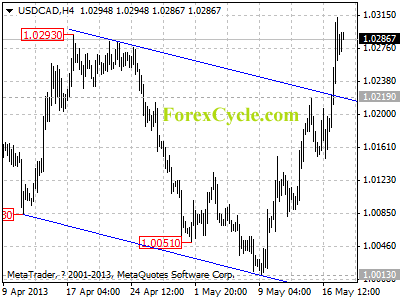
USDCAD broke above channel resistance

USDCAD broke above the upper line of the price channel on 4-hour chart, suggesting that the downward movement from 1.0341 (Mar 1 high) had completed at 1.0013 already. Further rise to test 1.0341 resistance would likely be seen, a break above this level will indicate that the uptrend from 0.9632 (Sep 14, 2012 low) has resumed, then then next target would be at 1.0500 area. However, as long as 1.0341 resistance holds, the rise from 1.0013 would possibly be correction of the downtrend from 1.0341, one more fall towards 0.9500 is still possible after correction.

usdcad

Daily Forex Forecast

Forex Weekend Update: COT Speculator USD bets highest since June 2012

US Dollar Speculators increased bullish bets last week to highest since June

By CountingPips.com


cot-values


The weekly Commitments of Traders (COT) report, released on Friday by the Commodity Futures Trading Commission (CFTC), showed that large futures traders continued to boost their total bullish bets of the US dollar last week. Total US dollar long positions have increased for two straight weeks and are at a new high level since June 2012, according to data by Reuters.

Non-commercial large futures traders, including hedge funds and large International Monetary Market speculators, raised their overall US dollar long positions to a total of $32.27 billion as of Tuesday May 14th. This was an advance from the total long position of $26.83 billion registered on May 7th, according to position calculations by Reuters that derives this total by the amount of US dollar positions against the combined positions of euro, British pound, Japanese yen, Australian dollar, Canadian dollar and the Swiss franc.


See the full COT report & charts here…


Technical Outlook: US Dollar ended last week higher against the Major Currencies

The US dollar continued to show its strength in the currency markets last week and increased against the other major currencies across the board. Notably, the USD rose against the Australian dollar, New Zealand dollar, Canadian dollar, Swiss franc, British pound and the euro for a second straight week while advancing against the Japanese yen for third consecutive week.


See the full Technical Currency Pairs post and charts here…


Next Week’s Economic Events Highlights:


Tuesday, May 21

Australia — reserve bank meeting minutes
New Zealand — reserve bank 2-yr inflation expectation
United Kingdom — consumer price index
United Kingdom — producer price index

Wednesday, May 22

Japan — Bank of Japan rate decision
Japan — monetary policy update
United Kingdom — Bank of England minutes
United Kingdom — retail sales
United States — Ben Bernanke testimony
United States — FOMC meeting minutes
United States — existing home sales
Canada — retail sales

Thursday, May 23

United Kingdom — GDP report
China — PMI manufacturing
United States — jobless claims weekly
United States — new home sales
New Zealand — trade balance

Friday, May 24

Euro zone — Germany GDP report
euro zone — Germany business climate index
United States — durable goods orders report

See our economic calendar for full listing


A Big Surprise From Mutual Funds

By Investment U

[embed_weekily_video]

There are two things I am absolutely certain of. First, next April 15 I will be writing a check to the IRS. And second, natural gas will be the primary fuel for the next 100 years.

Well-positioned gas companies will be golden for many years to come, and no one is doing it better or has more potential than Chesapeake Energy (NYSE: CHK).

I know they have had a tough road for the last year or so, but Chesapeake is set to be one of the biggest and best once again.

It recently blew away earnings and year-over-year comparisons.

The company had a 67% year-over-year increase in earnings, a 42% increase for the same period in revenues and beat earnings and revenue estimates.

Natural gas liquids production was up 9% year over year, oil production was up 56% and, for the same period, Chesapeake lowered production costs 26%.

And, most notably, 85% of its drilling is focused on oil plays, which brings a much higher price than natural gas.

Now, I know Chesapeake has had a funding gap that has been at the root of most of its problems for the past year, but it has already met one half of its assets sales goal in just the first quarter of this year. It did it by selling drilling leases that are about to expire on undeveloped gas properties.

Chesapeake has been able to solve its funding problems by selling drilling rights that will not affect its future performance, and it still owns 14 million acres of gas and oil rights.

In fact, the company’s production growth rate for the past few years is 15% to 20% in spite of the sale of assets.

Seventy-eight percent of its 2013 gas production is hedged at a price that’s one dollar higher than the best price the company got last year, and its production costs in the first quarter are down 18% from last year.

And, to top it all off, Chesapeake recently won a big lawsuit involving its bonds and – this is beginning to sound like a wishlist – there are rumors that Chevron (NYSE: CVX) or Exxon (NYSE: XOM) could make a buyout offer. A buyout is unlikely but, as we all know, rumors like these drive the stock price.

You must own companies in the gas business, and Chesapeeake is my favorite.

A Big Surprise From Mutual Funds

For the 30 years I have been in the markets, the one rule for mutual funds that seemed to be cast in stone was not to chase short-term performance. In other words, you had to look at the long-term performance of funds to make a good choice.

Well, so much for cast in stone in the markets.

A recent article in The Wall Street Journal cited data since the collapse in 2008 and 2009 that indicates short-term performance – one-, three-, six- month and one year – is a much better indication of future returns. And it’s by a big margin.

The study tracked the performance of 300 mutual funds since 1999. It clearly showed that focusing on the one- to 12-month performance periods returned 12% annually since 1999 as compared to 3.5% for the S&P 500. And, returns got progressively worse as the length of the performance period increased.

A caveat to the findings is this system worked best with no load funds and less-risky funds. Look for funds with risk levels equal to the overall market. But the cheapest funds in this study were not the best performing.

In fact, the study concluded that investors are too focused on costs and not enough on returns… and it is costing them money. They lose it on the other end of the equation.

No one was more surprised by these results that I was. This is earth-shattering for the mutual fund world.

The “Slap in the Face” Award: An Expensive Umbrella

For the better part of the last 22 years, rain or shine, I have walked to work, about two miles each way. And in that time I have lost, left behind, broken or had the wind blow apart at least 100 umbrellas. And umbrellas are the point of this week’s Slap in the Face Award.

In fact, it’s an $1,800 umbrella

The Fox Company of London sells an umbrella that costs $1,800. It has a silver handle with black beech for its shaft.

$1,800!

If you remember the TV show The Avengers, a Fox umbrella was always in the hand of Steed.

But, no matter what the materials are, or who carries them, you can still leave it in a restaurant, a doctor’s office or a hundred other places. The wind will still blow it inside out and break the little parts that hold the fabric up and another person can innocently pick up one of a thousand black umbrellas, which is what the Fox is, and leave you his $10 one.

I can think of a lot of things to do with $1,800; an umbrella is not one of them. If I had purchased Fox umbrellas, I would have spent something in the area of $36,000 on umbrellas over the past 22 years. I haven’t spent that much on cars in the last 20 years. But, that’s another story.

We really have too much money to spend.

Article By Investment U

Original Article: A Big Surprise From Mutual Funds

Monetary Policy Week in Review – May 18, 2013: Israel, Turkey, Serbia cut, five hold as BOJ easing reverberates

By www.CentralBankNews.info
    This week eight central banks took policy decisions with three banks cutting rates (Israel, Serbia and Turkey) and five leaving rates on hold (Indonesia, Iceland, Russia, Latvia and Chile) as the Bank of Japan’s (BOJ) monetary easing continues to impact monetary policy decisions worldwide.
    This week’s rate reduction by Israel and Turkey brings it to a total of five rate cuts in reaction to the BOJ’s new phase of monetary easing, which has lead to a drop in the value of the yen and raised fears of an accelerated influx of capital into higher-yielding currencies, threatening to create asset bubbles.
    Prior to this week’s cuts, Australia and Korea had cut rates, specifically mentioning foreign exchange as part of their reasoning, while Turkey has now cut rates twice since the BOJ’s announcement on April 4, in both cases pointing to strong capital inflows.
      Israel’s move came as a complete surprise to markets, with the Bank of Israel (BoI) combining a 25 basis point cut with a plan to buy some $2.1 billion of foreign exchange this year to ease the pressure on the shekel from “the beginning of natural gas production from the Tamar gas field, the interest rate reductions by central banks worldwide, notably the ECB, and the continued quantitative easing programs in several major economies around the world.”
    The BoI’s intervention in foreign exchange markets follows news the previous week that the Reserve Bank of New Zealand (RBNZ) had intervened for the first time since 2007 to weaken its dollar and reports this week that Taiwan’s central bank has intensified its intervention in foreign exchange markets to prevent its dollar from rising too much and making its exports more expensive.
    Since the BOJ announced its new policy, a total of 17 central banks have cut rates 18 times (Turkey twice) for a total reduction of 935 basis points. However, 13 of those cuts were not in direct response to the BOJ but rather in response to a continuing decline in domestic inflationary pressures and weak economic growth.
    The cumulative rate cuts in response to the BOJ by Turkey, Australia, Korea and Israel amount to 175 basis points, still a considerable amount in the course of six weeks.

    In addition to lowering their policy interest rates, central banks – especially in emerging markets – are drawing on other weapons in their arsenal, typically macroprudential measures, to respond to the twin challenge of slowing economic growth and capital inflows. Not only do capital inflows tend to push up the value of the currency and thus make exports more expensive, but they also boost local asset prices, such as property and equity prices above a sustainable level.
     Thailand finds itself at the center of this issue, with a meeting last Monday between the Bank of Thailand’s (BoT) monetary policy committee, government and private sector representatives to discuss an adequate response.
    The meeting, which was only been scheduled the week before, lead to speculation that the BoT would cut rates, but this did not occur. The BoT’s next scheduled meeting by its monetary policy committee is May 29.
    Instead, the BoT has proposed four macroprudential measures to the Thai finance minister, according to press reports, including limiting foreign investors ability to buy some Thai bonds, imposing a fee of foreigners profiting from investing in bonds and compelling foreign investors to hedge their exchange rate risk.
    Other ways to deter high capital inflows without raising policy rates and dampening economic activity includes Turkey’s decision this week to raise the reserve requirement for foreign currency deposits.
    The Philippines has also been experimenting with a similar move in recent months, cutting the rate on the central bank’s Special Deposit Account (SDA) facility to make it less attractive for foreign funds to park their money there.
 
    Through the first 20 weeks of this year, 25 percent (or 48) of the 195 policy decisions by the 90 central banks followed by Central Bank News have lead to rate cuts, another weekly increase from 24 percent after 19 weeks and 20 percent after the first 18 weeks.
    This week’s total rate cuts of 125 basis points boosted the cumulative decline in global policy rates to 2,251 basis points so far this year, pushing the average Global Monetary Policy Rate (GMPR) down to 5.64 percent from 5.66 percent last week and 6.2 percent at the end of 2012.
    Most central banks still keep their rates on hold from week-to-week, but it is clear that there has been an acceleration in rate cuts in recent weeks. By the end of this week, 71 of all policy decisions have favoured keeping rates on hold, down from 72 percent last week and 75 percent after the first 16 weeks of this year.

LAST WEEK’S (WEEK 20) MONETARY POLICY DECISIONS:

COUNTRYMSCI    NEW RATE          OLD RATE       1 YEAR AGO
ISRAELDM1.50%1.75%2.50%
SERBIAFM11.25%11.75%9.50%
INDONESIAEM5.75%5.75%5.75%
ICELAND6.00%6.00%5.50%
RUSSIAEM8.25%8.25%8.00%
LATVIA2.50%2.50%3.50%
TURKEYEM4.50%5.00%5.75%
CHILEEM5.00%5.00%5.00%

    NEXT WEEK (week 21) features five scheduled central bank policy meetings, including Nigeria, Ghana, Japan, South Africa and Trinidad and Tobago.

COUNTRYMSCI             DATE              RATE       1 YEAR AGO
NIGERIAFM21-May12.00%12.00%
GHANA22-May15.00%14.50%
JAPANDM23-May0%0.10%
SOUTH AFRICAEM23-May5.00%5.50%
TRINIDAD & TOBAGO24-May2.75%3.00%

 
  www.CentralBankNews.info