Central Bank News Link List – May 21, 2013: Thailand can ease monetary policy if economy slows, Prasarn says

By www.CentralBankNews.info

Here’s today’s Central Bank News’ link list, click through if you missed the previous link list. The list comprises news about central banks that is not covered by Central Bank News. The list is updated during the day with the latest developments so readers don’t miss any important news.

Vodafone hits biggest fall in service revenue

By HY Markets Forex Blog

One of the world’s largest mobile operators, Vodafone Group Plc   reported its biggest fall in fourth-quarter wireless service revenue on Tuesday. Vodafone are still struggling with the weak economy.

Service sales slipped by 4.2% in the past three months ended March 2013 which marks the third straight quarterly decline. The mobile operator struggles with the economy cuts to the charged rates for other carriers. According to analysts, a 4.4 % drop on average was predicted and the operating profit excludes items that will be between 12bn pounds and 12.8bn pounds according to reports compiled by Bloomberg.The biggest fall in revenue came from the southern Europe, where operators were cutting prices to win business from struggling consumers .Service profits in Italy slipped by 12.8% while in Spain fell by 11.5%.

Since 2005, Vodafone sales went down 4.2 % to 44.4bn pounds while earning fell to 3.1% to 13.3bn pounds according to reports released.

The company did not address the speculations and assumptions of selling its stake to joint venture partner Verizon Communication.

“We have faced headwinds from a combination of continued tough economic conditions, particularly in Southern Europe, and an adverse European regulatory environment,” said Chief Executive Vittorio Colao said.

“The board remains focused on balancing ongoing shareholder remuneration with the long-term investment needs of the business, and going forward aims at least to maintain the ordinary dividend per share at current levels.”

The post Vodafone hits biggest fall in service revenue appeared first on | HY Markets Official blog.

Article provided by HY Markets Forex Blog

Europe stocks retreats as yen weakens

By HY Markets Forex Blog

The European stock rose during the muted holiday trading on Monday with a positive investor sentiment towards the economic data released throughout last week. Shares in Europe are expected to open at a lower rate while investors wait for Federal Reserve Chairman Ben Bernanke comment on whether   the central bank would start on tampering its bond-buying program.UK’s FTSE 100 index was leading shares with 0.48% to 6,755.63 points, while Frankfurt the DAX30 index marked a record high close after climbing 0.69% to 8.455.83 points and the French CAC40 rose 0.54% to 4,022.85 points.

The Asian stock market was traded in a negative territory on Tuesday while the Bank of Japan begins a two-day policy meeting. The European currency grew from $US1.2834 to $US1.2868 in New York on Friday .The US dollar dropped from 103.19 yen to 102.51 yen. The Japanese yen had reached a record low against the US dollar at 103.31 yen.

Milan’s index dropped by 0.55% to 17,506 points according to data released while the Japanese Nikkei share slipped and touched a 5-1/2 year high as investors such as Sharp scooped up under performing stocks. The Nikkei rose by 0.1% to 15,381.02, marking its highest after being traded in a negative territory.

Earlier this week, Nasdaq gained 0.20% to 3506.4 points and S&P 500 rose by 0.24 % to 1,671.42 points while The Dow Jones average gained 0.13% to 15,373.70 points.


The post Europe stocks retreats as yen weakens appeared first on | HY Markets Official blog.

Article provided by HY Markets Forex Blog

Look for Small-Cap Resource Stocks with Plenty of Cash

By MoneyMorning.com.au

‘Number one, cash is king…number two, communicate…number three, buy or bury the competition.’ – Jack Welch, former Chairman of General Electric

Jack Welch knows a thing or two about running a successful business. In the twenty years that he ran GE, the share price increased forty-fold.

Welch’s number one rule was: ‘cash is king’.

Today, cash is more important than ever.

Checking a company’s kitty will not only help avoid a disaster, but it will also help you identify the better stocks on the market…

Cash is lower out there in small-cap land than ever before. Some just won’t make it. Many are running on fumes and will inevitably hit the wall.

But at the other end of the spectrum, there are a few with a surprisingly big wedge of dough to their names.

So far, my research has pulled up a cluster of small-cap mining stocks with so much cash that the cash balance is greater than their market cap.

You read that right. The market is valuing the company at less than its bank balance.

The Beauty of Small-Cap Stocks

That makes no sense at all of course. How could a $45 million bank balance be valued at $28 million by the market? In effect, investors can buy a dollar for just 62 cents!

I’d like to hear anyone who believes in markets being efficient explain this one. This is the beauty of small-cap stocks: with less liquidity, they trade illogically, and so can set up ridiculously easy buying opportunities.

When a stock is trading for less than its cash balance, you’re getting everything else for free as well! The resource, the infrastructure, the mine, the equipment, and so on…

It’s amazing these opportunities exist, but then again, not many people can be bothered crunching the numbers when it comes to small cap resources. I enjoy it, but then I always was an exciting bloke.

But that’s not the only stock with a cash stash bigger than its market cap. Another small-cap stock I spotted has $99 million in cash, yet has a market cap of just $55 million.

Incredible!

And even after factoring a bit of debt, it’s still trading well below ‘net cash’. There are plenty of others in a similar situation. Here are a few more:

So Why Does Any of This Matter?

Easy: because it’s tough as all hell to raise cash right now.

There are almost a thousand resource companies clamouring for cash from investors who basically don’t want to pay up.

And it’s getting tighter.

In the first four months of 2011, the total amount of cash raised was $11.5 billion.

In 2012 it fell to $8.8 billion.

And in 2013, the total so far has been just $7.5 billion.

You can see the trend. The purse strings are closing.

So having a stack of cash is an enviable position. Firstly, it enables survival. And secondly, like Jack Welch said, it means you can buy the competition. These cashed up stocks will be able to pick up some great companies, or their assets, for a fraction of their true value.

This is the right time to run this kind of analysis: right as the mining sector is at its low point. Last time I ran these numbers to see what came up was back in 2009. That’s when the resource sector was on its knees. The stocks with cash went on to increase by 60% on average in a few months.

One stock went one better than that: it gained 2,000% in the next few years.

So it’s worth spending a bit of time to trawl through the entire sector and see what comes up!

Looking at cash is just one part of the analysis of course. There’s a long checklist of things I like to run through as well.

And if the market cap is below the cash balance, is there any obvious reason why? Maybe the stock is stuck in a legal situation, or can’t get its environmental permit, or perhaps the commodity it’s looking at mining has crashed in price.

Another reason these stocks are trading for below cash value is that investors assume the company will spend the cash. Conservative investors would rather wait to see what the company does with the money before buying shares.

You can hardly blame them, given the way the market is right now.

But if there is no obvious reason why the stock is trading at a sub-cash discount, it could be the easiest profit opportunity waiting for you anywhere in the resource sector.

Resource Stocks May Finally Be Starting to Turn

For two months now the Metals and Mining index has held its ground.

Last week it fell, but only lost half of the huge gain it put in the week before when it finished up by 9.44% (Friday close to Friday close). This was its biggest percentage change over a week for more than four years.

Biggest Weeks in Last Four Years for the Resource Sector

Click to enlarge

This huge move was a good signal to watch out for better times ahead for mining stocks. This is still the cheapest sector of the ASX by far.

It’s the polar opposite to the banks, which have looked ridiculously expensive for a while. I suspect the falling Aussie dollar could trigger foreign investors to whip their money out of the banks, after doing well on both the stock price and the currency.

So if you want a cheap sector that’s starting to grind higher, resources are a good bet. And if you want to bet on some big moves, these cashed up small-caps could be the best bet of all.

Dr Alex Cowie
Editor, Diggers & Drillers

Join me on Google+

From the Port Phillip Publishing Library

Special Report: IT’S A TRAP

Daily Reckoning: A Simple Interpretation on Gold for Times of Monetary Madness

Money Morning: Why Bank Stocks have Outperformed Resource Stocks…

Pursuit of Happiness: Working Towards Independence From The State

Diggers and Drillers:
Why You Should Invest in Junior Mining Stocks

How Long Can Share Prices Continue to Boom?

By MoneyMorning.com.au

Share prices around the world are on a tear.

Most developed markets are near five-year highs. The US is now at fresh all-time highs.

Yet, there seems little to justify this good mood. Corporate profits are stagnant by and large, as are underlying economies.

What’s going on? And for how long can it continue?

The Truth about Share Prices and Company Earnings

The boom in share prices is confusing some analysts. The basic problem, as John Authers notes in the Financial Times, is that since September 2011, ‘global earnings per share have been flat.’

So what rising share prices suggest is that investors are willing to pay more for a given level of earnings. ‘Price/earnings multiples have gone from 12 to 16 in the process.

In the jargon, this is known as a ‘re-rating’. It suggests that investors are feeling upbeat about the future, and that they expect earnings growth to improve (because otherwise you wouldn’t be willing to pay an apparently high price for today’s earnings).

The trouble is, that might make sense if there was any hint that profits would soar in the foreseeable future. However, profit margins are already at record levels. If anything, you’d expect them to drop back closer to their historical average.

So what’s driving this enthusiasm for stocks? I’m sure you’ve already guessed: quantitative easing (QE).

We’ve mentioned on several occasions in the past that history shows there is no obvious connection between economic growth and the performance of a country’s stock market.

Lee Adler of the Wall Street Examiner argues that there also no real connection between profit margins as a whole and share prices. The reason that you often see an apparent correlation is because they are both influenced by monetary policy.

When central bank policy is loose, profit margins are expanding (because people are buying more) and share prices go up too. When the central banks are tightening, people stop buying as much, and earnings go down. Share prices do too.

However, it’s not the change in profits that drives share prices. It’s the change in the amount of money being pumped into the system. ‘In the aggregate, price levels are driven by the amount of liquidity in the system. When central banks pump liquidity into the markets day in and day out as the Fed has been doing… stock prices rise faster than profits.

In other words, share indexes simply measure how much money is being pumped into the market: profits – current or future – have very little to do with it all.

How Quantitative Easing Forces Share Prices Higher

This is a slightly cynical view of the market’s value as a ‘discounting’ mechanism of course. But it also makes a lot of sense.

As Brian Reading of Lombard Street Research puts it, QE ‘works by raising asset prices. It reduces the supply of the assets it buys, generally limited to those with least risk, and increases the demand for the assets it does not buy, with higher risk.

When central banks are buying government debt and other ‘low-risk’ assets, they crowd out other buyers (such as pension funds for example). These other buyers have to buy something slightly riskier, such as corporate bonds for example. And so the cost of borrowing falls across the spectrum.

This doesn’t do much for the ‘real’ economy. Banks are bust, so they are not keen to lend money to small businesses and consumers. But it does do wonders for anyone who can employ a bit of financial engineering.

If a company can borrow extremely cheaply by issuing bonds, then it starts to make sense to buy its own shares back with borrowed money, or to pay special dividends to keep existing shareholders happy.

Indeed, the weak state of the ‘real’ economy is also revealed by the fact that companies would prefer to buy their own shares, than borrow money to buy rivals. As the FT points out, in 2006, 60% of corporate loans were made for acquisition activity. Now, it’s just 25%, according to S&P Capital IQ, even although interest rates are at similarly low levels.

So on the one hand, QE encourages investors to take more risk: it increases the demand for shares. And on the other, it encourage companies to use debt rather than equity to finance themselves – so the supply of shares decreases too.

The Federal Reserve has explicitly said in the past that it wants to drive share prices higher. That’s partly to make people feel wealthier, and so more happy to spend. If that seems rather a roundabout way of getting more money into the ‘real’ economy, then you’d be right, but the Fed doesn’t seem to have many other ideas on that score.

In short, for as long as the printing presses are running, markets can probably go higher. The flipside, as Adler notes, is that ‘when central banks pull the plug on the money printing, stock prices will come back down, hard, regardless of what profits do.

The Federal Reserve isn’t Going to Rein in Quantitative Easing Quickly

So, do we have any idea of what would bring an end to Quantitative Easing? On Wednesday this week, we’ll hear Federal Reserve chief Ben Bernanke talking to US politicians about his outlook on the economy. Investors have been starting to ponder when the Federal Reserve will pull back on QE, and many of Bernanke’s colleagues have been making noises about ‘tapering’ purchases.

For now though, it seems unlikely that the Fed will pull back. The economy simply isn’t strong enough, and there is nothing to stop the Federal Reserve as yet – inflation remains benign, for now. The longer this goes on for, of course, the bigger the eventual fall.

John Stepek
Contributing Editor, Money Morning

Publisher’s Note: This article originally appeared here.

Join Money Morning on Google+

From the Archives…

The Foundations for the Great Lie We Have Built Our Lives Upon
17-05-2013 – Vern Gowdie

How the Aussie Dollar is Running Out of Friends, Fast
16-05-2013 – Murray Dawes

STOP PRESS…Resource Stocks Pay Dividends Too
15-05-2013 – Dr Alex Cowie

‘Best Week in Four Years’: Resource Stocks are Starting to Move…
14-05-2013 – Dr Alex Cowie

Why You Won’t See Me on ABC or CNBC Discussing Financial Markets…
13-05-2013 – Kris Sayce

How to Play the Best Bull Markets in the World

By MoneyMorning.com.au

Find the best bull markets in the world. Get in early. Buy the best assets. Ignore the volatility. And enjoy the ride.

That was the basic formula Harris Kupperman, CEO of Mongolia Growth Group, presented at the Value Investing Congress in Las Vegas.

Below are some notes from his inspiring presentation…

A Tale of Two Markets

Harris suggested that the best places to find ideas are in assets not yet ‘financialised’. By this, he means assets for which there is no ready public market. No easy way to invest. An example would be farmland in 2004.

In 2004, Harris saw a big opportunity in farmland. The outline of the idea was simple and seems obvious now, but at the time it was often overlooked. There were four main parts. First, rapidly growing and industrializing emerging markets raised the demand for food.

Second, existing stockpiles were tight. Third, prices for agricultural goods were low versus inflation. And finally, mandated ethanol usage almost guaranteed corn prices would go up. This would have a spillover effect on many other crops.

The question was: How do you play it? You could buy fertilizer stocks, seed companies, irrigation stocks and the like. While all were plays on the agricultural sector, none had pure leverage to farmland prices. Exposure to farmland is what Harris wanted.

For good reason, as it turned out. Farmland prices would take off. Take a look at the nearby chart – ‘Iowa Farmland: Prices per Acre’ – which Harris used in his presentation.

But there was no way for an investor to buy it…short of buying the asset itself. And that was the point of Harris’ presentation. How you should have played agriculture in 2004 was to build a company yourself that owned farmland.

As Harris said, ‘Stop attending ‘ag’ conferences looking for ideas if you know the answer: Build it yourself.

A Lesson from Mongolian Real Estate

It may sound impractical, but this is exactly what Harris did in Mongolia. When he arrived in 2010, Mongolia had a $7 billion economy. It was building one mine that would produce $8 billion in copper and gold per year. It had a few dozen other things that would total $30-50 billion. And its commodity exports were set to grow from $2 billion in 2010 to $20-80 billion by 2020.

How would all that fit in such a small economy? The answer is: it would force asset prices way up. How to get exposure? Much as with farmland in 2004, Mongolia was not yet ‘financialised’. There was no easy way to get exposure to Mongolia. So Harris built it himself along with a business partner and team.

He focused on real estate, which has strong leverage to economic growth. Rents increase in a growing economy. In Mongolia, cap rates (or rental yields) were in the high teens. These would compress as the economy matured, sending prices higher. In 2010, Mongolia real estate was worth less than 10% of comparable real estate in Kazakhstan or third-tier cities in China.

Harris created Mongolia Growth Group to get exposure to the Mongolia bull market, which was set to be one of the world’s best bull markets.

So far, things are playing out more or less as expected. Cap rates have started to fall and are now in the midteens. Prime rents have more than doubled since 2010. And Mongolian real estate is still cheaper than most of the rest of Asia’s. Real estate prices have increased at a rate three times faster than economic growth. The platform is set and the potential upside is enormous.

Harris did not pitch Mongolia Growth Group at the conference. His talk was mainly one of sharing his experiences of building a public company and the lessons learned. When you see a great opportunity and there is no way to play it, don’t give up. Build it yourself.

Chris Mayer
Contributing Editor, Money Morning

Join Money Morning on Google+

From the Archives…

The Foundations for the Great Lie We Have Built Our Lives Upon
17-05-2013 – Vern Gowdie

How the Aussie Dollar is Running Out of Friends, Fast
16-05-2013 – Murray Dawes

STOP PRESS…Resource Stocks Pay Dividends Too
15-05-2013 – Dr Alex Cowie

‘Best Week in Four Years’: Resource Stocks are Starting to Move…
14-05-2013 – Dr Alex Cowie

Why You Won’t See Me on ABC or CNBC Discussing Financial Markets…
13-05-2013 – Kris Sayce

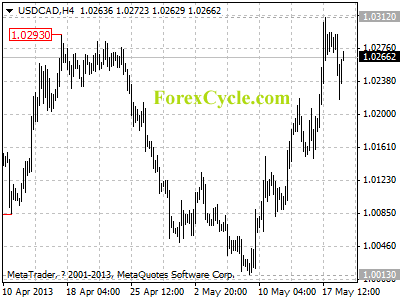
USDCAD pulls back from 1.0312

Being contained by 1.0341 resistance, USDCAD pulls back from 1.0312. However, the fall is likely consolidation of the uptrend from 1.0013, one more rise to re-test 1.0341 resistance is possible, a break above this level will signal resumption of the longer term uptrend from 0.9632 (Sep 14, 2012 low), then next target would be at 1.0500 area. On the downside, as long as 1.0341 resistance holds, the rise from 1.0013 would possibly be correction of the downtrend from 1.0341, another fall towards 0.9500 is still possible after correction.

usdcad

Forex Signals

Mark Zuckerberg Pays a $5.8-Billion Fine

By WallStreetDaily.com

Mark Zuckerberg Pays 5.8 Billion

Facebook (FB) CEO Mark Zuckerberg has lost $5.8 billion on paper since he took the company public a year ago. Call it a “fine” for allowing the company’s share price to dwindle this year.

And although shares have climbed notably higher since hitting a low in September, the stock has a ways to go before it reaches its IPO level.

Can’t say that we’re surprised.

We’ve been dogging Facebook long before its IPO.

In January 2012, Chief Investment Strategist, Louis Basenese, provided the three most compelling reasons why the company was doomed to fail from the start.

~Reason #1: Social Media IPO Flops

Both Zynga (ZNGA) and Groupon (GRPN) had flopped during their IPOs. Zynga traded below the offering price on its first day of trading. And although Groupon zoomed 55.7% higher on the first day of trading, within weeks, the stock collapsed to trade below its IPO price of $20 per share.

Today, they’re both trading way below their IPO price.

~Reason #2: Beware Slow Growth

With IPOs, you’re essentially investing in the future of the company. So if that company can’t grow, watch out below!

And as Louis said last year, “In about four years’ time, Facebook’s user base went from 66 million to 800 million. If Facebook grows at the same rate over the next four years, its user base would hit 9.7 billion. I can guarantee Facebook isn’t going to keep growing that fast. There literally aren’t enough potential customers on Earth.”

Article By WallStreetDaily.com

Original Article: Mark Zuckerberg Pays a $5.8-Billion Fine


Triple-Dip Recession in France…What Now?

By The Sizemore Letter

The numbers came in last week: France is in recession again, for the third time in five years.  A triple-dip recession. Sacre bleu!

There is some debate as to whether this is a double-dip or a triple-dip recession; that mini-recession in 2012 was questionable.  But there is no escaping the broader point here.  France has a serious growth problem, and so does most of the rest of Europe.

As a block, the Eurozone’s economy has been shrinking for six consecutive quarters, and the unemployment rate has crept up to 12.1%.  Ever the country to outdo its neighbors, Italy has seen its economy shrink for seven quarters in a row.  Even the German economy—the engine that is supposed to be driving the rest of the continent—is showing weakness, growing at a pitiful 0.1%.

Years of policy paralysis and a broken banking system have taken their toll. The European economy has official ground to a halt.

The upside?   Well, to start French President Francois Hollande has promised an “offensive” to bring “more growth and less austerity.”

Wow, that’s brilliant.  Why didn’t anyone think of that before?  Clearly, all Europe needs to get out of its on-again / off-again, five-year recession was for the President of France to go on an offensive. (Please feel free to insert the joke of your choice about French military prowess in the last two world wars, Vietnam and Algeria here.)

Ok, now the real upside.  Mr. Hollande’s impotent pronouncements about “offensives” aside, serious pressure is mounting on France to reform its labor markets and relax some of the bureaucracy that makes doing business in France so miserably difficult.  Being a man of the left, Hollande has a better chance of actually ramming the reforms through in the sense that only an American foreign policy right-winger like Richard Nixon could normalize relations with Red China.  The French state is so resistant to change, that if it is going to happen it has to led by “one of their own.”

Is Hollande up to the task?  We’ll see. But he is at least starting to say the right things, such as indicating that French workers would have to work longer in order to qualify for their pensions.   Let’s hope he’s serious. The world economy needs a strong Europe, and Europe needs a strong France.

The broader issue of Europe’s banking system being broken also has some promising developments.  In the “bad news is good news” world of central bank policy, the European Central Bank promised to keep its loose monetary policy in place for “quite a long time.”

As John Maynard Keynes pointed out decades ago, stimulative monetary policy in the absence of real aggregate demand is akin to “pushing on a string.”  That is basically where we are today.  Credit is being made available, but it’s not making its way into the real economy or having much of an effect.

Part of this is due to lack of demand, but certainly not all.  Small and medium-sized companies in Spain and Italy—the companies most needed to hire new employees and get the economy moving again—are being starved of capital because the funds that the ECB are making available are not flowing through the local banking systems and into their treasuries.

Desperate times call for desperate measures, and that is exactly what ECB President Mario Draghi has promised to deliver. Draghi has publically suggested lowering the deposit rate than the ECB pays on bank deposits to below zero, meaning that the ECB would effectively be taxing Europe’s banks for not lending.

Will it spur the banks to lend to one another…and to the corporate borrowers that need the funds the most? We shall see.  But the ECB’s willingness to go to extreme means to shock the system out of stasis is a major positive.

And finally, we come to Germany.  Germany’s low growth rate is disturbing, but all of the news on that front isn’t bad.  The low overall growth was affected by low levels of investments and masked a strong performance by German consumers, who have been criticized throughout the crisis for being too frugal.

The situation in Europe looks bad, but I continue to believe that things are moving in the right direction there, even if it is slowly and in fits and starts.  And in the meantime, I continue to be bullish on European equities.  European equities tend to have better exposure to emerging markets than their American counterparts and particularly to the emerging markets I find most promising, such as Africa.

European equities are also attractively priced at the moment.  The iShares MSCI France ETF ($EWQ) trades for just 12 times earnings and is dominated by some real gems, including fashion powerhouse LVMH Moet Hennessey Louis Vuitton ($LVMUY), food products company Danone ($DANOY) and international oil major Total ($TOT), among others.

If you believe, as I do, that Europe will muddle through this crisis intact, then keeping an allocation to European shares makes sense at current prices.  I expect most major European indices to outperform their first-world rivals in North American and Japan over the next five years.

Sizemore Capital is long EWQ and LVMUY.