What Was Behind the Stock Market’s Massive Breakout?

What Was Behind the Stock Market’s Massive BreakoutSomething big happened at the beginning of the year—Wall Street gave up on Washington.

I’ve been trying to figure out how this incredible stock market action started at the beginning of the year. Things were trending fairly normally, and then institutional investors just started buying—blue chips first, a little break in February, then blue chips again, with a broadening out into the NASDAQ.

But there wasn’t any big catalyst that suddenly galvanized a change in investor sentiment. There wasn’t anything new from the Federal Reserve, and fourth-quarter earnings season hadn’t started yet.

But the Dow Jones Transportation Average and blue chips just took off.

It’s as if big investors just threw up their hands and said, “Forget policymakers; we’re going ahead anyway.”

The Dow Jones Transportation Average continues to be one of the key indices for the stock market. This is nothing new. The stock market run-up was led by this index and followed by blue chips.

Dow Jones Transportation Average Chart

Chart courtesy of www.StockCharts.com

The action in this index now is similar to the break it took in the last half of March. The index didn’t re-accelerate until the beginning of May.

Both transportation stocks and blue chips are definitely due for an extended break after this big run-up. It could very well last until second-quarter earnings season begins, or right into the fourth quarter.

But while the stock market needs to experience a retrenchment, there is still buying on the part of institutional investors. On a number of occasions, when the stock market opened down recently (either technically or on bad news), the main indices fought their way higher, often closing flat.

Trading volume, especially among blue chips, has been on the decline. If new cash inflows to the stock market have now been invested, it’s evident in declining volume. (See “The Great Big Gamble: Can a Little Earnings Growth Turn into a Lot?”)

With blue chips now overbought, there isn’t a lot of new action to take, especially if you’re a non-active investor.

It’s now up to corporations to show genuine business growth to justify the recent run-up. This is going to be a tall order, considering the mixed economic news recently. The financial health of most blue chips continues to be excellent, but top-line growth has proven to be genuinely difficult—especially for multinationals.

It is possible that the broader stock market can hold together if second-quarter earnings season turns out to be flat. There remains considerable willingness on the part of big investors to be buyers of equities.

Great uncertainty remains throughout the world: the sovereign debt crisis in Europe hasn’t gone away, there are always geopolitical events, the marketplace still has no idea how exposed it is to derivatives, and quantitative easing is on the chopping block.

In spite of all the uncertainties, institutional investors decided to buy stocks anyway.

A well-deserved break is in the cards. This is now the historically slow time of the year for stocks.

Article by profitconfidential.com

This Year Solar Is Tops, Precious Metals the Dogs

This Year Solar Is Tops, Precious Metals the DogsAs we approach the mid-point of the year, U.S. stocks continue to fare well with the annualized return of the Dow at 42% and the S&P 500 at 39%. While I have long been skeptical of the idea of stocks continuing at their current pace, you never know, as trading can be irrational, based on my stock analysis. Just think back to late 1999 and early 2000, prior to the technology implosion.

As my stock analysis suggests, you know things may be irrational when the Nikkei 225 in Japan is up over 70% during the last six months prior to a more than seven-percent correction on May 23 and 3.2% on May 27. Japanese stocks could further correct, as I’m not convinced the economy in Japan is guaranteed to grow consistently, despite the steady injection of easy money, based on my stock analysis. (Read “Japan Not Home-Free Despite Strong GDP.”)

A closer look at some of the sector performances so far this year shows gold and silver mining investments are faring the worst, with the gold mining sector down nearly 33% this year and its silver counterpart down a whopping 38%, according to data from Barchart.com. At this time, based on my stock analysis, I’m still not that anxious to play a bounce in gold and silver, as there are opportunities for making much better returns elsewhere.

The top-performing sector so far this year is the solar energy sector, which is up a staggering 89.7%, according to my stock analysis. And while the advance has been impressive, be aware that this sector is high-risk as far as volatility and that it is largely driven by momentum trading, as my stock analysis indicates. Some of the top players in the solar area include large-cap First Solar, Inc. (NASDAQ/FSLR), a developer of solar hardware that converts solar power from the sun into electricity. Of the mid-caps, there’s SunPower Corporation (NASDAQ/SPWR), and on the small-cap end, take a look at Canadian Solar Inc. (NASDAQ/CSIQ).

First Solar Inc Chart

Chart courtesy of www.StockCharts.com

Insurance and financial stocks have also provided some excellent leadership this year, according to my stock analysis. The big banks are delivering and providing great returns to shareholders, and I expect this to continue—especially as they become able to pay dividends again, according to my stock analysis. The insurance sector, comprising those multi-line offerings, is up 48% this year.

I also continue to favor the technology sector, especially those stocks with a focus on mobility and the Internet. The Internet services sector is up 35% this year. Here we have online travel operators, such as Travelzoo Inc. (NASDAQ/TZOO) and Expedia, Inc. (NASDAQ/EXPE). In the social media space in China, take a look at Renren Inc. (NASDAQ/RENN), and in the Chinese e-commerce space, take a look at E-Commerce China Dangdang Inc. (NASDAQ/DANG).

Another sector that is doing well is the aerospace parts and services provider sector, which is up 31% this year, based on my stock analysis. Here you will find interesting companies, including two of my favorites: B/E Aerospace, Inc. (NASDAQ/BEAV), a supplier of seat and lighting accessories for planes, and Spirit AeroSystems Holdings, Inc. (NYSE/SPR), a maker of fuselage, propulsion, and wing systems.

BE Aerospace Inc Chart

Chart courtesy of www.StockCharts.com

On the small-cap end, consider taking a look at Astronics Corporation (NASDAQ/ATRO). And finally, for speculative investors, micro-cap CPI Aerostructures, Inc. (NYSE/CVU) is worth a look.

Article by profitconfidential.com

Buyer Beware: Japanese Government Bonds are Moving

By MoneyMorning.com.au

Last week I gave a clear warning that Japan was at the epicentre of market moves world-wide. I gave that warning before the large fall in their stock market.

Of course I had no idea that on the very day I wrote my article we would see huge gyrations in their stock market. But I have followed the immense moves occurring in Japanese government bonds (JGB’s) and knew we weren’t far away from some fireworks.

And it seems to me the worst is far from over…

The falling bond market is a completely sensible reaction by investors to the Bank of Japan’s (BoJ) threat of seeking 2% inflation. Most are of course sceptical that the BoJ can achieve a 2% inflation rate. But it’s hard to see anyone buying bonds at a 0.5% yield when the central bank is doing all in its power to ensure investors ultimately receive a negative real yield.

Kuroda, the BoJ governor, has even met with large holders of JGB’s begging them not to sell out. That course of action won’t work. The first man out the door is better off. Who wants to be left holding the bag if Japanese government bond’s collapse further?

Even though the Bank of Japan is soaking up 70% of all new issuance, Japanese government bonds are still selling off. I’m sure they still have tricks up their sleeves (they always do), but I think we are still in the early stages of a large exodus out of Japanese bonds.

Matters are certainly not being helped by the rise in yields on US Treasuries. 10 years are now at 2.06% and heading higher. That will place upward pressure on Japanese yields regardless of what the BoJ wants.

If there is one thing that my reading of economic history has taught me it is that crashes occur due to tensions created between the large central banks.

If Bernanke is really serious about slowing down asset purchases and the BOJ is in the early stages of firing up their printing presses that will create a lot of tension between their respective bond markets. Kuroda may find he is pushing on a string in his attempt to cap interest rates. Motherhood statements saying that it is ‘extremely desirable‘ for the nation’s debt market to be stable mean less than nothing.

It is the Bank of Japan’s action that is creating the volatility, so it’s hilarious to hear them complaining about it.

All Hell to Break Loose in Japan

I have a big bag of popcorn and I’m eagerly awaiting the next instalment in this saga. Will the markets finally stand up to the immense arrogance of the central banks? Or will they get beaten back into submission? The Japanese government bond’s are at the core of this battle between sound economics and the will of a few men. We know that economic truth must win out in the end, but it can take many years to play out.

The BoJ has now placed a line in the sand at a 1% yield in the JGB’s. Last week, before the fun and games began I said ‘it is going to be very interesting watching how their bonds behave once they start heading above a 1% yield.

Now that the BoJ has shown its hand and intervened in the JGB’s at a yield of 1%, I can assure you that if yields bust out above that level then all hell will break loose.

I think it’s a similar situation to George Soros’s bet against the Bank of England (BoE). The BoE drew a line in the sand in the Pound and Soros didn’t think they could hold it. He bet against them and won.

If the BoJ wants to print their way to a 2% inflation rate then their bonds won’t stay below a yield of 1%.

But while that cauldron starts to boil there are some very interesting charts that I’ve kept my eye on.

The Dax (German), FTSE (English) and S+P 500 (American) stock markets are all resting at or above all-time highs. They are potentially tracing out a triple top which would be very bearish if confirmed:

DAX, FTSE and S+P 500 Weekly Chart


Source: Slipstream Trader

All of my long term trending indicators are still pointing up in each index so it’s still early days, and topping formations can take months if not years to form, but looking at that chart I would have to say you’re mad if you are buying the stock market at these levels.

With US bonds selling off, their yield is now higher than the stock market. It won’t be long before we see investors switching back into bonds from equities. Especially if economic data continues to worsen. If Bernanke pulls back from QE perhaps we’ll even see bonds and equities selling off together. God forbid.

High yield junk bonds are an immense accident waiting to happen. How could it be that investors think it’s OK to buy the least credit worthy debt at the lowest yield EVER when the macro data continues to keel over? The mind boggles.

Yesterday the JGB’s sold off hard and closed at a yield of 91bps after starting the day at 83bps. That’s a very large move. I’ll watch the trading in Japanese government bond’s very closely over the next few days.

Murray Dawes
Editor, Slipstream Trader

Join me on Google Plus

From the Port Phillip Publishing Library

Special Report: Enter the Slipstream

Daily Reckoning: The Japan’s Nikkei is Starting to Crack

Money Morning: A Revolution in the Share Market is Coming…

Pursuit of Happiness: How One Reader Saved $300 with a Simple Phone Call

Murray Dawes
Editor, Slipstream Trader

Join me on Google Plus

EURUSD continues sideways movement

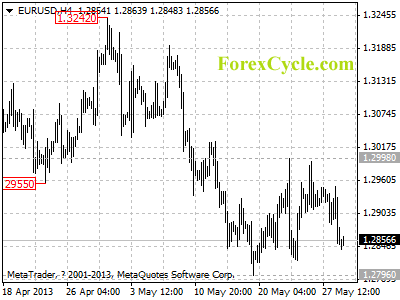
EURUSD continues its sideways movement in a range between 1.2796 and 1.2998. Key resistance is at 1.2998, as long as this level holds, the sideways movement could be treated as consolidation of the downtrend from 1.3242, another fall to test 1.2747 support is still possible. However, a break above 1.2998 resistance will indicate that the downtrend from 1.3242 had completed at 1.2796 already, then the following upward movement could bring price to 1.3500 zone.

eurusd

Daily Forex Analysis

The Real Magic Of Apple

By MoneyMorning.com.au

What’s Apple doing at the moment? Possibly the greatest magic trick the corporate world has seen. And it scares me that a company of this size and stature seems to have lost their way.

Dan Denning went so far to say Apple might not even exist in the next 5 years.

The question that haunts me is why is a company that is supposed to make technology offering corporate bonds? They’ve lost sight of what they’re all about; making and inventing breathtaking technologies. That should be the real driver for the company.

Perhaps Apple haven’t been the tech-gods we’ve held them up to be. What if instead they’re actually the best magicians in the history of mankind?

Where David Copperfield could make the Statue of Liberty disappear, Apple it seems can make money disappear and products appear in its place. It’s the corporate version of the Shell Game.

The Real Genius Behind Apple

Apple’s products seem to just appear on the market from nowhere. A colourful cloud of smoke and ‘shazam!’ we have the worlds next greatest device at our fingertips.

But what if I was to tell you everything inside the iPhone, iPad, iPod and iMac was readily available or conceptually borrowed perhaps, from other technologies?

Imagine a world with email, games, the internet, music, weather updates and GPS in a phone. And years before the iPhone was even released.

Well that world actually existed. You could have had all those features if you’d known about the IBM Simon Personal Communicator, The Danger Hiptop (SideKick), Ericsson R380 and Benefon Esc!. But you didn’t; most people didn’t.

What Apple did, was take a little from column A, and little from column B, C, D and E, make it pretty and market the pants off it. There’s nothing ‘new’ about <Apple's products at all. In fact to quote Steve Jobs, 'Good artists copy, great artists steal.

One thing’s for certain though, every Apple product is a master class in design.

That means if you want to really put the successes of Apple down to one man, it’s not Steve Jobs, it’s certainly not Tim Cook. It’d be Sir Jonathon ‘Jony’ Ive.

Ive is the design maestro behind the iMac, iPod, iPhone and iPad. He’s the real genius at Apple. And with Ive still on board, there’s a glimmer of hope left.

Apple finally realised this when they shifted Ive from pure prototype and product development. He now has unprecedented influence over software development after the death of Jobs.

Thievery is Just Part of the Game

But let’s not forget the core of what Apple built their company around; computers. The first range of computers Apple made in the 80′s was actually quite awful.

The story goes they (and Microsoft) stole the graphical user interface and hardware technology from Xerox to create their masterpieces.

It was one of Apple’s most daring illusions. Copy and repackage the Xerox Star into something more elegant and beautiful. The Apple Macintosh.

We continue to go through Apple’s product range and find examples of technology that preceded them. It’s a back catalogue of great ideas, redesigned, made pretty, and labelled Apple.

MPMan and the Diamond Rio preceded the iPod. The Intel WebTablet and HP Compaq Tablet PC preceded the iPad. The difference between them all? Ive’s industrial design, and the marketing power of Apple.

The other area where Apple succeeded and others failed was their commitment to user friendly design and interface software. They weren’t always the most powerful or technically the most amazing. But they were easy to use, so easy a 5 year old could manage their way around one.

And now Apple’s advantage has expired.

It’s not necessarily that Apple’s stopped innovating. It’s just that the competition has figured out the game plan: Take some existing tech (even Apple products), make pretty, market well, sell. Easy.

Apple vs. The Rest is deep in the fourth quarter and ‘The Rest’ have figured out how to beat them. And Apple it seems has no defence. Their offence still has their quarterback (Jony Ive), but the competition knows their plays.

Consider this, the smartphone market has just surpassed the ‘feature phone’ market for devices sold. And feature phones include gems like the Nokia 1100, 3210 and 1200 (combined sales of over half a billion units).

Samsung, HTC, LG, Huwaei, Nokia, Blackberry, Lenovo, Sharp, Toshiba, Motorola (amongst others) all now make smartphones. There are thousands of examples now on the market. Competition is fierce, and Apple no longer is the prettiest or most user friendly.

Same goes for the tablet market. Apple got the jump with the iPad. But now all the same companies that make smartphones make tablets. And many of them are faster, more powerful and more user friendly than the iPad.

Then what’s next for Apple? Competition has become so hot they need a new product to reboot the share price, and the company. But one isn’t coming. In absence of a new product, what else could they do?

Apple’s Best, and Possibly Last Illusion

Well the boffins down at Cupertino decided the answer was a new type of illusion. A share buy-back and bond issue, a band-aid where a tourniquet is required.

And this illusion could be their last if they can’t come up with a ground-breaking product after this.

Having sold $17 billion (USD) of corporate bonds to assist their share buy-back program and reinvigorate their fledgling stock price, Apple are hoping to make you look one way while they try and make magic happen elsewhere.

It’s sleight of hand at its finest. And something Apple is well practiced in.

There’s an accounting term called the ‘Double Irish With A Dutch Sandwich.’ Here’s the definition of it from Investopedia;

A tax avoidance technique employed by certain large corporations, involving the use of a combination of Irish and Dutch subsidiary companies to shift profits to low or no tax jurisdictions. The double Irish with a Dutch sandwich technique involves sending profits first through one Irish company, then to a Dutch company and finally to a second Irish company headquartered in a tax haven. This technique has allowed certain corporations to dramatically reduce their overall corporate tax rates.

A New York Times report claimed Apple invented this technique. Possibly one of the only things they’ve actually ever invented.

What does The Double Irish Dutch have to do with the bond issue? Well Apple’s headquarters are in Cupertino, California. But most of their profits are actually from overseas. And about $100 billion of their $145 billion in cash resides outside of the US.

If you’re Tim Cook, you need to get some confidence back into the company. What better way than a buy-back! But you need to fund the buy-back. And most of the money is on holiday, indefinitely.

It’s away in places like Ireland, The Netherlands, Luxembourg, The British Virgin Islands and of course the US. Try following the red ball with that shuffle game…

Mind you, Apple isn’t alone either. Google, Microsoft, IBM and Apple all lobby the White House hard and regularly for a tax repatriation holiday.

That is, a cease-fire with the IRS to bring their billions, likely trillions, of cash back home from abroad. Because none of them want to bring that cash back when it would mean billions in taxes.

Needless to say, the US aren’t having a bar of it.

Tax avoidance aside, in Apple’s case there’s only one way to breathe life back into the share price right now, and that’s a buy-back and bond issue. When you’re not doing what you should – making cool tech – you still have to keep shareholders happy.

Ta-da! Over 8% shift upwards in the last week. The illusion is in play. And it might be their last one.

While the markets are looking to the right, over on the left, Apple is desperately trying to come up with the next big thing during this diversion.

iWatch? iTV? iCar? It seems as though Apple have lost their mojo. Because none of those products that are rumoured to be in the pipeline will do for the company what they hope.

Forget about $1,000 share prices, widely touted as the next level for Apple this time last year. They’ll be lucky to keep their heads above $100 on the track their heading.

My point here is when people say Apple have stopped making great new products, they’re wrong. They never started. And they’re not on track to amaze us again anytime soon.

If anything, Apple’s an amazing design and marketing company parading around as a technology company.

When the illusion is over and Apple can’t magically make a product appear…the audience will be disappointed, and disappear themselves.

And in the tech world, the audience will simply go to one of the other, many, more exciting shows.

Sam Volkering
Technology Analyst, Pursuit of Happiness

Join Money Morning on Google+

From the Archives…

Working Towards Independence From The State
20-05-2013 – Kris Sayce

The Useful Wisdom of Mrs. Borsodi’s Canned Tomatoes
15-05-2013 – Chris Mayer

What the Latest Interest Rate Cut Could Mean for You
8-05-2013 – Kris Sayce

The Government’s Idea of Wealth Creation
6-05-2013 – Kris Sayce

Is There More to Life Than Money and Investing?
29-04-2013 – Kris Sayce

The Transatlantic Trade and Investment Partnership: Will It Happen?

By The Sizemore Letter

What do you get when you have a second-term American president eager to secure a positive legacy and a European continent desperate for economic growth?

If all goes well, you’ll have a game-changing free trade agreement between the United States and the European Union.

The agreement—tentatively called the Transatlantic Trade and Investment Partnership (“TTIP”)—will potentially be the biggest trade deal in history, covering half the world’s economic output and roughly a third of all global trade. It makes NAFTA and the (alas, defunct) attempt at the Free Trade Area of the Americas look puny by comparison.  Negotiations are supposed to formally begin in July and might take as long as two years.

A free trade deal of this scale is no easy project; even small deals, such as recent pacts with Colombia and South Korea, have political stumbling blocks.  What may be liberating for consumers in the form of lower prices and better selection is the protected turf of favored industry and labor groups.

Past attempts at comprehensive trade deals across the Atlantic have lost steam.  Neither side was committed enough to challenge the subsidies given to their coddled farmers and some of their “national champion” industries (think American Boeing vs. French Airbus).  France has also consistently insisted that there be “cultural exceptions” for French-language films, music and art…which gums up negotiations on media and intellectual property.   And the United States government procurement market is much harder for foreign firms to break into than most European government markets.  Congress tends to play the populist “Buy American” card when it comes to supplying the government…which, of course, jacks up expenditures for American taxpayers.

So, while Americans and Europeans both like the idea of free trade in theory, in practice the status quo has been too hard to overcome.

But today, the timing might finally be right.  You have free-trading Republicans controlling Congress and a Democratic president who sees an opportunity to strengthen political and economic ties with “Old Europe.”

The Democratic Party—traditionally hostile to free trade for the perceived damage it does to American labor—has also been gradually getting more comfortable with it since the presidency of Bill Clinton, and the fact that European labor markets are regulated as high (or higher) than America’s makes a deal easier for them to swallow.  This isn’t a giveaway to Big Business using cheap third-world labor; it is partnership between two large players with similar income levels.

And for the geopolitical strategists and foreign policy hawks, uniting the Western world under a giant trade umbrella allows the West to effectively set the rules for the world economy for the next 50 years and waters down the influence of China, India, and other emerging countries.

And on the European side, it amounts to one word: growth. 

The Eurozone crisis has stabilized in the sense that the breakup of the currency union is off the table, at least for now.  But the entire continent is suffering from having too much debt and not enough growth to realistically pay it back…or even stop it from snowballing.

As the past two years have proven, Europe’s leaders will push through major reforms only when they have the bond market pointing a proverbial gun to their heads.  But shaking up their protected industries, while politically hard, is easier than raising taxes and cutting spending in perpetuity. A free trade deal with the United States give Europe a potential way out of the malaise.

The potential deal has broad support, but it also has two powerful enemies on both sides of the Atlantic: populism (of both the labor left and the isolationist right) and entrenched interests.   Let’s hope the voices of reason prevail.

SUBSCRIBE to Sizemore Insights via e-mail today.


Steer Clear of Gold for Now

By The Sizemore Letter

From The Slant:

Gold has pushed below $1,400 again. And despite a bump Thursday on a decidedly “risk-off” day for the market after poor China manufacturing data, gold prices are threatening to retest lows around $1,320 set in mid-April.

Of course, the rebound in gold prices off those April lows — about 12% in just several trading days — have some swing traders wondering if another leg up is in order.

Not quite.

Charles Sizemore of Sizemore Capital Management chats with me about the dynamics working against gold in this latest podcast, particularly the notion that somehow the selloff is less real because it involves “paper gold” as securitized via bullion-backed ETFs like the SPDR Gold Shares (GLD) or the iShares Gold Trust (IAU).

My two cents: Gold’s declines are real, the losses are real, and the risks to future declines are real, too.

What Housing Recovery? Percentage of First-Time Home Buyers Falls Again in April

Home-BuyersIt’s almost as if the mainstream media is defining the U.S. housing market as being “hot,” while some economists are calling for robust growth ahead for the housing market. But the reality is that we are far from a recovery in the housing market and more troubles could follow.

As I have discussed in these pages many times before, institutional investors are running to buy homes for rental income, because the yields elsewhere are getting thinner. As a result, we’ve experienced hikes in home prices in the U.S. housing market.

Institutional investors rushed to buy homes with the philosophy of buy cheap, renovate, and rent. But they might be in for a surprise. According to real estate research firm Trulia Inc., since 2005, there have been almost four million single-family homes added to the rental market. That supply has met the demand created during the crisis in the housing market. (Source: Trulia Inc., April 4, 2013.)

As a result, the rental rates that institutional investors were banking on are actually compressing. Take a look at the table below, which depicts the year-over-year change in rental rates and home prices in some major cities in the U.S. economy.

U.S. City

Year-over-Year % change in rental rates for single-family homes

Year-over-Year % change in single-family home prices

Las Vegas, NV

-1.9%

24.6%

Fort Lauderdale, FL

-1.2%

10.7%

Chicago, IL

-1.2%

3.6%

Orange County, CA

-0.7%

13.7%

Washington, DC

-0.7%

6.2%

As institutional investors are paying more for homes, their rental income is getting softer.

And the fact of the matter is that we are missing the most important piece of the puzzle for a real housing market recovery—first-time home buyers. Existing-home sales reported by the National Association of Realtors (NAR) showed that in April, first-time home buyers accounted for only 29% of the purchases in the housing market—a decline of more than 17% from April of 2012, when first-time home buyers accounted for 35% of all the existing-home sales. (Source: National Association of Realtors, May 22, 2013.)

And there are other troubling issues in the housing market; more than a quarter of all homes with a mortgage in the U.S. housing market had negative equity in the first quarter of 2013, while 18.2% of homeowners didn’t have enough equity to be able to cover the related costs of selling or moving into another home. (Source: Zillow, May 23, 2013.)

All of this is just simply adding to my skepticism toward the housing market recovery. At the very best, the U.S. housing market is still very anemic.

Article by profitconfidential.com

Tips on Avoiding Forex Broker Scams – What All Forex Traders Must Know

By Jason Hamilton

With all the Forex brokers out there, ready and willing to take your money to help you make your first trade, it may be a little intimidating finding a honest broker. To that end, as part of your Forex training, here are a 6 tips that will help you in choosing a broker that you can trust and not end up taking and walking away with your money.

1. Watch out for a company that claims that there is little or no risk in trading the currency market. Any broker that is legitimate should tell you that there is ALWAYS risk! True, you can mitigate that risk with stop losses, sound trading techniques, and equity management, but there is always a risk involved in trading. If it sounds too good to be true, it usually is too good to be true!

2. Check out the company’s background. If a company refuses to give you background information on their company or information about their customer’s experience, beware! You may also want to check with the National Futures Association for any history of fines or deceptive trade practices by the company in question. Another good source of information is the Chicago Board of Trade. It’s there that you can check to see if the company is a registered “futures commission merchant” (or FCM for short). Companies registered with these two organizations are more likely to be legitimate than those that are not. In addition, there is a lot of information that can be found with these two organizations that can help you further your Forex training.

3. If a company says that you will make fantastic amounts of money in a short time, run for cover! Like anything else in life, to be a good Forex trader takes time, effort, and LOTS of study. There is no magic formula that will have you making thousands in just a few days, unless you’re a scammer or amongst the best traders in the world.

4. Use caution when dispatching cash over the Internet. Make sure the entity you are sending money to has satisfied your background check and that they are registered to business in a country with strong legal laws in case a problem arises. Be especially wary about sending money to countries that have reputations for high levels of corruption and bribery.

5. Use caution when trading on the margin. Depending on the broker, they may make you responsible for more money than you actually deposited. A key part of your Forex training should teach you how margins work and your broker’s approach to them before you trade margins.

6. Watch out if a company states that they are safe to work with because they trade in the “interbank market.” To date, the interbank market is largely unregulated and is usually traded by central banks, multinational corporations and other big time players. A possible scam by a fraudulent currency trading firm may boast of good prices because they deal with the “interbank market.” It is most often the case that only extremely large companies deal with the interbank, and again, it is not regulated and is a loose conglomerate large business and governmental organizations and institutions.

Now that you have some of this Forex training under your belt, there are a few other ways to evaluate a broker. They are: websites that compare brokerages, Forex training courses, and word of mouth. Finally, checking in with an experienced retail Forex trader who has good trading strategies and deals with his or her broker on a regular basis. Doing all of these things can help you make a great choice in selecting a Forex broker that will help you keep that great tune “Money” playing in your head.


About the Author

Jason Hamilton has been successfully trading the Forex market since 2002. He recently reviewed the popular Fap Turbo – Forex Trading Robot, which can be read at: Fap Turbo Review


Hungary to consider further rate cuts if inflation on target

By www.CentralBankNews.info     Hungary’s central bank, which cut its rate for the 10th time in a row to 4.50 percent, said it would consider cutting rates further if the “medium-term outlook for inflation remains in line with the Bank’s 3 per cent target and the improvement in financial market sentiment is sustained.”
    The forward guidance by the National Bank of Hungary has been similar for many months, indicating that the bank is likely to continue the cycle of monetary easing that started in August 2012.
    The contrast between benign financial markets and the weak outlook for global growth continues to pose a risk and this call for maintaining a cautious approach to policy, the central bank said.
    Hungary’s central bank has now cut rates by 250 basis points since August last year and by 125 basis points this year alone.
    The central bank sounded a slightly optimistic tone about the outlook, saying Hungary’s economy may recover from recession in the first half of 2013 due to a reversal of “adverse one-off shocks” at the end of last year though a sustained pick-up in growth is first likely from the end of this year  when demand from export markets improves.
    “In the council’s judgement, the incoming economic data suggest that weak demand continues to exert a strong disinflationary impact on prices, and therefore companies have limited ability to pass on higher production costs into prices, while they are making stronger adjustments through the labor market,” the central bank said in a statement after a meeting of its council.
    Hungary’s inflation rate fell to 1.7 percent in April from 2.2 percent in March, continuing the trend of declining inflation since a peak of 6.6 percent in September 2012.
    “Recent trends in underlying inflation continue to reflect the strong downward pressure of weak domestic demand on prices,” the central bank said, adding the risks of inflation will remain moderate in the medium term.
    The central bank targets inflation of 3.0 percent and said last month inflation was likely to remain below this target this year and settle around the target in 2014.

    Hungary’s Gross Domestic Product expanded by 0.7 percent in the first quarter of this year for annual contraction of 0.9 percent, less than the 2.7 percent shrinkage in the fourth quarter.