It’s Good Times for the Rich: Luxury Spending Surging Worldwide

It’s Good Times for the RichConsumer spending on luxury goods continues to ramp up.

The easy monetary policy by the Federal Reserve has created a whole new generation of millionaires, or the “new rich,” as the stock market propels to new records.

The spending on high-end goods in the retail sector was further confirmed on Tuesday after high-end jeweler Tiffany & Co. (NYSE/TIF) delivered an impressive quarter, driven by a rise in global spending. The fact that spending on luxury goods is on the rise globally is bullish.

Recall my recent Profit Confidential article in which I stated that the rich continue to spend (see “Higher Taxes: Who Cares? Not the Rich”). The Shullman Luxury and Affluence Monthly Pulse, which is an excellent metric detailing the spending habits of consumers making over $250,000 annually, suggested that higher taxes will not impact the spending patterns of 61% of those earning over $500,000 annually. (Source: Frank, R., “Wealthy Say Higher Taxes Don’t Hurt Spending,” CNBC, March 27, 2013.)

It appears Tiffany is proving the research correct.

In the first quarter, Tiffany reported a nine-percent rise in its worldwide sales to $895 million. If you looked at the sales numbers on a constant-exchange-rate basis, the increase was 13%. Interestingly, the sales increase was worldwide, which bodes well for Tiffany.

In the main Americas region, sales increased six percent to $408 million, representing 46% of total sales. I feel this allocation will shift, as Tiffany expands its presence in Asia, which currently accounts for about 41% of total sales.

The Asia-Pacific region including China but excluding Japan reported impressive sales growth of 15% year-over-year to $223 million. Tiffany’s key comparable store sales jumped nine percent.

The results from Japan were affected by the weak yen, which made the currency translation impact quite noticeable. Yet sales still managed to rise two percent to $145 million. On a constant-exchange basis, sales in Japan surged 20%, with comparable store sales up a whopping 21%. See what the easy monetary policy in Japan is doing?

Even the economically challenged eurozone region managed to pull off a six-percent increase in sales to $93.0 million, which is good, given the mess in this region.

With the report, Tiffany’s shares surged to a new 52-week high on Tuesday and have outperformed the S&P 500 over the past 52 weeks.

Tiffany NYSE Stock market chart

Chart courtesy of www.StockCharts.com

While Tiffany reported excellent results, my favorite luxury-brand stock continues to be apparel and accessories-maker Michael Kors Holdings Limited (NYSE/KORS).

In the handbag area, I continue to favor Coach, Inc. (NYSE/COH), which you can read more about in “These Stocks Benefiting as Rich Spend Lavishly at High-End Retail.”

Article by profitconfidential.com

Gold $1400 Key for Both Western Traders and Asian Buyers as Europe Shrugs Off 2nd Slump in Japanese Equities

London Gold Market Report
from Adrian Ash
BullionVault
Thurs 30 May, 08:10 EST

SILVER and GOLD retreated from one-week highs Thursday morning in London, dropping back as European stock markets reversed earlier losses.

Tokyo’s Nikkei stock index had ended the day 5.5% lower, its second slump in 6 sessions after nearly doubling in six months to hit 5-year highs.

New York stock futures pointed higher however, while commodities slipped and major government bonds held steady.

Silver bullion tracked the gold price’s earlier 1.4% rise, before slipping back beneath $22.60 per ounce.

Gold edged back below $1400 per ounce, a “psychologically important” level according to Marex Spectron’s David Govett, advising short-term traders to buy gold “if we can break and hold above” that mark.

“Physical buyers have helped to limit declines,” says Cinda Futures’ senior trader Yang Shandan in Hong Kong, pointing to the recent surge in Asian gold demand.

“But they have also become more price-sensitive and tend to stay on the sidelines near $1400.”

“The physical market seems to be loosing a little steam,” agrees a note from Swiss refining and finance group MKS.

“The bearish trend remains in place,” says a technical note from bullion bank Scotia Mocatta, even though “we are short-term neutral until this consolidation period is resolved.”

The base of gold’s current consolidation sits at $1339, says Scotia, pegging resistance at last week’s gold price high of $1414 – the same level identified today by UBS’s chart analysts.

Following mid-April’s 17% crash in gold prices, “Important liquidations in percentage terms are familiar in this market,” says the latest analysis from Italian bullion supplier Italpreziosi.

Pointing to the gold price slumps of May 2006 (-26%), spring 2008 (-30%), and Sept. 2011 (-21%), “what seems different is that the crash was accompanied by a ‘bear media campaign’, which could undermine confidence in the multi-annual bull trend,” says the note.

Wednesday saw the first uptick in nearly 3 weeks in bullion holdings at the world’s largest exchange-traded gold trust fund, the SPDR listed in New York (ticker: GLD).

Only the 6th increase in 2013 to date, however, it left the SPDR’s total holdings more than 5% down for the month of May, and 25% below the record of Dec. 2012.

Gold demand in Asia in contrast is on track for a record quarter said market-development organization the World Gold Council on Wednesday.

“Even if E.T.F. outflows continue in the United States,” managing director Marcus Grubb told Reuters, “it is quite likely that gold will find a ready market among Indian, Chinese and Middle Eastern consumers who are taking a long-term view.”

Adrian Ash

BullionVault

Gold price chart, no delay | Buy gold online


Adrian Ash is head of research at BullionVault, the secure, low-cost gold and silver market for private investors online, where you can buy gold and silver in Zurich, Switzerland for just 0.5% commission.


(c) BullionVault 2013

Please Note: This article is to inform your thinking, not lead it. Only you can decide the best place for your money, and any decision you make will put your money at risk. Information or data included here may have already been overtaken by events – and must be verified elsewhere – should you choose to act on it.


Moldova holds key rates steady, base rate at 3.5%

By www.CentralBankNews.info     Moldova’s central bank maintained its basic rate at 3.5 percent along with its 1.5 percent rate on overnight deposits and 6.5 percent rate on overnight credits.
    The National Bank of Moldova (NBM) did not issue any statement in connection with the decision by its council to keep rates steady.
    Moldova’s central bank last changed rates on April 25 when it cut its rates by 100 basis points. The central bank targets inflation of 5.0 percent, plus/minus 1.5 percentage points.
    Moldova’s inflation rate eased to 4.5 percent in April from 5.4 percent the previous month and down from an average of 4.7 percent in 2012. The International Monetary Fund forecasts 2013 inflation at 4.6 percent.
    Moldova’s Gross Domestic Product grew by 0.91 percent in the fourth quarter of 2012 from the third quarter for an annual contraction of 2.5 percent, a sharper decline than the third quarters’s 0.2 percent fall.
    Last year Moldova’s economy contracted by 0.8 percent due to severe drought and reduced demand for its products by its main trading partners, Romania and Russia.
    Moldova is one of the poorest countries in Europe, located between Romania and the Ukraine.  
    In January the NBM governor forecast that Moldova’s economy should expand by 3 percent this year and 4 percent in 2014.

    www.CentralBankNews.info

Central Bank News Link List – May 30, 2013: Wheeler says RBNZ ready to weaken kiwi as resolve challenged

By www.CentralBankNews.info

Here’s today’s Central Bank News’ link list, click through if you missed the previous link list. The list comprises news about central banks that is not covered by Central Bank News. The list is updated during the day with the latest developments so readers don’t miss any important news.

WTI trades flat before the OPEC meeting

By HY Markets Forex Blog

West Texas Intermediate crude traded close to the lowest price in four weeks, according to reports released by the American Petroleum Institute (API), which indicated that the U.S stockpiles increased the most in a month.

The report also indicates that the U.S crude inventories increased by 4.4 million barrels last week to 395.1 million barrels, the highest in over three decades.  WTI crude oil was slightly up 0.13% trading at $93.26 a barrel, while Brent crude rose up to 0.31% trading at $102.72 a barrel on Thursday morning.

Futures in New York fell by 2 percent yesterday, marking its biggest drop since May 1st.

Oil investors are focusing towards the Organization of the Petroleum Exporting Countries (OPEC) meeting, which is due to take place on Friday in Vienna. Members of the board and investors are expected to tackle and discuss the issues and topics regarding oil production. OPEC supplies about 40%of global oil supply and now producing 30.4 million barrels per day.

The meeting is expected to review the group’s target for oil production to keep the oil prices above $100 per barrel level. Economists and analysts are predicting, there won’t be a change in the output target.

“Only a little above the organization’s target and this reflects the demand on its crude,” the United Arab Emirates’ Energy Minister Suhail Al Mazrouei said this week. Global demand for crude is expected to stay “relatively weak this year” at around 800,000 barrels per day more than in 2012, the minister added.

The Market sentiment was hit by reports from the OECD that cuts its growth forecast for the global economy from 3.4% to 3.1 this year.  While the trader’s outlook got hit after the international Monetary Fund cut its projection for China’s growth in the economy to approximately 7.75% this year.

The post WTI trades flat before the OPEC meeting appeared first on | HY Markets Official blog.

Article provided by HY Markets Forex Blog

European stocks increases ahead of U.S data

By HY Markets Forex Blog

European stocks rose from a three-week low on Thursday. Investors from around the world are predicting the U.S economy had expanded by 2.5 percent in the first quarter. Investors are still awaiting the US gross domestic product reports for the first quarter.

The Stoxx Europe 600 Index inched up 0.2 % to 303.14 at 8:08am GMT .While the German’s DAX reduced by 0.10% to 8,328.29, Standard & Poor’s 500 index fell by 0.1% .Franc e CAC 40 increased by 0.43% to 3,990.82 and the UK’s FTSE 100 gained 0.27% to 6,645.30.

With the Stoxx 600 dropping by 1.9 yesterday, investors raise concerns in the U.S. Treasury market that the Fed will narrow the bond purchases as the economy strengthens.

Meanwhile in Spain, the final gross domestic product fell by 0.5 percent in the first quarter. In Italy, the retail purchasing managers’ Index for the euro zone stood at 46.8 points in May compared to April’s record of 44.2. According to the National institute for statistics, Producer prices in Italy fell by 0.4% from month to month in April after a flat reading in March.

In Rome, the government will try to sell five-year bonds with a fixed coupon of 2.84%, with bonds growing in 2023 with a fixed coupon of 3.94%. The target for the sale is an estimated 5.75 billion euros.

The German Chancellor Angela Merkel met with French President Francois Hollande to discuss plans on how to strengthen the management of the 17-nation boost of the industry.

The post European stocks increases ahead of U.S data appeared first on | HY Markets Official blog.

Article provided by HY Markets Forex Blog

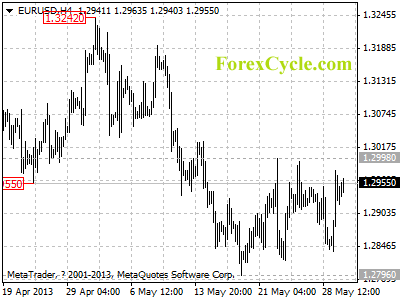
EURUSD is facing 1.2998 key resistance

EURUSD is facing 1.2998 key resistance, a break above this level will indicate that the downward movement from 1.3242 had completed at 1.2796 already, then the following upward movement could bring price to 1.3500 area. On the downside, as long as 1.2998 resistance holds, the price action in the trading range between 1.2796 and 1.2998 is treated as consolidation of the downtrend from 1.3242, one more fall to test 1.2747 support is possible after consolidation.

eurusd

Daily Forex Forecast

Getting in on the ‘99 Cent Craze’ with Crowdfunding

By MoneyMorning.com.au

When we hear news reports about consumer spending being soft and businesses struggling, frankly we think it’s all rubbish.

From our perspective, no other time in history has been so promising for people with a great idea (some call them entrepreneurs) to go from zero dollars to a million overnight.

And the way they do this is from other normal people with great ideas.

You see people are willing to spend their money. But…only on great ideas or great people. And in the digital world, there’s plenty of both.

As money flows into the digital economy it takes great ideas and turns them into multi-million dollar businesses. Because of this, it’s the best time to have a great idea; you just have to get it out to the people…

The exciting part about it all is its happening more regularly and frequently as we get more entrenched in the digital world.

It isn’t some inflated bubble of an industry. It’s a whole new financial system. And the reliance on financial institutions and borrowing has gone out the window. Hoorah!

Most people will spend a dollar. You see a single dollar is psychologically insignificant. Some will spend ten and some a hundred with the same mindset. But the point is there’s plenty of spare money floating around.

And the best example of this is the explosion of crowdfunding thanks to the internet and social networks.

Crowdfunding, A Huge Trend Developing

Crowdfunding takes a big job (a project) and breaks it down into thousands of little jobs. That is, instead of trying to raise one lot of $100,000 from a bank, it’s possible to raise 100,000 single dollars from 100,000 people. It about getting funding from the ‘crowd’.

And this isn’t some fad. Crowdfunding projects rose to over $2.7 billion in 2012. It’s projected crowdfunding will swell to over $5.1 billion in 2013. At this rate, crowdfunding will likely surpass $10 billion by the end of next year.

The great thing about crowdfunding is anyone can become an entrepreneur. If you want to start a business making paper planes or cat memes you can raise a project on one of the many crowdfunding websites.

If your project is good enough people will fund you. It could be a dollar, it could be $10,000. The key to it is being able to sell your project online. A great video and graphic illustration of the project is a good start.

You might have heard of some of the crowdfunding sites, Kickstarter, Indiegogo and RocketHub. Either way, if you haven’t, you should. Because anyone can be a success through these sites.

Take for example the biggest crowdfunded project ever. The Pebble watch. It’s a watch with an e-ink display. It’s Bluetooth connected to your smartphone and displays some of the key information from your phone, on the watch.

Initially the project needed $100,000 to launch their product. At the end of the funding timeframe, the project had raised over $10.2 million.

Let’s just consider the scope of that. Crowdfunding led to the project being 10,000% overfunded.  And if a project is overfunded it just means the project creators get more cash to grow the business.

The Pebble project has been an outstanding success. It’s even inspired a whole new range of consumer technology. Apple’s now doing a smart watch like the Pebble, as are Microsoft and Samsung. The disruptive potential for successful projects is mind-blowing.

Of course the catch is for anyone that funds a project, they usually get something in return. Usually a pre-release product, a limited edition version or multiple products. They get something for the dollars they put in.

Unleashing the Entrepreneurs with Crowdfunding

Pebble isn’t alone either. Some other recent projects are now rolling in millions thanks to crowdfunding. Oculus Rift, a Virtual Reality head-mounted display, raised $2.4 million. Ouya, a new type of game console, raised $8.5 million. Even a start-up that makes a durable hoodie raised over $1 million.

For every million dollar project there are five more in the hundreds of thousands. And for every 5 of those, there’s 20 in the tens of thousands. It’s like Matroyshka dolls made from cash.

We’re talking small projects that instantly become million dollar companies. Literally sometimes overnight, Pebble hit a million dollars within 28 hours of listing on Kickstarter. Crowdfunding is simply going in the same direction as the App Revolution. Or as we like to put it, the ’99 cent craze’.

Think about it like this, the Apple App store is almost at 50 billion downloaded apps. That means, in a roundabout way, every single person on earth has 7 apps.

And the average app price in the Apple App store is $1.43. That makes an industry of over $71 billion. And that’s just the Apple Apps. Android downloads are around 25 billion.  Ahem…who said consumer spending was slow?

Crowdfunding is heading along the same trajectory. What has grown into a multi-billion dollar system in just 4 years will soon hold more power and sway than the largest financial institutions, who have been around for hundreds of years.

If you’re anything like me, Kickstarter and Indiegogo will sit high on your online bookmarks. I regularly trawl through new projects looking for the next great product, or novel, or game, or piece of design.

Because crowdfunding and the companies they create aren’t going away. But what it might do is turn out the next Google or Apple. And if you’re savvy enough it’ll be the chance to get in literally at the earliest stage possible.

Sam Volkering
Technology Analyst, Money Morning Australia

From the Port Phillip Publishing Library

Special Report: How to Buy Better Stocks 

Daily Reckoning: House Prices First, Stocks Second.

Money Morning: Buyer Beware: Japanese Government Bonds are Moving

Pursuit of Happiness: How One Reader Saved $300 with a Simple Phone Call

Join Money Morning on Google+

When Science Fiction Becomes Science Fact

By MoneyMorning.com.au

We may have not seen the day when we have flying cars…but damn, are we getting close!

Early last year, for example, Google started testing self-driving cars. With Nevada taking the first leap of faith by giving them licenses, now they’re legal in Florida, California and Texas as well.

As of August 2012, over 300,000 autonomous hours are logged so far with a flawless safely record, unless you count the two accidents that happened when they were manually piloted.

This is just one example of how we have reached a tipping point.

Science and Technology is Changing the World…

Yet most people aren’t paying attention.

When the right minds and the right capital get behind such ambitious dreams, science fiction can become science fact. To see what I really mean, consider this…

You know about 3-D printing. But did you know that an Italian by the name of Enrico Dini has created a 3-D printer that’s capable of printing a two-story building?

Complete with rooms, stairs, pipes and partitions, the resulting material is as durable as reinforced concrete and has the look of sculptured marble.

According to him, similar structures can be built in a fourth the time as traditional buildings and without specialist knowledge. Imagine the impact on the construction industry…

Sound scary? Not if you’re on the team doing the disruption…

How about genetically modified silk that’s stronger than steel?

At University of Wyoming, scientists modified a group of silkworms to produce silk that is, weight for weight, stronger than steel. That could mean stronger sutures for the medical community, biodegradable alternatives to plastics or lightweight armour for our military.

Speaking of the military, did you know British Columbia Company HyperStealth has built a functioning prototype of an invisibility cloak for the U.S. and Canadian militaries this year?

I know that sounds like something straight out of the Harry Potter books your children and grandchildren read. And maybe you have to see (or not) to believe, but do you think the militaries of sovereign nations would seriously consider science fiction?

I didn’t think so. It’s called Quantum Stealth, and it works by bending light waves around the wearer without the use of batteries, mirrors or cameras. It blocks the subject from being seen visually, and also keeps them hidden from thermal scans and infrared.

Driving the Point Home

Consider how the invisible is being made visible…in Outer Space. Voyager 1 was launched in 1977 as the first man-made object, and while it was originally intended to fly to Saturn and Jupiter and send home images, NASA scientists soon realized the probe would venture into the unknown blackness of deep space.

So the team showed their playful side for any potentially friendly aliens out there. They placed recordings on Voyager I with sounds ranging from music to whale calls and greetings in 55 languages… just to give a sample of intelligent life on Earth… for anyone listening.

And while James Cameron was making sci-fi movies like Avatar about far off planets with forests filled with blue people, he was also scheming to accomplish a 2.5-hour voyage 6.8 miles deep to the Mariana Trench, the deepest known point in our oceans.

As you may have guessed, he did it. And in so doing was the first solo human – in his 2.5-story ‘vertical torpedo’ submarine – to witness the exotic life within those great depths, collecting various samples along the ocean floor.

It makes you salivate as an investor.

Josh Grasmick
Contributing Editor, Money Morning

Join Money Morning on Google+

From the Archives…

The Day Japan and China Shook the Aussie Market

24-05-2013 – Kris Sayce

Why the Only Thing That Matters in the Markets is Japan
23-05-2013 – Murray Dawes

When Soros Buys Gold Stocks, You Better Take Note…
22-05-2013 – Dr Alex Cowie

Look for Small-Cap Resource Stocks with Plenty of Cash
21-05-2013 – Dr Alex Cowie

Why Bank Stocks have Outperformed Resource Stocks…
20-05-2013 – Kris Sayce

Brazil raises rate 50 bps to bring down inflation

By www.CentralBankNews.info   Brazil’s central bank raised its benchmark Selic rate by 50 basis points to 8.0 percent to help bring down inflation and “ensure that this trend will continue next year.”
    In a brief statement, the Central Bank of Brazil said its policy committee, known as Copom, had agreed on the rate rise unanimously and it did not issue a bias about the future trend of policy.
    It is the second consecutive rate rise by Brazil’s central bank following a 25 basis point rise in April, bringing this year’s total rate increase to 75 basis points. In 2012 the central bank cut rates by 375 basis points in response to declining economic growth before freezing rates from November through March.
    Today’s rate rise was largely expected and follows recent warnings by the central bank’s governor that he would do “what is needed, in a timely manner, to ensure inflation declines.”
    Brazil’s inflation rate eased to 6.46 percent in the rolling one-month period through May 15 from 6.49 percent in April, close to the upper limit of the central bank’s target range of 4.5 percent, plus/minus two percentage points. It was first decline since inflation started to accelerate in July 2012.

   The central bank has forecast inflation of 5.7 percent this year and 5.3 percent in 2014.
    Brazil’s Gross Domestic Product expanded by 0.6 percent in the first quarter, the same quarterly rate as in the fourth quarter, for annual growth of 1.9 percent, up from 1.4 percent in the fourth quarter, continuing a rebound since hitting a recent low of 0.5 percent in the second quarter of 2012.
    Nevertheless, growth in the first quarter was below expectations as industrial output dropped, driven by a 6.6 percent drop in mining, along with lower construction activity.
    Earlier today, the central bank lowered its 2013 growth forecast to 2.93 percent from 2.98 percent but maintained the 2014 forecast at 3.5 percent. In 2012 the economy expanded by only 0.9 percent.

    www.CentralBankNews.info