Asian stocks rise ahead of Fed meeting

By HY Markets Forex Blog

The Asian shares were traded higher on Monday ,along with the Japanese shares due to the strong profit in exporters stocks ,while investors waits for data about the bank’s bond-purchasing  from the Federal Reserve (Fed) policy meeting on Tuesday  .

The broader Topix edged at 2.7%to 1,084.72, while the benchmark Nikkei 225 rose 2.73%   to 13,033.12 by the end of the session. Australia’s S&P/ASX 200 increased with 0.7, closing at 4,811.00   , while New Zealand’s NZX 50 index edged higher by 0.6 %.

South Korea’s Kospi closed at 0.32% to 1,883.10, while the Chinese Shanghai composite rose 0.17% to 2,165.70 and in Hong Kong, Hang Seng increased with 1.30% to 21,242.30, all as of 6.04 am GMT. The Singapore Straits Times index advanced 0.7% and the Taiex index added 0.7 %.

The market waits for this week’s Fed policy meeting which should clarify investors regarding the bond-purchasing program, which has caused a bit of an outbreak in the markets.

The Chairman of Fed Ben S. Bernanke is expected to address the subject after the two-day Federal Open Market Committee (FOMC) has been held.

Approximately $3 trillion has been wiped from the global market since the Fed boss Ben.S Bernanke said, policy makers could cut back stimulus if the job market improves.

The Chinese economic growth is predicted to increase in the second half of the year, with a year gross domestic product estimated at 8.1%, according to reports released by Renmin University. While the Bank of Japan (BoJ) purchased a total of 111.4 billion yen in the Japanese government bond this Monday.

The post Asian stocks rise ahead of Fed meeting appeared first on | HY Markets Official blog.

Article provided by HY Markets Forex Blog

Gold prices increases reflecting on US data

By HY Markets Forex Blog

The yellow metal price rose slightly higher on Monday as investors outlook was affected by the weaker-than-expected US data from Friday. Gold edged to 0.10% to $1,389.10 per ounce at 4:45pm GMT.

Recommendation from the US Commodity Futures Trading Commission suggested that investors should cut their net long positions in gold futures by 4.1% to 54,779 contracts.

The US dollar index increased up to 0.14% to 80.786 as of 4:56pm GMT, while gold futures finished last week higher, closing at approximately 0.35% ($1,382.60).

The US consumer outlook dropped from its previous month’s record of 84.5 to 82.7 in June, according to data released from the UoM on Friday.

The US central bank has tied the bond purchasing program, which is helping to increase the gold prices to its highest in years and improving the labor market. Policymakers suggest that if the unemployment rate continues to reduce they would consider reducing the rate of the bond purchases, which is at a current $85 billion a month.

Fed policymakers are expected to even out the market swings at its upcoming two-day meeting from Tuesday. The Fed boss Ben Bernanke is expected to ease the effects of the global financial markets regarding an early cut of the QE program after the team on the Federal Open Market Committee (FOMC) approve more weeks of full bond-buying.

The post Gold prices increases reflecting on US data appeared first on | HY Markets Official blog.

Article provided by HY Markets Forex Blog

India maintains rate, CRR, fall in rupee may fuel inflation

By www.CentralBankNews.info     India’s central bank held its policy rate and cash reserve ratio (CRR) steady and warned the recent fall in the rupee could fuel inflation and it was ready to use “all available instruments and measures to respond rapidly and appropriately to any adverse developments.”
    The Reserve Bank of India (RBI), which was faced with a rapid drop in its currency last week – along with other emerging markets – acknowledged that inflation had eased but food inflation remained high and warned that “upside pressures on the way forward from the pass-through of rupee depreciation, recent increases in administered prices and persisting imbalances, especially relating to food, pose risks of second-round effects.”
    India’s annual wholesale price inflation, the country’s main inflation gauge, eased to 4.7 percent in May from 4.89 percent in April for the lowest rate since November 2009. All categories in the index fell except for food, which is sustaining the upside pressure on inflation, the RBI said.
    Retail price inflation fell to 9.3 percent in May from an average of 10.2 percent in fiscal 2012/13. The RBI does not have a formal inflation target but is aiming for inflation of 5 percent by March 2014.
    “Given that food inflation remains high, the inflation outlook will be influenced by concerted efforts to break food inflation persistence,” the RBI said, adding that the outlook would be affected by “suppressed inflation being released through revisions in administered prices, including the minimum support prices (MSP) as well as the recent depreciation of the rupee.”
    Following the recent decline in the rupee, economists had expected the RBI to keep its policy rate steady at 7.25 percent but many had expected the central bank to cut the CRR,  which determines the proportion of deposits that banks have to keep in cash at the RBI, to stimulate growth.
    The RBI has cut its policy rate three times this year by a total of 75 basis points and last cut the CRR by 25 basis points in January.
    The RBI said its policy stance would be determined by the path of economic growth, inflation and the balance of payments situation in the months ahead.
    “It is only a durable receding of inflation that will open up the space for monetary policy to continue to address risks to growth,” the RBI said.
    Although several measures have been taken to contain the current account deficit, the RBI said it had to be vigilant about the current “global uncertainty, the rapid shift in risk perceptions and its impact on capital flows.”
    Most emerging markets have faced pressure on their currencies and domestic markets since late May when investors started to prepare for an expected reduction in asset purchases by the U.S. by reducing their holdings of emerging market assets.
    India is especially vulnerable to the effect of an outflow of capital due to its high current account deficit (CAD) which widened to $32.6 billion in the fourth quarter of 2012, equivalent to 6.7 percent of Gross Domestic Product.
    The CAD is expected to narrow in the current 2013/14 financial year due to softer global commodity prices and recent measures to dampen gold imports, the RBI said, adding the main challenge is to reduce its to a sustainable level so it can be financed through stable capital flows.
    An improvement in the government deficit and its commitment to keep the fiscal deficit for 2013/14 at 4.8 percent from 4.9 percent for 2012/13 should have a favourable impact on investor confidence.
    India’s rupee has been depreciating since July 2011 but stabilized in the first few months of this year, trading around 55 rupees to the U.S. dollar. But since the beginning of May, the rupee has fallen rapidly and hit a record low of 58.98 to the dollar last Tuesday before recovering after dealers reported intervention in the market by the RBI.
    From May 22 – when Federal Reserve Chairman Ben Bernanke said asset purchases could be reduced “in the next few meetings” of the Fed – to June 11, the rupee fell by 6.6 percent “due to sell-off by foreign institutional investors, reflecting risk-off sentiment triggered by apprehensions of possible tapering of quantitative easing by the U.S. Fed,” the RBI said.
    Last week the Finance ministry’s chief economic adviser, Raghruram Rajan was also quoted as saying that India’s government and the RBI would take action to ease the sharp fall in the rupee.
    “As recent experience has shown, shifts in global market sentiment can trigger sudden stop and reversal of capital from a broad swath of emerging economies, swiftly amplifying risks to the outlook. India is not an exception,” the RBI said.
    The RBI also said that global economic activity had slowed since its last statement in May and risks remain elevated.
    Economic conditions in India also remain weak, hamstrung by infrastructure bottlenecks, supply constraints, lacklustre domestic demand and subdued investment sentiment, the RBI said.
    India’s Gross Domestic Product expanded by 4.8 percent in the first quarter of 2013, up from 4.7 percent in the fourth quarter of 2012.

    www.CentralBankNews.info

D-Day for Australian Investors

By MoneyMorning.com.au

Today is D-Day. After six months of preparation I’m finally ready to officially launch Australia’s most exciting investment advisory service.

This afternoon you’ll receive a personal invite to join a technological revolution.

And I don’t say that lightly. You’ll find out about the simple invention that could overthrow China as the cheap manufacturer of the world…how TVs, smart phones and laptops will become so powerful and so flexible, you’ll be able to roll them up and store them in your wallet…and also how energy – rather than getting more expensive – will actually become cheaper, cleaner and more abundant than ever.

I’m certain what you read will impress you. Check your email for full details around 2pm this afternoon.

Until then, on with today’s Money Morning

When does a bull market not feel like a bull market?

When it has gone on for four years and yet barely a day has gone by without fear the market will crash.

Investing in a bull market is supposed to be easy. But you usually only hear those claims after a bull market has ended, with the help of rose-tinted hindsight glasses.

But really, that’s not how it is at all.

Below is a chart of the US S&P 500 index:


Source: Google Finance

The chart covers the last 10 years. It covers two huge bull market rallies. The first lasted from March 2003 until October 2007.

Then followed a bear market that lasted until March 2009…when the next bull market began. Four-and-a-bit years later and this current bull market is still going.

But look at the chart. You could hardly say that both bull markets have been a walk in the park for investors. The current bull market has been especially testing. Several months of gains followed by big falls that have doubtless shaken many investors out of the market…only to see it take off again.

That pattern has repeated at least five times on the US market since 2009.

Australia’s Missing Bull Market

But despite the volatility, the US market has recovered enough to go past the 2007 high.

The latest bull market hasn’t been quite so kind to Australian investors. In fact, when we look at the chart it’s hard to claim with any conviction that the Australian market has seen a bull market since 2009 at all:


Source: Google Finance

Since 2009 the Australian market has a completely different shape to the US market. Where the US market burst higher in 2010, the Aussie market sputtered. Then when the US market took off again in 2011, the Aussie market couldn’t even muster a false start…it just fell in a heap.

It stayed that way for the best part of a year.

Even though the Australian market enjoyed a similar run to the US market in 2012, it did so from a much lower base. So that while the US market hit a record high, the Aussie market is 2,000 points away from taking out the 2007 top.

But regardless of whether you invest in US stocks or Australian stocks, we need to get away from the idea that making money during a bull market is easy, because it isn’t.

Australian Market in No-Man’s Land

The buy-and-hold investors will point to the US index and say, ‘that’s what happens next, stock prices will go back up again.’ They’ll say you should put all your money in the stock market and never sell.

The naturally bearish investors will point to a chart we haven’t shown you today, the Japanese Nikkei225 stock index. They’ll say that’s what happens when a credit-fuelled market crashes and the central bank can no longer prop up the market.

That puts Aussie investors in a bind. Right now the Australian market is in no-man’s-land. It’s a long way from both the high and the low. It’s just stuck in the middle.

This is why we encourage you not to fall for the old buy-and-hold nonsense. In Money Morning we encourage you to take a more active involvement in your investments. And we’re not saying this with the benefit of hindsight either.

In late 2010 we started telling our Australian Small-Cap Investigator subscribers to take some money off the table because we believed the market had seen the end of the best gains.

Turns out we were right.

And then in late 2011 we suggested investors forget about blue-chip growth stocks and instead invest in cash, gold and most importantly, dividend stocks…a message we repeated often through 2012 and into 2013.

But the key question is what you should do next?

A View From the Other Side of the Market

By now you should know your editor’s view on this market. While it looks dangerous and volatile, we still say this is a great time for investors to build wealth.

We say you should use the current period of falling prices to top up your portfolio with a mix of income and growth stocks.

In fact, we’re confident the Aussie market will reach a new high in 2015. But not everyone here at our Albert Park office agrees with that view. In fact, your editor is in the minority on that score.

So, what do our other editors think? One person we suggest you listen to if you’re after another view is our old pal, Sound Money, Sound Investments editor, Greg Canavan.

A few weeks ago Greg sat down to discuss a crucial influence on the Aussie stock market and economy – China. Greg says a slowdown in China could have a major impact on Aussie stocks in the months and years ahead.

In fact, it could be the single biggest influence that determines whether the Aussie market takes off on a new bull market run like the US or sinks into a decade long slump like Japan.

As we say, your editor is optimistic about the future. We believe this is the best time in four years to buy stocks in particular sectors. And that investing in businesses is the single best way to build wealth.

But we also know you can only be a truly enlightened investor if you take into account more than one viewpoint. So we suggest you tune into
Greg’s video to check out his view on the markets, the economy and China.

Cheers,
Kris

Join me on Google+

From the Port Phillip Publishing Library

Special Report: Buy These Four Yen Dive Stocks Now

Daily Reckoning: How the Australian Dollar Stole Your Capital Gains

Money Morning: Money Weekend’s Technology FutureWatch 15 June 2013

Pursuit of Happiness: Government Spies: I Warned of This Trend More Than a Year Ago…

Australian Small-Cap Investigator:
How to Make Big Money from Small-Cap Stocks

The Single Biggest Mistake a Technology Investor Can Make

By MoneyMorning.com.au

Technology helps the world advance. As humans it’s in our nature to investigate, innovate and solve problems.

This curiosity means we make things, create things and develop new technologies.

You can look back thousands of years for basic examples of technology pushing civilisation forward.

Stone Age: it might sound simple, but the development of stone and bone blades and tools was vital to the development of mankind. The earliest example of innovation and technology is a shovel that was fashioned from the shoulder blade of an Ox.

Iron Age: in the Iron Age, iron smelting was all the rage. It helped make better, more efficient tools. This helped construction, agriculture and civilisation continue to advance.

Industrial Revolution: the industrial revolution sparked a wave of new technology. Manufacturing went from being hand produced to machinery made. New efficiencies and tools helped to bring an era of unprecedented wealth.

Of course I’ve skipped a few different ages. Importantly though you can find examples in the Bronze Age, the Atomic Age and the Information Age too.

Over the journey, well at least the last hundred or so years, there have been companies that have been built on these advances in technology. All of them using some form of technology that was ground-breaking at the time.

Some of these companies started on the smell of an oily rag. Today they have transformed into multibillion dollar companies. And there are numerous examples of rags to riches stories across the tech world.

Of course many of these companies went from being just an idea, to a private company, and then to a listed company. For some they just toiled away for many years, the world blind to their potential.

But fundamentally these companies had breakthrough technology ready to be unleashed. And when they took off they made returns in excess of 1,000%. Some of them have returned over 10,000% over the years.

Investment World of Technology

The investment world of technology is thankfully large. Technology is quite a broad term and it spans across many industries. That means opportunities are ample.

It’s easy to think of technology as just computers, phones, tablets and gadgets. But in all reality technology and technology stocks cover a range of industries. These include medicine, resources, telecommunications, automotive and aerospace.

Look at Ford Motor Co. They make cars…so what? But remember, the first cars were revolutionary technology. The car literally changed the world. And Ford started with just $28,000 and one car in 1903. 110 years later they’re a $60bn company that sells over 2.25million cars a year.

Then there’s the Computing-Tabulating-Recording Company started in 1911 with 1,300 employees. They made weird (and large) machines that could calculate mathematics.

Later in 1924 they renamed to International Business Machines (IBM). They helped shape the world we live in today and were pioneers in computing. IBM’s now a $223bn business with over 434,000 employees.

These are two examples of companies started over 100 years ago that exist today because of continued innovation and cutting edge technology.

One final example is a company that started out as a simple radio repair shop in Tokyo in 1945. They went on to make Japan’s first transistor radio. They’re now a $20bn company that has dominated consumer technology for over 30 years. That’s the simplified story of Sony.

Over the years as these companies have grown into billion dollar businesses they’ve made a lot of investors very wealthy. But they started from humble beginnings with technology that not everyone really understood the full potential of.

The Biggest Mistake You Will Make As A Technology Investor

But how are you to know which technology is world changing and which one is all hype? What is it that separates those that make money from investing in tech stocks from those that don’t make any money investing in tech stocks?

Well there’s one big mistake technology investors make when investing in tech stocks. It’s important to know to make sure you don’t make it. I’ll get to it in a second…

One of the key things you need to know first is there’s a lot happening, a lot of new technology and a lot of companies promising the world.

The other is there are fundamentals that you need to know as an investor in tech stocks. In fact in any stocks these fundamentals apply. Good leadership, a good product or service, competitive advantage, a strong plan and the ability to remain solvent are all pretty important.

But what tech stocks eventually boil down to is will this technology change the world? And will enough people pay for whatever the company is selling?

If you get an answer to both of those questions, then you’re well on the way to finding a diamond in the rough.

But the one big mistake that too many technology investors make is ignoring technology breakthroughs by not understanding the technology.

Let me explain in a bit more detail.

When Google first listed in 2004 they were a search engine that sold advertising. Simply, they helped to find information on the internet. Now no one could have seriously predicted that less than 10 years later they’d be making wearable technology and have the dominant mobile operating system. But that’s irrelevant.

But those in the know realised Google’s technology wasn’t just a search engine. According to the company, they had the ability ‘to organize the world’s information and make it universally accessible and useful’.

And this was far more powerful than most people realised. The mechanics of it involved complex algorithms that sorted information on the internet. It made online life easy for billions of people.

By sorting that information Google could rank websites based on their content. Smart investors understood that e-commerce was taking off and having a ‘visible’ website was vital for business.

It made sense that businesses would pay Google to enhance their listing, and to advertise their websites.

More than just a search engine, Google was and still is an advertising behemoth. And that’s what their core business is and always will be. It’s resulted in 705% gains in just 9 years.

Then there’s a company like Illumina, involved in DNA sciences. To most people their understanding of DNA is the double helix image and that it somehow makes us the way we are.

But the work Illumina do is at the cutting edge of the Personalised Medicine trend. As the Human Genome project was underway, Illumina was gearing up their business to cash in on this.

Then in 2003 the entire human genome project was completed. And the potential for a DNA sciences companies was unleashed. Subsequently those that understood the technology Illumina had at their disposal were in for gains of 3,199%.

‘Crazy Talk’ Is Tomorrow’s Future

What this all means is that there are companies out there involved in cutting edge research and technology breakthroughs. And in the early stages many investors see tech breakthroughs as just a fad, or say, ‘It won’t take off.’

One thing is for certain, what might sound like ‘crazy talk’ now will be the future you live in tomorrow. No one thought man could achieve powered flight, walk on the moon, dive km’s under the sea, have a bionic eye or make calls on the go from a computer the size of your palm.

What’s clear is that technology advances civilisation, and those that ignore the inevitable do so to their own detriment. Those that seek to understand the potential are the ones that benefit financially.

The biggest mistake you can make is ignoring the technology breakthroughs happening every day.

Now I’m not saying you need a Doctorate in every new technology, but you need to be able to decipher and filter the real deal from the hype. And for that, you need expert information.

The best thing you can do is use this information to realise the potential revolutionary technology has.

Armed with the info you won’t be the person that looks back and says, ‘I had the chance to invest in Apple back in the 80′s.’

You’ll be the person that says, ‘I invested in Apple back in the 80′s, look at me now.’

Sam Volkering
Technology Analyst

Join me on Google+

From the Archives…

Don’t Make Investing a Chore… Invest in an Innovative Business
14-06-2013 – Kris Sayce

The Technology Revolution Begins in Four Days…
13-06-2013 – Kris Sayce

Zero G for the Australian Dollar is a Shot in the Arm for Miners
12-06-2013 – Dr Alex Cowie

There’s More to Technology Than Facebook and Spying
11-06-2013 – Sam Volkering

Four Great Australian Technological Achievements
10-06-2013 – Sam Volkering

USDCHF is facing channel resistance

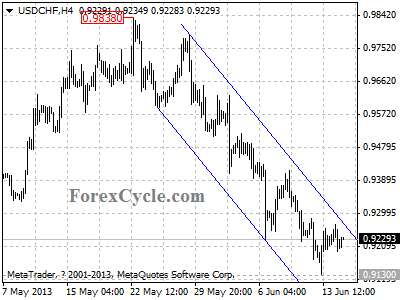
USDCHF is facing the resistance of the upper line the price channel again. As long as the channel resistance holds, the rise from 0.9130 could be treated as consolidation of the downtrend from 0.9838, one more fall towards 0.9000 is still possible after consolidation. On the upside, a clear break above the channel resistance will indicate that lengthier sideways consolidation of the downtrend is underway, then range trading between 0.9130 and 0.9350 could be seen to follow.

usdchf

Forex Signals

Here Comes the (Cat) Bride

By Investment U

Anyone who knows anything about dividend stocks knows that an 8.4% yield has to have a catch. Seadrill (NYSE: SDRL) is no exception. By most measures the big dividend is secure, but if you plan on buying into this one, you better know what you’re getting into.

Its current yield of 8.4% is more than twice that of its nearest competitors, Ensco (NYSE: ESV), Noble Energy (NYSE: NBL) and Transocean (NYSE: RIG). Plus, its management team has more deals running at one time than most bookies. But, that is not to say it doesn’t know what it’s doing.

Here’s what Seadrill reported in just the first quarter…

  • It had its best operating results ever with an EBITDA of $713 million.
  • It beat first quarter earnings and revenue estimates by 35%.
  • It increased the dividend, again, by $0.03.
  • It increased the company’s rig utilization rate from 86% to 92%.

The one thing that keeps most analysts away from this stock, which may be a good thing, is that the company has so many buy and sell programs for drilling rigs that most analysts can’t understand the stock.

Just recently Seadrill had something in the area of $4 billion flying around in new and used rig deals.

All this activity is geared toward constantly improving the company’s fleet of drilling rigs to deliver the newest and best technology to an industry that, since the Gulf oil disaster, has to have safer operations. It may be confusing, but it will result in the newest and most advanced fleet of rigs in the business.

Also, 60% of the worldwide drilling fleet is approaching 25 years of age, and Seadrill is positioning itself to be the leader in new, safe and leading edge technology. It currently has 19 new rigs under construction with delivery expected between now and 2015.

Ensco, Noble and Transocean offer reasonable growth and dividends, but the ultimate aggressive growth and income idea may be Seadrill. If you can put up with a volatile ride, the 8%-plus dividend is there for the taking. Just go in with your eyes wide open.

Google for the Long Run

A recent Barron’s article stated that Facebook (Nasdaq: FB) will not eat Google’s (Nasdaq: GOOG) lunch. In fact, long term, Google just might win the social-media race. And, as we already know, Google’s stock is leaving its competitors in the dust, topping $900 this year.

Barron’s thinks that despite its recent brush with $920 per share, the search giant should be in most portfolios. And I agree… but only on pullbacks. It currently sits at about 20% above its 200-day moving average. It is not what I consider a screaming buy at these prices.

But there are solid long-term reasons to own it.

Google’s future growth lies in in the fact that despite its huge numbers, only 20% of global advertising spending is done on the Internet, versus 41% on television. This is where Google could get a very big leg up in future revenue gains.

Local advertising alone hit $133 billion last year and only 16% of that is online – another untapped resource.

Analysts think Google’s earnings could run from last year’s $39.88 to $53.39 in 2014. New ventures in peer-to-peer lending and a statistical model that targets businesses being shunned by banks are being viewed as bold new efforts to deploy the company’s cash with good potential.

All the stars are aligned for Google. It has for a very bright long-term picture, but my concern is buying anything at record highs. This is one you want to own and definitely need to have on your bogie board. But, look for pullbacks approaching the 200-day moving average for buying opportunities. Build your position on weakness and dips.

The “Slap in the Face” Award: Hide This Guy’s Checkbook

This one is a smack for the record books, but not a good record.

There’s a fashion designer who has a cat, but not just any cat. This cat has three maids and flies on a private jet. Crazy, right?

Hold on to your hats. This guy wants to marry his cat. His name is Karl Lagerfeld and he is dead serious.

The three maids are there to take down everything the cat does while Karl is away, and he reads it to keep up on his, umm, cat to be. I don’t know what else to call it.

When asked about the need for maids and a private jet for a cat, he said, “Why not?” His only concern is that the cat will become more famous than he is.

Oh, Karl also has a person whose only job is to follow him around with a Pepsi Max on a sliver tray. Thirsty and looney!

Someone should take this guy’s checkbook away from him.

Article By Investment U

Original Article: Here Comes the (Cat) Bride

Forex Weekly: Speculators slashed USD bets as Dollar dropped across the board

Large Speculators slashed US Dollar bets last week. Euro bets Surge


cot-values


The weekly Commitments of Traders (COT) report, released on Friday by the Commodity Futures Trading Commission (CFTC), showed that large futures traders sharply cut their total bullish bets of the US dollar last week and decreased their holdings for a second consecutive week.

Non-commercial large futures traders, including hedge funds and large International Monetary Market speculators, pulled back on their overall US dollar long positions to a total of $28.28 billion as of Tuesday June 11th. This was a decrease from a total long position of $39.12 Billion registered on June 4th, according to position calculations by Reuters that derives this total by the amount of US dollar positions against the combined positions of euro, British pound, Japanese yen, Australian dollar, Canadian dollar and the Swiss franc.

On May 28th, US dollar long positions reached their highest level on record (Reuters data) with a total of $43.77 billion before retreating.


See the Full COT Currencies Report & Charts….


US Dollar dropped Across the Board last week to Major Currencies


usdchf-w6-14


The US dollar fell sharply across the board against the other major currencies last week in the forex trading action. The American currency continued to decline for a fourth straight week against the euro, the Swiss franc and the Japanese yen while falling against the British pound sterling for a third week. Against the commodity currencies, the the US dollar declined against the Canadian dollar for a second straight week while the Australian and the New Zealand dollars finally staged a rebound from their five-week bearish trends and recorded weekly increases.


See the Full Report and Currency Pair Levels Commentary…


This Week’s Economic Calendar highlights:

Monday, June 17

Canada — existing home sales

Tuesday, June 18

Australia — reserve bank meeting minutes
United Kingdom — producer price index
United Kingdom — consumer price index
United Kingdom — retail price index
euro zone — German ZEW report
United States — consumer price index
United States — housing starts and building permits
Japan — trade balance

Wednesday, June 19

Switzerland — ZEW survey report
United Kingdom — bank of England minutes
United States — FOMC interest rate decision
New Zealand — GDP report

Thursday, June 20

Switzerland — interest rate decision
Switzerland — trade balance report
China — HSBC manufacturing PMI
Japan — leading index/coincident index
euro zone — purchasing managers indexes
United States — weekly jobless claims
United States — Philadelphia Fed reserve survey
United States — leading indicators
United States — existing home sales

Friday, June 21

Canada — consumer price index
Canada — BOC consumer price report
Canada — monthly retail sales

See our full economic calendar for more events.


Finally Some Good News for the U.S. Economy?

By Profit Confidential

Finally, some good economic news is coming to the U.S. economy

The U.S. Census Bureau has reported that retail and food services sales for the month of May, adjusted for seasonal effects, increased 0.6% from April and 4.3% from the same period a year ago.(Source: U.S. Census Bureau, June 13, 2013.) This is the first report I’ve seen in a long time that shows increasing consumer spending in the U.S. economy.

And the Thomson Reuters/University of Michigan Consumer Confidence Index for May showed consumer spending increasing as well. The index registered at 84.5 in May, improving from 76.4 in April. (Source: Bloomberg, May 31, 2013.) This was the highest level the index has been at since July of 2007.

While this is all good news, my concerns about the U.S. economy remain…

Since the financial crisis in the U.S. economy, the Federal Reserve has been increasing the size of its balance sheet (printing trillions of dollars in new money) and the U.S. government has been spending rigorously, all for the sake of spurring economic growth. Consumer spending in the U.S. economy makes up 70% of our gross domestic product (GDP); hence, it’s vitally important that consumer spending rises if we are to have a sustainable economic recovery.

As it stands, the Federal Reserve is still creating $85.0 billion a month in new money to purchase government bonds and mortgage-backed securities. This may be the biggest reason why economic numbers like May’s retail sales are looking better.

But the unemployment rate in the U.S. economy is still staggeringly high. According to the most recent jobs market report, there are almost 12 million people who are jobless in the U.S. economy; more than 15% of the U.S. population is on some form of food stamps, and that number has been increasing at a serious pace.

Last but not least, there are still millions of Americans in the U.S. economy who are living in a house with negative equity—their house is worth less than the loan on their home.

The minor “pop” we are seeing for some U.S. economic numbers could turn in the wrong direction very quickly. Troubles from the global economy will eventually move into the U.S. economy. Retail sales and consumer confidence increasing is certainly a step in the right direction, but I wouldn’t break out the champagne yet.

What He Said:

“Interest rates at a 40-year low: The Fed has made borrowing as easy as possible, resulting in a huge appetite for loans and mortgages. We are nearing a debt crisis.” Michael Lombardi in Profit Confidential, April 8, 2004. Michael first started warning about the negative repercussions of then Fed Governor Greenspan’s low interest rate policy when the Fed first dropped interest rates to one percent in 2004.

Article by profitconfidential.com

Failed Projections or Just Another Government Lie? You Judge

By Profit Confidential

Failed Projections or Just Another Government LieBoy, were they wrong!

Not so long ago, the Congressional Budget Office (CBO) said it expected the U.S. government to register a budget deficit in the current fiscal year of $642 billion.

But hold on a minute…

The budget deficit so far (as of May 31, 2013) has already hit $626.3 billion, and we still have four more months to go in the government’s current fiscal year!

Since the beginning of the U.S. government’s current fiscal year 2013, which began in October of last year, the government has posted a budget deficit in six out of the past eight months.

The Department of the Treasury just reported the U.S. government registered a budget deficit of $139 billion for the month of May. The federal government took in $197 billion and paid out $336 billion for the month. (Source: Department of the Treasury Financial Management Service, June 12, 2013.)

Comparing it to last year, May 2013’s budget deficit was 11% higher than that of May 2012.

The government has been raking in a budget deficit of over one trillion dollars in each of the last four years; and with four months still left in this fiscal year, it wouldn’t surprise me to see us register a fifth consecutive year of trillion-dollar-plus deficits, despite being repeatedly told by politicians that our budget deficit this year would come in under $800 billion.

This is troubling news; the more budget deficits the U.S. government registers, the more the national debt will increase, and the more the government will need to borrow to pay for expenses. It’s that simple.

Currently, our national debt stands at $16.9 trillion. (Source: www.investmentcontrarians.com, last accessed June 14, 2013.)

The ratio of the U.S. national debt to the gross domestic product (GDP) of the U.S. economy is close to 110% percent. This means that we owe more than what we produce in one year.

The chart below shows a gruesome picture of our national debt compared to U.S. GDP. Notice the rate of change since 2008—it is skyrocketing. Federal Debt:TotalPublicDebt as Percent of Gross Domestic product

Chart copyright Lombardi Publishing Corporation, 2013;
Data source: Federal Reserve Bank of St. Louis, June 14, 2013.

The U.S. has been the family that spends more than it earns for many years now. In the short term, spending more than one takes in can work (especially if the Fed just prints new money and gives it to the government to pay its bills). But in the long term, if fundamental changes are not made to the government’s spending habits, financial chaos just starts all over again.

Posting a budget deficit year after year is not sustainable. The debt-infested eurozone nations did very much the same; they borrowed to spend. Look where they are now.

Michael’s Personal Notes:

Finally, some good economic news is coming to the U.S. economy

The U.S. Census Bureau has reported that retail and food services sales for the month of May, adjusted for seasonal effects, increased 0.6% from April and 4.3% from the same period a year ago.(Source: U.S. Census Bureau, June 13, 2013.) This is the first report I’ve seen in a long time that shows increasing consumer spending in the U.S. economy.

And the Thomson Reuters/University of Michigan Consumer Confidence Index for May showed consumer spending increasing as well. The index registered at 84.5 in May, improving from 76.4 in April. (Source: Bloomberg, May 31, 2013.) This was the highest level the index has been at since July of 2007.

While this is all good news, my concerns about the U.S. economy remain…

Since the financial crisis in the U.S. economy, the Federal Reserve has been increasing the size of its balance sheet (printing trillions of dollars in new money) and the U.S. government has been spending rigorously, all for the sake of spurring economic growth. Consumer spending in the U.S. economy makes up 70% of our gross domestic product (GDP); hence, it’s vitally important that consumer spending rises if we are to have a sustainable economic recovery.

As it stands, the Federal Reserve is still creating $85.0 billion a month in new money to purchase government bonds and mortgage-backed securities. This may be the biggest reason why economic numbers like May’s retail sales are looking better.

But the unemployment rate in the U.S. economy is still staggeringly high. According to the most recent jobs market report, there are almost 12 million people who are jobless in the U.S. economy; more than 15% of the U.S. population is on some form of food stamps, and that number has been increasing at a serious pace.

Last but not least, there are still millions of Americans in the U.S. economy who are living in a house with negative equity—their house is worth less than the loan on their home.

The minor “pop” we are seeing for some U.S. economic numbers could turn in the wrong direction very quickly. Troubles from the global economy will eventually move into the U.S. economy. Retail sales and consumer confidence increasing is certainly a step in the right direction, but I wouldn’t break out the champagne yet.

What He Said:

“Interest rates at a 40-year low: The Fed has made borrowing as easy as possible, resulting in a huge appetite for loans and mortgages. We are nearing a debt crisis.” Michael Lombardi in Profit Confidential, April 8, 2004. Michael first started warning about the negative repercussions of then Fed Governor Greenspan’s low interest rate policy when the Fed first dropped interest rates to one percent in 2004.

Article by profitconfidential.com