How to Protect Your Portfolio from Central Bankers’ Mind Games

By MoneyMorning.com.au

Sir Mervyn King has an oft-quoted story about central banking. He talks about Diego Maradona scoring a particular goal.

He looked like he was going to move left, so the defenders reacted. Then he looked like he’d move right, so they reacted to that. And in the end, he scored by simply running in a straight line down the middle of the pitch.

I’m sure someone who’s actually interested in football could give you a much more compelling rendition of that story, so my apologies to any fans out there.

But the outgoing Bank of England governor’s point is that a big part of a central banker’s job is to manage expectations. What the market thinks you’ll do is at least as important as what you actually do.

So the big question for this week is: what does Ben Bernanke want us all to think?

Ben Bernanke Tries to Do a Maradona

The big central bank story this week is the meeting of the Federal Reserve’s policy making team on Wednesday. Fed chief Bernanke will make a statement afterwards, and investors will be hanging on his every word.

Why does this matter so much? Well, in case you hadn’t noticed, the big slump in most stock and bond markets around the world is down to fears that the Federal Reserve is going to turn the money taps off by ending its quantitative easing (QE) programme.

At the start of this year, we’d hit a ‘Goldilocks’ moment. Growth wasn’t strong enough to justify stopping QE. But it was good enough to justify rising stock markets.

But then Bernanke and other Fed members opened their mouths and hinted that it might be time to start thinking about possibly winding things down, depending on how the economic data panned out.

It’s important to understand: all the Federal Reserve has done is suggested that it might pull back if the US economy looks like it’s recovering. It’s still manning the monetary pumps. There’s still $85bn being shoved into the markets every month.

Yet the suggestion it would end has been enough to inspire a correction in most markets (that’s a 10% fall), and send others into a bear market (a 20% or more fall).

So is Bernanke pulling a Maradona? Is he faking this move to tighten things up, just to keep markets on their toes?

The Federal Reserve Has Every Excuse to Keep the Money Flowing

The truth is, I find it hard to believe that the Federal Reserve will start tightening monetary policy as early as markets are worried that it will.

Bernanke is probably the most famous student of the Great Depression on the planet. It’s his view that the problem both back then and in Japan is that the central banks didn’t do enough. Any time it looked as though they were going to succeed, they pulled out too early.

He’s not going to take that risk, and he doesn’t have to. The Fed has all the excuses it needs to keep monetary policy slack.

Inflation – at least by official measures, which is all that counts for Fed policy – is really not a problem in the US. With commodity prices under pressure, you could even make an argument that deflation is a threat.

I don’t want to get into a debate over the merits or otherwise of deflation here (though I’d argue that falling commodity prices are a good thing, and not to be countered by monetary policy). The point is, Bernanke is under no pressure to withdraw QE.

So having given over-exuberant investors a sobering reminder of the abyss we are all tightrope-walking over, I suspect the Fed will extend some words of comfort at its meeting this week. And if that’s the case, then markets would probably bounce.

But we can’t be sure. This is the problem with expectations management. Maybe the Federal Reserve doesn’t think investors are scared enough yet. Or maybe now that investors have had a wake-up call, it’ll take more than a few soothing words to get them to stop fleeing risky assets.

So what can you do? Simple. Don’t get sucked into this central bank game-playing. Warren Buffett once said that the market is a voting machine in the short-term, and a weighing machine in the long run.

So from day to day, it’s all about how investor mood swings and fads affect where money is flowing to. But in the longer term, quality and value will out – buy decent companies and assets at relatively cheap prices, and you’ll make money.

John Stepek
Contributing Writer, Money Morning

Join The Daily Reckoning on Google+

From the Archives…

Don’t Make Investing a Chore… Invest in an Innovative Business
14-06-2013 – Kris Sayce

The Technology Revolution Begins in Four Days…
13-06-2013 – Kris Sayce

Zero G for the Australian Dollar is a Shot in the Arm for Miners
12-06-2013 – Dr Alex Cowie

There’s More to Technology Than Facebook and Spying
11-06-2013 – Sam Volkering

Four Great Australian Technological Achievements
10-06-2013 – Sam Volkering

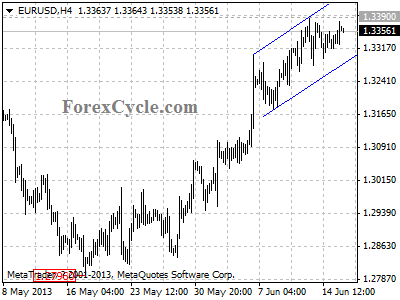
EURUSD remains in uptrend from 1.2796

EURUSD remains in uptrend from 1.2796, the fall from 1.3390 is treated as consolidation of the uptrend. Support is now located at the lower line of the price channel on 4-hour chart. As long as the channel support holds, the uptrend could be expected to resume, and one more rise to 1.3500 area is still possible. On the downside, a clear break below the channel support will suggest that lengthier consolidation of the uptrend is underway, then the pair will find support around 1.3200.

eurusd

Daily Forex Forecast

India’s Energy Ties with Iran Unsettle Washington

By OilPrice.com

India’s relentless search for hydrocarbons to fuel its booming economy has managed the rather neat diplomatic trick of annoying Washington, delighting Tehran and intriguing Baghdad, all the while leaving the Indian Treasury fretting about how to pay for its oil imports, given tightening sanctions on fiscal dealings with Iran.

On 7 June the US State Department reluctantly announced that it was renewing India’s six-month waivers for implementing sanctions against Iran, along with seven other countries eligible for waivers from the sanctions owing to good faith efforts to substantially reduce their Iranian oil imports. In New Delhi’s case, it is the U.S. and EU-led sanctions rather than any willingness on India’s part that has seen a fall in its Iranian oil imports. India is the second largest buyer of Iranian oil, a nation with whom it has traditionally had close ties. U.S. Secretary of State John Kerry said that India, China, Malaysia, South Korea, Singapore, South Africa, Sri Lanka, Turkey, and Taiwan had all qualified for an exception to sanctions under America’s Iran Sanctions Act, based on additional significant reductions in the volume of their crude oil purchases from Iran. Kerry told reporters, “Today’s determination is another example of the international community’s strong and steady commitment to convince Iran to meet its international obligations. This determination takes place against the backdrop of other recent actions the administration has taken to increase pressure on Iran, including the issuance of a new executive order on June 3. The message to the Iranian regime from the international community is clear: take concrete actions to satisfy the concerns of the international community, or face increasing isolation and pressure.”

But even with Washington’s beneficence, New Delhi is struggling to find ways to pay for its Iranian oil imports.

The U.S. and European sanctions have deeply affected Iran’s international oil trade, reducing its exports by more than 50 percent and costing Iran billions of dollars in revenue since the beginning on last year. Tightening the screws, the Obama administration is now attempting to reduce Iran’s oil exports even further, to less than 500,000 barrels per day through tighter sanctions. Nevertheless, despite plummeting sales overseas, Iran, OPEC’s second largest oil exporter, remains one of the world’s largest oil producers, with sales bringing in tens of billions of dollars in revenue annually.

And Iran is anxious to keep India as a favored customer. Last month Iran offered India lucrative terms for developing its oilfields, routing a proposed natural gas pipeline through the sea to avoid Pakistan as well as insurance to Indian refiners provided New Delhi raised oil imports. Making its case, Iran sent a high-level delegation led by Oil Minister Rostam Ghasemi to India to urge New Delhi to raise its oil purchases, which slid to 13.3 million tons in 2012-13 from 18 million tons in 2011-12. Heightening Iran’s concerns, later this year Indian imports are slated to fall further to around 11 million tons.

After meeting Ghasemi Indian Oil Minister M. Veerappa Moily issued a statement noting, “The Iranian side encouraged the Indian side to increase its crude purchase. “The Indian side explained that it would encourage companies to maintain their engagement in terms of crude oil purchase, taking into account their requirements, based on commercial and international considerations.”

While Iranian-Indian trade ties continue to deepen, with Indian-based Consul General of Iran Hassan Nourian predicting that bilateral trade between India and Iran will be worth $25 billion by 2017, India is hedging its bets about energy imports, and where to make up the shortfall from the increased sanctions regime.

…and what better place to look than the Middle East’s rising petro-state, Iraq?

India’s External Affairs Minister Salman Khurshid is heading for Baghdad for a two-day visit beginning 19 June.

Top of the agenda?

Oil – Iraq is now India’s second largest supplier of oil after Saudi Arabia, having replaced Iran and become a “critical partner” of India.

It is a potential marriage made in heaven. Iraq needs an assured market for its increasing crude production, having set itself a production target of 7 million bpd from its current 3 million bpd, while India is in search of a long-term partnership with a major oil producer.

While such deepening ties will thrill Washington as much as they distress Iran, there is still a wild card in the Iraqi mix – China, now Iraq’s biggest customer, already purchasing nearly half the oil that Iraq produces, almost 1.5 million barrels a day. Worse still for Indian aspirations, China is now trying for an even bigger share, bidding for a stake currently owned by Exxon Mobil in one of Iraq’s largest oil fields, West Qurna.

New Delhi’s choices are stark – make Washington happy, alienate long-time partner Iran, and keep fingers crossed that Beijing doesn’t stitch up any further Iraqi concessions.

Tough call.

Source: http://oilprice.com/Geopolitics/International/Indias-Energy-Ties-with-Iran-Unsettle-Washington.html

By. John C.K. Daly of Oilprice.com


Greece Downgraded to “Emerging Market.” But Will It Ever Emerge?

By The Sizemore Letter

Most of us would agree that Greece is not a “developed market” on par with the United States, Canada, or Western Europe.  Its instability, pitiful economic governance, corruption and cronyism—all of which contributed to its spectacular sovereign debt crisis—prove that the country is not quite ready for the big leagues.

Morgan Stanley Capital International (“MSCI”), the provider of the indexes that comprise the popular iShares MSCI Emerging Markets ($EEM) and  iShares MSCI EAFE ($EFA) ETFs, among many, many others, acknowledged as much last week.  The MSCI Greece Index will no longer be classified as a “developed market” and has officially been demoted to “emerging market.”

I’m on board with Greece being declassified as “developed.”  But I do take issue with it being reclassified as “emerging.”

“Emerging” implies that the country will eventually emerge.  It implies that the country is going somewhere.  It implies a young population of upwardly mobile labor and rising living standards.  More than anything, it implies a country with a future.

By even the most generous interpretation, does Greece fit this (admittedly subjective) description?  Let us consider:

  1. The median age of Greek citizens is 43 years old.  To put that in perspective, the median American is 37 years old and the median Frenchman is 40.  Greece has a median age only three years younger than that of Japan (at 46)—which, with its massive population of elderly citizens, is fast becoming the world’s first nursing home nation.  Greece also has one of the lowest birth rates in the world. (Source: CIA World Factbook)
  2. Living standards are falling.  By some estimates, the standard of living in Greece will fall by fully 50% before the crisis and the assorted reform programs run their course.  By any objective measure, living conditions have deteriorated in Greece and won’t be improving any time soon.
  3. Even after more than three years of severe economic depression, Greece has a large trade deficit of nearly $17 billion.  And unlike most emerging markets, which have large manufacturing and agricultural sectors, services make up 80% of the economy.

Greece is not an emerging market…but you can’t by any stretch of the imagination call it developed either.  It’s a country that is stuck in something of a no man’s land: a country that is politically and culturally underdeveloped and unprepared for life as an “adult,” but too old, too urbanized, and with too bleak a future to be “emerging.”

Sadly, the best analogy I can come up with is an elderly person with advanced dementia who has regressed to the mental level of a child.

While it can be tempting to beat up on Greece, I have a legitimate and far more pressing reason for bringing all of this up.  When you buy an emerging market mutual fund or ETF, you need to take a look under the hood to see what you are buying.

Let’s revisit the iShares MSCI Emerging Market ETF ($EEM).  South Korea and Taiwan together make up a quarter of the ETF’s holdings.

Nothing against South Korea or Taiwan, of course.  But both of these countries have living standards close to those of Europe.  It’s hard to call these true “emerging” markets because they have already largely emerged.  Samsung ($SSNLF), the single largest holding in the fund, is arguably the world leader in smart phones, TVs and home appliances.  Great company, but not what I would think of as an “emerging market stock.”

This brings us back to Greece.  After the downgrade, will Greek stocks dominate the portfolio of EEM and other emerging market ETFs and funds?

Probably not.  And even if they did, that might not be such a bad thing in the short-term.  Greek stocks were one of the favored investments in InvestorPlace’ s Best Stocks of 2013 contest.

But my point remains: when you buy an ETF or mutual fund—emerging market or otherwise—you should spend that extra five minutes to visit the fund’s website and see what it owns.

Sizemore Capital has no positions in any security mentioned.


Daimler Roars Back to Life

By The Sizemore Letter

Back in March, I recommended that readers use the recent weakness in Daimler (DDAIF) shares to add to their positions.   American and Japanese automakers had enjoyed a fantastic first quarter while German automakers Daimler, BMW (BAMXY) and Volkswagen (VLKAY) had seriously underperformed.

The reason for the rough ride?

Investors had been punishing the German automakers for a handful of reasons:

  1. They had the misfortune of being domiciled in Europe, which happened to be spooking the market at the time with Italian and Spanish political drama and the bungled Cyprus bailout.
  2. They were distinctly not domiciled in Japan.  The drop in the value of the yen was seen as a boost to Japanese auto exporters at the expense of their German rivals.
  3. The German luxury cars are the favorites of wealthy Chinese, and China had recently begun to crack down on extravagance by political figures.  (Giving a new Mercedes or Rolex watch to a public official was a good way to grease the wheels, so to speak).

I viewed each of these issues as temporary distractions that would run their course.  Europe has been “in crisis” and China has been “slowing” for the better part of three years now, and yet luxury auto sales have never been stronger.  And given the dynamics of the luxury market,   a weaker yen is not catastrophic for the German exporters.  If you can afford a $70,000 car, then you’re going to buy the car you want;  price competitiveness would matter much more to mass-market automakers like Volkswagen.

And even if I had been underestimating the macro risk, Daimler was already priced for zero growth.  At time of writing Daimler traded for 12 times earnings and yielded over 5% in dividends.  Roughly a third of the company’s market cap was in cash.  Barring an end-of-the-world apocalypse, it seemed to me that it would be difficult to lose money on an investment in Daimler over any decent time horizon.

What a difference a couple of months can make.  Daimler’s stock has come roaring back to life, and my recommendation has shot from 7th place to 2nd place in the InvestorPlace Best Stocks of 2013 contest with a year-to-date return of 20%, including dividends.

That’s all fine and good, but what about now?  Is Daimler still a buy?

Yes.  Even after the recent run-up in price, Daimler is far from expensive.  Based on 2013 estimates, it trades for just 10 times earnings 0.4 times sales.  It yields 4.6% in dividends, though I should warn you that the American ADR only pays a dividend once per year, in April, so don’t buy this stock for the dividend unless you’re willing to hold on to it for a while.

Meanwhile, Daimler’s profit outlook is looking up, and demand for the redesigned S-Class—its high-end flagship model—has been strong.

As investors continue to rotate out of defensive sectors and into more cyclical, economically sensitive sectors, automakers such as Daimler should continue to do well.   I’m expecting a strong finish to 2013.

If you don’t own shares of Daimler already, I recommend buying on any dips.

Disclosures: Sizemore Capital is long Daimler. This article first appeared on InvestorPlace.

SUBSCRIBE to Sizemore Insights via e-mail today.

Central Bank News Link List – Jun 17, 2013: Withdrawal syndrome sparks anxiety for Fed

By www.CentralBankNews.info Here’s today’s Central Bank News’ link list, click through if you missed the previous link list. The list comprises news about central banks that is not covered by Central Bank News. The list is updated during the day with the latest developments so readers don’t miss any important news.

FOMC “The Big Driver for Precious metals this Week”, Wall Street Betting Against Silver Price

London Gold Market Report
from Ben Traynor
BullionVault
Monday 17 June 2013, 07:30 EDT

THE U.S. DOLLAR gold price drifted back below $1390 an ounce Monday morning in London, but remained well within its trading range of the last few weeks, as European stock markets edged higher, with analysts citing Wednesday’s Federal Open Market Committee decision on US monetary policy as “the big driver” for this week.

 “On the whole, the market hopes for insightful comments in the course of the next Fed policy meeting…which will affect gold’s further development as well,” says a note from bullion refiner Heraeus.

 Any so-called ‘tapering’ of the Fed’s $85-billion-a-month quantitative easing program “would be bearish for gold and the other precious metals” says Jonathan Butler, precious metals strategist at Mitsubishi in London.

 On the New York Comex, the so-called speculative net long position in gold futures and options – calculated as the number of ‘bullish’ long minus ‘bearish’ short contracts held by traders classed as speculators – fell in the week ended last Tuesday, according to Friday’s weekly Commitment of Traders report from the Commodity Futures Trading Commission.

 Silver meantime edged back below $22 an ounce, as other industrial commodities were broadly flat on the day, while on the currency markets the Euro held steady against the Dollar above $1.33.

 For silver futures, the number of short contracts held by those in the Managed Money category – which includes hedge funds and other money managers – was slightly larger than the number of long contracts, CFTC data show. The last weekly reports to show money managers betting on aggregate against the silver price were published in April – prior to that no managed money net short silver position had been published since September 2007.

 “Silver has been trying in vain to regain the $22 per troy ounce mark…[but] the high level of pessimism among money managers is putting pressure on the price,” says today’s commodities report from Commerzbank.

 The world’s biggest gold exchange traded fund SPDR Gold Trust (ticker: GLD) saw the volume of bullion held to back its shares hold steady at 1003.5 tonnes Friday, though it ended last week down 3.6 tonnes. The GLD has seen outflows amounting to one quarter of the gold it held at the start of this year.

 Despite this, the GLD’s biggest holder, hedge fund Paulson & Co., says it has no intention of closing its Gold Fund, news agency Bloomberg reports, citing a letter to investors it has obtained.

 “While gold continues to pivot between negative investment appetite, which has slowed, and softer physical demand, this week the market focus will shift to the FOMC meeting and press conference,” a note from Barclays says.

 “The markets are a little bit fatigued at the moment,” agrees Victor Thianpiriya, commodities analyst at ANZ.

 “They are still looking for direction from the Fed meeting. That’s clearly the big driver this week.”

 Over in China meantime, Huaan Asset management, one of two physically-backed gold ETF providers to be approved by the China Securities Regulatory Commission, has said it aims to attract $400 million of initial funding – equivalent to around 9 tonnes at current prices – though no launch date has yet been announced.

 “Gold hasn’t lost its appeal as a store of value in China,” says fund manager Xu Yiyi, who will run the Huaan ETF.

 “Investors here usually like to buy on dips, so a decline in the bullion prices this year should work in our favor.”

 Over in India, the only country with stronger gold demand than China last year, gold and silver imports amounted to $8.4 billion last month, a 90% year-on-year rise, though this was down from April’s 138% annual rise, a trade ministry official said Monday. India’s trade deficit meantime widened from $17.8 billion in April to $20.1 billion last month.

 Gold and silver prices fell sharply in April, prompting a spike in physical gold demand, while Indian importers were also reported last month to be looking to get ahead of new regulations. Earlier this month, Indian authorities raised the import duty on gold to 8%, the second hike this year, and also curbed imports on a consignment basis.

 In Northern Ireland meantime the conflict in Syria and tax avoidance are expected to be two of the major topics discussed by world leaders meeting for the G8 summit.

 In Iran, outgoing president Mahmoud Ahmadinejad has been summoned to appear before a criminal court, the Washington Post reports, following the election Sunday of his successor Hasan Rohwani, a reputed moderate who won 51% of the vote.

Ben Traynor

BullionVault

Gold value calculator   |   Buy gold online at live prices


Editor of Gold News, the analysis and investment research site from world-leading gold ownership service BullionVault, Ben Traynor was formerly editor of the Fleet Street Letter, the UK’s longest-running investment letter. A Cambridge economics graduate, he is a professional writer and editor with a specialist interest in monetary economics. Ben can be found on Google+


(c) BullionVault 2013

Please Note: This article is to inform your thinking, not lead it. Only you can decide the best place for your money, and any decision you make will put your money at risk. Information or data included here may have already been overtaken by events – and must be verified elsewhere – should you choose to act on it.

George Soros Joins Michael Ballanger on the Goldbug Side of the Market

Source: Brian Sylvester of The Gold Report (6/14/13)http://www.theaureport.com/pub/na/15373

In his 36-year career, Michael Ballanger, director of wealth management at Richardson GMP, has seen good markets and bad. As a true contrarian, he sees opportunity in the undervalued precious metals assets and lauds George Soros’ recently reported large gold-related positions. In this interview with The Gold Report, Ballanger discusses market sentiment and some companies that he expects to take off when the market turns.

The Gold Report: A news story in mid-May reported that billionaire hedge fund manager George Soros had almost $240 million ($240M) in gold-related positions. Moreover, on May 16 he had purchased $25M in call options on the Market Vectors Junior Gold Miners ETF (GDXJ). What are your thoughts on that move?

Michael Ballanger: All one needs to look at is the historical relationship between gold and gold shares to see the logic behind such a move. With every market on every continent now surging to record high levels in response to central bank stimuli, it would be reasonable to manage risk by owning one of the most beaten-down sectors I can ever recall.

TGR: Why does someone like Soros buy gold-related instruments and not equities, even the large caps?

MB: In the case of the GDXJ, he is actually buying a “basket” of equities related to gold/silver mining and exploration. By doing this, he spreads his risk over a large population of companies in the same space. Picking individual companies in this space invites execution risk because as we have seen in numerous cases in the past decade, a one-off event such as politics or natural disasters can undermine a correct call on the sector as a whole.

TGR: Are you aware of other big-time players that are making similar moves?

MB: Not specifically and certainly no one as notable as Mr. Soros. It is interesting that the managers who were early in the gold trade such as Eric Sprott are more bullish today than ever and that is noteworthy given gold’s performance since 2000; despite this current correction and in my view, it is a correction rather than a secular bear.

TGR: When last we spoke you were convinced the market had found a psychological bottom. You noted that at the end of 2012, the TSX Venture Exchange (TSX.V)—acting as a proxy for the junior mining sector—was trading at 0.71 times the gold price. As of May 31, it was 0.69 times the gold price. Do you see the TSX.V-gold price ratio moving further sideways for the foreseeable future?

MB: I based my “bottom call” on sentiment. The sentiment in the junior space in January was abysmal and it is just as abysmal today. However, weak sentiment numbers, while historically reliable, do not tell you that the price has stopped declining. In that context, I was early because not only has the Venture Exchange dropped to new lows under 1,000, the TSX.V-gold ratio has recently hit .66 versus the bull market high over 5.0, which is actually quite remarkable.

TGR: What’s your thesis for investing in mining equities (large, mid and small cap)? Precious metals investors want to know what they should do over the course of the summer months. What’s your advice?

MB: There is always a degree of seasonality to the mining sector and the numbers dictate that one should wait until mid-August to begin initiating positions but I suspect that may be too “cute” because of the severity of the valuation compression we are witnessing in the juniors. Companies that were considered good value at $75/ounce (Measured) are now trading at under $20/ounce and so these prices may not wait for mid-August if gold decides to reverse or if sentiment shifts early back to the bull camp.

TGR: In our last interview you discussed “well incubated” junior mining companies, ones with a core of investors that understand how the game is played and have the long play in mind. Where are those companies?

MB: In a nutshell, some have done quite well but most have been disappointing. Despite either positive earnings reports or new discoveries, each time they try to lift off the bottom, they have been sold as a liquidity event. It is almost a Pavlovian reaction; they sell off because they have sold off in the past and until new volumes come in to relieve the supply that will not change until sentiment changes.

TGR: In January, you told our readers about Tinka Resources Ltd. (TK:TSX.V; TLD:FSE; TKRFF:OTCPK). What’s happening with Tinka now?

MB: Since the January interview, Tinka has continued to execute its corporate strategy of upgrading the Peruvian silver resource to Measured from Inferred while adding more ounces, but the big event was the recent A13-05 drill result, which was arguably one of the best massive sulphide intercepts in at least my time in this space. Sixty meters of 7.75% zinc with the total section of mineralized envelope running north of 200 meters is a very encouraging, if not spectacular, intercept. The company completed a financing in May (full disclosure: RichardsonGMP participated in that funding) and is now poised to recommence with further exploration on Ayawilca (the zinc) while finishing off the redefinition of Colquipucro (the silver). The share price has retrenched from the all-time high of $1.25 in March to the current $.75–.80 range.

TGR: Would you like to give any other updates on companies you’ve mentioned in previous interviews? At the moment, are there any other companies you’re closely following?

MB: Bitterroot Resources Ltd. (BTT:TSX.V) is another name in the unloved category. When I met its president, Michael Carr, he showed me the geophysics on his project in northern Michigan, just south of the White Pine mine. Within the exploration sector, this is a compelling story that speculators could sink their teeth into at $0.09 or $0.10/share. It is an exploration play so it may not be suitable for all investors but for those that can bear the risk, it is an interesting speculation.

MB: Another Peruvian junior I have been dabbling in is Darwin Resources Corp. (DAR:TSX.V). The company has a gold property in northern Peru, sandwiched by Rio Alto Mining Ltd. (RIO:TSX.V; RIO:BVL; RIOAF:OTCQX) and Barrick Gold Corp. (ABX:TSX; ABC:NYSE). Darwin trades around the $0.12 range on the TSX Venture Exchange. Darwin was a spinout of Mawson Resources Ltd. (MAW:TSX; MWSNF:OTCPK; MRY:FSE). Early geochemical results have been very interesting, to say the least.

TGR: Before we let you go, please give our readers something to ponder.

MB: Whenever I am interviewed for my comments on the precious metals sector, I am usually addressing an audience that is predisposed to understanding the value of holding gold or silver bullion or equities in their portfolios, but what is rarely addressed is the correct allocation. There are some who believe that it is the ONLY asset that one should own and there are others that believe that it should be used as a balancing tool within a larger mix of assets.

No greater example of the need for a correct mix of assets could have been more obvious than the behavior of gold versus the S&P 500 since mid-2011. While bullion has dramatically outperformed the S&P 500 since 2000, the S&P 500 has been a superstar versus gold for the past 18 months. For this reason, it is critical to be flexible in your allocations because while I am certainly one of the most fervent believers in the importance of gold in protecting the purchasing power of portfolios, as a wealth manager I have to maintain a balance and that is something everyone must remember.

TGR: Thank you for your time.

Originally trained during the inflationary 1970s, Michael Ballanger, director of wealth management at Richardson GMP, is a graduate of Saint Louis University where he earned a Bachelor of Science in finance and a Bachelor of Art in marketing before completing post-graduate work at the Wharton School of the University of Pennsylvania. With more than 30 years of experience as a junior mining and exploration specialist, as well as a solid background in corporate finance, Ballanger’s adherence to the concept of “Hard Assets” allows him to focus the practice on selecting opportunities in the global resource sector with emphasis on the precious metals exploration and development sector. Ballanger takes great pleasure in visiting mineral properties around the globe in the never-ending hunt for early-stage opportunities.

Want to read more Gold Report interviews like this? Sign up for our free e-newsletter, and you’ll learn when new articles have been published. To see a list of recent interviews with industry analysts and commentators, visit our Streetwise Interviews page.

DISCLOSURE:

1) Brian Sylvester conducted this interview for The Gold Report and provides services to The Gold Reportas an independent contractor. He or his family own shares of the following companies mentioned in this interview: None.

2) The following companies mentioned in the interview are sponsors of The Gold Report: Tinka Resources Ltd. Streetwise Reports does not accept stock in exchange for its services or as sponsorship payment.

3) Michael Ballanger: I or my family own shares of the following companies mentioned in this interview: Tinka Resources Ltd. and Bitterroot Resources Ltd. I personally am or my family is paid by the following companies mentioned in this interview: None. My company has a financial relationship with the following companies mentioned in this interview: Tinka Resources Ltd. I was not paid by Streetwise Reports for participating in this interview. Comments and opinions expressed are my own comments and opinions. I had the opportunity to review the interview for accuracy as of the date of the interview and am responsible for the content of the interview.

4) Interviews are edited for clarity. Streetwise Reports does not make editorial comments or change experts’ statements without their consent.

5) The interview does not constitute investment advice. Each reader is encouraged to consult with his or her individual financial professional and any action a reader takes as a result of information presented here is his or her own responsibility. By opening this page, each reader accepts and agrees to Streetwise Reports’ terms of use and full legal disclaimer.

6) From time to time, Streetwise Reports LLC and its directors, officers, employees or members of their families, as well as persons interviewed for articles and interviews on the site, may have a long or short position in securities mentioned and may make purchases and/or sales of those securities in the open market or otherwise.

Streetwise – The Gold Report is Copyright © 2013 by Streetwise Reports LLC. All rights are reserved. Streetwise Reports LLC hereby grants an unrestricted license to use or disseminate this copyrighted material (i) only in whole (and always including this disclaimer), but (ii) never in part.

Streetwise Reports LLC does not guarantee the accuracy or thoroughness of the information reported.

Streetwise Reports LLC receives a fee from companies that are listed on the home page in the In This Issue section. Their sponsor pages may be considered advertising for the purposes of 18 U.S.C. 1734.

Participating companies provide the logos used in The Gold Report. These logos are trademarks and are the property of the individual companies.

101 Second St., Suite 110

Petaluma, CA 94952

Tel.: (707) 981-8999

Fax: (707) 981-8998

Email: [email protected]
 

Three (or Five) Rules of Thumb for Watching Insider Trading: Ted Dixon

Source: Brian Sylvester of The Gold Report (6/13/13)http://www.theaureport.com/pub/na/15372

Data on trades made by company insiders—key executives and directors—demonstrates to Ted Dixon, co-founder and CEO of INK Research, that most of them are contrarian in their approach. Lately, Dixon finds that insider indicators in the gold and junior gold miner sectors are “off the charts.” In this interview with The Gold Report, Dixon shares the names of frequent traders in recent months, along with insights into why, when and how insiders are trading.
The Gold Report: Ted, INK Research monitors stock transactions made by key executives and directors inside their companies and uses that data to develop sentiment indicators for various indices and sectors. How does your system work?

Ted Dixon: When we look at a market and a sector, we use insider activity—buys and sells in the public market—to get a sense of how those insiders feel, not just about their company, but about the overall market or sector. This led us to develop what we call a sentiment indicator, which is basically a daily poll of insiders. You could compare it to the polls you see during election campaigns. Every night, we take a poll of what insiders are doing within the market and the sector. We aggregate all of the buys and sells in the different companies in that sector to get a sense of the overall mood of insiders in that area.

TGR: The sentiment indicators at the moment show almost twice as much insider buying among Toronto Stock Exchange-listed stocks as selling. Yet, the opposite is happening in the American market. How do you explain that?

TD: One of the rules of thumb when looking at insider activity is that insiders tend to be contrarian. They like to do the opposite of what other people are doing.

In 2013 to date, the U.S. market has had a nice run as the indices have been hitting new, all-time highs. As everyone else is piling into the market and chasing momentum, insiders, being contrarians, are selling into that and are taking profits.

We have not had quite the same ride here in Canada; different sectors have experienced different fortunes. Some sectors and stocks have been hit hard. Because they are contrarian, insiders will go shopping for bargains during periods of selloff. While everyone is hitting the sell button, insiders and select companies will pick up stocks that have been beaten down. The key element to keep in mind here is the time horizon. Insiders typically have a long time horizon. The fact that they may be buying does not mean they expect a 50% reversal over the next two or three months. It means that, over the long term, the risk-reward ratio has improved enough for them to jump in.

TGR: Among the TSX Venture Exchange-listed stocks, insiders are buying almost eight times more than they are selling. What trends have emerged from insider buying on the Venture Exchange?

TD: Before the Lehman Brothers collapse, insiders were a bit more opportunistic in their buying and selling. Since then, we have seen a long-term, secular commitment to buy among junior miner insiders. This has been going on for quite a while, but as we go through bouts of selloff in the sector, insider activity within the junior miners tends to pick up. That is happening now.

In fact, it would concern us if there were no increase in insider activity when junior miners sold off. That might indicate that insiders are giving up on the sector. We are not seeing that.

TGR: Where is your Venture Exchange sentiment indicator on a 12-month horizon?

TD: It is near all-time highs, just as the Venture Exchange index works down toward new multiyear lows. We have been at elevated buying levels, driven primarily in the gold group. The spring saw a massive spike.

TGR: Does a spike in insider buying in an underperforming sector generally predict medium- or long-term equity performance?

TD: It is important to remember that insider activity and the INK indicators are not a silver bullet to market timing. They are used in conjunction with the technical indicators that many of your readers follow and the fundamental research they do.

It is important to look at insider activity during a major selloff correction or a major rally: What are the insiders doing? Is insider activity spiking, suggesting a turning point is near?

Right now, we see a major move to the downside in commodity stocks and a major spike in insider buying. That is also what happened in December 2008. It is almost as if the mining industry is going through its own Lehman Brothers moment. Our indicators suggest now is the time to be bargain hunting for good companies. The time to exit the industry was a while ago.

TGR: Did you notice a significant change in insider buying or selling in the gold sector when gold had that significant selloff in April?

TD: Absolutely. When gold sold off in April, our indicator for the gold group jumped substantially. It got as high as 10:1, meaning 10 gold companies had key insider buying for every one that was selling. That is an astronomically high level of buying.

We had another test of that in early June when we saw renewed weakness in the gold stock indices and the gold price. Buying picked up. Insiders seem to be suggesting that they are very interested as the S&P/TSX Gold Composite Index toys with the 1,500 level.

TGR: Is there any seasonality at play, given the adage “sell in May and go away?” Or, has it changed to “buy in May?”

TD: I think price level is the key factor, not the month of the year. In the U.S., there was a nice rally into May, and we saw a lot of insider selling across the board. In Canada, among the miners, prices have tumbled to a level that is attracting significant insider interest.

TGR: It is also meaningful that, in the junior mining sector, when an executive adds to his or her position in a smaller company it can mean a significant percentage of ownership; for a larger company, it is often a drop in the bucket. What are some recent examples in the junior gold space where an executive has exercised options or bought shares that resulted in a significant increase in his or her stake in the company?

TD: You are absolutely right about the importance for smaller companies, Brian. When Nejat Seyhun did his comprehensive study of insider activity in 1998, “Investment Intelligence from Insider Trading,” he found that top executives such as CEOs and CFOs of smaller firms outperform the market by about 8% a year.

You get a better bang for your buck, on average, with smaller companies. I say on average, because in some cases insiders still suffer from wishful thinking and miscalculation.

Most of the insider buying is in the junior and the small companies. We have an indicator list that tracks what we call key insider buying—beneficial ownership buying where officers or directors directly own the interest in those stocks; they are not managing other people’s money. Our users can also generate net buying lists.

TGR: What are some of the smaller names on your 30-day activity list, meaning there has been insider trading in the last 30 days?

TD: The smaller names would include Belo Sun Mining Corp. (BSX:TSX.V) and Veris Gold Corp. (VG:TSX; YNGFF:OTCBB).

Remember, because these are small companies, some small gold miners may not be easy to invest in, as a matter of liquidity. Some may not trade much. Nor are these investment recommendations. They are companies on our list showing insider buying in the last month.

TGR: Veris Gold insiders bought 555,000 shares.

TD: As of June 10, it was 605,000 shares.

TGR: In general, do you know who is making such purchases?

TD: In the case of Belo Sun Mining, CEO Mark Eaton has been buying. He bought throughout the month of May: 2,000 shares on May 30 and 425,500 on May 15–16. Another company executive bought nearly 230,000 shares on May 31 at $0.59/share after buying 11,500 shares earlier in the month. All my dollar and cents figures are in Canadian currency. On May 16, a third officer bought 100,000 shares. That makes three insiders buying in the public market during May. During that same period, there were no insider public-market sales. That is a good example of the type of insider buying you want to see when there is market weakness in a stock.

TGR: Have you ever done a study of share price performance versus buying? Is there a greater correlation with more executives buying than with just one buyer?

TD: In general, the more, the better. You want to see situations where multiple insiders are buying and no one is selling.

When the CFO is buying is another good signal. Always keep an eye on what the CFO is doing. I say that because, in general, they tend to be more conservative.

TGR: What other small juniors are buying and selling?

TD: Orvana Minerals Corp. (ORV:TSX) is another multiple insider buyer situation. CEO Michael Winship bought 60,000 shares at $0.53/share in May and was joined by a director, Audra Walsh. Together they spent $52,000 of their own money in buying in the public market. That seems to be good timing because the stock is now trading around the $0.60/share level.

TGR: And they bought where?

TD: It looks as if they bought between $0.50 and $0.53/share.

TGR: Can you tell us about other companies where insiders are buying?

TD: Angkor Gold Corp. (ANK:TSX.V) is being bought by CEO Michael Weeks. Over the last 30 days, he has spent about $44,000 buying stock in that company. His purchases have been in a range of $0.38 and $0.42/share. Angkor Gold is a smaller company based in Cambodia. It is interesting to see its insider buying among the top 10 by dollar amount for over the past 30 days.

Interestingly, in the gold group we are seeing not only a lot of insider buying, but buying with a very broad geographic reach. It is not just the names in Nevada, Mexico and Ontario.

Centerra Gold Inc. (CG:TSX; CADGF:OTCPK), based in the Kyrgyz Republic, has gone through quite a news cycle over the past few weeks. Mine production, I believe, is expected to be restarted after some political events there. But we see some insider activity in that company as well.

Centerra is a high-risk stock. What the insiders seem to be signaling there is that perhaps the stock price has overshot the risks. Even when insiders are buying, you still have to look at the stock’s risk profile to see if it is something you want to get into. Just because insiders are buying does not mean the stock is not risky. It sends a signal related to the risk-reward outlook on average. The risk level may still be quite elevated.

TGR: Which companies are on the Top 5 list for officer and director buying on the 60-day list?

TD: In that time period in terms of development companies, the top net buyer was Colossus Minerals Inc. (CSI:TSX; COLUF:OTCQX), a development-focused miner in Brazil.

Orex Minerals Inc. (REX:TSX.V) would be No. 2, followed by Belo Sun and Veris Gold. Large-capTurquiose Hill Resources Ltd. (formerly Ivanhoe Mines Ltd.) (TRQ:TSX; TRQ:NYSE), which also owns producing assets, would be the fifth one.

Luna Gold Corp. (LGC:TSX.V), another Latin American company that you would classify as a producer, also has seen a lot of insider buying.

One name that is more of a pure gold play, junior nonproducer at this point is Giyani Gold Corp. (WDG:TSX.V). It is in South Africa. Duane Parnham, who founded Forsys Metals Corp. (FSX:TSX) and UNX Energy Corp., has now turned his attention to Giyani Gold. He has been buying a fair amount lately.

TGR: Are well-known CEOs or executives buying the junior companies, people like Ross Beaty?

TD: Ross Beaty’s latest purchase was in the alternate energy area. Maybe that is a story for another day. And of course, we have talked about other CEOs who have been buying.

TGR: Are there any mid-cap names that stand out?

TD: Centerra and Luna Gold would be in that category.

We saw insider buying in both Colossus Minerals and Detour Gold Corp. (DGC:TSX) during the selloff in April. Subsequently, both companies have gone to the capital markets to raise some money. That shows that the gold sector is perhaps not as bad as everyone thinks.

It is nice to see some emerging investor interest in the sector beyond the insiders. Lately, the news flow has been so negative that sometimes it sounds as if only insiders are interested in their companies’ stocks.

TGR: There also is activity in some of the gold sector’s biggest names. Who is buying there?

TD: Peter Munk, chairman of Barrick Gold Corp. (ABX:TSX; ABX:NYSE), has come back to the market. He bought 100,000 shares worth $2.1 million at $21.05/share on May 9.

TGR: Are other Barrick Gold executives buying its shares?

TD: In the last 60 days, Peter Munk is the only insider with public-market buying at the firm.

A few months ago Ian Telfer, chairman of Goldcorp Inc. (G:TSX; GG:NYSE), bought his company’s shares.

Compensation schemes at larger companies are structured a little differently than smaller companies. At Goldcorp, insider holdings have been on the rise through a combination of net public market activity and compensation-related acquisitions. It is nice to see insiders building their positions at these levels. Even though some of it is compensation-related, that is what we would like to see and are seeing in Goldcorp.

TGR: Are you seeing any other insider buying at the big gold names?

TD: There has been some net buying at Kinross Gold Corp. (K:TSX; KGC:NYSE) and there has been a fair amount of insider activity at IAMGOLD Corp. (IMG:TSX; IAG:NYSE). It is in fourth place on our list of direct insider buying over the last month. Over the last 90 days, IAMGOLD insiders have spent $504,778 buying shares in the public market. Notably, both the CEO and CFO have been buying shares. That is a positive contrarian signal for longer-term investors with the right risk tolerance.

TGR: How do your subscribers use your research?

TD: One of the most popular ways of using INK is to look at what insiders are doing with their options, both when they are being granted in some of the smaller companies and when they are exercised. Do they sell all their shares? Do they hang on to all or some of them?

That is particularly important in some of the mid- to larger-cap companies. We want to see if they are exercising options and not selling. That is why we are encouraged by what we see at Goldcorp. A lot of the Goldcorp activity is compensation-related acquisitions. It is encouraging to see insiders building their positions.

That said, sometimes insiders have to sell a portion of their compensation-related awards to pay taxes and the exercise costs, depending on the plan. There is no real standard in how compensation plans are structured. It is important to dig down into the details. We like to see insiders paying their taxes or exercise costs and then hold on.

TGR: What are the best ways to use the information INK provides?

TD: Three rules of thumb. First, good things come in small packages. Small companies are where you will get the most bang for the buck following insider activity.

Second, insiders usually go against the flow. They are contrarian. When a stock is falling, it is a good signal if insiders are buying.

Third, sometimes insiders go with the flow. When they are selling when everyone else is selling, that typically is not good news. When they are buying when other people are buying, it is usually pretty good news.

TGR: And four and five would be to follow the CFO and look for multiple executives buying.

TD: Right. Multiple executives buying along with the CFO indicates a good situation, especially if it is real discretionary buying as opposed to stock awards. If we see the CFO and other executives buying during a selloff, we have more confidence in that signal than if it is a single insider.

TGR: Investors in the gold space and the junior gold space have been beaten and battered. Can you leave them with something that might raise their spirits?

TD: For contrarians, the best time, up until now, to buy junior gold miners was November and December 2008. However, in the wake of the recent pullback, our insider indicators are off the charts. The time to start looking for bargains is when everyone has left the room, not when your next-door neighbor is talking about the latest gold stock he or she bought.

TGR: Ted, thank you for your time and your insights.

Ted Dixon is co-founder of INK Research; INK stands for Insider News and Knowledge and is Canada’s first online financial news and research service providing investor insight into what public company executives and significant shareholders are doing with their ownership interests. INK is also first in North America to provide a free source of insider trading alerts and reports across both the U.S. and Canadian stock markets. Free INK services are found on CanadianInsider.com andInsiderTracking.com. Dixon has also lectured in corporate finance at the British Columbia Institute of Technology. Before starting INK, he worked at the Connor, Clark & Lunn Financial Group where his responsibilities included portfolio strategy and product development. He has also been an analyst at the Fraser Institute and a treasury specialist at TD Bank. In the early days, he was a floor trader on the Vancouver Stock Exchange. Dixon is a Chartered Financial Analyst and member of CFA Vancouver (formerly The Vancouver Society of Financial Analysts). He holds a Master of Business Administration in financial management from the University of Chicago and a Bachelor of Commerce from the University of British Columbia.

Want to read more Gold Report interviews like this? Sign up for our free e-newsletter, and you’ll learn when new articles have been published. To see a list of recent interviews with industry analysts and commentators, visit our Streetwise Interviews page.

DISCLOSURE:

1) Brian Sylvester conducted this interview for The Gold Report and provides services to The Gold Report as an independent contractor. He or his family own shares of the following companies mentioned in this interview: None.

2) The following companies mentioned in the interview are sponsors of The Gold Report: Orvana Minerals Corp., Angkor Gold Corp., Colossus Minerals Inc., Detour Gold Corp. and Goldcorp Inc. Streetwise Reports does not accept stock in exchange for its services or as sponsorship payment.

3) Ted Dixon: I or my family own shares of the following companies mentioned in this interview: None. I personally am or my family is paid by the following companies mentioned in this interview: None. My company has a financial relationship with the following companies mentioned in this interview: None. I was not paid by Streetwise Reports for participating in this interview. Comments and opinions expressed are my own comments and opinions. I had the opportunity to review the interview for accuracy as of the date of the interview.

4) Interviews are edited for clarity. Streetwise Reports does not make editorial comments or change experts’ statements without their consent.

5) The interview does not constitute investment advice. Each reader is encouraged to consult with his or her individual financial professional and any action a reader takes as a result of information presented here is his or her own responsibility. By opening this page, each reader accepts and agrees to Streetwise Reports’ terms of use and full legal disclaimer.

6) From time to time, Streetwise Reports LLC and its directors, officers, employees or members of their families, as well as persons interviewed for articles and interviews on the site, may have a long or short position in securities mentioned and may make purchases and/or sales of those securities in the open market or otherwise.

Streetwise – The Gold Report is Copyright © 2013 by Streetwise Reports LLC. All rights are reserved. Streetwise Reports LLC hereby grants an unrestricted license to use or disseminate this copyrighted material (i) only in whole (and always including this disclaimer), but (ii) never in part.

Streetwise Reports LLC does not guarantee the accuracy or thoroughness of the information reported.

Streetwise Reports LLC receives a fee from companies that are listed on the home page in the In This Issue section. Their sponsor pages may be considered advertising for the purposes of 18 U.S.C. 1734.

Participating companies provide the logos used in The Gold Report. These logos are trademarks and are the property of the individual companies.

101 Second St., Suite 110

Petaluma, CA 94952

Tel.: (707) 981-8999

Fax: (707) 981-8998

Email: [email protected]