Hungary cuts rate 11th time but caution now warranted

By www.CentralBankNews.info
    Hungary’s central bank cut its base rate for the 11th time in a row, as expected, and expects to continue to reduce rates due to moderate inflationary pressure but the bank signaled it may have to slow down the pace of easing as volatile financial markets may force it to be become more cautious.
    The National Bank of Hungary cut its rate by another 25 basis points to 4.25 percent, increasing the total reduction in rates since August to 275 basis points, with rates cut by 150 basis points in 2013 alone.
    The central bank’s monetary council said there was still “a significant degree of spare capacity in the economy, inflationary pressures are likely to remain moderate in the medium term, and therefore the 3 percent target can be me with looser monetary conditions.”
    “However, the global financial environment has been volatile recently,” the bank said, adding “a sustained and market shift in perception of the risks associated with the economy may influence room for manoeuvre in monetary policy. The council judges that as long as the outlook for inflation and the real economy justifies it, interest rates can be reduced further; however, increased caution in warranted in the volatile and rapidly changing global environment.”

     So far, sentiment in global markets have remained supportive of Hungary, the bank said, but uncertainty has increased recently.
    The central bank said it expected inflation to ease further in the short term, mainly due to falls in administered prices and commodity prices, and the disinflationary impact of weak domestic demand.
    In May, Hungary’s inflation rate rose to 1.8 percent from 1.7 percent in April.
    “Overall, inflationary pressures are likely to remain moderate over the medium term,” it said.
    Recent economic data suggest that domestic demand and slack in labour markets are affecting expectations and the tax-adjusted inflation rate is expected to remain below 3 percent.
    The output from Hungary’s economy is likely to return to its previous level only gradually, it added.
    In the first quarter, Hungary’s Gross Domestic Product grew by 0.7 percent from the previous quarter but on an annual basis the economy contracted by 0.9 percent, the fifth quarterly contraction in a row.

    www.CentralBankNews.info

Europe shares remains high as PBOC calms investors

By HY Markets Forex Blog

The European market remained green as stocks traded at a positive territory in midday, after the People’s Bank of China (PBOC) stated it would monitor money-market rates and lead them to reasonable levels.

The European Euro Stoxx 50 climbed 1.34% to 2.545.50 at 11:50am GMT, while Vinci gained 3.70% .Germany’s DAX rose 1.50% to 7,807.70 at the same time, as Daimler fell to a low 0.58%.

In France the French CAC 40 rose 1.48% to 3,648.30 at 11:50am GMT, while Alstom fell 3.37 higher and carmaker Renault surged 5.36% while rivals Peugeot soared 5.46%.

In italy, UniCredit fell 0.64%, while the energy group E.ON lowered to 0.57%.

The UK’s FTSE 100 gained 1.04% to 6,091.80 at the same time, as Experian climbed 4.15%. ARM Holdings rose 4.03%.

In Italy, the retail sales fell 0.1% on a monthly basis since April, as retail sales slid 2.9% after the previous revised fall of 3.2%, according to the National Institute of Statistics.

The roman government held an auction of new zero-coupon bonds maturing in 2015 at a high yield of 2.403%.Italy raised 3.5 billion euros, in line with the maximum target.

In Asia , the Deputy Director of the central bank’s Shanghai branch Ling Tao, announced that the People’s Bank of China (PBOC) will be observe and keep the money market at a reasonable level.

However, Ling did not hint what the central bank consider a reasonable level but he did state that the central bank would be flexible with managing the interbank liquidity.

The Shanghai’s repurchase agreement rate opened at 5.73% on Tuesday, which rose to a high 7.63% in the morning. The Shanghai benchmark index closed at 5.3% on Monday , lowest in four years while investors fears over banking crises in the country. The index closed at a low 0.18% on Tuesday.


The post Europe shares remains high as PBOC calms investors appeared first on | HY Markets Official blog.

Article provided by HY Markets Forex Blog

Chinese stocks fall on credit tightening doubts

By HY Markets Forex Blog

The Chinese stocks dropped as the People’s Bank of China (PBOC) said its credit tightening policy would continue.

Concerns have been raised regarding the People’s Bank of China (PBOC) decision to proceed with its credit tightening policy.

Shanghai Composite SSE index declined 5.3% to 1,963.24, while the Hang Seng index closed at 2.22%. Japanese Nikkei closed at 1.26%, and the financial stocks overall, dropped to more than 7%.

Most of the state-owned Chinese banks have been charging some of the highest lending rates recently, from over 25% in most cases.

This is because the People’s Bank of China have temporarily have stopped the supply of low-priced money in order to inflict more control and reduce the reliance on credit from its banks.

Concerns were raised regarding the possible cut in the money market after PBOC’s decision, which could place the small lenders out of business. However, while PBOC sends out a warning to commercial banks to improve their cash reserves management, inter-banks left its lending rates eased on Monday.

The Chinese economy introduced a big monetary stimulus in order to enhance and increase and boost China’s economic growth, after its financial crises in 2008 – 2009.

According to reports released, the manufacturing activity in China dropped to a nine-month low.

The World Bank reduced its 2013 growth forecast for China to 7.7%, from previous forecast of 8.4%.


The post Chinese stocks fall on credit tightening doubts appeared first on | HY Markets Official blog.

Article provided by HY Markets Forex Blog

The Five Smartest Responses to the Stock Market Selloff

By WallStreetDaily.com

According to Barron’s Kopin Tan, “The whiff of [interest] rate volatility” is all it took to send stocks reeling last week – erasing some $775 billion in value in two days.

In case you’re wondering, that figure is equal to about nine months’ worth of Fed bond buying.

So my labeling the recent selloff as an “overreaction” seems apropos. Especially considering that traditional safe havens – U.S. Treasuries and gold – got sacked, too. If the economy and market were truly in trouble, those assets would be rallying right now.

So chill, would ya?

All right. I know that simply telling you to “keep calm and carry on” over and over again won’t cut it. As investors, we crave a specific plan of attack for every conceivable market scenario.

As I shared yesterday, though, retreating into cash can’t be our default setting. It doesn’t protect wealth; it destroys it.

So here are five alternative courses of action to consider in the current market. (Yes, it’s possible to put the market volatility to work for us.)

I’ll start with the easiest to implement and progress to a couple of more involved (but opportunistic) strategies.

~Volatility Buster #1: Trim it Up

Emotional responses always undermine our profitability. We either sell too early, missing out on more profits. Or we sell too late, making it that much harder to recover from our losses.

That means in all market conditions, we need to be robotic. Or, more plainly, we need to take emotions out of the equation.

The best way to do that, which maximizes profits and simultaneously minimizes losses, is to use trailing stops.

As a general rule of thumb, I use a 25% trailing stop on larger-cap, more liquid investments. For smaller-cap, more speculative investments, I go with a 35% trailing stop.

And when fears over a market selloff materialize, all we have to do is trim up our stops. Doing so keeps us in the market just in case our fears are misplaced, yet preserves our profits at the same time. It’s a win-win.

Now, the most common argument against using trailing stops is that market makers can see our orders – and, in turn, they’ll intentionally manipulate prices to stop us out. I’ll admit that it does happen. But not frequently enough to swear off using this type of free insurance.

~Volatility Buster #2: “Put” Your Way to Profits

Buying put options, which gives you the option to sell a stock at a predetermined price, is the closest alternative to using trailing stops. They essentially let you lock in your sale price in advance. And there’s nothing a market maker can do to interfere with the strategy.

Keep in mind, though, there’s a real cost associated with hedging risk using put options.

You have to pay for the option. So if the stock never drops below the strike price (i.e. – the stock resumes its rally), you’ll be out-of-pocket the cost of the option.

As I’m sure you’ll agree, sometimes it’s worth paying a little for a lot of peace of mind.

~Volatility Buster #3: Get Inverted

Dozens of inverse mutual funds and exchange-traded funds (ETFs) now exist that rise when stocks drop. You can purchase these funds in retirement accounts, too.

ProShares, Rydex and Direxion offer the most popular and liquid funds. By taking a small position in any of these funds, you can help smooth out any market volatility.

However, if you plan to hold the funds as a form of long-term insurance, just stay away from the double- and triple-leveraged funds.

~Volatility Buster #4: Bet on the House

We can actually profit from the uncertainty over future interest rates – and stock market volatility – by scooping up shares of CME Group (CME) and CBOE Holdings (CBOE).

The former exclusively handles trading of interest-rate derivatives. So as more and more traders speculate about the next move for interest rates, the company promises to book more profits.

As for the latter, it’s the trading venue for options and futures on the VIX Volatility Index (VIX). Again, as traders get more skittish about the next gyrations in the market, they’re bound to ramp up their bets on the next move for the VIX.

Since the house always wins, it’s best for us to avoid making predictions about interest rates and volatility, and just invest in the companies that promise to benefit from everyone else’s wagers.

~Volatility Buster #5: Buy Value, Not Momentum

During bull markets, many investors get lazy and buy what’s working. And they’re all too quick to “pay up” for momentum stocks. But guess what? When volatility spikes, high-flying momentum stocks are the first to give back gains.

Since I don’t believe the bull market is over, we should respond to the market volatility by putting new money to work in undervalued stocks with hidden growth potential. By that I mean, companies with separate operating units that are growing at different rates.

Why?

Well, as I told WSD Insiders earlier this month, sometimes analysts get lazy and only look at consolidated figures. So a company with a division that’s growing at a rapid clip – but happens to own another unit that’s flat-lining – tends to be overlooked (and mispriced).

And since earnings continue to climb under the radar, such companies promise to march higher – even if the multiple expansion for the S&P 500 grinds to a halt.

Sure, finding such opportunities requires more work. But it pays.

Case in point: When I mentioned this to WSD Insiders on June 11, I recommended an undervalued growth opportunity. And it’s up almost 15% already, compared to a 2% decline for the S&P 500 Index over the same period.

Yet, by my calculations, the stock could easily rally another 50% before the year is out. So it’s not too late to enter a position. (To find out the ticker right away, sign up for a risk-free trial.)

Ahead of the tape,

Louis Basenese

The post The Five Smartest Responses to the Stock Market Selloff appeared first on  | Wall Street Daily.

Article By WallStreetDaily.com

Original Article: The Five Smartest Responses to the Stock Market Selloff

Central Bank News Link List – Jun 25, 2013: China shares slide; central bank relaxes grip on money market

By www.CentralBankNews.info Here’s today’s Central Bank News’ link list, click through if you missed the previous link list. The list comprises news about central banks that is not covered by Central Bank News. The list is updated during the day with the latest developments so readers don’t miss any important news.

How Central Bank Zombies Control the Stock Market

By MoneyMorning.com.au

Zombies…zombies everywhere!

Popular culture is infested with the un-dead.

No less than sixty-five zombie movies hit the silver screen in the last twelve months. Some, like World War Z are worth watching, while you can probably miss Dating a Zombie.

The infestation has spread to TV shows too, with series like The Walking Dead.

No longer are you safe on the streets either. ‘Zombie walks’ – where tens of thousands of people stumble through the streets as zombies – have erupted globally including Australian cities.

What is it with this recent obsession with zombies?

On the way home from watching World War Z at the cinema with the missus, the answer struck me.

…We can blame Ben Bernanke, and let me explain why…

In a world where apathy reigns, the zombie walk resonates as a mild mannered protest.

Take a look at this photo from the recent Brisbane zombie walk:

It’s the same demographic each time: Generation Y, the teenagers through to the ‘thirty-somethings’.

Sure, they’re out to have some fun. But why do it all, and why specifically zombies…why aren’t they dressing up as the other current horror genre: vampires for example?

Is it a coincidence that zombies are a social metaphor for a rudderless, corrupted, join-or-die culture, mindlessly consuming as it spreads?

And is it by chance that Gen Y is has found expression in the zombie metaphor over the last few years in particular, as financial turmoil has spread to economic and social turmoil?

If this is getting a bit heavy, think about it. We are all Bernanke’s zombies in the markets too.

Almost half a decade of quantitative easing has long since transformed the investing community from fresh-faced free-marketeers into the half-alive-half-dead, stumbling around for fresh QE to feed on – all the time festering and slowly rotting a bit more.

The drip feed of US Federal Reserve QE has kept the market twitching for years. But is it all about to dry up?

Bernanke is hinting so. But I don’t want to add more zombie column-inches to the pointless discussion of ‘will he or won’t he’. The messages out of separate Fed members make it clear that they couldn’t agree on the colour of an orange between them.

Let’s look further up the food-chain instead to get word from zombie central command (AKA: The Bank of International Settlements – or BIS). BIS is ‘the central bank’s bank’ and their message is clear – no more QE please:

Central banks cannot do more without compounding the risks they have already created…How can they avoid making the economy too dependent on monetary stimulus? When is the right time for them to pull back … how can they avoid sparking a sharp rise in bond yields? It is time for monetary policy to begin answering these questions.

Tough words indeed from the Zombie Central Command…

60 countries’ central banks are members of BIS.

These include the Federal Reserve, the Bank of Japan, the Peoples Bank of China, as well as the European Central Bank.

BIS has clearly aimed this not just at the Federal Reserve, which has talked about dialling back the QE, but also Japan which is in the early stages of an epic QE program planned to go for another eighteen months.

But let’s not worry about Japan for today. That’s a whole separate barrel of worms.

Front and centre for market zombies today is if the BIS is pressuring the Fed to dial back on the QE sooner rather than later.

Markets Are Crashing Everywhere On the Prospect

And it doesn’t matter what it is.

…Bonds are falling.

…Currencies are falling.

…Commodities are falling.

…Stocks are falling.

Markets in Free Fall – Across All Asset Classes

<img src="http://portphillippublishing.com.au/images/MPR20130625c.jpg
” width=”367″ height=”198″>

Source: stockcharts

The zombies are in full-blown panic as their life support threatens to dry up.

But it’s not just the fear of the Federal Reserve liquidity drying up.

There has been a big China scare in the last week regarding interbank lending. The rate at which banks lend to each overnight other spiked to 14%, when 1-3% is more normal.

But instead of hosing the problem down with liquidity as is the usual response, the Peoples Bank of China (PBoC) has held back, with reports of a small level of support for one bank.

What stands out is that the PBoC has put the blame on the banks, telling them to do a better job of managing liquidity, and not to expect the cavalry to come riding over the hills to the rescue every time they stuff up.

The official response read:

At present, the overall liquidity in China’s banking system is at a reasonable level, but due to many changing factors in the financial markets and also because of the mid-year point, the requirements for commercial banks in liquidity management have become higher … commercial banks need to closely follow the liquidity conditions and boost their ability to analyze and make predictions on the factors that influence liquidity.’

It’s a dangerous game to play. Once a credit bubble pops, you don’t have much, if any, opportunity to stop it. So PBoC needs good reason to respond this way.

Maybe the words from Zombie command (BIS) hit home. After all, China has been one of the biggest credit junkies in recent years.

My colleague Greg Canavan at Sound Money Sound Investments has closely followed this story for a few years, and recently put out a chilling video of how this could pan out. It’s worth a watch.

The markets have very quickly flipped from complacent to fearful in the last few weeks. Until we get a better idea of what to expect from the Fed, and from China’s central bank…watch out for attacking zombies.

Dr Alex Cowie
Editor, Diggers & Drillers

Join me on Google+

From the Port Phillip Publishing Library

Special Report: The Sixth Revolution Has Just Begun

Daily Reckoning: When it Comes to Future and Technology, Which Camp Are You in?

Money Morning: Why The ‘Asia-Zone’ Crisis Makes Australian Stocks a Buy…

Pursuit of Happiness: Don’t Blame Progress, Blame the Governments

Diggers and Drillers:
Why You Should Invest in Junior Mining Stocks Now

That Ben Bernanke is One Lucky Guy!

By MoneyMorning.com.au

Thursday, I picked up my copy of the Wall Street Journal. On the front page was a photo of Federal Reserve Chairman Ben Bernanke, looking professorial. That, and he was smiling. The headline stated, ‘Markets Flinch as Fed Eyes Easy Money End.’

‘Why is that man smiling?’ I thought.

Then, on Friday, the WSJ headline did an about face, ‘Turmoil Exposes Global Risks.’ This refers to the selloff of pretty much everything that would attract a bid.

Well, which is it? ‘Markets Flinch,’ or market ‘Turmoil?’ How does it affect us? And is Ben Bernanke still smiling?

I’m only using the WSJ headlines to illustrate how, despite labels, markets are down hard across a spectrum. Stocks, bonds, gold, silver, energy, other commodities. Down, down, down. All of ‘em. It’s only a question of how far, how fast and where’s the landing point.

The scope of the selloff was vast, to the point of odd. That is, when one or two asset classes sell off, others usually rise while investors flee to so-called ‘safe havens’. It seems people want to go to cash – mostly dollars – and wait.

Of course, we don’t really know what’s coming next from the Federal Reserve. In fact, the Fed hasn’t done anything different versus previous, recent policy.

The so-called ‘news’ behind the headlines is that Federal Reserve gurus and economic witch doctors are talking about…y’know…maybe…eventually…changing policy from sort of ‘expansive’ monetary approach, to…something else…likely with higher interest rates.

That’s news? It’s not as if we haven’t heard something like that over many months. Indeed, media rumour mills have offered ample vibes that our Fed would eventually raise interest rates. It can’t keep interest rates negative, or at near-zero forever, right?

That, and the Federal Reserve needs to scale back its program of spending $85 billion per month to buy bonds and prop up the stock markets. The Fed can’t do that forever either, right?

Looking ahead, the Federal Reserve will likely scale back on its low-interest bond subsidy. The training wheels are coming off. Global markets will have to stand on their own. Thus markets ‘sold’ the news.

Shiny Stuff Down

Closer to our beat, the price of shiny stuff like precious metals – gold and silver – took it hard. Copper, too.

Why sell? Because nominal inflation is low. Gold prices have stagnated or declined in recent months – all that new Federal Reserve money supply notwithstanding. Meanwhile, many sectors of the investing space are hard-wired for relatively high return, and hard assets don’t seem to offer that just now.

Specifically, the price of gold is under $1,300 per ounce, down over 30% from its high above $1,900 in August 2011. Silver is under $20 per ounce, down a similar percentage from a recent excursion towards the $30 level. Copper is down from $3.30 per pound a few weeks ago to near $3.00.

You can call it a metal meltdown. Or at least a metal adulteration, as if the Fed is turning ‘precious’ metals back into lead. (Although in all fairness, lead has traded in a reasonably stable, $1 range per pound for most of nearly four years!)

Destroying Capital in the Mines?

It’s worrisome that, across the Big Gold industry, fully burdened costs of production are about $1,250 per ounce. That’s eerily close to the current selling price. So if this keeps up, say goodbye to profit margins. Over time, dividend payouts could be at risk too.

Plus, if low gold prices carry on, mining companies lose sustaining capital for expansion, and/or acquisitions. In a worst-case scenario, mining becomes capital destruction instead of wealth creation.

Look at one of South Africa’s largest players. Harmony Gold (HMY) is hard-down as well of late, with its shares trading in the $3.50 range.

In terms of ounces, Harmony has among the largest gold resource of any company, anywhere. But its shares have declined over the past six months as gold prices generally drifted down and mining costs generally crept up.

Yes, I understand the risk issues for South Africa. But right now, with Harmony, you can buy the outfit for a measly $1.5 billion. That’s simply bizarre!

Freeport McMoRan Copper & Gold (FCX), is down sharply, as well. Shares are trading in the $27.75 range. That’s quite a comedown, considering that within the past two weeks Freeport CEO James Flores bought a cool one million shares of his company’s stock at about $31.

On that last point, the Freeport shares were not a ‘grant’ to Flores. He wasn’t exercising options. This was a stand-up ‘buy’ order. Apparently Flores thought that his company’s stock was cheap.

What’s the Value of ‘Cheap?’

Let’s think about that last item. Here we have a company insider at Freeport, one of the world’s largest producers of key materials – copper, gold, silver and more. He knows as much about metal markets as anyone.

He knows all about his company’s business condition, to include those nettlesome government, labour and technical issues at its largest production facility at Grasberg, Indonesia – another story.

The Freeport guy walks up to the trading window and buys a million shares of his own firm, at $31 each. Then a few weeks later, the Fed guys mention that they might raise interest rates and make some other changes. Freeport shares tank by 10% or so.

Heck, if the guy who runs Freeport can’t make a lowball buy, what chance does anybody else have? Talk about not fighting the Fed!

Then again, the Federal Reserve has managed to warp the whole world economy for years at a time. And with smiling Ben Bernanke and his crew sailing the Seven Seas, is anything safe? Can we know the proper value of anything anymore?

The Federal Reserve’s zero-interest rate policy has undermined incentive of people to save. Constant inflation – even at nominally ‘low’ annual rates – has destroyed capital.

Direct Fed intervention has distorted price levels, such that it’s hard to affix a long-term value to most things anymore, such as housing, stocks, bonds, commodities, precious metal or energy. Even the guy who runs Freeport doesn’t know when to buy cheap.

Thank the Oil Patch

Which takes me back to a theme I’ve addressed before. The ‘fracking’ revolution in the North American oil patch has created immense monetary flexibility for the Fed.

That is, at the wellhead level, fracking has freed up otherwise tight oil and gas resources. At the macro-level, fracking has added large volumes of new energy to the national economy.

Every new barrel of domestic oil displaces an imported barrel. This helps keep a lid on global energy pricing, much to the chagrin of OPEC potentates. This oil price-lid is kind of like a massive tax cut to the overall energy-consuming economy. Meanwhile, reduced import levels for oil help to contain the US current account deficit in foreign trade.

There’s nothing like an ‘extra’ two million barrels of oil per day to help the Federal Reserve Chairman manage U.S. monetary policy. That’s a net gain of $200 million per day to the domestic economy, at $100 oil. And since oil is foundational to the rest of the economy – in the form of motor fuel, chemicals and the entire downstream industrial ladder – there’s a multiplier effect.

No wonder Ben Bernanke is smiling. He’s one lucky guy.

What Does the Future Hold?

They say not to bet against the Federal Reserve. OK, I get that. Then again, the Fed benefits from higher US energy output, and I have to wonder how long those US oil numbers will keep heading upwards. The Federal Reserve benefits from fracking and the oil that comes out of the ground. But fracking is capital intensive. Those fancy wells are expensive, and they deplete fast. And the Fed is tightening up on how much capital is out there.

In other words, what happens with the fracking revolution when the Fed raises interest rates and stops pumping big bags of new bucks into the economy? I believe we’re about to find out. We may not like what we see.

With higher interest rates, we’ll likely witness fewer wells drilled, first of all. They’ll be more expensive wells. We’ll see worse economics at the well head. Eventually, we’ll see a plateau in US oil output.

I won’t be overly pedagogical here. I’ll just say that the current sell-down for metals and miners is a classic shakeout of the weak hands. But gold, silver, etc. all ran up in the first place for a reason – the Fed. Now, what can we say has changed?

Eventually, I suspect that the Fed’s inflation will pop up to the surface in the economy. It would not surprise me that future inflation will be led by energy prices when…yes…the fracking revolution slows down. Courtesy of the Federal Reserve.

I’ll put it another way. Easy money helped increase the US energy supply. Tighter money will scale things back, out in the oil patch. The Federal Reserve is powerful, but it can’t have it both ways.

Byron King
Contributing Editor, Money Morning

Publisher’s Note: This is an edited version of an article that first appeared here.

Join Money Morning on Google+

From the Archives…

The 12 Most Important Rules Every Investor Must Know
21-06-2013 – Vern Gowdie

The US Economy Butterfly Effect
20-06-2013 – Murray Dawes

Beware The Federal Reserve’s Deadly Game of Poker
19-06-2013 – Dr Alex Cowie

Why Thursday Could Be a Key Day for Silver…
18-06-2013 – Dr Alex Cowie

The Single Biggest Mistake a Technology Investor Can Make
17-06-2013 – Sam Volkering

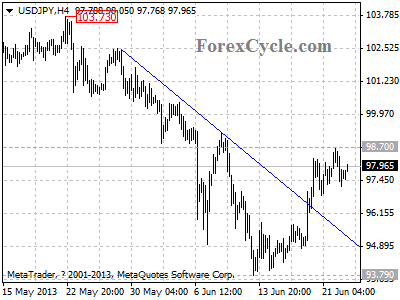
USDJPY remains in uptrend from 93.79

USDJPY remains in uptrend from 93.79, the fall from 98.70 is likely minor consolidation of the uptrend. Further rise could be expected after consolidation, and next target would be at 100.00 area. Support is at 96.80, as long as this level holds, the uptrend will continue. On the downside, a breakdown below 96.80 support will indicate that the upward movement from 93.79 has completed at 98.70 already, then the following downward movement could bring price back to test 93.79 support.

usdjpy

Daily Forex Forecast

Extreme Energy, Extreme Implications: Interview with Michael Klare

If oil and gas is a profoundly dynamic phenomenon, then so too must be environmental risk and conflicts over natural resources—and we are not getting the full picture from the mainstream media, according to Michael T. Klare, professor of peace and world security studies at Hampshire College, TomDispatch blogger, and author of Rising Powers, Shrinking Planet: The New Geopolitics of Energy (Metropolitan Books, 2008). As risk multiply, conventional sources evaporate and we are left with “extreme” energy, renewables may be the only way to avoid war and disaster.

In this exclusive interview with Oilprice.com, Klare discusses:

  • Why we are talking about a “resurgence” of American power
  • Why the issue of US natural gas exports is a geopolitical dilemma
  • Why Myanmar is important but not critical to the US Asia-Pacific “pivot”
  • Why Myanmar IS critical to China
  • Why India and Japan are key to the US’ evolving Asia policy
  • Why the shale revolution is the number topic around the world
  • Why unconventional oil and gas has the unfair advantage
  • Why WE don’t need Keystone XL, but the tar sands industry is desperate
  • Why the renewables are the only way forward


Interview by. James Stafford of Oilprice.com


James Stafford: In a recent article, you opined that “Militarily, culturally, and even to some extent economically, the US remains surprisingly alone on planet Earth in imperial terms, even if little has worked out as planned in Washington.” Can you add to this from the perspective of the unconventional oil and gas boom in the US?

Michael Klare: The United States emerged from the end of the Cold War with the most powerful military force on Earth and, because of the decline of the USSR and its other rivals, was seen as the world’s dominant power. In recent years, however, the rise of China has led some analysts to question America’s overwhelming superiority, saying that China’s accumulation of economic and technological power will allow it to compete on equal terms with the US in the not-too-distant future.

This, combined with the economic toll generated by the economic crisis of 2008 – largely attributed to lax economic oversight in the US – has led some to speak of the eventual “decline” of American power. But now, with the rise in domestic oil and gas production, that talk is disappearing; instead, analysts are speaking of a “resurgence” of American power based on strong oil and gas output.

James Stafford: In terms of the pending decision on whether to expand US natural gas exports, the geopolitical argument for this appears to be trumping the economic arguments. Will the geopolitical argument–natural gas exports to challenge Russia and Iran–win out in Washington?

Michael Klare: This is hard to predict, as the geopolitical argument cuts both ways:

while increased exports bolster American power vis-a-vis Russia and Iran, a revival of domestic manufacturing based on cheap energy also bolsters American power in the global economic equation. I would predict some exports, but not so much as they endanger the expected surge in domestic manufacturing.

James Stafford: How important is Myanmar to Washington’s Asia “pivot”, and how should we interpret the sudden blossoming of relations here despite the systematic ethnic cleansing that is taking place? China has the foothold here, but can it maintain it?

Michael Klare: Myanmar is important to the Asia-Pacific pivot, especially in symbolic terms (as it was long in the Chinese orbit), but not especially critical. Far more important are US ties with Japan, the Philippines and, above all, India. You can expect a major US drive to bolster military ties with New Delhi – this will really capture the attention of the Chinese!

James Stafford: How important will Myanmar’s potential hydrocarbon reserves be against its position as a strategic gateway?

Michael Klare: Myanmar’s hydrocarbon reserves are not that important to either China or the US. But it is becoming very important as an alternative delivery route from the Indian Ocean to southwest China, diminishing their reliance on the vulnerable Strait of Malacca, which is largely dominated by the US Navy. China is keenly determined to reduce its reliance on sea lanes controlled by the US Navy.

James Stafford: Iraqi Kurdistan is shaping up to be one of the hottest exploration venues in the Middle East, and while it comes with a lot of political baggage, oil companies show no concern. What do you think the political risk potential is once the Kurds get a new pipeline up and running directly to Turkey by the end of this year or early next year, courtesy of Anglo-Turkish Genel Energy?

Michael Klare: I think it would be very dangerous to make predictions about this, given all the instability in the region. The Iraqis in Baghdad are obviously very unhappy about this, and have various means to make it difficult for companies that invest there. But these companies may feel that the risks can be overcome, or minimized. Given the unrest in Syria and Turkey, I just don’t know how all this will play out.

James Stafford: We’ve written a lot about the petro-politics surrounding the conflict in Syria, both in terms of the Iranian-Qatari race for good pipeline acreage as well as the recent discoveries in the Levant Basin. What role do you think hydrocarbons and hydrocarbon infrastructure are really playing in the end game for this conflict?

Michael Klare: Well, I always tend to look for the role of oil and gas in conflicts like this, and I’m sure that they’re present. But I suspect that this is less about oil and gas per se than about the ultimate division of power in the Middle East between long-contending actors – the Iranians, Kuwaitis, Turks, Iraqis, Russians, Americans, and so on. Of course, this has a lot to do with oil and gas in the long run, as the victor in this power struggle will be able to dominate the production and sale of hydrocarbons. But for now I see it as a power game first and foremost.

James Stafford: What is the number one energy topic that grabs your readers, and how does your coverage of it go beyond the depths (or shallows) of the mainstream media?

Michael Klare: Right now the number one topic is how the “Shale gas (and oil) revolution” will alter the power balance between the United States and its major rivals, especially Russia and China. I heard this in Russia, China, and Mexico during visits to universities and think-tanks to these countries last year – it was always the #1 question. They want to know if other countries can replicate the US success in this field, or will be forever dependent on American fracking technology. People also want to know how this “revolution” will affect the future of renewables. Will more gas production prove a “bridge” to renewables, or a “bridge to nowhere?”

James Stafford: In your view, how is the mainstream media being manipulated in the climate change debate? How is the public being cheated out of a rational, smart debate?

Michael Klare: I am concerned that the media is not adequately explaining the difference between conventional and unconventional oil and gas. Proponents of fracking, the Keystone XL pipeline, deep-offshore production, and so on all say that these are just other forms of “oil” and “clean-burning natural gas,” without explaining that vastly different production techniques are involved and that these techniques have significantly worse impacts on the environment.

James Stafford: Will we ever get to the real debate, or will interest groups continue to maintain control?

Michael Klare: We can have a fair debate in universities and think-tanks, but the American media are saturated with advertising paid for by the oil and gas industry that distorts the environmental consequences of relying on these fuels – and it’s very hard for ordinary people to challenge these accounts.

James Stafford: Recently you have expressed your disappointment over the climate change rallies, focusing on the Keystone XL pipeline. What’s gone wrong? Has the movement lost its momentum?

Michael Klare: Perhaps I’ve expressed some disappointment from time to time but I’ve been very impressed by the emergence of a new movement on college campuses–including my own–to get colleges and universities to eliminate their investments in big carbon corporations, as a way of persuading them to keep unproduced carbon in the ground.
James Stafford: Do we need the Keystone XL pipeline?

Michael Klare: We Americans do not need Keystone XL – there are plenty of other available sources of energy, and we can reduce our demand through conservation efforts. But the tar sands industry desperately needs KXL, as all other practical conduits for exporting increased tar sands production seem to be closed off (like the Northern Gateway pipeline through British Columbia) – meaning they’ll have lots of resources, but no export options. No wonder they’re desperate to get Obama to approve the pipeline!

James Stafford: What should we know about Keystone XL that the mainstream media doesn’t tell us, or doesn’t understand?

Michael Klare: The fact that KXL will not carry “oil” at all–despite their claims–but a heavily polluting mixture of bitumen, diluents, and toxic chemicals that must be processed through extraordinary means before it can be refined into anything resembling a usable fuel.

James Stafford: How do you address the renewable energy-vs-fossil fuels race?

Michael Klare: My argument is that the production of oil and gas is not a static phenomenon but is undergoing profound changes, involving greater risk to the environment and greater risk of conflict over disputed sources of supply (such as offshore and Arctic reserves). These risks are bound to multiply as all sources of “easy” oil disappear and we become increasingly reliant on hard-to-reach, hard-to-process “extreme” energy. Only through the accelerated development of renewables can we avoid an inevitable spiral of war and disaster.

James Stafford: Is there a point at which we will be able to say that the two can help each other?

Michael Klare: Some investments in biofuels may have this capacity, but otherwise I do not see how.

James Stafford: There has been a lot of transparency activity in the US and Europe this year aimed at punishing big oil and its bankers for manipulating energy prices, for which the end consumer eventually foots the bill. Energy price manipulation is a time-honored tradition and usually the giants get a slap on the wrist and a fine that wouldn’t even make them blink. Are times changing, though? Will things be different now?

Michael Klare: Well, we can always hope so. But with Chinese, Indian, and Russian state-owned companies playing an ever-increasing role in the extraction of fossil fuels, I’m not optimistic about this!

Source: http://oilprice.com/Interviews/Extreme-Energy-Extreme-Implications-Interview-with-Michael-Klare.html

By. James Stafford of Oilprice.com


Why We Have Seen the End of the S&P 500’s Bear Market Rally

By Profit Confidential

Since the announcement from the Federal Reserve about tapering off quantitative easing, the key stock indices have been showing increased selling pressures. Just take a look at the chart of the S&P 500 below.

 SPC S and P 500 Large Cap Chart

Chart courtesy of www.StockCharts.com

The S&P 500 started 2013 with momentum to the upside. Investors bought in hopes that the index would continue to go higher, and by no surprise, it did reach its all-time high. As expected, after the Federal Reserve announcement, sellers took hold of the S&P 500, and it broke below its 50-day moving average for the first time this year (indicated by the black circle in the chart above)—a bearish indicator, according to technical analysts.

The last time the S&P 500 reached this far below its 50-day moving average was in October 2012. When that happened, the S&P 500 declined six percent, and it didn’t recover until December (as noted by the green circle in the above chart).

Note: other key stock indices like the Dow Jones Industrial Average and the NASDAQ Composite Index have also fallen below their 50-day moving averages.

Looking at this, I have to ask: is the bear market rally that lured investors into buying over?

The decline in the key stock indices has certainly proved my theory: money printing was a major factor in their flight to their all-time highs. Now, when we have hints that the Federal Reserve will be pulling back on its quantitative easing, the key stock indices are sliding lower.

Corporate earnings, one of the main reasons for the rise in the key stock indices, aren’t improving as expected either. As a matter of fact, 86 companies on the S&P 500 have issued negative guidance for their second-quarter corporate earnings. The expectation for earnings growth has been continuously declining.

At the end of March, analysts expected the corporate earnings of the S&P 500 companies to grow 4.4% in the second quarter, but unfortunately, their estimates came down to 1.3% at the end of May. (Source: FactSet, May 31, 2013.)

On the global macro level, the Chinese economy is sending threats to the key stock indices. Not only is the country expected to grow at a very slow pace compared to its historical average, but the amount of credit has also amassed in the Chinese economy since the financial crisis of 2008 and 2009. Recently, the country experienced a slight cash crunch when the rate banks charge each other rose significantly. (Source: The Globe and Mail, June 21, 2013.)

Dear reader, be careful. When I look at all this, the best investment strategy seems to be capital preservation. The risks of the key stock indices like the S&P 500 sliding even lower are piling up.

What He Said:

“The U.S. lowered interest rates in 2004 to their lowest level in 46 years. And what did Americans do with their access to easy money? They borrowed and borrowed some more, investing the borrowed money into real estate. Looking ahead, perhaps the Fed’s actions (of lowering interest rates so low as to entice consumers to borrow more than they can afford) will one day be regarded as one of the most costly errors committed by it or any other banking system in the last 75 years.” Michael Lombardi in Profit Confidential, July 21, 2005. Long before anyone was thinking of a banking crisis, Michael was warning that the coming real estate bust would wreak havoc with the banking system.

Article by profitconfidential.com