After Labor Strikes, What’s Next for Platinum?

Source: Brian Sylvester of The Metals Report (6/25/13)

http://www.theaureport.com/pub/na/15399

Violent South African mining labor strikes shocked the globe in 2012, but the resulting negotiations underway could create more stable supply flows in the long term—that’s how CPM Commodity Analyst Erica Rannestad sees it. In this interview with The Metals Report, Rannestad discusses the key developments that could signal a price rise and which producers could clean up big on high-priced PGMs.

The Metals Report: Erica, the platinum group metals (PGM) sector created a lot of buzz at the beginning of this year. What can investors expect in the coming 12 months?

Erica Rannestad: There’s going to be a lot of development in labor and wage negotiation structures in South Africa. It could potentially improve labor conditions in the platinum mining sector, which would provide more certainty about supply flows.

The PGM markets are highly concentrated, meaning that both supply and demand are heavily reliant on only a few sources. On the supply side, about 75% of platinum mine supply comes from South Africa.

These metals are primarily industrial commodities and their prices move in tandem with industrial activity, mostly in the auto sector. At present, there is weakness in platinum prices because demand from the European auto sector is weak and contracting. During the next 12–18 months, growth could improve in the European auto market, which would be positive for platinum prices.

TMR: Could the downturn in automobile purchases in Europe be offset by growing automobile purchases in China and the rest of Asia?

ER: Not necessarily, because platinum is mostly used in diesel automobiles and the auto markets in China and most Asian countries are predominantly gasoline powered. While commercial vehicles are sold throughout the world, most are powered by diesel and the market only accounts for a minority of total global vehicle sales. Even though there is improved growth in the Chinese auto market, it’s not filtering into platinum prices so much as palladium prices because the Chinese auto market is much more reliant on palladium.

TMR: In 2012, some intense labor conflicts in South Africa lead to the Association of Mineworkers and Construction Union (AMCU) to become the majority union at Lonmin Plc (LMI:LSE), Impala Platinum Holdings Ltd. (IMP:JSE) and Anglo American Platinum Ltd.’s (AMS:JSE) Rustenburg complex. What does this mean for the industry at large?

ER: Lonmin and the AMCU are struggling to form an agreement about revisions to the wage negotiation process. There’s still a lot of uncertainty right now, and high risk of additional strikes over the upcoming months. But there’s potential for a reduction in uncertainty about labor-related disruptions to supply in the long term.

TMR: Will the Lonmin deal set the precedent for other companies?

ER: Not necessarily. Last year, Lonmin agreed to a maximum 22% increase in wages. The market thought it was going to set a precedent, but that didn’t necessarily happen. The Chamber of Mines, the Department of Mineral Resources and platinum mining companies are working together in a collaborative way to try and resolve labor issues.

TMR: How much platinum and palladium has Lonmin been responsible for annually?

ER: It has the capacity to produce about 1.5 million ounces (1.5 Moz) of platinum, palladium and rhodium, which is about 9% of global mining capacity of PGMs.

TMR: That could be a significant shortfall if negotiations don’t go well. When is the earliest we could expect an agreement?

ER: It’s been turned over to arbitration. The Commission for Conciliation, Mediation and Arbitration has scheduled the arbitration for June 26. Therefore, I think there could be a decision in the next month or so.

TMR: The other difficulty often associated with South Africa is the threat of nationalization. Those whispers were more ubiquitous a year ago. What are you hearing now?

ER: Our view is that nationalization of the mining industry in South Africa will not occur. That conversation is always coming into the market and it’s always being shut down.

TMR: Let’s get to some hard numbers.

ER: Overall, we do expect an improvement in both supply and demand for all the PGMs. For platinum, last year there was a nearly 11% reduction in supply. This year, we expect about a 4% increase to 7.3 Moz. Last year, fabrication demand was flat from 2011 levels. Most of that was driven by a sharp reduction in European auto demand, which was offset by an increase in jewelry demand. This year, we expect about a 0.9% increase in fabrication demand to 7.4 Moz. That will mostly be driven by a much smaller reduction in European auto demand coupled with continued growth in jewelry demand.

Palladium supply contracted by 5.5% last year to 8.6 Moz, which was slower than the reduction in platinum because the palladium market is less dependent on South African supply. This year, we expect about a 6% palladium production increase to 9.1 Moz. Much of that is the return of supply from South Africa, but also growth in Zimbabwe.

Palladium demand last year grew 8.5% to 5.5 Moz. This year, we expect about a 6.4% increase to 5.8 Moz. The reduction in fabrication demand growth isn’t necessarily a negative thing. Less demand one year could manifest as pent-up demand in the following year. That was the case with Japan last year, following the 2011 natural disasters in the country that disrupted economic and industrial activity. That pent-up demand is largely behind the market now and we expect more normalized growth.

Total supply of rhodium declined 8% last year and we expect it to rise 5% this year to 933,000 ounces (933 Koz). Fabrication demand rose last year by 4.4% to 931 Koz. A lot of that growth was a return in demand from Japan last year. This year, we expect a 1.5% increase in fabrication demand to 945 Koz.

TMR: Where is investment demand trending for platinum and palladium?

ER: Last year, there were a lot of investors selling in the market. The reasons varied. Some investors who had invested years ago saw that the price had doubled and were offloading inventories. Investors in PGMs do best when they have a long-term horizon because these markets are very cyclical and highly concentrated, with very strong and price-positive long-term supply/demand fundamentals. Other investors sold because of cyclical weakness in these markets—contracting demand in Europe and slowing growth in China.

This year, we’re seeing some renewed, although hesitant, interest in PGMs. The new South African physical platinum exchange-traded fund (ETF) that was launched, NewPlat ETF by Absa Investments, has garnered a lot of interest from the South African community. Prior to the launch, institutional investors were only able to invest in the platinum market through mining equities, and equities have not performed very well for several years.

TMR: Right now, prices are at $1,475 for platinum, $750 for palladium and $1,175 for rhodium. What are your projected averages for those three through the end of the year?

ER: We expect platinum will average $1,555 for the year, which is almost flat from 2012. However, we expect a pickup in the Q4/13. We’re much more positive on palladium. We expect about a 13% increase in the annual average price to $730. The average rhodium price could experience a 12% decline to $1,120/oz.

TMR: You’re forecasting modest growth in demand in 2013. Why?

ER: The price weakness during the past two years has been cyclical. It’s also been a function of reduced overall investor interest in precious metals since they touched their peaks in 2011. We do believe that the prices will pick up. Investors need to watch for changes in demand prospects. If the European auto market does significantly improve, it’s going to be positive for platinum demand and prices. The long-term factors that drive the PGM markets are still very positive for the price. Investors that are still in the market with long-term objectives likely have not changed their views about the PGM markets, because many of those price-positive factors remain intact.

TMR: Can you explain the dynamics of PGM’s fabrication demand?

ER: We get this question a lot because these metals are reliant on very cyclical industries. Is there potential for PGMs to be substituted out of an auto catalyst? The answer right now is no. You can use platinum and palladium interchangeably in auto catalysts in gasoline vehicles—less so in diesel vehicles—but these metals are the most efficient, reliable and cheapest answer to reducing harmful emissions. There’s no other metal or technology that is able to perform those functions at those costs. It doesn’t look like PGMs are going to be thrifted out of the auto industry any time soon. Other applications that use PGMs, like the glass and petrochemical industries, don’t have much substitution potential either.

TMR: About a decade ago, Ford Motor Co. and others began stockpiling PGMs to guard against price increases. Could larger manufacturers using PGMs begin to stockpile again?

ER: The industry is much more sophisticated now and understands these markets better than they used to. The market is a little bit more transparent and we have a better idea of where the metal is. There’s also larger secondary supply than there was a decade ago, which has helped to diversity supply sources for fabricators. Of course stockpiling could happen again, but I doubt it would to that magnitude.

TMR: Are there any PGM mines slated to begin production this year?

ER: There are three mines or mine expansions that should start producing metal this year. The Booysendal project, which is owned by Northam Platinum Ltd. (NHM:JSE), is expected to begin producing metal in H2/13. The project could produce about 160 Koz PGMs annually. Northam already has one mine in South Africa, the Zondereinde Mine, which is the deepest, level mine in the country.

The Serra Pelada mine in Brazil, which is owned by Colossus Minerals Inc. (CSI:TSX; COLUF:OTCQX), will produce some PGMs from its asset. It’s primarily a gold mine.

TMR: Platinum and palladium are produced as byproducts at a lot of mines, including First Quantum Minerals Ltd.’s (FM:TSX; FQM:LSE) Kevitsa project in Finland.

ER: Then there is Zimplats in Zimbabwe, which is expanding its Ngezi mine with an additional 174 Koz.

TMR: Are there any other PGM projects on the drawing board?

ER: Xstrata Plc (XTA:LSE) has a project in Tanzania, called Kabanga, with a resource of about 1 Moz of PGMs slated for 2015.

Royal Nickel Corp.’s (RNX:TSX) Dumont nickel project in Canada could create 19 Koz of PGMs per year as a byproduct of nickel production. There are 1.5 Moz platinum and palladium Measured and Indicated resources. Only 19 Koz PGMs would be produced per annum, based on the latest reports.

In the U.S., the NorthMet project in Minnesota is being developed by Polymet Mining Corp. (POM:TSX; PLM:NYSE.MKT).

The largest project slated to come on-stream in the near term is the Platinum Group Metals Ltd. (PTM:TSX; PLG:NYSE.MKT) WBJV 1 project in South Africa. It’s a primary platinum project with 275 Koz of annual output.

TMR: That’s a low-cost producer as well.

ER: It’s a near-surface mine, not nearly as deep as most operations in the area. This feature helps reduce the cost, offsetting the fact that the deposit is relatively lower grade.

TMR: There is a slight uptick in cash costs globally, too.

ER: C1 cash costs rose globally by 10% last year and 14% in South Africa. We don’t see any end in sight for cost increases in the medium term. We forecast annual increases of around 10% in the next few years. Labor costs in South Africa have increased at a double-digit pace for the past 30 years. We don’t expect that to change.

TMR: Will price increases outpace cash cost increases, or are they in lockstep with each other?

ER: That hasn’t been the case. We’ve seen prices decline and costs increase, which has deteriorated profit margins. The moment we see a cyclical turnaround in demand growth—again focusing mostly on the European auto market—there could be stronger price increases, which would help alleviate some of that margin pressure on profits.

TMR: How are the institutional investors playing the platinum space?

ER: Investors have been exiting the market over the past 18 months because they reached their long-term price objectives, or shorting the market because of short-term demand weakness. Investors mostly look at the PGMs as an industrial metal and treat it as a cyclical investment. The futures market has expanded in the PGM space remarkably during the past several years. It’s a much different market than it used to be.

Another thing to point out in the futures market is the gross short positions of non-commercials, which are at multi-year highs. Non-commercials are the market participants like money managers and traders, rather than commercial market participants who use the futures market for hedging purposes.

Even though there has been tremendous growth in long positions over the past several years, since H2/12, gross short positions increased to near-record levels. There’s a huge increase in market participation, but also a lot of bearish signs with regards to the growth in short positions. That’s indicative of the entire precious metals complex. All the precious metals are experiencing multiyear highs in gross short positions of non-commercials. We could see some turnaround in the latter half of this year or next year that could be pretty significant.

TMR: Given the strong industrial demand factors then, do you see more offtake agreements coming in this space?

ER: I think what we are seeing is some more interesting financial structures going on in the precious metals industry overall. We’re seeing a lot more metal streaming agreements, for instance.

TMR: Any parting thoughts?

ER: Last year was a turning point in South African supply. It has filtered into decisions on labor issues in the country and the overall industry. Going forward, we are going to see a lot of development at the government, company management and labor union levels in how wages are negotiated and how unions approach labor disputes, which could be a long-term positive for the certainty of supply flow.

The strikes in 2012 were not new to the PGM market. The heightened level of violence certainly was new. That triggered what we are beginning to see as a long-term improvement in labor structure in the country. Investors should watch to see if that provides more certainty. There could be some long-term shifts in certainty and supply flow.

CPM Group actually just released its Platinum Group Metals Yearbook 2013, which includes final 2012 statistics for platinum, palladium and rhodium supply and demand as well as projections for the rest of 2013. In this edition, we’ve included disaggregated PGM secondary supply statistics for the first time, and those are broken down by spent auto catalyst, old jewelry and end-of-life electronics recycling. It’s a great, in-depth resource for investors interested in PGMs.

Erica Rannestad is a commodity analyst at CPM Group. Rannestad covers the precious metals and agricultural softs markets as well as currency markets. She is responsible for building CPM Group’s supply and demand statistics for the precious metals Yearbooks and Long-Term Outlook reports. Rannestad is currently most closely monitoring the silver and platinum markets, providing near- and medium-term price forecasts for these metals in CPM Group’s Precious Metals Advisory, a monthly publication. Rannestad also often contributes to and supports CPM Group consulting projects and regularly presents CPM Group’s market views at conferences and seminars around the world. Rannestad holds a Bachelor of Science degree in finance from Fordham University’s Gabelli School of Business.

Want to read more Metals Report interviews like this? Sign up for our free e-newsletter, and you’ll learn when new articles have been published. To see a list of recent interviews with industry analysts and commentators, visit our Metals Report <href=”#interviews” target=”_blank”>homepage.

DISCLOSURE:

1) Brian Sylvester conducted this interview for The Metals Report and provides services to The Metals Report as an independent contractor.

2) The following companies mentioned in the interview are sponsors of The Metals Report: None. Streetwise Reports does not accept stock in exchange for services.

3) Erica Rannestad: I or my family own shares of the following companies mentioned in this interview: Platinum Group Metals LTD. I personally am or my family is paid by the following companies mentioned in this interview: None. My company has a financial relationship with the following companies mentioned in this interview: None. I was not paid by Streetwise Reports for participating in this interview. Comments and opinions expressed are my own comments and opinions. I had the opportunity to review the interview for accuracy as of the date of the interview and am responsible for the content of the interview.

4) Interviews are edited for clarity. Streetwise Reports does not make editorial comments or change experts’ statements without their consent.

5) The interview does not constitute investment advice. Each reader is encouraged to consult with his or her individual financial professional and any action a reader takes as a result of information presented here is his or her own responsibility. By opening this page, each reader accepts and agrees to Streetwise Reports’ terms of use and full legal disclaimer.

6) From time to time, Streetwise Reports LLC and its directors, officers, employees or members of their families, as well as persons interviewed for articles and interviews on the site, may have a long or short position in securities mentioned and may make purchases and/or sales of those securities in the open market or otherwise.

Streetwise – The Gold Report is Copyright © 2013 by Streetwise Reports LLC. All rights are reserved. Streetwise Reports LLC hereby grants an unrestricted license to use or disseminate this copyrighted material (i) only in whole (and always including this disclaimer), but (ii) never in part.

Streetwise Reports LLC does not guarantee the accuracy or thoroughness of the information reported.

Streetwise Reports LLC receives a fee from companies that are listed on the home page in the In This Issue section. Their sponsor pages may be considered advertising for the purposes of 18 U.S.C. 1734.

Participating companies provide the logos used in The Gold Report. These logos are trademarks and are the property of the individual companies.

101 Second St., Suite 110

Petaluma, CA 94952

Tel.: (707) 981-8999

Fax: (707) 981-8998

Email: [email protected]
 

Choosing the Right REIT ETF

By The Sizemore Letter

It may seem like madness to suggest buying REITs at a time when yields are soaring and anything associated with “income investing” is getting slammed.  But with many popular REITs down 30% or more, now is precisely the time to start digging around for value.

This bond market selloff roiling all income-focused securities may very well continue for a while, and I don’t recommend trying to catch the proverbial falling knife by calling an exact bottom in REIT shares.  But at the very least, you can build a watch list of your favorite names and average into them on any weakness.  This has been my approach in my own income-focused portfolios.

But what about REIT ETFs?

Given the popularity of REITs, a plethora of ETFs have sprung up, each offering a slightly different approach to the asset class.  While I prefer to cherry pick a portfolio of my favorite REITs, REIT ETFs may be a great option for smaller accounts or investors who prefer a “one stop shop” approach.

I’ll go through several familiar (and probably not so familiar) names today.


REIT

Ticker

Dividend Yield

AUM

Expenses

Vanguard REIT ETF

$VNQ

3.37%

$34.68 billion

0.10%

SPDR Dow Jones REIT

$RWR

2.84%

$2.13 billion

0.25%

iShares Cohen & Steers Realty Majors

$ICF

2.86%

$2.87 billion

0.35%

iShares Dow Jones US Real Estate

$IYR

3.52%

$5.78 billion

0.47%

 
Let’s start with the biggest and most popular ETFs in the segment, which hold the largest-cap equity REITs.  In this space, we have the Vanguard REIT ETF ($VNQ), the SPDR Dow Jones REIT ($RWR), the iShares Cohen & Steers Realty Majors ($ICF) and the iShares Dow Jones US Real Estate ETF ($IYR).  

What is immediately striking about this group is the pitifully low yield on RWR and ICF.  For an asset class that is ostensibly income-focused, that is simply not a high enough yield to warrant serious consideration.

Each of these ETFs uses a slightly different index to track the sector, but their top ten holdings are nearly identical.  Simon Property Group ($SPG) is the single largest holding in all four ETFs, and HCP Inc ($HCP), Public Storage ($PSA), Vornado ($VNO), and Equity Residential ($EQR) feature prominently as well.

While there is nothing “wrong” with these large-cap REITs, some of them have yields that are a little less than impressive for securities that were designed to be income vehicles.  Simon Property Group, the largest holding in all four ETFs, yields only 2.9%.

Some of these REITs—and Vornado has been a high-profile case of this in recent years—have evolved away from pure landlording and have moved to become “deal making” growth vehicles in which property speculation is as important (or more so) than collecting rent checks.  Again, there is nothing inherently “wrong” with this, but it may not be what you are looking for if you consider yourself an income investor.

LC REITS

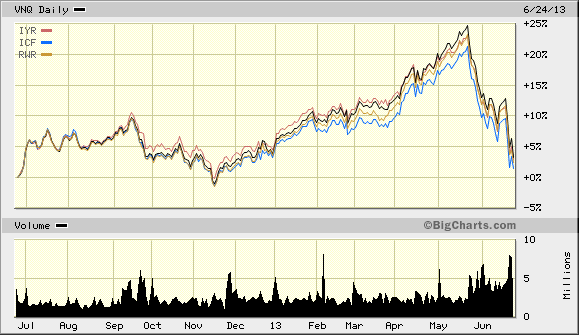
Figure 1: Large-Cap Equity REIT ETFs

Not surprisingly, since all four large-cap REIT funds hold substantially the same securities, they tend to track each other pretty closely (see Figure 1).  Given that these are index investments with no active management in place, the smartest course of action is to buy the ETF with the highest yield and lowest management fee.  This leaves us with the Vanguard REIT ETF and the iShares Dow Jones US Real Estate.

The iShares Dow Jones US Real Estate has a slightly higher current yield (15 basis points) though its management fee is 37 basis points higher.

Normally, I would call that close enough to be a wash.  But the Vanguard ETF is a purer play on actual property-owning equity REITs, whereas the iShares fund has exposure to mortgage REITs and to non-REIT development and holding companies such as Alexander and Baldwin ($ALEX), which, among other things, produces sugar and coffee on Hawaiian plantations.

For broad large-cap REIT exposure, go with Vanguard’s VNQ.  I would consider this appropriate for a long-term asset allocation, and—in the interests of full disclosure—that is exactly how I utilize it myself.

Specialty REITS


REIT

Ticker

Dividend Yield

AUM

Expenses

PowerShares KBW Pr Yield Equity REIT

$KBWY

4.36%

$71.81 million

0.35%

IQ US Real Estate Small Cap ETF

$ROOF

4.48%

$39.41 million

0.69%

iShares FTSE NAREIT Residential

$REZ

2.96%

$309.76 million

0.48%

iShares FTSE NAREIT Retail

$RTL

2.95%

$20.83 million

0.48%

iShares FTSE NAREIT Residential

$FNIO

2.72%

$12.5 million

0.48%

As I mentioned in the section above, cap-weighting tends to skew the large-cap REIT ETFs towards a handful of very large REITs that tend to have mediocre yields. This brings me to two small-to-mid-cap REIT ETFs:  The PowerShares KBW Premium Yield Equity REIT ($KBWY) and the IQ US Real Estate Small Cap ETF ($ROOF).

There is a lot to like about the small-cap sector.  Because the REITs are smaller and less followed by Wall Street, you can often find better pricing and higher yields.  You have to do your homework and look at the underlying property portfolios for signs of over concentration in certain markets or deteriorating tenant quality.  But with that added bit of work comes the potential for a lifetime of higher dividend payments.  And of course, with an index fund like KBWY or ROOF, you can avoid the homework by just buying the entire basket.

Unfortunately, both KBWY and ROOF are small in terms of assets under management and have fairly thin trading volumes.  So, you have to be careful when buying or selling and you should use a limit order.

And ROOF may be somewhat poorly named, as it includes both mortgage REITs and traditional equity REITs. (For anyone needing a review, “equity REITs” hold properties whereas “mortgage REITs” hold mortgages and mortgage derivatives. One is an investment in real assets; the other in paper.)

I like KBWY’s portfolio and consider it worth owning alongside the large-cap Vanguard REIT ETF.  National Retail Properties ($NNN) is a core holding in several income portfolios I run, and I consider Omega Healthcare Investors ($OHI), Government Properties Income Trust ($GOV), and Health Care REIT ($HCN) to be solid income producers.

And what about sector REIT ETFs?

iShares has multiple offerings on this front, but none are exceptionally appealing.  The iShares FTSE Industrial/Office REIT ETF ($FNIO) has 32% of the portfolio in just two stocks—ProLogis ($PLD) and Boston Properties ($BXP).  It also has a pitiful $12 million under management and trades only 3,000 shares per day.  This ETF may not be in business a year from now.

Likewise, the iShares FTSE NAREIT Retail REIT ETF ($RTL) is heavily weighted in just one stock—Simon Property Group, at 22% of the portfolio—and trades just 8,000 shares per day.

The iShares FTSE NAREIT Residential REIT ETF ($REZ) is the only sector REIT ETF that has any volume to speak of, at 70,000 shares traded per day, but even this is too low a volume for a larger portfolio.  This residential REIT ETF is also the best diversified of the lot, though I do not consider apartment REITs particularly attractive at current prices and yields.

With the housing market recovering and with the Echo Boomers (aka “Generation Y” or the “Millennials”) now, for the most part, moved out of their parents’ basements and into apartments of their own, the strong demand that has underpinned the sector is looking a little more tepid.  This doesn’t mean that the sector is facing a pending crash, mind you.  But I don’t see the growth going forward, and 2.9% is not a high enough yield to warrant holding based on income alone.

And finally, I should say a word about mortgage REITs.  Mortgage REITs operate like “virtual banks,” borrowing cheaply short term and using the proceeds to buy long-dated mortgages.  The difference between the two is the “spread,” which varied based on the term structure of interest rates.

Rising bond yields have wrecked the book value of the REITs’ mortgage holdings and have prompted investors to dump the securities en masse.  But going forward, a steeper yield curve is actually good, as it increases the spread between the borrowing rate and the lending rate.

The question you have to ask yourself as a potential investor is this: Has the curve finished steepening, or do we have a ways to go?

If believe, as I do, that the hike in Treasury bond yields is a short-term blip and not a major regime shift, then mortgage REITs as a sector make sense.  Many of the larger names—such as Annaly Capital Management ($NLY) now sell for well below book value.

But I should be clear here: while equity REITs are solid “buy and hold” investments for investors who want exposure to real, income-producing assets, mortgage REITs most assuredly are not.  They are closer to publically traded hedge funds and are nothing more than highly-leveraged paper-shuffling vehicles.  Mortgage REITs should be viewed as a trade, not a long-term investment.

On the ETF front, there are two mortgage REIT funds of note: the Market Vectors Mortgage REIT ETF ($MORT) and the iShares FTSE NAREIT Mortgage Plus Index ETF ($REM), which currently yield 9.25% and 11.15%, respectively.  Though please note that mortgage REIT dividends are fair less consistent than equity REIT dividends.

Note: There are plenty of REIT ETFs I left out of this write-up either due to lack of assets under management and liquidity concerns or due to the fact that, in my estimation, they added no noteworthy new exposure that wasn’t already covered by another ETF.

Disclosures: Sizemore Capital is long NNN and VNQ. This article first appeared on InvestorPlace.

SUBSCRIBE to Sizemore Insights via e-mail today.

Roger Wiegand Predicts a Brand New World for Gold

Source: Peter Byrne of The Gold Report (6/24/13)

http://www.theaureport.com/pub/na/15382

The quant who produces Trader Tracks newsletter tells The Gold Report that the technical charts project a brightening future for precious metals. Technical market analyst Roger Wiegand tracks annual trading cycles while keeping an expert eye on potentially disruptive world events. He is a stickler for fundamentals, though, when it comes to picking out the best juniors for safe bets in a cash-poor industry.

The Gold Report: In early 2012, Roger, you predicted that the price of gold would rise to over $2,000/ounce ($2,000/oz) during the year. But as the overall stock market increased in value, the yellow metal went in the opposite direction. What happened?

Roger Wiegand: Two things happened. First, the last gold peak almost made it. It went to $1,923/oz, and that was a technical and fundamental top. Then it sold down. The other thing that happened is that the U.S. Treasury intentionally sold gold to protect the stock and bond markets. Treasury feared that if gold ran up too high too quickly, people would dump securities en masse.

We are in the seasonal cycle when many markets go sideways. We have seen the selloff at the end of last week. A triple bottom is extremely bullish. The snap back in the price going long could be impressive.

TGR: What factors are keeping gold down in the near term?

RW: Gold is taking a pounding since the big bullion banks have full control and they have to cover their radical short positions taken at the behest of the FOMC and U.S. Treasury to preserve the fiat markets. Briefly, they kept the gold market under control to prevent a runaway for the FOMC and are now using TARP bank capital and derivative dollars to drive gold to the basement. Next, they are accumulating all the gold bullion they can to preserve their wealth in the forthcoming legendary crash. In addition, they get to buy it on the cheap as the dumb money is in full exit in fear.

Also, China, South Korea and Japan have problems and each central bank is dealing American bonds. Recently, China sold American paper through its own markets in order to offload Treasury bonds for currency. All kinds of problems are looming in China; some experts claim that China’s export trade numbers are only half of what was actually reported. South Korea is clearly weakening, and Japan is experiencing an emergency, causing it to stimulate at twice Mr. Bernanke’s rate. That is simply unsustainable. Japan is the Achilles heel of the whole financial system. If the yen runs away, it’s a disaster.

What does that mean for gold? Starting in August, the price will likely rise until the end of September. Then harsh political and economic factors will create serious problems in the global markets: I’m calling for a 50% correction in the U.S. stock markets in Q4/13.

TGR: In your June 6 newsletter, you said that we are on the verge of a brand new world.

RW: The brand new world is imminent because the lessons of 2008 were not learned. The banks are doing the same bad things they were doing before the crash, only worse. The derivative markets are larger now than they were back then. A huge number of student loans might well be written off. And the real estate market is doing a rerun. Incredible! People with foreclosures who may not be qualified for a new mortgage are receiving Federal Housing Authority-insured loans in a desperate effort to try to prop up the home loan industry, which is a major sector of the U.S. economy.

We are in a depression, not a recession. The real numbers for unemployment in the U.S. are 25%. They were 25% in the 1930s. In Spain, 54% of the workers under age 25 are unemployed. The down-the-hill slide is global and in slow motion. People still believe a lot of media nonsense, but this market simply has not corrected. The ultimate jobs program will be a new war.

TGR: Where do you think a war will break out, Roger?

RW: Iraq is cranking up for another round. War is on the agenda in Turkey. Libya has bad problems, not to mention the horror that is Syria. China is beating a war drum, but that’s just talk. North Korea is not capable of going to war. But more wars over energy resources will continue to break out in the Middle East.

War creates jobs. World War II ended the Depression of the 1930s. I don’t think there will be a nuclear war, but three or four conventional wars can go on simultaneously, hire a lot of people, square away the economy and get things righted in the bond market.

TGR: Given such a dismal scenario, how will that affect the price of bullion and shares in gold mining firms?

RW: In the short term, gold and silver shares will follow the futures and cash markets. We are still in a corrective phase, which can last for another six weeks. But once gold and silver start to climb, the shares will follow. It’s a big mistake right now for people to unload shares in good junior companies just because the stock has been beaten down. The companies with good fundamentals and enough cash to sustain operations for the next two to three years are going to do better. Look for good management with a project next door to a senior that is going to buy out reserves. Cash-starved greenfield juniors out in the middle of nowhere with no senior around to buy them out will not make it. It is like the salmon going upstream—some fish fall by the streamside, some make it home to nest.

TGR: What technical tools do you use to analyze the future of gold?

RW: I look at the Market Vectors Junior Gold Miners ETF (GDXJ), which is the Index for the juniors group. Right now, the graph of that technical tool looks like an upside down head and shoulders, and that’s very bullish. It is going to take a few more weeks for the junior stocks to pick up steam.

TGR: Do you have any junior names that meet your criteria for success?

RW: Watch California Gold Mining Inc. (CGM:TSX.V) at $0.08/share. The company has top management from Northern Gold Mining Inc. (NGM:TSX.V). It is located in a region with gold mining activity historically. Six mines are in various stages at that location. California Gold Mining stock had a low of $0.03 and a high of $0.24/share. Technically, we add the high and low and divide by two and find a 50% retracement. That is half of $0.27 or almost $0.14. The company has money and it has strong backers.

One of the standards out there that has been very good to our readers for the last four years is Timmins Gold Corp. (TMM:TSX; TGD:NYSE.MKT). It is a steady play, always on the upswing. When the futures and the cash markets rise, Timmons runs alongside. The near-term price is between $2.50 and $2.75/share. We’re looking at $2.85 to $3/share in the next 30–60 days, roughly.

We have followed Canasil Resources Inc. (CLZ:TSX.V) for years. It is trading around $0.055/share. Rounding to $0.06, we are looking at $0.125 as a goal within 90 days. A key point with Canasil is it is primarily a silver exploring company in northern Mexico. Its partner is MAG Silver Corp. (MAG:TSX; MVG:NYSE), and the two companies just signed a partnership agreement, expanding a major project with an injection of several million dollars. MAG Silver has a lot of capital. MAG Silver’s Peter Megaw is one of the top geologists in the business. He told me that the company plans to build a 100 million ounce silver reserve and make it as big as the biggest of the precious metal mines in Mexico. So far, it is doing exactly that. Canasil also has some wonderful projects in British Columbia that just got permits.

At Trader Tracks, we like Santacruz Silver Mining Ltd. (SCZ:TSX.V; 1SZ:FSE) at CA$1.15/share. We are looking for a 50% retracement back to CA$1.75/share.

And there is Gold Standard Ventures Corp. (GSV:TSX.V; GSV:NYSE) in Nevada, right next door to Newmont Mining Corp. (NEM:NYSE). The chief geologist for Newmont has done the exploratory work and the results look good. The firm’s shares have big support by some very wealthy investors and are going up. The price was down to CA$0.50/share in May, and it is at CA$0.67 today. Gold Standard Ventures is the perfect example of a company that is building good reserves next door to a senior that, in my opinion, is going to buy it out.

One of our old favorites is Hecla Mining Co. (HL:NYSE). Today, it is at $2.79/share. The company went through a spate of problems during the last three years. But after settling a lawsuit with the Environmental Protection Agency, it expanded the Lucky Friday mine in Idaho. It bought out Rio Tinto Plc’s (RIO:NYSE; RIO:ASX) partnership shares there. It now totally owns the Greens Creek project on Admiralty Island in Alaska, which has a silver life of 50 years. That island mine was running on electricity generators, and now it is connected by wire to the mainland. Hecla has been busy with a gold mine in northern Mexico in an area that is very rich, with four seniors operating in the region. We are looking for a high of $4.88/share in three to six months. Hecla’s stock likes to go to $8 or $9/share, and then retreat on a correction.

TGR: Roger, can you tell us what kind of technical information you look at to come up with your recommendations?

RW: I am mainly a chartist and a technician, but one cannot neglect the fundamentals, particularly considering the state of political economy in the world. First off, does a firm have good management? Is it located in an area that’s politically reliable? Does it have expertise in engineering and geology? Then, we look at valuations.

Remember, if you want to find gold or silver, go where the old mines have been prolific. Just because a lot of ore has been pulled out successfully does not mean that there is not more there to be mined. California Gold is a perfect example. The two big mines that Hecla runs in Idaho and Alaska are examples. The old mines in northern Mexico are loaded with silver. First Majestic Silver Corp. (FR:TSX; AG:NYSE; FMV:FSE) is an intermediate-size miner in Mexico that has done exceedingly well. Its stock is lofty in price, but the company continues to prove its way down the road and make money by expanding the business.

After assessing the fundamentals, we examine the technical side with a long-range chart of 5 or 10 years. Then we narrow it down to a one-year chart. We next narrow it down to the cycles. Historically, gold and silver do very well between Nov. 1 through April. From May through mid-August, everything slows down. The annual fall rallies start the second or third week of August and run until the middle of October. Traders and investors in gold and silver know that the two big contracts in Q4 for gold and silver are the December futures, and they expire in November.

TGR: The futures explain the cycles?

RW: Yes. August gold is not that big a deal. December is the really big one for gold. In silver, March is the big one. July is less important. September is big because it’s in the middle of the peak season going higher. The other big cycle for silver is December. So keep these cycles in mind when trading and investing. Those are the times of year a trader or investor with average experience can profit from quantification. Chart the time of year when prices consistently bottom out and then start to rise.

TGR: Any junior names for us outside of North America?

RW: We follow Global Minerals Ltd. (CTG:TSX.V; DPF:FSE) in Slovakia. It has great reserves. It is a previously exploited, proven mine. Slovakia is a business-friendly, Westernized country with all the big auto and consumer companies operating there. Global Minerals had a dewatering project that went on for about eight months. The pumping is completed, and the engineers and geologists are working at the 3,000-foot level, doing the exploratory work for the next move.

TGR: Do you own stock in Global Minerals?

RW: I trade futures and commodities. Because I recommend stocks for the Trader Tracks newsletter, ethically I cannot buy them. That breaks my heart, sometimes, because I’ve seen some dandies that I knew were going to do well. But I personally trade futures in gold, silver, currencies, the energy sector and grains.

TGR: Any parting advice, Roger?

RW: Please have patience, gold investors. Some analysts are predicting crazy numbers, like $900/oz. Not me.

TGR: Thanks, Roger.

Roger Wiegand—aka Traderrog—produces Trader Tracks newsletter to provide investors with short-term buy and sell recommendations and give them insights into political and economic factors that drive markets. After 25 years in real estate, Wiegand has devoted intensive research time to the precious metals, currency, energy and financial market for more than 18 years. He creates a weekly column forJay Taylor’s Gold, Energy & Tech Stocks newsletter.

Want to read more Gold Report interviews like this? Sign up for our free e-newsletter, and you’ll learn when new articles have been published. To see a list of recent interviews with industry analysts and commentators, visit our Streetwise Interviews page.

DISCLOSURE:

1) Peter Byrne conducted this interview for The Gold Report and provides services to The Gold Reportas an independent contractor. He or his family own shares of the following companies mentioned in this interview: None.

2) The following companies mentioned in the interview are sponsors of The Gold Report: Timmins Gold Corp., MAG Silver Corp., Santacruz Silver Mining Ltd., Gold Standard Ventures Corp. and Global Minerals Ltd. Streetwise Reports does not accept stock in exchange for its services or as sponsorship payment.

3) Roger Wiegand: I or my family own shares of the following companies mentioned in this interview: None. I personally am or my family is paid by the following companies mentioned in this interview: None. My company has a financial relationship with the following companies mentioned in this interview: None. I was not paid by Streetwise Reports for participating in this interview. Comments and opinions expressed are my own comments and opinions. I had the opportunity to review the interview for accuracy as of the date of the interview and am responsible for the content of the interview.

4) Interviews are edited for clarity. Streetwise Reports does not make editorial comments or change experts’ statements without their consent.

5) The interview does not constitute investment advice. Each reader is encouraged to consult with his or her individual financial professional and any action a reader takes as a result of information presented here is his or her own responsibility. By opening this page, each reader accepts and agrees to Streetwise Reports’ terms of use and full legal disclaimer.

6) From time to time, Streetwise Reports LLC and its directors, officers, employees or members of their families, as well as persons interviewed for articles and interviews on the site, may have a long or short position in securities mentioned and may make purchases and/or sales of those securities in the open market or otherwise.

Streetwise – The Gold Report is Copyright © 2013 by Streetwise Reports LLC. All rights are reserved. Streetwise Reports LLC hereby grants an unrestricted license to use or disseminate this copyrighted material (i) only in whole (and always including this disclaimer), but (ii) never in part.

Streetwise Reports LLC does not guarantee the accuracy or thoroughness of the information reported.

Streetwise Reports LLC receives a fee from companies that are listed on the home page in the In This Issue section. Their sponsor pages may be considered advertising for the purposes of 18 U.S.C. 1734.

Participating companies provide the logos used in The Gold Report. These logos are trademarks and are the property of the individual companies.

101 Second St., Suite 110

Petaluma, CA 94952

Tel.: (707) 981-8999

Fax: (707) 981-8998

Email: [email protected]


Stunning Chart Shows Gold and Silver Defy Bulls’ Optimism

By Elliott Wave International

Gold and silver have been all over the financial news.

On Thursday, June 20, silver fell below $20 (-60% from 2011 high), and gold fell below $1300 (-30% from 2011 high).

We first published the chart below after metals plunged in mid-April. It shows EWI’s forecasts not only leading up to those big moves … but during the past three years of opportunity.

Three years of volatile price action in these two markets is plain to see. And the forecasts speak for themselves.

Overwhelmingly, most metals experts favored the other side of the gold and silver trend for the past three years – and they still do today. Meanwhile, EWI subscribers were prepared ahead of time for nearly every important turn.

Now, some periods are more vexing than others. But currently we are in a period where the wave patterns are particularly clear.

Metals prices may bounce higher near-term – like we warned they would do after the April 16-18 lows – but the quotes on the chart clearly show how countertrends are the source of opportunity. And that is the great strength of pattern analysis via the Elliott wave method, along with tools like sentiment, momentum and price.

For a limited time you can see the full story in metals in a free report from EWI. See below for more details.


FREE Gold Video from Elliott Wave International

Elliott Wave International forecasted nearly every major trend and turn of the past three years in gold and silver. If you invest in precious metals, you owe it to yourself to see how we got to where we are today. In a 10-minute video titled Gold Defies Bulls’ Optimism, Elliott Wave International’s Chief Market Analyst Steve Hochberg lays out what has transpired in gold since 2011 so you can understand where it’s headed next.

Click Here to See the Video Now — It’s FREE by joining the largest Elliott wave community at no cost >>

This article was syndicated by Elliott Wave International and was originally published under the headline Stunning Chart Shows Gold and Silver Defy Bulls’ Optimism. EWI is the world’s largest market forecasting firm. Its staff of full-time analysts led by Chartered Market Technician Robert Prechter provides 24-hour-a-day market analysis to institutional and private investors around the world.


June 23rd- How we scored 7.7-8% gains in a few days in DXM

By activetradingpartners.com

We alerted our stock swing traders to an opportunity in DXM on Friday, June 14th.  We felt the stock was poised to move to the upside near term and it was time to enter. This was after watching the stock on our watch list for many days and following the behavior of the stock and how it trades.

Armed with this information, we advised our traders to buy from 17.40-17.90 per share if possible that day.

2-3 trading days later we we booked gains at 8% and 7.7% gains respectively taking 1/2 off the table on each sell alert sent to our traders.

Below are the actual Email/Text alerts sent to our traders:

June 17th- 230pm EST- 

“DXM- 19.15-Sell 1/2 take 8% profits, hold 1/2 long”

June 18th- 10am EST

“DXM- 19.07 Time to punch out final 1/2 and take 7.7% or so gains”

Consider joining us for Stock and 3x ETF alerts, where you receive both a SMS Text Message and E-mail  on buys and sells, and daily updates on open positions. Learn more at www.activetradingpartners.com


Bank Analysts Cut Gold Forecasts Again as US Fed Tries to Temper “Taper Talk”

London Gold Market Report
from Adrian Ash
BullionVault
Tues 25 June, 08:25 EST

PRECIOUS METALS rallied in London on Tuesday morning as European stock markets also bounced with commodity prices.

Gold and silver recovered half of yesterday’s 1.7% and 3.1% drops respectively.

 The US Dollar eased back on the currency market, as did major government bond yields.

 “The gold price [is] trad[ing] erratically without any clear direction,” say London bullion dealers Standard Bank in their daily note, “due to residual concerns over the Fed’s likely reduction in monetary stimulus, coupled with growing concerns over Chinese banking liquidity.”

 The People’s Bank of China said today it has lent short-term money to some institutions to keep money-market interest rates at a “reasonable level” – its first statement of action since short-term rates in Shanghai spiked above 10% earlier this month.

 “There’s room for further [gold] price declines before a meaningful consolidation,” writes bullion market-maker Scotia Mocatta’s strategist Russell Browne.

 “Our target for the move is $1155-1156, and there are no big levels of support between here and there.”

 After major bank analysts last week cut their silver price forecasts, London bullion bank HSBC yesterday cut both its 2013 and 2014 gold price forecasts by 10%, down to $1396 and $1435 per ounce respectively.

 “Clearly, recent market events show we did not cut [forecasts] enough” in previous revisions, HSBC added.

 Fellow market-maker Deutsche Bank meantime cut its 2013 gold price forecast by 7% to $1431 per ounce, while Morgan Stanley cut its forecast by 5% to $1409.

 “This year has seen a significant change in fortunes for the gold market,” says Deutsche, “driven by a turn in the US interest rate cycle, an increasingly bullish outlook for the US Dollar and a reallocation among global investors from fixed income into equities.”

 With foreign money being pulled from investments in India – the world’s No.1 market for physical gold – the possible end of US quantitative easing “[is a] big negative for the Rupee as flows dwindle further,” says Religare Capital Markets in a note from Mumbai.

 Russian government debt today rallied from a sell-off which drove interest rates up to an 18-month high.

 Russia added to its gold reserves for the 8th month running in May, new data from the International Monetary Fund showed Tuesday, taking it 996 tonnes – the 7th largest national hoard, ahead of Japan and behind Switzerland.

 Gold buying by emerging-market central banks “is one of the underpinnings for gold in the long term,” reckons ANZ analyst Victor Thianpiriya.

 Amongst Asian households and investors, however, “There is only a slight improvement in demand right now due to the price drop,” Reuters today quotes Dick Poon at German refining group Heraeus’ Hong Kong office.

 “It’s definitely not up to April levels. Part of the reason is weak seasonal [gold] demand. But economic factors and China growth are also hurting.”

 Longer-term says new analysis from Barclays bank, “The US cyclical position continues to look relatively healthy versus other developed market countries, where central banks are either in easing mode or are not expected to tighten policy any time soon.”

 “We expect the Dollar rally to broaden as the second half of 2013 progresses,” writes the New York head of FX research at Barclays, Jose Wynne.

 “Anybody who holds gold in Dollar terms,” said trader and newsletter advisor Dennis Gartman to CNBC Monday, “finds himself in a very uncomfortable position.”

 “Gold needs fuel, [it] needs monetary aggressiveness to push it up.”

 US Fed chairman Ben Bernanke said last week that the central bank may start ‘tapering’ its quantitative easing, and perhaps end the program by mid-2014.

 Provided that inflation stays low and the US Dollar is strong, says Swiss bank UBS in a note, “Investors are likely to regard QE-insurance [meaning gold] as obsolete.”

 “You don’t walk up to a lion and flinch,” said Dallas Fed president Richard Fisher in a speech in London on Monday, commenting on the sell-off in all asset classes following Fed chairman Bernanke’s comments.

 “Big money does organise itself somewhat like feral hogs,” said Fisher. “If they detect a weakness or a bad scent, they’ll go after it.”

 Fisher added, however, that the word “exit” is “not appropriate.”

 Speaking at a separate event Monday, non-voting Fed member Narayana Kocherlakota of the Minneapolis Fed said the US central bank “[has to] hammer it every time we talk about policy” that interest rates will stay “highly accommodative…for a considerable time after the asset purchase program ends and the economic recovery strengthens” – a key phrase from recent Federal Reserve statements.

 Although interest rates and central-bank asset purchases “must return to more normal conditions at some point,” said outgoing Bank of England governor Mervyn King to the UK parliament today, “that point is not today.”

Adrian Ash

BullionVault

Gold price chart, no delay | Buy gold online

Adrian Ash is head of research at BullionVault, the secure, low-cost gold and silver market for private investors online, where you can buy gold and silver in Zurich, Switzerland for just 0.5% commission.


(c) BullionVault 2013

Please Note: This article is to inform your thinking, not lead it. Only you can decide the best place for your money, and any decision you make will put your money at risk. Information or data included here may have already been overtaken by events – and must be verified elsewhere – should you choose to act on it.


Support at 1.3065 Range Holds as the EURUSD Decrease

Support at 1.3065 Range Holds the EURUSD Decrease

eurusd25.06.2013

Nothing important happened at the beginning of a new trading week. The EURUSD hesitantly tested the support at 1.3065. After that, the pair recovered its position to 1.3143 and then it dropped to 1.3109. The pullback from the support level after such pair`s decrease was quite expectable because of pair`s oversold. But the EURUSD did not manage to recover and consolidate its position above 1.3180,  that explained the downward trend movement. That is why, the upward movement`s attempts should be considered  as an opportunity to open short positions at the best price.


The GBPUSD Remains Positive

gbpusd25.06.2013

The GBPUSD recovered its positions yesterday. The pair`s currency rate increased to 1.5434 after it had tested the support at 1.5343, and then it increased up to 1.5465. The decrease in a cross- rate also supported the GBPUSD. Today, the pair is being traded with a positive sentiment, and it may test the resistance near the 55th figure. It is early to speak about a pullback because in this case the British pound should recover and consolidate its position above 1.5530. This will mean the bottom formation and the upward trend development. Otherwise, the pair will test the current positions.


The USDCHF Returns to Support near the 93 figure

usdchf25.06.2013

The U.S. dollar has not managed to continue its upward movement against the Swiss franc. Instead, it returned to the support level approaching the 93rd figure yesterday. The pair consolidation is obvious after such high increase in the pair and the decrease of the EURCHF. The further U.S.currency`s prospects may be failed due to losing in the support. Then the bears may count on the support testing near 0.9260 and, in case of its overcoming, they may test 0.9220. The decrease below this level will mean the development of the downward trend for the bulls.


The USDJPY Remaining above 97.22

usdjpy25.06.2013

The recovery in the USDJPY pair stopped at 98.70 where the currency rate decreased to 97.22 and the 100 day MA was crossing. This support meets the bulls expectations. The loss of support will lead to the downward movement to  96.00 for  the U.S. dollar. The increase above 99.00 will confirm the uptrend movement. In this case the bulls may count on  the 100th figure testing.

provided by IAFT


Sizemore on CNBC: Old Enemies Come Together in Microsoft-Oracle Partnership

By The Sizemore Letter

Watch me discuss the Sprint ($S)Clearwire ($CLWR)Softbank ($SFTBY) merger and the Microsoft ($MSFT)Oracle ($ORCL) partnership with CNBA Asia’s Bernie Lo and Oriel Morrison:

Ben Bernanke’s Real Message for Gold Investors, Translated by John Williams

Source: JT Long of The Gold Report (6/24/13)

http://www.theaureport.com/pub/na/15398

Don’t fall for propaganda from the Federal Reserve about tapering quantitative easing, says ShadowStats editor John Williams in this interview with The Gold Report. His corrected economic indicators show the U.S. is nowhere near a recovery and the Fed will have to increase rather than decrease bond buying to prop up the banks and push off inevitable dollar debasement. That could be very bad for savers, but good for gold.

The Gold Report: On Wednesday, the Federal Reserve hinted that it might begin tapering quantitative easing by the end of the year based on signs of an improving economy. Gold immediately dropped from $1,347 an ounce ($1,347/oz) to $1,277/oz, a 7% decline and the lowest price in more than two years. The Dow Jones Industrial Average and NASDAQ were also off more than 2%. You called this “jawboning” and said that due to stresses in the banking system the Fed would be obliged to continue bond buying. Why would the central bank threaten to cut off the flow if it didn’t plan to do it?

John Williams: All the hype over the Fed’s so-called tapering is absolute nonsense. Fed chairman Ben Bernanke said the Fed’s pulling back of quantitative easing was contingent on the economy recovering in line with the Fed’s relatively rosy projections. He also indicated, however, that if the economy worsened, he would expand quantitative easing. When you consider that the official Fed projections are grossly optimistic, the conclusion is that we will have more, not less, bond buying from the government.

The jawboning was a multifaceted attempt to placate the Fed’s critics, while soothing the stock and bond market jitters at the same time. The comments, however, hammered equities and bonds, as well as gold. The negative impact on gold likely would have been viewed as a positive result by the Fed.

The banking system nearly collapsed in 2008. The federal government and Federal Reserve took extraordinary measures to keep the financial system from imploding. Those actions prevented an immediate systemic collapse, but they did very little to resolve the underlying problems. I contend that we’re still in recession, with the economy deepening into a renewed downturn. At the same time, the banking system solvency problems continue. Little has changed in the last five years.

The purported nature of the quantitative easing is a fraud on the public. While Bernanke describes the extraordinary accommodation in terms of trying to stimulate the economy, lowering the unemployment rate and attaining sustainable economic growth in the context of mild inflation, those factors are secondary concerns for the Fed. The U.S. central bank’s primary function always has been to assure banking system solvency and liquidity. All the easing efforts have been aimed at the banking system. The flood of liquidity spiked the monetary base, but it has not flowed through to the money supply and ordinary people.

Simply put, the Fed is propping up the banking system. Bernanke is using the cover of a weak economy to do that because the concept is not politically popular, but it’s what the Fed has to do because the underlying system is just as broken today as it was in 2008.

TGR: Let’s go back to your statement that the economy is doing worse rather than better. Didn’t positive housing start statistics and consumer confidence numbers just come out? How do you know if the economy is getting better or worse?

JW: Housing starts are still down 60% from their peak. Based on the first two months of the second quarter, housing starts are on track for a quarter-to-quarter contraction, a rather substantial one. Industrial production also is on track for a quarterly contraction. These indicators easily could foreshadow a contraction in the current quarter’s gross domestic product (GDP). The underlying economic issues remain, as in 2008, with structural constraints on consumer liquidity and banking system stability. With those ongoing, fundamental weaknesses, there has been no basis whatsoever for the purported economic activity since 2009, or for a recovery pending in the near term.

The consumer directly drives more than 70% of GDP activity. Indirectly, the consumer impacts the balance of the economy. To have sustainable growth in consumption, there needs to be sustainable growth in liquidity, reflected in income and, ideally, supported by credit. Instead, household income is shrinking and traditional consumer credit is heavily constrained.

Headed by two former senior Census Bureau officials, SentierResearch.com publishes monthly estimates of median household income adjusted for the government’s headline CPI inflation number. Those numbers show that household income plunged toward the end of the official economic downturn. Officially, the recession went from the end of 2007 to the middle of 2009, but the reality is that household income kept plunging after the middle of 2009. It hasn’t recovered. Right now, it’s flat and bottom-bouncing at the low level of activity for the cycle.

If you look at those numbers on an annual basis, again adjusted for headline CPI inflation, median household income in 2011 (latest available) is lower than it was in the late 1960s and early 1970s. The consumer here is in severe trouble. You can’t have inflation-adjusted or real growth in consumption without real growth in income. Income drives consumption. That’s basic.

You can buy a little extra consumption through debt expansion. The consumer in the precrisis era tended to maintain his or her standard of living by borrowing from the future. Recognizing a developing liquidity squeeze, then-Fed Chairman Alan Greenspan encouraged the consumer to take on as much debt as possible. In the decade prior to the 2008 panic, the bulk of economic growth was fueled by debt growth, not income growth. For the consumer, the credit crisis dried up everything except federally issued student loans, and those don’t buy washing machines and houses.

If you don’t have income growth or credit availability, that takes a toll on consumer confidence. Usually consumer sentiment follows the tone of the popular press on the economy, and monthly movement in the different consumer measures can be quite volatile. Despite the happy hype of recent headline monthly gains in consumer confidence, the news doesn’t have much relevance to our being out of economic trouble. Consumer confidence plunged starting in 2006 and we’ve been bottom-bouncing ever since. Current levels are consistent with numbers seen during the depths of the worst recessions in the post-World War II era. We’re still at recession levels in consumer confidence; those measures have not shown the full recovery that has been reported in the GDP.

Official GDP reporting shows that the economy turned down right after the end of 2007, plunged through 2008 into the middle of 2009, and then started turning higher and has continued higher ever since. If you believe the GDP numbers, the economy fully recovered as of the fourth quarter of 2011, regaining its prerecession highs, and has continued to expand ever since. No other economic series confirms that pattern.

The big issue in the reporting of the GDP is with the inflation-adjustment process. The government in the last several decades has changed its inflation estimation methodologies to lower the reported rate of inflation. In the case of the CPI adjustments, it’s has been trying to cut budget deficits by using a lower inflation rate to calculate cost of living adjustments for Social Security. A number of the changes to CPI reporting also affected estimates of the GDP’s implicit price deflator, the inflation measure used to remove the effects of inflation from the GDP calculations.

If you correct for the understatement of GDP inflation, the accompanying overstatement of economic growth reverses, showing that the GDP started to turn down in 2006, plunged into 2009 and has been bottom-bouncing along with other indicators, including housing starts, median household income and consumer confidence measures, and along with reporting of other series corrected for inflation overstatement, particularly industrial production and real retail sales. Other real world business indicators, including corporate sales of consumer products, are showing the same pattern of plunge and bottom-bouncing, as opposed to plunge and recovery. The reality is that the economy is weak and it’s going to get weaker.

We haven’t seen a recovery and that is why the Fed won’t end quantitative easing. Any talk of tapering is pure propaganda to placate global markets on the U.S. dollar, trying to hit gold and maybe get a sense of how the markets would respond to an actual withdrawing of quantitative easing.

TGR: We saw the response loud and clear on Thursday.

JW: Yes, the stock market is like a drug addict and Bernanke’s been the drug dealer, pushing direct liquidity injections.

TGR: The market came back a little bit on Friday. Do you think the plunge was just a temporary knee-jerk reaction and things will be back to their upward trajectory in no time?

JW: The stock market is irrational. It’s heavily rigged with big players manipulating it, and with the President’s Working Group on Financial Markets taking actions to prevent “disorderly” conditions in the equity market, as well as other markets. I would tend to avoid the stock market. Gold took a big hit, too, but the underlying fundamentals remain extraordinarily strong for gold. This is not a situation where everything’s right again with the world and the Fed is going to pull back from debasing the dollar. If anything, the Fed is going to have to move further into dollar debasement. That is what Bernanke was saying. If the economy doesn’t recover we’ve got to expand the easing. He is propping up the banking system under the cover of propping up the economy. Nothing that he is doing is helping the economy.

TGR: You called the dollar “a proximal hyperinflation trigger” and said that “gold is the primary and long-range hedge against the upcoming debasement of the dollar irrespective of any near-term price gyrations.” Yet the dollar seems to be stronger than ever. What would trigger the dollar-selling panic that you have predicted by the end of the year?

JW: A visibly weaker economy could have a devastating impact on the dollar. It would force Bernanke to expand rather than contract quantitative easing. That would result in heavy selling pressure against the dollar and a spike gold prices.

At present, there are four major factors out of whack between market perceptions and the fundamental, underlying reality. These misperceptions will tend to shift toward reality, and a confluence of these factors would be devastating to the U.S. currency.

At the top of the list, at the moment, is Fed policy, which we’ve been discussing. My contention is that the Fed is locked into quantitative easing. It can’t escape it.

A close second are U.S. fiscal conditions and long-range sovereign insolvency risks. Fiscal issues should come to a head after Labor Day, when the government runs out of room with all its current bookkeeping finagling so as not to exceed the debt ceiling. Prospects for a meaningful resolution of the fiscal problems remain nil. In the summer of 2011, the market reaction to the government’s fiscal inaction was clear: Heavy dollar selling and gold buying came out of that.

The third factor, again, is the economy being a great deal weaker than consensus expectations, based on the indicators I outlined. As weakening business conditions become more evident in the popular economic releases, that should be a large negative for the dollar. Aside from increasing speculation as to increased Fed easing, it also would have a negative impact on the federal budget forecasts going forward. Economic growth of 4% projected for 2014 is not going to happen. The deficit will explode, and, again, that is very bad for the dollar.

Finally, developing scandals in Washington have the potential to hit the dollar hard. The press has started raising questions about a number of cover-ups. I was involved in the currency markets during the Watergate era. I can tell you that on a day-to-day basis, as the scandal began to unfold, whenever the news was bad for President Nixon, the dollar took a hit. Anything that questions the stability of the government is a big negative for the dollar.

All of these factors work in conjunction with each other. That is why I am predicting a massive decline in the dollar at some point this year, which will spike inflation, certainly spike gold prices and will lead us into the very high inflation environment that will provide the basis for actual hyperinflation in 2014. It’s not just current government actions. It’s series of circumstances that have evolved over decades into a developing crescendo of dollar debasement or inflation.

TGR: You recently wrote that we’re approaching the endgame based on volatility in equities, currencies and monetary precious metals of gold and silver. What will that endgame look like? And how will we know if we are in it?

JW: Primarily I would look at the U.S. dollar as an indicator, when very heavy, consistent, massive selling of the U.S. dollar and dollar-denominated assets begins. As the selling becomes heavier, pressure to remove the dollar from its current world currency reserve status should become unstoppable. I would take that as a sign that we are moving into the position that will set the stage for the hyperinflation.

TGR: Whatever happens in the economy, it sounds as if Bernanke’s days will be numbered. What could that mean for economic policy and Federal Reserve actions? And what advice do you have for whoever takes his place?

JW: I wouldn’t want to be the person who takes his place. Bernanke is a very smart and generally well-intentioned individual who’s in a situation that was not of his creation, but one that he has been trying, with great difficulty, to extricate the Fed from. The Fed doesn’t have any real options here. The best it can do is continue to buy time.

There’s nothing the Fed can do that will stimulate economic activity, except possibly to raise interest rates. Low interest rates are actually negative for economic activity at this point. They constrain loan growth. With higher interest rates, banks have the ability to make more of a profit margin on their lending. The greater the profit margin, the greater the ability to lend to perhaps less qualified borrowers, to take a little more credit risk, but with that also comes loan growth. That helps fuel economic activity. It might even cause the money supply to pick up. The biggest constraint on bank lending, though, remains the still-troubled nature of the banking industry.

Separately, low interest rates devastate the finances of those trying to live on a fixed income. It used to be you could go invest your money in a CD and make a positive return, after inflation, and your money was safe, at least within the insured limits of the banking system. That’s not the case anymore. Domestically, there is no safe investment where you can beat the rate of inflation. Government policies are driving savers into riskier investments, such as the highly unstable stock market.

TGR: So you think by default we will have a continuation of the current policies?

JW: Yes, effectively. The Federal Reserve board has run along with the program, moving in accord with the government to save the financial system. Back in 2008, it could have let the banking system fail. Understandably, though, the Fed and the federal government decided to save the system at all costs. That meant spending, creating, lending and guaranteeing whatever money was needed. Whatever had to be done they did. They prevented the system from collapsing, pushing the problems down the road. Now all those problems again are coming to a head. With many of the same risks in the system today, as in 2008, there is potential for another panic. The Fed has to keep easing here to maintain liquidity in the banking system. The U.S. central bank does not have a choice in the matter.

TGR: It sounds as if there isn’t a lot that Bernanke’s replacement could do. Would your only advice be don’t hold a lot of press conferences?

JW: That would be a big plus. If there’s bad news, basically the central banker has to lie. If he or she says, “The banks are going to collapse,” or “The economy is going to hell,” that will move the process along in a self-fulfilling negative cycle. Accordingly, central bankers often attempt to put false a positive spin on things. Having a Fed chairman hold press conferences is actually something relatively new. “Jawboning” was one tool Bernanke thought he could use to influence the economy and market behavior. That’s deliberate policy, but it has problems, as we saw on Wednesday. The tradition for Fed chairmen has been to keep remarks to the minimum, whenever possible.

TGR: Sounds like some very good advice. Thank you for your time.

JW: Thank you.

Walter J. “John” Williams has been a private consulting economist and a specialist in government economic reporting for more than 30 years. His economic consultancy is called Shadow Government Statistics (shadowstats.com). His early work in economic reporting led to front-page stories in The New York Times and Investor’s Business Daily. He received a bachelor’s degree in economics, cum laude, from Dartmouth College in 1971, and was awarded a master’s degree in business administration from Dartmouth’s Amos Tuck School of Business Administration in 1972, where he was named an Edward Tuck Scholar.

Want to read more Gold Report interviews like this? Sign up for our free e-newsletter, and you’ll learn when new articles have been published. To see a list of recent interviews with industry analysts and commentators, visit our Interviews page.

DISCLOSURE:

From time to time, Streetwise Reports LLC and its directors, officers, employees or members of their families, as well as persons interviewed for articles on the site, may have a long or short position in securities mentioned and may make purchases and/or sales of those securities in the open market or otherwise. John Williams was not paid by Streetwise Reports for participating in this interview. Interviews are edited for clarity.

Streetwise – The Gold Report is Copyright © 2013 by Streetwise Reports LLC. All rights are reserved. Streetwise Reports LLC hereby grants an unrestricted license to use or disseminate this copyrighted material (i) only in whole (and always including this disclaimer), but (ii) never in part.

Streetwise Reports LLC does not guarantee the accuracy or thoroughness of the information reported.

Streetwise Reports LLC receives a fee from companies that are listed on the home page in the In This Issue section. Their sponsor pages may be considered advertising for the purposes of 18 U.S.C. 1734.

Participating companies provide the logos used in The Gold Report. These logos are trademarks and are the property of the individual companies.

101 Second St., Suite 110

Petaluma, CA 94952

Tel.: (707) 981-8999

Fax: (707) 981-8998

Email: [email protected]