Snowden’s Flight to Freedom

By MoneyMorning.com.au

Dear rest of the world: Please know that it’s painful for Americans to see what is happening in the case of Edward Snowden.

Here he is flying from Hong Kong to Russia – countries that seem like safe havens from the long reach of the US empire. Where will he end up? Could be Iceland, Venezuela, or Ecuador. He needs someplace to go where the authorities can’t be intimated to turn him over to his jailers and possible executioners.

It’s either that or face the chair for doing the right thing. Even though I understand the corruption of the system – and I get just how bad things really are – it’s still hard to process.

Liberty is Dead in America

The law under which he has been charged dates from 1917, and its sole purpose was to destroy the peace movement of the time. As Woodrow Wilson said before the law passed, ‘Creatures of passion, disloyalty, and anarchy must be crushed out.’

And they were. If you spoke out against the war, you were arrested. Papers were effectively nationalised. Prices were controlled. Independent thinkers of all types were jailed.

Actually, a number of Americans at the time fled to Russia for freedom and found themselves in the middle of the Bolshevik Revolution. Then, like now, the choice was the frying pan or the fire.

So yes, we know that America has not been itself for a long time. Maybe it never was. But still, we read the Federalist Papers. We read Thomas Jefferson. We read the Declaration, the Constitution, the words of Madison and Paine.

We just can’t shake the idea that there is something to this notion that government ought to be limited and that people have the right to freedom.

Snowden is a good young man who wanted his fellow citizens to know what our own government is doing to us. He wanted to warn us that our own government is reading our emails and chats and listening in on our phone calls.

He blew the whistle on the alarming fact that our own government is assembling a vast database from which it can draw at any point in the future, essentially putting the government in a position to blackmail every citizen forever.

He didn’t just assert all this. He proved it with vast documentation. And he blew the whistle because he thought that doing so might help bring change.

I detect something like naivete in his voice. It’s like he still holds to the old ideals. Maybe he was paying attention in the civics class where they teach about the ‘Land of the Free’ and things like that.

To say what he revealed is unconstitutional is a ridiculous understatement. This program utterly shreds not only the Constitution, but every notion of liberal society.

If we had any truly democratic features remaining in our system, Snowden would be given total immunity to prosecution and asked to testify to Congress. Then Congress would get to the bottom of the scandal and gut the agencies that took advantage of public fear to enact totalitarian surveillance.

Alas, Snowden is on the run. But everywhere he goes, he releases more information. No matter how bad you think it is, it seems to get worse. While in Hong Kong, he showed journalists evidence that the US government hacked Chinese mobile phone companies to read millions of text messages.

It followed the communications of professors at Tsinghua University. It burrowed into the databases of Pacnet in Hong Kong, their version of AT&T.

These revelations come after years and years of kvetching by US officials that China has been stealing US trade secrets. Whether that is true or not (maybe they’ve made a mountain out of a molehill), just think for a minute about what Snowden’s information implies.

Imagine the Shoe on the Other Foot

Let’s just say that a Chinese dissident came to the US and provided The New York Times with proof that the Chinese communists had tapped the phones of our university professors, had been reading our text messages, and had burrowed down deep to have a direct passage to listen to our phone calls.

Can you imagine that response? There would be hysteria. Sermons from the pulpit on Sunday would once again attack the godless communists and their imperial ways. After a few weeks, we might even be close to all-out war. The American people would be absolutely beside themselves.

So you wonder why the Chinese people might be just slightly annoyed to hear this information. And then consider that the US is hounding this leaker and demanding he be captured like a criminal and turned over to the US for a thorough flogging, a life sentence in jail, or possibly even worse.

What’s mystifying is that all of this is happening under a president who ran on a platform of encouraging whistle-blowers. Maybe this promise was like Chairman Mao’s promise to let a hundred flowers bloom. Once they bloomed, he cut them down. Maybe Obama’s encouragement of whistle-blowers was designed to find the traitors and eliminate them.

I actually doubt it, really. In fact, I wonder how much Obama really can control the national security state at all. I’m not against blaming the president for anything and everything, and it’s true that he might have intervened to stop it – and he might have even personally approved it.

More likely, however, is the strange reality that no American really wants to admit: namely, that the president is a figurehead. A glorified PR man for the state, and not a godlike central planner in charge of all things.

There are only so many hours in a day, and most of the president’s days are filled with defending himself, keeping his entourage together, putting the gloss on the elites and their policies, and meeting people and the like.

The system is much bigger than one man, and that one man that everyone trumpets is mostly a bit planner, a survivor who watches the clock and worries what the history books will say about him.

In the day-to-day machinations of the state, we are largely ruled by bad laws and legislation enacted by people long dead – the worst of it passed 100 years ago – and they are enforced by bureaucrats and players today who are not subject to any aspect of the democratic system.

This combination of legislative cruft plus bureaucratic inertia on behalf of public and private elites is the real source of the tyranny of our times.

Jeffrey Tucker
Contributing Writer, Money Morning

Publisher’s Note: This article originally appeared in Laissez Faire Today

Join Money Morning on Google+

From the Archives…

The 12 Most Important Rules Every Investor Must Know
21-06-2013 – Vern Gowdie

The US Economy Butterfly Effect
20-06-2013 – Murray Dawes

Beware The Federal Reserve’s Deadly Game of Poker
19-06-2013 – Dr Alex Cowie

Why Thursday Could Be a Key Day for Silver…
18-06-2013 – Dr Alex Cowie

The Single Biggest Mistake a Technology Investor Can Make
17-06-2013 – Sam Volkering

USDJPY continues its sideways movement

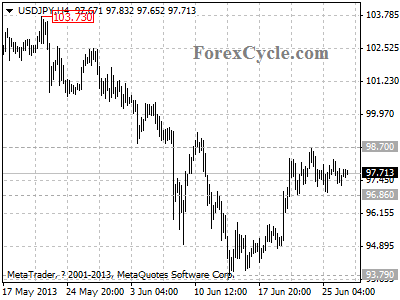
USDJPY continues its sideways movement in a range between 96.86 and 98.70. Key support is located at 96.86, as long as this level holds, the price action in the range could be treated as consolidation of the uptrend from 93.79, one more rise to 100.00 area is still possible after consolidation. On the downside, a breakdown below 96.86 support will indicate that the upward movement from 93.79 had completed at 98.70 already, then the following downward movement could bring price back to 95.00 zone.

usdjpy

Forex Signals

Ian Gordon: Who Killed the Gold Price?

Source: Brian Sylvester of The Gold Report (6/26/13)

http://www.theaureport.com/pub/na/15405

The gold price may have taken a tumble, but Ian Gordon, chairman and founder of the Longwave Group in British Columbia, is watching for a recovery. As bullishness in gold reaches some of its lowest levels, Gordon, in this interview with The Gold Report says he believes that is indicative of a turn and he discusses where he has invested his money to ride the upswing.

The Gold Report: On April 15, the gold price plunged about 9%—the biggest one-day loss ever for the yellow metal. Many gold investors got “murdered” that day. Has your personal investigation revealed any suspects?

Ian Gordon: I suspect it was akin to what happened in 1999. The then-governor of the Bank of England, Edward George, supposedly said that “any further rise in the gold price would take down one or more trading houses.” He said the rising price of gold was curtailed through the work of the Federal Reserve and the Bank of England. It appears that a bullion bank was caught offside on the short side and they had to take the price of gold down quite dramatically to allow it to cover.

I think something similar happened in April. I think it was manipulated to the downside. Goldman, Sachs & Co. encouraged its clients to short sell gold two days before this occurred.

TGR: Could it have just been an error?

IG: I always suspect the worst. There’s so much manipulation in all the markets as I see it.

TGR: That one-day drop caught even long-time gold investors off guard and shook their confidence. Is being a precious metals investor at this point simply about having the resolve to stay the course, or should even the ardent investors make adjustments to their gold portfolios?

IG: I’m extremely bullish on gold. Bullishness in gold, according to the website Market Vane, is at 40%, the lowest it has been since 2001. Bullishness in the stock market is at 70%, which is almost the highest it has been since Market Vane began tracking it. I see a reversal occurring here, for the gold price to the upside and the stock market to the downside.

TGR: There’s no way to sugar coat the disappointing performance of gold and silver in 2013. But has the current global economic backdrop provided some new and compelling reasons to own gold and precious metal equities?

IG: There are compelling reasons to be bullish on gold particularly, simply because there is a real worldwide crisis in fiat money. The unfolding crisis is similar to the 1930s, when the whole monetary system collapsed. We’re envisioning something quite similar to that collapse is now occurring.

We can see that there’s this huge move to gold, not only by countries like China and Russia and even the small “-stan” countries, but major investors are also taking up the physical metal because they can see this crisis unfolding.

TGR: Most of what I’m reading says that there just aren’t a lot of bids in the market right now for precious metals. Investment demand has waned, with gold falling consistently lower since its high in 2011.

IG: Investment demand is huge. The output of American Eagle gold bullion coins by the U.S. Mint is at record highs. Demand by the small investors for gold and silver is at unprecedented levels. The amount of gold that’s being imported through Hong Kong into China is at a record level.

TGR: Yet, at the same time, India, which is the world’s biggest gold consumer, increased the royalty from 6% to 8% on gold imports.

IG: It has, but India is notorious for gold smuggling. Most people are going to look for a way to go around those taxes. I suspect that there will be the same amount of gold imported into India through Dubai, but most of it won’t be declared.

TGR: You say you’re seeing strong demand for the physical metal, but investors have been getting out of exchange-traded funds (ETFs) and equities in mass numbers.

IG: With regards to the gold ETFs, I suspect that many investors are cashing in their paper claims to take possession of the physical. Yes, gold stocks, particularly the juniors, have been slaughtered, But once bullishness returns to gold, bullishness will return to gold equities. When you get this overly bearishness in markets, it’s usually indicative of a turn. I’m confident that we’re going to see a turn to the upside. I also believe that the turn in the stock market to the downside is about to begin.

TGR: I get the sense that there’s a prevailing sentiment that we haven’t hit a bottom yet in the mining equity space and that there’s another leg down before we see a move to the upside. Do you see that as well?

IG: That is always a possibility and it can’t be ruled out, but the precious metals’ fundamentals are as compelling today as they have ever been.

TGR: Could it be seasonality due to the summer?

IG: I don’t think so and anyway I am a long-term investor and I am essentially not concerned by short-term price machinations. As I have said, the most compelling reason to own gold is the crippling debt crisis, which has brought about the probability of a catastrophic end to fiat currencies.

TGR: Sean Boyd, the chief executive of Agnico-Eagle Mines Ltd. (AEM:TSX; AEM:NYSE), recently told Bloomberg that gold could reach about $1,800/ounce ($1,800/oz) within a year. What’s your medium-term outlook for gold and silver?

IG: The market is going to have to go through a consolidation that could last for weeks. However, I’m much more bullish on gold than I am on silver because gold has traditionally been recognized as money sine qua non. Industrial demand is going to drop quite precipitously as the world goes into the depression stage of the cycle. Nevertheless, it is likely that silver will take on the role of poor man’s gold.

My belief is we’re going to see a decoupling between the paper markets and the physical markets. The demand for physical is going to grow dramatically. It’s going to make the paper markets irrelevant.

I’m not sure if it’s going to be a year as Sean says, but it’s going to be extremely strong and the move will be very dramatic once it starts. The old highs of $1,900/oz will be surpassed by a long shot over the medium to long term.

TGR: Do you think silver will fall below the $20/oz level in the next six months to a year?

IG: We’re as oversold as we were in 2008, although the price isn’t as low as it was then. I see a consolidation in the price, but I don’t forecast much lower prices occurring in either of the precious metals. Once this consolidation is over, I see a resumption of the bull market.

TGR: Amid the moribund news cycle for gold and silver, there have been some feel-good stories in the equities space.

IG: True. A company like Newmont Mining Corp. (NEM:NYSE) is a really good story because it has a 4% dividend. It’s trading at a low book value.

Agnico-Eagle is well managed. It’s been moving into the junior space in anticipation of a move up in the market. Agnico-Eagle has recently acquired interests in five junior mining companies because management is bullish on gold and the company can invest in promising junior companies at very cheap prices that have good potential to grow their assets.

TGR: Does Newmont have the cash flow to maintain a 4% dividend?

IG: Yes, I think it does. Investors are buying these companies at or close to a price low. When the gold price increases, Newmont’s profitability will increase and it should be able to raise the dividend quite dramatically. The same thing happened in the 1930s. Even though the gold price was fixed at $20.67/oz, the dividends that companies like Homestake and Dome Mines were paying out were enormous—10% dividends were being paid out, particularly after Roosevelt raised the price from $20.67 to $35/oz.

TGR: Is there any good news among the juniors?

IG: In the junior sphere, you can buy some companies for nearly $10/oz of gold in the ground.

One of the juniors that I’ve consistently talked about is Temex Resources Corp. (TME:TSX.V; TQ1:FSE), which has about 4 million ounces (4 Moz) of gold in the ground in Ontario, Canada.

TGR: What is Temex’s cash position?

IG: The company has about $7 million ($7M) in cash. It did a financing prior to this horror story that we’ve gone through in the past year. I talked to the CEO, Ian Campbell, who said that Temex has sufficient cash to last another two years, even with the drilling that is ongoing.

TGR: Are you more bullish on the Whitney or the Juby project?

IG: I guess I’m more bullish on Juby, even though it’s a lower grade project. Temex only owns 60% of the Whitney property; Goldcorp Inc. (G:TSX; GG:NYSE) owns 40%.

The chances are that there’s about 3 Moz at Juby. The gold definitely runs beyond where the company has drilled and I believe that overall Juby could turn into a major deposit. I am not belittling the Whitney property because that too could be a very large deposit, but Temex only owns 60% of Whitney.

Another old favorite is Barkerville Gold Mines Ltd. (BGM:TSX.V). The company’s trading has been halted by the British Columbia Securities Commission (BCSC) as it answers some questions about its NI 43-101. . It has just published a new NI 43-101 resource of 4.98 Moz and a potential resource of 9–27 Moz. These are very good numbers. It will be interesting to see what value investors put to these numbers. I believe that there is significant potential for the company to grow this discovery quite substantially.

TGR: Are there any other gold equities that you’re fond of at these low prices?

IG: I own about 10% of Alliance Mining Corp. (ALM:TSX.V). The company has a little bit of a cash problem, but it has some fantastic projects in the largest gold-silver producing area in Arizona. It also purchased some properties in Mexico that are almost contiguous to the Orisyvo mine. The company is well managed and has good relationships with the mining fraternity in Arizona. It’s a good story with some very prospective properties.

TGR: What about some other companies?

IG: I own Freegold Ventures Ltd. (FVL:TSX) in Alaska, which has about 5 Moz and growing. It’s close to the Kinross Gold Corp. (K:TSX; KGC:NYSE) Fort Knox mine. I like the management of Freegold. Investors should be looking at it simply because of the growth in the ground gold assets that the company owns, its proximity to the Fort Knox mine and a dedicated management team.

I’m extremely bullish on Terraco Gold Corp. (TEN:TSX.V). The company is one of the best managed juniors out there. Todd Hilditch, the CEO, does a fantastic job in acquiring royalties on the Barrick Gold Corp. (ABX:NYSE)/Midway Gold Corp. (MDW:TSX.V; MDW:NYSE.MKT) Moonlight property in Nevada. These royalties have been estimated to have a value of about $70M on the Barrick/Midway Moonlight property in Nevada. Barrick doesn’t have to tell us how much gold is being discovered there, but people are quoting it at 6 Moz and I think that it is based on that number that the value of the Terraco royalty has been estimated.

TGR: What about Terraco’s Spring Valley project?

IG: It’s contiguous to the Barrick/Midway project. There’s a good chance that the gold being discovered on the Barrick/Midway project is going to run onto the Terraco property.

TGR: Terraco is worth about $18M right now. Why wouldn’t Barrick just buy Terraco versus obtaining the royalty?

IG: Some of these companies, like Agnico, are prepared to do that, but a lot of these seniors have made so many blunders that they’re too frightened to do anything. Take, for example, Pascua Lama, the Barrick property on the border of Argentina and Chile. See how mismanaged that appears to have been, the capital expenditure that has already gone into it, and the bickering between the Chilean government and the company and great properties?

But you’re right. Why wouldn’t someone go after a company like Terraco, which has a nice royalty?

TGR: What about companies outside the Americas?

IG: I like Orex Minerals Inc. (REX:TSX.V), which has about 1 Moz gold in Sweden. However, it has mainly silver properties in Mexico. Orex was planning to spin out the silver properties into a separate company, but it hasn’t done that yet because of the market.

TGR: Detour Gold Corp. (DGC:TSX) is not too far from Temex. It poured gold this year, but hasn’t reached commercial production yet. It secured a credit facility and financing. Is it on track to go commercial in the second half of this year?

IG: I love the Abitibi greenstone belt and I love Detour’s project. It’s huge—25 Moz. I’m sure it will get into production this year, but I don’t own Detour.

I did own the company that basically found Detour, Pelangio Exploration Inc. (PX:TSX.V). Pelangio was an exceptionally good investment for my investors when I was a broker at Canaccord. I did a financing in Pelangio around 2001 at $0.11/share. When Detour took Pelangio over, it was valued at about $5/share.

TGR: Pelangio plans to produce 650,000 oz annually. Is that realistic?

IG: It never happens as smoothly as anticipated. I’m sure there will be hiccups, but eventually that kind of production rate can be achieved.

TGR: The silver producers continue to perform regardless of the commodity price performance or investor sentiment for the most part. What names are you following in that segment of the precious metals market?

IG: I’m more bullish on gold, Brian. However, I do follow a few companies that I don’t have a stake in. I keep an eye on Fortuna Silver Mines Inc. (FSM:NYSE; FVI:TSX; FVI:BVL; F4S:FSE) because it took over an asset of a company that I financed called Continuum Resources Ltd. I like the management of Fortuna.

I watch Endeavour Silver Corp. (EDR:TSX; EXK:NYSE; EJD:FSE) because I helped finance the company in its preproduction days when I was at Canaccord. The company is also extremely well managed. I love the growth profile that the company has achieved. It’s really interesting and cheap. If you’re looking for a silver play, it might be the one simply because it’s so cheap. Its high is $13/share and it’s at around $3.85/share, yet it’s increasing production all the time.

TGR: You are often investing in financings. Do you ever buy equities in the open market?

IG: I do. For example, I bought Barkerville in the market. When it came out with its numbers last June, they were received with massive disbelief. The price of the stock didn’t reflect the numbers. I went in the market and bought substantially to build my position because the price wasn’t reflecting the asset.

I also bought Alliance Mining and Temex when the shares have been cheap.

TGR: How do you determine cheap?

IG: Relative to where it was formerly priced and the value I place on the company’s assets. I started to buy gold and silver stocks in 2000 because they were cheap and no one wanted them. We are in the same position in the market today. We know the bullish consensus numbers for gold are at the same levels that they were in 2001. You can buy these things really cheap.

The only reason anybody wouldn’t be buying them is because they don’t believe that the price of gold is going to rise. I believe that the price is going to rise substantially because the chaos in the financial markets is going to be horrendous.

TGR: Thanks, Ian.

A globally renowned economic forecaster, author and speaker, Ian Gordon is founder and chairman of the Longwave Group, which comprises two companies—Longwave Analytics and Longwave Strategies. The former specializes in Gordon’s ongoing study and analysis of the Longwave Principle originally expounded by Nikolai Kondratiev. With Longwave Strategies, Gordon assists select precious metal companies in financings. Educated in England, Gordon graduated from the Royal Military Academy, Sandhurst. After a few years serving as a platoon commander in a Scottish regiment, he moved to Canada in 1967 and entered the University of Manitoba’s History Department. Taking that step has had a profound impact because, during this period, he began to study the historical trends that ultimately provided the foundation for his Longwave theory. Gordon has been publishing his Longwave Analyst website since 1998. Eric Sprott, chairman, CEO and portfolio manager at Sprott Asset Management, describes Gordon as “a rare breed in the investment-adviser arena.” He notes that Gordon’s forecasts “have taken on a life force of their own and if you care to listen, Gordon will tell you how it will all end.”

Want to read more Gold Report interviews like this? Sign up for our free e-newsletter, and you’ll learn when new articles have been published. To see a list of recent interviews with industry analysts and commentators, visit our Streetwise Interviews page.

DISCLOSURE:

1) Brian Sylvester conducted this interview for The Gold Report and provides services to The Gold Reportas an independent contractor. He or his family own shares of the following companies mentioned in this interview: None.

2) The following companies mentioned in the interview are sponsors of The Gold Report: Goldcorp Inc., Terraco Gold Corp., Detour Gold Corp. and Fortuna Silver Mines Inc. Streetwise Reports does not accept stock in exchange for its services or as sponsorship payment.

3) Ian Gordon: I or my family own shares of the following companies mentioned in this interview: Alliance Mining Corp., Barkerville Gold Mines Ltd., Freegold Ventures Ltd., Orex Minerals Inc., Temex Resources Corp. and Terraco Gold Corp. I was not paid by Streetwise Reports for participating in this interview. Comments and opinions expressed are my own comments and opinions. I had the opportunity to review the interview for accuracy as of the date of the interview and am responsible for the content of the interview.

4) Interviews are edited for clarity. Streetwise Reports does not make editorial comments or change experts’ statements without their consent.

5) The interview does not constitute investment advice. Each reader is encouraged to consult with his or her individual financial professional and any action a reader takes as a result of information presented here is his or her own responsibility. By opening this page, each reader accepts and agrees to Streetwise Reports’ terms of use and full legal disclaimer.

6) From time to time, Streetwise Reports LLC and its directors, officers, employees or members of their families, as well as persons interviewed for articles and interviews on the site, may have a long or short position in securities mentioned and may make purchases and/or sales of those securities in the open market or otherwise.

Streetwise – The Gold Report is Copyright © 2013 by Streetwise Reports LLC. All rights are reserved. Streetwise Reports LLC hereby grants an unrestricted license to use or disseminate this copyrighted material (i) only in whole (and always including this disclaimer), but (ii) never in part.

Streetwise Reports LLC does not guarantee the accuracy or thoroughness of the information reported.

Streetwise Reports LLC receives a fee from companies that are listed on the home page in the In This Issue section. Their sponsor pages may be considered advertising for the purposes of 18 U.S.C. 1734.

Participating companies provide the logos used in The Gold Report. These logos are trademarks and are the property of the individual companies.

101 Second St., Suite 110

Petaluma, CA 94952

Tel.: (707) 981-8999

Fax: (707) 981-8998

Email: [email protected]
 

Central Bank News Link List – Jun 26, 2013: Fed communication went through ‘rocky’ patch: official

By www.CentralBankNews.info Here’s today’s Central Bank News’ link list, click through if you missed the previous link list. The list comprises news about central banks that is not covered by Central Bank News. The list is updated during the day with the latest developments so readers don’t miss any important news.

Harley-Davidson’s Flat Tire: Demographics

By The Sizemore Letter

Harley-Davidson, Inc. ($HOG) is an American icon.  It’s also a well-managed company and one of those true rarities: a successful turnaround story.  This is a company that was facing bankruptcy in the early 1980s yet managed to rebuild itself into the pride of American manufacturing…and the subject of countless case studies in MBA programs worldwide.

Harley’s management was able to pull off that coup by leveraging that intangible quality that is so hard to imitate: brand cachet.  For a particular breed of leather-wearing motorcycle enthusiast, there is simply nothing on par with a Harley.

But all of that said, I wouldn’t touch the stock, or at least not at today’s prices.

At first glance Harley wouldn’t appear exceptionally pricey.  It trades for 17 times trailing earnings and 2 times sales.  This compares to 16 times earnings and 1.5 times sales for the S&P 500.

A modest premium is appropriate for an iconic company with Harley’s branding power (and not to mention its high return on equity of 25.8%), right?

Well, maybe.  But Daimler ($DDAIF)—a company that knows a thing or two about vehicle branding—trades for just 10 times earnings and 0.42 times sales.  Yes, I realize it’s not an apples-to-apples comparison and that Harley runs a higher-margin operation in a business with fewer direct competitors.  All else equal, Harley should trade at a slight premium to a larger automaker like Daimler.

But all else is not equal, and Harley has a serious growth problem.  And it’s not one that will go away with a recovering economy.

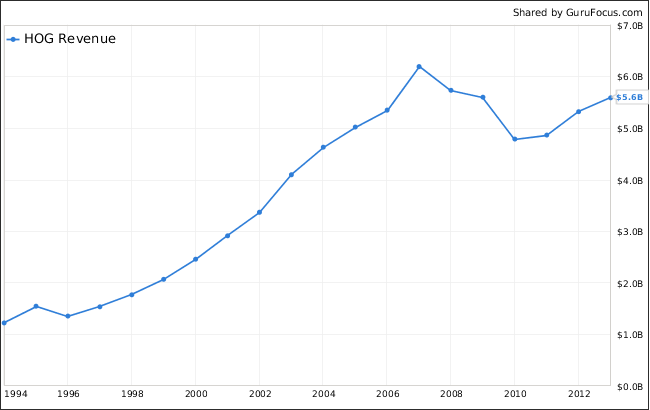
 chart

 Harley’s revenues are still below their pre-crisis highs (see chart).  Unit sales paint an even bleaker picture.  Harley sold 349,196 bikes in 2006; the number in 2012 was just 247,625.  That’s a unit decrease of nearly 30%.

To be fair, revenues and unit sales have enjoyed a nice bounce since the pits of the financial crisis.  But Harley will never get its old mojo back for one critical reason that is completely outside the control of management: demographics.

Down the road from my house in Dallas, there is greasy drive-in burger joint called Keller’s…a place I’ve been known to frequent a little more often than my doctor might recommend.  On any given weekend, you might see a dozen or more bikers parked in the lot, showing off their chrome-laden Harleys.  And nearly all of them are over the age of 45. Most are over 50.

This isn’t a coincidence.  Harley Davidson is a brand whose sales depend disproportionately—for that matter, almost exclusively—on middle-aged Caucasian males.  Riders younger than 40 generally lack the time, interest, or the bankroll to buy a Harley.  But by the time they get into their 60s or older, the noise and joint pain have begun to make riding lose its allure.  You may still ride in your 60s, but you’re doing it less frequently and you probably aren’t buying a new bike.

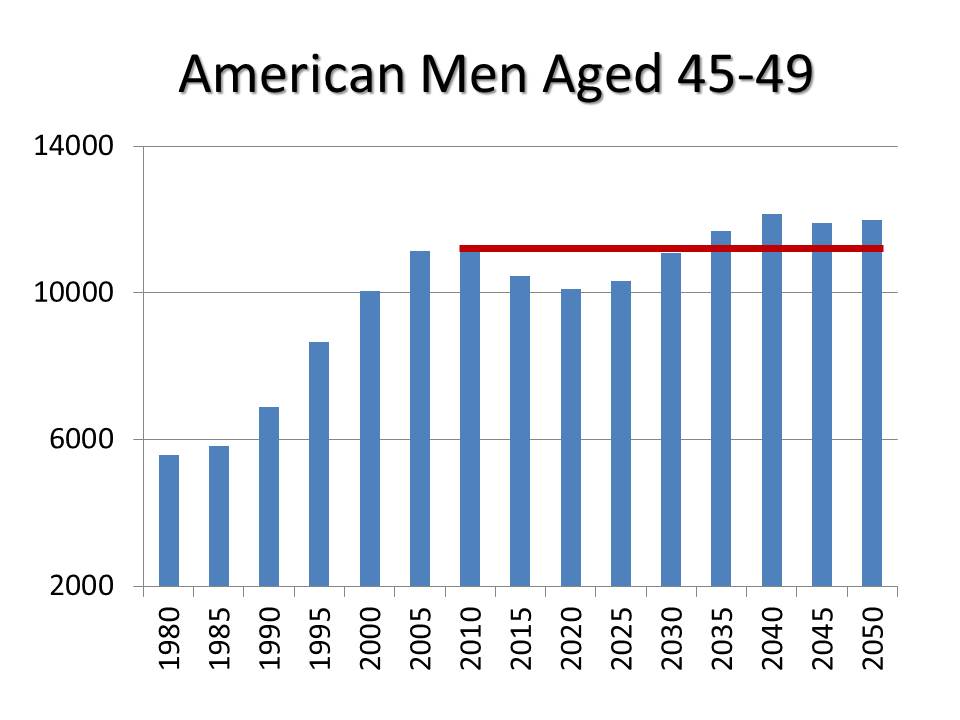
 American Men Aged 45-49

The sweet spot is the mid-40s to early 50s.  And with the Baby Boomers—the largest and wealthiest generation in history—now largely aged out of this key demographic bracket, Harley has a serious problem.  Generation X—my generation—is not nearly large enough to pick up the slack, and Generation Y (aka “the Millennials” or “Echo Boomers”) are decades away from being in the demographic sweet spot for Harley.  The number of American men aged 40-49 is set to decline through the early 2020s and won’t reach its old 2010 peak until 2035.

CNN Money reported on this as far back as 2010, and demographic strategist Harry Dent—my old boss—has used Harley as a case study for decades.

Harley Davidson’s management is not stupid.  They understand the issues they face, and they have gone so far as to address it with a dedicated page on their Investor Relations site: Harley Davidson Demographics.  The company has aggressively expanded its marketing efforts to attract younger men, non-Caucasian men, and women and has had modest success.  Per the demographic site, management writes “In 2012, U.S. sales of new Harley-Davidson motorcycles to our ‘outreach’ customers — young adults 18-34, women, African-Americans and Hispanics – grew overall at more than twice the rate as sales to our traditional U.S. customer base of Caucasian men, ages 35-plus.”

But realistically, there is no replacing the white Boomer male.  And this means a very rough decade ahead for Harley Davidson.

Stocks in industries in gentle decline are not necessarily bad investments, as tobacco stock investors have no doubt noticed (see “My Favorite Tobacco Stock is…Intel?” and “Can E-Cigarettes Relight Big Tobacco”).

Under the right set of circumstances—strong financial health, large barriers to entry, good dividend growth and share buybacks—stocks in no-growth industries can make better investments than those in high-growth industries.

But for this to be the case, the stock has to be priced appropriately.  Big Tobacco has had a great decade-long run because it started out cheap and hated and paid a monster dividend.  Harley Davidson, in contrast, trades at a slight premium to the market and yields only 1.7%.

Harley Davidson may be a good buy—eventually. But given the demographic headwinds it faces, it’s not cheap enough for serious consideration at this time.

Diclosures: Sizemore Capital is long Daimler. This article first appeared on InvestorPlace.

SUBSCRIBE to Sizemore Insights via e-mail today.

Hard Proof There Is No Real Economic Recovery

By Profit Confidential

Economic RecoveryThere’s a lot of talk about economic recovery these days. Mainstream economists are saying the U.S. economy will continue to grow, and the stock advisors are telling investors to buy on dips because everything is headed upward. Their arguments are: housing is hot, the unemployment rate is declining, and consumers are spending.

But I have to disagree with those claims. I believe this isn’t a real economic recovery. What we have seen since 2009 has been nothing more than a result of artificially low interest rates, money printing, and increased government spending. Real economic recovery only occurs when conditions improve across the board and return to their historical averages.

The jobs market, which should improve during an economic recovery, is actually stalled and tormented. The official unemployment rate has come down from 10% to 7.6% in May. But the official unemployment rate is not an accurate indicator of the jobs market, as it does not take into account the soaring rate of involuntary underemployment.

There is a spur of job creation in retail and other low-wage sectors, but the 4.4 million long-term unemployed in the U.S.—those who have been out of work for more than six months—aren’t seeing robust improvements. Each month, just 10% of them find jobs, and that number hasn’t changed in the last two years. (Source: Wall Street Journal, June 24, 2013.)

According to estimates from the Brooking Institution’s Hamilton Project, after adjusting for population growth, it could take up to three years for the unemployment rate in the U.S. economy to get back to its prerecession level.

The fact: American consumers are the ones that drive the U.S. economy towards economic recovery. But they are struggling right now. According to a survey by Bankrate.com, 76% of Americans live paycheck-to-paycheck. The survey, with 1,000 respondents, showed that 50% had savings that wouldn’t last them for three months without income and that 27% didn’t have any savings at all. (Source: CNN Money, June 24, 2013.)

The so-called “economic recovery” is tepid at best. The U.S. economy is growing at a much slower rate than its historical average—an annual pace of 2.2%, far below its decades-long average of 3.3%. (Source: Wall Street Journal, June 24, 2013.)

There are problems in the making for any real economic recovery. The long-term bonds rate yields are increasing very quickly. Keep in mind that the long-term bonds are used as a benchmark to price not only the mortgage rate, but also what rate the banks will charge their clients on loans. If these yields continue to skyrocket, you can expect loan rates to increase, putting businesses already struggling into greater danger—which is hardly an environment of economic recovery.

As my readers know, the anemic economic recovery and stock market rally we have seen since the financial crisis was a result of easy monetary policies. If Bernanke goes ahead with his warning last Wednesday that the Fed will pull back on printing money (and I’m still skeptical if the Fed will actually pull the trigger), the ramifications for the U.S. economy, stock market, and housing market will be more severe than most analysts can fathom.

Michael’s Personal Notes:

It hasn’t been too long since I started to warn readers of Profit Confidential about what might happen in the U.S. bond market. (See “Bond Market Shows Signs of Weakness Ahead.”) As I have said many times before, the sell-off in the bond market will start slowly and then eventually pick up speed. And, as predicted, it’s all coming together.

Take a look at the chart of the 10-year U.S. bond prices below:

UST 10 Year Treasury Note Price Chart

Chart courtesy of www.StockCharts.com

The selling in the U.S. bond market has escalated. The 10-year U.S. bonds were trading in a down channel—making successively lower lows and lower highs since the middle of 2012. Recently, after the Federal Reserve, which has turned into a major buyer of long-term U.S. bonds, said it might pull back on its purchases, it all turned. The bond prices started to come down quickly (as you can see in the red circle on the chart above).

Since the beginning of the year, the 10-year U.S. bonds prices are down about four percent—from $131.00 to below $126.00 now. The image elsewhere in the bond market is very similar. The 30-year U.S. bonds are also shifting gears, and the bonds with higher risks, such as junk bonds, are seeing an even steeper sell-off.

Investors are running for the doors, fleeing the bond market at a very fast pace. According to the Investment Company Institute’s data, in April of 2012, long-term bonds mutual funds witnessed an inflow of $24.7 billion. In April of this year, these types of mutual funds had an inflow of only $12.1 billion—51% less. (Source: Investment Company Institute, June 19, 2013.)

In this month, June, it is possible that the long-term bonds mutual funds will witness an outflow for the first time since August of 2011. For the weeks ended on June 5 and June 12, the long-term bonds mutual funds witnessed outflows of $10.8 billion and $13.4 billion, respectively.

As the U.S. bonds prices come down and the bond market faces severe pressure, I see a significant number of mainstream economists missing its implications. Here’s one: the pension funds rely heavily on the bond market; they will face losses as the bond prices continue to slide lower.

The sell-off in the bond market shouldn’t be taken lightly, because it’s much bigger than the equity markets. Investors are fleeing on speculation over when the Federal Reserve will stop purchasing U.S. bonds; if inflation starts to pour into the U.S. economy, as I expect it will, the “slowly declining” bond market will become a “crashing” bond market.

What He Said:

“When property prices start coming down in North America, it won’t be a pretty sight because consumers are too leveraged. When consumers have over-borrowed so much that they have no more room in their credit lines to borrow more, when institutions start to get tight on lending, demand for housing will decline and so will prices. It’s only a matter of logic, reality and time.” Michael Lombardi in Profit Confidential, June 23, 2005. Michael was already warning investors of the coming crisis in the U.S. real estate market right at the peak of the boom, now widely believed to be in 2005.

Article by profitconfidential.com

Even Bigger Sell-Off Ahead for U.S. Bond Market?

By Profit Confidential

It hasn’t been too long since I started to warn readers of Profit Confidential about what might happen in the U.S. bond market. (See “Bond Market Shows Signs of Weakness Ahead.”) As I have said many times before, the sell-off in the bond market will start slowly and then eventually pick up speed. And, as predicted, it’s all coming together.

Take a look at the chart of the 10-year U.S. bond prices below:

UST 10 Year Treasury Note Price Chart

Chart courtesy of www.StockCharts.com

The selling in the U.S. bond market has escalated. The 10-year U.S. bonds were trading in a down channel—making successively lower lows and lower highs since the middle of 2012. Recently, after the Federal Reserve, which has turned into a major buyer of long-term U.S. bonds, said it might pull back on its purchases, it all turned. The bond prices started to come down quickly (as you can see in the red circle on the chart above).

Since the beginning of the year, the 10-year U.S. bonds prices are down about four percent—from $131.00 to below $126.00 now. The image elsewhere in the bond market is very similar. The 30-year U.S. bonds are also shifting gears, and the bonds with higher risks, such as junk bonds, are seeing an even steeper sell-off.

Investors are running for the doors, fleeing the bond market at a very fast pace. According to the Investment Company Institute’s data, in April of 2012, long-term bonds mutual funds witnessed an inflow of $24.7 billion. In April of this year, these types of mutual funds had an inflow of only $12.1 billion—51% less. (Source: Investment Company Institute, June 19, 2013.)

In this month, June, it is possible that the long-term bonds mutual funds will witness an outflow for the first time since August of 2011. For the weeks ended on June 5 and June 12, the long-term bonds mutual funds witnessed outflows of $10.8 billion and $13.4 billion, respectively.

As the U.S. bonds prices come down and the bond market faces severe pressure, I see a significant number of mainstream economists missing its implications. Here’s one: the pension funds rely heavily on the bond market; they will face losses as the bond prices continue to slide lower.

The sell-off in the bond market shouldn’t be taken lightly, because it’s much bigger than the equity markets. Investors are fleeing on speculation over when the Federal Reserve will stop purchasing U.S. bonds; if inflation starts to pour into the U.S. economy, as I expect it will, the “slowly declining” bond market will become a “crashing” bond market.

What He Said:

“When property prices start coming down in North America, it won’t be a pretty sight because consumers are too leveraged. When consumers have over-borrowed so much that they have no more room in their credit lines to borrow more, when institutions start to get tight on lending, demand for housing will decline and so will prices. It’s only a matter of logic, reality and time.” Michael Lombardi in Profit Confidential, June 23, 2005. Michael was already warning investors of the coming crisis in the U.S. real estate market right at the peak of the boom, now widely believed to be in 2005.

Article by profitconfidential.com

The Only Way to Protect Your Investments from the Turmoil in China

By Profit Confidential

The Only Way to Protect Your Investments from the Turmoil in ChinaThe deleveraging that’s taking place around the world is obviously echoed in tumultuous capital markets, but a retrenchment in the bond and stock markets has been overdue for ages.

As is usually the case, several catalysts came together at the same time to produce an unsurprising stock market sell-off. These included: comments from the Federal Reserve regarding quantitative easing, rising 10-year Treasury yields, weak earnings from benchmarks, and concern over China’s real estate market and its banks.

While China’s stock market has been in a pronounced downtrend since the first week in June, its banks are still controlled by the government, so any potential banking crisis in that country is a different game than we’ve seen before because of China’s $3.3 trillion in foreign currency reserves (mostly in U.S. Treasuries).

But that very game could have serious consequences for the U.S. stock market if China needed that money to flood its capital markets with liquidity. With a different approach to saving, money creation, and fiscal management in general, currency destabilization from China is an ongoing risk.

It was just a few years ago that capital markets treated economic news from China as emerging market news only. Now, China’s economic news is taken very seriously by the global economy, and the country’s numbers directly affect the U.S. stock market.

It’s just one more reason to be very conservative with your equity holdings now. Investment risk across all financial asset classes is high.

One thing that China and many of its U.S.-listed companies have proven is that they’re unreliable with their numbers. After countless missteps with U.S. regulators and outright frauds on the stock market, the biggest Ponzi scheme the world has ever seen might not be the U.S. monetary policy, but rather China’s domestic banking system.

It’s a growing investment risk for all financial assets. Because China is not an open economy, we just can’t quantify the degree to which the world is at risk due to its management. The entire “Red Dragon” (forecast to be larger than the U.S. economy by 2016) is a powder keg of ambiguity.

It’s just one of the many reasons why I’m an advocate for keeping retirement stock market holdings as blue-chip and domestic as possible. Financial control for U.S. investors continues to be on the decline.

Both Treasuries and the U.S. stock market have been due for a major correction for some time. On the cusp of a new earnings season, more stock market weakness is likely. I don’t expect corporate earnings to surprise to the upside.

There should be no doubt that China’s domestic economic situation directly affects U.S. capital markets and now the stock market.

Recent trading action in all asset classes illustrates the degree to which all investors are vulnerable in a supercharged monetary world. Reliability of data, processes, the regulatory environment, market participants, and cash itself is untenable. (See “Crash, Down Quarter, Major Correction—It’s All in the Cards.”)

For investors, only the safest names will do. Generally speaking, I still feel the stock market isn’t worth buying after its big run-up.

More China-related turmoil in capital markets is highly likely in the near term.

Article by profitconfidential.com

Why Timing Will Be Critical to Take Advantage of Coming Market Swings

By Profit Confidential

Why Timing Will Be Critical to Take Advantage of Coming Market SwingsThe major stock indices started the week with another downward blast, just as I had warned.

You shouldn’t be surprised; in fact, it was more obvious as the stock market traded higher and higher (sometimes for no reason) that a time of reckoning was on the horizon. Even at a 5% discount in the recent months, I was still hesitant to jump into the stock market with reckless abandon. (Read “Buyer Beware: Stocks May Be Signaling More Weakness to Come.”)

Now with the 7% correction in the S&P 500, my senses are beginning to tingle, but I’m still not ready to join the market yet. Recall my recent dinner with my investment manager friend (see “Wine, Steak, and the State of the U.S. Economy”). I came away from that dinner thinking my friend was expecting a major correction in the stock market and was buying put options as a hedge. Well, the stock market could be in the midst of a major correction.

If stocks don’t settle down and find a place to pause, it could easily translate into more losses. A 10% adjustment is possible. I would love to see a more significant correction, as I would then be looking more seriously at nipping the stock market.

The Federal Reserve created this current stock market drama. But don’t forget—you also owe Fed chairman Ben Bernanke a big “thank you” for the money you’ve made over the past few years.

Let’s go back to a chart of the S&P 500 that I first created in May (featured below). Note the purple ovals that pointed to a correction. I was quite concerned about the advancement this year and said it was not sustainable at the same pace. Now take a look at the current deterioration on the chart, highlighted by the selling that has driven down the S&P 500 by more than 110 points from its peak in May.

S&P 500 Large Cap Index Chart

Chart courtesy of www.StockCharts.com

The 1,550 level appears to offer some support, but failure to hold here could see the index become vulnerable to dropping below 1,500.

The chart below shows the downward move of the S&P 500 stocks that had been above their respective 200-day moving averages. The reading was in excess of 93% during its peak in May, but it has since collapsed to below 80%.

S&P 500 Percent of Stocks Chart

 Chart courtesy of www.StockCharts.com

Over the next few weeks, the key will be to see how the stock market behaves and whether the so-called “bargain hunters” start to surface.

I would rather just take a seat and wait for potentially more selling before jumping in. The fact is that there will be opportunities to make money on the market swings to be sure.

Article by profitconfidential.com

Why the Tumble in Gold Prices Actually Predicts a Bullish Market

By Profit Confidential

Predicts a Bullish MarketNo matter where I look, it seems as if there’s a rush to sell gold bullion.

For the week ended June 21, assets in the SPDR Gold Trust (NYSEArca/GLD)—the biggest gold bullion exchange-traded product (ETP)—declined below 1,000 tons. This is the first time since February of 2009 that the fund’s gold bullion holdings have reached this level. (Source: Bloomberg, June 24, 2013.)

That’s not all. Gold bullion holdings in ETPs have declined 533.3 metric tons this year alone and Societe Generale—one of the biggest banks in France, also referred to as SocGen—expects gold bullion investors to sell another 285 tons this year.

As readers of Profit Confidential know, I am a contrarian. Increased selling and a significant amount of negativity towards gold bullion is actually a bullish indicator to me. The decline is really separating the men from the boys. Remember: buy when there’s blood in the streets.

The prospects for gold remain very strong in spite of the price decline.

At the very core, what gold bullion essentially does is provide safety from uncertainty. The economic troubles we’ve had recently haven’t gone away—in fact, new troubles are emerging.

The health of the global economy looks to be deteriorating. As the eurozone problems have already exacted a toll, now problems in China are sending threats to the global economy. The country is expected to show anemic growth this year, and worries of a credit crunch in the Chinese economy are growing very quickly.

What gold bears don’t realize is that central banks in the global economy are still printing money. The Bank of Japan, through its quantitative easing, is buying almost $72.0 billion worth of bonds; the European Central Bank (ECB) has lowered its interest rates after it promised it will do whatever it takes to save the region.

Our own central bank, the Federal Reserve, is still printing money at $85.0 billion a month and buying government bonds and mortgage-backed securities (MBS). It hasn’t stopped just yet, but it has provided hints to the market that it soon might be pulling the punch bowl from the party.

On top of all this, the central banks around the global economy are still purchasing gold bullion to diversify their reserves. They can’t rely much on the “reserve currency,” the U.S. dollar, because it has become prone to wild swings.

Furthermore, the demand for gold is increasing among retail investors as well. They now have another chance to buy more gold bullion. It has been very well documented in these pages how the gold bullion-consuming countries in the global economy, like India and China, are seeing exuberant demand, and that here at home investors are rushing to buy more.

In the midst of negativity about gold bullion, I see bullish signs and I maintain my stance on the precious metal. When the gold bullion price will hit the bottom is very difficult to tell, but it doesn’t seem very far away.

Article by profitconfidential.com