USDCAD remains in uptrend from 1.0137

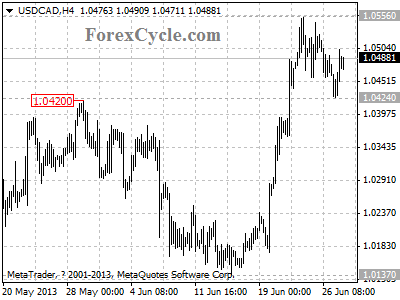
USDCAD remains in uptrend from 1.0137, the fall from 1.0556 is likely consolidation of the uptrend. Another rise towards 1.0600 is still possible after consolidation, and a break above 1.0556 resistance could signal resumption of the uptrend. Key support is now at 1.0424, only break below this level could indicate that the upward movement from 1.0137 is complete, then the following downward movement could bring price back to 1.0200 zone.

usdcad

Daily Forex Forecast

End of the Road for Pfizer’s Key Drug Patent

By WallStreetDaily.com

End of the Road for Pfizer’s Key Drug Patent

// <![CDATA[
wistiaEmbed = Wistia.embed("nq1cfzzlyl", {
version: "v1",
videoWidth: 525,
videoHeight: 295,
volumeControl: true,
endVideoBehavior: "reset",
plugin: {
"socialbar-v1": {
buttons: "email-twitter-reddit-stumbleUpon-facebook",
logo: true,
badgeUrl: "http://www.wallstreetdaily.com/wall-street-research/",
badgeImage: "http://embed.wistia.com/deliveries/ae6edb685caefd59e311e37ae8ffafad7a41152d.jpg?image_crop_resized=100×20"
}
}
});
// ]]>

Pfizer (PFE) lucked out when its patent for the mega popular drug, Viagra, was extended to 2020.

But now that the company has lost its patent in Europe, it opens the door for the 20 generic drugmakers that are already lined up with their own copies of the drug. Once the generic versions hit the market, it will drop the price of Viagra significantly for consumers.

As Paul Fleming, Technical Director of the British Generic Manufacturers Association, says, “Certainly we’re aware that there are a lot of companies with regulatory approval already in place… At least a dozen or so will actually launch a product later this month. So we do expect the price decline to be very rapid and very steep. So in fact we’d expect the price to go down by 90% very quickly.”

This has some investors wondering how it’s going to impact the company’s profits. With good reason, considering that half of the company’s Viagra sales come from overseas.

What’s worse for Pfizer is that most patients won’t even have to make the decision to switch to the generic version. Since doctors already write prescriptions using the generic name of the drug (most of the time).

As Paul Fleming says, “The great majority of prescriptions are already written with the generic name. So they’re not written with the name Viagra. And because of that, once the patent expires, the great majority of patients will immediately be switched to one of these many generic formulations that will be available. So Pfizer will [immediately] be competing amongst that field of double-digit competitors.”

Pfizer will certainly feel at least some pain losing the European patent. According to The Telegraph, “Viagra was Pfizer’s sixth best-selling drug last year, generating $2.05 billion in global revenue.”

Plus, consider that Pfizer got slammed after its $10-billion cholesterol fighting drug, Lipitor, lost its patent protection in the fall of 2011.

The post End of the Road for Pfizer’s Key Drug Patent appeared first on  | Wall Street Daily.

Article By WallStreetDaily.com

Original Article: End of the Road for Pfizer’s Key Drug Patent

Energy Companies Pull a Blackwater

By OilPrice.com

Norwegian energy company Statoil said last week it was forming a special operations division to handle emergency operations in response to a terrorist attack on a natural gas facility in Algeria. The company said it would double the amount of employees it had designated for existing security operations after reviewing the measures in place at the In Amenas gas facility. A January attack there left employees with Statoil and BP dead in what al-Qaida said was a response to French intervention in Mali. With the economy just as much a viable target as any, counter-terrorism may becoming more than just the military’s game.

A January attack by a division of al-Qaida in the Islamic Maghreb left several energy company employees and foreign fighters dead. The Algerian attack had the logistical support of Islamic fighters who traveled across the western border from Libya, still unsettled nearly two years after the revolution.

Statoil said last week it was forming a special unit in response to the attack as part of a comprehensive response to the tragedy. Operations at In Amenas resumed at a limited capacity after the attack for owners Statoil, BP and Algeria’s state energy company Sonatrach. French supermajor said it too was spending more on industry-wide security operations since the January attack. Natural gas production has declined more or less since 2005 for Algeria and lingering instability in the region suggests a turnaround isn’t likely in the medium term.

BP said it had its own concerns, noting it was holding back on natural gas projects in the country because of the security situation there. Algerian Energy Minister Youcef Yousfi told a Houston energy conference in March the country “remains a stable country” despite the terrorist attack. He said the country wasn’t discouraged by the incident and remained committed to developing its natural gas sector. Algeria has enacted policies that would give foreign investors an incentive to take a closer look at unexplored fields in the country. Algeria in 2011 produced around 2.9 trillion cubic feet of gas and has since worked to return to its previous glory.

Statoil said it would appoint an official to lead security operations by July. The security team is part of what Statoil said was a “broader response” to the tragedy in Algeria. British Foreign Secretary William Hague said Friday the attack in Algeria shows that al-Qaida may be weakened, but it’s not yet out of the picture. He complained some members of the international community aren’t willing to take on the responsibility to tackle the threat themselves, however. With the international economy depending on a reliable source of energy to keep churning, Statoil’s actions suggest the energy sector may start to take on some of that burden itself.

Source: http://oilprice.com/Energy/Energy-General/Energy-Companies-Entering-War-on-Terror.html

By. Daniel J. Graeber of Oilprice.com


“Sour” Investment Sentiment Sees Gold Head for Biggest Quarterly Drop on Record

London Gold Market Report
from Ben Traynor
BullionVault
Thursday 27 June 2013, 08:00 EDT

WHOLESALE gold bullion prices fell back towards $1230 an ounce Thursday morning in London, having ticked higher in earlier Asian trading, as stocks and commodities were little changed on the day and the Dollar was also flat after showing little reaction to yesterday’s downward revision for US economic growth.

 Gold in Euros traded as low as €940 an ounce this morning, with gold in Sterling dipping as low as £802 an ounce.

 Silver meantime was trading around $18.71 an ounce by lunchtime in London.

 “[Bullion] markets are still susceptible to the downside, but all in all, I feel that for the moment we have done enough,” says David Govett, head of precious metals at broker Marex Spectron.

 Gold in Dollars has lost 23% during the current quarter, which ends tomorrow. Going by London Fix prices, gold is on course for the biggest quarterly loss since at least 1968, the year that the London Gold Pool collapsed.

 “For investors to come back in droves, we will need to see some consolidation in prices and a return to an upward trending market,” one Hong Kong-based trader told newswire Reuters this morning.

 “Investor sentiment is still quite sour right now.”

 Dutch bank ABN Amro cut its year end gold price forecast to $1100 an ounce Thursday, a cut of 15%.

 “There is no reason to hold precious metals,” reckons the bank’s FX and commodity analyst Georgette Boele.

 “The outlook for capital gains [is] dim and they pay no income.”

 Over in India, the biggest source of private gold demand worldwide, premiums on physical gold – calculated as the amount buyers pay over and above the spot price – jumped Wednesday as the gold price fell, local dealers report.

 “We are unable to supply, though there is demand,” says Harshad Ajmera at wholesaler JJ Gold House in Kolkata.

 Other Asian dealers however report that the recent price drop has not been met with the kind of surge in physical demand that was seen in April.

 The US economy meantime grew at an estimated 1.8% annualized rate in the first three months of 2013, official figures published Wednesday show. US gross domestic product growth was revised lower from the previous estimate of 2.4%.

 “The revision should imply that the Federal Reserve will likely delay the rollback of its bond buying program, a variable that should be theoretically bullish for gold,” says INTL FCStone metals analyst Ed Meir.

 “Instead, the release fell flat in terms of impact [on the gold price].”

 In contrast with gold, US stock markets rallied yesterday following the downward revision.

 “Whenever there is good news out of the US it will cause selling because people see it as a confirmation for Fed tapering [i.e. slowing the pace of asset purchases],” says Daiwa Securities economist Tobias Blattner.

 “If we have something more disappointing like yesterday people will say, ‘Well OK, it won’t happen yet’…that, unfortunately, is the kind of volatility that is going to continue for the next couple of months.”

 Across the Atlantic, the estimate for annualized UK GDP growth for the first quarter was also revised lower, figures published Thursday by the Office for National Statistics show.

 Sterling fell to a three-week low against the Dollar following the announcement, dropping below $1.53.

 “Some people were expecting an upward revision and that didn’t happen,” says Jane Foley, senior currency strategist at Rabobank in London.

Ben Traynor

BullionVault

Gold value calculator   |   Buy gold online at live prices


Editor of Gold News, the analysis and investment research site from world-leading gold ownership service BullionVault, Ben Traynor was formerly editor of the Fleet Street Letter, the UK’s longest-running investment letter. A Cambridge economics graduate, he is a professional writer and editor with a specialist interest in monetary economics. Ben can be found on Google+


(c) BullionVault 2013

Please Note: This article is to inform your thinking, not lead it. Only you can decide the best place for your money, and any decision you make will put your money at risk. Information or data included here may have already been overtaken by events – and must be verified elsewhere – should you choose to act on it.


Taiwan holds rate, global outlook moved by market turmoil

By www.CentralBankNews.info     Taiwan’s central bank held its key interest rates steady, including the benchmark discount rate at 1.875 percent, in light of global economic uncertainty, modest domestic economic recovery and reduced inflationary pressures.
    The Central Bank of the Republic of China (Taiwan), which has held the discount rate steady since June 2011, said it expected the rate decision to “help prices and overall economic stability” and the global economy was recovering at different speeds.
    The central bank added the global economic outlook was being affected by the turmoil in global financial markets from the U.S. preparing to exit quantitative easing, liquidity issues on the Chinese mainland “together with a large number of international short-term capital movement.”
    The domestic economy contracted by 0.69 percent in the first quarter from the fourth, for annual growth of only 1.67 percent due to weak external demand and conservative private consumption with the comptroller head office forecasting growth of 2.40 percent this year, down from the bank’s December forecast of 3.15 percent.
    Taiwan’s inflation rate eased to 0.74 percent in May from 1.05 percent due to stable raw materials and weak consumption with the comptroller forecasting inflation of 1.14 percent in the second half of the year, down from 1.23 percent.

    www.CentralBankNews.info

Europe stocks mixed while EU talks banking union

By HY Markets Forex Blog

The European stocks were trading mixed in the midday session on Thursday, after the European Union finance ministers finalized a deal regarding future bank failures.

The European Union finance ministers settled on a deal about bank bailouts in the future .The new rules shows that bondholders, depositors and shareholders with over 100,000 euros, should share the weigh down of saving a bank.

The European Euro Stoxx 50 index fell 0.18% to 2,598.12 as of 10.18am GMT , while the French CAC 40 index advanced 0.04$ to 3,727.56 and the German DAX index gained 0.09% to 7,948.36 at the same time . The UK FTSE 100 index added 0.39% to 6,189.30 at the same time. Germany’s Consumer climate index went up to 6.8 points in July from previous record of 6.5 in June, according reports from GfK.

According to the National Institute of Statistics (INE), retail sales in Spain weakened in May than the previous month.

Sales fell 4.6% in April, after a record of 4.8% year-on-year downfall in April. Retail sales picked up by 1.3% in May from April.

The European Central Bank (ECB) still going ahead to take action if the local government needs to extend growth, according the President Mario Draghi.

“The ECB has done as much as it can to stabilize markets and support the economy. Now governments and parliaments need to do all they can to raise growth potential,” he said.

“These include reducing barriers to entry for new firms and young people, and removing burdens on business like complex tax and labor laws or distortionary regulations,” Draghi added.


The post Europe stocks mixed while EU talks banking union appeared first on | HY Markets Official blog.

Article provided by HY Markets Forex Blog

German unemployment drops in June

By HY Markets Forex Blog

According to the German labor agency, the unemployment count in European powerhouse Germany dropped in June.

Registered unemployment in June dropped by 12,000, the first fall since January, according to reports released. However, the unemployment rate remained the same at 6.8% in June, while analysts predicted the reading would go up slightly to 6.9%.

Germany’s consumer climate went up 6.8 points in July from previous record of 6.5 in June, according to reports from GfK. Data released show that the consumer sentiment advanced due to the strong labor market , showing signs that the economy is recovering at a fast pace.

The ifo Business Climate Index for Germany rose to 105.9 in June, from previous record of 105.7 in May, according to Ifo Institute reports.

The Current Assessment index fell to 109.4 in June, from previous posting of 110.0 in May, according to reports. While the ifo Expectations Index advanced to 102.5 in June, increased from 101.6 in the previous month.

The ZEW index slightly increased to 38.5 points in June, from 36.4 points from previous month.

German’s gross domestic product (GDP) rose by 0.1 percent quarter-on-quarter, in line with the market expectations.

Germany’s adjusted GDP fell 1.4 percent in the first quarter, compared to the previous year, shown in reports from Germany’s statistical office Destatis.

Overrall, Germany’s GDP is expected to increase by 0.4 percent in 2013 and 1.8 percent the year after. Exportation predictions have improved regardless of the external orders for industrial goods, which have dropped.

The post German unemployment drops in June appeared first on | HY Markets Official blog.

Article provided by HY Markets Forex Blog

Central Bank News Link List – Jun 27, 2013: Europe strikes deal to push cost of bank failure on investors

By www.CentralBankNews.info Here’s today’s Central Bank News’ link list, click through if you missed the previous link list. The list comprises news about central banks that is not covered by Central Bank News. The list is updated during the day with the latest developments so readers don’t miss any important news.

Last Call for Europe?

By WallStreetDaily.com

The biggest problem with being a contrarian is having the nerve to actually buck conventional wisdom.

Most people don’t have the contrarian gene in their DNA, which means missing out on tons of moneymaking opportunities.

It’s a real shame, too. I mean, playing it safe is easily the worst form of self-torture one can inflict on his portfolio.

Long live the contrarian, I say!

Of course, being a true contrarian also requires a bit of patience.

That’s a tough reality to swallow in this day and age of instant gratification.

That being said, the wait might (finally) be over for one of my most contrarian calls in 2013. Let me explain…

Not Just Another Head Fake

Back in January, I told you to overlook “lingering financial turmoil, social unrest in Greece and Spain, and an economic rebound that still seems a long way off” – and just buy European stocks.

To be fair, Barron’s beat me to the punch by a few weeks. But they didn’t offer up a feasible way for everyday investors (like you and me) to play an imminent rebound. Instead, they expected us to buy shares listed on overseas exchanges. Based on my years of managing money, that’s not happening for the average investor. (More about that in a moment, though.)

What’s most important right now is the fact that European stocks just staged their most impressive rally in almost a year.

Since Monday’s close, the STOXX Europe 600 Index is up 3.2%, which is its biggest two-day jump since July 27 of last year, according to Bloomberg.

Of course, the move could be just another dreaded head fake. Or it could signal that the long-anticipated rally in European stocks is beginning in earnest.

I’m inclined to think it’s the latter. And here’s why…

Cheaper, Higher Yielding and (Long) Overdue for a Rally

Fundamentally speaking, a move much higher is warranted.

Remember, blue-chip European stocks trade much cheaper than their U.S. counterparts. And they yield more, too.

The average U.S. stock trades for 14.26 times forward earnings and yields 2.15%. In contrast, the average European stock trades for 12.61 times forward earnings and yields 3.75%.

So, yes, European stocks definitely represent the better bargain right now. And it appears other investors might finally be waking up to that reality, too.

Rest assured, a two-day price swing isn’t the only reason I’m getting more optimistic about my contrarian call on Europe.

Yesterday, I happened to speak with Morgan Stanley’s (MS) Head of Emerging Markets, Ruchir Sharma, who oversees more than $25 billion in investments. And he also believes Europe represents a compelling opportunity right now.

As far as specific European countries, he’s particularly optimistic about Germany’s prospects. The data backs him up, too.

The June consumer confidence reading in Germany came in higher than expected at 6.8. And analysts at GfK AG expect July’s reading to cross the board at its highest level since 2007.

Add it all up, and we could be approaching that critical turning point in sentiment for European stocks. Once that occurs, the buying will naturally follow suit.

And that’s where my recommendation of the SPDR EURO STOXX 50 Fund (FEZ) comes in…

Remember, it’s a low-cost, exchange-traded fund that invests in 56 of the bluest of blue-chip stocks in Europe. And it’s traded on a U.S. exchange, so we don’t have to worry about the hassle or expense of investing on overseas exchanges. (While Barron’s might forget about the little guys, we never will, because I’m one of them!)

What’s more, 33% of the fund is invested in German companies, including Bayer, Siemens and BASF.

Granted, the fund has failed to impress so far. It’s down about 1.8%, including dividends, since I first recommended it. But if the broad market rally in Europe over the last two days – along with the sentiment of some of the world’s most savvy investors – is any indication, we could be on the cusp of a breakout.

Bottom line: Being early doesn’t necessarily mean we’re wrong when it comes to contrarian investments. It just means we might have to wait a little while for average investors to wise up to the opportunity.

And thankfully, that moment might be upon us for European stocks. So don’t miss out.

Ahead of the tape,

Louis Basenese

The post Last Call for Europe? appeared first on  | Wall Street Daily.

Article By WallStreetDaily.com

Original Article: Last Call for Europe?
Is This Your Last Chance to Sell Before the Stock Market Sinks?

By MoneyMorning.com.au

Last week I said that if the S+P 500 fell below 1,598 then ‘my conviction levels will increase dramatically that further large falls are in the offing…

That very night the S+P 500 busted below 1,598 and we saw a very sharp fall over the next few days to a low of 1,553. My target on the S+P 500 from here is down to the 200 day moving average at around 1,504.

Longer term I think we’re heading much lower than that, but I would prefer to stick to realistic goals along the way.

There have now been some rather important shifts in momentum in US markets. I have been constantly amazed by their resilience over the past six months in the face of difficulties elsewhere, but the indicators that I like to keep an eye on are finally starting to roll over…

The first thing to note in the chart below is the fact that prices have closed below the 10 week moving average for the first time this year:

S+P 500 Weekly Chart


Click to enlarge

Look at the last few times we’ve seen a weekly close below the 10 week moving average in this bull market and you can see quite clearly that each and every time this indicator has presented itself the S+P 500 has had a pretty steep fall over the next few weeks/months.

While we remain in long term uptrend (10 week MA above the 35 week MA) the chances are that the stock market will revisit the 200 day moving average and then possibly bounce from there. That’s why I have that as my short term target.

The next thing to note is that the weekly MACD has now turned down and broken below its signal line. Again a quick look at the past instances of this occurring during this bull market and it’s plain as day that a shift in the MACD to the downside has been a great warning that more selling was coming around the corner.

The final thing worth pointing out (and the reason why I believe there is a lot more downside to come) is the fact that we’re having a false break of the 2007 high of 1,576. A confirmation of that false break will create a double top formation that so often signals of the end of a bull market.

The fact is that it’s not only a double top but a triple top when you see the data going all the way back to the 2000 internet bubble. A failure from this level could spell real trouble for the S+P 500 going forward.

Markets never go down in a straight line though. If you want to take advantage of a big fall in the stock market the key is to wait until other traders are ‘stopping’ out of their short positions before entering a trade.

The current squeeze higher in the share market is a perfect example. We’ve had a sharp sell-off and people are nervous. But a press conference in China that said absolutely nothing and some bad GDP revisions have increased confidence that Bernanke won’t start tapering just yet. This has resulted in a bounce over the last few days.

People who are short the market will be under pressure as the market goes higher. They won’t want to go from a winning position to a losing position, so they’ll stop out of the trade if the market runs back up to their initial entry price. This buying can feed on itself and create a sharp rally known as a ‘short squeeze’.

Once that buying is out of the way the stock market is often a lot higher than where it should be and sellers return. Since the buying was short covering and not genuine buyers, the buying volume dries up at the elevated level, and so prices then fall just as rapidly as they rose.

My prediction for the S+P 500 from here would be that the current rally will only last another 1-5 days and top out between 1,610-1,640 (with an outside chance of a move to 1660) before rolling over again and plunging to 1500.

Hang Seng Reaches Target in Two Weeks

Now let’s look at my last prediction.

On the 13th of June (two weeks ago) I wrote to you outlining some of my theories on price action and made a prediction based on where I thought the Hang Seng Index should go.

In the article I wrote that:

The Hang Seng is about to send the fourth long term downtrend signal and is busting down through the point of control on a weekly chart.

When you add up the principles above it seems pretty clear that there is a high risk we are about to see the Hang Seng fall all the way to the bottom of the range at 19,400. That would be a 9% fall from here.

Fast forward all of two weeks and the Hang Seng made a low of 19,395 on Tuesday 25th June and has since bounced above 20,000.

Hang Seng Hits 19,400 Target


Click to enlarge

So who knows if I’ll be right about the next move in the S+P 500? Sometimes the market does what you least expect.

But the technical set up in the S+P 500 at the moment is one of the most compelling I have seen in a long time.

Murray Dawes
Editor, Slipstream Trader

Join me on Google Plus

From the Port Phillip Publishing Library

Special Report: Panic of 2103

Daily Reckoning: Tony Soprano’s Got Nothing on The Federal Reserve

Money Morning: China’s Growth Story Ends With a Whimper

Pursuit of Happiness: Is Technology the Most Exciting Industry in the World?