Chinese manufacturing growth rate falls

By HY Markets Forex Blog

The Chinese manufacturing growth rate fell in June, going through a slowdown in the Chinese economy, according to reports. The Purchasing Managers’ Index declined to 50.1 from previous record of 50.8, marking its lowest in four months, according to the National Bureau of Statistics.

The PMI from the HSBC Holdings Plc and Markit Economics dropped to 48.2, weakest since September. Indicating a weak demand, the sub-index for new orders declined as well.

Meanwhile in the euro region and India, the Markit factory advanced for June .Germany and South Korea remained at a negative territory, with its lowest since November.

The domestic debt sales fell by 48% in June to 190.6 billion yuan ($31 billion), while the Shanghai Composite index advanced 0.8%.

The Chinese exporters, manufacturers and investors have raised concerns regarding the slowdown in the key markets from the US and euro zone.

The Goldman Sachs Group Inc. and HSBC holdings pared their growth projections this year blow the government’s goal of 7.5 to 7.4 last month.

The Chinese economy expanded in the first quarter by 7.7%, down from the previous quarter record of 7.9%.

According to the official PMI report released , the reports indicates a fall in new orders ,input prices ,employment and other sub-categories.


The post Chinese manufacturing growth rate falls appeared first on | HY Markets Official blog.

Article provided by HY Markets Forex Blog

Stocks in Europe advances on positive PMI data

By HY Markets Forex Blog

Stocks in Europe climbed higher on Monday, after the final manufacturing data for euro zone’s largest economies were released.

The Euro Stoxx 50 advanced 0.89% to 2,625.64 at mid-day in London, while the German’s DAX climbed 0.62% to 8,008.21 at the same time. The French CAC 40 gained 0.92% 3,773.90, while the UK FTSE 100 rose 0.99% to 6,277.30 .Beverage company Pernod Ricard rose 2.55%, while retailer Henner & Mauritz gained 3.63%.

According to the Manufacturing Purchasing Managers’ Indices (PMI) data released by the Markit Economics, the estimate of manufacturing in euro zone rose to 48.8 in June from previous record of 48.3 in May.

The final PMI for Spain rose to 50 points in June, compared to previous record of 48.1 in May. In Italy the final manufacturing PMI advanced to 49 in June, exceeding previous predictions of 47.6.  The French final manufacturing PMI rose to 48.4 in June from 46.4 in May, while the German’s final manufacturing PMI dropped to 48.6 in June from 49.4 in May.

The final manufacturing PMI in China was at 50.1 in June, analysts forecasted a slow-down in activity from previous reading of 50.8 in May.

In New York, the institute for supply management index advanced to 50.5 in June from previous reading of 49 in May, while Siemens gained 2.6% to 79.66 euros, after the companies concluded to bring the telecommunication-equipment to an end.


The post Stocks in Europe advances on positive PMI data appeared first on | HY Markets Official blog.

Article provided by HY Markets Forex Blog

Gold Rally “Only Technical” But Short-Selling Now “a Crowded Trade”

London Gold Market Report
from Adrian Ash
BullionVault
Monday, 1 July 08:05 EST

The PRICE of gold rose hard in Asian trade Monday morning, extending Friday’s strong rally, but slipped back in London to start the third quarter of 2013 with an AM Fix of $1243.50 per ounce.

 That was 26% below New Year for US Dollar investors, 21% down in Sterling, and 25% lower in Euros.

 Silver also spiked before pulling back, dropping below Friday’s finish at $19.69 per ounce.

 Commodity prices rose, major government bonds slipped again, and European stock markets reversed an early fall.

 “Friday’s [rally] strikes us as being technical in nature,” says one analyst in a note today, repeating his view that gold bullion fell too hard, too fast and was due a sharp bounce.

 “For gold to regain the trust of investors,” Reuters quotes a Hong Kong trader, “it needs at the very least to consolidate for a few days.”

 Swiss investment and London bullion bank Credit Suisse last week called the drop in gold prices “shattering” for long-time investors.

 Clients of hedge-fund manager David Einhorn’s Greenlight Capital lost nearly 12% in June, according to Reuters, thanks to the fund’s large position in physical gold.

 Sales of American Eagle gold bullion coins meantime sank to a 10-month low in June, down more than 80% from the sudden 3-year record set in April, data from the US Mint show.

 Gold trust funds traded on stock markets in the developed West last week shrank for the 20th week running, taking the net outflow of bullion for 2013 to nearly 600 tonnes – over one fifth of their holdings at the start of the year.

 “There is still room for liquidation should sentiment remain averse,” writes Marc Ground at Standard Bank. But in the futures and options market, “shorting the metal is becoming a crowded trade,” he adds.

 Speculative bets against the gold price increased again last week, data from US regulator the CFTC showed late Friday, hitting fresh record highs.

 Accounting for bullish and bearish bets amongst those ‘Large Speculators’ using Comex gold futures and options, the so-called “net long” position shrank to a new multi-year low equal to just 102 tonnes by value – down by 79% from New Year and almost 90% below the peak of summer 2011.

 “So extreme has the price move been,” says a note on gold bullion from Australia’s Macquarie Bank, “we’re tempering our bearishness.

 “Financial markets, and in particular the gold market, appear to have got ahead of themselves on QE tapering and the potential for higher interest rates.”

 Friday this week will bring the latest US non-farm payrolls employment report, typically a key data point for analysts and traders.

 Before that, both the Bank of England (under new chief Mark Carney) and European Central Bank will vote on their monetary policy Thursday.

 “We believe that an interim low is now in place,” says Germany’s Commerzbank in a chart analysis of gold bullion prices today.

 “A corrective move higher towards the $1321.50 April low is now underway.”

 “We could see gold move back toward $1100 an ounce in the short term,” counters Mark Pervan at ANZ Banking Group, speaking to Bloomberg TV.

 “[But] I don’t think it’s sustainable at that level. Lower prices will induce strong demand in Asia.”

 New data from China – set to overtake India in 2013 as the world’s #1 gold consumer according to some analysts – today showed manufacturing activity shrinking at the fastest pace since September on the unofficial Purchasing Managers’ Index compiled by HSBC and Markit Economics.

 Turkey meantime imported 44 tonnes of gold bullion in June, widening the country’s trade deficit and further extending the rise in gold demand in the world’s fourth largest consumer.

 Over in India, and putting aside the recent duty hikes and import restrictions, households could buy 10% more gold at current world prices, The Hindunewspaper reports, if it weren’t for the Indian Rupee’s sharp drop to record lows on the currency markets.

 Vietnamese capital Hanoi yesterday saw customers “flood gold stores to purchase gold bullion”, official daily newspaper the Saigon Giai Phong reports, thanks to the continued fall in prices.

 “In Tran Nhan Tong Street where dozen gold stores locate, many local gold buyers gathered causing traffic congestion.”

 Adrian Ash

BullionVault

Gold price chart, no delay | Buy gold online


Adrian Ash is head of research at BullionVault, the secure, low-cost gold and silver market for private investors online, where you can buy gold and silver in Zurich, Switzerland for just 0.5% commission.


(c) BullionVault 2013

Please Note: This article is to inform your thinking, not lead it. Only you can decide the best place for your money, and any decision you make will put your money at risk. Information or data included here may have already been overtaken by events – and must be verified elsewhere – should you choose to act on it.


The Senior Strategist: Important week ahead

Important week ahead for investors with the release of keydata from the US: Jobfigures for June (Friday) as well as the industrial confidence indicator ISM (Monday).

On top of that investors will look to Frankfurt Thursday and the centralbank meeting in ECB.

Senior Strategist Ib Fredslund Madsen with his take on this weeks most important financial events.

Legal information

Video by en.jyskebank.tv


Central Bank News Link List – Jul 1, 2013: China’s central banker says cash crunch reminder for banks-paper

By www.CentralBankNews.info Here’s today’s Central Bank News’ link list, click through if you missed the previous link list. The list comprises news about central banks that is not covered by Central Bank News. The list is updated during the day with the latest developments so readers don’t miss any important news.

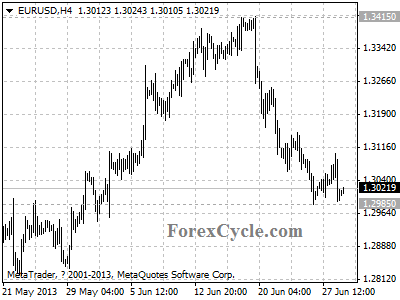
EURUSD remains in downtrend from 1.3415

EURUSD remains in downtrend from 1.3415, the bounce from 1.2985 could be treated as consolidation of the downtrend. Another fall could be expected after consolidation, and a breakdown below 1.2985 could signal resumption of the downtrend. Key resistance is now at 1.3100, only break above this level will suggest that the downtrend from 1.3415 had completed at 1.2985 already, then the following upward movement could bring price to 1.3600 zone.

eurusd

Daily Forex Analysis

Why This Could be Another Great Year for Australian Stocks…

By MoneyMorning.com.au

With another financial year behind us it’s worth looking at the performance of a few key asset classes – shares, cash, gold, and property.

However, one point worth noting is that this isn’t an exercise in saying you should put all your money in one asset class rather than another.

And we aren’t saying you should diversify your assets across an equally balanced portfolio.

Rather, we’re saying you should actively manage your investments and not be afraid to re-balance your portfolio at certain points during the year.

Because as the past 12 months have shown, those investors who refused to see that the market had change have missed out on spectacular gains…

First, let’s see how the various assets stack up over the past year:

  • S&P/ASX 200: up 17.3%
  • Cash: up 4-5%
  • Aussie dollar Gold: down 13.2%
  • Property: up 2.85%

There is no doubt shares were the best performing asset class over the past 12 months. Remember, we’re not being a ‘Hindsight Harry’ on this. We’ve said since late 2011 that it was time to build up your stock exposure (especially dividend stocks) after we had been bearish for the previous year.

The worst performing asset was gold. What more can we say? Gold is a great investment and you should own some. But it won’t make you rich.

As for property, that figure is of course the gross amount based on numbers from RPData. If you take into account financing and other costs of holding a property, then it has been a negative financial year for the average property investor.

Look, we know spelling this out won’t be popular. Bashing the stock market has become something of a blood sport in recent years. Heck, we’ve even given it a well-deserved smack around the chops.

But as we’ve continued to explain in Money Morning, whatever the knockers say, the stock market still remains hands down the best way to build wealth. Of course, the numbers we’ve just given you are last financial year’s numbers.

Who’s to say the stock market will give investors the best return this financial year?

Two More Years of Gains for Australian Stocks?

The following chart shows you how the last financial year’s performance compares with previous years:


Source: Bloomberg, The Australian

You don’t need that chart to tell you it has been a volatile seven years for stocks.

So after a standout year, can you expect this year to provide another big double-digit gain?

Well, our bet is that Australian stocks will hit a new record high in 2015. In order for the market to do that, the Australian market will need to gain 46% from Friday’s end-of-financial-year closing price.

That’s roughly a 21% gain each year.

It’s not impossible, but we won’t kid you…it’s a tough ask considering how volatile the market has been over the past seven years.

And it will be even harder following the market’s recent 10% fall.

The Market Has Made These Gains Before

Despite that, there is a precedent for the market to make stunning returns when few expect it to. You only have to look at the last nine months for a classic example.

But also look at March 2003 to October 2007.  In four-and-a-half years the market gained over 150%. That’s three times the percentage gain we need for the market to take out a new high in 2015.

Of course, that’s longer than the two-year timeframe we’re looking at now. But how about March to October 2009? You may have forgotten about that period because it all happened so quickly.

In the space of just seven months, while most investors thought the entire world economy and financial system would collapse, the Aussie index gained 54%.

We agree that was an extreme time. But that’s exactly our point.

It’s at times when most investors, analysts and commentators have given up on the market that you should look to buy. But what and where?

Right now, from an Australian market perspective, we’ve got our eye on two key segments – companies that can pay a dividend and hopefully grow that dividend; and speculative stocks.

That’s not to say other stocks such as blue-chip growth stocks won’t go up, because there’s a good chance they will if the market pans out as we expect.

But the important factor is to get as much bang for your buck as you can, without unnecessarily putting too much of your money on the line.

Even Big Corporations Keep a Cash Buffer

Obviously, you’ll have your own attitude to risk. It will be different to ours and to other people’s.

If you’re as bullish on the stock market as we are, you need to shift more of your cash into it.

That doesn’t mean investing all your cash. It’s crucial to have a big cash buffer – even big corporations like Google [NASDAQ: GOOG] and Apple [NASDAQ: AAPL] keep plenty of cash in reserve. (At the end of March, Apple had USD$145 billion in cash, about one-third of its market cap.)

That’s why we like term deposits. It forces you to lock cash away for 3, 6 or 12 months at a time. It means you can’t succumb to temptation and invest more than you should in the stock market.

Even so, to our mind the conditions are ripe for another stock rally. Interest rates, regardless of recent spikes, are still near record lows globally. The Reserve Bank of Australia’s Cash Rate is at a record low and seems set to fall further.

And even if it doesn’t, the recent fall in the Australian dollar should provide a boon to Australian exporters and attract investors.

Finally, the overseas market that appears to influence the Australian market the most – Japan’s Nikkei 225 – has started to rebound after a torrid few weeks. For all the talk of the Japanese market crashing, it’s still up 52% for the year.

The Australian market has underperformed compared to the Japanese market in recent months. That’s due to the poorly performing resource sector. That trend won’t last for long.

In fact, after ignoring resource stocks for most of the past year, we say that resource stocks should be back on your shopping list. We’re looking around at a few beaten-down stocks now.

But as we say, that’s not the only bargain out there right now. Before you add risky resource stocks to your portfolio, you need to make sure you’re on board with the yield rally.

Despite the talk about the yield rally being over, the reality is different. It’s far from over. In fact, the recent stock price slump has created a bunch of opportunities investors would be foolish to ignore. And if we’re right, stock prices and high yields won’t stay this way for long.

Cheers,
Kris
+

From the Port Phillip Publishing Library

Special Report: Just What are ‘Turbo Cap’ Stocks?

Daily Reckoning: How the Power of Tweets Saved Tesla Motors

Money Morning: Don’t Get Caught in the Market Crossfire

Pursuit of Happiness: Is Technology the Most Exciting Industry in the World?

Australian Small-Cap Investigator:
How to Make Big Money from Small-Cap Stocks

Natural Gas Stocks are About to Reprise an All-Star Performance

By MoneyMorning.com.au

Everyone likes a good comeback story where large obstacles are overcome on the way to a favourable outcome.

And we’re about to see one in the investment world…

The shale gas boom seemed to be a disaster for the natural gas industry as the price of natural gas plummeted over a five-tear period to reach a multi-year low below $2 per million BTU in April 2012.

But as Money Morning Global Energy Strategist Dr. Kent Moors forecast, natural gas prices have rebounded with a vengeance since then. The price has more doubled (trading at about $3.80 now) since that bottom last spring, becoming this year’s top performing commodity. Nat gas hit a 20-month high of $4.43 per million BTU in April.

That trend of steady to rising prices is likely to continue thanks to increasing demand.

These factors, often pointed out by Moors, include the switchover by utilities from coal-fired power to gas-fired power, the start of exports soon of liquefied natural gas, and increased demand from industries such as the chemical industry.

And the trend is huge news for natural gas stocks, and their investors – especially when you look at what happened nearly 10 years ago…

Natural Gas Stocks in 2013

First, let’s look at what has happened to natural gas stocks this year.

Logic would dictate that the last year or so has been a great time to be invested into natural gas stocks.

In the past few years, many natural gas companies have reduced their costs while keeping production in check in order to stay viable in a tough market environment.

This has put a good number of them in a position of strength to benefit from the higher natural gas prices we’ve seen in 2013.

The companies that are poised to benefit the most are those with the lowest cost of production and that are leveraged to the price of natural gas.

Robert Mark, oil and gas analyst for Canadian firm MacDougall, MacDougall & MacTier, told the Globe & Mail ’Companies that have been producing profits over the past two years [when selling prices have been low] have proven their worth and are attractive investments.

But the market is rarely logical. Despite the most sustained upward move in natural gas prices in over 10 years, the shares of most gas companies have yet to embark on a sustained move upward.

The Market Rhymes

But we’ve seen this movie before. . .

As Mark Twain said, ‘History doesn’t repeat itself, but it does rhyme.

In this specific case, the ‘rhyme’ goes back to 2001-2002.

At that time, natural gas prices also tanked to below $2 per million BTU. Then over the next several years, prices more than doubled to over $4. Just as it has now, with the difference being the current rebound happened in a shorter time frame.

Yet, as now, the stocks of natural gas companies just sat there.

But eventually these stocks did move higher…and in a big way.

Over the next two years, natural gas companies soared in excess of 200%, a true comeback story!

In effect, sooner or later, the stocks of natural gas firms have to follow prices higher.

That should apply in the current market environment as well.

Tony Daltorio
Contributing Editor, Money Morning

This article first appeared in the US Money Morning on 27 June, 2013

Join Money Morning on Google+

From the Archives…

Why Your Financial Advisor Won’t Like This Investment Advice…
28-06-2013 –  Kris Sayce

Is This Your Last Chance to Sell Before the Stock Market Sinks?
27-06-2013 – Murray Dawes

Is This the Ultimate Contrarian Opportunity…Or a Death Wish?
26-06-2013 – Dr Alex Cowie

How Central Bank Zombies Control the Stock Market
25-06-2013 – Dr Alex Cowie

Why The ‘Asia-Zone’ Crisis Makes Australian Stocks a Buy…
24-06-2013 – Kris Sayce

Forex Weekly: USD gained on Majors for 2nd straight week last week

Forex Outlook: US Dollar gained last week vs Major Currencies, Non-Farm Payrolls Report Highlights this week’s trading

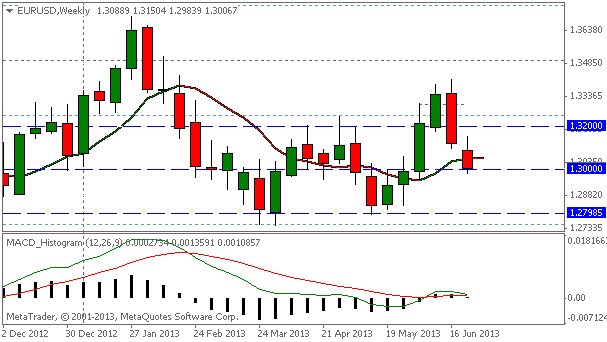
eurusd-w6-28


The US dollar advanced versus all the major currencies last week and rose higher against most of them for a second straight week as market traders continued to position themselves for the potential unwinding of the US Federal reserves quantitative easing program. This week has some very big fundamental events to watch for with the highlight being the US Non-Farm Payrolls Employment data on Friday.

There are also interest rate decisions out of Australia, the United Kingdom and the Eurozone to look out for as well as some manufacturing data out of the US and China and other 2nd tier releases. See more currency pair comments and economic event highlights below.

Read more Currency Pair Commentary Here….


Large Currency Speculators trimmed US Dollar bullish bets last week for 4th straight week


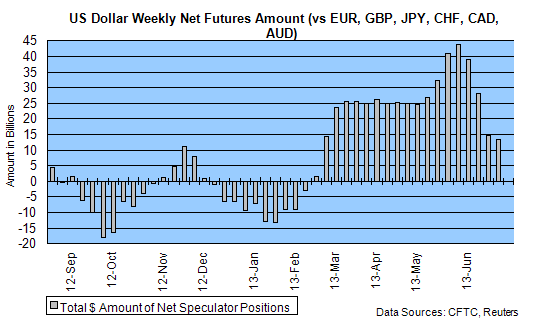
cot-values


The weekly Commitments of Traders (COT) report, released on Friday by the Commodity Futures Trading Commission (CFTC), showed that large futures traders and speculators decreased their total bullish bets of the US dollar last week for a fourth consecutive week.

Non-commercial large futures traders, including hedge funds and large International Monetary Market speculators, trimmed their overall US dollar long positions to a total of $13.28 billion as of Tuesday June 25th. This was a decline from the total long position of $14.55 Billion registered on June 18th, according to position calculations by Reuters that derives this total by the amount of US dollar positions against the combined positions of euro, British pound, Japanese yen, Australian dollar, Canadian dollar and the Swiss franc.

USD net long positions are at their lowest level since February 19th when bullish positions equaled $1.481 billion, according to Reuters data calculations.

See full COT Report & Charts here…


 Highlights of Fundamental Economic Events Next Week

Sunday, June 30

China — leading index
Japan — Tankan manufacturing data
Australia — manufacturing index

Monday, July 1

China — manufacturing PMI
euro zone — consumer price index
United States — ISM manufacturing data
euro zone — purchasing managers index
United Kingdom — purchasing managers index

Tuesday, July 2

Australia — interest rate decision
euro zone — producer price index
United States — factory orders data

Wednesday, July 3

China — non-manufacturing PMI
Australia — retail sales data
Australia — trade balance
United States — ADP employment data
euro zone — retail sales
United States — weekly jobless claims
United States — trade balance
United States — ISM non-manufacturing

Thursday, July 4 – *American Holiday

United Kingdom — BOE interest rate decision
euro zone — ECB interest rate decision

Friday, July 5

Japan — leading index
Switzerland — consumer price index
United States — non-farm payroll report
Canada — employment change report
Canada — Ivey purchasing managers index


Monetary Policy Week in Review – Jun 24-28, 2013: 8 banks hold rates, 1 cuts, markets adjust to coming Fed exit

By www.CentralBankNews.info

    This week 10 central banks took policy decisions with only Hungary cutting rates while global financial markets continued to adjust to an earlier-than-expected exit from quantitative easing by the U.S. Federal Reserve.
     Eight central banks kept their policy rates on hold (Israel, Armenia, Taiwan, the Czech Republic, Fiji, Colombia, Angola and Trinidad and Tobago) as a measure of calm returned to markets after a frenetic month that witnessed a major shift of capital away from emerging markets and other assets perceived as risky.
    The National Bank of Hungary, which cut rates for the 11th time in a row, was the latest central bank to adjust its policy stance to the volatility in global markets from an expected tightening in U.S. monetary policy, saying it may have to slow down its pace of future easing due to the shift in “markets perception of risks.”
    Uruguay’s central bank offered further details of its decision from earlier this month to target money supply rather than interest rate to control above-target inflation. The Central Bank of Uruguay will target an 8.0 percent growth in money supply for the quarter ending in June 2015, a contraction from the current 12.5-13.0 percent expansion in the quarter ending September 2013.
    While Uruguay’s central bank maintained its inflation target of 6.0 percent, it widened the tolerance band to 3-7 percent from July 2014 from 4-6 percent.
    Through the first 26 weeks of this year, central bank policy rates have been cut 63 times, or 24.9 percent of the 253 policy decisions taken by the 90 central banks followed by Central Bank News, slightly down from 25.5 percent last week.
LAST WEEK’S (WEEK 26) MONETARY POLICY DECISIONS:

COUNTRYMSCI    NEW RATE          OLD RATE       1 YEAR AGO
ISRAELDM1.25%1.25%2.25%
ARMENIA8.00%8.00%8.00%
HUNGARY EM4.25%4.50%7.00%
TAIWANEM1.88%1.88%1.88%
CZECH REPUBLICEM0.05%0.05%0.50%
FIJI 0.50%0.50%0.50%
COLOMBIAEM3.25%3.25%5.25%
URUGUAY               N/A9.25%9.25%
ANGOLA10.00%10.00%10.25%
TRINIDAD & TOBAGO2.75%2.75%3.00%
    NEXT WEEK (week 27) features six scheduled central bank policy meetings, including Romania, Australia, Sweden, Poland, the United Kingdom and the euro area.

COUNTRYMSCI             DATE              RATE       1 YEAR AGO
ROMANIAFM1-Jul5.25%5.25%
AUSTRALIADM2-Jul2.75%3.50%
SWEDENDM3-Jul1.00%1.50%
POLANDEM3-Jul2.75%4.75%
UNITED KINGDOMDM4-Jul0.50%0.50%
EURO AREADM4-Jul0.50%1.00%

 
 www.CentralBankNews.info