Central Bank News Link List – Jul 18, 2013: Bernanke says unwinding excessive risk boosted long-term rates

By www.CentralBankNews.info   Here’s today’s Central Bank News’ link list, click through if you missed the previous link list. The list comprises news about central banks that is not covered by Central Bank News. The list is updated during the day with the latest developments so readers don’t miss any important news.

South Africa holds rate, inflation will determine next move

By www.CentralBankNews.info     South Africa’s central bank held its benchmark repurchase rate steady at 5.0 percent, as widely expected, saying upside risks to inflation from a lower exchange rate was limiting its ability to ease policy and stimulate a weak economy, and the outlook for inflation would determine its policy stance.
    The South African Reserve Bank (SARB), which is facing the uncomfortable combination of rising inflation and slowing growth, said that at this stage “a sustained breach of the inflation target is not our central forecast. However, we are concerned about the revised higher trajectory of core inflation and macroeconomic vulnerabilities that are increasingly evident.”
    Gill Marcus, governor of SARB, said the bank’s policy committee was mindful of these conflicting pressures and its policy would be “highly dependent on how we see the inflation trajectory unfolding in this very uncertain environment. In other words, it has become even more data dependent.”
    SARB revised its growth forecast downward and its inflation forecast upward.
    SARB, which targets inflation of 3.0-6.0 percent, said the outlook for inflation had deteriorated since May and it now expects average inflation of 5.9 percent this year, up from a previous forecast of 5.8 percent, 5.5 percent in 2014, up from 5.2 percent, and 5.2 percent in 2015, up from 5.0 percent.

    “The deterioration is mainly due to continued currency weakness and higher-than-expected petrol price increases,” SARB said, adding that inflation is expected to breach the upper end of its target in the third quarter of this year – an average level of 6.3 percent from 6.1 percent – but then return to the target range by the fourth quarter of this year. 
    South Africa’s headline inflation rate eased to 5.6 percent inflation in May from 5.9 percent in April, March and February, but SARB said this was likely a temporary decline as a 73 cent cut in petrol prices in May had been reversed by an 84 cent increase in July.

     The central bank’s policy committee again revised its 2013 growth forecast down to 2.0 percent this year, from a 2.4 percent forecast, and to 3.3 percent in 2014 from a previous forecast of 3.5 percent.
    “The downside risk to growth has already resulted in the Bank being more tolerant of inflation at the upper end of the target range than would normally have been the case, an approach that is consistent with a flexible inflation targeting framework,” Marcus said.
    Economic growth is expected to improve in 2015, with the economy expanding by 3.6 percent, down from a previous forecast of 3.8 percent. In 2012 South Africa’s Gross Domestic Product grew by 2.5 percent and SARB last cut its policy rate by 50 basis points in July 2012.
    “The risks to the outlook are still assessed to be on the downside, particularly in the face of further delays in overcoming electricity supply constraints,” Marcus said.

    South Africa’s economy lost steam in the first three months of this year, with GDP expanding by only 0.9 percent from the previous quarter,  the lowest quarterly growth rate in almost four years. On an annual basis, GDP expanded by 1.9 percent, down from 2.5 percent in the fourth quarter.

    But SARB’s ability to boost growth is limited by inflation and Marcus said the main risk to the inflation outlook comes from exchange rates and “much will depend on the strength of the pass-through to inflation, which to date has been relatively muted.”

    “However, the risk remain that these pressures could be mounting, particularly if further currency weakness occurs and affects inflation expectations, which are currently anchored at the upper end of the target range,” she said, adding that the outcome of the present round of wage talks will be critical in determining how much wage pressure would impact the inflation outlook.
    South Africa’s rand has been under pressure since mid-2012 when labour unrest and high wage demands in the mining sector started to undermine the confidence of investors. The rand was also caught up in the general fall in emerging market currencies in May in response to fears of a tightening of U.S. monetary policy.
    Since May, the volatility of the rand’s exchange rate has increased, trading between 10.36 and 9.60 to the U.S. dollar, and since the start of the year it has declined by 14.2 percent agains the dollar.
    Marcus said the relatively muted pass-through to inflation of the depreciation in the rand was likely due to weak pricing power as economic growth is low.

     www.CentralBankNews.info


Gold Rallies But “Very Oversold” Miners Extend Losses Post-Bernanke

London Gold Market Report
from Adrian Ash
BullionVault
Thursday, 18 July 08:25 EST

WHOLESALE GOLD traded in a tight range around $1280 per ounce Thursday morning after recovering over a third of yesterday’s $30 drop from 4-week highs.

Gold miner equities, in contrast, extended their fall as broader stock markets rose.

 By lunchtime in London, African Barrick, spun out of the world’s largest gold producer in 2010, stood 2.2% lower but held above last month’s record low.

Russian miner Petropavlovsk lost a further 5%, taking its 2013 drop to more than 75%.

 Like the gold bullion price, silver prices were quiet after Wednesday’s sharp 4.3% swing, in line with other commodities.

 US Treasury bonds ticked higher, nudging 10-year yields down to 2.48%.

 “The sentiment [in gold stocks] is terrible – worse even than the sentiment towards gold,” says HSBC analyst Patrick Chidley to the Financial Times.

 “We have seen a 50% fall in gold mining shares in six months,” the paper also quotes Evy Hambro, co-manager of the $2 billion Blackrock Gold & General Fund.

 “Common sense would naturally say we are in very oversold territory.”

 Gold-heavy hedge fund manager John Paulson – whose $2 billion position in AngloGold Ashanti alone lost clients $317 million in the second quarter, according to the Wall Street Journal – yesterday defended his continued investment in both gold and gold producers.

 “People who bought gold in anticipation of inflation have lost their patience,” Paulson told CNBC’s Delivering Alpha conference.

 “[But] the consequence of printing money over time will be inflation, it’s just difficult to predict when.”

 That makes gold “an important part of anyone’s portfolio.”

 US Fed chairman Ben Bernanke restated his aim of starting to taper quantitative easing in testimony to Congress on Wednesday.

 But on short-term rates – now at zero for more than four years – “I don’t think the Fed can get interest rates up very much,” he said, “because the economy is weak, inflation rates are low.

 “If we were to tighten policy, the economy would tank.”

 Bernanke was due to resume his semi-annual testimony at 10am Thursday in Washington.

 “The $30 pullback in gold prices [after Bernanke spoke Weds] was likely more a reflection of disappointment that prices did not manage to break resistance [at] $1300,” says Swiss investment and London bullion bank UBS’s strategist Joni Teves.

 “Our economists,” says a note from Commerzbank’s commodity team, “are still confident that the Fed’s bond purchasing programme will be gradually scaled back from December.

 “This is likely to be largely priced in and should thus no longer weigh significantly on the gold price.”

 But “shifting sentiment regarding the timing of Fed tapering will impact gold and make trading volatile,” warns HSBC analyst James Steel.

 “Since investment demand is weak, with ongoing gold ETF liquidation, a strong physical market is crucial if gold prices are not to sink considerably further.”

 Further ahead, gold-mine output is set to shrink in the years to come, said Gold Fields’ boss Nick Holland in an interview Wednesday, thanks both to the falling gold price and “a dearth of exploration projects.

 “The industry is struggling to replace what it mined,” says Holland, CEO of the world’s 8th largest producer.

Adrian Ash

BullionVault

Gold price chart, no delay | Buy gold online

Adrian Ash is head of research at BullionVault, the secure, low-cost gold and silver market for private investors online, where you can buy gold and silver in Zurich, Switzerland for just 0.5% commission.

(c) BullionVault 2013

Please Note: This article is to inform your thinking, not lead it. Only you can decide the best place for your money, and any decision you make will put your money at risk. Information or data included here may have already been overtaken by events – and must be verified elsewhere – should you choose to act on it.


Six Tech Advancements Changing the Fossil Fuels Game

By OilPrice.com

Oil and gas is getting bigger, deeper, faster and more efficient, with new technology chipping away at “peak oil” concerns. While hydraulic fracturing has been the most visible revolutionary advancement, other high-tech developments are keeping the ball rolling—from the next generation of ultra-deepwater drillships, subsea oil and gas infrastructure and multi-well-pad drilling to M2M networking, floating LNG facilities, new dimensions in seismic imagery and supercomputing for analog exploration.

ADVANCED SEMI-SUBMERSIBLES & 6TH GENERATION DRILLSHIPS

Rig advancements are coming online in tandem with the significantly increased momentum to drill in deeper waters as shallower reserves run out. For 2012, 49% of new offshore discoveries were in ultra-deepwater plays, while 28% were in deepwater plays. What we’re looking at now are amazing advancements in deepwater rigs, with new semi-submersibles capable of drilling to depths of 5,000 feet or deeper. Beyond that, though, new sixth generation enterprise-class drillships can go to depths of 12,000 feet! From a global perspective, there are 120 ultra-deepwater rigs in existence—and demand is on the steep rise.
SUBSEA PROCESSING

Subsea processing can turn marginal fields into major producers.

Subsea production systems are wells located on the sea floor rather than the surface. Petroleum is extracted at the seafloor, and then ‘tied-back’ to an already existing production platform. The well is drilled by a moveable rig and the extracted oil and natural gas is transported by riser or undersea pipeline to a nearby production platform. Subsea systems are typically in use at depths of 7,000 feet or more. They don’t drill, they just extract and transport.

The real advantage of subsea production systems is that they allow you to use one platform—strategically placed—to service many well areas. And as the cost of offshore production rises, this could represent significant savings.

Subsea production could rival traditional offshore production in less than 15-20 years, and we’re looking at expected market growth for subsea facilities of around $27 billion in 2011 to an amazing $130 billion in 2020. Analysts expect E&P companies to invest more than $19 billion in subsea production equipment in 2013 alone–and up to $33 billion by 2017.

Subsea processing can handle everything from water removal and re-injection or disposal, to single-phase and multi-phase boosting of well fluids, sand and solid separation and gas/liquid separation and boosting to gas treatment and compression.

Subsea processing allows producers to separate the unwanted elements right on the seafloor, without using complicated and expensive flowlines to bring these elements up to the above-water processing facility to remove them and then send them back down to the seafloor to be re-injected. We’re cutting out the middle man here. The middle man in this case is the process known as “subsea boosting”.

What we’re talking about, essentially, is saving space and time (which means money) by performing processing activities on the seafloor rather than sending fluids back and forth between the seafloor and the processing facilities above water.

We are particularly interested in a new subsea rotating device that promises to enhance dual-gradient drilling (DGD). This is a system being developed by Chevron, which is hoping to deploy the system is the Gulf of Mexico later this year. What the DGD system will do is render the thousands of feet of mud that is bearing down on the wellbore … well … weightless.

And then we have subsea power grid plans, which have been making progressive leaps since 2010 towards the advancement of electric grids installed on the floor of the sea to run processing systems at the site of underwater wells. It reduces the need for so many platforms on the water surface, and makes the entire process much less complicated. The ultimate goal here is to be able to operate offshore wells remotely from land—saving countless billions.

MULTI-WELL-PAD DRILLING: OCTPUS IN THE HOUSE

One of the greatest drilling developments of the last decade is multiple well pads, which some like to refer to as “Octopus” technology.

Imagine gaining access to multiple buried wells at the same time, from a single pad site. This is what “Octopus” technology is doing, first in a canyon in northwestern Colorado in the Piceance Shale Formation and then in the Marcellus shale. It’s definitely not your traditional horizontal drilling.

Traditionally, to drill a single well, a company needs a pad or land site for each well drilled. Each of these pads covers an average of 7 acres. The Octopus allows for multiple well drilling from a single pad, which can handle between 4 and 18 wells. So, a single pad on 7 acres can now be used to drill on up to 2,000 acres of reserves. More than anything, it means that drilling will be faster, faster, faster … And less expensive in the long run once it renders it unnecessary to break down rigs and put them together again at the next drilling location. It’s simple math: 4 pads usually equals 4 wells; now 1 pad can equal between 4 and 18 wells.

Here’s how the technology works: A well pad is set up and the first well is drilled, then the rig literally “crawls” on its hydraulic tentacles to another drill location from the same pad, repeatedly. And it’s multi-directional. It takes about two hours between each well drilling. With traditional horizontal drilling methods, it takes about five days to move from pad to pad and start drilling a new well.


Last year, Devon Energy (DVN) drilled 36 wells from a single pad site using Octopus technology in the Marcellus Shale. More recently, Encana (ECA) drilled 51 wells covering 640 underground acres from a single pad site with a surface area of only 4.6 acres in Colorado. Multi-well pad drilling is also revolutionizing drilling in Bakken, and this is definitely the long-term outlook for shale. It will become the norm.

It’s also good (or at least slightly better) news for the environment because it means less drilling disturbance on the surface as we render more of the process underground.

SUPERCOMPUTING & SEISMIC DIMENSIONS EINSTEIN WOULD APPRECIATE

Oil majors are second only to the US Defense Department in terms of the use of supercomputing systems. That’s because supercomputing is the key to determining where to explore next—and to finding the sweet spots based on analog geology.

What these supercomputing systems do is analyze vast amounts of seismic imaging data collected by geologists using sound waves. What’s changed most recently is the dimension: When the oil and gas industry first caught on to seismic data collection for exploration efforts, the capabilities were limited to 2-dimensional imaging. Now we have 3-dimensional imaging that tells a much more accurate story.

But it doesn’t stop here. There is 4-dimensional imaging as well. What is the 4th dimension, you ask: Time (and Einstein’s theory of relativity). This 4th dimension unlocks a variable that allows oil and gas companies not only to determine the geological characteristics of a potential play, but also gives us a look at the how a reservoir is changing LIVE, in real time. The sound waves rumbling through a reservoir predict how its geology is changing over time.

The pioneer of geological supercomputing was MIT, whose post-World War II Whirlwind system was tasked with seismic data processing. Since then, Big Oil has caught on to the potential here and there is no finish line to this race—it’s constantly metamorphosing. What would have taken decades with supercomputing technology in the 1990s, now can be accomplished in a matter of weeks.

In this continual evolution, the important thing is how many calculations a computer can make per second and how much data it can store. The fastest computer will get a company to the next drilling hole before its competitors.

We are talking about MASSIVE amounts of data from constant signal loops from below the Earth’s surface. For example, geologists generate sound waves using explosives or other methods that dig deep into the Earth’s surface and then are sample 500 times per second. Only a supercomputer could possibly process all this complex data and make sense of it.

We’ve moved beyond geographical interpretations, such as pursuing exploration based on geological proximity, like Tullow’s Ethiopia play is on trend with its massive Kenya finds. This is child’s play. What we’re talking about is using supercomputing to tell us that standing in prolific Brazil is pretty much the same as standing in Angola; or that Ghana is analog to French Guiana.

Supercomputing advances remove a great deal of the risk involved in undertaking expensive drilling when you’re not sure what’s there. Supercomputing essentially puts the idea of peak oil to bed for the foreseeable future.

LNG TECHNOLOGY: FLOATING IS NOT A FANTASY

Liquefied natural gas (LNG) technology—from LNG seaborne tankers and LNG trains to floating LNG facilities have quickly gone from concept to commercialization, opening up new possibilities in new frontiers and rendering the remote—well, much less remote.

Liquefaction of natural gas is the process of super-cooling natural gas to minus 260 degrees Fahrenheit (minus 162 degrees Celsius) at which point it becomes much safer and easier to transport. After shipped to its destination, regasification plants at importing or receiving terminals return the fuel to a gaseous state.

Floating LNG production, storage and offloading concepts are revolutionary because they have the ability to station a vessel directly over distant fields, removing the need for offshore pipelines and adding the advantage of mobility—these floating facilities can be moved to a new location once existing fields are depleted.

Floating liquefaction technology can bring additional LNG supply by accessing stranded gas reserves that were previously thought to be too remote, small or otherwise challenging for conventional land-based LNG development.

Shell’s most prized LNG project is its Prelude Floating Liquefied Natural Gas (FLNG) Project in Australia, which is moored some 200 kilometers out to sea and will produce gas from offshore fields and liquefy it onboard. This vessel will be six times bigger than the biggest aircraft carrier and will cost between $10.8 and $12.6 billion to build—but it also means that Shell won’t have to pay rising prices in Australia’s onshore LNG plants. The facility will produce about 3.6 million metric tons of LNG and 1.3 million tons of gas condensate a year.

M2M FOR OIL & GAS: GETTING SMARTER AND MORE CONNECTED

The hottest arena in the smart grid world is machine-to-machine (M2M) technology—an industry worth $1 trillion. It’s relevance to the oil and gas industry should not be underestimated. Now it’s about to get even bigger because the cost of sensors used to make M2M possible has fallen so much that they are BEYOND commercially viable; and wireless networks are now cheap and everywhere. This is the next frontier in cross-sector technology.

M2M device use in the oil and gas industry is set to more than double, as these technologies (including SCADA Telemetry– supervisory control and data acquisition) emerge as key differentiators in expediting oil and gas exploration and accelerating operational efficiencies.

Adopting M2M early on enables remote monitoring and allows for more flexible control of assets from wellhead to pipeline. It also enables fiscal metering, drilling monitoring and fleet management, as well as worker safety and accident response.

It means higher productivity and eventually, lower costs for the oil and gas industry.

This is the important part: The number of devices with cellular or satellite connectivity deployed in oil and gas applications worldwide is expected to rise more than 20% over the next several years.

The top two applications for M2M in the oil and gas sector are in-land pipeline monitoring and onshore well-field-equipment monitoring.

The drivers are new regulations, rising operating costs (think unconventional drilling) and increasing competition (a lot more players on the field, and the rising ranks of the juniors).

WHO TO WATCH (AND OWN)

In the high-tech hydrocarbons game these are our four picks: General Electric (GE) for subsea infrastructure; Transocean (RIG) for deep and ultra-deepwater rigs, Schlumberger for 3D seismic, and FMC Technologies.

As upward pressure pushes up day rates for deep-water (especially ultra-deep) rigs, it’s Transocean (NYSE:RIG) all the way. This year’s already been a pretty good year for Transocean, despite some rather serious legal problems, and it’s got a nice backlog of contracts. But we’re also looking at Ensco and SeaDrill.

But hands down, it’s GE Oil & Gas, General Electric’s fastest-growing segment, with annual 16% revenue growth over the last three years. GE is one of the most diverse companies out there, and it has carved itself a nice niche in the oil and gas sector. And it’s impressively forward-thinking—from massive LNG projects to subsea drilling equipment. GE is positioned to experience significant growth.

This year has been an amazing year for GE Oil & Gas, with a list of contracts that would impress the biggest skeptic. Since January, GE has sealed a $620 million, 22-year contract for QGC’s Queensland Curtis LNG plant offshore Australia; a $333 million 16-year contract extension for Russia’s Sakhalin-2 LNG plant; a $500 million contract Petrobras for new pre-salt projects in Brazil; $600 million in multiple-customer propulsion system contracts; and most recently, a $147 million deal with Statoil for carbon dioxide injection. Adding to GE Oil & Gas’ market share here is the recent acquisition of Lufkin Industries. Though it had a very rough time of things during the financial crisis, GE has turned around—and quickly. Downsizing GE’s Capital Division has been fortuitous, and we see huge things ahead for this company.

By. OilPrice.com Premium Analysts

This report is part of Oilprice.com’s premium publication Oil & Energy Insider. Oil & Energy Insider gives subscribers an information advantage when investing, trading or doing business in the energy sectors. Successful investors, hedge funds and senior executives, have access to high level intelligence and power in ways that you, as an individual investor, are locked out of (the game is and never has been fair.) Let us help you level the playing field by using our network of traders, intelligence assets and high level partnerships to ensure you are making the right investment decisions.

To find out more on how you can get a legal inside advantage in the energy markets please take a moment to visit: http://oilprice.com/premium


“Mexico Mike” Kachanovsky Believes the Best Cure for Low Prices Is Low Prices

Source: Brian Sylvester of The Gold Report (7/17/13)

http://www.theaureport.com/pub/na/15444

Even though precious metals stocks are going through a nasty and unpleasant interval, Mike Kachanovsky, founder and partner of smartinvestment.ca, looks at the market through a bullish lens. Shrewd accumulators are buying all the gold and silver juniors they can. When prices recover, investors will realize that mining stocks have been driven down to generational lows and money will rapidly flow back into the juniors. In this interview with The Gold Report, Kachanovsky details actions smaller juniors can take to survive the downturn and discusses companies with the resources to stay afloat until the markets rebound.

The Gold Report: Mike, the prevailing wisdom in the market favors producers over explorers in the precious metals equities. The thinking seems to be why buy the pasture when entire farms are selling at nearly the same price? What do you think of that strategy?

Mike Kachanovsky: That is a good summary of current affairs. Market values for the entire sector have been trimmed dramatically; even many of the highest rated stocks are down 50% to 60%. From a value perspective, it makes sense to buy higher up the food chain when you have the opportunity, to buy more established companies that offer legitimate earnings and established infrastructure.

TGR: Kenneth Hoffman of Bloomberg Research notes that production from the world’s biggest gold mines has dropped 17% since early 2011. He predicts that gold mines, especially high-cost mines in Africa, will start to close as gold hovers around $1,200/ounce ($1,200/oz). Is there a bullish medium-term case to be made for gold given the shrinking supply?

MK: We have been through similar severe price corrections before. At the beginning of this century, gold’s market value was below what it cost to produce it. Mines closed and companies went out of business. That scenario evolved into the bull market we have today and the achievement of all-time high metals prices.

TGR: But this is not a bull market.

MK: A lot of the mainstream commentary is telling us this is a bear market for gold. I consider this to be a very severe correction within the context of a long-term bull market, a volatile event that will lead back into an even more bullish case down the road. I think we will see new highs for both gold and silver before this is over.

TGR: Predicting how long this will last is not easy, but what is your best guess?

MK: In my last Gold Report interview just over a year ago, I thought we would see a recovery before the end of 2012. I was dead wrong, obviously. Trying to predict the timing is just asking to be proven wrong.

The longer we get into this correction, I believe we are setting up for an even higher and more vibrant recovery. I would like to think the selling pressure would be washed out by this fall, but who knows? Silly can always get sillier.

TGR: Could gold test the $1,000/oz threshold this summer?

MK: Putting this in perspective, when gold was setting new highs in 2011, we had a parabolic short-term price curve. People speculated the price would break through $2,000/oz on the upside. We are now looking at a parabolic decline, which is just as unsustainable as a parabolic rise.

TGR: If silver and gold do rebound, what will underpin those rebounds?

MK: Demand for actual physical bullion is running at all-time highs. That is what will trigger more bullish conditions.

Both gold and silver exist in finite quantities. Speculators are panicking at these low prices, but shrewd accumulators who understand that gold and silver have always been money are buying all they can at these prices.

I saw it for myself in Hong Kong this April: people lined up three deep screaming, wanting to buy metal. That demand, along with supply curtailed by the lack of new development projects, will cause a shortage. That will trigger the next new high in gold as the market reacts.

TGR: If investors do return to precious metals, what would that mean for junior mining stocks?

MK: After metals prices have recovered, people will realize that mining stocks have been driven down to generational lows and money will rapidly flow back into the juniors. The selling today comes from hedge funds, exchange-traded funds and mutual funds. The recovery will be the mirror image of that, when the same funds want to accumulate these stocks again.

TGR: Until then, what do junior precious metals equities need for you to make a bid on them?

MK: It still makes sense to look at explorers one-by-one and find companies that are sitting on a large cash position and good projects. Many good stories are priced at generational lows. Even in this weak market, it is a good time to accumulate companies positioned for the day sentiment swings back to more bullish. This is an opportunity to buy cheaply and establish positions at very low cost averages.

But you must be selective. Warren Buffett once compared investing in stocks to playing a game of baseball where there are no called strikes. You have to wait and look for that really fat pitch to come across the middle of the plate before you swing the bat. The willingness to wait until you find that one company that is priced cheaply and has all the attributes to succeed will define the investors who make the most money after this downturn in market sentiment is resolved.

I look for companies with great cash positions, strong management, robust projects and low operating margins. Even really good stories are trading as if they were impaired.

TGR: You routinely make site visits. What mines or projects have you visited recently?

MK: I was at Scorpio Gold Corp. (SGN:TSX.V) in Nevada in April to tour its brand-new crushing plant at Mineral Ridge. That plant will allow the company to increase production and lower its unit cost.

Scorpio could well be one of the lower cost junior producers in Nevada, yet the stock has been a train-wreck. It is a good company priced at an almost ridiculous valuation, but it is well positioned to survive the downtrend and continue with its growth plan.

TGR: Scorpio settled a lawsuit in 2012 and seemed poised for better things in 2013, including more output at Mineral Ridge. Is its low price all market related or are there company-specific issues?

MK: I have been buying Scorpio all the way down, asking myself if I am missing something. Everything—cash costs, debt load, operations—looks sustainable and well-run. I have not been able to find a reason that justifies all this selling other than the overall weakness in the sector.

TGR: In late June, Atna Resources Ltd. (ATN:TSX) suspended operations at its Pinson mine in Nevada until a “revised operating plan is developed and gold prices are sufficient to support positive cash flow from operations.” Is this strictly about the gold price or are things just getting tougher in Nevada?

MK: Things are tough everywhere. Cash costs in every significant gold-producing region of the world have risen more than the metals prices. Now that the metals have corrected, operating and profit margins are under severe pressure.

Whenever there is a longer term correction in prices, production will revert to the lowest margin producers; the smaller companies and the higher cost producers will be taken offline. That is what we are seeing now.

The oldest cliché in the commodities sector is that the best cure for low prices is low prices. The longer gold remains in its current price range, the more mines will go offline, limiting the gold supply. Low supply will eventually contribute to a recovery and to higher prices.

TGR: Rye Patch Gold Corp. (RPM:TSX.V; RPMGF:OTCQX) is another junior operating in Nevada. It recently settled with Coeur Mining Inc. (CDM:TSX; CDE:NYSE) over the Rochester mine claims. What does that settlement mean for its investors?

MK: First, the settlement with Coeur injected $10 million ($10M) in working capital upfront for Rye Patch to move ahead.

Second, it gives Rye Patch a revenue stream. The royalty part of the settlement will contribute another $28M of recurring income that Rye Patch can use to fund projects.

There is about $38M in cash value from the settlement, which works out to about $0.25/share in value, on a stock trading at about $0.19/share.

TGR: In other words, if you believed in Rye Patch before it staked the Rochester claims, you should really believe in it now.

MK: Exactly. I think the sellers in Rye Patch are speculators who bought in expectation of a bigger settlement and more of an upside as the lawsuit progressed.

I look at it from the other point of view: A lot of good companies are dead in the water with no access to capital. Rye Patch has now emerged as one of the best funded juniors, ready to spend on its other properties or to make acquisitions.

A stock that trades at $0.19/share has a clear path to survive this downturn and to take advantage of the low-price opportunities out there. I am buying it and plan to continue to buy as long as I can get shares in this price range.

TGR: You are well known as Mexico Mike. What are your favorite junior equities in Mexico?

MK: Mexico is one of the premier spaces for investors in the junior mining space. Many good companies have been active there for years, but today their price ranges are so low that you can accumulate them almost as new entrants.

I have been a fan of IMPACT Silver Corp. (IPT:TSX.V) since the company acquired its first project in Mexico more than 10 years ago. IMPACT has put three new mines into production in the last couple of years. The company is running at capacity and is a low-cost operator. It has an extremely strong cash position and a huge inventory of untested new targets for future growth.

This is a company you can hold with confidence even if this correction drags on.

TGR: What is IMPACT Silver’s cash position?

MK: As of May 24, the working capital position was $16.8M, which is enough money to go for a while.

TGR: IMPACT Silver recently commissioned its 100%-owned Capire Production Centre. The company expects to begin concentrate shipments in the next six months. What will that add to IMPACT’s bottom line?

MK: I am not sure what the bottom-line numbers will be. To me, Capire’s significance is that it is being set up as a test mining operation. The company will be evaluating the strength of that whole mining area based on the small-scale operations of Capire.

In the early stages, the numbers are not as important as getting an idea of how the ore from that new zone will behave in a conventional processing environment. If it is profitable, IMPACT can redirect the cash flow back into expanding the operation and making it a much more significant production center.

TGR: Capire hosts high-grade, polymetallic mineralization. How important are byproduct credits to margins in this market?

MK: Most Mexican mines produce concentrates with silver in a zinc or a lead concentrate. The value of the concentrate itself has come down. These polymetallic mines get a lot of their total cash value from the base metals they produce along with the silver.

Silver has lost about 60% of its value off its peak, and other base metals have been affected by the same deflationary price trend. Right now both zinc and lead are at much lower price levels than when they were trading near their peaks. The companies will not gain as much benefit from byproducts as they did in the bull market.

TGR: What equities do you follow in Mexico?

MK: Like IMPACT, Great Panther Silver Ltd. (GPR:TSX; GPL:NYSE.MKT) has invested a lot in infrastructure. The company also has made significant discoveries. It improved the efficiency of its operations and can recover high percentages of the byproducts for every kind of ore that the company processes. Great Panther can use its strong cash position to continue investing in its operations and stay strong however long this correction continues.

TGR: Great Panther’s president, Martin Carsky, recently announced his resignation. How will that affect the share price?

MK: Bob Archer, who helped build the company over the last 10 years, will succeed Carsky, so the analysts and the institutions know that the same committed person will be running the company in the short term. In the long term, it would be smart for Bob to appoint a new president and not wear as many hats.

TGR: Do you have another Mexican story?

MK: Avino Silver & Gold Mines Ltd. (ASM:TSX.V; ASM:NYSE.MKT; GV6:FSE) has been active in Mexico since the 1990s. The company invested in infrastructure and in developing a new mine. That improved its cash costs and the output is in a rising trend. The company has reported strong cash flow and has access to additional capital through a line of credit. It is well positioned to survive a long downtrend.

TGR: We saw Endeavour Silver Corp. (EDR:TSX; EXK:NYSE; EJD:FSE) buy El Cubo from AuRico Gold Inc. (AUQ:TSX; AUQ:NYSE) and turn that asset around. Do you expect any small producers, like those you just mentioned, to buy distressed assets and prepare them to produce if prices turn around?

MK: I doubt any of the smaller producers have the clout to acquire a producing mine at this point. They are not capitalized or funded to take on major new deals.

Instead, I think junior producers will start to merge in friendly transactions. Perhaps the overall sector weakness will encourage more management teams to sit down and agree to deals to make that happen. Friendly mergers could be a win-win for any of these smaller juniors.

TGR: Do you see a likely dance partner for Avino in that situation?

MK: There are probably a dozen strong producing juniors, any one of which would be a good candidate for a partnership. In some cases they are operating individual mines immediately adjacent to each other, working very similar projects.

It is just a question of whether or not management is willing to agree to a transaction. That has been the problem all the way through this market; the smaller juniors resisted any efforts to merge.

TGR: What prompts that reaction? Self-preservation? Ego?

MK: Most junior miners were built from the ground up by one or two people. For a merger to succeed, some of those senior people would have to hand over the reins to a new management structure where they are no longer leading the charge. That is a difficult transition, even if it makes better sense for the company as a whole.

Unless merger becomes a necessity, I think most management teams will continue to resist mergers. The market conditions of today may create that necessity.

TGR: Mike, you have made a lot of money in this space and obviously believe that can happen again. Can you share one unsung aspect of your success, a trick of the trade?

MK: Probably the most significant thing that I did, starting with a very small amount of money at the beginning of this bull market, was to spread it around and get onboard a number of speculative stories.

All you need is one tenbagger, a company that goes from $0.10 to more than $1/share. You then redeploy those profits into other similarly positioned companies. In a robust bull market it is like firecrackers going off; one junior mining story after another suddenly becomes a huge winner.

The trick of course is to understand when the market rolls over and conditions become less bullish. Then you take some money off the table, back away and wait for the next speculative cycle to kick off. That is the next phase I am dealing with now.

TGR: You are waiting for the next cycle?

MK: Yes. I am convinced we will see another, even more intense bull market. The ability to keep your options open and be positioned in the next round of winning companies will define the next round of successful speculation. My attention is focused on finding the companies that have the potential to lead the entire market higher.

TGR: Mexico Mike, thanks for your time and your insights.

Mike Kachanovsky is a consultant providing analysis of junior mining and exploration stocks. His work is published on a freelance basis in a variety of publications, including the Mexico Mike column inInvestor’s Digest of Canada. He is a founder of www.smartinvestment.ca, which serves as an online community for the discussion of all topics relating to junior mining stocks.

Want to read more Gold Report interviews like this? Sign up for our free e-newsletter, and you’ll learn when new articles have been published. To see a list of recent interviews with industry analysts and commentators, visit our Streetwise Interviews page.

DISCLOSURE:

1) Brian Sylvester conducted this interview for The Gold Report and provides services to The Gold Report as an independent contractor. He or his family own shares of the following companies mentioned in this interview: None.

2) The following companies mentioned in the interview are sponsors of The Gold Report: Rye Patch Gold Corp., IMPACT Silver Corp. and Great Panther Silver Ltd. Streetwise Reports does not accept stock in exchange for its services or as sponsorship payment.

3) Mike Kachanovsky: I or my family own shares of the following companies mentioned in this interview: Scorpio Gold Corp., Rye Patch Gold Corp., IMPACT Silver Corp., Endeavour Silver Corp., Great Panther Silver Ltd. and Avino Silver and Gold Mines Ltd. I personally am or my family is paid by the following companies mentioned in this interview: None. My company has a financial relationship with the following companies mentioned in this interview: IMPACT Silver Corp., Great Panther Silver Ltd. and Avino Silver & Gold Mines Ltd. I was not paid by Streetwise Reports for participating in this interview. Comments and opinions expressed are my own comments and opinions. I had the opportunity to review the interview for accuracy as of the date of the interview and am responsible for the content of the interview.

4) Interviews are edited for clarity. Streetwise Reports does not make editorial comments or change experts’ statements without their consent.

5) The interview does not constitute investment advice. Each reader is encouraged to consult with his or her individual financial professional and any action a reader takes as a result of information presented here is his or her own responsibility. By opening this page, each reader accepts and agrees to Streetwise Reports’ terms of use and full legal disclaimer.

6) From time to time, Streetwise Reports LLC and its directors, officers, employees or members of their families, as well as persons interviewed for articles and interviews on the site, may have a long or short position in securities mentioned and may make purchases and/or sales of those securities in the open market or otherwise.

Streetwise – The Gold Report is Copyright © 2013 by Streetwise Reports LLC. All rights are reserved. Streetwise Reports LLC hereby grants an unrestricted license to use or disseminate this copyrighted material (i) only in whole (and always including this disclaimer), but (ii) never in part.

Streetwise Reports LLC does not guarantee the accuracy or thoroughness of the information reported.

Streetwise Reports LLC receives a fee from companies that are listed on the home page in the In This Issue section. Their sponsor pages may be considered advertising for the purposes of 18 U.S.C. 1734.

Participating companies provide the logos used in The Gold Report. These logos are trademarks and are the property of the individual companies.

101 Second St., Suite 110

Petaluma, CA 94952

Tel.: (707) 981-8999

Fax: (707) 981-8998

Email: [email protected]


WTI futures drops on low US stockpiles record

By HY Markets Forex Blog

The West Texas Intermediate crude futures declined on Thursday despite the fall in US oil inventories. Prices remain high as analysts warn that current price level may be weak. However, Brent futures were seen trading lower, but still above the $108 level.

The West Texas Intermediate delivery for August, as the New York’s NYMEX were seen traded slightly fell 0.25% lower to $106.09 a barrel on Thursday. The Brent futures declined 0.13% to $108.47 a barrel.

WTI futures rose on Thursday, when it reached $107.45 a barrel, reaching a five-month high after the US stockpiles fell for the second week.

WTI gained 0.5% after falling in response to the US Energy Information Administration’s (EIA) report showing a drop in the US crude inventories.

The reports released on Wednesday indicated that the stockpiles dropped by 6.9 million barrels to 367 million in the previous week ending July 12.

Reports from the EIA showed that the US refineries processed the most crude in 8 years, as the high-on-demand season is peaking in the Northern Hemisphere.

On Thursday, American Petroleum Institute (API) was leaked showing the readings were in line with EIA. The leaked report suggests that the API may report supplies up 3.8 million barrels.

Saudi Arabia shipped 7.79 million barrels of oil a day in the month of May, highest since last year June, according to reports from the Joint Organization Data.

The post WTI futures drops on low US stockpiles record appeared first on | HY Markets Official blog.

Article provided by HY Markets Forex Blog

Europe market expected to open negative

By HY Markets Forex Blog

The Markets in Europe are expected to open negative on Thursday after the Federal Reserve (Fed) Chairman Ben Bernanke said the bank’s monthly asset-purchase program is depending on the economic and financial progression, which are currently not strong enough. While in Spain, the auction for the benchmark bonds is expected to proceed.

The European Euro Stoxx 50 fell 0.32% lower at 2,671.50, while the German DAX futures were 0.26% down. The French CAC 40 futures were seen 0.36% lower at 3,858.50, while the UK FTSE futures declined 0.15% to 6,514.50.

Fed Chairman Ben Bernanke stated on Wednesday that the central bank are targeting  cutting down its bond-buying program by the end of this year ,however  he added the labor mark outlook could worsen if  inflation goes below the banks 2% aim .

“I emphasize that, because our asset purchases depend on economic and financial developments, they are by no means on a preset course,” Bernanke said to the House Financial Services Committee.

He said even though the central bank may slowdown its bond-buying program earlier than expected, Fed Chairman Bernanke mentioned if the financial and economy condition don’t show any further improvement, the bank would push back any plans or development for cutting down the bond-buying program.

According to the Beige book report from the Fed meeting, the US economy is continuing to grow at a moderate pace in the past month since first week of June.

The euro zone current account is expected to show a sum of 21.3 billion for May on a seasonally adjusted basis, compared to previous record of 19.5 billion for the month of April.

While in Spain, the governments are expected to sell Treasury bonds maturing in 3, 5 and 10 years with coupons of 3:30%, 3.75% and 4.40%.


The post Europe market expected to open negative appeared first on | HY Markets Official blog.

Article provided by HY Markets Forex Blog

Read This Before You Buy Another Stock or Bond…

By MoneyMorning.com.au

US Federal Reserve chairman Ben Bernanke fronted up to Congress for his testimony to the House Financial Services Committee last night our time. After his comments last week sent stocks skyrocketing, everyone was waiting to see if he would continue with his dovish tone.

He didn’t disappoint when he said ‘I emphasize that, because our asset purchases depend on economic and financial developments, they are by no means on a pre-set course.

Financial markets began to rally on these words, but it was a muted rally. As Goldman Sachs said in their round up as reported on ZeroHedge: ‘despite having ample opportunity, the Chairman did not significantly push back on expectations that tapering would begin in the next few FOMC meetings.

So it looks like tapering is still well and truly on the table later in the year, but the goal posts could be shifted if worse data than expected starts coming in…

Thus begins the twilight zone of good is bad and bad is good. If data continues to improve at a faster pace than expected then tapering may be brought forward and increased and stocks and bonds could suffer. If data falls off a cliff then tapering will be delayed and stocks and bonds may rally.

Forget spending years at university studying macroeconomics and fundamental analysis of stocks. The US Fed is the only game in town and that’s all you need to know about.

I will be interested to see how markets react over the next few days to the slightly less dovish tone of Bernanke’s testimony. After a very sharp rally over the last month the S&P 500 is retesting all-time highs. I would expect to see a pullback from overbought levels if the market is disappointed by Bernanke’s comments.

ASX 200 Diverging From AUD/Yen

There have been some interesting developments in the relationship between the ASX 200 and the Aussie/Yen in the past month. I’ve mentioned how closely the two have tracked each other over the past few years on many occasions.

ASX 200 vs Aussie/Yen

I’m still amazed when I look at the above chart and see how strong the relationship is between the two.

There is little doubt that the relationship has broken down on this most recent rally in the ASX 200. When you look at the rally in the ASX 200 within the ellipse it is quite clear that the Aussie/Yen isn’t coming along for the ride.

What could this mean?

Investors have borrowed in Yen and invested money in Australia which has caused the Aussie/Yen to rise along with the stock market as those investors bought stocks and bonds.

As a result it may not be so far-fetched to say that the current rally isn’t being caused by carry traders loading up on risk again. If it was, then you would expect to see the currency rising alongside the stock market.

If this rally isn’t being caused by the thing that has been so instrumental in our stock market rally of the past year then what is causing it? Perhaps the rally is just a bout of short covering and soon enough the buying will peter out and the ASX 200 will turn down and reconnect with the Aussie/Yen.

Of course the Aussie dollar may be nearing the end of its current downtrend and we may see the Aussie/Yen jump to meet the ASX 200, in which case we could become more confident of the staying power of the rally. But at the moment I think the large divergence that has opened up between the two brings the current rally into doubt.

Another thing that I have my eye on is my ATR indicator.

The ATR indicator shows the average true range (including overnight gaps) of a stock/index over a certain period of time. It’s a quick gauge of price volatility. I like to tweak the indicator by taking the ATR value and then dividing it by the price of whatever I’m studying so that you end up with a percentage of the price as the average true range number. I use the 10 period ATR.

I then overlay the indicator and invert the scale so that you can see the relationship between changes in price and volatility.

ASX 200 and ATR Per Cent Indicator

This indicator is most useful when looking for divergence between prices and volatility. You can see from the above chart that there have been a few instances over the past few years where the indicator gave a great warning sign about an impending decline.

In early 2011 (inside the first circle) you can see where prices and volatility diverged. The stock market shot to new highs but the ATR indicator didn’t go along for the ride.

In other words volatility was still high even though you would expect volatility to fall during market rallies that are sustainable. (Remember the scale for the ATR indicator is inverted so when the indicator rises in the chart it is saying that volatility is falling).

Sure enough, the stock market made a new high but then promptly fell over and began what was a 1300 point dive over the next five months.

Fast forward to May this year and you can see that the same thing happened again. Prices rallied from the end of April to the middle of May but the ATR indicator didn’t go along for the ride. Yet again, prices topped out and then fell in a straight line to 4700. That set-up was one of the reasons why I predicted the fall in the ASX 200 at the time.

The current rally is not being confirmed by the ATR indicator, so I’m sticking to my guns and saying that this rally is a bull trap and will soon enough run out of puff and turn back down.

Murray Dawes+
Editor, Slipstream Trader

Join Money Morning on Google+

From the Port Phillip Publishing Library

Special Report: The Sixth Revolution

Daily Reckoning: A Structurally Sick Economy

Money Morning: With Gold, Don’t Miss the Top

Pursuit of Happiness: The Dark Side of Technology

Rising Oil Prices Are All About Egypt…Or so Some People Say

By MoneyMorning.com.au

The price of oil is rising lately, due to ‘events in Egypt’, as the saying goes. Well, yes. Despite being home to modest oil output with zero net oil exports, Egypt owns the Suez Canal. Thus, disruptive events in Egypt can move oil prices, at least in the short term while oil operators reroute large tankers.

Indeed, here’s the recent oil price chart, showing a rise of $8 or so per barrel (via the Brent crude benchmark) in the past few weeks:

When you fit the oil price chart to recent news events, it’s not hard to determine that something happened somewhere. No doubt that, say, the Saudis are pleased that their daily oil exports now yield another $80 million to the royal family bank accounts with which to pay for princely perks.

The Egypt Oil Story

Of course, as you doubtlessly know, in mid-June, about 14 million angry Egyptians took to their local streets. Poor and hopeless beyond most outsiders’ ability to comprehend – and really, you’ve got to visit Egypt to see how badly off the people are! – the (literally) starving, jobless masses protested the year-old government run by elected ideologues of the Islamist Muslim Brotherhood.

In response to evident repudiation of a ‘democratically elected’ government (long story there…), the well-fed Egyptian military guys answered the call by removing the clerical fascists who were and are, by most metrics, utterly incompetent to govern. Judge not, lest ye be judged, I suppose.

So that’s the recent Egypt oil story, or so some people say. Rising oil prices are all about Egypt, or so some people say.

Long-Term Oil

Then again, let’s step back and look at how Egyptian events fit into the long-term oil picture. Here, for example, is the oil price chart since the year 2000:

As you can see, long-term trends in oil prices follow a path of their own. That short, tight price spike in 2001 was – you know this – the oil market’s response to the Islamist terror attack on the US on Sept. 11 of that year.

A few years later, the big oil price run-up in 2007 and 2008 was due to the global financial melt-up. The price crash of 2008 was due to…well, the Crash of 2008.

Oil prices recovered in 2009-2011. This was not due to any significant economic recovery in the West, to be sure. Neither North America nor Western Europe was the world’s ‘economic locomotive’, to use a term from the olden days of the 1980s.

No, rising oil prices in 2009-2011 were due to energy demand growth across global emerging markets – certainly China, but also India and a host of other smaller economies.

Indeed, Western oil demand has fallen in recent years across the US, Canadian and Western European economies. Meanwhile, fast-growing, emerging markets bid up the price for marginal barrels.

The oil price plateau of 2011 through now – that $95-115 range for the Brent Crude posting – was due to a combination of extreme economic distress in Japan (Fukushima meltdown) and Europe (eurozone meltdown) plus lingering recession in North America.

Now add in the evolving slowdown in China growth. (One acquaintance just got back from Beijing and stated categorically that ‘Everything big has stopped in China.‘ Uh-oh.)

Finally, of course, add in the oil supply increase from US and Canadian fracking. There’s your lack of significant oil price movement over the past two years, one way or the other.

Egypt’s Background Noise

So let’s get back to the first point I made in this note. Where do events in Egypt fit into this oil price picture?

Egyptian issues are important to people who are caught up in the day-to-day matter. It’s arguable that Egyptians – in both the street and the halls of the general staff – did what they had to do to remove a government that was on the verge of totalitarian rule while tipping the ancient nation into economic collapse, if not mass starvation.

(And note that post-takeover, the Russians and Chinese immediately offered food aid to Egypt, while the US promised four more F-16 fighter-bombers to the generals.) In the large picture, however, recent events in Egypt are background noise to long-term energy trends.

The Oil War Scenario

Of course, those same recent events in Egypt might presage a looming cultural clash across the Middle East, with wider impact on future energy prices. That’s another story, and it’s part of the ‘oil wars’ scenario that we’ve developed here over the past few years.

It’s not that Egyptian oil is so important to the world. Egypt’s oil – what the nation produces and what it imports – is not a big number to world markets. You can see how exports to the global market (green) have been declining for years, here:

But the short version of ‘oil wars’ is that religious-based turmoil anywhere in the Middle East has the potential to disrupt oil flows and drive prices in a big way.

When nations fall apart in the Middle East, oil volumes get disrupted almost by definition. The disrupted oil could be anything from a few hundred thousand barrels per day (as with the Libyan civil war of 2011) to 10 million and more barrels per day (imagine the Strait of Hormuz closing). It can be enough to move prices.

So Egypt’s politics could affect other nations in the region. Thus, my view is to stay away from investments that are too exposed to turmoil in the Middle East. Focus more on producers far from the Middle East, as well as the drillers and service companies that make the oil wells happen.

Byron King
Contributing Editor, Money Morning

Publisher’s Note: This article originally appeared here.

Join Money Morning on Google+

From the Archives…

Quantam Computers – Why It’s Time to Believe the Unbelievable
12-07-2013 – Sam Volkering

Red Alert: Why This Stock Market Rally is a Trap
11-07-2013 – Murray Dawes

Why Oil Could be the One Commodity to Defy the Doom…
10-07-2013 – Dr Alex Cowie

Gold Breaks A Record
9-07-2013 – Dr Alex Cowie

Time to Plan for the Year-End Stock Rally?
8-07-2013 – Kris Sayce

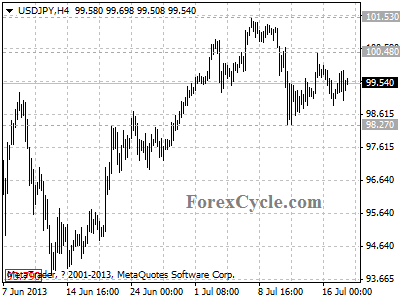
USDJPY moves sideways between 98.27 and 100.48

USDJPY moves sideways in a range between 98.27 and 100.48. Resistance is now at 100.48, as long as this level holds, the price action in the range could be treated as consolidation of the downtrend from 101.53, and another fall to 95.00 to complete the downward movement would likely be seen after consolidation. On the upside, a break above 100.48 will indicate that the uptrend from 93.79 has resumed, then the following upward movement could bring price to 110.00 area.

usdjpy

Provided by ForexCycle.com