Disadvantages of Trading Binary Options

Traders who enter the market of binary options are able to make a fair sum of money from it.  Like all trading in the financial market, the profits you show can as easily become losses.  There are inherent risks involved in the trading market and you should be aware of the disadvantages linked to trading before you invest your money into it.

Risk Level Settings

In binary options trading, traders do not have the same facilities as those in the foreign currency exchange market.  In the currency exchange market traders have the option to trade with a micro or mini accounts which limits their risk levels. In the binary options market, brokers have a minimum trading limit. This places you at more risk of losing your entire capital amount when you trade in this market.

For example, in forex you may be allowed to open a mini account with about $250.  This allows you to limit your risks accordingly.  In the binary market, you generally will not find brokers who give you the option to trade anything below $50, even if you hold an account of $250.  This means that if you are unlucky enough to experience five losing trades, your account will be wiped out.

Trade Adjustments

Traders in the commodities and foreign exchange markets have the option to close their trades when it hits a loss situation and commence with opening another potentially profitable one.  This is possible if the trader made a mistake when placing or exiting the first trade.  It is not possible to do this in the binary options market.

As soon as an options trade has been placed, the amount in the trade is reduced to show the commissions which have been levied by the broker. The payout available on the trade that is reversed is fixed and it cannot be used effectively to cover any losses from the incorrect trade.

Trading Tools

Many of the binary brokers do not offer their clients the necessary trading tools, such as technical analysis or charts.  This means that most traders are actually doing all their trades in the dark, particularly newcomers to the market.  The more experienced traders have means of obtaining these tools elsewhere, especially if they are already trading in other financial markets.

Trading Odds

The trading odds are taken into account for trades done in this market.  This causes the payouts for trades to be reduced by significant amounts if the odds for the success of a trade are extremely high.  Some traders have experienced instances where they have earned 80% payouts on trades, but these are only available when you have set an expiry date way into the future from the commencement date of your trade.  This puts you at more risk as the trades take on a more unpredictable nature.

This is an indication that binary options trading may be profitable, but it also carries distinct disadvantages that you should be aware of at all times.  Bearing these points in mind will give you the opportunity to trade effectively and show long-term profits.


What’s Next for the Euro?

By The Sizemore Letter

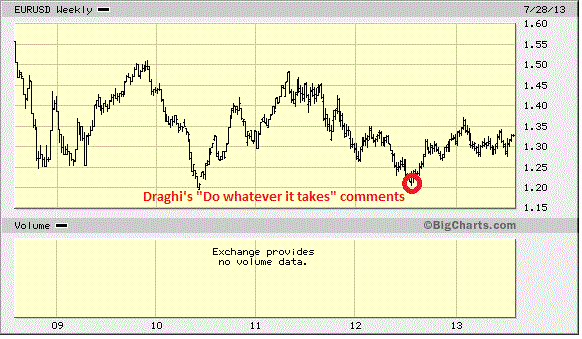
A year ago, European Central Bank chief Mario Draghi promised to “do whatever it takes” to save the euro.  The reality is that he hasn’t done much of anything.  He hasn’t had to.

The Outright Monetary Transactions bond-buying scheme—which was designed to calm the bond markets by buying potentially unlimited amounts of Eurozone periphery-country bonds in the secondary market—was put together after Draghi’s comments but has yet to be implemented.    Its mere existence—and Draghi’s perceived eagerness to use it—were enough to put the bond market as ease.

In the year that has passed, the Spanish 10-year bond yield—which has become a de facto measure of investor sentiment towards the Eurozone—has collapsed from 7.8% to 4.6% at time of writing.  It had fallen to as low as 4.0% in May, until Fed Chairman Ben Bernanke’s QE “tapering” comments caused a general world-wide hike in bond yields.

Italy’s bonds have fared even better.  Despite a political crisis brewing in Italy that could see former prime minister Silvio Berlusconi jailed and barred from office—and bring down Italy’s coalition government in the process—Italy bond market remains healthy, and the 10-year yield sits at a manageable 4.4%.

EURUSDred

As fears that the Eurozone would implode continued to build throughout late 2011 and the first half of 2012, the euro lost nearly 20% of its value relative to the dollar.  But as fears of a meltdown receded, the euro rallied, notching up gains of about 13% vs. the dollar before settling into a trading range that has lasted for most of 2013.

So, where does the euro go from here?

There are a lot of moving parts, but let’s look at some of the most critical drivers one by one.

1.All else equal, an improving Eurozone economy should  give investors faith that the worst is over for Europe.  Improving sentiment means new money flowing into Europe…which should point to a stronger euro.  On this count, we see what could be the first green shoots of recover.  European oil consumption is rising for the first time in two years, and the Spanish unemployment rate—though still shockingly high at 26.3%–ticked down for the first time in two years last quarter.

2. The “carry trade” is a major determinant of currency moves.  All else equal, higher-yielding currencies tend to rise relative to lower-yielding currencies.  Currency traders short the lower-yielding currency and buy the higher-yielding currency, hoping to profit both from the spread between the two interest rates and from appreciation in their long currency.  Right now, the Fed Funds rate is effectively zero (it’s official target is 0.00% – 0.25%).  Bernanke has indicated that rates will remain close to these levels for “the foreseeable future,” which is taken to mean through at least the end of 2014.

The ECB’s target rate is slightly higher, at 0.50%, but not high enough for the spread to be much of a factor.  At best, the euro is slightly less likely to be used as a funding currency than the dollar or yen.  Overall, I consider the carry trade to be neutral for the euro.

3. Lower inflation generally leads to an appreciating currency, all else equal.  And on this count, I see a mild positive for the euro.  Inflation in the Eurozone can in at 1.6% last month, and core inflation was just 1.2%.  In the U.S., the numbers were 1.8 and 1.6, respectively.  I expect inflation to remain tame in both the U.S. and Europe, though when inflation does eventually start to trend upward again I expect it to happen in the U.S. first.

4. A positive trade balance is good for a currency, all else equal, and this metric favors the euro.  While five years of economic malaise have brought the American current account deficit down to just 2.7% of GDP,  the Eurozone has a current account surplus of about 2% of GDP.

The numbers suggest that the euro should enjoy modest gains against the dollar over the next year, or at the very least continue to trade near the upper end of its recent trading range.  Of course, all of this could go out the window in an instant if Italy or Spain slide into political crisis again or if the bond markets revolt as they did early last year.

Trading “near the upper end of its recent trading range” is not a ringing endorsement of a long-euro trade.  But given the likelihood of relative stability in the euro, a strong case can be made for European equities.  Taken as a group, European stocks are substantially cheaper than their American counterparts and tend to pay higher dividends.

This article fist appeared on MarketWatch.

SUBSCRIBE to Sizemore Insights via e-mail today.

Join the Sizemore Investment Letter – Premium Edition

Toyota, Nissan, Honda, Mitsubishi Collaborate on EV Charging

Toyota, Nissan, Honda, Mitsubishi Collaborate on EV Charging (via Environment News Service)

TOKYO, Japan, August 5, 2013 (ENS) – Four of Japan’s largest automakers will work together to promote the installation of chargers for electric vehicles and build a charging network that offers greater convenience to drivers in Japan. Toyota, Nissan…

Continue reading “Toyota, Nissan, Honda, Mitsubishi Collaborate on EV Charging”

The 4 Major Currency Pairs in Forex and Factors that Influence the Change in Value

By admiralmarkets.in

A strategy to maximize profit in the foreign exchange industry or forex markets should begin with knowing which currency pairs you should be trading. First, you have to learn that the first currency in a pair is called the base currency and the second is known as the quoted currency. Next, you need to know of the factors that could affect their trading values. As not all factors are equally significant, it is wise to invest your money only based on those factors that can cause a fair impact on global markets.

The 4 Major Pairs

  1. British Pound Sterling (GPB) and US Dollar (USD)

The GBP/USD currency pair, sometimes referred to as Cable, indicates how many US dollars are necessary to buy a British pound. It follows that the British Pound Sterling is valued per US dollar.

  1. US Dollar (USD) and Swiss Franc (CHF)

USD/CHF is defined as the amount of quoted currency needed to purchase the base currency. Swissie, as others call the currency pair, is dependent on the different interest rates of the Swiss National Bank and the Federal Reserve (Fed).

  1. US Dollar (USD) and Japanese Yen (JPY)

Exchanging USD/JPY is alternatively termed as trading Gopher. It suggests how many Japanese Yens are necessary to buy a US dollar.

  1. Euro (EUR) and US Dollar (USD)

EUR/USD is the amount of US dollars required to purchase 1 euro. Exchanging European and American dollars is also known as exchanging Euro.

What Are the Top Factors that Affect the Value of Each Pair?

– Consumer and Producer Index

– Gross Domestic Product

– Retail Sales

– Durable Goods

– Payrolls

In forex, it is known that a currency pair’s value is often related to both countries’ economic growth (both countries that make up the currency pair). If a country’s growth is stable, that country’s currency usually is too and vice versa. Because of the interdependent nature of currency pair trading, it is important to keep each country’s economic situations in the forefront of analysis. In the event when there’s a major change or intervention in a country’s economic outlook, it will immensely affect its currency’s strength and performance.

All in all, currency movement is often thought to be based on the activity of the exchange of products and services or trade balance of a country. If the trade status is positive, it implies that the country’s goods and services are in high demand which can boost a currency while a negative balance means that the market is weak for that country and may be seen through a less demanded currency. Letting this be the basis of what to exchange and when to exchange can often be a factor that could get you more for your capital.

If you wish to be successful in the foreign exchange market, you should take the time to learn about the different currency pairs and their trading characteristics. Discussed above were only the major ones. Especially if you’re planning to be in the business for a long while, you should be familiar with ways you can maximize your profit by analyzing the economics, currency history and unique characteristics of the major country’s of the world. Other than the fact that you’ll be using them extensively, you’ll be getting the best value for your exchanges.

Content Source, www.admiralmarkets.in


Finding Bargains Down Under with Rick Rule

Source: Karen Roche of The Gold Report (8/5/13)

http://www.theaureport.com/pub/na/finding-bargains-down-under-with-rick-rule

Down markets are notoriously rife with good deals, and nowhere is this truer than down under in Australia. In this interview with The Gold Report, Rick Rule, founder of Sprott Global Resource Investments, explains how he takes advantage of Australia’s small, volatile market and investors’ ethnocentrism to find high-quality companies whose shares are, in his opinion, going for a steal.

The Gold Report: You recently said that this is your fourth cycle in a commodity sector in your 40-year career. Where are we in this current cycle, and how do you determine that?

Rick Rule: The bottom is usually marked by a two- or three-week period of capitulation selling followed by a standoff, where both the buyers and the sellers are exhausted. We haven’t seen that yet. We’ve had two or three different periods with a couple of days of capitulation selling but not a two-week period as we saw in 2000.

I wouldn’t be surprised if the downturn was four years, which suggests we have a year and a half to two years before we clean out the excesses. The junior sector is substantially overpopulated with companies, managers and agents. There needs to be a major cleansing over the next 18 months.

TGR: Will it be more cleansing or more mergers and acquisitions?

RR: Cleansing. Most of the walking dead juniors, the zombies, are a bunch of liabilities disguised as public companies. Their assets are liabilities; their financials are liabilities; mostly their managements are liabilities. It’s wonderful. Every 5 or 10 years you have this major reset in the junior sector. Although it’s extremely unpleasant to go through, it’s very healthy.

A lot of money can be made in deep and cataclysmic market downturns, not just on the rebounds. People do egregiously stupid things out of panic at the bottom. They engage in capitulation selling with no regard to value. In that situation, you don’t need to buy in anticipation of news, because good news comes out and there’s no market reaction to it. You can wait for the news to get out, analyze and digest it and then buy it. That’s as much fun as you can have in this business.

TGR: Is this basically buy and hold? Find the good values now and ride through this down market?

RR: That has always been my technique. For me a market is just a facility to buy and sell assets. Juniors rise in value when they answer a series of unanswered questions; that takes time. I never go into a speculation with a planned timeframe of fewer than 18 months. I’m 60 years old now—the idea that I have to hold a stock for 18 months doesn’t give me apoplexy. I’m on my 31st cycle like that.

When I interview a junior I ask, “What are you going to do with the money you’re asking me for? Tell me how this $3 million is going to make the company worth twice as much.” About 70% of the time the junior doesn’t have an answer. That makes my life really easy. I just get up and leave.

TGR: That’s a pretty quick litmus test.

RR: It’s as though somebody is going to drive from Los Angeles to San Francisco and starts driving east. Those juniors don’t have a plan. They don’t have a map. They plan to pay down payables and then slam a few holes in the ground, and if there’s good fishing nearby, they’ll take advantage of that.

TGR: You’ve been focusing on Australia, which you’ve said is cheaper than North America and has better quality.

RR: It’s true in both cases. This is a wonderful topic because I can get the Australians and the North Americans mad at me at the same time. Compared to the North American market, Australia’s is very small and much more volatile. When outside money floods into it, the valuations explode and the market goes higher faster. When outside money pours out, the market contracts ridiculously.

The Australian equities market becomes very ethnocentric in a bad market. Australians focus within Australia and tend to sell non-Australian things more than Australian things. We like to go into Australia in bad markets and find the companies that have done a good job overseas but have been sold because of this ethnocentricity. We try to put equity into existing Australian companies and be supportive shareholders.

The Australian exploration community is extremely competent overseas, particularly in Africa. They’re used to Archean terrain and harsh climate conditions.

TGR: Can you highlight some of the companies you’re investing in that have projects in Africa?

RR: We’re following 70 or 80 exploration plays in Africa. Most are too low grade to ultimately attract our attention, but seven or eight deposits will almost certainly become mines.

With the number of companies active in West Africa, there’s going to be a fairly active consolidation. In several situations, we think we’re going to get what we laughingly refer to as a “double bump”: the property will prove itself up, and then the company that has the property will be acquired, and then the newly acquired property will provide a growth profile to the acquirer. You get a bump for being acquired and a bump for the earnings visibility of the people who acquired it.

This theme worked well for us in the early 1990s and coming out of the 1998–2002 market. Our hope is that West African consolidation over the next five years will give us several double, triple or quadruple bumps.

TGR: Australia-based companies in the Sprott portfolio that are doing business in West Africa includePapillon Resources Inc. (PIR:ASX), Birimian Gold Ltd. (BGS:ASX) and Perseus Mining Ltd. (PRU:TSX; PRU:ASX). Are those the types of double bumps you’re looking for?

RR: There’s a range of discussions there. Papillion is a first-rate deposit. It’s done a superb exploration job, and its deposit has size and grade. It could get over the 5 million ounce (5 Moz) market; it certainly has 3 Moz–plus potential. It could make a lot of money for its ultimate acquirer.

Birimian and Hummingbird Resources Plc (HUM:AIM) are attractive in their own right. They’re not as large as Papillion, but the potential profitability of their deposits stands out. Perseus has had operational failings that have caused people to reflexively sell them out of disgust. They’re just too cheap—the market is valuing their exploration and development assets at zero, and we don’t think they’re worth zero. A year and a half ago I would have said that Perseus would be a consolidator, but now I expect it will be consolidated because it’s selling for 80% less than it did 18 or 19 months ago.

West Africa is superior exploration terrain. The amount of money being spent there and the quality of the people exploring there could yield the best exploration results of any region on the globe. It has a lot to give up, and we think it will give it up this cycle. Three or four players will come to dominate the sector. That theme has worked for us in Mexico, in Peru and in Nevada. We are confident it will work for us in West Africa.

TGR: Because Australia is such a small and volatile market, is it challenging for companies listed there to raise money? Do they start cross listing?

RR: They don’t necessarily need to cross list. Really good projects will finance themselves. We recently participated in a small financing of about $12 million for Hot Chili Ltd. (HCH:ASX), an unfortunately named copper explorer in Australia that’s mining in Chile. To raise that money, it talked to the top five people on its shareholders register. It didn’t have to go to the brokers or the institutions.

If Papillion needed to raise more money, I expect it wouldn’t have to engage the Australian broker/dealer community. It could engage the top 10 names on its shareholder register.

TGR: I noticed that all the major mining areas in Australia are in New South Wales or Western Australia. Is it critical that those locations are part of your investment strategy for Australia?

RR: We like the whole continent—the Gawler Craton and South Australia. We like New South Wales and Queensland, the eastern goldfields, a lot. We still like the iron oxide copper-gold exploration opportunities in Australia. We like the Archean terrain in eastern Australia and the western Australia goldfields. The Australian continent has an unusually generous mineral endowment.

Our existing participation is limited to the areas where people deliver good drill holes and the Australian valuations are insufficient. In other words, it’s limited to where we see bargains. We like what Peel Mining Ltd. (PEX:ASX) has been achieving up at Cobar. Cobar is familiar territory for us, which is an advantage.

TGR: Do you think Australia-based companies will get a bump up if Kevin Rudd comes back as prime minister and alleviates the mining tax?

RR: The mining industry has had a good 10 years in Australia and has unfortunately bragged about its good fortune so much that Australians think there’s more money to steal from miners. Similarly, wages are sticky. People competed aggressively for workers in Australia, and workers’ wages did extraordinarily well, tripling in many instances. It will take two to three years for those expectations to diminish—expectations on the part of the issuers, suppliers, workers, managements and government-sponsored entitlement beneficiaries.

TGR: There is a perception that Australia’s growth is linked to China’s due to the proximity of the two. If China’s growth is slowing, does that mean Australian mining could potentially slow?

RR: The perception that Australian growth is tied to Chinese growth isn’t really a perception—it’s reality. China has several problems, such as its weakness in the economies to which it exports, the misallocation of capital internally and the opacity of the lending and capital allocation system. China will have a rough 18 to 36 months working through the capital misallocation. The other part of me says that 5% or 6% growth from a huge base like that means a recovery is inevitable.

Looking at the incredible success of the Chinese diaspora globally, you see that as people become freer, they become richer. I think the process is underway and inescapable in China. You don’t put the toothpaste back in the tube. It’s just the way it works.

TGR: Australia has been getting a lot of press for rare earths, particularly heavy rare earths. Could it complement or overtake the Chinese production of rare earths?

RR: It has the ability to complement Chinese production. If the Chinese were to raise the rare earth prices, production would increase in South Africa, Congo, Australia and any place with Archean rocks and pegmatites. The Australians are leaders in Archean geology.

TGR: Australia is becoming a hotbed for oil and gas exploration. Are you looking at that sector?

RR: We certainly like Australian geology and Australian geologists, but we haven’t found the opportunity in conventional energy in Australia that we have found in mining there.

TGR: You are heading down to do a variety of presentations in the coming months. What message do you hope your audience takes away?

RR: I don’t know that I have an awful lot to say to conference attendees other than bear markets cause bull markets and that these are wonderful times if you’re an investor as opposed to a momentum player.

My message to the financial services industry and to the issuers in Australia is that while capital markets may be shut, Sprott is not. We are able to mobilize our own capital, and we have clients and partners with the same capabilities and outlook that we have.

TGR: Can a regular investor who is not accredited take advantage of this extreme opportunity for financing, as Sprott is doing through private placements and private equity, by buying into Sprott funds?

RR: That depends on the domicile of the investor and his or her personal circumstances. Of course, we would solicit discussions that would lead to people participating with us or owning us. Our U.S. brokerage operation offers resource investment services to investors with portfolios of all sizes.

TGR: So if investors are interested, what should they do?

RR: The easiest way is to go to our website, http://www.sprottglobal.com. I encourage readers to click on the Sprott’s Thoughts tab and take advantage of the free subscription. That’s a free daily publication that draws information analysis and paradigm from 26 of Sprott’s thought leaders. The best way to get to know us is to listen to us on a daily basis for free.

TGR: Rick, I appreciate your time.

Rick Rule, founder and chairman of Sprott Global Resource Investments Ltd., began his career in the securities business in 1974. He is a leading American retail broker specializing in mining, energy, water utilities, forest products and agriculture. His company has built a national reputation on taking advantage of global opportunities in the oil and gas, mining, alternative energy, agriculture, forestry and water industries.

Want to read more Gold Report interviews like this? Sign up for our free e-newsletter, and you’ll learn when new articles have been published. To see a list of recent interviews with industry analysts and commentators, visit our Streetwise Interviews page.

DISCLOSURE:

1) Karen Roche conducted this interview for The Gold Report and provides services to The Gold Reportas an employee. She or her family own shares of the following companies mentioned in this interview: None.

2) The following companies mentioned in the interview are sponsors of The Gold Report: None. Streetwise Reports does not accept stock in exchange for its services or as sponsorship payment.

3) Rick Rule: I or my family own shares of the following companies mentioned in this interview: Papillon Resources Inc., Peel Mining Ltd., Hot Chili Ltd., Perseus Mining Ltd., Hummingbird Resources Plc and Birimian Gold Ltd. I personally am or my family is paid by the following companies mentioned in this interview: None. My company has a financial relationship with the following companies mentioned in this interview: None. I was not paid by Streetwise Reports for participating in this interview. Comments and opinions expressed are my own comments and opinions. I had the opportunity to review the interview for accuracy as of the date of the interview and am responsible for the content of the interview.

4) Interviews are edited for clarity. Streetwise Reports does not make editorial comments or change experts’ statements without their consent.

5) The interview does not constitute investment advice. Each reader is encouraged to consult with his or her individual financial professional and any action a reader takes as a result of information presented here is his or her own responsibility. By opening this page, each reader accepts and agrees to Streetwise Reports’ terms of use and full legal disclaimer.

6) From time to time, Streetwise Reports LLC and its directors, officers, employees or members of their families, as well as persons interviewed for articles and interviews on the site, may have a long or short position in securities mentioned and may make purchases and/or sales of those securities in the open market or otherwise.

Streetwise – The Gold Report is Copyright © 2013 by Streetwise Reports LLC. All rights are reserved. Streetwise Reports LLC hereby grants an unrestricted license to use or disseminate this copyrighted material (i) only in whole (and always including this disclaimer), but (ii) never in part.

Streetwise Reports LLC does not guarantee the accuracy or thoroughness of the information reported.

Streetwise Reports LLC receives a fee from companies that are listed on the home page in the In This Issue section. Their sponsor pages may be considered advertising for the purposes of 18 U.S.C. 1734.

Participating companies provide the logos used in The Gold Report. These logos are trademarks and are the property of the individual companies.

101 Second St., Suite 110

Petaluma, CA 94952

Tel.: (707) 981-8999

Fax: (707) 981-8998

Email: [email protected]
 

Europe stock market mixed as Fed official hints tapering

By HY Markets Forex Blog

The European stock market were seen trading mixed on Tuesday  , as investors raise concerns and fears over the possible start of the reduction of the asset-purchasing program ,after a Federal Reserve official made a comment that the central bank would begin to scale back its measures soon.

The European Euro Stoxx 50 advanced 0.05% to 2,810.55 during the market open, while the German DAX declined 0.05% to 8,394.06 at the same time. The French CAC 40 edged up 0.19% higher at 4,057.86, while the UK’s FTSE 100 declined 0.07% to 6,615.00.

The Fed President for Dallas Richard Fisher stated on Monday that the Federal Open Market Committee (FOMC) is expected to begin tapering the asset-purchasing program by fall.

“With the unemployment rate having come down to 7.4%, I would say that the Committee is now closer to execution mode, pondering the right time to begin reducing its purchases, assuming there is no intervening reversal in economic momentum in coming months,” Fisher said.

Meanwhile in Germany, Factory orders have been expected to rebound in June, as the reading expected to increase by 0.01% on a monthly basis, while on a yearly basis orders are expected to pick up by 0.2%.

Italy’s industrial production for June is reported to have picked up by 0.3% on a monthly basis, after the 0.1% increase in the month of May. While on an annual basis, the output declined 2.1%, according to reports from the National Institute of Statistics.

Italy is expected to release its gross domestic product (GDP) report for the second quarter, as analysts have forecasted the Italian economy to have fallen by 2.2%, on an annual basis.

The post Europe stock market mixed as Fed official hints tapering appeared first on | HY Markets Official blog.

Article provided by HY Markets Forex Blog

WTI Fluctuates ahead of US stockpiles data

By HY Markets Forex Blog

The West Texas Intermediate was seen fluctuating during the early trading hours on Tuesday after declining for two days ahead of the expected government reports which may show that the world’s largest oil consumer drop in  crude and fuel stockpiles .  Investors continue to raise concerns over the ongoing conflict in Libya and Egypt.

WTI delivery for September were seen trading nearly flat , as it fell 0.20% to $106.35 a barrel , on the  New York’s Mercantile Exchange at the time of writing. While the September settlement for  Brent declined  , as it dropped 22 cents to $108.48 a barrel in London at the same time .

According to the median estimate survey taken by Bloomberg, the U.S gasoline stockpiles was most likely dropped by 500,000 barrels in the week ending August 2nd, while heating oil and diesel is expected to fall by 400,000 barrels.

On Monday, the US non-manufacturing data released, showed that the US economy was still growing and improving. The reports released gave oil a push, even though it did not manage to end the day with green.

The weekly American Petroleum Institute (API) report is expected to be released later today and may show a further fall in US oil and fuel supplies, after last week’s reported fall of 740,000 barrels.

The official report from the US Energy Information Administration (EIA) is expected to be released on Wednesday and likely to show a massive drop in US crude inventories, as analysts have forecasted a 1.1 million barrel drop to 363.5 million barrels last week.

The post WTI Fluctuates ahead of US stockpiles data appeared first on | HY Markets Official blog.

Article provided by HY Markets Forex Blog

Australia cuts rate by 25 bps, to adjust policy as needed

By www.CentralBankNews.info     Australia’s central bank cut its cash rate by a further 25 basis points to 2.50 percent, as widely expected, and said it “will continue to assess the outlook and adjust policy as needed to foster sustainable growth in demand and inflation outcomes consistent with the inflation target over time.”
    In recent months, the Reserve Bank of Australia (RBA) had said it had scope to adjust policy if required to support demand, but that statement was omitted today, signaling that it has now shifted to a more neutral policy stance.
    The RBA, which has cut rates by 50 basis points this year and by 225 points since October 2011, said the Australian dollar remains at a high level although it has depreciated by around 15 percent since early April.
    “It is possible that the exchange rate will depreciate further over time, which would help to foster a rebalancing of growth in the economy,” the RBA said, repeating last month’s statement and acknowledging the benefits of a lower exchange rate on the international competitiveness of its exports.
    The Australian dollar rose in response to the RBA’s outlook, to 0.898 cents to the U.S. dollar from 0.892 prior to the news. The A$ had been above parity to the U.S. dollar most of the time since early 2011 but then started to weaken in early May in response to the RBA’s first rate cut this year.
    Compared with the start of the year, it is down 13.5 percent against the U.S. dollar when it was trading around 1.038 to the US$.

    RBA Governor Glenn Stevens said Australia’s economy had been growing a bit below its trend over the past year and this “is expected to continue in the near term as the economy adjusts to lower levels of mining investment.”
    Unemployment has risen and inflation is consistent with the bank’s target. With growth in labour costs moderating, Stevens said inflation should continue in line with the bank’s target of 2-3 percent over the next one to two years, “even with the effects of the recent depreciation of the exchange rate.”
    Australia’s unemployment rate rose to 5.7 percent in June, continuing its climb this year and the highest rate since late 2009.
    In the second quarter of this year, the inflation rate eased to 2.4 percent from 2.5 percent in the first quarter, while the country’s Gross Domestic Product expanded by 0.6 percent in the first quarter from the previous quarter for annual growth of 2.5 percent, down from 3.1 percent in the previous two quarters.
   Easier monetary policy over the past 18 months has supported interest-sensitive spending and asset values and further effects can be expected over time, Stevens said, adding that the pace of borrowing had been relatively subdued but there were signs of increased finance demand by households.
    Looking abroad, Stevens said global growth is a bit below average this year but there were reasonable prospects of a pick-up next year.
    Financial conditions remain very accommodative, though he admitted that sovereign bond yields has risen “noticeably” from exceptionally low levels following the reassessment of the outlook for U.S. monetary policy. This had led to higher volatility in financial markets, particularly affecting a number of emerging economies, he added.

    www.CentralBankNews.info


Old Adage of “Don’t Fight the Fed” Stands, but Big-Cap Earnings Uninspiring

By Profit Confidential

Don’t Fight the FedEarnings season continues and the deluge of results is positively affecting the S&P 500, which is pushing new record highs.

Also continuing its positive upward trend are biotechnology stocks, which still harbor a lot of price momentum from institutional investors.

Ligand Pharmaceuticals Incorporated (LGND) has been very hot since the beginning of the year. The company produced a very strong first half as second-quarter revenues grew 67% to $9.6 million. Earnings were $6.1 million compared to a net loss of $2.5 million.

We’re now seeing a larger number of smaller companies report. They typically take longer to produce their quarterlies because they don’t have the large accounting departments multinational companies do.

Unscientifically, among the large number of companies I follow, I am noticing a more positive second quarter compared to blue chips. This is important, because smaller companies are much more tied to the domestic U.S. economy and, without question, they are stronger drivers of new employment. (See “This Benchmark Company Is Shocking the Street.”)

Mohawk Industries, Inc. (MHK), which is a flooring manufacturing company for residential and commercial customers, leaped higher after reporting second-quarter sales grew 35% to $2.0 million. Earnings per share jumped 61% to $1.84 after unusual charges. Company management said that it is increasingly confident regarding the U.S. market. The position jumped nine percent on the stock market after reporting.

ServiceSource International, Inc. (SREV) is a small company that’s in the business of providing cloud applications to grow recurring corporate revenues. This company announced a solid 13% increase in its second-quarter sales, reaching $67.7 million.

Adjusted earnings were flat, but ServiceSource’s revenue growth was good and the position moved higher on the equity market.

I’m still not a fan of buying many stocks with the main indices at their highs. My key index to watch remains the Dow Jones Transportation Average, and it has been pushing up strongly since toying with the recent low of 6,000 in June.

All in all, investor sentiment is still positive enough (with the Fed onside) for further stock market gains on good news. If a company beats consensus, even on only one financial metric, the Street will bid the shares.

This is very much a difficult market in which to make predictions and be a speculator. There’s momentum out there, but stocks are sitting on a hair trigger when it comes to anything from the Fed.

I view large-cap company earnings this season as uninspiring. Of course, some blue chips are doing better than others. The general trend of little to no top-line growth met with consensus earnings due to cost control remains.

But this isn’t a stock market that is going to come apart without some catalyst, and we know with a good degree of certainty that the Fed is onside (right or wrong) for quite some time. This is what pleases Wall Street, but it’s not necessarily what is good for the long run.

Company earnings expectations have been coming down lately and so have expectations for economic data. As I see it, this market is just one big hold right now. Dividend payments continue.

Article by profitconfidential.com