Why You Should Pay Attention to Yahoo! Inc.?

Article by Investazor.com

As I mention a few months ago, in an article about Yahoo! Inc. which you can find here, this company may worth you full attention. Since then, the CEO at Yahoo Marissa Mayer, continued with buying startups and made 9 new brand acquisitions. When will she stop? It looks like the main purpose of Marissa Mayer is to buy people instead of the ideas behind the startups. She is actually pointing towards the engineers of these little organizations which will be kept by 2 to 4 years contracts.

Apparently, the new CEO found the malfunction of the company and now is taking steps in order to fix it. Definitely there is an urgent need of creative engineers and Marissa Mayer is doing nothing but to provide the company with this medicine in return of billions of dollars. It will take time in order to see whether or not this strategy will work and indeed the company will produce new value and attract and retain new users. Revenue for the full year of 2013 is projected to be in the range of $108.0 million to $112.0 million without dropping far below the last year’s figures.

The post Why You Should Pay Attention to Yahoo! Inc.? appeared first on investazor.com.

The Australian Dollar, on the Right Path?

Article by Investazor.com

Today, the Australian dollar was one of the top movers as the Central Bank decided to cut again the interest rate, reducing it to an historical low, at 2.5%. Even if this decision makes the Aussie dollar depreciate and therefore makes it less attractive for the investors, it is intended to help the economy get back to growth. Lately, Australians have had a less encouraging economic climate as the country’s economy kept deteriorating. One of the major concerns is the growing unemployment rate which pointed to 5.7% as well as a serious breakdown of the mining industry.

As two of the core industries are the coal and iron ore, a slowdown of one of them is seriously affecting the overall picture. China is at fault for these negative news, as its economy is cooling. If previously they used to invest significant amounts of money in their infrastructure and building factories, increasing the demand of natural resources from Australia, now, the leaders of China would rather not to boost the economy for a while. The slowing down of the mining industry is expected to cause further damages like: increasing the unemployment rate, reducing the investments, affecting the exports and the price of these resources. On the medium term (until the final of 2013), the Australian economy will be closely watched before additional measures will be taken, as they are not excluded.

The post The Australian Dollar, on the Right Path? appeared first on investazor.com.

Rwanda sees lower inflation in H2, below 7.5% end-year

By www.CentralBankNews.info     Rwanda’s central bank expects headline inflation to continue to ease in the second half of this year and not exceed 7.5 percent by December.
    The National Bank of Rwanda (BNR) also said in its Monetary Policy and Financial Stability Statement that economic activity in the second quarter and prospects for the second half of this year indicate that the economy will continue to grow as planned.
   In the first quarter, Rwanda’s economy expanded by an annual 5.9 percent, in line with the 7.5 percent growth that is projected for the full year, but down from 8.8 percent in the fourth quarter.
    “Going forward, BNR will continue to closely monitor development in underlying factors of inflation so as to take appropriate measures to limit inflationary pressures, using the monetary policy instruments,” the central bank said.
    Rwanda’s inflation rate rose to 3.7 percent in June from 2.98 percent in May and compared with 5.9 percent in June 2012.
    In June the BNR cut its repo rate by 50 basis points to 7.0 percent, the first change since May 2012 when it raised its rate.

    www.CentralBankNews.info
   

What is going down in Yemen?

Article by Investazor.com

Yemen-New-Afghanistan-06.08.2013On Tuesday, the United States told its citizens in Yemen to immediately leave the country. The official announcement on the U.S. State Department was: “The Department urges U.S. Citizens to defer travel to Yemen and those U.S. Citizens currently living in Yemen to depart immediately.”

Moreover, it seems that all diplomatic missions of the United States across the Middle East are to be closed these days, following warnings of potential attacks coming from the zone. Important communication between bin Laden’s successors as al Qaeda leader, Ayman al-Zawahri, and the Yemen based wing were intercepted by U.S. Secret Services. It is strongly believed that the terrorist attacks are oriented against the U.S. because of some drone aircraft strikes that took place lately in Yemen.

Even if Yemen is one of the poorest Arab country, the intensity of the threat must not be neglected, and measures already appeared in the whole Western countries. Great Britain also took initiative by advised its citizens in Yemen to “leave now” and by “temporarily evacuating all its embassy staff” (according to Reuters).

Given this context, it is important to analyze how the events can influence, on a short term period, the economic relations between Yemen and the United States. As we mentioned before, Yemen is not a rich country, but it has established diplomatic relations with the U.S. in 1947. It is not competing with other Arabic countries from the economic point of view, nor from the natural resources aspect.

Its oil reserves and natural gas deposits, on which the Yemeni economy is totally dependent, are important in the agreements between the two countries. However, the oil reserves in Yemen are expected to be depleted by 2017, possibly bringing on economic collapse. At this point, we can now argue whether these reserves are enough for the U.S. to keeping wanting the country close in a diplomatic manner.

The rupture announced these days does not seem so big as to have effects on the oil’s price on the international market. However, the announcement made by the U.S. about the closure of all diplomatic relations across the Middle East could raise questions and produce signals in financial markets. It is a situation to be closely followed, because consequences on short periods of time can appear and can also give birth to long term consequences on the financial markets, as the politics are strongly related to economics all over the world.

Depending on the consequences of these threats, which may prove false or true, we will be able to provide the economical consequences, at least in terms of oil prices. Of course, the position of the U.S. to these events is not negligible, but we might take into account that a total and irreversible retreat of them from Yemen is not possible, because of strategic reasons on which the United States are counting.

The post What is going down in Yemen? appeared first on investazor.com.

EURUSD Dragged Towards 1.34 on QE Continuity

Article by Investazor.com

Last week the FOMC statement showed that Federal Reserve officials are still on the Quantitative Easing side. It seems that the QE is expected to be shut down only if the unemployment rate will drop to 6.5% or if the inflation rate will rise 0.5% above the medium target. Keeping in mind that the United States has an unemployment rate at 7.4% we can say that it might take a while until the end of the program or at least until the tapering. On Thursday the unemployment claims surprised with a value of 326K (under estimates) while on Friday the Non-Farm Payrolls came at 162K, with 20K lower than the forecast.

On Thursday the ECB maintained the interest rate a record low 0.50%. The main ideas from Draghi’s press conference were:  the ECB will continue to keep low interest rates and high liquidity, will keep the door open for new rate cuts and forecast a slow recovery at the end of the year and in 2014.

The latest economic releases for the Euro Area were mainly above expectations: a lower unemployment rate, higher PMIs for both manufacturing and services sectors and better industrial production for Germany.

eurusd-dragged-towards-1.34-06.07.2013

Chart: EURUSD, Weekly

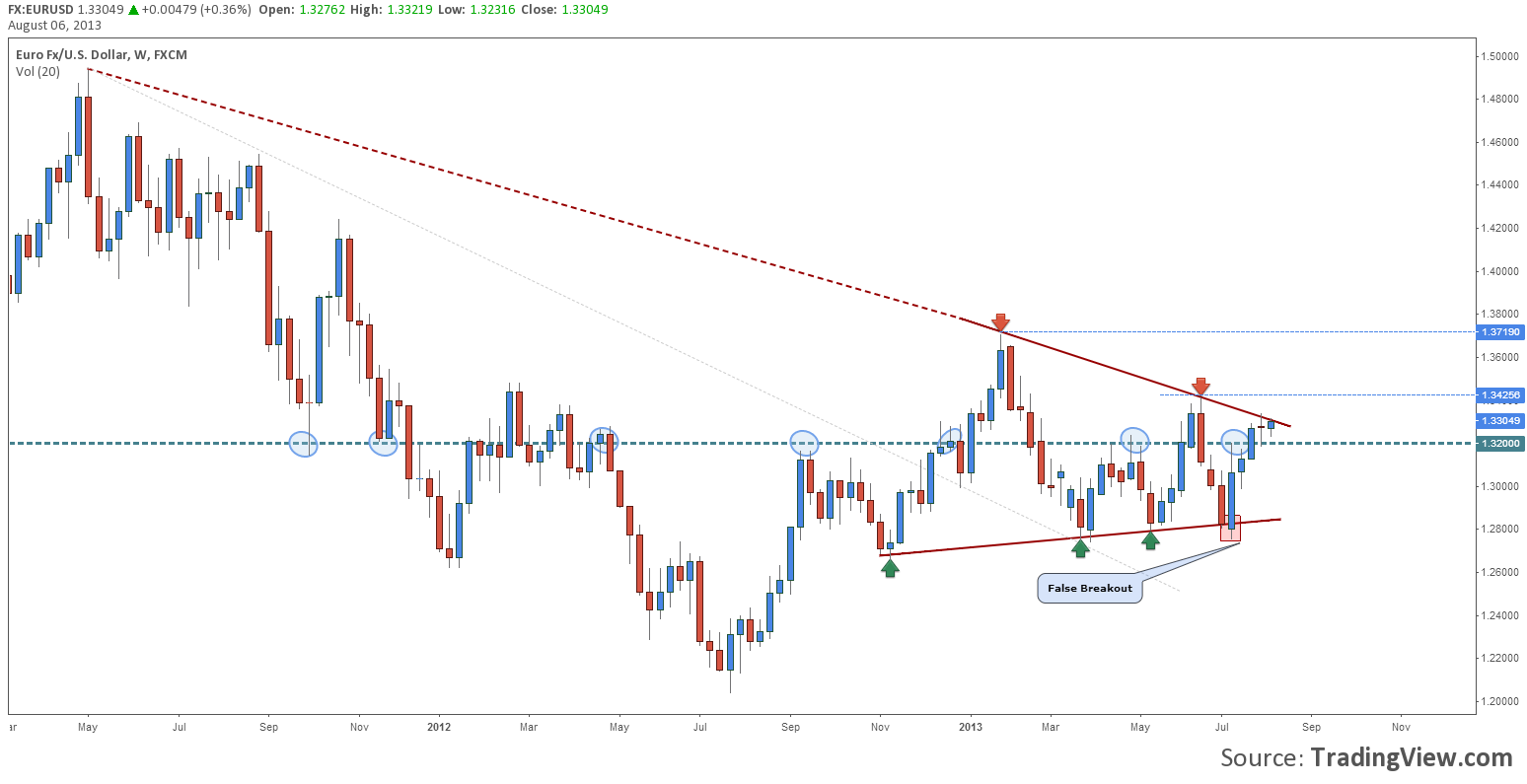
Looking at the EURUSD we can see that the pressure is now on the upper line of a symmetrical triangle. Last week was a Doji candle above 1.3200. If this week will close above 1.3345, last week’s high we might see a rally toward 1.34 or why not even higher to 1.35. A false breakout above 1.34 could signal a reversal.

The post EURUSD Dragged Towards 1.34 on QE Continuity appeared first on investazor.com.

Central Bank News Link List – Aug 6, 2013: India names Rajan central bank governor as rupee plunges

By www.CentralBankNews.info Here’s today’s Central Bank News’ link list, click through if you missed the previous link list. The list comprises news about central banks that is not covered by Central Bank News. The list is updated during the day with the latest developments so readers don’t miss any important news.

A Tale of Two Markets

By WallStreetDaily.com

Lately, China has been on something of a stealth mission in Detroit. And the timing is no coincidence. You see, there’s an ancient Chinese proverb that says, “A crisis is an opportunity for riding the dangerous wind.” And Chinese investors are taking this idea to heart.

Just look at Shanghai Auto (SAIC U.S.A.). Though it employs only 20 Detroit engineers, SAIC caught the collective car industry off-guard when it opened offices in Birmingham, a Detroit suburb.

For SAIC, the biggest selling point is a large, experienced pool of workers who were laid off during the past few years. The company’s goal is to sell Chinese-made cars on a mass scale in the United States.

SAIC isn’t alone on its mission, either…

Chang’an U.S. Research and Development Center Inc. set up a research and development shop in Michigan in 2011.

Wanxiang Group Corp. bought battery maker A123 Systems Inc.

Another 50,000 Chinese professionals work at GM (GM) and Ford (F), and live in the metropolitan area. The Ford Chinese Association, with its 650 white-collar workers, has become one of Ford’s largest employee groups.

And the Detroit Chinese Business Association’s flourishing membership includes 100 local, Chinese-owned businesses – mostly auto-related.

Who can blame the Chinese for moving in at this point? There are certainly some “dangerous winds” in Detroit these days.

I prefer, however, to put my faith (and investment dollars) into a couple of tried-and-true American staples.

The Chinese may be making moves in Detroit. But that doesn’t mean that American automakers are stuck in idle.

On the contrary… GM and Ford posted their highest sales levels since June 2008 and June 2006, respectively. And best of all, they plan to do some invading of their own… in China.

Buy Red, White and Blue

That’s right. Just as the Chinese are moving in on Detroit, U.S. automakers are doing exactly the opposite. And it’s no surprise why…

Ford estimates that by 2020, one billion Chinese will be able to afford to buy cars. And the company has positioned itself perfectly. Today, Ford is the fastest-growing international car company in China, with a 12.6% hike in the first five months of 2013. The company is shooting for additional market share growth of 6% by 2015 and 7.5% by 2020.

Two new SUVs – the Kuga and Explorer – are driving Ford’s rapid growth. And the company plans to invest $4.9 billion through 2015 to double production capacity to approximately 1.6 million vehicles.

Ultimately, Ford plans to one day generate 40% of its global sales from China.

In comparison, GM saw 11% year-over-year growth, and it remains the biggest foreign auto company in terms of total vehicle sales. It sold around 1.3 million in the first five months of 2013, and the company expects to sell as many as three million vehicles before the year’s end.

GM is also planning an $11-billion investment to build four new plants, including a $1.3-billion Cadillac plant that just broke ground in China. In the meantime, the company will launch at least 10 new or revamped models every year through 2016, aiming for a production capacity of five million cars.

My take? I’d say investors in Ford and GM will fare much better than their Chinese counterparts chasing profits in downtown Detroit.

Ahead of the tape,

Karen Canella

The post A Tale of Two Markets appeared first on  | Wall Street Daily.

Article By WallStreetDaily.com

Original Article: A Tale of Two Markets

Are markets looking at the recovery through rose-colored glasses?

Are markets looking at the recovery through rose-colored glasses? (via Futures Magazine)

Overview and Observation; The rhetoric from Washington continues to run rampant. The “glee” associated with the monthly jobs “created” figure ignoring the weekly first time unemployment number is a painfully obvious “exclusion” of reality. The jobs…

Continue reading “Are markets looking at the recovery through rose-colored glasses?”

The S&P 500 is Plagued with Divergences

By J.W. Jones, OptionsTradngSignals.com

By now everyone has a prediction about where the S&P 500 Index (SPX) is going to be heading in the future. Most of the sell side and their ilk are all rolling out the green bullish carpet and predicting that a major bull run is right around the corner.

I am a contrarian investor by nature and I tend to sell when others are buying.  When retail investors are buying and the professional sell-side is quickly reducing their long equity exposure I get increasingly more bearish. A recent report from Zerohedge shown here, was accompanied by the charts shown below courtesy of Bank of America Merrill Lynch:

Chart


As can clearly be seen above, retail investors have been strong buyers as of late while the institutional or professional investors have been sellers. The institutions almost always are net sellers near market tops while the retail crowd buys up the professionals’ inventory at high prices only to sell lower. The sheep are coming to the slaughter, they just do not know it yet.

Using a more quantitative methodology, it becomes apparent that the probabilities are not favorable for a significant bull run to emerge as we edge toward the back half of the year.

As a professional options trader, I focus on probabilities to help guide my investment thesis. One of my favorite underlying indexes to monitor for probability based moves is the S&P 500 Index (SPX).

The probabilities shown below were derived from statistical calculations based on the SPX option chain that will expire December 31, 2013.

Chart1(1)


As can clearly be seen above, the probability that price will close at the end of this year above 1,750 on the S&P 500 Index (SPX) as of Monday’s close was roughly 35%. Based on current implied volatility, there is a nearly 72% chance that we will trade up to 1,750 before the year is over at some point in time.

Again, referring to the SPX option chain shown above, there is a 20% probability      that price will close above 1,800 on the last day of the year with only a 41% chance that price will reach 1,800 at any point from now until December 31, 2013.

The numbers go down considerably when we begin to look at the probabilities of reaching 1,850 on the SPX. The probability that price closes above 1,850 at the end of this calendar year is less than 10%. However, the probability we touch the 1,850 price level at some point later this year is around 20% based on current implied volatility levels.

The SPX option chain is telling us that this monstrous move is unlikely to be able to hold through the end of the year based on current implied volatility levels. Clearly these levels will adapt to market conditions as they change every day during normal market hours, but at this point they are not providing a strong indication of significantly higher prices before year end.

By now readers are probably expecting me to make a prediction about where prices are going to be headed. I do not do specific predictions because I do not feel that I know anymore than anyone else regarding future price action. However, I do believe we are closing in a topping pattern that is likely to give us a strong correction sometime before year end.

In addition to the professional versus retail investor charts and probability based determinations for future price expectations, there are two more indicators which are showing a divergence or a non-confirmation signal from the price action in the S&P 500 Index (SPX).

As shown below, the money flow indicator has failed to break to new highs as of today (Monday) which thus far fails to confirm the recent move to new highs in the S&P 500 Index (SPX).

Chart2(1)


The chart above does not require much explanation. The last time we witnessed a major divergence was in the autumn of 2011 which culminated into a nasty correction.

In addition to the divergence shown above in the Money Flow Indicator, there is also a strong non-confirmation signal in the NYSE Advance / Decline Index which is shown below.

Chart3(1)


I want to be clear to readers that I am not trying to imply that prices are going to collapse tomorrow or even in August or September. I am simply trying to point out through the use of a variety of analytical methodologies that buying here is a rather risky endeavor.

While more upside may await in the short-term, the intermediate term could be plagued by strong selling pressure. One thing is certain, I expect the selling pressure to come out of nowhere and the retail crowd will most certainly be left holding the bag. Risk is high.

If you are looking for a mathematical and statistical based approach to trading, OptionsTradingSignals.com may be a perfect fit to improve your option trading results. Give OptionsTradngSignals.com a try today!


This material should not be considered investment advice. J.W. Jones is not a registered investment advisor. Under no circumstances should any content from this article or the OptionsTradingSignals.com website be used or interpreted as a recommendation to buy or sell any type of security or commodity contract. This material is not a solicitation for a trading approach to financial markets. Any investment decisions must in all cases be made by the reader or by his or her registered investment advisor. This information is for educational purposes only.


Majors Continue Consolidating

EURUSD – The EURUSD Unable to Increase Above Figure 33

eurusd06.08.2013

Yesterday, the EURUSD tried to attack the 33rd figure once again, without success again. The pair was being sold there, as a result it returned to the support near 1.3264, broke it through and dropped to 1.3232. After that, there was a pullback to 1.3271, today the euro is under pressure again, and it is decreasing again. Thus, it is not necessary to talk about any changes in the overall picture of the pair so far, since it continues consolidating. The inability to get up and consolidate above the 1.3306 inspires the pair bears, but they still fail to develop an upward movement. However, this situation cannot last forever, and the range may broken though at any moment with the following strong movement in a particular direction. There on the daily, weekly and monthly timeframes the Parabolic SAR is below the price chart, suggesting, but not guaranteeing, the prices’ breakdown in the upward direction. In this case, it will be possible, even with a high degree of probability, to predict the development of a high-grade upward trend towards the February highs at 1.3710. But the loss of the support near 1.3200-1.3176 will confirm that the downward trend in the EURUSD remains in force.


GBPUSD – The GBPUSD Increase to 1.5377

gbpusd06.08.2013

The GBPUSD managed to continue increasing – it was contributed by the passing of the resistance around 1.5300. This has increased the upward momentum, and as a result we have saw the pair’s increase to the next resistance at 1.5377. After that, there was a pullback to 1.5320, but the remained in demand at this level, and returned to yesterday’s highs. The sentiment is still positive, but the bulls still have to overcome the resistance proximity of 1.5377 – 1.5434, the level of 1.5434 is the July high. Until it has been passed, risks of the renewed downward momentum remain, and the loss of the 52nd figure would significantly worsen the pair’s further outlook.


USDCHF – The USDCHF Continues Consolidating

usdchf06.08.2013

The dollar has increased above the 0.9307 resistance being paired Swiss franc, but having reached 0.9332, it came under pressure and dropped to 0.9268. In the Asian session, the decrease continued, and as a result the dollar nearly reached the level of 0.9245, but soon it began to recover and has already approached the 93rd figure. The USDCHF decrease was largely caused by the decrease in the EURCHF. However, there has been no changes to the overall picture of the pair, since the USDCHF continues consolidating in the formed range. Its breakthrough would mean the development of a strong trend towards the breakdown, thus trading in the range should be terated with an extreme caution and it is also wise to mind false breakouts when placing stops.


USDJPY – Current Support in the USDJPY Hinders the Downward Correction Development

usdjpy06.08.2013

Having failed to stay above the 99th figure, the USDJPY continued decreasing until it reached the level of 98.28 with the following rebound to 98.77, but the sales interest due to the growth has remained, and the pair dropped to 97.83, where the dollar was bought, recovered and increased to 98.51. It is possible that at this stage, the dollar is forming the basis near the 98th figure, and in this case, we should expect the uptrend resumption. This would be confirmed by the pair’s growth and the ability to consolidate above the 99th figure. The loss of the support near 97.60 would mean that the downward correction is still valid.

provided by IAFT