Look How Well It Goes Tesla Motors Inc!

Article by Investazor.com

Tesla is the company that shined lately by its impressive results. Not only that its sales increased more than expected, but also the profit on shares beat expectations by far. On 15th of July Tesla was included in the Nasdaq 100, index that tracks the largest companies on the exchange. The place is freed by Oracle which is moving to the New York Stock Exchange.

Thursday, August 08, 2013, the Nasdaq 100 Index rose, driven by gains in the technology sectors. In this respect, Tesla Motors Inc brought its substantial contribution as it jumped 14.2% to $153.46 a day.

Early this year, Tesla started to glitter by proudly announcing the first quarter on profit in its ten years’ history. Immediately in May, its shares passed the 100$ threshold, now being established around the value of $150/share. Reporting the financial situation on 7th of August 2013, the second quarter was closed with $746 million in cash. The main sales market is the United States while is considerably expanding in Europe and Asia where it intends to open more service locations. China and Japan are expected to be major importers of these cars. After the steep increase registered until now, things are expected to calm down a little bit but by the end of each quarter of this year, profits are expected to be reported, sustaining the increasing trend that Tesla is following lately.

Chart:

The post Look How Well It Goes Tesla Motors Inc! appeared first on investazor.com.

New Pipeline Safety Technology Could Bring Industry and Environment Together

By OilPrice.com

The 2010 Kalamazoo spill and the 2013 Exxon leak in Arkansas are the most glaring incidents, but these are just the big leaks that are found right away and reported.

Most leaks are found eventually—but there is money to be saved and damage to be avoided by catching them at the smallest rupture. Right now, we rely on pigs in the pipeline to do this.

It’s called “pigging”. Pigs are inspection gauges that can perform various maintenance operations on a pipeline—from inspection to cleaning—without stopping the pipeline flow. The first “pigs” were used strictly for cleaning and they got their name from the squealing noise they emitted while travelling through the pipeline. The current generation of “smart pigs” can detect corrosion in the pipeline and are thus relied on for leak detection.

The Kalamazoo and Arkansas leaks were massive and caused by complete pipeline ruptures. These are rare incidents that account for less than 10% of leaks. But the small leaks–those that traditional pipeline detection systems don’t catch—account for more than 90% of US pipeline leaks.

According to a recent report from the U.S. Department of Transportation Pipeline and Hazardous Materials Safety Administration ( PHMSA) , the majority of leaks are smaller but can persist for months or even years, and those that are even reported are generally done so by people who have stumbled upon them by accident.

The fact remains that current systems and technologies only detect 50% of leaks. We need new solutions if we want to avoid another Arkansas, or another Kalamazoo.

The “pigs” are the darlings of the regulators, who force operators who have had any problems to “pig” their lines at a massive cost of over $1,000 per kilometer.

Certainly, today’s smart pigs are well advanced beyond their ancestors—the balls of rags wrapped with barbwire, but they have their shortcomings.

Pigs can spot general corrosion and identify potential areas of concern, but they cannot detect pinholes in pipelines as their spatial resolution is poor and they can only see corrosion that is 1-2 inches in size. This is significant because a small leak of 10 barrels per day from a liquid pipeline operated at a standard pressure would come from a hole much smaller than this.

They are also only deployable over tens of kilometers, not the thousands needed.

Even if all the pipelines in the world were “pigged” every year, a pipeline operator would still not be able to ensure that small leaks are being detected.

For the larger pipes, the industry relies on SCADA. SCADA is a basic infrastructure monitoring system, where remote hubs relay data back to central monitoring point, using fiber-optic cable or other communications equipment. But it is not enough on its own.

A case in point is this: A SCADA system was working normally on the Pegasus pipeline in Arkansas at the time of the rupture and helped Exxon verify that an accident had occurred. Pegasus did not, however, have a Computational Pipeline Monitoring (CPM) program in place on the pipe. It wasn’t enough. Indeed, in late 2012, PHMSA issued a 17-page warning to Exxon about its insufficient pipeline leak detection.

Then we have Keystone XL, which is always in the spotlight, most recently when TransCanada said it would opt out of new pipeline leak detection systems and stick with traditional methods that many believe are not good enough.

The 90%+ of leaks are small and more of a concern for the miles and miles of aging pipelines that crisscross the US, while new pipelines, like Keystone XL will benefit from new technologies during their construction, such as better pipe metallurgy and better welding. This will mean less chance of leaks, but not a zero chance. The fact is that the leak detection systems that will be used by new pipelines like Keystone XL (assuming it gets the green light), are not really any better than the current fare.

There is new technology floating around out there—but it’s new and relatively untested in the marketplace.
RealSens remote-sensing pipeline detection technology aims to pick up where SCADA and the pigs leave off, detecting leaks over an entire pipeline network.
According to Banica, Synodon’s CEO, realSens can actually save companies money by detecting the leaks sooner and faster and thus reducing the amount of spilled product and the environmental damage. But it’s a new technology that was only introduced into the market 12 months ago.

Still, some of the big operators remain skeptical of new pipeline leak detection systems, as their cost-saving applications are as yet unproven.

“The first hurdle is that operators might not be aware that it exists and what the capabilities are. The second hurdle is that they have a hard time believing it works and have to see proof through customer field tests, which are currently ongoing,” Banica told Oilprice.com.

But the issue of pipeline leak detection will increasingly be on everyone’s radar following the Quebec train disaster that killed at least 38 people, and counting. No pipeline failure has ever come close to this level of human carnage. This will help shape the transport debate.
What the Quebec tragedy demonstrates, says Banica, is that pipelines are a far better option than rail. “Whereas pipelines do not kill as many people as rail (or even truck transport, as more drivers die due to accidents), they do pose a bigger environmental risk than rail due to larger potential leaks and releases.”

Source: http://oilprice.com/Energy/Energy-General/No-More-Spills-New-Technology-Could-Transform-the-Pipeline-Sector.html

By. James Stafford of Oilprice.com


Is the Euro Overbought or the Uptrend is Sustained?

Article by Investazor.com

Well, let us see what are the premises? For the Euro Area we had some very good PMIs published this month, lower unemployment rate and Germany surprised with better than forecast industrial production, trade balance, factory orders and unemployment change. Furthermore the ECB maintained the interest rate unchanged and Mario Draghi recovered his optimism in what concerns the economic evolution of Europe.

Adding to this the fact that Federal Reserve is still maintaining the Quantitative Easing program unmodified we can say that there are reasons for the investors to go long Euro and short the US dollar.

In every FOMC statement and speech of Ben Bernanke it is said that Fed will continue the QE as long as it is necessarily for the labor market to get back on its feet. On the other hand the officials that gave statements to the press believe that the tapering of the program will start in September, because the unemployment rate started to drop and there are signs of economic recovery.

Bering this in mind, we believe that this uptrend will continue until the Fed will announce the tapering of the stimulus and the date that will end the QE.

So to answer our question: The Euro is not yet overbought, but the uptrend might not be sustained for a long period of time.

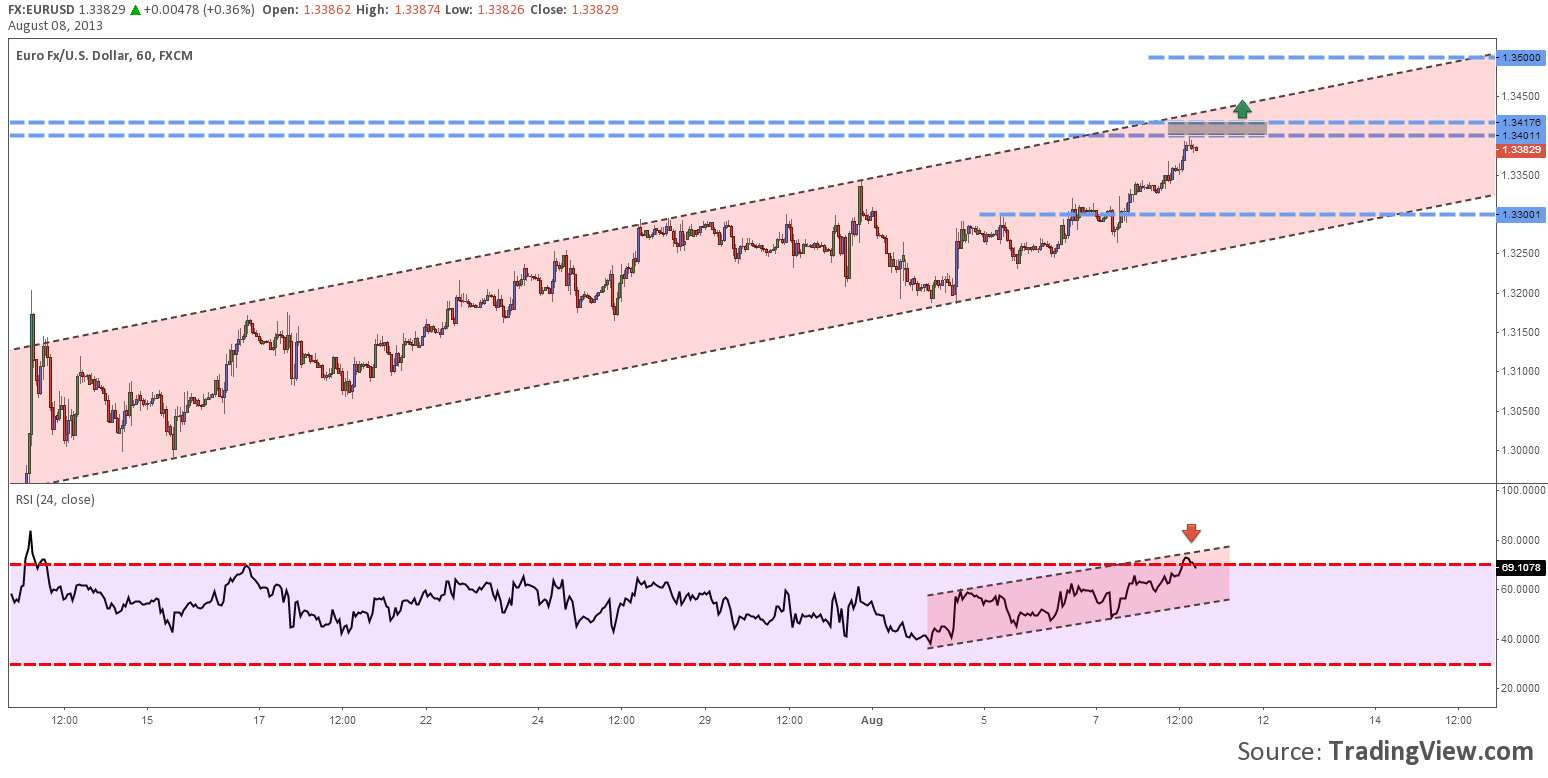
From the technical point of view, the price has breached above Friday’s top and almost hit 1.3400. For today it seems that the rally stopped. If this week will close above 1.3350 it will confirm the break above the higher line of the symmetrical triangle (you can find more details reading EURUSD Dragged Towards 1.34 on QE Continuity) and also signal that the uptrend could continue for the rest of August.  A false breakout could bring the price back to 1.33 or even lower.

eurusd-overbought-or-trend-is-sustained-08.08.2013

Chart: EURUSD, H1

Looking at the lower time frame we can see that the price has reached a resistance area at 1.3400/20. Adding the overbought in the RSI evolution we should open the eyes for a pullback. A break above the resistance could open the way for another rally that is targeting 1.3500.

The post Is the Euro Overbought or the Uptrend is Sustained? appeared first on investazor.com.

Elon Musk, Deepak Ahuja, & Tesla Motors Offer Up Another Surprise: A Q2 Profit

Elon Musk, Deepak Ahuja, & Tesla Motors Offer Up Another Surprise: A Q2 Profit (via Clean Technica)

Originally posted on RenewEconomy.By Sophie Vorrath Elon Musk has pulled another rabbit out of a hat, surprising the market yet again on Wednesday with better-than-expected earnings from his electric car maker, Tesla Motors, which pushed up the company…

Continue reading “Elon Musk, Deepak Ahuja, & Tesla Motors Offer Up Another Surprise: A Q2 Profit”

Serbia holds rate, still sees inflation in range in October

By www.CentralBankNews.info     Serbia’s central bank maintained its key policy rate at 11.0 percent due to the higher risk aversion of international investors and added that weakening inflationary pressures are expected to accelerate and inflation should return to the bank’s target range by October.
    The National Bank of Serbia (NBS), which last cut its rate in June, said the decline in inflation is largely due to its policy measures and a stabilisation in the food market. Last month the NBS also said it expected inflation to return to its range of 4.5 percent, plus/minus 1.56 percentage points, by October.
    Serbia’s inflation rate has been stable at 9.8 percent in June and May, down from a recent high of 12.9 percent in October last year.
    The central bank said the economic recovery that started late last year is continuing and it estimates that Serbia’s economy will expand by 2 percent this year, led by rising exports. In the first quarter of this year the economy grew by 1.9 percent from the fourth for annual growth of 0.7 percent, down from 2.1 percent in the fourth quarter.

    But the bank’s executive board also said additional fiscal consolidation and structural reforms will help ease inflationary pressures further, along with external imbalances, boosting the risk perception by international investors of Serbia.
    “However, given the higher risk aversion of international investors, prompted by the Fed’s hint at downsizing of the quantitative easing programme, which spurred a rise in the country’s risk premium and depreciation pressures in Serbia and almost all countries in the region, the Executive Board decided to keep the policy rate unchanged,” the NBS said.
    Like other emerging markets, Serbia was hit by an outflow of funds in May and the central bank intervened in foreign exchange markets several times in June to slow the decline in the dinar. Since the beginning of July, the dinar has stabilized and is down only 1.5 percent agains the euro this year, trading around 113.98 to the euro today.

    www.CentralBankNews.info

Korea holds rate, inflation stable but up in coming months

By www.CentralBankNews.info     South Korea’s central bank kept its base rate steady at 2.50 percent, as widely expected, saying inflation is forecast to remain stable due to a continued negative output gap in the economy but prices  will rise in coming months due to imbalances in agricultural supply from bad weather and an unfavourable comparison with very low rates last year.
    The Bank of Korea (BOK), which cut its rate in May, repeated last month’s statement that Korea’s economy was continuing to expand, albeit moderately, mainly led by exports. The economy’s negative output gap will remain for a considerable time but gradually narrow.
    Korea’s economy recorded its strongest quarterly growth rate in nine quarters in the second quarter of this year, with Gross Domestic Product up by 1.1 percent from the first, for annual growth of 2.3 percent, up from 1.5 percent in the previous quarter. Fresh government spending helped boost growth.
    Last month the BOK raised its 2013 growth forecast to 2.8 percent, with GDP rising 3.7 percent in the second half of the year from 1.9 percent in the first half.
    South Korea’s inflation rate rose to 1.4 percent in July from 1.0 percent in June due to higher prices of agricultural and livestock products, as well as petroleum products. The BOK targets inflation of 2.5-3.5 percent and has forecast average inflation this year of 1.7 percent.

    The BOK took note of a stabilisation of its financial markets due to “the easing of concerns about an earlier-than-expected tapering off of US quantitative easing,” adding that long-term market interest rates have risen modestly, primarily on improved global economic indicators.
    “Stock prices, after having risen due to a shift to net inflows of foreigners’ stock investment funds, have fallen back somewhat recently and the Korean won has appreciated,” the BOK said.
    Following the launch of the Bank of Japan’s new phase of monetary easing in April, the won rose over 10 percent against the Japanese yen by mid-May, raising alarm bells in Korea over the competitiveness of its exporters. The won then eased through mid-June and has risen again.
    Compared with the start of the year, the won is up 5.7 percent against the yen, quoted at 11.55 per yen today.
    Repeating last month’s statement, the BOK also said it still expects the global economy to sustain its modest recovery, helped primarily by the U.S. economy, but the downside risks comprise changes in global financial market conditions related to the exit strategy of the Federal Reserve, a slowdown in Chinese economic growth and uncertainties surrounding the implementation of fiscal consolidation in major countries.
   
    www.CentralBankNews.info

Dan Hrushewsky: Low-Cost, High-Margin Mining in West Africa

Source: Brian Sylvester of The Gold Report (8/7/13)

http://www.theaureport.com/pub/na/dan-hrushewsky-low-cost-high-margin-mining-in-west-africa

There are two things investors pay too much attention to, according to Jennings Capital Analyst Dan Hrushewsky: metals prices and grade. Why? Extremes of low and high prices never last, and high grades don’t always make for economic deposits. In this interview with The Gold Report, Hrushewsky explains the metrics behind his all-in cash cost estimates and profiles West African projects that are connecting the dots.

The Gold Report: So far in 2013 we’ve seen steep one-day drops in metals prices and seemingly endless redemptions in gold exchange-traded funds (ETFs). Is the gold bear here to stay?

Dan Hrushewsky: Interesting question. Bear markets never last forever, and being roughly two years into this one, I would say that we are closer to the end than the beginning. It is difficult to say how far away we are from the end. We may be seeing the first signs of life. You’ll recall that during the last bear market in the late 1990s and early 2000s, signs of life began showing up in the diamond sector first. It’s almost as if investors still had a bad taste in their mouth from the traditional gold and base metal sectors, but started feeling comfortable with risk again and started with a different “flavor.” We could even be starting to see this in the uranium sector with some of the juniors active in the Athabasca Basin, such as Fission Uranium Corp. (FCU:TSX.V) and Alpha Minerals Inc. (AMW:TSX.V).

TGR: Some mines aren’t profitable at $1,250 per ounce ($1,250/oz) gold. How are companies adjusting to the new price environment for gold?

DH: Recently, a lot of companies have been talking about: 1) cutting head office costs, 2) renegotiating contracts with third parties, 3) deferring capital expenditures (capex), cutting down on sustaining capex and deferring pre-stripping, 4) re-sequencing mine plans to access higher grades first, 5) re-calculating resource estimates at higher cut-off grades, reserve estimates at lower gold prices and 6) suspending, closing or divesting of higher-cost assets.

TGR: Are mines operating in West African countries typically higher margin?

DH: Not necessarily. It depends on the specific characteristics of the deposit, such as grade and metallurgy, and access to infrastructure, such as cheaper hydroelectric power and water. High-margin projects are strong performers in high or low gold price environments and, as an example, two such higher-margin projects are those of Roxgold Inc. (ROG:TSX.V) and True Gold Mining Inc. (TGM:TSX.V). Roxgold’s 55 Zone deposit is one of the highest-grade deposits in the world with 0.6 million ounces (0.6 Moz) Measured and Indicated at 19.3 grams per ton (19.3 g/t) at a 5 g/t cut-off grade, and has very high gravity recovery. This translates into a low cost, high-margin project with lower financing risk. True Gold’s Karma project is one of the highest-grade heap-leach projects in the world with above-average recoveries and leach kinetics. This also translates into a low capex with therefore lower financing risk.

TGR: What are your near-term and medium-term prices for gold?

DH: I use a near-term gold price similar to current levels, and a long-term gold price of $1,500/oz. I don’t use lower gold prices in the long term, because if you use steady state lower prices you have to assume a lower-cost structure, and you have to assume different mine plans and different resource/reserve estimates (i.e., smaller reserves/resources at higher grades). Making these detailed adjustments in my model just doesn’t make sense.

TGR: As an analyst, are you shifting your focus to low-cost producers? Perhaps some equities operating high-grade underground mines or open-pit, heap-leach operations?

DH: Most of the companies I cover are attractive depending on your gold price outlook. For example, if you think gold prices are going up, you would want to own companies with high leverage to gold price increases, such as Volta Resources Inc. (VTR:TSX), Orezone Gold Corporation (ORE:TSX) or Perseus Mining Ltd. (PRU:TSX; PRU:ASX). If you think low gold prices will be around for a long time, then the companies with high-margin projects, such as Roxgold and True Gold, are optimal investments. Of course these latter companies do well in rising gold price environments as well.

TGR: Many of the companies you cover are either exploring or mining in West Africa. In a risk-averse market, why would an investor in junior equities want to be vested in West Africa versus somewhere like Mexico?

DH: Because I find that the West African companies are a better value than companies elsewhere due to perceived higher risk. I say “perceived” because I believe that many places in, for example, Mexico, are higher risk than many West African countries. I also believe that the potential for exploration success in West Africa is better due to relatively less previous mining activity there.

TGR: How does an investor mitigate risk while getting exposure to African plays?

DH: By choosing companies with good management and higher-quality, advanced projects in good jurisdictions. This includes True Gold, Roxgold, Orezone, Perseus, Asanko Gold Inc. (AKG:TSX; AKG:NYSE.MKT) and PMI Gold Corp. (PMV:TSX.V; PVM:ASX; PN3N:FSE).

TGR: In June you visited Teranga Gold Corp.’s (TGZ:TSX; TGZ:ASX) Sabodala gold mine in Senegal and the adjoining Oromin Explorations Ltd. (OLE:TSX; OLEPF:OTCBB). Teranga has made a takeover bid for Oromin. How would investors be served by a successful bid?

DH: Because mining is often an isolated and standalone activity, combinations rarely add much synergy. However, the Teranga/Oromin combination would be very synergistic and should significantly benefit the shareholders of both companies. Teranga has a mill, but only two years of effective mine life, whereas Oromin has 43.5% of an open-pittable reserve of 1.4 Moz grading 2.05 g/t, which Teranga could definitely use—a match made in heaven. Teranga would also need to work out an arrangement with the other 56.5% joint venture owners to either buy them out or process their share of the deposit, in order to gain access to the whole deposit.

TGR: How is Teranga controlling costs at Sabodala?

DH: Teranga is stockpiling lower-grade ore (we estimate the stockpile grade is approximately 0.67 g/t on average) and is only processing the remaining higher-grade material for now.

Also, Teranga is implementing margin enhancement initiatives such as optimizing mine plans, re-sequencing pits, renegotiating contractor and supplier contracts, reviewing employment levels and reducing discretionary expenditures such as delaying new mine development, reducing sustaining capital, reducing exploration expenditure and reducing corporate costs. Teranga also has an excellent preventive maintenance program at the Sabodala mine, which has resulted in significant cost savings.

TGR: Let’s circle back to Roxgold. SEMAFO Inc. (SMF:TSX; SMF:OMX) owns the Mana project in Burkina Faso, which is next to Roxgold’s Yaramoko concession. SEMAFO just sold its stake in the Samira Hill gold mine in Niger. Is SEMAFO likely to use that cash as part of a bid for Roxgold?

DH: It is rumored that SEMAFO made an informal offer for Roxgold a year or so ago, before both companies underwent management changes. The offer was purportedly too low, and both companies agreed to discontinue discussions. Since then, SEMAFO has discovered the Siou deposit, 15 kilometers east of its Mana mill. The Siou deposit has an in-pit Inferred resource of 1 Moz grading 4.62 g/t. I suspect that the urgency of finding additional higher-grade feed for its Mana mill has abated with the discovery of this very interesting deposit.

TGR: Some of the companies you cover in West Africa have published some noteworthy drill results in 2013. Could you tell us about some of the more newsworthy ones?

DH: True Gold has had some interesting results from in-pit metallurgical drilling for its definitive feasibility study. Grades of these holes have been significantly higher than the resource grade. The diameter of these holes was some 40% greater, and may indicate that when True Gold goes to mine the deposit, grades will be higher than the estimated resource grade. Also, I am excited by some of the extensional drilling outside of the current pit outlines, which speaks to the excellent potential to expand the resources of the project.

Sarama Resources Ltd. (SWA:TSX.V), a company that I do not cover but follow closely, has had excellent results—36 meters (36m) of 6.48 g/t—at its MM prospect, which is shaping up to be a potential 2+ g/t resource. Perseus has had interesting results from its regional program in Cote D’Ivoire, including 28m of 8.1 g/t at its Mbengue prospect. PMI, in its quest to find a viable oxide starter pit for its Obotan gold project in Ghana, has discovered a potential candidate—its aptly named Dynamite Hill prospect, where one hole returned 10m of 13.65 g/t. Roxgold has had excellent high-grade results throughout its resource delineation drilling at Zone 55, and recent results such as 14.2 m of 12.7 g/t were no exception.

TGR: Are there any other gold stories in West Africa that you would like to share with our readers?

DH: Some other interesting stories to watch are Orbis Gold Ltd. (OBS:ASX), Papillon Resources Inc. (PIR:ASX), Aureus Mining Inc. (AUE:TSX; AUE:LSE), African Gold Group Inc. (AGG:TSX.V) and Ampella Mining Ltd. (AMX:ASX).

TGR: To conclude, when it comes to junior gold equities, what is one thing investors put too much emphasis on and one thing investors pay too little attention to?

DH: Investors put too much emphasis on the gold price (extremes of low and high gold prices never last), and grade (high grade on its own does not always make a deposit). They put too little emphasis on grade continuity (isolated high-grade drill results are meaningless—you need the dots to connect and a lot of them) and costs (you don’t put grade in the bank; you put the difference between the gold price and the cost). Also, you need to take into account all the costs. My all-in cash costs include the direct mining and milling costs, royalties, sustaining capital, taxes, corporate general and administrative expenses and financed amortized capex.

TGR: Thank you for your time.

Dan Hrushewsky, senior precious metals analyst at Jennings Capital, is primarily responsible for African precious metals. He joined Jennings Capital in Toronto from NCP Northland Capital Partners, and was previously senior vice president, corporate development with Chalice Gold Mines and vice president of High River Gold. Hrushewsky has nearly 30 years of experience within the mining sector. Hrushewsky holds an engineering degree from the University of Toronto, a Master of Business Administration degree from McMaster University and is a CFA.

Want to read more Gold Report interviews like this? Sign up for our free e-newsletter, and you’ll learn when new articles have been published. To see a list of recent interviews with industry analysts and commentators, visit our Streetwise Interviews page.

DISCLOSURE:

1) Brian Sylvester conducted this interview for The Gold Report and provides services to The Gold Report as an independent contractor. He or his family own shares of the following companies mentioned in this interview: None.

2) The following companies mentioned in the interview are sponsors of The Gold Report or The Energy Report: Fission Uranium Corp., Roxgold Inc., Teranga Gold Corp. and True Gold Mining Inc. Streetwise Reports does not accept stock in exchange for its services or as sponsorship payment.

3) Dan Hrushewsky: I or my family own shares of the following companies mentioned in this interview: None. I personally am or my family is paid by the following companies mentioned in this interview: None. My company has participated in a syndicate that has raised money for Roxgold Inc. I was not paid by Streetwise Reports for participating in this interview. Comments and opinions expressed are my own comments and opinions. I had the opportunity to review the interview for accuracy as of the date of the interview and am responsible for the content of the interview.

4) Interviews are edited for clarity. Streetwise Reports does not make editorial comments or change experts’ statements without their consent.

5) The interview does not constitute investment advice. Each reader is encouraged to consult with his or her individual financial professional and any action a reader takes as a result of information presented here is his or her own responsibility. By opening this page, each reader accepts and agrees to Streetwise Reports’ terms of use and full legal disclaimer.

6) From time to time, Streetwise Reports LLC and its directors, officers, employees or members of their families, as well as persons interviewed for articles and interviews on the site, may have a long or short position in securities mentioned and may make purchases and/or sales of those securities in the open market or otherwise.

Streetwise – The Gold Report is Copyright © 2013 by Streetwise Reports LLC. All rights are reserved. Streetwise Reports LLC hereby grants an unrestricted license to use or disseminate this copyrighted material (i) only in whole (and always including this disclaimer), but (ii) never in part.

Streetwise Reports LLC does not guarantee the accuracy or thoroughness of the information reported.

Streetwise Reports LLC receives a fee from companies that are listed on the home page in the In This Issue section. Their sponsor pages may be considered advertising for the purposes of 18 U.S.C. 1734.

Participating companies provide the logos used in The Gold Report. These logos are trademarks and are the property of the individual companies.

101 Second St., Suite 110

Petaluma, CA 94952

Tel.: (707) 981-8999

Fax: (707) 981-8998

Email: [email protected]
 

Japan maintains policy, sees rising inflation expectations

By www.CentralBankNews.info  The Bank of Japan (BOJ) maintained its monetary policy stance but voiced growing confidence about rising inflation, raised the prospect that it may finally be able to escape 15 years of deflation and almost 20 years of economic malaise.
    The BOJ, which embarked on a new phase aggressive phase of monetary easing in April, said “inflation expectations appear to be rising on the whole” and “the year-on-year rate of increase in the CPI is likely to rise gradually,” bolstered by the fact that Japan’s headline inflation rate rose by 0.2 percent in June, the first month with higher prices in 13 months.
    Last month the BOJ said that some indicators had suggested a rise in inflation expectations and that the year-on-year rate of change in the CPI is likely to turn positive.
    Apart from its growing confidence about inflation, the statement from the BOJ’s policy board largely mirrored last month’s statement, including the description of the economy as “starting to recover moderately.”

    Japan’s Gross Domestic Product expanded by 1.0 percent in the first quarter from the previous quarter for annual growth of 0.4 percent, the same pace as in the fourth quarter.
    The BOJ maintained its guidelines for money market operations, saying it aims to increase the monetary base – cash and banks’ deposits at the BOJ –  at an annual pace of about 60-7- trillion yen, purchase Japanese government bonds so the amount rises by an annual pace of about 50 trillion along with purchases of exchange-traded funds, Japanese real estate trusts, commercial paper and corporate bonds.
    In July Japan’s monetary base expanded 38 percent to 170.39 trillion yen from July 2012, reflecting the continued injections of liquidity into the financial system, with banks’ current account balances at the BOJ rising by 116 percent to 82.35 trillion and reserve balances up by 112.5 percent to 73.43 trillion.
    Japan’s monetary base is forecast to rise to 200 trillion this year and to 270 trillion at the end of next year.
    The BOJ also maintained its description of the global economy, saying overseas economies are gradually heading toward a pick-up, “although a lackluster performance is partly seen, and exports have been picking up.
    Japan’s economy is still expected to “recover moderately on the back of the resilience in domestic demand and the pick-up in overseas economies,” but there are still a high degree of uncertainty, including Europe’s debt problem, developments in emerging and commodity-exporting economies and the pace of recovery in the U.S. economy.
    “The Bank will continue with quantitative and qualitative easing, aiming to achieve the price stability target of 2 percent, as long as it is necessary for maintaining that target in a stable manner,” the BOJ said, repeating its statement from recent months.
    A majority of BOJ board members forecast last month that Japan’s GDP would expand by 2.8 percent in the current fiscal year, which began on May 1, slow to 1.3 percent in fiscal 2014 and then grow by 1.5 percent in fiscal 2015.
    Consumer price inflation is forecast at 0.6 percent this fiscal year, rising to 1.3 percent in 2014 – excluding the effects of the planned consumption tax hikes – and then 1.9 percent in fiscal 2015.
    Japan’s prime minister Shinzo Abe plans to decide later this year whether to proceed as planned with a two-stage increase in sales tax. BOJ Governor Haruhiko Kuroda has called on the government to raise the sales tax because it is needed to strengthen public finances, warning that government bond yields could rise – undermining the BOJ’s actions – if investors believe that the BOJ is merely financing government spending.

    www.CentralBankNews.info

Tech Billionaire Jeff Bezos Grossly Overpaid for This Dinosaur

By WallStreetDaily.com

On the heels of eating crow over my prediction that the newspaper industry – and, in turn, newspaper stocks – were doomed, Amazon’s (AMZN) Founder and digital billionaire, Jeff Bezos, had to go and pile on the punishment.

In a “thunderbolt” announcement, as one analyst put it, Bezos pledged $250 million to buy the struggling Washington Post from The Washington Post Co. (WPO).

The money came out of his personal bank account, no less.

Now everyone is led to believe that there are gobs of value to be unlocked in other newspapers like The New York Times (NYT) and The Financial Times, owned by Pearson Plc (PSO).

Case in point: A story at The Daily Beast proclaims that the deal “could help the sales of other major newspapers, such as the Los Angeles Times or the Chicago Tribune, and if the Sulzbergers ever decide to sell The New York Times, they could get around $5 billion.”

Total nonsense. Here’s why…

Backwards Math

Last year, the Newspaper Publishing Division for The Washington Post Co. generated about $14.5 million in earnings before interest, taxes, depreciation and amortization (EBITDA).

In a buyout, particularly for a struggling business, one would expect a multiple of maybe four or five times EBITDA. Yet Bezos’ purchase price clocks in at a whopping 17 times EBITDA.

He paid a “multiple over the multiple,” as Ken Doctor, Media Analyst at Outsell, told Bloomberg. Indeed!

Even Standard & Poor’s only thought a deal would be worth $80 million, at best.

The only winner in the deal appears to be (go figure) Warren Buffett. At least on paper. On the heels of Bezos’ purchase, shares of The Washington Post Co. hit a five-year high, sending the value of Buffett’s stake to over $1 billion. (Even at 82 years old, he’s still got the Midas touch.)

Now, if we apply the same multiple that Bezos paid to, say, The New York Times, it should be worth double its current price. That’s bad math, given the company’s continued struggles and the stiff industry headwinds.

You see, there’s just no money to be made by selling newspapers. All the money is supposed to come from selling advertising in newspapers.

But guess what? That’s not happening, either.

Last year, total newspaper advertising revenue fell to its lowest annual level since 1950, when the Newspaper Association of America started tracking the data.

As Dr. Mark Perry of the American Enterprise Institute puts it, “The dramatic decline in newspaper ad revenues has to be one of the most significant Schumpeterian gales of creative destruction in the last decade.”


And according to Perry (and I agree), the trend isn’t “even close to being over.” But unless it reverses course, there’s no way The New York Times would ever be worth anything close to $4 or $5 billion. Let alone its current valuation of $1.8 billion.

Nevertheless, don’t expect The Grey Lady to ever run this headline: “Jeff Bezos (Grossly) Overpaid.”

Although the paper’s controlling family swears they’re not interested in selling, there’s no doubt that they secretly hope they can fetch such a sweet premium when they do finally decide to cash out. Hence the softball headlines we’re seeing about the deal – like “Bezos Brings Promise of Innovation to Washington Post.”

He better! Otherwise, he might find himself unloading the flagship newspaper to some other chump in a fire sale down the road.

Kind of like The New York Times just did with The Boston Globe. After paying $1.1 billion in 1993, the company unloaded it to Red Sox owner, John Henry, for $70 million – or about $0.07 on the dollar. (Ouch!)

Ironically, a report in The Washington Post best depicts the formidable obstacle Bezos needs to overcome if his gamble is going to pay off:

“But for much of the past decade, The Post has been unable to escape the financial turmoil that has engulfed newspapers and other ‘legacy’ media organizations. The rise of the internet and the epochal change from print to digital technology have created a massive wave of competition for traditional news companies, scattering readers and advertisers across a radically altered news and information landscape and triggering mergers, bankruptcies and consolidation among the owners of print and broadcasting properties.”

I guess when you’re a billionaire there’s nothing better to do with a couple hundred million than to bet it against all odds. (Must be nice.)

For us lowly retail investors, though, it makes no sense whatsoever to take such outsized risks.

Bottom line: Investing in newspaper stocks based on the prospect of a takeover is an investment strategy fraught with risk. Don’t take it.

Ahead of the tape,

Louis Basenese

The post Tech Billionaire Jeff Bezos Grossly Overpaid for This Dinosaur appeared first on  | Wall Street Daily.

Article By WallStreetDaily.com

Original Article: Tech Billionaire Jeff Bezos Grossly Overpaid for This Dinosaur