Corn – Wheat Spread might Narrow Down

Article by Investazor.com

Last year, there were a lot of speculations that because of the dry weather from the United States the wheat and corn production would be very low so the prices rallied to record highs. In the autumn of 2012 even though the yields were pretty low, the production was not that bad and prices started to fall. This year the production is estimated to be high. Each time prices go up; producers are planting more and more so the offer rises fast, while the demand remains constant. In these cases the price tends to fall.

corn-wheat-spread-narrowing-resize-15.10.2013

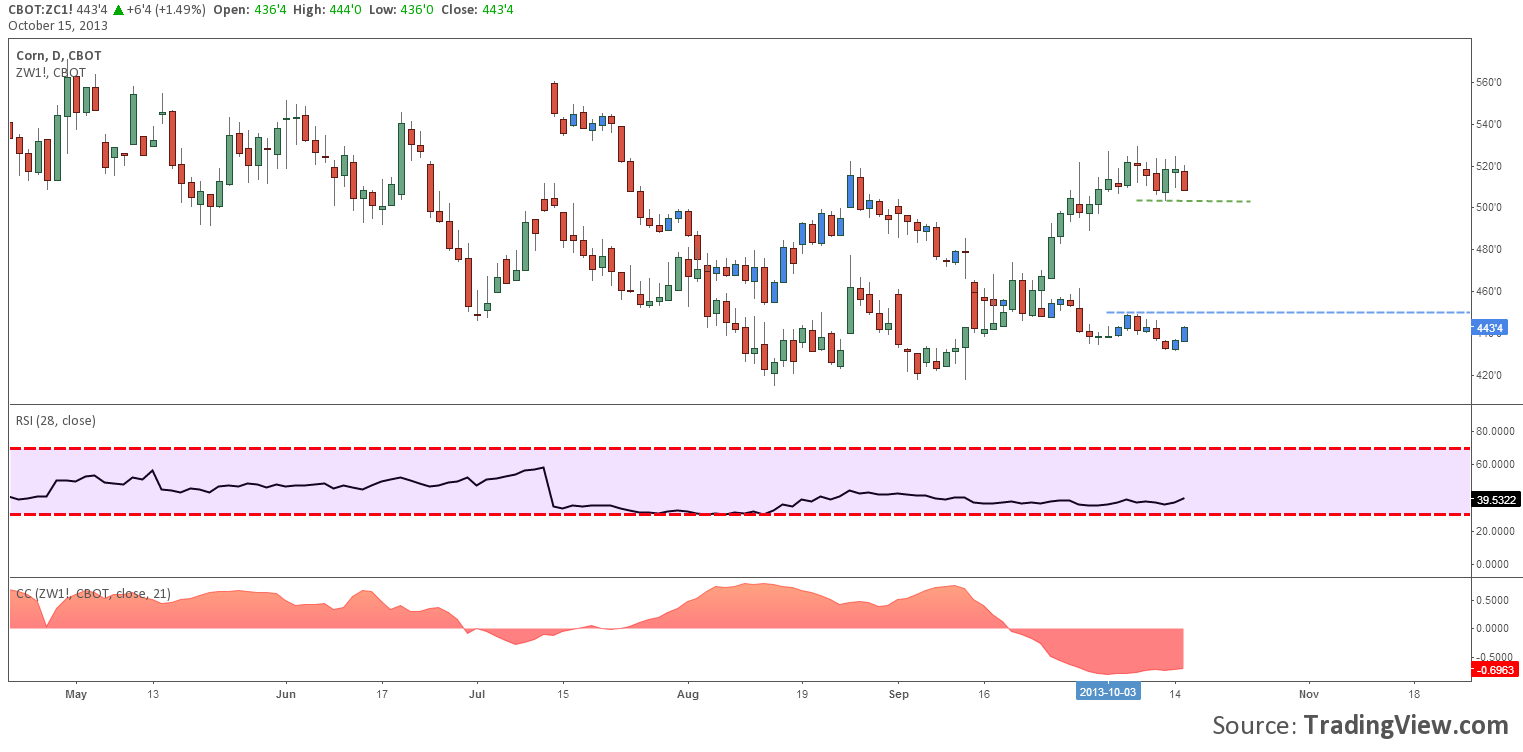
Chart: Corn/Wheat, Daily

The prices of corn and wheat tend to be pretty good direct correlated. But sometimes happens that the prices start to diverge. This happened again during the past weeks. From 20th of September, the price of corn continued its down trend, while the price of wheat started a rally.

At this point there are some technical signals that corn might come back above 4.5$ per bushel. The positive divergence on the RSI signals a possible reversal, but from my experience, I would say that it will be helpful to see a close above 450.00 level. For the 2.4$ spread, between these two grains, to be covered we could also expect a fall of the price of wheat. The technical signal for this would be a drop under the local support, given by the latest low.

Using this divergence, traders could use a spread system and enter long corn and short wheat. A pretty used hedging system that could get a pretty interesting return for its user.

The post Corn – Wheat Spread might Narrow Down appeared first on investazor.com.

The U.S Dollar Trading Mixed

The U.S Dollar Trading Mixed

The EURUSD Fails to Increase Above 1.3600

There is no any progress in the EURUSD. The pair has tested the support near 1.3545, and then increased to 1.3597 and returned to the support. Thus, the situation remains the same. The growth and ability to be consolidated above 1.3600 will confirm upside potential retention. The loss of the support near 1.3475 will open a way to the 34th figure. If U.S. lawmakers reach a compromise, this may trigger a sharp decline in the pair’s rate, but, most likely, it can be considered as a possibility to buy EURUSD.

eurusd15.10.2013


The GBPUSD Trading Below 1.6000

The situation both in the GBPUSD and the EURUSD is the same. Yesterday the pair was traded within a narrow range, being unable to develop a movement in one or another direction. The inability to rise and be consolidated above 1.6000 may trigger a more deep descending correction, the support near the level of 1.5766 may become its aim. In order to reach it the bears should break through the area of supports at 1.5915—1.5873. A growth above 1.6018 will give the GBPUSD bulls confidence.

gbpusd15.10.2013


The USDCHF Sticks in the 91st Figure

The USDCHF still cannot break away from the 91st figure. The pair has decreased for a while to 0.9063, but demand for it preserves and it has increased to 0.9114. Thus, the range has been formed here, its breakout is necessary for the further movement direction marking. Consequently, a rise above 0.9130 will open a way to 0.9200—0.9220 and a fall above 0.9063 will give the bears a possibility to test the 90th figure.

usdchf15.10.2013


Demand For The USDJPY Remains

Despite the current situation in the U.S. the USDJPY continues to be in demand. Yesterday, after a decline to 98.09 the pair was purchased, which allowed the rate to increase to 98.70. Here buying interest dried up and the dollar fell back to 98.39. As in other currency pairs, the situation in the USDJPY had not changed yesterday. We can only point to remained sustainable demand for the dollar, but if the pair fails to overcome the 99th figure, the bears may return to the market, and then the support around 97.00-96.56. would be at risk again.

usdjpy15.10.2013


provided by IAFT


My Two Favorite Railroad Stocks

By Mitchell Clark, B.Comm. For Profit Confidential

Reporting this week is one of my favorite benchmark stocks.

Union Pacific Corporation (UNP) is a railroad company that’s been a solid wealth creator in what’s been a resurgence of old economy stocks over the last several years.

Wall Street earnings estimates have been going down for Union Pacific for this year and next. But the company is still expected to post double-digit earnings growth in 2013 on an estimated five-percent gain in total revenues.

The company provided the marketplace with its own third-quarter guidance. Earnings per share are expected to be between $2.45 and $2.48, compared to $2.19 in the third quarter of 2012. Operating revenues are expected to grow 4.0%–4.5%.

The worry for Union Pacific and other railroad companies is coal. Low natural gas prices are eating away at the demand for coal, which is one of the principal commodities that railroads haul. Warmer weather is also an issue, and the company cited flooding in Colorado as also having an impact on coal shipments.

Union Pacific is typically conservative with its forecasting. But it’s possible that the recent winning streak for many railroad stocks could be coming to an end. Shipments of oil are way up, but not enough to offset declines in coal.

The Association of American Railroads said that 11 of the 20 commodity categories it tracks saw a year-over-year increase in carload in the month of September. The biggest carload gains were in crushed stone, sand, and gravel, followed by automobiles and parts, then petroleum and petroleum products.

September declines were in coal, down 2.7% to 12,894 carloads, and grain, down 11.3% to 8,627 carloads for all members combined.

This time four years ago, Union Pacific was trading around $60.00 a share. Now, it’s approximately $160.00 a share, with a 2.1% dividend yield and a forward price-to-earnings (P/E) ratio of around 14.5.

On the stock market, Union Pacific has always been a solid performer. The company’s share price was cut in half during the financial crisis, but like so many other old economy names, it recovered strongly to its current level.

Even with a slow quarter based on lower shipments of coal, I wouldn’t necessarily take profits in a company like Union Pacific. The railroad business is still a good one to be in, and revenues are expected to accelerate from their current rate in 2014. (See “Strong Cash Flow, Increasing Dividends Make This Old Economy Stock Attractive.”)

Union Pacific has outperformed on the stock market compared to a number of other railroad stocks, especially over the last six months.

This is a market where I believe existing winners will continue to be the place for investors to be. Union Pacific falls into this category, and its peer group leadership should continue.

I’m not a big fan of buying this market, and equity investors definitely don’t need to rush into any positions. According to history, the right railroad company would be a worthy addition to a long-term equity portfolio. Canadian National Railway Company (CNI) and Union Pacific are my two favorites within the sector.


The McDonald’s Alternative for Small-Cap Investors

By George Leong, B.Comm. For Profit Confidential

The restaurant and fast food sectors are fickle, and can easily turn lower without much warning. It happened to burrito maker Chipotle Mexican Grill, Inc. (NYSE/CMG), when it got hammered between April and early October 2012 following its reports of soft results. The stock has since staged a steady rally back to above its previous high in April 2012.

The same thing happened to Ruby Tuesday, Inc. (NYSE/RT), with the stock plummeting around 16% after reporting a soft first quarter that saw continued declines in many key metrics, according to my stock analysis. Ruby could and will likely rally, based on my stock analysis, but it’s not in the same ballpark as Chipotle, so be careful if you are looking to trade the stock.

If you are looking for small-cap growth in the restaurant and fast food sector, you may want to consider a play like Denny’s Corporation (NASDAQ/DENN), as my stock analysis suggests. This sit-in family diner is known for its “Grand Slam” breakfast. The company has superior valuation to its peers, as my stock analysis indicates.

Take a look at the table below, and see how Denny’s sizes up:

Forward P/E

P/S

PEG

Denny’s

16.69X

1.17

1.15

Roby Tuesday

33.16X

0.36

13.98

McDonald’s

15.41X

3.35

2.0

Burger King

20.77X

4.56

1.49

The big Wall Street shops focus on the big-name stocks that bring up tons of investment banking and advisory fees. While McDonalds Corporation (NYSE/MCD) is clearly the “Best of Breed” in the restaurant and fast food group, my stock analysis suggests smaller companies, like Denny’s, offer an alternative for investors along with better upside potential; albeit, they’re also riskier. (Read “McDonald’s Proving Position as ‘Best of Breed’ in the Fast Food Sector.”)

Denny’s has gone up 22.47% over the past 52 weeks and has easily outperformed the S&P 500 advance of 15.60% and the 0.99% advance by McDonald’s.

Chart courtesy of www.StockCharts.com

Over the past few years, Denny’s has restructured its operations by selling many of its stores to franchisors, which allows it to simply collect franchise fees while cutting overall costs to operate the stores, based on my stock analysis. According to the company’s web site, about 90% of the 1,690 restaurants in its global network are currently franchised. By changing to this model, Denny’s is now a stronger company, as my stock analysis indicates.

For those interested in Denny’s, my stock analysis suggests that the upside is there, but it could take a while, as the company continues to streamline its operations, play with its menu, and make it more visible to both the investment community and restaurant goers.

My stock analysis indicates that while McDonald’s is the top player in the restaurant and fast foods sector, for some added potential, a restaurant like Denny’s is geared toward the investor looking for a small-cap idea.


“Disappointing” Gold Hits 3-Month Low as US Finds Short-Term Fix for Debt Limit

London Gold Market Report
from Adrian Ash
BullionVault
Tues 16 Oct 09:15 EST

The WHOLESALE price of gold bounced hard Tuesday lunchtime in London from new 3-month lows, regaining $10 per ounce from $1255 as European shares rose but US stock futures pointed lower.

 The Dollar rose, knocking almost 1 cent off the Euro, as word spread of an apparent US political deal to avert technical default at the debt limit’s deadline on Thursday.

 The proposal would extend government funding to January, with an interim hike in the $16.7 trillion debt limit, according to reports.

 US bond prices edged lower, however, nudging interest rates up.

 Silver mapped and extended the action in gold, dropping almost 3% before climbing back to $21.01 per ounce.

 “Most disappointing [about gold],” says a note from brokers INTL FCStone, “is the fact that the precious metal has hardly managed to stage any kind of rally, even when the outlook for the US budget and debt ceiling negotiations was at its bleakest.

 “Now that an imminent resolution seems to be in the offing…the prospects for a further advance look all the more questionable.”

 Looking at the trading action, “What is evident,” says one Singapore dealing desk in a note, “is that gold remains trapped in a bearish trend.”

 “Gold market bears have the technical advantage,” agrees Indian dealer and jewelry chain Riddisiddhi Bullions. “A seven-week-old downtrend is in place.”

 Rupee gold prices also slipped Tuesday to a new 3-month low as the India currency recovered further from September’s all-time record lows to the Dollar.

 Legal exports of gold bullion to India from Dubai – a major route into the world’s largest gold consumer – fell nearly one-fifth by value over the first 8 months of the year, new data from the Arab emirate’s Chamber of Commerce said at the weekend, dropping to the equivalent of $815 million.

 Following rumors of Indian gold deposit banking products, aimed at “mobilizing” existing gold holdings to meet new consumer demand, Reuters today said the central bank is about to launch savings certificates linked to changes in India’s inflation rate.

 This retail investing offer is part of a move announced in May to raise $2.4 billion using inflation-linked bonds. It’s also part of the Indian government’s “continued bid to encourage households to diversify away from gold,” Reuters says, citing official sources.

 Consumer price inflation in India rose in September to a 7-month of 9.8% per year. The best bank interest rate currently offered is 10.1% for 16-month deposits, according to MoneyControl data.

 Speaking in Washington yesterday, “[India] can pay three-fourths of its debt from its forex reserves,” said Raghuram Rajan, governor of the Reserve Bank of India.

 Stressing that India has no need of IMF support to strengthen its reserves or boost the Rupee, and referring to private gold consumption, “We [as a nation] bought over $60 billion gold last year,” said Rajan.

 “$60 billion accounts for three-fourth of our current account deficit. If the push comes to shove, we can pay the world in gold.”

 Gold dealers in China have meantime “been a reasonable buyer of late,” says a note from MKS Capital, a division of the Swiss-based refining and finance group, pointing to a rise in Shanghai Gold Exchange’s gold prices to $19 above London’s benchmark.

 “But the more progress made [in US debt ceiling talks], the more pressure is applied to gold. Investors are becoming increasingly worried about gold’s long term stance as an investment product.”

 Talking about gold prices on Monday with Bloomberg, “I think between $1200 and $1250 it’s getting into a buying range,” said Swiss money manager and now Asia-based author Marc Faber of the Gloom, Boom & Doom Report.

 “The sentiment about gold is very negative. But if you look at everything considered, [there is] monetization of the US debt, and the debt ceiling sooner or later will be increased.

 “Because both Democrats and Republicans are big, big spenders.”

 Adrian Ash

BullionVault

Gold price chart, no delay | Buy gold online


Adrian Ash is head of research at BullionVault, the secure, low-cost gold and silver market for private investors online, where you can fully allocated bullion already vaulted in your choice of London, New York, Singapore, Toronto or Zurich for just 0.5% commission.


(c) BullionVault 2013

Please Note: This article is to inform your thinking, not lead it. Only you can decide the best place for your money, and any decision you make will put your money at risk. Information or data included here may have already been overtaken by events – and must be verified elsewhere – should you choose to act on it.


USDJPY Elliott Wave Analysis: 4-Month Triangle Could Be Near Completion

By Elliott Wave Analysis Service

USDJPY is trapped in tight range for around four months now which could be at the end if we consider an Elliott Wave triangle pattern that is pointing higher. The reason is a move in five legs, labeled as A-B-C-D-E, which suggests that pattern is near completion. In fact, we have seen a sharp reversal last week from 61.8% Fibonacci support compared to wave C) distance which is usually a stopping point for E) waves. As such, we suspect that prices will rally in days ahead, this time towards and ideally through 100.50 mark that will put bullish price action in play for a new high of the year on USDJPY.

USDJPY Daily

USDJPY Elliott Wave Analysis

Educational Part: Elliott Wave Triangle Pattern

A Triangle is a common 5 wave pattern labeled A-B-C-D-E that moves counter-trend and is corrective in nature. Triangles move within two channel lines drawn from waves A to C, and from waves B to D. A Triangle is either contracting or expanding depending on whether the channel lines are converging or expanding. Triangles are overlapping five wave affairs that subdivide 3-3-3-3-3.

Contracting triangle

Contracting Trianble Elliott Wave Pattern

• Structure is 3-3-3-3-3
• Each subwave of a triangle is usually a zig-zag
• Wave E must end in the price territory of wave A
• One subwave of a triangle usually has a much more complex structure than others subwaves
• Appears in wave four in an impulse, wave B in an A-B-C, wave X or wave Y in a double threes, wave X or wave Z in a triple threes

Written by www.ew-forecast.com

Try EW-Forecast.com’s Services Free For 7 Days >>> Here


Global Market Review 15/10/2013

Global Market Report provided by binaryoptionsdailyreview.com

Dow Jones

Stocks on Wall Street initially opened weaker but hopes grew during the afternoon that politicians in America were inching towards an agreement to raise the debt ceiling before the possibility of the US going into default. The Dow, which had been down 101 points, rallied to close up 64.15 at 15,301.26. The S&P 500 index added 6.94 points to finish at 1,710.14 and the Nasdaq Composite gained 23.40 points to close at 3,815.28.

Europe

European markets were lacking direction on Monday as the continuing deadlock over a solution to the debt ceiling in the US kept investors on the sidelines. Mixed economic data out of China also did little to enthuse investors. The Stoxx Europe 600 Index ended the session up 0.2% at 312.22.

FTSE

The FTSE ended the day higher despite the ongoing uncertainty surrounding the US debt ceiling, as US politicians still seem unable to come up with a solution that suits both parties. It closed up 20.46 points at 6,507.65, marking the highest close since the 27th September.

Pre Market Opening

European markets are expected to open higher, following gains on Wall Street and in Asia as optimism grows that US politicians would soon agree on a deal to re-open government and avoid a possible debt default. According to news reports the plan under discussion would end the partial government shutdown and would raise the debt ceiling by enough to cover the nation’s borrowing needs up to mid February 2014. The FTSE is expected to open around 30 points higher, the DAX around 40 points higher and the CAC around 20 points higher.

The Nikkei closed up 36.80 points at 14,441.54; the Hang Seng was last seen up 97.71 at 23,316.03.

Analyst View

There was mixed economic data released from China as trade figures showed an unexpected year on year decline of 0.3% in September as a result of weaker global demand. However imports jumped 7.4% which, along with a pick-up in consumer demand in August, showed that domestic demand is strong. In Europe, industrial production rose slightly more than expected, coming in with a rise of 1% against an expected rise of 0.8%.

Forex News

The Dollar was weaker early in the day’s trading session following the breakdown of debt ceiling talks over the weekend. Some losses were reversed late in the session as news emerged of further meetings to try and break the deadlock. The USD/JPY ended up 0.14% at ¥94.42 having rallied from a low of ¥98.12. Better-than-expected Eurozone data helped the EUR/USD gain 0.24% to $1.3573. The Pound was slightly better against the Dollar with the GBP/USD up 0.29% at $1.5992. Weak Chinese trade data over the weekend and weaker-than-expected home loans data initially caused the AUD/USD to drop but it managed to claw back losses to end 0.31% better at $0.9495. The Dollar was also easier against the New Zealand and Canadian dollars with the NZD/USD up 0.32% at $0.8818 and the USD/CAD fell 0.04% to close at CAD$1.0353.

Commodity News

Gold futures ended the day firmer but off session highs; short covering, bargain hunting and some safe-haven demand were seen as reasons for a firmer session. Gains in gold were pared in late-morning trading on reports US lawmakers may be close to agreement on a US budget and debt ceiling plan that would reopen the US Government. December gold was last up $9.80 at $1,278.00 per ounce. Spot gold was last quoted up $5.30 at $1279.00. December silver last traded up $0.141 at $21.40 per ounce.

Oil futures moved away from their lows of the day as news that president Obama was set to meet with congressional leaders raised investors’ hopes that a deal on the debt ceiling was close. Crude oil for November rallied from below $102 to close $.051 better at $102.53 per barrel.

Market Overview

The ZEW economic sentiment is being released today for both the Eurozone and for Germany. Being the powerhouse of Europe, more importance is place on the German reading. It’s worth bearing in mind that forecasts are for a split with the German number weakening slightly and the Eurozone strengthening and so may have little impact on the market. However should both move in the same direction there is a possibility that the Euro will react. The expected reduction in the German number is small, with forecasts pointing at a reduction from 49.6 to 49.2, given that this figure has outperformed on the past two occasions there is a good possibility that we could see this move higher.


Sri Lanka cuts rate 50 bps on favourable inflation outlook

By www.CentralBankNews.info     Sri Lanka’s central bank cut its benchmark repurchase rate by 50 basis points to 6.50 percent because the favourable outlook for inflation had made room for a further easing of monetary policy to stimulate the economy and thus reach a higher growth trajectory in 2014.
    The Central Bank of Sri Lanka has now cut its repurchase rate by 100 basis point this year following a rate cut in May and also cut its reverse repurchase rate by 50 basis points to 8.50 percent.
   The central bank cut its rate by 25 basis points in December last year and economists had expected the central bank to keep its rates steady today. However, in July the bank’s governor had said that monetary policy was likely to remain on hold until September or October when he would be a little more inclined to relax the policy if inflation continued to fall.
    Sri Lanka’s inflation rate eased marginally to 6.2 percent in September from 6.3 percent in August while core inflation fell to 3.0 percent. Inflation has remained in single digits for the last 56 months.
    “Going forward, the inflation outlook continues to remain favourable with restrained international commodity prices, reduced domestic supply side pressures, and well contained demand driven inflationary pressures,” the central bank said.
    The central bank aims for inflation to fall to 5.0 – 5.5 percent by the end of this year for an average rate of 7 percent.

    The bank added that broad money growth in August was in line with its projections, “indicating that the current monetary conditions could support higher growth in the second half of 2013.”
     Lower credit obtained by public corporations during August is expected to continue and thus release resources for private sector investments, the bank said, adding the easing of policy since December had resulted in a “reasonable” downward adjustment in short term interest rates, with space for further adjustments in longer term lending rates.
    Sri Lanka’s Gross Domestic Product expanded by an annual 6.8 percent in the second quarter and the central bank said the reduced borrowing costs have encourage private sector investment and this should enable the economy to exceed a 7 percent growth rate this year.
    Previously, the central bank has forecast 7.5 percent growth this year while the International Monetary Fund has forecast growth of only 6.3 percent, slightly down from 2012’s 6.4 percent.
    But while the central bank was largely optimistic about Sri Lanka’s economy, it voiced concern over the global economy.
    “The heightened uncertainty arising from the delay in announcing tapering of the quantitative easing (QE) by the US Federal Reserve, coupled with the current political impasse experienced by the United States, resulting in a government shutdown and inability to increase the debt ceiling has also increased market volatility,” the bank said.
    Nevertheless, Sri Lanka’s gross official reserves reached 7.0 billion in August – the equivalent of 4.5 months of imports – and the trade account deficit narrowed by almost 25 percent due to higher export earnings and lower imports, easing the pressure on the current account and balance of payments.

    www.CentralBankNews.info

GBPUSD stays below a downward trend line

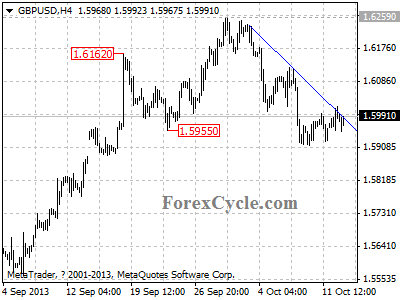
GBPUSD stays below a downward trend line on 4-hour chart, and remains in downtrend from 1.6259. As long as the trend line resistance holds, the downtrend could be expected to resume, and another fall towards 1.5800 is still possible. However, as long as 1.5800 key support holds, the fall from 1.6259 would possibly be consolidation of the longer term uptrend from 1.4813 (Jul 9 low), and one more rise towards 1.6500 could be expected after the consolidation. Now the pair is facing the trend line resistance, a clear break above the trend line could signal completion of the downward movement from 1.6259, then further rise to test 1.6259 resistance could be seen.

gbpusd

Provided by ForexCycle.com

Why the Market Could Triple by 2017

By MoneyMorning.com.au

From 2007 to late 2008 it would be fair to say we were bearish on the markets. That means we thought there was a chance stocks would fall.

Although if we’re honest, they fell much further than we expected.

From late 2008 to late 2009 we were bullish. From that point on until early 2012 we were largely neutral to bearish again.

Since early to mid-2012 we’ve had pretty much one thing on our mind – a raging bull market for stocks. And while many seem to think the bull market glory days are over, we’re in no mood to agree.

In fact, despite the volatility and the bearish market atmosphere, we still say that stocks are heading in one direction over the next 18 months, and that’s up…

That’s not to say there won’t be some bumps along the way.

There’s still a chance that the US government will default on its obligation to pay interest and principal on its bonds.

While a default would be good in the long run, in the short term it would have a big impact on the markets. Remember that US government bonds affect the prices of all securities worldwide.

That’s because investors see US government bonds as a risk-free investment. Every other investment such as bonds, stocks, and mortgages has its price in some way determined by the US bond price.

The Next Rally Could be Just the Beginning

There’s also the question of whether new US Federal Reserve chairman, Dr Janet L Yellen, will continue to print money and buy US government bonds.

Many think it will be business as usual under Dr Yellen. To your editor it’s a no brainer. There’s no way the Fed will halt a policy that has helped boost stock prices to a record high.

This is why we’ve set a price target of 6,000 points for the S&P/ASX 200 by early next year, and 7,000 points in 2015. If we’re right and the market gets there then anything is possible after that. In fact if the market really starts to bubble you could see stock prices reach 15,000 points by 2017.

We’ll admit it’s an out-there call. But similar sized increases have happened in the past. The Australian stock market doubled from mid-2004 to late 2007. That was just over three years:

Source: Google Finance


So is it really so crazy to think stocks could do something similar over the next two to four years?

Remember that the Australian market is only up 65.6% since the March 2009 low. So it’s not as though the market has exhausted all its potential gains. Although as we mentioned in yesterday’s Money Morning, a selection of Aussie blue-chip stocks have performed much better than the broader index.

Bear Market Trades in a Bull Market

But despite our talk about stocks going up, it’s important to remember that we’re not a cheerleader for the stock market and the current state of the world economy.

We understand there are problems…big problems. But we also understand that this is exactly the type of market where you can make some serious money.

Of course, not everyone agrees with our view. There are still a lot of bears saying the market is set to fall. But so far it has been a tough year for most bearish hedge fund traders. Although some bears have done better, such as our old pal Dan Denning, who has helped his readers make money without short selling stocks.

The reason the hedge funds have gotten it so wrong is that they’ve tried to short what has been (so far) a gradually rising market.

Source: Google Finance

It can be hard to make money short selling at the best of times. It’s even harder when stocks keep going up despite the worsening macro-economic outlook.

But to make matters worse it seems the short sellers may have been the victims of their own actions. As the Bloomberg report notes:

The embrace of bearish trades has squeezed returns for professionals and is one reason stocks have repeatedly rallied in 2013 amid slowing economic and profit growth, according to Cambiar Investors LLC and Pension Partners LLC. Rather than falling, shares that investors have shorted the most are up 38 percent since January, a consequence of forced buying during rallies by speculators who borrowed and sold them, data compiled by Goldman Sachs Group Inc. show.

So not only have the stocks short sold by hedge funds not fallen, but those stock have almost doubled the performance of the S&P 500 during the same timeframe – which is only up 21.9%.

Talk about a kick in the guts.

Crash Alert Set to High, but We’re Still Buying Stocks

And doubtless last night’s market action has given them another kick. With all the talk about the US budget and debt ceiling talks still up in the air, it would have been reasonable to think stocks would fall. But they didn’t. They closed the day up 0.4%.

The tech-heavy NASDAQ index did better, gaining 0.6%.

Even so, we’ve always got our crash alert set to high. We’re always looking out for excessive bravado. (Maybe our own claim about the market hitting 7,000 is excessive bravado and should be a warning in itself!)

But there is a difference. We get it that the world economy is living on borrowed time. Most in the mainstream still don’t quite get it. More from Bloomberg:

“There still are people out there who are convinced the whole market and financial system is some house of cards,” said Brian Barish, president of Denver-based Cambiar Investors, which manages about $8 billion, said Oct. 10. “I think they wind up shooting themselves and their investors in the foot with the permabear mentality, but it persists.”

That’s the voice of someone who doesn’t get it.

That’s the voice of a financial advisor who probably has most of their client’s money invested in stocks without any thought that stocks could crash.

As for us, despite our call of the ASX hitting 7,000 we’ve still got a level head when it comes to investing. We know that you can make a lot of money, but we also know it’s risky.

Our bet remains that the US deadlock will end within days. Providing you understand the risks, our view is that you should use the current price weakness as an opportunity to buy stocks. Once the US politicians reach a deal it could signal the start of the next rally.

Cheers,
Kris+

From the Port Phillip Publishing Library

Special Report: UNAVOIDABLE: Australia’s First Recession in 22 Years

Join Money Morning on Google+