T Minus 1 for US Downgrade, Gold Jumps 2.9% from 3-Month Low

London Gold Market Report
from Adrian Ash
BullionVault
Weds 16 Oct 08:05 EST

LONDON GOLD moved in a $10 range Wednesday morning around $1281 per ounce – the early August low, down more than 10% from that month’s peak – as both the US House and Senate were due to meet in what headline writers called “a last ditch attempt” to resolve the government’s debt-limit deadline, set for tomorrow.

US debt will likely be downgraded from its AAA status, the Fitch ratings agency warned yesterday, if the government hits a technical default when it reaches the current debt ceiling of $16.7 trillion on Thursday.

The US debt downgrade by S&P in summer 2011 is widely credited with helping investors take gold to record highs above $1900 per ounce.

US debt sales scheduled for Wednesday included $68 billion in 1-month Treasury bills.

Prices for outstanding 1-month T-bills fell early Wednesday, pushing their yield up to 5-year highs of 0.37% annualized.

“We feel that the onus of providing the countervailing deficit [in trade, to balance export surpluses worldwide] will eventually fall on the United States,” Reuters today quotes Deutsche Bank strategist Sanjeev Sanyal.

US deficits will continue to offer the rest of the world’s “savings glut” a home in US Treasury bonds, the newswire explains, extending the huge central-bank reserves already seen in Japan and China.

 Sanyal has long argued that “the Dollar will most likely remain the dominant global currency long after the US has been [economically] surpassed,” pointing to the persistence in world trade of Roman coin, Spanish silver and British Pounds after those empires began their decline and actively devalued their currencies.

The Chinese Yuan today hit a new record high vs. the Dollar for the third session running.

With gold rallying 2.9% at one point from yesterday’s sudden 3-month low, world stock markets slipped.

“If the deadline is crossed, it could send gold higher,” says Swiss investment bank UBS analyst Daniel Morgan. “But that would be combined with other financial market moves that would exert a lot of pressure on policymakers to find a solution.

“I wouldn’t be looking to buy gold on the basis of this short-term debt ceiling issue.”

“It is inconceivable,” says the daily note from brokers INTL FCStone, “that the politicians in Washington will come up empty-handed.”

That makes next week’s US Federal Reserve meeting “about the only source of support” for gold.

 Speaking Tuesday, Dallas Fed president Richard Fisher said “I personally would have a hard time arguing for us to dial [quantitative easing] back.

 “My personal opinion is that [tapering QE is] not in play. This is just too tender a moment.”

 “Extended spending/quantitative easing augments our constructive view on gold,” says a note from Japanese financial group Nomura.

 “[So does] tail-risk potential from a US government default, a low-probability outcome, but a noteworthy associated non-linear impact.”

Meantime in India, domestic gold prices rose to record highs above international benchmarks as local shortages worsened thanks to the government’s strict anti-import policies and the failure – so far – to mobilize existing Indian holdings for resale through gold banking deposits.

 Indian premiums over London quotes today hit $100 per ounce, according to dealers, up from $40 only a week ago.

 “There is a little demand due to festivals,” says Bachhraj Bamalwa of the All India Gems & Jewellery Trade Federation. But “there are no supplies in the domestic market.

 “What little supplies that come, go to exporters,”

 The Rupee edged higher against the Dollar on Wednesday morning, and the British Pound also jumped, hitting a 1-week high above $1.60 after new data showed the UK’s jobless count falling faster than expected in September.

 Wednesday morning’s London Gold Fix still rose £10 per ounce from Tuesday AM’s near-2013 low of £787, the lowest price in Sterling since end-June’s 3-year low.

 UK wages meantime rose only 0.8% on average this summer from a year earlier, separate data said Wednesday.

 The slowest growth in average UK earnings on record, that was less than one-third the pace of consumer-price inflation, reported Tuesday at 2.7%.

 Adrian Ash

BullionVault

Gold price chart, no delay | Buy gold online


Adrian Ash is head of research at BullionVault, the secure, low-cost gold and silver market for private investors online, where you can fully allocated bullion already vaulted in your choice of London, New York, Singapore, Toronto or Zurich for just 0.5% commission.


(c) BullionVault 2013

Please Note: This article is to inform your thinking, not lead it. Only you can decide the best place for your money, and any decision you make will put your money at risk. Information or data included here may have already been overtaken by events – and must be verified elsewhere – should you choose to act on it.


Gold Signaling Reversal, Target 1400$

Article by Investazor.com

gold-signaling-reversal-wedge-resize-16.10.2013

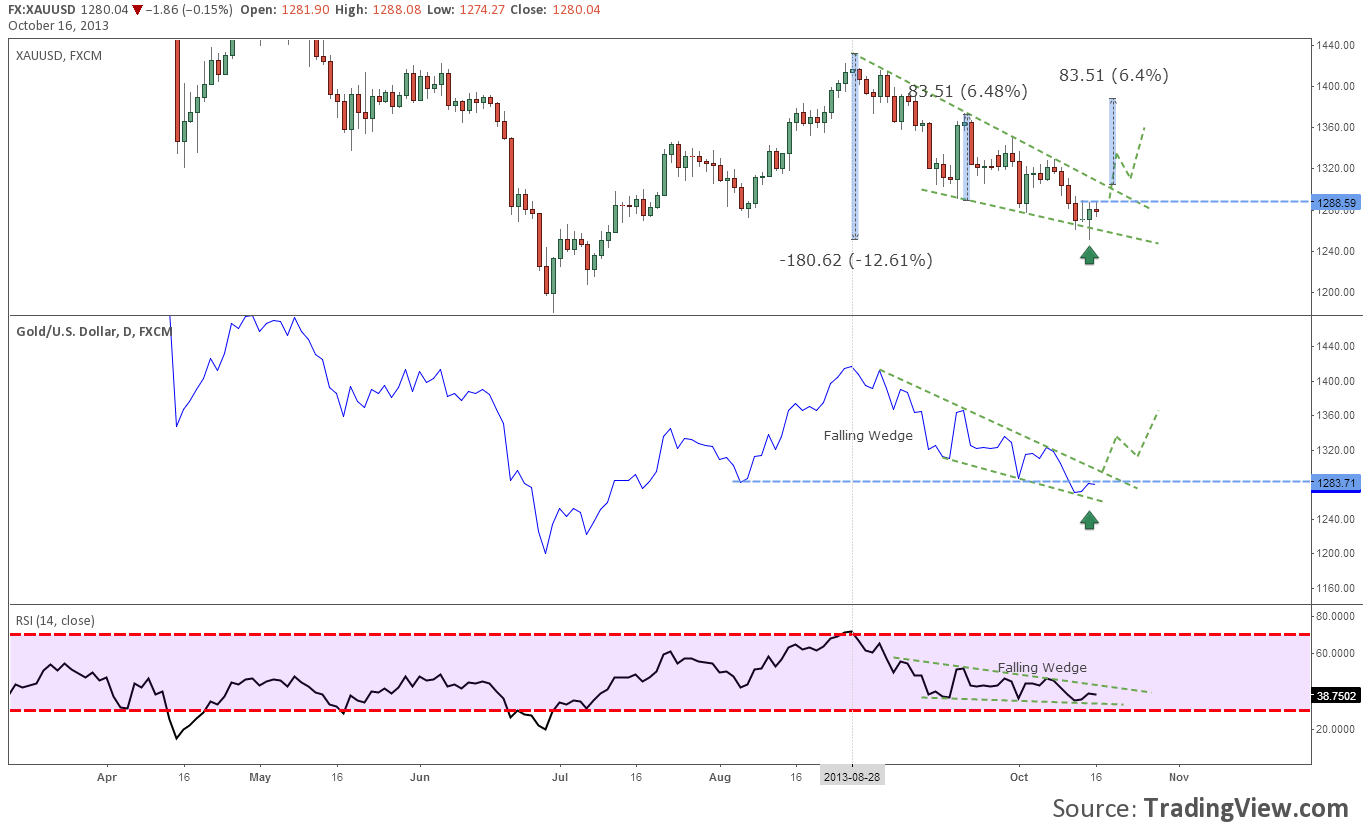
Chart: XAUUSD, Daily

The price of gold started to fall at the end of august. In less than 2 months it touched a low at 1251$ per ounce, marking a loss of 12.6% from the high of this second half of 2013. The down trend seems to have lost its power with every swing low and yesterday the price has drawn a reversal candle, Hammer.

Looking at the form of the down trend on both, candle stick chart and line chart, we can observe that the price has drawn a Falling Wedge. This pattern usually signals a reversal. A breakout through the upper line of the price pattern it would be enough to confirm a rally. The price target of this Wedge sits around 1400 dollar per ounce.

Even though there are bullish signals, traders should wait for a clear confirmation in the price action. If the price will continue to make new lows, than it means that investors have already set their mind and the down trend might continue all the way to 1200$ per ounce.

The post Gold Signaling Reversal, Target 1400$ appeared first on investazor.com.

More Evidence Pointing to Manipulation in Gold Market?

By Michael Lombardi, MBA for Profit Confidential

While I avidly follow the actions of central banks to see where the gold bullion prices may be headed next, when I look at them today, their actions are speaking louder than words.

Central banks have pretty much stopped selling gold bullion, which is very important. In 1999, a number of central banks in Europe formed an alliance and agreed that they would not sell more than 400 tonnes of gold bullion per year. The agreement was called the Central Bank Gold Agreement (CBGA). In 2004, the CBGA was renewed again; this time the limit was 500 tonnes. Once again, it was renewed for another five years in 2009, and the limit is back to the sale of no more than 400 tonnes of gold bullion per year.

The chart below shows how much gold bullion the central banks in Europe sold in each period of the CBGA. (Source: World Gold Council web site, last accessed October 11, 2013.)


* Sales are until 2013.

Years

Sales in Tones

CBGA 1

1999-2004

2000

CBGA 2

2004- 2009

1884

CBGA 3*

2009-2014

200.3


Notice anything different? The central banks in Europe have put the brakes on their sales of gold bullion. In fact, from September 27, 2012 to September 26, 2013, these central banks only sold 5.1 tonnes of gold bullion! This is hands down the lowest amount sold since the agreement started in 1999.

When it comes to stocks, if owners of a stock aren’t selling and there’s a significant number of buyers who want to buy, the price of the stock usually goes up as the simple rule of economics come into play: supply and demand.

Sadly, when it comes to gold bullion prices, this is not the case. Gold bullion prices are actually going down despite less supply and more demand. The price action in the gold market doesn’t make sense. What if all the conspiracy theories I keep reading about in respect to gold bullion prices being manipulated are right?

As I ponder manipulation in the gold bullion market, I heard recently that the U.S. Justice Department is looking into manipulation in the $5.0-trillion-a-day foreign exchange market. Traders in big banks around the global economy are accused of manipulating key exchange rates. (Source: Reuters, October 11, 2013.) If the biggest market in the global economy can be manipulated, why can’t the gold bullion market be manipulated?

I’m sticking to my guns; the depressed prices of well-managed senior and junior gold-producing companies are a screaming opportunity for investors.


A Bullish Undercurrent That’s Impossible to Ignore

By WallStreetDaily.com

I routinely get railed for my optimistic bias. But this week, I’ve been receiving an inordinate amount of fan mail, expressing the same disgust.

They all go a little something like this…

“The nation is on the brink of total collapse. Yet you’re out issuing bullish memes? How could you possibly be so ignorant? I’m unsubscribing from this nonsense immediately!”

I’ll miss you. Seriously. But I’ll be here to welcome you back with open arms once you realize it has nothing to do with ignorance.

It has everything to do with ignoring what Peter Lynch appropriately deemed “background noise” – events that ultimately have no bearing on our long-term investments. Instead, I focus on meaningful market information that does.

With that in mind, there’s a serious bullish undercurrent in the market that warrants turning a blind eye to the tussle in Washington and staying the course.

So whether you’re a bull, bear, or flat-out confused, listen up…

Small Caps Breaking Out

There’s no better leading indicator than small caps.

Or as Sam Stovall, Chief Equity Strategist at S&P Capital IQ, said, “We found that small-cap stocks, as long as we’re in bull market mode, tend to be in a leadership position.”

Guess what? They’re leading.

At the first whiff of an accord between Republicans and Democrats on Monday, calm returned to the broader market. The S&P 500 held its 50-day moving average support line.

Small caps, on the other hand, did much more than just hold firm. They broke out. In fact, the Russell 2000 Index surged to a new all-time high.

If you’re an institutional buyer or hedge fund manager ignoring small caps right now, well… you might lose your job!

Small caps will continue to drive the market for the foreseeable future, too.

As we all know, small caps tend to be the most sensitive to the domestic economy. So if politicians really posed a long-term threat to the economy – and, in turn, the bull market – small caps would be sinking, not soaring.

That’s not happening.

In fact, over the last six months, the performance gap between small caps and the S&P 500 actually widened. After trading neck and neck for the year, small caps are now up 20%, compared to a 10% rise for the S&P 500 since April.

Now, before the week is out, we’ll be releasing our latest issue of WSD Insider, which reveals two more bullish undercurrents in the market that also warrant your attention right now. To discover what they are – along with the latest small-cap stock I’ve uncovered to capitalize on the situation – sign up for a risk-free trial here.

Ahead of the tape,

Louis Basenese

The post A Bullish Undercurrent That’s Impossible to Ignore appeared first on Wall Street Daily.

Article By WallStreetDaily.com

Original Article: A Bullish Undercurrent That’s Impossible to Ignore

Thailand holds rate, sees gradual economic recovery

By www.CentralBankNews.info     Thailand’s central bank held its policy rate steady at 2.5 percent, as expected, saying the Thai economy was stabilizing and should gradually recover, and the current accommodative policy stance should support “economic recovery in the periods ahead, given uncertain global economic and financial conditions.”
    The Bank of Thailand (BOT), which cut its rate by 25 basis points in May amid growing economic risks and a rise in the baht currency, said its monetary policy committee had voted unanimously to maintain the policy rate. Last month one committee member had voted to cut the rate and at today’s  meeting one member was absent.
    The BOT said the economy had expanded more slowly than previously assessed but there have been signs of improvement in some sectors and exports have begun to recover in line with better global demand while private consumption and investment have stabilised.
    “The outlook points towards a gradual growth recovery, supported by accommodative financial conditions,” the bank said, adding that key downside risks stem from the uncertain global economy and a delay in fiscal disbursement for infrastructure projects.
     Thailand’s Gross Domestic Product contracted by 0.3 percent in the second quarter from the first, the second quarterly contraction in a row, for annual growth of 2.8 percent, down from 5.4 percent in the first quarter.

    Thailand’s inflation rate eased to 1.42 percent in September from 1.59 percent in August while core inflation was 0.61 percent, in the low end of the BOT’s core inflation target of 0.5 to 3.0 percent.
    The BOT also mentioned that household debt had decelerated somewhat and inflation had edged lower due to subdued production costs and domestic demand.
    The BOT noted the downside risks to the global economy with the U.S. expanding at a moderate pace on the back of private consumption. But while the impact of the U.S. government shutdown should be limited, “failure to lift the debt ceiling poses a substantial risk to global financial and economic stability.”
    “The region remained exposed to global market volatility amid uncertainties about the timing of QE tapering and the US fiscal impasse,” the BOT added.
    The BOT did not make any references to the Thai baht, which has been largely steady since mid-September, trading at 31.25 to the U.S. dollar today, down 2.0 percent for the year.
    From the start of the year to late April the baht rose by almost 6 percent, hitting a high of 28.6 baht to the dollar on April 26. But it started to depreciate after Thai authorities voiced their concern over the impact of the strong bath on exports and continued to drop following May’s rate cut.

    www.CentralBankNews.info

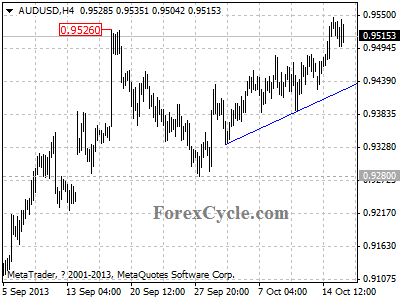
AUDUSD stays above a upward trend line

AUDUSD stays above a upward trend line on 4-hour chart, and remains in uptrend from 0.9280. As long as the trend line support holds, the uptrend could be expected to continue, and next target would be at 0.9650 area. On the downside, a clear break below the trend line support will indicate that lengthier consolidation of the longer term uptrend from 0.8847 (Aug 5 low) is underway, then deeper decline to 0.9300 area to complete the consolidation could be seen.

audusd

Provided by ForexCycle.com

Are You Scared of Investing and Making Money?

By MoneyMorning.com.au

Too many investors fear the wrong thing in investing.

They fear something that’s good for them.

Something that could make them a lot of money.

When we tell you what it is you probably won’t believe us, but it’s true.

They actually fear making money.

We’ll explain what we mean…

Since stocks began to soar last November we’ve heard a constant stream of the same message – ‘Don’t buy stocks, the market is about to crash.’

We won’t argue with the reasons behind the message.

In fact we agree with it almost entirely. Stocks will fall…at some point. But it has been almost a year since the rally started.

And despite a few bumps (including one or two big bumps) the Australian stock market is 19.8% higher than it was last November.

Missing Out on Fat Dividend Cheques

So why is it that so many investors fear making money?

The way we see it, many investors get so caught up with thinking about the worst thing that could possibly happen that they become too worried to think about the positives.

The sad thing in the case of the stock market is that many investors have missed out on the potential for double-digit gains, and the accompanying dividend cheques.

So instead they’re still in cash…at what has been an ever-decreasing interest rate.

It’s important to remember the point of investing and what it means. You invest because you want to make money. But investing comes with the risk of losing money too.

The key is to weigh up the odds of making money versus the odds of losing money. If the odds are in favour of making money then you should invest. If the odds are against making money then maybe you shouldn’t invest.

This is what we mean about investors being too scared to make money. Because any way you slice and dice things during that time, the odds were always in favour of investors making rather than losing money.

We’ll Ask You One Question

And we’re not using hindsight here. We’ve said that in one way or another all along.

If you’re new to Money Morning feel free to scan through the archives. You’ll see we’ve consistently said this is a buyer’s market.

There was a simple reason. There was no way on Earth that anyone in charge of fixing interest rates would allow rates to rise and therefore create a negative environment for bond and stock prices.

Yet that didn’t stop many investors from fretting about what would happen when interest rates eventually have to rise. Even though rates may not rise for another two, three or five years.

And if things are really bad interest rates may not go up for another 20 years – see Japan.

Even now, as bad as thinks look in the US, you still have to play the odds. So what are the odds right now?

Well, let’s stop and think about it. We’ll ask you one question…

Do you think US politicians will come to an agreement to prevent a default?

If you answer yes, then that can only be a positive result for the market. In that case you should continue to hold and, if you’re so inclined, buy stocks.

If you answer no, then that can only be a negative result for the market. In that case you should sell your stocks and stay in cash.

But be realistic with your answer. If you answered no, do you honestly believe that any politician will do anything to allow the government to default on its bond payments?

Think about why politicians enter politics. They do it so they can gain office. Trust us, there are very few votes to be won by bringing on a collapse of the US bond market and the US dollar.

Don’t Miss This Chance to Boost Your Wealth


So instead of worrying about what may happen years into the future and letting it impact your investment decisions today, we say that it’s great you understand the long-term fall-out of current policies, but don’t let it cloud your need to invest and make money today.

Because that’s one of the most important things. Even with all the nonsense going on in Washington DC, stocks are still moving. And in most cases they’re moving up.

We’re talking tiny small-cap stocks as well as big blue-chip stocks. We’re talking technology stocks with innovative ideas as well as solid industrial stocks paying a handsome dividend.

But after all we’ve said today, if you don’t believe us, maybe you’ll believe the market. We’ll put it this way. The Australian market hit an intra-day high of 5,314 points on 27 September. The next day the markets panicked as fears spread of a possible US debt default.

Yesterday the Aussie market closed at 5,259.

In other words, for all the talk and fear and panic over the US government potentially defaulting on its debt obligations, the Australian market has lost a grand total of 55 points. That’s just over a 1% fall.

And even if the market falls by another 50 points today, you’re barely looking at more than a 2% drop from the peak.

As we say, take notice of the problems facing the world economy, and build long-term strategies to combat these problems into your investing gameplan.

But whatever you do, don’t let the bad news consume you. Don’t lose focus on the great opportunities that exist in the Aussie market today.

Cheers,
Kris
+

From the Port Phillip Publishing Library

Special Report: UNAVOIDABLE: Australia’s First Recession in 22 Years

Join Money Morning on Google+

Why Investors Must Be Cautious At These Prices

By Chris Vermeulen – TheGoldAndOilGuy.com

Last week on October 8th the financial market experienced a broad based sell off. Every sector was down with utilities being the only exception.

The individual leadership stocks, which are typically small to mid-cap companies (IWM – Russell 2K) that have a strong history and outlook of earnings growth, were hit hard as well.

Whenever the broad market experiences a price correction, one of the most important factors I analyze is how well leading stocks hold up and show relative strength to the broad market.

So, where does this leave us going forward?

When stocks that have been leading the market higher and only pausing during market corrections in the S&P500, Dow, and NASDAQ, it’s a positive sign. This tells us investors and big money continues to flow into the risk on assets (stocks).

Conversely, when these leading stocks/sectors begin succumbing to the selling pressure of the broad market, it quickly grabs my attention and tells us it’s time to be aware that a major top may be forming.

It looks as though the broad market rally is just barely hanging on. If the leading stocks and sectors begin breaking below their 50-day moving averages, my proprietary SP500 Market Timing & Trading System will shift to sell mode and things could get ugly for those who do not know how to trade a bear market.


Weekly Relative Strength Showing Negative Divergence

This chart has two important things I would like to point out. First is the fact that the RSI has being overbought twice in the past three years with the most recent one taking place a few months ago. The last time this took place the SP500 had a very strong correction.

The second insight the RSI is providing us with is the diverging price and relative strength as shown with the purple lines on the chart below. This is telling us that the power/momentum behind the market is slowing.

div1


Daily Bullish Percent Index – Shows Negative Divergence

I always prefer to watch and analyze the NYSE as it’s the big board where all the HUGE money is flowing from traders and investors. The chart below clearly shows that less stocks are moving higher as seen with the purple bullish percent index line. With less stocks making new highs, yet the stock market continues to climb this is a warning sign that this bull market is slowly running out of steam.


div2


Technology & Financial Sector Are Rising But For How Long?

Two very powerful sectors are holding up well but once they start to breakdown from these chart patterns things could get ugly real quick. Our 3x ETF trading newsletter becomes very active in bear markets as the upside potential is much larger.

The XLK technology sector looks to be forming a bearish rising wedge. If/once it starts to slide it will have a strong impact on the broad market.

div3

Financial Sector XLF

The recent price action of scattered trading ranges looks to be similar to the top we saw in 2011. If this is the case then we have bearish head & shoulders pattern with a rising neckline forming. Once price breaks through the neck line we should expect sharp drop in price.

This sector is heavily weighted in the SP500 so if it start to drop, expect the SP500 to fall with it.

dvi4


Major Market Top Lurking…

The chart below pointing out the next bear market likely to take place is a scary looking chart to most individuals. But if you know what you are doing, they can provide more profits in a shorter period of time than a four year bull market.

If this market is starting to stall out and is in the process of forming a top. Keep in mind that market tops are a process. They take typically 3-6 months to form before a true breakdown occurs and the bear market starts. And until then, price will be choppy and difficult to trade.

majorcycle


Cautious Trading Conclusion:

In short, this report shows you some major divergences in the financial market. Remember, you do not really trade off divergences, as they are not good at timing. They are simply a warning sign telling us that something large is brewing and that risk is higher than normal.

There are few ETFs I like on various sectors and commodities that show some oversized upside potential in the coming weeks/months. Depending on what takes place in Washington this week will move the market and likely trigger some sharp moves. Until then, sitting tight is the safe play.

Get my trading reports and my trade alerts at www.TheGoldAndOilGuy.com

Chris Vermeulen


Janet Yellen: An Insane Choice for a Debt-Crazed Economy

By MoneyMorning.com.au

Soon we won’t have Ben Bernanke to kick around anymore. Janet Yellen will head the US Federal Reserve Bank.

What does it mean to you?

In an ideal world, it would mean nothing. You would shrug and go back to your morning coffee. Fed chairmen (and chairwomen), like referees, should not have such an impact on the game.

But we don’t live in that world. So unfortunately, we have to at least consider what reckless thing the Fed might do next.

Perhaps we should back up and say what the Federal Reserve is all about. As President Obama said: ‘A lot of people aren’t necessarily sure what the Federal Reserve does.

Including, I might add, the president himself. If he did, he wouldn’t have said the outlandishly stupid thing he said next.

Thanks to Ben, Obama said, ‘more families are able to afford their own home; more small businesses are able to get loans to expand and hire workers; more folks can pay their mortgages and their car loans.

Ben is responsible for all that, is he?

Mainstream Media an Establishment Mouthpiece

The press generally gushed over the choice. I chuckled as I canvassed the newspapers, the mouthpieces of the establishment. I thought of my old favourite, A.J. Liebling (1904-1963), who wrote some of the most insightful press criticism in the English language.

In his The Press (I recommend the expanded 1975 edition put together by his widow, Jean Stafford), Liebling wrote how newspapers ‘did not always, monolithically, without effort, like a piano falling down a stairwell, follow the official line…‘ But mostly, they did. They still do.

The New York Times was typical:

President Obama was wise to nominate Janet Yellen, vice chairwoman of the Federal Reserve, to be the Fed’s next leader. As a deeply respected economist, she will bring two vital attributes to that role as a steward of the economy.

The ‘deeply respected‘ bit was something that was often repeated. Not repeated was the fact that she didn’t see the last crisis – the biggest since the Great Depression – until it happened.

In her own words:

For my own part, I did not see and did not appreciate what the risks were with securitization, the credit ratings agencies, the shadow banking system, the SIVs – I didn’t see any of that coming until it happened.

I have no idea if she is competent. Competence in an economist is hard to measure, like knowing whether your auto mechanic is really any good.

As for vital attributes, the Times did get one right. ‘She represents continuity,‘ the Times wrote. That pretty much says it all. Janet Yellen is establishment all the way. She won’t wobble the canoe. She’s not a Paul Volcker coming in to break things up.

And that’s all you need to know about Janet Yellen. She’s got the same playbook in her pocket as Bernanke. If anything, there are hints she’ll be even more aggressive in printing money than Bernanke.

And old Ben was pretty proficient in this area. Since he took over back in February 2006, the Fed’s securities holdings are up 365%, to $3.5 trillion. It bought all that with money it created out of nothing.

How Big Will the Pile Be When Yellen Leaves?

My guess is it will be higher. Expect the easy money and distortions to continue. The stock market may continue to rise, as it has, with the size of the Fed’s holdings. This can’t end well, but the party between now and the end could be something.

Already, the markets have come unhinged.

I can’t help but drag out a quote from my well-thumbed Humble on Wall Street, by Martin Sosnoff. ‘The most reliable indicator of speculative excess is the new-issue market,‘ he wrote.

If you want to see the effects of an overindulged, careless market, look there. A good piece by Telis Demos in the Wall Street Journal highlighted this. Out of the 28 new technology stocks listed this year, 19 of them were money-losing firms.

That’s the highest percentage of losers since 2007. Twitter is the next one up. It will go public and likely command a market value that starts with a ‘b’. Yet last year, it lost $79 million.

The rise of the profitless corporation is a curious phenomenon. Murray Stahl, the money manager at Horizon Kinetics (and co-manager of the Virtus Wealth Masters Fund) picked up on this idea in a note in August:

It is hard to imagine that there are companies deemed successful that have little or no profit – and yet they exist. Examples include Salesforce.com, Workday, Netflix and even, to a great extent, Amazon.com.

Amazon has been around seemingly forever. The market values the stock at $141 billion. It begs one to ask as Stahl does:

If it is possible to be successful without generating profits [but] merely by growing revenues, why should not more companies engage in that approach?

He leaves the question unanswered, but probably the executives at Twitter have wondered the same thing, if only privately.

On the other side of the spectrum, there are many companies enjoying profit margins at or near record highs. IBM, for example, has profit margins nearly twice as high as in 1999, right near the peak of the last tech bubble.

As Stahl points out, ‘There are many huge firms in the major stock indexes with enormous profit margins.‘ Among these are IBM, Microsoft, Oracle, Intel and Apple. So these stocks – and others – look cheap based on recent earnings. But those recent earnings come from reaping the rewards of  high profit margins. There is a big risk that these will revert to something less heroic.

(This is why I’ve been careful to pick up stocks where profit margins are at historically low levels at the moment – such as banking or insurance. Reversion to some average is a force you want to harness for gains, not one you want to fight against.)

US Stocks a Tough Market

Point being we live in a weird, funhouse sort of market. Fed policy distorts everything, starting with its suppression of honest interest rates. The market rallies over silly things – even a ‘temporary’ fix to the debt crisis gets a cheer, instead of groans – and no bad news keeps the market down for long.

All of this makes it a tough market to stay safe in, because you may lag behind awhile. I like to read the shareholder letters of a number of my value-minded friends and colleagues. Many are lagging the market this year because they don’t own the junk that’s leading the pack.

Robert Sanborn, who runs the Elkhorn Fund and is one of the laggards, reminisced about how this market reminds him of the 1990s. He lagged then too.

I distinctly recall one partner of mine tell me that I would never ever ‘catch up’ to the relative performances of the highfliers that year… In the next three years, the Nasdaq dropped about 70%, and I had the best absolute and relative investing years of my life. Those heroes of the late ’90s all imploded and from point to point, suffered large and permanent losses in capital.

I think the Yellen era may well follow a path like that. It’s a big party for a while, and then it isn’t.

Chris Mayer
Contributing Editor, Money Morning

Publisher’s Note: Janet Yellen: An Insane Choice for a Debt-Crazed Economy originally appeared in The Daily Reckoning USA.

Join Money Morning on Google+

Maximizing Returns in an Uncertain Mining Market: Tom Szabo

Source: Brian Sylvester of The Metals Report (10/15/13)

http://www.theaureport.com/pub/na/maximizing-returns-in-an-uncertain-mining-market-tom-szabo

Tom Szabo, an investment strategist and principal of MetalAugmentor.com,

invests in miners with base metal, specialty metal and rare earth element projects because the market isn’t quick to notice them—meaning it’s easy to get in early on a great project. His Peerless system helps to identify opportunities based on unique attributes. So, which metals and rare earth companies are set to strike in this volatile market? Szabo doles out tips in this Metals Report interview and explains why he likes companies that have yet to achieve market favor.

The Metals Report: As an investment strategist at MetalAugmentor.com, you use the Peerless system to rank equities in the mining space. What exactly is the Peerless system?

Tom Szabo: Our system is a qualitative ranking of companies. It’s a binary system: A company is either peerless or it’s not. However, we do have companies that we consider “candidates” for peerless. The Peerless system takes into account success factors. These success factors may be different based on the stage of development of the company. An exploration company’s success factors will be somewhat different from a producer, although they will share some similarities like management and corporate strategy.

TMR: What are some non-precious metal equities that are providing interesting opportunities in the current cycle?

TS: In base metals, we are more interested in the exploration or earlier-stage plays. One of the reasons is the market doesn’t tend to add a large premium to a non-precious metal discovery until the bigger players have had a chance to wrap their arms around the story. Often the proper valuation doesn’t appear until the project becomes an obvious candidate for being taken out. While the wait can sometimes be frustrating, it also allows astute investors to be positioned ahead of the crowd.

An example of a peerless company in this space would be North American Nickel Inc. (NAN:TSX.V). This is an exploration company that’s active in Greenland. It has made a potentially district-scale discovery of a magmatic nickel-copper-cobalt-platinum-group-metals system with some similarities to the Sudbury Basin in Ontario, Canada.

TMR: Is Greenland considered mining-friendly?

TS: It is. The population seems to be pretty pragmatic. Most people live in areas away from where the exploration and deposits are located.

TMR: They tend to be very protective of their glaciers and things like that, however.

TS: Yes, this is true. You don’t want to be around the areas where there are heavy glaciers. There are quite a few mining projects elsewhere, however. You can develop projects in Greenland if you approach it in the right way.

The area where North American Nickel is active along the southwest coast doesn’t have year-round snow. There are also huge areas elsewhere in Greenland that have not been explored because recent glacier melting has just exposed these areas, some of which could be world class.

TMR: What’s the next step for North American Nickel?

TS: It has found several areas of mineralized conduits, including the Imiak Hill complex. It encountered massive sulfides across decent intervals deeper in the system. Assays are confirming the high nickel grades that have been anticipated. It’s an encouraging development that’s accounted for a run-up in the share price.

TMR: You’ve suggested investors play North American Nickel through VMS Ventures Inc. (VMS:TSX.V), which owns a large stake of the company.

TS: VMS Ventures owns about 25% of North American Nickel. At this stage, the leverage isn’t that great, but if North American Nickel starts to run you’ll see the leverage start to work.

VMS also has the Reed Lake joint venture with HudBay Minerals Inc. (HBM:TSX; HBM:NYSE).

TMR: VMS bills itself as Manitoba’s next copper mine.

TS: It should be in full operation next year. VMS’s underlying price is more or less supported by the Reed Lake project. Anything that happens with North American Nickel is a bonus. It is a lower-risk, longer-term, value-oriented way of being exposed to a discovery story and a near-term production story at the same time.

TMR: Barclays reported in September that five of the six base metals in the London Metal Exchange are currently in surplus, but the bank remained more optimistic about the long-term prospects for base metals due to possible mine shutdowns in the near term. Are there some base metals you favor?

TS: Copper is king. I don’t suspect we’ll run out of copper deposits anytime soon, but we could run out of deposits that are inexpensive to mine. Deposits that have high grades or low cost profiles are attractive to me. Copper will continue to be big. China has really just started to electrify beyond the public transmission and transport infrastructure. India hasn’t really even started. Africa hasn’t started at all.

Zinc also comes to mind. There aren’t any huge zinc mines waiting to come on line. Most of the deposits that are larger have issues or are located in areas where development isn’t easy. The deposits that can be developed readily aren’t particularly big.

Nickel has some similarities to copper in terms of both supply and demand. Nickel sulfides tend to occur with copper. Nickel laterites are large but low-grade deposits similar to copper porphyries whereas magmatic systems containing nickel can be quite high grade as we are seeing with companies like North American Nickel. In any case, miners need a certain price in order to be profitable. A viable long-term operation also needs to be low cost and there are a few different opportunities out there among the various deposit types.

TMR: Do you have any other ideas on how to get exposure to copper?

TS: Atico Mining Corp. (ATY:TSX.V; ATCMF:OTCBB) in Colombia is almost like a “Fortuna Copper”: The principals are from Fortuna Silver Mines Inc. (FSM:NYSE; FVI:TSX; FVI:BVL; F4S:FSE). The strategy is similar. Atico is picking up a historical operation that has not seen modern mining applied to it.

TMR: It’s a small, high-grade story at this point. Is there reason to believe it gets bigger?

TS: What’s been explored here historically has been near the surface. But there hasn’t been a lot of modern exploration to find additional mineralized lenses at depth or along trend. Atico came along and it wasn’t too difficult for the company to find the next ore body.

It’s a growth story. Management has been focused on getting this up to a level where it can expand and self-sustain.

TMR: Do you have a zinc play that you’re following?

TS: Pure zinc deposits are virtually nonexistent. With zinc you usually end up with a polymetallic-type system. Pretty much all the silver producers are polymetallic. However, they don’t produce a large enough portion to be considered zinc plays.

If there were to be some kind of zinc mania in the future—and we actually sort of had one already when zinc went to $2/lb in 2006—I would perhaps look at Hecla Mining Co. (HL:NYSE). It is a peerless candidate and its Greens Creek project has a very significant zinc component. Hecla is not on our list now, but if it’s able to get its Idaho Lucky Friday operation stable, it will start to focus on growth opportunities elsewhere. The company has several projects it’s been looking at building up in the background.

Let’s go from a relatively large company to an extremely tiny one, Western Pacific Resources Corp. (WRP:TSX.V). It’s actually run by a couple of former Hecla big wigs. It started out with some gold projects in Nevada and Idaho. The company didn’t want to suffer from too much dilution in such a difficult financing environment, so it searched out a near-term production story. It found one at the Deer Trail Mine in Utah.

This was a project that was mismanaged by a previous company. It did have a significant amount of mining infrastructure installed, however. There is a bona fide deposit there. It’s not big at this point, but it has the potential for a similar style and scale of polymetallic replacement mineralization that’s found in a number of successful mines in Mexico. We should note that Western Pacific does have to raise money to finish refurbishing the mine and get into production.

TMR: What other non-precious or specialty minerals or metals should investors be paying attention to in the near term?

TS: There has been a lot of hype around the so-called rare earth elements (REEs) but they aren’t really that rare. There are lots of REE deposits, it’s just a matter of getting at them and processing them effectively. However, while they might not be geologically rare, there also may never be a substitute found for some of these substances.

Take, for example, neodymium and dysprosium, the REEs that are primarily used in high-strength magnets. In order for the technologies and industries that rely on magnets to grow, there will need to be more mine supply of these REEs. There’s opportunity for a new project developer to be that supplier but that doesn’t mean just mining at a low cost. It has to also be competitive with China on selling the specific products demanded by the market and that essentially means having access to a separation process that produces a high-purity REE material like the neodymium metal required for magnet alloys. In other words, the prospective REE mining company and its partners must cut China out of the loop. This is proving to be exceedingly difficult to accomplish, but someone will eventually figure out a way to do it.

The agricultural minerals phosphate and potash have a fundamental growth story: an increasing global population and less nutrient-rich arable land. In order to produce more food we will have to provide more and more nutrients artificially into the soil to keep up the yields. There are quite a few potash and phosphate deposits, but which have an advantage? Are some close to market, have better processing that makes it more attractive or some other aspect that creates an advantage beyond the size or economics?

One of the companies we like in this space is Allana Potash Corp. (AAA:TSX; ALLRF:OTCQX) in Ethiopia. The Dallol project is in a large evaporitic basin. One of its key advantages is that the hot desert allows the potash concentrate to be left in big salt ponds to dry out prior to shipping, significantly reducing capex and operating costs. Also, the project is close to roads, planned rail lines and the east coast of Africa. From there it’s a relatively short distance to India, Southeast Asia and China.

TMR: There’s been some turmoil in Ethiopia over the years. Is that a negative factor?

TS: The fact is that you’re probably not going to find too many stable jurisdictions in Africa, but you could do worse than Ethiopia. Generally speaking, I don’t consider instability to be an ongoing issue.

Funding could be an issue. Allana Potash will have to find someone who can look past the fact that the project is in a country that hasn’t historically seen big investments of this nature. More and more, that “someone” seems to be China although the company is working with a number of international groups as well.

TMR: Why is Allana a timely investment?

TS: The price driver is obtaining funding. That will remove a significant source of uncertainty and take the company to the next level. It is significant.

TMR: Any other specialty minerals or metals?

TS: Perhaps I should add to our previous discussion of REEs because many of the issues that apply there will also be important in other specialty sectors. For example, deposit size or ore grade are often not the most critical factors in these non-commodity mine products. Namibia Rare Earths Inc. (NRE:TSX, NMREF:OTCQX) doesn’t have a particularly large deposit, but the development timeline could potentially be short. It also has a very high percentage of valuable heavy rare earths, probably one of the highest in the world. At 0.5% to 1% grade the value of it is much more significant on a per-ton basis than most other deposits out there. Namibia’s project would not be a huge operation, but it could be a highly profitable one if it could join up with a partner that’s able to take the product further than just production of a mixed REE concentrate. There are a number of potential partners in the form of exploration and mining companies looking for innovative ways to move further up the REE production value chain. Two interesting ones we follow are GéoMégA Resources Inc. (GMA:TSX.V) andGreat Western Minerals Group Ltd. (GWG:TSX.V; GWMGF:OTCQX).

Similar to REEs, other specialty metal and mineral projects require a viable plan to add value beyond just producing an ore concentrate at competitive cost. Investors who cast their nets wide enough should be able to find several attractive candidates across the mining sector at any given time.

TMR: Are there companies that investors perhaps should sell?

TS: The list is too long! In general, it’s a good idea right now to sell companies with production predicated on high prices because it’s going to be very difficult for these companies to generate profits. It may also be difficult for them to raise necessary funds if they have significant debt. And of course companies that have run out of cash and don’t have any attractive assets are at risk of going dormant and missing out on the next upturn in the sector. Consequently, investors should also sell any exploration play without ready access to capital especially if that company doesn’t already have at least a significant sniff of a major discovery on its hands.

TMR: Do you think investors should stay out of the equities market until the U.S. government shutdown is resolved?

TS: It’s difficult to read how one event in isolation will impact equities. If you just focus on one thing, you could always find a reason not to be in equities. In fact, that “reason” to stay out can ultimately turn into a reason to be invested. If the federal shutdown is over next week, there could be a big relief rally back up before the next artificial crisis comes along.

Generally, however, equities are highly overvalued. I’m not talking about mining equities. I’m talking about general equities. There is a significant risk of another correction or crash in the general markets. I’ve also discussed elsewhere that there’s probably going to be a secondary bottom in gold and the other metals. Perhaps it’s a correction in general equities that precipitates it. There may not be a fundamental issue with gold or the mining sector. It could just be a drag-down effect from the general markets.

TMR: Do you have a timeframe for that second bottom?

TS: It doesn’t have to be a lower bottom than what we’ve already seen so we won’t know until after the fact. I believe it will be sooner than later. For example, some technical work that we use suggests that the earliest phase of a new multi-year rally may appear by next spring. Our other qualitative and quantitative work indicates a mining cycle peak in the next two to three years. That would suggest the bottom is not too far out because the market will need time for the rebuilding phase to undo all the technical damage. Then you get into the speculative blow-off stage of the rally, which itself could take 6 to 12 months.

TMR: Wow.

TS: What we’re looking for now is a classical bottom, which should have capitulation and other factors indicating that the last marginal seller has thrown in the towel. Capitulatory selling has been happening in fits and starts, but I don’t get the sense that it’s finished yet. I don’t mean to be pessimistic. It’s just part of the market cycle. I still think that there are good opportunities out there, but generically buying the mining sector is probably not a good idea—at least for the time being.

TMR: Thanks, Tom. It’s been a pleasure.

Tom Szabo is co-chief analyst of MetalAugmentor.com, an investment research service focused on metals and mining. Szabo has co-founded several precious metal related businesses and investment funds.

Find out how Tom Szabo applies his Peerless concept to precious metals in his interview with The Gold Report, The Peerless Way to Precious Metal Profits.

Want to read more Metals Report interviews like this? Sign up for our free e-newsletter, and you’ll learn when new articles have been published. To see a list of recent interviews with industry analysts and commentators, visit our <href=”#interviews” target=”_blank”>Streetwise Interviews page.

DISCLOSURE:

1) Brian Sylvester conducted this interview for The Metals Report and provides services to The Metals Report as a contractor. He or his family own shares of the following companies mentioned in this interview: None.

2) The following companies mentioned in the interview are sponsors of The Metals Report: Namibia Rare Earths Inc., Fortuna Silver Mines Inc. and Atico Mining Corp. Streetwise Reports does not accept stock in exchange for its services or as sponsorship payment.

3) Tom Szabo: I or my family own shares of the following companies mentioned in this interview: Atico Mining, Geomega Resources. I personally am or my family is paid by the following companies mentioned in this interview: None. My company has a financial relationship with the following companies mentioned in this interview: VMS Ventures. I was not paid by Streetwise Reports for participating in this interview. Comments and opinions expressed are my own comments and opinions. I had the opportunity to review the interview for accuracy as of the date of the interview and am responsible for the content of the interview.

4) Interviews are edited for clarity. Streetwise Reports does not make editorial comments or change experts’ statements without their consent.

5) The interview does not constitute investment advice. Each reader is encouraged to consult with his or her individual financial professional and any action a reader takes as a result of information presented here is his or her own responsibility. By opening this page, each reader accepts and agrees to Streetwise Reports’ terms of use and full legal disclaimer.

6) From time to time, Streetwise Reports LLC and its directors, officers, employees or members of their families, as well as persons interviewed for articles and interviews on the site, may have a long or short position in securities mentioned and may make purchases and/or sales of those securities in the open market or otherwise.

Streetwise – The Gold Report is Copyright © 2013 by Streetwise Reports LLC. All rights are reserved. Streetwise Reports LLC hereby grants an unrestricted license to use or disseminate this copyrighted material (i) only in whole (and always including this disclaimer), but (ii) never in part.

Streetwise Reports LLC does not guarantee the accuracy or thoroughness of the information reported.

Streetwise Reports LLC receives a fee from companies that are listed on the home page in the In This Issue section. Their sponsor pages may be considered advertising for the purposes of 18 U.S.C. 1734.

Participating companies provide the logos used in The Gold Report. These logos are trademarks and are the property of the individual companies.

101 Second St., Suite 110

Petaluma, CA 94952

Tel.: (707) 981-8999

Fax: (707) 981-8998

Email: [email protected]