Monetary Policy Week in Review – Nov 11-15, 2013: Indonesia, Pakistan raise rates,Yellen signals easy policy

By CentralBankNews.info

    Last week the central banks of Indonesia and Pakistan raised their rates to combat the twin scourge of inflation and currency depreciation as the global economy limps along and the presumptive new chair of the U.S. Federal Reserve signals that monetary policy will remain ultra-easy.
    While the stock market cheered Janet Yellen’s dovish stance during her confirmation hearing to succeed Ben Bernanke, commentators again focused on the growing risk of asset bubbles and market distortion from five years of ultra-easy monetary policy in advanced economies.
    Latvia’s 125 basis-point rate cut, ahead of joining the euro next year, was a fresh reminder of just how sluggish economic growth remains despite central banks’ valiant efforts to overcome the lingering effects of the global financial crises and make up for a lack of concerted political action.
    
    Through the first 46 weeks of this year, central banks have cut their policy rates 104 times, or 23.27 percent of this year’s 447 monetary policy decisions taken by the 90 central banks followed by Central Bank News. 
    This is steady from the previous week’s 23.23 percent, but down from 25.3 percent after the first six months of the year.
    In addition to Latvia, Armenia also cut its rate last week in response to easing inflationary pressures.
    Meanwhile, four central banks maintained their policy rates last week.
    Sri Lanka, which has already cut rates by 100 basis points this year, saw a benign inflation environment; Mozambique, which has cut rates by 125 points this year, said inflation was in line with its objective; South Korea, which has cut by 25 points this year, is experiencing below-target inflation, while Belarus, which has cut by 650 points in 2013, continues to maintain high interest rates to attract capital and slowly push down inflation.
    Indonesia raised its rate for the fifth time this year in an attempt to get inflation back down to the central bank’s target range along with its effort to limit imports and narrow the current account deficit, which has fueled investors’ concern and lead to capital outflows and thus currency depreciation.
    Although Bank Indonesia’s senior deputy governor last week said the central bank was comfortable with the exchange rate, a further decline in the rupiah following the rate rise must cause concern, especially because expectations that the Fed will continue its asset purchases should have taken the heat of the rupiah.
    Indonesia has been hit hard by the shift in global capital away from emerging markets and back toward advanced economies, with its rupiah down almost 16 percent this year against the U.S. dollar. In addition to the pass-through effect of a lower currency, Indonesia’s inflation rate has been pushed up by the government’s cut in fuel subsidies and the subsequent rise in petrol prices.
    Pakistan, which raised its rate for the third time this year, also finds itself trying to tackle “resurging” inflationary pressures and saw its rupee drop further despite the rate rise. The rupee has depreciated some 9.4 percent against the U.S. dollar this year.
    Policy rates have been raised 25 times out of this year’s 447 policy decisions, for a percentage of 5.6 percent, up from 5.2 percent the previous week and 4.7 percent after the first half. 
    The rising percentage of rate rises by central banks in major emerging markets reflects the moves to limit inflationary pressures and shore up currencies, whose depreciation from capital outflows has fueled import prices and thus overall inflation.
    Half of this year’s 25 rate rises worldwide have been taken by central banks in emerging markets with Indonesia, Brazil and India raising rates by a total of 12 times.
    
 LAST WEEK’S (WEEK 46) MONETARY POLICY DECISIONS:

COUNTRYMSCI     NEW RATE           OLD RATE         1 YEAR AGO
SRI LANKAFM6.50%6.50%7.75%
LATVIA0.25%2.50%2.50%
ARMENIA8.00%8.50%8.00%
INDONESIAEM7.50%7.25%5.75%
PAKISTANFM10.00%9.50%10.00%
MOZAMBIQUE8.25%8.25%9.59%
SOUTH KOREAEM2.50%2.50%2.75%
BELARUS23.50%23.50%30.00%
    This week (week 47) four central banks are scheduled to hold policy meetings, including Turkey, Nigeria, Japan and South Africa.

COUNTRYMSCI             DATE CURRENT  RATE        1 YEAR AGO
TURKEYEM19-Nov4.50%5.75%
NIGERIAFM19-Nov12.00%12.00%
JAPANDM21-Nov                N/A0.10%
SOUTH AFRICAEM21-Nov5.00%5.00%

    www.CentralBankNews.info

Simple Scalping System based on Directional Movement

Article by Investazor.com

We are recommending you to test a very simple scalping system based on a pretty interesting indicator – Directional Movement or you will also find it as ADX.

This indicator has three elements: +DI, -DI and the ADX. The most important characteristics of these elements are:

–          When +DI crosses above –DI then the trend is up;

–          When –DI crosses above +DI the trend is down;

–          The ADX shows the strength of the current trend.

We tested this system on different time frames, currency pairs and periods for the ADX and we concluded that it works best on medium volatility pairs like AUDUSD, EURUSD, GBPUSD and others. The time frame with the best results was an M5 and as for the indicator we use a 28 for smoothing the ADX and 28 for the DIs.

Why do we say it is simple? Well we observed that the volatility of the market rises after a hiccup was drawn on the Directional Movement.

simple-scalping-system-on-directional-movement-resize-17.11.2013

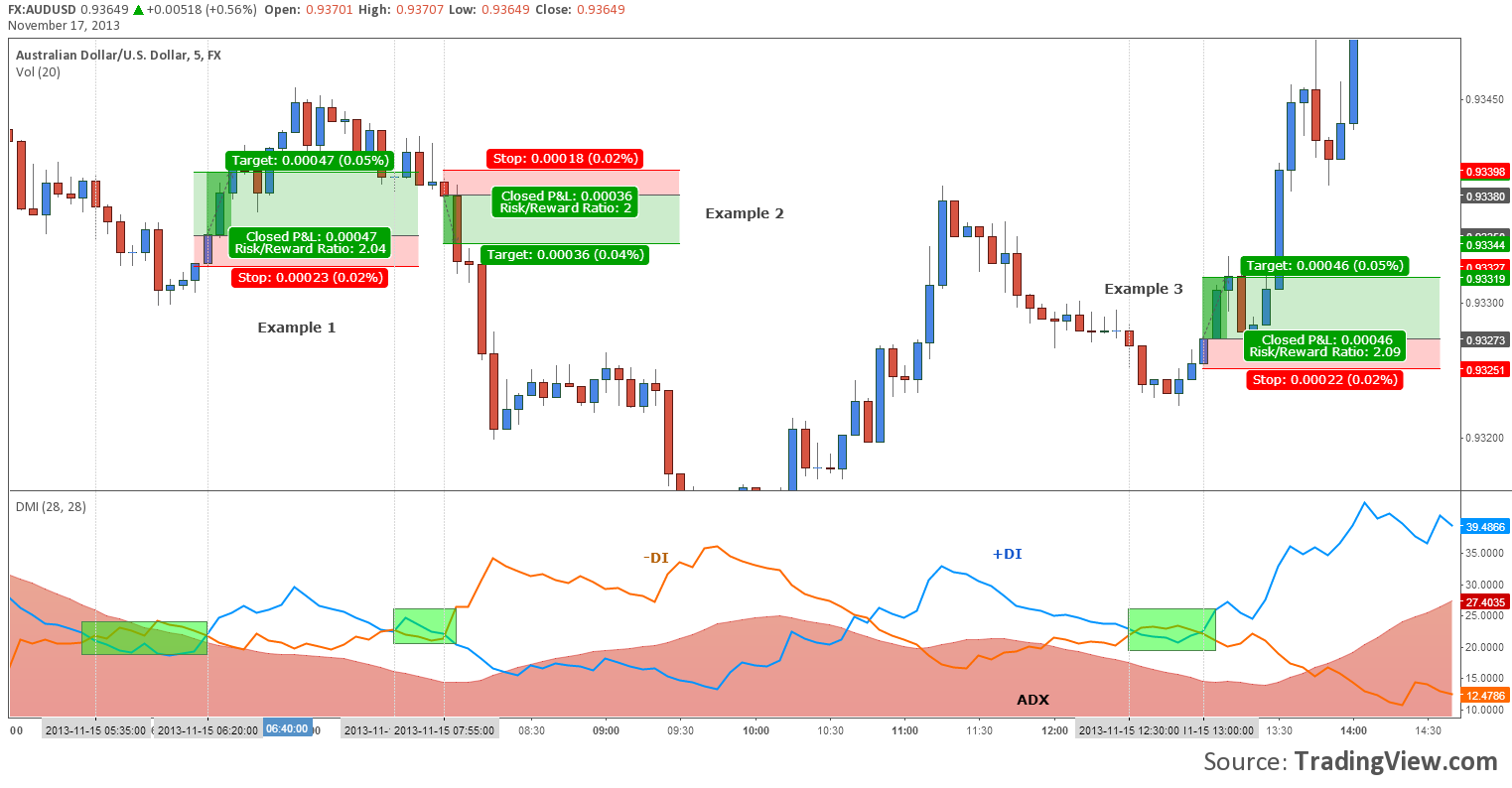
Chart: AUDUSD, M5

First you will have to look for a crossover between +DI and –DI. For better understanding let’s take:

Example 1

+DI dropped under –DI and in a relatively short period of the time +DI went back over –DI (we call this a hiccup). When this happens wait for the 5 minutes candle to close and confirm the crossover. Open a buy on the opening of the next candle and place a Stop Loss under the confirmation candle (just like in our example.)

Example 2

This time –DI dropped under +DI, but in a short period of time it went back over. Sell on the opening of the next candle and place a Stop Loss above the confirmation candle (you can put it several pips above the high of the candle to take into consideration also the spread).

From our tests we observed that as for the profit level it is best to set it two times the risk. So the risk/reward ratio would be of 1:2. You can play a little with your money management system so that the first target to be set at this reward level, the second at 1:3 and so on.

The post Simple Scalping System based on Directional Movement appeared first on investazor.com.

The Practical Investor Weekend Update

Weekend Update

November 15, 2013


— VIX has finally completed its Primary Wave [5] which may have been truncated.  This happens more often than one would suppose.  The Cycles Model suggests that the decline is finished.  Perhaps we may see new highs developing now.

SPX “throws over” its trendline.


— SPX did a final throw-over of the massive Ending Diagonal.  Throw-overs do not last.  The reversal from this point may be violent.


(ZeroHedge)  As we “forecast” this morning (and a month ago – if our extrapolation of the Fed’s balance sheet is correct – i.e. no Taper – that the S&P 500 Fed L-A-B-I-A should be around 1800 by year-end), the Fed can be proud that they managed (remember it “costs” $3.25bn in POMO to create 1 S&P 500 point) to get the key US equity index – the S&P 500 – near the critical 1,800 level…


NDX meets two trendlines.


— This week NDX found itself pressing against two upper trendlines, that of the Massive Ending Diagonal and the upper trendline of the Broadening Wedge formation.   While Ending Diagonals often have throw-overs, Broadening Tops do not.  This suggests that NDX may be at the end of the line.


(ZeroHedge)  It is becoming increasingly obvious that we are seeing the disconnect between financial markets and the real economy grow. It is also increasingly obvious (to Citi’s FX Technicals team) that not only is QE not helping this dynamic, it is making things worse. It encourages misallocation of capital out of the real economy, it encourages poor risk management, it increases the danger of financial asset inflation/bubbles, and it emboldens fiscal irresponsibility etc.etc. If the Fed was prepared to draw a line under this experiment now rather than continuing to “kick the can down the road” it would not be painless but it would likely be less painful than what we might see later.

The Euro is bouncing between support and resistance.


.


— The Euro bounced back through Intermediate-term support/resistance to close short of its Short-term resistance at 135.54 this week.  The bounce may be over in very short order, since the Cycles Model suggests the Euro may be due for a significant low in mid-December.


(ZeroHedge)  As we discussed two weeks ago, it would appear Germany’s lack of willingness to throw itself on the pyre of self-sacrifice and not adopt a global Fairness Doctrine – as engendered by the US Treasury’s (and IMF’s) bashing of the core European nation’s for maintaining its export strength and daring to keep Europe intact and thus a periphery-damaging strong Euro – is gathering steam.


The Yen is dropping out of its Triangle formation.


–The Yen dropped beneath the Triangle formation this week.  The Cycles Model suggests an imminent sharp decline that may challenge the Head & Shoulders neckline at 96.00. The Yen may break down beneath the neckline in a Primary Wave [5] in a very strong Primary Cycle decline through early December.

Investing.com – The yen weakened further against the dollar on Friday, helping the Nikkei jump smartly in morning trade on expectations that easy global monetary policies will continue aggressively in the near term in the United States, Japan and Europe

USD/JPY kept gains above 100 in early Asian trade on Friday, continuing a trend from overnight after Federal Reserve Chair Nominee Janet Yellen said that monetary stimulus tools should stay in place as needed to ensure a more robust recovery…

The US Dollar consolidates at mid-Cycle support.


— USD closed above its mid-Cycle support at 80.73, leaving it in the upper half of its weekly trading band.  The long-term uptrend has regained the upper hand in a very negative environment.  Dollar shorts are retreating as institutions begin to allocate more toward the Dollar.


(RT)  To protect Russians against the “collapsing US debt pyramid”, a Russian legislator has filed a draft bill to ban circulation of the currency in Russia.  Once a Moscow mayoral hopeful, Mikhail Degtyarev, 32, likens the US dollar to a worldwide ponzi scheme which he says is scheduled to end in 2017.  “If US national debt continues to grow at its current rate, the dollar system will collapse in 2017,” the submitted draft legislation says.

“In light of this, the fact that confidence in the US dollar is growing among Russian citizens is extremely dangerous,”  Degtyarev wrote in his explanatory note attached to the bill.


Gold bounces from its Cycle Bottom.


— Gold bounced from its last support – the Cycle Bottom at 1261.79.  Since it appears to have completed an impulsive decline it may retrace some of its losses as far as Short-term resistance at 1311.82.  The big picture looks very grim for gold.  The nearer term target is the completion of its Cup with Handle formation near 731.28.  I hope that I am wrong on the lower target.


Treasuries also bounce from the Cycle Bottom.


— USB declined to its Cycle Bottom at 130.27.  The lower trendline of its Broadening Wedge is just beneath it, but may provide little support.  Once it has completed its retracement, USB has an appointment with an important low possibly during Thanksgiving week.

(CFTCLaw)  According to Businessweek, the Commodity Futures Trading Commission will be voting today on a new rule that will result in Treasury collateral being subject to a “prearranged and highly reliable funding arrangement.” Should the rule be passed, clearinghouses will be forced to back Treasury bonds with credit lines.

The rule, according to experts, could cause liquidity facility costs to double. The steep rise in operating price may lead to clearing members either passing those costs on to end customers or leaving the business outright.  It seems that, while Treasury bonds are considered to be an extremely safe investment, liquidating them could take up to a day, which many think would be too long should an event similar to the financial crisis of 2008 arise.

Crude remains beneath mid-Cycle support/resistance.


— Crude extended a very powerful Primary Cycle decline to Thursday.  At this point, it appears ready to stage a multi-week rally.  We are evaluating to see whether it may rise above its Long-term support/resistance at 98.36.  The Cycles Model suggests that, should it rally above critical support, it may continue to rise into mid-December.  If so, we could see crude Challenging its Cycle Top at 110.09 by then.  The alternate view suggests a rather lackluster bounce and further decline to the Cycle Bottom at 81.17.

(BBCNews)  US domestic crude oil production has exceeded oil imports for the first time since 1995, according to the Energy Information Administration (EIA).  The EIA said petroleum imports were at their lowest since 1991, partially due to surging domestic oil production from hydraulic fracturing, or fracking.  In October, US crude oil output averaged at 7.7 million barrels per day (bpd).  The EIA says it expects output to exceed 8.8 million bpd by 2014.

China stocks struggle to maintain Intermediate-term support.


–The Shanghai Index declined lower, but bounced back above its weekly Intermediate-term support at 2127.41.  Support may not hold, since the Cycles Model suggests the decline may extend to the third week of November.  China stocks are in a Primary Cycle decline, which has the potential of being much stronger than might be expected.

(ZeroHedge)  The initial disclosures from the much anticipated and recently completed Third Chinese Plenum were a dud. Which, in a world where all the upside comes from hope and faith in the future (since the present continues to get worse), meant at least 20-30 S&P points left on the table just because the quality of promises, pledges and emotional words out of the Chinese Communist Party was not strong enough. So in order to change that, Xinhua has just pre-released a document summarizing all the party reform initiatives, this time with the promises taken up to the next level.

The India Nifty loses Short-term support  .


— The India Nifty index may be starting a very fast decline to its Cycle Bottom.  After it completed its final reversal it dropped through weekly Short-term support at 6076.35 and retested it as resistance at the close of the week.

The trigger to activate the Orthodox Broadening Top formation lies at the bottom trendline at 4400.00  It appears that CNXN may be reaching the bottom of this chart as early as the end of November, due to a Primary Cycle decline now underway.

The Bank Index closed above Intermediate-term support.

— BKX  “ran the stops” again by rallying on Friday back above its trendline.  Even still, it did not make a new high, so the August 2 high still stands.  However, BKX has an important low to make in late November.  This has been a very difficult index to short for many investors.

(ZeroHedge)  By now everyone has heard of securitization: the process whereby banks take risky assets on their books, package, tranche them, and then re-sell them to yield chasing fiduciaries of widows and orphans. The conversion process can be nebulous, usually involving a 20 year-old evil French mastermind working for Goldman, and a billionaire hedge fund manager, who select the worthless securities put into the weakest tranche, just so the abovementioned two parties can short it while misrepresenting their conflicts of interest, and make a boatload of money when the whole securitized structure implodes. The process usually takes place “off balance sheet” via Special Purpose Vehicles so it is completely unregulated, and as such allows massive leverage.

(ABCNews)  European Union finance ministers vowed on Friday to make sure the region’s banks have restructuring plans ready in case they flunk a key review of their finances.

The European Central Bank is leading a yearlong review of the EU’s largest banks to find and then either fix or weed out weak banks. The question is what to do in case the review finds a bank needs to raise more capital.  The ministers in Brussels said that they would make sure to have the banks prepare “specific and ambitious strategies.”

(ZeroHedge)  Today’s release of the 2013 edition of the Global Shadow Banking Monitoring Report by the Financial Stability Board doesn’t contain anything that frequent readers of this site don’t know already on a topic we have covered since 2009. It does however have a notable sidebar which explains the magic of “(un)fractional repo banking” – a topic made popular in late 2011 following the collapse of MF Global – when it was revealed that as part of the Primary Dealer’s operating model, a core part of the business was participating in UK-based repo chains in which the collateral could be recycled effectively without limit and without a haircut, affording Jon Corzine’s organization virtually unlimited leverage starting with a tiny initial margin.

Regards,

Tony

Anthony M. Cherniawski

The Practical Investor, LLC

www.thepracticalinvestor.com


Disclaimer: Nothing in this email should be construed as a personal recommendation to buy, hold or sell short any security.  The Practical Investor, LLC (TPI) may provide a status report of certain indexes or their proxies using a proprietary model.  At no time shall a reader be justified in inferring that personal investment advice is intended.  Investing carries certain risks of losses and leveraged products and futures may be especially volatile.  Information provided by TPI is expressed in good faith, but is not guaranteed.  A perfect market service does not exist.  Long-term success in the market demands recognition that error and uncertainty are a part of any effort to assess the probable outcome of any given investment.  Please consult your financial advisor to explain all risks before making any investment decision.  It is not possible to invest in any index.


The use of web-linked articles is meant to be informational in nature.  It is not intended as an endorsement of their content and does not necessarily reflect the opinion of Anthony M. Cherniawski or The Practical Investor, LLC.


Option Probabilities Spell Possible Trouble for Treasury’s

By J.W. JonesOptionsTradingSignals.com

The incredible rally in equities in 2013 has begun to stir concern among many that the stock market is now in a bubble. We have entered the euphoric stage of this bull market and equity prices cannot and will not go lower according to some talking heads in the financial punditry.

While chatter is starting to heat up that equities are in a bubble, the real bubble seems to be ignored for the most part. The larger, more concerning bubble is in the Treasury marketplace where the Federal Reserve continues to print money to purchase treasury bonds to help keep interest rates artificially low.

Instead of debating the bubbles in Treasury’s versus equities, or trying to predict when the bubble in either asset class may pop, I want to focus on the near term for price action expectations in longer-dated Treasury bonds.

Below is a weekly chart of the Treasury ETF TLT which is supposed to reflect the price action and yield generation of a portfolio of 20+ year duration Treasury bonds issued by the U.S. federal government.

Chart1 (4)

I have identified the key support areas which are supported by the price by volume indicator as well. No one in the financial media seems interested in discussing the nearly 13% drop year-to-date we have seen in longer-dated Treasury bonds shown above.

Furthermore, based on current price action we could see lower lows in the days and weeks ahead if price breaks below near-term support levels around $102.20 / share. I wanted to take this analysis one step further and look out into the future from an option trader’s perspective.

Based on the bill which was recently passed to reopen the government, there are two key dates which could impact Treasury bonds. The recently passed bill keeps the government open until January 15, 2014 at which point Congress will either compromise on a budget or accept additional sequester cuts. Furthermore, if no compromise is achieved and the sequester cuts are not favored, the federal government could shut down again.

The other key date is February 7th which is the date where Congress will yet again hit the debt ceiling. It is likely that through special measures the Treasury can push that date beyond February. However, the debt ceiling discussion will yet again impact government bonds as the threat of another default will likely emerge if recent discussions are any blueprint for the future.

Since the key dates are known, it allows option traders to focus on a specific expiration month. Based on the debt ceiling date of February 7, I wanted to look at the March 2014 TLT option chain for clues about what the options marketplace is indicating about any future event(s) and the potential impact on Treasury prices.

The first thing I did was to check the implied volatility of the various monthly option expirations and I found a glaringly obvious warning signal. The table shown below demonstrates that implied volatility is higher on the March 2014 options than the December or January expirations.

Expiration Month

Implied Volatility – 11/14/13 Close

December Monthly

11.95%

January Monthly

12.17%

February Monthly

12.57%

March Monthly

13.20%


The March 2014 option series has 10.46% more implied volatility than the December 2013 monthly option series based on the November 14th close. As can be seen above, the March monthly expiration has considerably higher implied volatility than the rest of the expiration series leading up to March.

Essentially this implied volatility skew is telling us that the option market believes that volatility will increase as we move into the March to April time frame. This corresponds with my expectations that Treasury’s may see serious price volatility late in the first quarter of 2014. The timeline fits nearly perfectly with the next debt ceiling discussion.

The next examination I look at is standard deviation based price levels to ascertain clues about the market’s expectations in the future. The TLT March 2014 monthly put option chain is shown below with the 1 standard deviation and 2 standard deviation price points highlighted.

Chart3 (1)

The chart above illustrates the closing price levels on November 14, 2013. As can clearly be seen, the 99 strike is roughly 1 standard deviation (68% probability) lower from the closing price of $104.52 / share. A 2 standard deviation move (90% probability) corresponds with the 91 put strike.

What the March 2014 put option chain is telling probability based option traders is that implied volatility levels are indicating that there is a 68% probability that TLT closes above $99 / share. There is a 90% probability that price closes above $91 / share at the March monthly expiration. Now we will look at the call side of the March 2014 TLT option chain.

Chart4 (1)

The closing price on November 13, 2013 was $104.52 / share. A 1 standard deviation (68% probability) corresponds to the 107 strike. A 2 standard deviation move (90% probability) corresponds with the 112 strike. Thus, there is a 68% probability that TLT closes below $107 / share at the March monthly option expiration. There is a 90% probability that price closes below $112 / share.

So what does this data tell option traders looking at probabilities? The answer is simple. The TLT March 2014 options’ implied volatility levels are telling us that presently the marketplace believes that TLT has a higher probability of being lower than today’s closing price of $104.52 / share on March 21, 2014.

There is a 68% probability that the price of TLT at the March expiration will be between $99 – $107 / share. There is a 90% probability that the price of TLT at the March expiration will be between $91 – $112 / share.

The one standard deviation upside strike is $107 / share which is just 2.37% above $104.52 / share. The downside strike is $99 / share which is 5.28% below today’s closing price. Based purely on those numbers, there is nearly a 2 : 1 probability that TLT’s closing price on March 21, 2014 will be below today’s closing price of $104.52 / share.

The same situation is true when we look at the 2 standard deviation predicted price range. The 90% probability upside target is $112 / share which would correspond with a 7.15% move to the upside. However, the 90% downside target is $91 / share which would correspond with a 12.93% move to the downside from today’s closing price.

I want to be clear that this does not mean TLT’s price will go down for sure. It is merely a road map as to what TLT’s option chain is indicating about future price action. It is without question that the implied volatility levels in March TLT options indicate that there is risk ahead regarding Treasury bonds.

Whether the risk revolves around the debt ceiling debate or a possible taper from the Federal Reserve is hard to know for sure, but at this point TLT is nearly 2 times more likely to move lower in the months ahead.


To learn more about probability based option trading, consider becoming a member of www.OptionsTradingSignals.com for a totally different view of the markets and how to trade options for consistent profitability over the longer-term.


This material should not be considered investment advice. J.W. Jones is not a registered investment advisor. Under no circumstances should any content from this article or the OptionsTradingSignals.com website be used or interpreted as a recommendation to buy or sell any type of security or commodity contract. This material is not a solicitation for a trading approach to financial markets. Any investment decisions must in all cases be made by the reader or by his or her registered investment advisor. This information is for educational purposes only.


The Future of the Currency War

By MoneyMorning.com.au

The markets have flipped again.

Earlier in the year, the market was bullish on Japan as Prime Minister Shinzo Abe and the Japanese Central Bank launched their stimulus package, dubbed ‘Abenomics’. At the same time the market was nervous about a major slowdown in the Chinese economy and the impact on Australia.

Now it seems the Japanese economy is struggling, while China’s (arguably) is picking up. But Japan is the key market to watch when it comes to the future of the currency war

Japan: The Early Warning Line?

Take this from the Australian Financial Review on Friday:

‘Mr Abe’s 11-month old administration has sought to re-energise Japan Inc after years of deflation and population declines reduced manufacturers’ incentive to expand at home. Thursday’s figures show companies have yet to respond in force, signalling bolder steps may be needed to cut regulation and give companies an incentive to deploy near-record stockpiles of cash…“Warning lights are flashing for Abenomics,” said Kiichi Murashima, chief economist at Citigroup in Tokyo. “With the absence of further weakening in the yen and a clear global recovery, Japan’s recovery is losing momentum.”’

Japan’s move to double the monetary base, or more simply the supply of yen, was the big shot of this year in the currency war. The yen is down almost 20% against the US dollar, a massive move for a major currency like the yen. It also sparked a rally in Japanese stocks at the beginning of the year.

But behind the rise in the share market is an ugly truth. Bloomberg reported last week that the share of Japanese households with no financial assets rose to a record figure since statistics began in 1963. Falling wages and incomes are forcing the Japanese to run down their savings just as a weaker currency and increased taxes hit at the same time.

Anyone on a fixed income in Japan is getting slaughtered. And there is no guarantee the Japanese Central Bank won’t attempt to drive the yen even lower to raise inflation. The whole Japanese standard of living will slowly rot away.

This is the misguided playbook of the central banks all over the world. They think liquidity can substitute for genuine structural reforms of the economy. So expect more of the same from Japan. And you can probably also expect more of the same from the US and Europe as well…

Central Banks and the War on the Savings Class

Inflationist central banks are on an all-out attack against deflation. The collateral damage they’re prepared to sacrifice are savers all over the world. That means you.

Take this report from Money Morning‘s sister pub The Five Minute Forecast:

‘Erik Townsend is a retired software entrepreneur turned commodities trader who has a weekly spot on Jim Puplava’s Financial Sense podcast. He attended a talk by [US Federal Reserve Chairman nominee] Yellen in San Francisco some time back.

‘”She was talking in her lecture,” he recalls, “about how if there was anything she could do to figure out a way to make interest rates negative, she would do that, because she feels that that’s what we need to do to make credit as easy as possible for the people. And I asked the obvious question that none of the San Francisco liberals were asking, which is, what about savers and investors? Doesn’t that punish them?

‘”And what she said didn’t surprise me that much. She said, well, we’re coming to the point where we have to consider the role of people who have significant savings and their responsibility in society, that it really is selfish to be hoarding it and that we need to create incentives through government for people to spend their savings, because that’s exactly what we need in order to rejuvenate the economy.”’

Remember, the current fear is the Fed will taper their bond purchases and pull the rug out from underneath the market in early 2014.

But the US economy is neither hitting the Fed’s inflation or unemployment target. So it’s perfectly possible for the Fed to increase QE. That’s the more likely scenario according to currency expert Jim Rickards. His analysis leads him to believe the Fed wants to hit 4% inflation. This is essentially to force American consumers into spending their depreciating dollars and unleash the multiplier effect to produce growth.

We’re sure Jim will have plenty more insight for us when he hits town next year for the Port Phillip Publishing conference World War D. He’ll be joined by the star of the last conference in 2012, Satyajit Das,  bestselling author John Robb and another genuine investing A-lister who we’re keeping under wraps for now. You can get on the early bird list here to get access to a discount with no obligation. It will all take place here in Melbourne.

If Yellen and the Fed do increase QE, pressure will come on the US dollar again. As currency moves are a zero sum game, that would mean a stronger euro. That won’t be a pleasant outcome for the European central bank, with the euro already trading over US$1.30. You probably know the ECB surprised the market when it cut the cash rate earlier this month.

Over at The Denning Report, Dan Denning has been studying the shifts in global capital. He suspects the ECB will step into the market in 2014 using the same playbook Japan and the US have turned to. He calls it the next shot in the currency war.

Dan’s got some ideas on how you might capitalise on these developments. You can check out his latest research here. The currency war will be battled out for years to come. It’s just a question of who makes the next move. Stay tuned.

Callum Newman+
Editor, Money Weekend

PS. Hey, just a reminder for you to put your name down on the advance list for the World War D conference. It’s in Melbourne on March 31 and April 1. There’s no obligation to attend, but by being on the advance list you’ll qualify for special early bird pricing. Go here to put your name on the list now.

Special Report: The ‘Wonder Weld’ That Could Triple Your Money

Join Money Morning on Google+


By MoneyMorning.com.au

Your Living Room is Worth Billions to These Technology Giants

By MoneyMorning.com.au

There’s a battle underway for your eyes, ears and attention. It’s not the latest Victoria Secret parade, but a battle between two of the biggest heavyweights in technology.

This is set to be bigger than VHS vs Beta, Cassette vs CD or PC vs Mac.

For an industry that’s over $66 billion in size there’s a fair bit at stake here. And this battle might spell the end for the loser…

It all kicked off yesterday and is set to intensify this coming Friday. This is just the beginning too, as this is set to drag on for at least the next five years.

It will see new companies achieve unheard of success and will definitely see the end of others. What’s more important than anything though is which side will you be on? Because you’ll side with one of these two.

If you don’t you’re simply missing out on the biggest change to your home entertainment since you got your first TV set.
 
We’re talking about the much-anticipated video game consoles from Sony [NYSE:SNY] and Microsoft [NASDAQ:MSFT].

This isn’t some play to get video games into kids Christmas stockings. This is serious business.

Yesterday Sony officially launched their new PlayStation 4 (PS4). This coming Friday Microsoft will release their Xbox One.

The last time Microsoft launched a games console was 2005. It was the Xbox 360 and it went on to sell 79.4 million units worldwide. Considering it’s still for sale, that number is only going to go up. In fact, add a couple million more as prices fall when the Xbox One goes live.

The first generation Microsoft game console was the Xbox. Launched in 2001, it set Sony and the PlayStation right in its sights.

Xbox sold over 24 million units worldwide. Their investment into gaming paid off. Microsoft had created a highly profitable business.

So they decided to invest more into the Xbox division. It turned into one of their most successful divisions as each generation of Xbox came to market.

Sony had been making money off console gaming for years before Microsoft entered the ring. Sony’s first serious gaming console was the (much-loved) PlayStation (PS). The first generation of PS launched in 1994 sold 102.45 million units.

Sony knew they were onto something and in 2000 they launched the biggest selling games console of all time. The PlayStation 2 (PS2). PS2 applied technology that most supercomputers (at the time) would be jealous of.

The PS2 sold over 155 million units worldwide. It is, hands down, the godfather of video gaming.

But not one to sit still, Sony launched the PlayStation 3 (PS3) in 2006. Not the resounding success of the PS2, the PS3 (only) sold 80 million units worldwide.

And now it’s time for the next battle. These two technology giants are going head to head with what they both claim to be a revolution in gaming.

They both want control of your living room. Because the next generation consoles, the PS3 and Xbox One, are more than just a gaming console. They’re entire multimedia systems.

This is serious business, with literally billions of dollars at stake. And it’s not just the actual consoles that are so important to this industry.

Hollywood is Dead. Long Live The Video Game

There’s no point having the world’s most advanced gaming console if you’ve got nothing to play on it. The games that go with each system are equally as important to Sony and Microsoft as the consoles they’re making.

Years in advance Sony and Microsoft approach game designers. They make them sign confidentiality agreements, and more than likely dump big hessian sacks filled with cash on their desks.

The whole point is to have games completely ready to go when the new consoles go live. And there’s big profits at stake if a game can be secured as an ‘exclusive’ title.

Because one successful game can make or break a company. It’s not just the game design company that put their business on the line; the console maker has a lot to lose also.

Take for instance Microsoft’s first console, the Xbox. There is absolutely no way it would have been the success it was if not for one particular game.

The game was Halo. Halo launched with the Xbox. It received praise from critics that most major films would be jealous of.

It broke sales records and hit one million units within a few months of release. If it wasn’t for that game it’s possible Xbox wouldn’t have had the success it’s had to date.

Success Comes at One Billion Dollars

If you think there’s big money in movies and Hollywood, you’d be wrong. Hollywood has taken a back seat. In fact ‘movie stars’ are playing video game characters. There’s better money in it. The new entertainment industry is all about gaming. Gaming is now a multi-billion dollar market.

Here’s why.

A few weeks ago a new video game, Grand Theft Auto V (GTAV) launched to market. Within 24 hours of release it reached $800 million in sales. It only took three days to reach $1 billion in sales. GTAV technically now holds the title of fastest selling, highest single day grossing game of all time.

Put this in comparison to one of 2013′s biggest Hollywood movies, Thor: The Dark World. In the space of a week Thor has grossed about $342 million in sales.

That’s about one third of GTAV.

Then last Tuesday another game, Call of Duty: Ghosts (CODG) launched. Within one day it’s maker, Activision [NASDAQ:ATVI] had shipped $1 billion worth of units into shops.

Every major video game title released now sets the bar at that mark. Success comes at one billion dollars; anything less is a waste of time.

This is all warming up to the next two weeks and the madness that is Christmas time. These game and console makers aren’t stupid. They know this is the prime time to launch their headline titles as people spend up big.

But don’t think that these video games or video game consoles are for the kids. The average age of your typical ‘gamer’ is 34. In fact the average age of gamers has steadily increased over the last few decades. Seems the older we get the more we like to play video games.

What it means is that companies like Sony, Microsoft and Activision are now aiming their products at a different demographic.

A ‘young professional’ will happily spend $549 on a new console. Then probably add a few accessories. Of course there’ll be accessories…and a few $90 games also. About $1,000 later they’re good to go. I should know. That’s how it went when I bought my PS3.

We’ll see how it pans out over the next two weeks. Failure of either one could kill the name PlayStation or Xbox for good. But success could mean massive profits, and a corresponding bump in the share price. Console releases only come around every seven years or so. So if you know whom to back there’s a small window to cash in on the huge profits available.

Between the game companies and console makers this year is going be huge for gaming. It’s a fickle business and there are new competitors wanting a slice of it. But for now the battle is between Sony and Microsoft. It’s a war in your living room where you get the enjoyment and these technology giants – and their investors – get the profits.

Sam Volkering+
Technology Analyst, Revolutionary Tech Investor

Join Money Morning on Google+


By MoneyMorning.com.au

Deliver or Die: Financial Survival Challenges for Today’s Junior Oil Companies

By OilPrice.com

Long gone are the days of easy money, so it seems. Junior energy companies are finding today’s capital to be more expensive and harder to access.

In the current market, juniors are fighting an ongoing battle just to balance sustainable growth, manage debt, and to compete with peers for dollars that just aren’t there. When assessing a junior, one must look at how they put their budgets together and maintain them if they’re to survive out there in the wild.

This isn’t a new phenomenon either, as a 2011 study of post-recession capital markets performed by the Society of Petroleum Engineers inferred that, “Upstream energy companies now compete not only for preferred access to the best new hydrocarbon resources but also for credit from capital markets.”

It’s time to point out the obvious. There’re not a lot of positive scenarios out there for these small caps.

The problem today is that many companies have to strap themselves in and take on debt, which puts them at great risk: Deliver or die.

The reality is that the rise of unconventional resource plays, along with the increased use of horizontal drilling and complex completions have driven prices through the roof. A company going to the street to raise $5-10 million for one horizontal well is really exposing itself. Even if they hit on their first well, the market can be unforgiving when a company comes knocking on the door of the coffers once again.

Lord help you if the well is a bust. When you’re a junior, you can’t bury the past behind 6 or 7 other wells with a huge capital budget. In reality they only raise a big enough budget for one high-cost well, and there’s no room for error.

The banks have also been unsympathetic, as the disposition market continues to dry up. Companies don’t have the opportunity they’ve had in the past to sell assets in order to get cash like they used to. That option is also closed.

So what’s a junior to do?

This is where it might be beneficial to look at two peer companies coming at the same problem with different methods, but similar strategies: Blackbird Energy [TSX.V: BBI] and Edge Resources [TSX.V: EDE].

Both are completely aware of the challenges ahead, and share roughly the same market cap while at the same time run programs consisting of lower-risk growth plans.

“This is quite frankly the biggest ‘show me’ market I’ve ever seen,” says Garth Braun, President and CEO of Blackbird Energy.

“If you can succeed in actually showing people your potential through your results, only then will you see movement. So you must show the investor that not only can you make them money, but that you have a suitable portfolio of assets and a stream of activity to come that you can sustain.”

Braun’s team is coming off of a very successful private placement capital raise that resulted in an oversubscription to the tune of $3.1 million. With a diversified asset portfolio that includes many (to steal a baseball analogy) singles and doubles on its low-risk Mantario properties, as well as a large land base with a high price tag within two areas of the highly sought after Montney play.

In order to keep up with his gameplan, Braun and his team intend to drill several of these low-risk Mantario wells over the next year. Given the examples led by their Mantario predecessors Rock Energy [TSX: RE], it’s plausible to predict that if Blackbird can repeat Rock’s successes they’ll be able to drill, complete and tie-in these wells at a cost of only $750,000 for production on average of 75 bbls/d each, picking up their production totals along the way.

But while Blackbird can easily afford to continue drilling these shallow conventional wells, it’s the big potential on their Montney real estate that has the potential to make the needle move. Surrounded in the Bigstone region by majors such as Kelt Exploration [TSX: KLT] and Delphi Energy [TSX: DEE], Blackbird knows that it’s sitting on some very valuable land that continues to grow in value as its neighbours drill.

Courting a major into a carried interest can only serve to help increase the value of the company going forward and production—all without having to take on the risk of going it alone. On the flipside, it would take the team a very long time to generate the kind of cash needed internally to take the higher risks necessary when elephant hunting in the Montney.

“The only way a junior can truly capitalize their program and fund their growth is through internal generation of cash,” says Brad Nichol, President and CEO of Edge Resources.

“Unfortunately, most juniors have to deal with Recycle Ratio, which is in a sense the profit to investment ratio. If you put a dollar in, how many dollars do you get out?”

Typically right now the average profit to investment ratio that companies are operating under is approximately 1.5. That means for every $1 they put into the ground, they get $1.50 out (over the life of the well).

“My profit to investment ratio is 3.5. I’m generating cash through investing into the ground and drilling wells that I know will generate much more cash then I put in,” says Nichol.

Much like Braun’s Mantario properties, Nichol’s Edge Resources is touting low-cost, low-risk production growth on its Eye Hill project. Both the Eye Hill and Mantario give each company the potential for pay out in roughly 6-8 months.

“I’m focusing on conventional shallow wells (as opposed to unconventional costly horizontal wells). With each one, I’m only risking $650,000 capital all in, and that’s not even the risk capital,” says Nichol. “That’s just the capital requirement to get me a producing well.”

“I’m spending less capital and getting a better result. I’m paying back the capital in 6 months or less, and I’m generating 3.5x the capital we put in. That’s the key to Edge Resources, and what makes us unique.”

Recent news from both companies has shown a different strategy in terms of raising money. Edge Resources has gone the debt route, while Blackbird went the equity route. The debt option was still open for Edge, perhaps because of the healthy recycle ratios, which don’t scare the bankers away from the teller window. For Braun’s strategy, there was still quite a bit of interest when he went to the market with some valuable additions to the company portfolio that lured in new investors (Disclosure: that includes this author on the most recent private placement).

“I’m not against debt if it’s in essence well serviced and I have ready access to the equity markets to replace it,” says Braun. “We felt we were at a point where in essence we originated all of our oil plays and now we’re focusing on drilling them up. It was premature for Blackbird to go and take debt on. It was offered to us but I felt it was too risky for our shareholders to be exposed to that kind of debt.”

“We wanted to drill up the assets and prove it. We felt there would be a material-value move to our company, and I wasn’t willing to take the risk on putting a date of failure on if I wasn’t able to raise equity. So with our private placement it does indeed cause some dilution, but the bonus is that I don’t have a proverbial Sword of Damacles in the form of a milestone date over my head. Instead, we worked to rally together a group of investors that wanted to invest in our company and see us grow through that investment.”

Blackbird’s most recent operational update hints towards a new milestone on Mantario. Production on it’s A15-6 well has officially been announced, with results soon to come in the next 15 days. As well, the company picked up an additional 18 sections (11,520 acres) of P&NG rights in the Greater Karr area, all of which include deeper rights like the highly prospective Duvernay formation. Should Blackbird continue to drill Mantario while dangling the Duvernay, they should be able to continue to make their new set of investors happy.

Source: http://oilprice.com/Finance/investing-and-trading-reports/Deliver-or-Die-Financial-Survival-Challenges-for-Todays-Junior-Oil-Companies.html


By. G. Joel Chury of Oilprice.com


Cap on debt- to-income can control home prices – BIS

By CentralBankNews.info
    Most countries that experienced an explosion in house prices ahead of the global financial crises have taken a variety of policy measures to avoid another real estate boom with evidence that a limit of the debt-service-to-income ratio is the best tool to slow housing credit growth, according to the Bank for International Settlements (BIS).
    But to slow down the actual growth of real estate prices, a BIS working paper found that higher housing- related taxes was the only tool that had any measurable impact.
    Measures specifically targeted at dampening a rise in real estate prices are now used by authorities worldwide as it has become clear that an increase in central bank interest rates that is large enough to dampen the rise in house prices would run the risk of triggering an overall recession.
    The working paper by Kenneth Kuttner, professor of economics at Williams College, and Ilhyock Shim, senior economist at BIS’ Hong Kong office, systematically examines the efficacy of nine different measures taken by 60 countries since 1980 to control housing credit and house prices.
    Click to read: “Can non-interest rate policies stabilize housing markets? Evidence from a panel of 57 economies.

    www.CentralBankNews.info

Investing in Generation Y and the Next Great Baby Boom

By The Sizemore Letter

No respect.

Generation Y, like Rodney Dangerfield, has a problem: they get no respect.

I’m joking, of course, but at this stage of their lives Gen Y really isn’t taken as seriously as they would like to be.  It is to be expected; they’re young.

The front end of Generation Y was born in the early 1980s, but the biggest cohort was born in the “mini baby boom” between 1989 and 1991.  This puts them in their early 20s today, in their last years of college or their first years on the job.

There are a few things you should know about Generation Y.  Growing up in such a large generation, they are competitive.  I grew up in Generation X, a much smaller generation.  For me and my peers, everything from making the little league baseball team to getting accepted to college was comparatively easy; there were relatively few of us competing for each slot.  Not so for Generation Y.  This is the generation that had to start studying for the SAT at age 11 and spend their summers building homes in Africa in order to be considered for admission to a decent university. Having grown up in comparative abundance, they may be a little spoiled.  But they’re certainly not slackers.

Your last experience with a member of Generation Y may have been having your order taken at Starbucks.  But as hard as it may be to believe today, that barista is going to be a mom or dad in a few short years.  And in the process, they are going to create a massive boom in everything from baby formula to starter homes.

Let’s take a look at the numbers here.  Depending on where you draw the precise lines, Generation Y is either a little bigger or a little smaller than the Baby Boomers.  But we’re talking about approximately 80 million people.

Mother-Wave

The average age of first childbirth is about 25-26 years today for American women, though that number continues to rise a little each year.  The higher educated a woman is, the longer she is likely to postpone motherhood, and Gen Y women are the highest-educated generation of women in U.S. history.  A bad economy with high unemployment among the young has probably added another year or two to the average as well.

But biological clocks don’t stop ticking, and the largest cohort of Gen Y women is quickly approaching their peak family formation years.   I expect the number of live births to increase every year from now through the early 2020s.  And if Gen Y has the standard two kids per family, you’re talking about 80 babies being born in the years ahead. 

How do you invest in this macro trend?  Take your pick.  You could invest in the makers of infant formula, such as Abbott Labs (ABT) or Mead Johnson Nutrition (MJN).  You could buy a portfolio of rental houses in the neighborhoods where young families are moving…or for that matter, you could selectively invest in homebuilder stocks.  You could start a business that caters to new parents…or grandparents! Any or all of these are perfectly viable ways to play this trend.

But if you want to be a successful investor in the U.S. equity markets over the next two decades, a general rule of thumb applies: figure out what Gen Y will be buying in the years ahead and invest in it before the crowd catches on.  And give Gen Y a little respect.  Their consumer preferences will shape the U.S. economy for the next generation.

FREE from Charles Sizemore: 4 Global Megatrends for 2014
FREE 8-part investing series from Charles Sizemore will outline which sectors will soar & which stocks will deliver the highest returns. “Global Megatrends for 2014” starts November 5– and won’t be repeated. Click here to sign up now!

This article first appeared on Sizemore Insights as Investing in Generation Y and the Next Great Baby Boom

Join the Sizemore Investment Letter – Premium Edition

Gold Rebounds as China Vows Market Reforms, US Fed Blamed for Shanghai Rates Spike

London Gold Market Report

from Adrian Ash

BullionVault

Fri 15 Nov 09:20 EST

The PRICE OF GOLD rose Friday lunchtime in London, regaining last week’s closing level of $1288 per ounce as European stock markets turned higher and the US Dollar slipped.

Following new Federal Reserve chief Janet Yellen’s “dovish” testimony Thursday, “Market participants who anticipated a premature withdrawal from ultra-expansionary US monetary policy [and] bet on a falling price are forced to close these positions again,” says a note from Germany’s Commerzbank.

But “Without some pick-up in non-Chinese demand,” says London market-maker HSBC, “particularly investment demand, it may difficult for gold to hold rallies, at least in the near term.”

Dropping 1.5% for Chinese traders this week, gold on the Shanghai Gold Exchange closed Friday’s business at a $7 premium per ounce to the world’s benchmark London quote.

That was up from $5 per ounce at the start of this week, but on lower trading volumes.

“Unprecedented changes” will follow Beijing’s decision at last week’s 3rd plenum to “upgrade” the role of free markets in the world’s second largest economy, according to new documents and comments from party officials today.

Beijing has previously cast gold as a central part of China’s market reforms, “play[ing] a very important role in the formation of the financial market system,” according to Xie Duo, general director of the People’s Bank of China, when presenting last year to the LBMA conference in Hong Kong.

China’s labor camps will now also be closed, newswires quote sources today, while the “one child policy” in the world’s most populous nation will be abolished for the sake of “long-term balanced development”.

Back in Friday’s action, and as gold slipped in Shanghai, China’s interbank lending rates meantime jumped at the fastest pace since June’s “credit crunch” spike, adding over one percentage point to the cost of 1-week money, which hit 5.33% as the central bank sold bonds to withdraw liquidity from the money market.

Traders quoted by Reuters said the People’s Bank wanted to offset “strong capital inflows into China as the US Federal Reserve continues its quantitative easing (QE) program.”

“We’re using policies that have never really been tried before,” said Fed nominee Janet Yellen yesterday to the Senate Banking Committee, discussing her likely appointment as Fed chair in February 2014.

“It is a work in progress.”

Denying that zero rates and money printing had made the Fed “prisoner of the market”, Yellen later said they could both “induce risky behaviour”.

Asked by Nevada’s Republican Senator Dean Heller what moves the gold market (a repeat of his July question to current Fed chair Ben Bernanke), “It is an asset that people want to hold when they’re very fearful about potential financial market catastrophe or economic troubles and tail risks,” Yellen replied.

“And when there is financial market turbulence, often we see gold prices rise as people flee into them.”

Building a position worth $4.6bn just before gold peaked in mid-2011, hedge fund group Paulson & Co., the single largest investor in the giant SPDR Gold Trust kept its shareholding unchanged between July and October to end the third quarter with GLD stock worth $1.3 billion, new regulatory filings said Thursday.

John Paulson’s hedge funds had slashed their GLD holdings in half over the previous quarter, as prices fell at the fastest pace in three decades.

Gold prices then rallied 11% in the third quarter of 2013, even as global demand fell by one fifth according to the latest Gold Demand Trends report from market-development group the World Gold Council.

Paulson’s PFR Gold Fund, which trades gold mining stocks and gold derivatives, has now lost 65% for 2013 to date, reports Bloomberg.

Revenue from the commodities markets has fallen by one fifth for the world’s top 10 banks so far this year, reports Reuters, citing data from the Coalition consultancy.

 Adrian Ash

BullionVault

 Gold price chart, no delay | Buy gold online


Adrian Ash is head of research at BullionVault, the secure, low-cost gold and silver market for private investors online, where you can fully allocated bullion already vaulted in your choice of London, New York, Singapore, Toronto or Zurich for just 0.5% commission.


(c) BullionVault 2013


Please Note: This article is to inform your thinking, not lead it. Only you can decide the best place for your money, and any decision you make will put your money at risk. Information or data included here may have already been overtaken by events – and must be verified elsewhere – should you choose to act on it.