Bearish Bets on Gold Hiked “Aggressively” But Prices Move “Sideways” Short Term

London Gold Market Report

from Adrian Ash

BullionVault

Mon 18 Nov 08:35 EST

LONDON prices for gold reflected subdued dealing Monday lunchtime as silver and other commodities also dropped but major government bond price edged higher.

European shares drifted lower as well, but the MSCI World index was pulled up to 6-year highs by a sharp rise in Chinese equities.

 Prices ended the day on the Shanghai Gold Exchange unchanged in the Chinese Yuan, holding at a $3.90 premium per ounce to the world’s benchmark quote for London settlement.

 Silver fell 1.3% to $20.54 per ounce before ticking higher in line with gold.

 “With no significant impulses expected,” says the latest weekly update from refining group Heraeus, “we foresee a sideway movement in a range of $1280-1295 for the next few days.”

 “Overall this is a sideways environment,” agrees bullion market-maker ScotiaMocatta’s head of precious metals Simon Weeks, speaking to Reuters.

 “Prices are likely to trade within a range in the near term,” says Barclays analyst Suki Cooper, noting that “a potential pick-up in Chinese buying ahead of Chinese New Year may provide some support on the downside.”

 Looking at last week’s dovish testimony on 2014 Federal Reserve policy from likely chairwoman Janet Yellen however, “Gold has been presented with a number of catalysts over the past year and in particular over the past two months, all of which have failed to reignite investor demand,” Cooper adds, noting that in the US Comex gold futures and options market, latest data show “the most aggressive reduction in positioning since March 2012.”

 In the week-ending last Tuesday, the “net long” of bullish minus bearish bets held by speculative players fell 25% to a 4-week low, new data from regulators the Commodity Futures Trading Commission showed late Friday.

 As a group, non-industry players in gold futures and options raised the size of their short positions by 60% to the highest level in 3 months.

 “The ratio of the longs to shorts” amongst those speculators “was at 1.79 the lowest since mid-August,” says analysis from ANZ Bank.

 Across 17 other commodities contracts, notes Bloomberg, the net long position (of bullish minus bearish bets) fell 12%.

 “People were feeling very bearish before Yellen’s statement,” the newswire quotes Donald Selkin, chief market strategist at the $3 billion National Securities Corp. in New York.

 “Her comments were dovish and can be seen as a postponement to tapering, which is definitely helpful for gold. But the main reasons why gold has fallen are intact. Inflation is low, and equity markets continue to march ahead.”

 Wednesday this week brings US consumer price inflation data for October, expected to slip to 1.1% annually.

 But after the US Federal Reserve failed to “taper” its quantitative easing of $85 billion per month as expected in September, “It’s unlikely that [current chairman] Bernanke will do anything at his last meeting if he perceives that his successor would prefer to leave policy unchanged,” says Nic Brown, head of commodities research at French investment bank and London bullion dealer Natixis.

 “The Dollar may drop back…potentially positive for gold in the very short term.”

 But “There are hardly any strong views out there at the moment,” says a note from Swiss investment bank and London bullion market maker UBS.

 “Instead, there is a lot of nervous, defensive trading as investors strive to either protect [year-to-date] profits or avoid losses as we head closer into year-end.”

Adrian Ash

BullionVault

Gold price chart, no delay | Buy gold online


Adrian Ash is head of research at BullionVault, the secure, low-cost gold and silver market for private investors online, where you can fully allocated bullion already vaulted in your choice of London, New York, Singapore, Toronto or Zurich for just 0.5% commission.


(c) BullionVault 2013

Please Note: This article is to inform your thinking, not lead it. Only you can decide the best place for your money, and any decision you make will put your money at risk. Information or data included here may have already been overtaken by events – and must be verified elsewhere – should you choose to act on it.


Gold Futures Trades Flat on Fed- Tapering Speculation

By HY Markets Forex Blog

Gold futures were seen trading flat on Monday, steady below the $1,300-level per ounce as investors speculate on the Federal Reserve (Fed) and hoping it will keep its bond-buying program until the end of the year.

Gold futures dropped 0.07% lower, trading at $1,286.60 per ounce at the time of writing, while silver futures edged 0.30% lower at $20.670 per ounce.

The US dollar index, which measures the strength of the US dollar against a basket of six of its major peers, edged 0.07% lower, standing at 80.792 points. Holdings in the SPDR Gold Trust came in at 865.71 tones on Friday.

Gold Futures – Federal Reserve

The yellow metal has been trading below the $1,300 threshold per ounce as investors continue to speculate about how long the Federal Reserve will keep its monthly bond-buying program at its current pace.

On November 14th, Fed Chairperson nominee Janet Yellen said she would support the central bank’s monetary policy until the US economy is stronger.

Yellen said the US economy still needs to work on the growth of the economy and the unemployment rate as it remains high.

The current Fed Chairman Ben Bernanke is expected to give a speech on Tuesday, while minutes from the Federal Reserve’s (Fed) October meeting are expected to be released on Wednesday, November 20th.

Analysts are worried over the possibility that the central bank may start to taper its bond-buying program at its next meeting, scheduled for December 17-18.

Recent data released reveals that the number of non-farm payrolls climbed 204,000 higher in October, while the US economic growth expanded an annualized 2.8% in the third quarter.

However, some analysts are predicting that the Federal Reserve will begin tapering its asset-purchasing program at the March meeting.


Interested in trading Metals Online? 

Visit www.hymarkets.com and start trading today from only $50!

The post Gold Futures Trades Flat on Fed- Tapering Speculation appeared first on | HY Markets Official blog.

Article provided by HY Markets Forex Blog

Crude Oil Drops; Saudi Arabia’s Oil Exports Climbs to 8-year High

By HY Markets Forex Blog

Crude oil futures began the trading week lower on Monday as Saudi Arabia, the largest oil exporter from the Organization of the Petroleum Exporting Countries (OPEC), rose to a eight-year high.

Prices for the West Texas Intermediate crude for December delivery dropped 46 cents to $93.38 a barrel on the New York Mercantile Exchange and stood at $93.52 at 3:45pm in Singapore. While the European benchmark crude Brent for January settlement declined 44 cents lower to $108.06 a barrel on the London-based ICE Futures Europe exchange. Brent crude was at a premium of $13.99 to WTI for the same month.

The North American crude oil marked its sixth consecutive weekly loss last week, the longest losing streak since 1998.

Crude Oil – Saudi Arabia

Saudi Arabia, the largest oil exporter among OPEC, produced 10.12 million barrels a day in October, up from 7.84 million barrels a day recorded in September.

The country’s production increased by 300,000 barrels a day in September, compared to any other month since November 2005, data from the Joint Organizations Data Initiative (JODI) confirmed.

Meanwhile in the US, crude stockpiles advanced to 388.1 million barrels in seven days ended November 8 while output rose to its highest since January 1989, the Energy Information Administration confirmed last week.

Talks with Iran over its nuclear program will resume on Wednesday, which the western powers are accusing the Persian Gulf nation of covertly seeking atomic-weapons capability.

In Libya, the deputy intelligence chief was kidnapped on Sunday as the turmoil in the country continues to weigh on oil production. Libya is now producing only 10% of its capacity.

According to data from the US Commodity Futures Trading Commission, money managers reduced net-long positions on WTI by 4.3% in the week ended November 12.


Visit www.hymarkets.com  today and find out more on how you can how you can trade Energy products with only $50.

The post Crude Oil Drops; Saudi Arabia’s Oil Exports Climbs to 8-year High appeared first on | HY Markets Official blog.

Article provided by HY Markets Forex Blog

Murray Math Lines 18.11.2013 (AUD/USD, EUR/JPY, SILVER)

Article By RoboForex.com

Analysis for November 18th, 2013

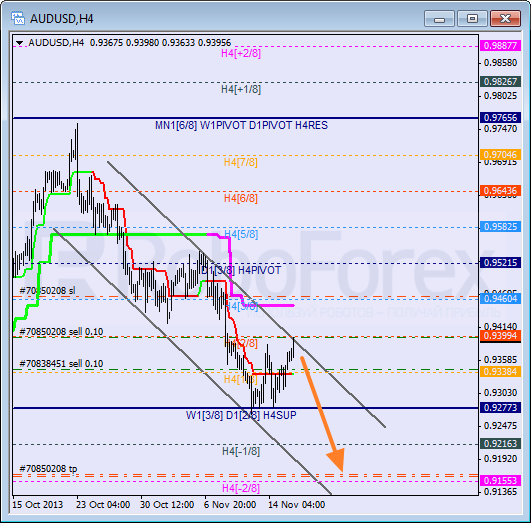
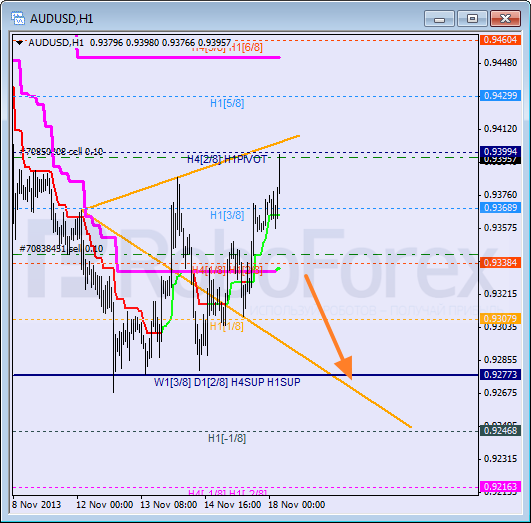
AUD/USD

Australian Dollar is still being corrected; price has already reached upper border of descending channel. If pair rebounds from the 2/8 level, instrument continue moving downwards and reach the -2/8 one.

At H1 chart, pair has already reached the 4/8 level and formed bearish Wolfe wave, which means that bears may return to market quite soon. If pair breaks Super Trends, it will start new descending movement.

EUR/JPY

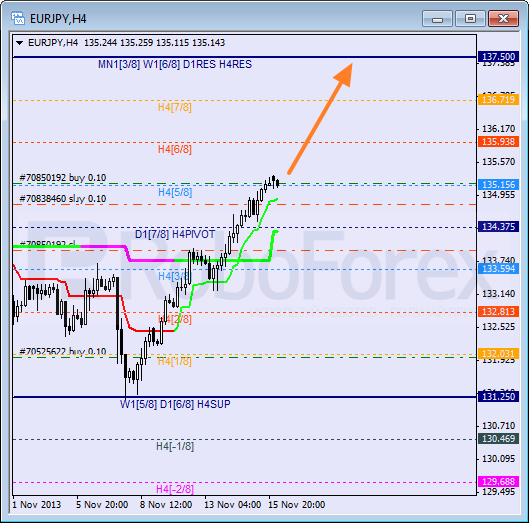
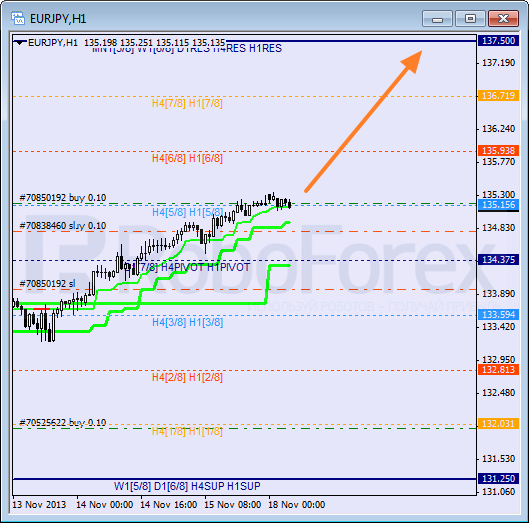
Pair continues growing up quite fast; earlier Super Trend formed “bullish cross”. I have three buy orders. If later bulls are able to keep price above the 5/8 level, market will continue growing up towards the 8/8 one.

Levels at H4 and H1 charts are completely the same. Current correction is supported by Super Trend; pair may rebound from it during the day. I’ll move my stops higher as soon as pair breaks its maximum.

SILVER

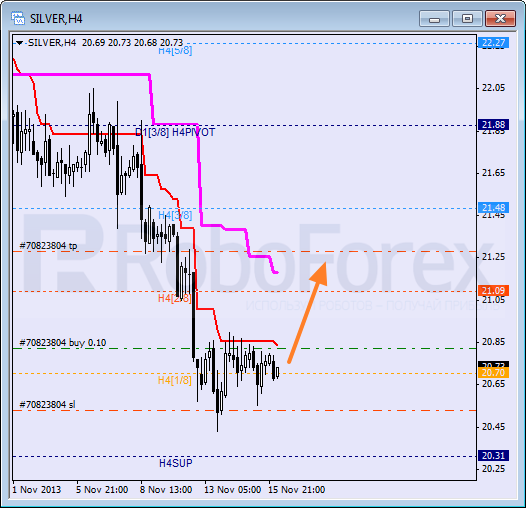
Silver is trading near the 1/8 level. It looks like price is making a pause before starting new correction. I’m keeping my buy order and planning to move stop into the black as soon as instrument breaks Super Trend.

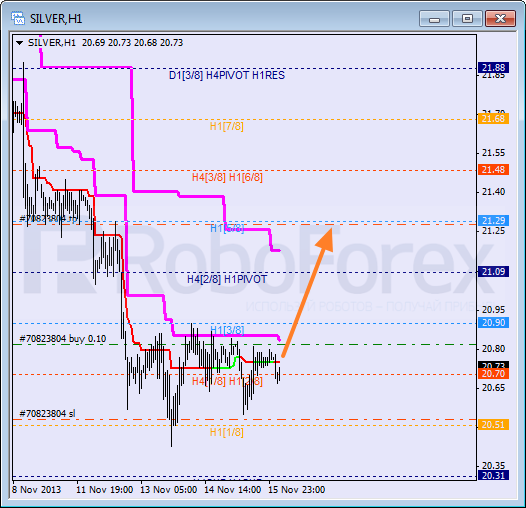
At H1 chart, market is consolidating; price has already rebounded from the 1/8 level three times. Most likely, instrument will break Super Trends during Monday. Short-term target is at the 5/8 level.

RoboForex Analytical Department


Attention!
Forecasts presented in this section only reflect the author’s private opinion and should not be considered as guidance for trading. RoboForex LP bears no responsibility for trading results based on trading recommendations described in these analytical reviews.

Article By RoboForex.com


Japanese Candlesticks Analysis 18.11.2013 (EUR/USD, USD/JPY)

Article By RoboForex.com

Analysis for November 18th, 2013

EUR/USD

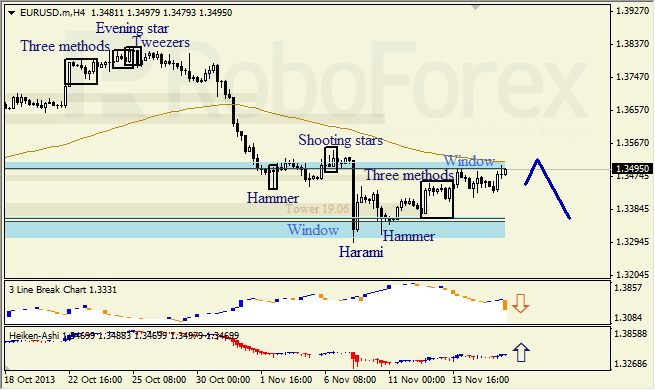
H4 chart of the EUR/USD currency pair shows sideways correction. Upper Window is resistance level. Three Line Break chart indicates that bearish tendency continues; Heiken Ashi candlesticks confirm ascending movement.

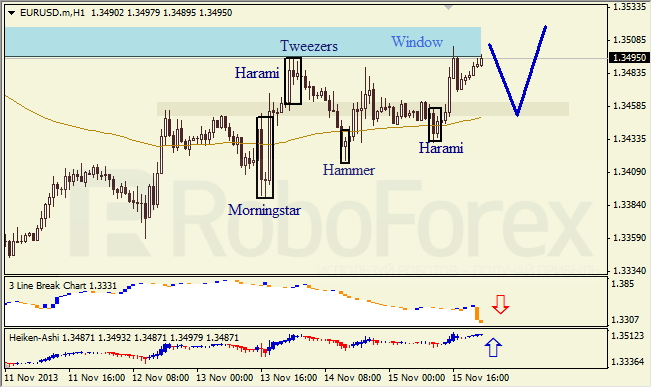
H1 chart of the EUR/USD currency pair shows resistance from closest Window. Three Line Break chart indicates that price may rebound from Window; Heiken Ashi candlesticks confirm that ascending tendency continues.

USD/JPY

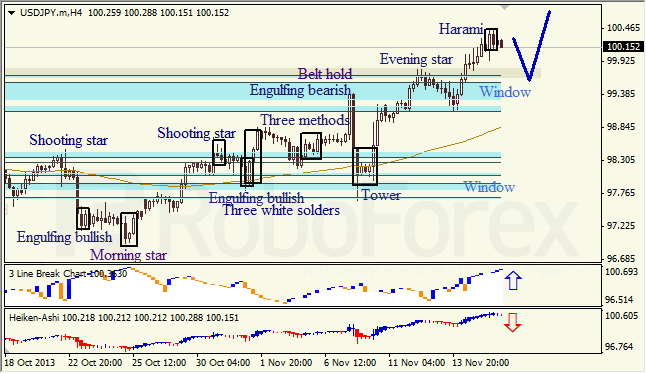
H4 chart of the USD/JPY currency pair shows descending correction. Upper Window is broken, it may become support level. Three Line Break chart indicates ascending movement; Harami pattern and Heiken Ashi candlesticks confirm that correction may continue.

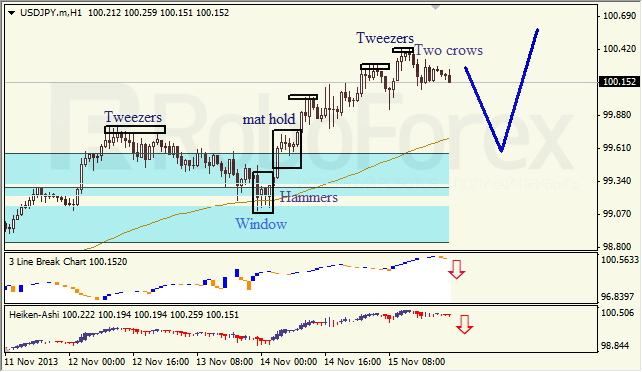
H1 chart of the USD/JPY currency pair also shows correction within ascending trend. Closest Window is support level. Tweezers and Two Crows patterns, along with Three Line Break chart and Heiken Ashi candlesticks confirm descending movement.

RoboForex Analytical Department

Attention!
Forecasts presented in this section only reflect the author’s private opinion and should not be considered as guidance for trading. RoboForex LP bears no responsibility for trading results based on trading recommendations described in these analytical reviews.

Article By RoboForex.com


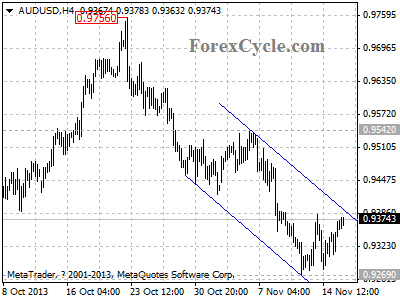
AUDUSD is facing channel resistance

AUDUSD is facing the resistance of the upper line of the price channel on 4-hour chart, as long as the channel resistance holds, the downtrend could be expected to resume, and one more fall towards 0.9000 is still possible. One the upside, a clear break above the channel resistance will suggest that the downtrend from 0.9756 had completed at 0.9269 already, then the following upward movement could bring price to 1.0000 zone.

audusd

Provided by ForexCycle.com

How to Avoid Being a ‘Stock Market Loser’ in 2014

By MoneyMorning.com.au

We’re bullish on the stock market.

But we’re not your average bull.

We don’t cheerlead for stocks to go higher…but we would certainly like them to go higher…and we hope they’ll go higher.

But if we ever find ourselves getting over-excited about stocks and falling for the idea that stocks can only ever go up, we make sure to check out the mainstream press.

We usually find something to snap us back to reality.

Thankfully an article on Bloomberg did the job nicely. It reminded us of the naivety of the mainstream and why we shouldn’t take this stock rally for granted…

As you should know by now, your editor is just as bullish as anyone in the mainstream.

To be honest, we’d say we’re more bullish than anyone in the mainstream. We don’t recall seeing anyone anywhere else sticking a 7,000 point target on the S&P/ASX 200 by 2015.

In fact, that’s the key difference.

We’re bullish because we know central banks will keep interest rates low (hello, the European Central Bank just cut its benchmark rate to 0.25%). These interest rates will continue to ignite a rocket under stock and other asset prices.

Because of that you’ll see a monumental, height-defying rally (some call it a ‘melt-up’ boom) that will ultimately end in an almighty crash.

That’s why we’re bullish. The mainstream is bullish for another reason…

If You Don’t See it, it Doesn’t Exist

Whereas we get the big picture of how central banks are slowly destroying economies and national currencies, the dopes in the mainstream think the central banks are helping economies.

A classic example is in the Bloomberg article we mentioned earlier. The subject of the article is gold and inflation. It also refers to attempts by US Republicans to get the US dollar back on a gold standard or at least for the US Federal Reserve to track the value of the dollar relative to gold and other commodities:

[Measuring inflation against commodity prices is] a stupid idea,” Joseph Gagnon, a former Fed economist, said in an interview. “It’s pretty clear the Fed thinks so, too, since they do the opposite. They go out of their way to exclude commodities.

Gagnon, now with the Peterson Institute for International Economics in Washington, says the Fed tracks most closely “core” inflation readings that exclude often-volatile commodities.

Comments such as that show the mainstream don’t quite get what’s going on. It’s the proverbial head in the sand approach – ‘If we don’t acknowledge certain rising prices, then they don’t exist.’

That’s why the US inflation rate is deceptively low. The Fed omits volatile items when it calculates consumer price inflation. It just happens that the volatile items include food and fuel – perhaps the two most important everyday purchases for any consumer.

By not admitting this, the mainstream can continue to believe that things are fine. They must be fine, because all the fear mongering about money printing leading to inflation just isn’t true – look at the consumer price index! You get the picture.

And that’s not all.

Because they believe the economy is returning to normal, they’ve also gotten into thinking that the Fed and other central banks will start raising interest rates, which will slow stock market growth. So you’ll just get normal stock market gains.

Fools.

The Market is Riskier Than 2007

So our bet is that the speed at which the market goes up will take most in the mainstream by surprise.

They just won’t see it coming. They’ll buy stocks expecting to get 5-10% annual growth, only to end up getting 15-20% annual growth over the next two years. And because this move will surprise them, they’ll foolishly think the boom has just begun, which will cause them to put everything they’ve got into the market.

Trouble is, by then the boom could be at its peak. At that point a major bust is more likely than a continued boom.

But that’s all speculation. You can never know for sure until it happens.

That’s why despite his largely bearish view on the market, our old pal Dan Denning advised his readers to buy one particular stock that could benefit from rising stock prices.

Like your editor, Dan understands that buying any stock right now is a speculation. So he gave his readers this warning in the latest issue of The Denning Report:

I don’t want you to think that since I’m recommending a stock to profit in 2014, I’m sanguine about the risks in the financial system.

I’m anything but. In fact, the world’s financial system could be even more fragile and risky today than it was in 2007. For starters, debt as a percentage of GDP is even larger than at the beginning of the crisis.

Japan’s Lesson for Australian Investors

We’ll go one step further than Dan. We’ll say that the financial system is even more fragile and risky today than it was in 2007.

There’s no doubt about that in our mind. That’s what makes stock investing so tricky for investors today. You have to invest because, despite what the official inflation statistics say, central banks and governments are devaluing your wealth.

If you fall for their propaganda and believe that a low bank deposit rate is fine because inflation is low, you’re heading for a rude shock. On the flip side, if you know they’re ‘fixing’ the inflation figures but you won’t play stocks because you think it’s too risky, we’re afraid to say you’re heading for a rude shock too.

There was much wailing and gnashing of teeth when Japan devalued its currency last year. Many claimed it was devaluing Japanese wealth. And it was. But only for those Japanese who refused to invest in stocks.

Over the past year the Japanese Nikkei225 index is up 68%. That is more than enough to outweigh the devaluation of the yen. It was a good time to own stocks.

Those who missed out were the poor who couldn’t invest and the stubborn who refused to invest. So far, both groups have turned out to be big losers in the central bankers’ game. 

If the same thing plays out in the Australian market (which is almost certain), the last thing you want as an investor is to stay on the sidelines. The stock market may not be pretty right now, but if you want any chance of growing your wealth over the next two years it’s the best chance you’ve got.

Cheers,
Kris+

Special Report: The ‘Wonder Weld’ That Could Triple Your Money

Join Money Morning on Google+


By MoneyMorning.com.au

The Economy Is On Strike

By MoneyMorning.com.au

You know one of the definitions of insanity, right? It’s repeating the same action over and over but expecting a different result. Well, there’s either a lot of insane people running the world’s financial system…or they’re just simply incompetent. Either way, it’s extraordinary.

Let’s be clear: central banks are out of ideas. Their policies pump up stock prices. Meanwhile, the real economy has gone on strike. It refuses to react in the way the academics in government and finance expect. Let me just give you two quick examples.

First, Japan’s growth rate fell by 50% in the third quarter (between July and September). GDP grew at an annualised pace of 1.9% for the quarter. But it’s been slower every quarter this year. It was 4.3% in the first quarter and 3.8% in the second quarter.

The bloom is off the cherry blossom for Abenomics. Promising to double the monetary base drove down the yen for a bit, which boosted export earnings. Stocks raced ahead. But all the momentum is gone. Emerging market demand (which is not boosted by QE) hasn’t recovered.

The chart above shows that the Nikkei is at the top of the trading range it’s been in since late July. It’s not looking over-bought on a relative strength basis. But this shows me that if you’re looking for the next blue chip rally driven by QE, you’re not going to find it in Japan, at least not without some new big, bold stimulus.

US stocks, on the other hand, flew like a gaggle of drones hunting for a strike after Janet Yellen fronted the US Senate Banking Committee. The nominee to replace Ben Bernanke as Chairman of the world’s most powerful banking cartel assured the suits in Washington they could expect the same from her, only more of it. The Dow Jones Industrials are closing in on 16,000 and the S&P 500 hit 1790 (or a year after the beginning of the French Revolution, if you’re looking for historical rhymes).

To chase the US stock rally at this point would be madness. You might make some short-term gains in the next few weeks, but the rocket is nearly out of Fed fuel. And stocks cannot trade at a permanently high plateau merely on the basis of Fed money printing.

A Speculative Trade for 2014

That leaves Europe, if you’re looking to take a punt on where the next gains could come from the currency wars. In Europe, there are two pieces of evidence to suggest that money is about to flow from the European Central Bank (ECB) and into stocks.

The first item is that GDP growth in Europe is even weaker than Japan. The 17-country Eurozone grew by just 0.1% in the third quarter. That’s an annualised rate of 0.4%. And it’s so low as to be statistically inconsequential, assuming it’s not flat-out made up. The ECB now has plenty of economic justification for hitting the gas pedal (even if Japan’s experience shows that the effects of doing so are temporary).

Next is what ECB executive board member Peter Praet told the Wall Street Journal earlier this week. He said that, ‘All options are on the table‘ for the ECB to fulfil its mandate of promoting growth, stable prices, and low inflation. That’s just as ridiculous as Janet Yellen committing to 2% inflation. You can’t have stable prices if your policy is designed to increase them (you CAN have asset inflation though, which is what the finance sector loves).

But it appears that ‘asset purchases’ are now on the table in Europe. The matter may have some added urgency, given the weak GDP figures. And if the US and Japan are a precedent, the biggest beneficiary of the ECB’s next campaign ought to be large cap European stocks; hence my recommendation of an Aussie-listed ETF.

World War D and Financial Feudalism

One final note on the ‘currency wars’. Let’s not forget that low interest rates aren’t just good for the financial sector. They’re great for governments with large fiscal deficits. These days, that’s pretty much every major Western government.

Governments would face an immediate 20% increase in debt service costs if interest rates went back to 2007 levels, according to a new study from McKinsey and Co. The study shows that suppressing official interest rates has ‘saved’ governments $1.6 trillion in lower interest payments since 2007. Regrettably, while governments are winners with lower borrowing costs, savers and pensioners can go suck eggs, as the chart below shows.


Source: McKinsey and Co.
Click to enlarge

The study is a good read, if you have time. There are lots of pretty charts and graphs. But the fundamental conclusions are inescapable.

Interest rates are at 30-year lows and can’t go any lower, at least in nominal terms. They could go negative if central banks start charging interest on the excess reserves. If you were a bank, you’d have to pay to deposit money overnight with the central bank.

But really, what this means is that asset purchases are the only tool left in the central bank toolbox. They’ve tried it and it hasn’t worked. All that’s left is to try more of it and see if that works. It won’t. But they’ll do it anyway and we’ll know they’re either incompetent or insane.

Let’s not rule out devious, either. This could all be deliberate. It’s a modern version of feudalism, only the peasants and serfs don’t realise they are wage slaves who are asset poor. If you have a high definition television and a full stomach, you can stand a lot degradation in life.

Besides, who needs castles and moats and armour and crowns when you control interest rates, have the only legal printing press in town, and own all the politicians?

Where all this is headed is anyone’s guess. A financial problem (too much debt and poor risk management) has become an economic one. The economic has become political. And the political has become social and cultural. It may not end in another French Revolution. But one regime – the global fiat money standard – is about to lose its head.

These are some of the ideas we’re going to talk about in Melbourne late next summer. If you click on this link, you can add your name to a list. Once on it, you’ll be notified when the conference – what we’re calling World War D – goes live.

Dan Denning+
Editor, The Denning Report

Join Money Morning on Google+


By MoneyMorning.com.au

Forex Trading For Beginners

Forex currency trading is rapidly escalating as a popular online method of earning big cash profits.  One of the main reasons being that investors find it relatively simple to master the techniques required to generate a great deal of money in a short time frame, given the frequency of market changes.

High volatility plus the continually changing global marketplace conditions open up many buying and selling possibilities. Factor in that the Forex market is open 24 hours a day, 5 days a week from  Monday to Friday and you have virtually unlimited trading hours worldwide.

Forex currency trading has several excellent software systems that can help you to make substantial profits.  But it is a good idea to research and thoroughly understand what each system provides before investing. The best suggestion is to try out a demo version of the software to see whether it meets your needs first.

For those that don’t have a lot to invest or just want to get their feet wet before committing too much money there is the option of opening a mini Forex currency trading account with only $250.

Forex currency trading is basically exchanging different pairs of currencies buying at one price and selling at another. The intention is to make a profit whenever the currency goes up or down. Whilst this is not complicated to grasp any transactions made in the international currencies market really should be done by using a Forex broker.

When searching for a Forex broker to handle your account, it’s important to check out their capability and qualifications. Try to find a company that is well established so you can feel confident that you are getting good advice and will get the most return on your investment.

Most Forex brokers offer training via the internet, through workshops and in some cases using 1 to 1 mentoring. Don’t make the mistake of underestimating the amount of information there is to learn before you can feel confident in making consistent profits. There is a lot of free training material available on the internet, most of it written in an easy to understand manner even for a complete novice to Forex trading.

Remember that although in most cases it is safe to conduct transactions over the internet, you will still come across the crooks and the scam artists hoping to part you from your money. So just make sure you are dealing with a reputable broker.

You will find that a Forex broker doesn’t charge a commission for placing a buy or a sell order in the same way as a stock broker by taking a commission on the sale. Forex brokers make their money on the difference between the bid and offer prices which is known as the spread. Brokers are also in this game for the money and the spreads can be quite substantial when you consider the amount of trades that take place in any given day.

The only tools you need to get started with your Forex trading are a good computer with a fast internet connection.  On a final note keep in mind that Forex trading isn’t for everyone. You will often need to make split second decisions as prices change, which can be nerve wracking for some, but can be very rewarding when the right decision is made.

To learn more please visit www.clmforex.com


Disclaimer: Trading of foreign exchange contracts, contracts for difference, derivatives and other investment products which are leveraged, can carry a high level of risk. These products may not be suitable for all investors. It is possible to lose more than your initial investment. All funds committed should be risk capital. Past performance is not necessarily indicative of future results. A Product Disclosure Statement (PDS) is available from the company website