Crude Oil Prices Advances on Weak Greenback

By HY Markets Forex Blog

Crude oil prices advanced during the Asian trading session on Wednesday, following a speech from the Federal Reserve (Fed) Chairman Ben Bernanke.

West Texas Intermediate rose 0.32% higher, trading at $94.16 per barrel as of the time of writing, while the European benchmark crude Brent gained 0.14% at $107.07 per barrel at the same time.

On Wednesday, the Federal Reserve (Fed) Chairman Ben Bernanke commented on strengthening the unemployment rate as it continues to rise and inflation picking up at approximately 2% before the US central bank would proceed with tapering its bond-buying program.

“In particular, the target for the federal funds rate is likely to remain near zero for a considerable time after the asset purchases end, perhaps well after the unemployment threshold is crossed and at least until the preponderance of the data supports the beginning of the of policy accommodation,” he said.

Crude Oil – Iran

Five members of the United National Security Council and Germany will resume talks with Iran over its nuclear program in Geneva on Wednesday.

Iran has said that its nuclear program is for only civilian purposes for medical and energy use; however western powers are accusing the Persian Gulf nation of covertly seeking atomic-weapons capability.

US Oil Inventories

The US crude oil inventories rose by 512,000 barrels in the last week, according to reports from the American Petroleum Institute (API).

Meanwhile, the Energy Information Administration (EIA) is expected release their report of US crude oil inventories later in the day, as analysts forecast an increase of 233,000 barrels in the last week.


Visit www.hymarkets.com  today and find out more on how you can how you can trade Energy products with only $50.

The post Crude Oil Prices Advances on Weak Greenback appeared first on | HY Markets Official blog.

Article provided by HY Markets Forex Blog

2014: The Year for Gold Bullion Investors?

By for Investment Contrarians

Gold Bullion InvestorsLast week’s testimony by Janet Yellen, President Obama’s choice for the next head of the Federal Reserve, was quite interesting. What I also found fascinating was the reaction in various markets.

Yellen was testifying in front of the Senate Banking Committee, and when asked about the possible formation of bubbles as a result of the Federal Reserve’s quantitative easing program, she stated point-blank, “By and large, I would say that I don’t see evidence at this point in major sectors of asset price misalignments.” (Source: Bloomberg, November 15, 2013.)

I certainly don’t have any experience working at the Federal Reserve, but I find this hard to believe.

Is the new Federal Reserve chairwoman trying to convince us that with a weak economy, it makes perfect sense for the stock market to be at all-time highs, margin debt to be soaring to record levels, the housing market to be experiencing bidding wars in certain areas of the country, and for vehicle sales to be soaring—all while incomes remain flat?

What do these factors tell me? All of these different sectors of assets are being fueled by cheap money produced from quantitative easing by the Federal Reserve.

Look at it this way: how many sectors of the economy are booming where there is no financing available, but cash purchases only? Very few. We keep hearing about retailers that cater to the average American having difficulty, since their consumers lack the cash to increase their spending. People are only buying goods if they can get credit, using cheap money.

Is this a bubble?

Well, I ask you to consider this: if the Federal Reserve were to remove all quantitative easing, would the markets, which have soared, including stocks, remain where they are currently? I would say no, because we are at artificially inflated levels. To me, that’s a sign of a bubble.

It’s one thing if the Federal Reserve were to inject quantitative easing over a short period of time due to a one-off event or crisis. Perhaps something catastrophic happens, the financial system lacks liquidity, and the Federal Reserve is the lender of last resort to calm the markets.

That’s fine; in such a limited capacity, quantitative easing is perfectly acceptable and no bubbles or misalignment of prices would emerge, because people would know it was a short-term event.

However, we now have several years of endless quantitative easing by the Federal Reserve, which have resulted in the U.S. economy and the markets becoming completely addicted to cheap money.

With the new Federal Reserve chairwoman explicitly stating that she is willing to continue these policies—even though we all realize that there aren’t any significant benefits to the average American—when quantitative easing finally ends, the pain will be horrendous.

I find the reaction in the gold bullion market quite interesting. If the new Federal Reserve chairwoman is saying she will continue policies that are as aggressive (and possibly more aggressive) to even larger amounts of quantitative easing (money printing), this can only be bullish for gold bullion.

Compared to earlier in 2013 when the Federal Reserve was considering the idea of reducing quantitative easing, this caused gold bullion to sell off. But now, the very thought of reducing quantitative easing appears to have been thrown out the window.

With much more money printing coming down the pipeline—and gold bullion significantly underperforming the stock market—investors can look for a catch-up move in precious metals going forward.


http://www.investmentcontrarians.com/gold-investments/2014-the-year-for-gold-bullion-investors/3325/


China’s Expected Baby Boom a Boon for U.S. Business

201113_PC_leongBy George Leong, B.Comm.

There you have it; the latest great news out of China, I think, will help drive sales of some U.S. companies going forward.

The news? There are going to be more babies born in China over the foreseeable future. In a surprise and strategic move, the Communist Party of China decided it was time to increase its baby population and look towards the future of the country.

Under the country’s new plan, the one child policy will be modified to allow two children per family in cases where one of the parents came from a one-child family.

As I said, this is huge; it could be a critical turning point in the direction and growth of the Chinese economy. (Read “Time to Look at Chinese Stocks Again?”) While the change in population control may seem archaic to us here in America, in China, this is a major change that could impact the country for decades going forward.

Make no mistake about it, China is ambitious and wants to expand its economy more and become the biggest economy in the world. This will inevitably happen; it could even take less than the previously estimated 20 years, given the new baby policy along with the opening of some state-operated industries to private investment and foreign companies.

And while the Chinese government wants to make sure there are sufficient babies born to replace the aging population, a key objective of the change is to inevitably drive up domestic consumption in the Chinese economy in the decades ahead.

The Chinese economy will see rising demand for food, homes, apparel, household goods, and services, just to list a few of the likely perks. What this all means is that the country will need to import more raw materials and goods from foreign markets—and that includes the U.S., meaning America could see a boost in its economy as a result of China’s reforms.

American multinational companies operating in China or selling in the country will likely see a rise in demand for goods. In the short-term, for example, family staples companies like The Procter & Gamble Company (NYSE/PG) and Colgate-Palmolive Company (NYSE/CL) will see a rise in their sales in China. And with the expected rise in the demand for food, companies like Caterpillar Inc. (NYSE/CAT) will likely see more demand for agricultural equipment.

In the United States, we could see a rise in demand for many raw materials and grains, such as wheat, corn, soybeans, and canola, to feed the new population growth in China. Companies like Archer-Daniels-Midland Company (NYSE/ADM) could likely see higher demand out of China as a result.

Whatever the case, the expected new population boom in China can only be a positive for American business—and investors.

This article China’s Expected Baby Boom a Boon for U.S. Business is originally publish at Profitconfidential


Central Banks Net Buyers of Gold for Eleven Consecutive Months Now

191113_PC_lombardi-150x150By Michael Lombardi, MBA

According to the World Gold Council (WGC), demand for gold bullion in the third quarter was 869 tonnes. (Source: World Gold Council, November 14, 2013.) And in the quarter, central banks purchased 93 of those tonnes.

Central banks have now been buyers of the precious metal for 11 consecutive quarters. Why have central banks been continuously buying more gold? My speculation is that they realize the fiat currency will eventually be problematic, with so much of it being created out of thin air these days.

Consumer demand for gold bullion is also robust. In China, in the third quarter, consumer demand for gold bullion accounted for 210 tonnes—18% higher than the same period a year ago. In India, consumers’ appetite for the precious metal declined 32% in the third quarter from the previous quarter, as the government and central bank worked together to curb consumer demand for gold bullion. But looking at the first nine months of 2013, gold bullion demand in India was 19% higher than the previous year.

In the third quarter, we saw higher demand for gold jewelry in countries like Vietnam, Thailand, and Indonesia. From the same period a year ago, precious metal jewelry demand in these three countries was up by 14%, 57%, and 19%, respectively. In Hong Kong, gold jewelry demand increased by 28%!

Need I say more?

Dear reader, the focus has shifted off gold bullion and onto the stock market these days, as stocks continue to break to new record highs.

With gold bullion prices off significantly from their peak, I stick to my belief that there is great value in the precious metal.

History tells us that gold bullion holds value in times of uncertainty. The mainstream doesn’t mention this, but aren’t currencies around the world in great danger, because so much paper money is being printed each passing month? Get a map, point a finger at a country, and big or small, chances are that the central bank of that country is involved in money printing. As this continues, the value of currencies around the world will diminish (and I’m not just talking about the U.S. dollar). As a result, the precious metal, which investors seem to dislike these days, will be in shortage.

The question, dear reader, is not if gold bullion prices will recover, but when? Don’t give up on gold as an investment.

This article Central Banks Net Buyers of Gold for Eleven Consecutive Months Now is originally publish at Profitconfidential


How to Profit from Fed’s Easy Money Mistake

By for Daily Gains Letter

Profit from Fed’s Easy MoneyThe Federal Reserve has been very accommodative. Its goals are very simple: it wants economic growth in the U.S. economy. As a result, the Federal Reserve is taking extraordinary measures, printing $85.0 billion a month and using it to buy U.S. bonds and mortgage-backed securities (MBS). The hope is that the money will go to the banks, which will lend it to consumers who then spend it, leading to economic growth.

Sadly, the problems continue to persist in the U.S. economy, leaving economic growth still far from sight. The techniques used by the Federal Reserve aren’t working: the unemployment rate continues to be staggeringly high, troubling trends have formed, and the inflation continues to be low—threats of deflation loom.

Given all this, one would assume there might be something else that the Federal Reserve can do. Unfortunately, instead of using different measures to fight the problems in the U.S. economy, the Federal Reserve is planning to keep on doing what it has been doing for years now. I believe the techniques used by the Fed will continue on for some time.

Here’s my reasoning: in a testimony before the U.S. Senate Committee on Banking, Housing, and Urban Affairs, the newly nominated chairman of the Federal Reserve, Janet Yellen, said, “We have made good progress, but we have farther to go to regain the ground lost in the crisis and the recession. Unemployment is down from a peak of 10 percent, but at 7.3 percent in October, it is still too high, reflecting a labor market and economy performing far short of their potential. At the same time, inflation has been running below the Federal Reserve’s goal of 2 percent and is expected to continue to do so for some time.” The Federal Reserve realizes the problems still remain, but no other solution was provided. (Source: “FRB: Testimony—Yellen, Statement before the Committee on Banking, Housing, and Urban Affairs—November 14, 2013,” Board of Governors of the Federal Reserve System web site, November 14, 2013.)

If the Federal Reserve continues to print money in the form of quantitative easing, don’t be surprised to see more of the same—key stock indices will head higher and bond yields will continue to decline.

But what happens when the Federal Reserve starts to put the brakes on its asset purchases? We saw a minor episode of it in May; the bonds market witnessed a very noticeable sell-off. This time around, I wouldn’t be surprised if the sell-off is much bigger.

Dear reader, you have to keep in mind that the Federal Reserve became a massive buyer of bonds. Its balance sheet is huge, and closing in on $4.0 trillion. If it sells the bonds it has, the bond yields will go high, and if it keeps them, the current money printing will result in higher inflation ahead.

So, how does one actually profit from the actions of the Federal Reserve?

As long as the Federal Reserve continues to print money, investors may be able to profit from exchange-traded funds (ETFs) like the iShares 20+ Year Treasury Bond (NYSEArca/TLT). Essentially, this ETF buys long-term bonds, so as the Federal Reserve continues to buy bonds, their prices will continue to go higher, and investors will profit.

Once the Federal Reserve moves away from its money printing, ETFs like the ProShares UltraShort 20+ Year Treasury (NYSE/TBT), which shorts long-term bonds, will be able to provide investors with profit.


http://www.dailygainsletter.com/income/how-to-profit-from-feds-easy-money-mistake/2124/


Japanese Candlesticks Analysis 20.11.2013 (EUR/USD, USD/JPY)

Article By RoboForex.com

Analysis for November 20th, 2013

EUR/USD

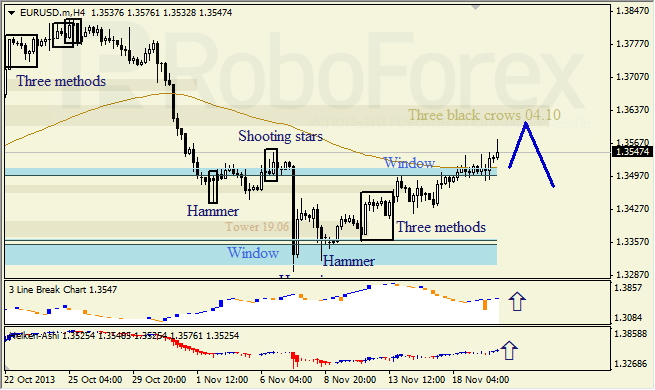
H4 chart of the EUR/USD currency pair shows ascending correction. Upper Window is support level. Three Line Break chart and Heiken Ashi candlesticks confirm ascending movement.

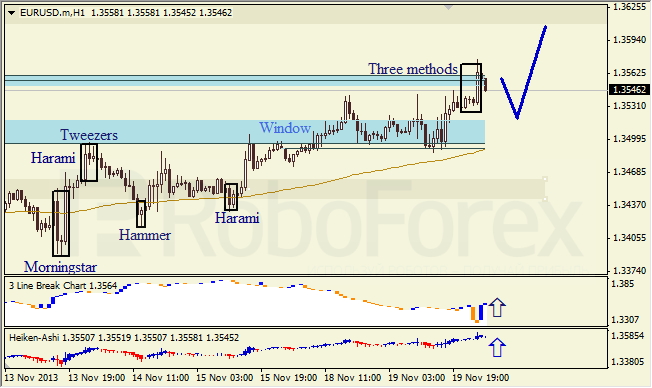
H1 chart of the EUR/USD currency pair shows resistance from upper Window and support from lower one. Three Methods pattern, Three Line Break chart, and Heiken Ashi candlesticks confirm that ascending tendency continues.

USD/JPY

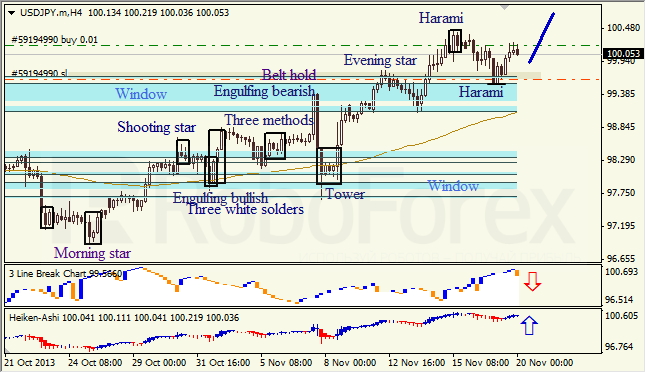
H4 chart of the USD/JPY currency pair shows bullish tendency within ascending trend. Upper Window is support level. Three Line Break chart indicates that correction may continue; bullish Harami pattern and Heiken Ashi candlesticks confirm ascending movement.

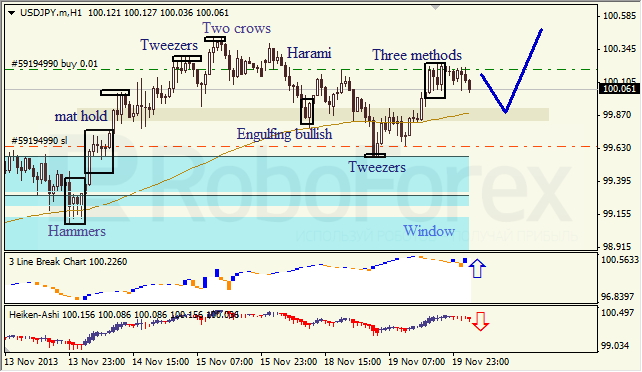
H1 chart of the USD/JPY currency pair shows correction within ascending trend. Three Line Break chart indicates ascending movement; Heiken Ashi candlesticks confirm correction.

RoboForex Analytical Department


Attention!
Forecasts presented in this section only reflect the author’s private opinion and should not be considered as guidance for trading. RoboForex LP bears no responsibility for trading results based on trading recommendations described in these analytical reviews.

Article By RoboForex.com


Murray Math Lines 20.11.2013 (AUD/USD, EUR/JPY, SILVER)

Article By RoboForex.com

Analysis for November 20th, 2013

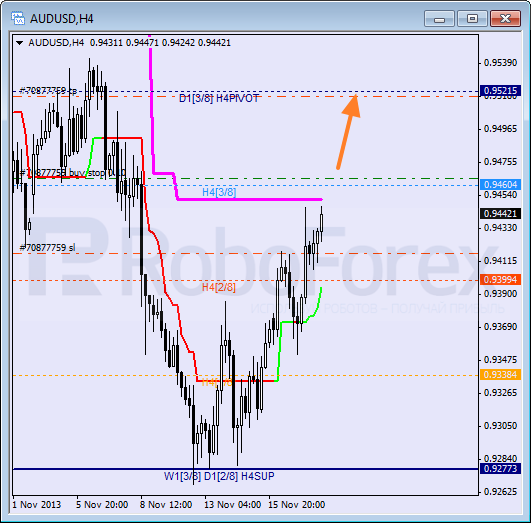
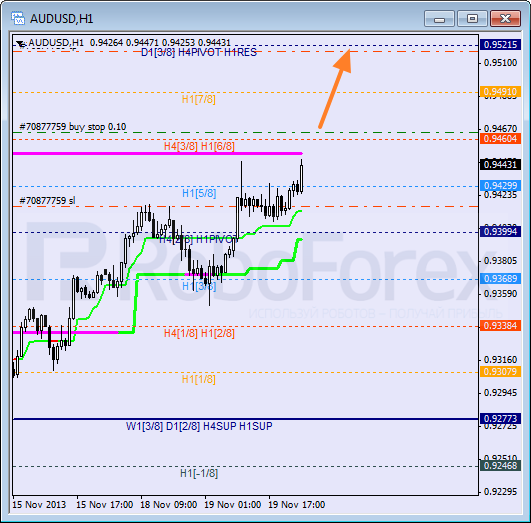
AUD/USD

Bulls took control and broke local maximum yesterday. The only thing that is slowing them down is weekly Super Trend. If they break it, price will continue growing up towards the 4/8 level.

At H1 chart, bulls are trying to keep price above the 5/8 level. If they succeed, pair will continue growing up. In this case, target will be at the 8/8 level.

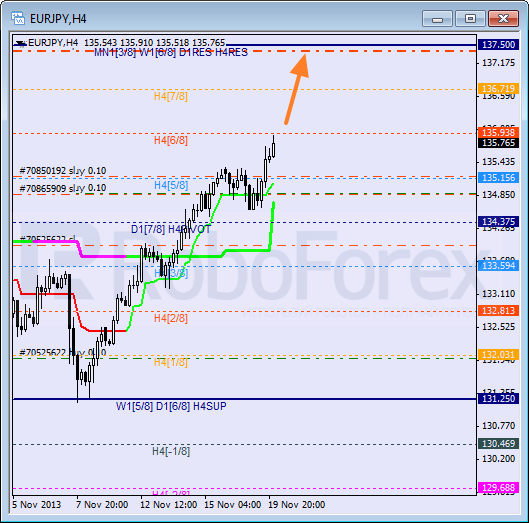
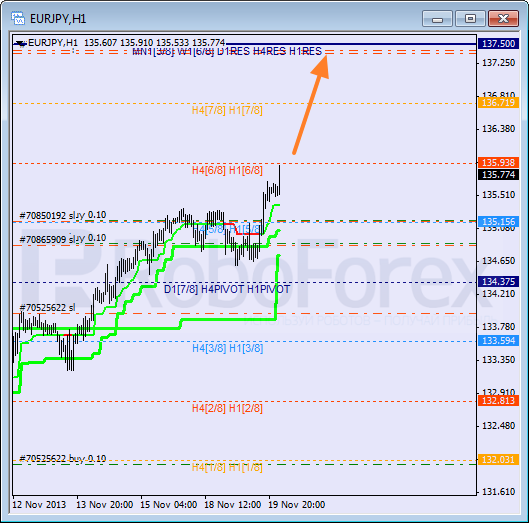
EUR/JPY

Pair continues moving upwards quite fast. On Tuesday, bulls broke maximum and right now price is moving above the 5/8 level. Most likely, after slight correction, market will continue growing up towards the 8/8 level.

Levels at H4 and H1 charts are completely the same; bulls are supported by Super Trends, from which pair rebounded yesterday. In the future, we recommend you to pay attention how price will move at the 7/8 level: if it rebounds from this level, market may reverse.

SILVER

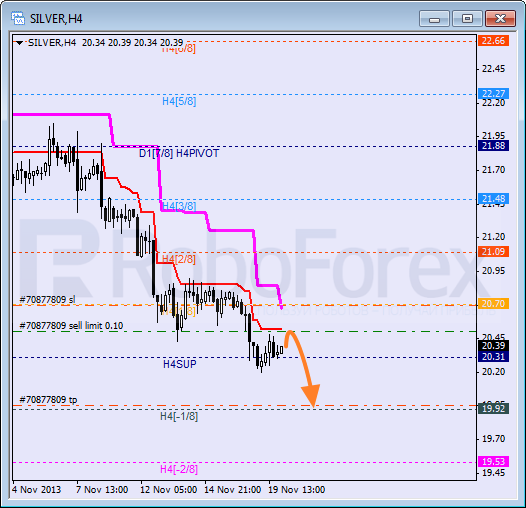
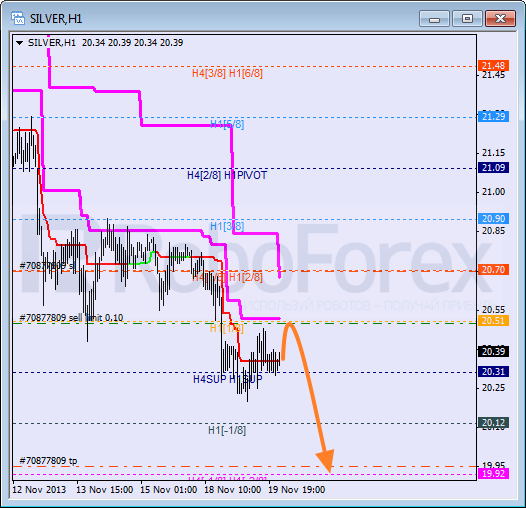
Silver is being corrected. Possibly, price may rebound from H4 Super Trend, which means that it may continue falling down. I’ve closed my sell order and placed a limit one instead.

At H1 chart, we can see that bears’ first attempt to enter “oversold zone” failed. If, in the nearest future, market rebounds from the 1/8 level, bears will have a chance to start new descending movement towards the -2/8 one.

RoboForex Analytical Department


Attention!
Forecasts presented in this section only reflect the author’s private opinion and should not be considered as guidance for trading. RoboForex LP bears no responsibility for trading results based on trading recommendations described in these analytical reviews.

Article By RoboForex.com


Chile cuts rate by 25 bps for second month in a row

By CentralBankNews.info
    Chile’s central bank cut its policy rate by 25 basis points to 4.50 percent, its second rate cut in as many months, with the bank saying data for the third quarter confirmed its expectation that all components of demand were slowing down.
    The Central Bank of Chile, which has now cut its rate by 50 basis points this year, also said that inflation was “behaving moderately and market expectations foresee that it will gradually normalize toward 3% within the next 24 months.”
    Chile’s inflation rate fell further in October to 1.5 percent from 2.0 percent in September, below the bank’s target range of 2.0-4.0 percent inflation around the 3.0 percent midpoint.
    The central bank repeated that it would be flexible in its monetary policy with the aim of inflation at 3 percent.
    “Any future changes in the monetary policy rate will depend on the implications of domestic and external macroeconomic conditions on the inflationary outlook,” the bank said.
    Chile’s economy is growing moderately, the bank said after data showed that the country’s Gross Domestic Product expanded by 1.3 percent in the third quarter from the second for annual growth of 4.7 percent, up from 4.0 percent.


    The global economy is recovering gradually, the bank said, led by the United States while growth in emerging countries is more moderate.

    www.CentralBankNews.info

Recent gains of euro versus dollar illustrate importance of Fed’s QE

By HY Markets Forex Blog

The recent gains that the euro has made against the U.S. dollar indicate the important role that quantitative easing plays in the exchange rate for these two currencies. Individuals who want to make money by trading the currency pair might benefit from being aware of the key role that these bond purchases play in the value of the two.

Euro appreciates versus dollar
The EUR/USD pair rose during the week that ended on Nov. 18, with the common currency increasing to as much as $1.3505 during that period, according to CNBC. This was the highest value for the exchange rate since Nov. 7.

The greenback sank relative to the common currency during the week when Janet Yellen, who has been nominated to serve as the next head of the Federal Reserve, testified before Washington lawmakers, helping to boost hopes that QE will not be tapered for some time.

Yellen, who currently serves as the vice chair of the Fed, is generally viewed as being supportive of these bond purchases because she has frequently voted in favor of such transactions. The central bank has been buying $85 billion worth of debt-based securities every month since late 2012, and as a result of making these transactions, its balance sheet has surpassed $3 trillion. These bond purchases are generally thought of as pushing the value of the greenback lower.

Market experts bearish on dollar
Charles St-Arnaud, who works in New York as a foreign-exchange strategist at Nomura Holdings Inc., told Bloomberg that market participants should shun the dollar because of the high chances that Yellen will become the next Fed chief.

"The market is risk-on today, so there's no need to hold [the] U.S. dollar," St-Arnaud told the news source. "The appointment of Yellen as chairwoman of the Fed has created a lot of expectations that tapering will most likely be delayed, as she's a dovish person."

In addition to St-Arnaud, many experts have been bearish about the dollar, and individuals who want to make money by trading currencies might benefit from knowing about the various forecasts that such individuals have made.

"The USD might come under pressure as the doves get their say," Emma Lawson, senior currency strategist at the National Australia Bank, told CNBC. "The market had been thinking about a December taper – I think that's going to be pushed out through to March after they speak." 

It is also important for traders to know that many market participants became more hopeful that the Fed will wait longer to start tapering assets after the partial shutdown of the U.S. federal government. This event, which lasted for more than two weeks, was thought of by many as presenting significant headwinds to the nation's current economic recovery.

High hopes of continued stimulus
When providing testimony, Yellen stated that until she is convinced that the current economic expansion has obtained significant strength, she will continue to harness asset purchases, according to Bloomberg News.

These statements are similar to the ones that were previously made by Ben Bernanke, who currently serves as Fed chief. Bernanke shocked markets in June when he told members of the media after a meeting of the Federal Open Market Committee that QE could be tapered as early as 2013 and then stopped completely in the following year.

He took a more conservative tone when testifying before Congress later that summer, stating that for bond purchases to be reduced in volume, certain key indicators – including those related to the job market – would need to improve to certain levels.

The economy could soon see some improvement, at least if the statements recently made by Federal Reserve Bank of New York President William Dudley have any accuracy, the media outlet reported.

"While growth in 2013 has been disappointing, I believe a good case can be made that the pace of growth will pick up some in 2014 and then somewhat more in 2015," Dudley stated as part of remarks provided on Nov. 18. in Flushing, New York, according to the news source. "As growth picks up, I expect to see more substantial improvement in labor market conditions."

Such a change in the business climate could have significant implications for bond purchases, and therefore the dollar. Individuals who want to make money by trading currency pairs such as the EUR/USD might benefit from carefully watching the latest economic reports.

The Fed official stated that the dollar could be pushed lower as a result of the lackluster growth that the economy has suffered, MarketWatch reported. Alan Ruskin, global head of G10 foreign-exchange strategy at Deutsche Bank, weighed in on how the most recent data could affect the greenback.

He stated in a recent note to clients that the latest reports are "still not providing much support for a significantly stronger [U.S. dollar] story," according to the news source. 

The post Recent gains of euro versus dollar illustrate importance of Fed’s QE appeared first on | HY Markets Official blog.

Article provided by HY Markets Forex Blog

USDCAD remains in uptrend from 1.0182

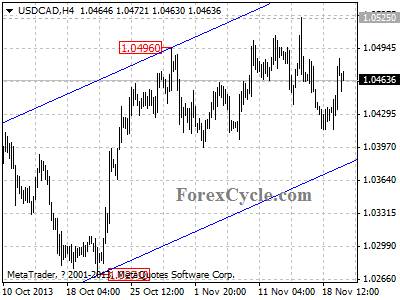
USDCAD remains in uptrend from 1.0182 (Sep 19 low), the price action from 1.0496 could be treated as consolidation of the uptrend. Key support is located at the lower line of the price channel on 4-hour chart, as long as the channel support holds, the uptrend could be expected to resume, and one more rise towards 1.0700 is still possible. On the downside, a clear break below the channel support will indicate that the uptrend from 1.0182 had completed at 1.0525 already, then the following downward movement could bring price to 1.3000 zone.

usdcad

Provided by ForexCycle.com