Short Term Technical Forecast for EURUSD

Article by Investazor.com

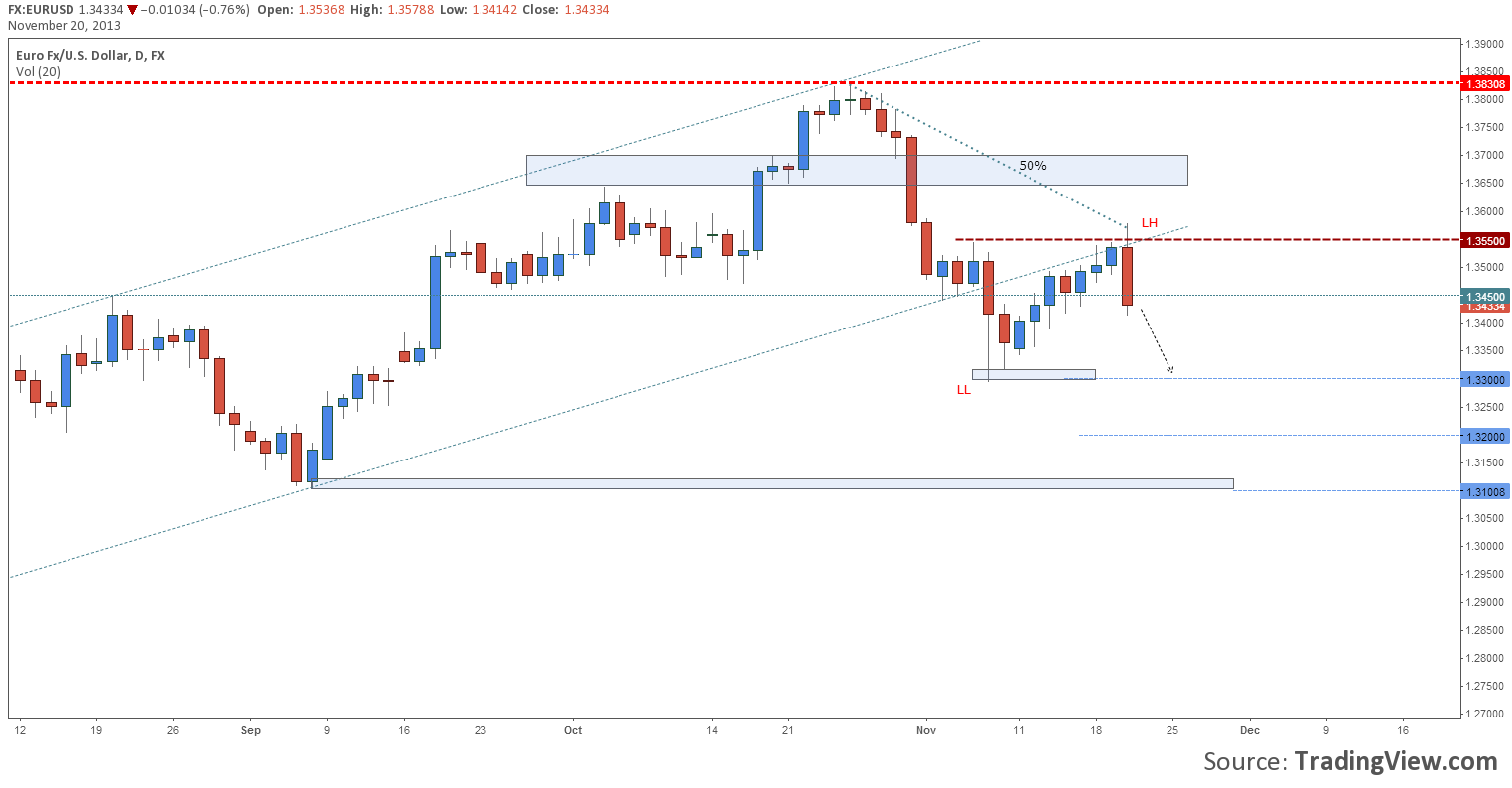
From the low hit on 7th of November the Euro started to rise in front of the US dollar, getting itself back around 1.3550. Although both the current Fed governor, Ben Bernanke, and the future one, Janet Yellen, sustained that the US economy still needs the QE at its full speed it wasn’t enough to keep the dollar on a down trend. Today the ECB mentioned in a statement that they are willing to get to negative rates if necessarily to help the Euro Area economy and that ended in a drop in the EURUSD.

eurusd-technical-forecast-resize-20.11.2013

Chart: EURUSD, Daily

From the technical point of view the current situation looks a bit bearish. The retest on 1.3550 was also a test of the 50% retrace of the drop and a retest on the earlier broken trend line. Today’s fall managed to engulf the price action of the last 5 days signaling heavy selling of the Euro.

We are expecting to see a continuation of this drop all the way to 1.3300, support level or even a continuation of the down move to 1.3200. Even though on the short term the direction is down don’t forget to keep an eye, especially if you are a day trader, on the economic releases which might trigger high volatility and sudden reversing moves.

The post Short Term Technical Forecast for EURUSD appeared first on investazor.com.

Online Retailer Surging 70% on IPO Debut Example of Market Euphoria

By for Investment Contrarians

Online Retailer SurgingSound the bull horns, folks! Stocks are sizzling on the chart, and Wall Street is partying like there’s no tomorrow. Kind of sounds like late 1999/early 2000, doesn’t it? And we all know what happened when the party ended then, with the NASDAQ having surged to a ridiculous 5,132 and subsequently crashing.

On Monday, the S&P 500 broke 1,600 and the Dow Jones Industrial Average invaded 16,000 for the first time. There have been five new records broken over the past six sessions. And while the NASDAQ is still eyeing 4,000, there will likely be a move soon.

With about 30 trading days remaining in the year, stocks appear to be heading higher.

While the creation of stock market wealth is fantastic for market participants, I’m growing more wary with each record and feel the stock market is vulnerable to selling.

As I have commented on numerous occasions, you can thank the Federal Reserve and central bankers around the world for the stock market advance.

And with the dovish Janet Yellen expected to be approved as the next Chair of the Fed, the easy money will likely linger going forward.

The buying in the stock market will likely continue to be driven by expectations that the Fed will maintain its bond buying until at least the first quarter of 2014 and low interest rates for a few years.

The obvious reaction to the new records is the reference to a bubble. Now while I don’t think the stock market will crash like it did in early 2000 (that was not fun to watch), I continue to believe the S&P 500 and Dow Jones Industrial are vulnerable to a stock market correction.

My previous discussion on the initial public offering (IPO) market indicates there is clearly some froth. In the previous week, Zulily, Inc. (NASDAQ/ZU), an online retailer of women’s and kids’ clothing, surged over 70% in its IPO debut. The jump was staggering, especially as it values the company, which has only $567 million in sales over the trailing 12 months ended September 29, at around $4.5 billion. At nearly eight times its sales, Zulily’s valuation is ridiculous, and I would not be surprised to see a correction.

The market action in the IPO stock market clearly points to overheated buying and suggests there could be some selling on the horizon.

The reality is that the fact that stocks continue to edge higher is amazing. It appears the market is just happy not to see downward revisions and accepting average results.

But with the advance, the stock market is vulnerable to selling on any major negative news.

Now, as we approach the key Black Friday on November 29, the focus over the next few weeks will be on the retail sector. But it could be a sad holiday season and an ugly showing.

At this point, I suggest you continue to ride the gains and don’t fight the tape, as the market appears to be heading higher. However, at the same time, consider taking some profits and having some put options in place as a hedge.


http://www.investmentcontrarians.com/stock-market/why-im-getting-flashbacks-to-1999/3323/


How to Find Trading Opportunities in ANY Market Using Bar Patterns

Learn to trade a Key Reversal Bar Pattern — another high-confidence trade setup

By Elliott Wave International

Senior Analyst Jeffrey Kennedy is the editor of EWI’s trader education service, Elliott Wave Junctures, and is one of our most popular instructors. Jeffrey’s primary analytical method is the Elliott Wave Principle, but he also uses several other technical tools to supplement his analysis.

In this video lesson, Jeffrey shows you how to use one of his favorite bar patterns to identify a trade setup on your charts.


Too often, people take a “ready-fire-aim” approach to trading — which is obviously a backwards way of doing it. A trade setup is different from a trade trigger. Today, we’ll talk about what turns a setup into a trigger.

A trade setup that I’m always on the lookout for is a double close key reversal outside bar combination.

A double close key reversal forms when prices make a new extreme, yet close above or below the prior two closes. The outside bar portion of this formation is self-explanatory: The current bar’s high and low are above and below the previous price bar’s high and low.

It is important to remember that this bar pattern is a setup only — and not a signal to immediately take a trade. For this formation to become tradable, it must prove itself by trading beyond the key reversal bar’s high or low. If the high of the key reversal bar is penetrated, then the low of the key reversal bar may act as an initial protective stop for longs and vice versa for shorts.

By employing these guidelines, your trading style becomes one of ready-aim-aim-aim-fire. Watch my 5-minute video for more:


Learn to Identify High Probability Trading Opportunities Using Price Bars and Chart PatternsSenior Analyst Jeffrey Kennedy has spent over 15 years developing techniques to “read between the lines” on a price chart, and he shares some of his techniques with you in this free 12-page eBook. You’ll be amazed at how much information a price chart can provide you to improve your trading success.

Download your free eBook now >>

This article was syndicated by Elliott Wave International and was originally published under the headline How to Find Trading Opportunities in ANY Market Using Bar Patterns. EWI is the world’s largest market forecasting firm. Its staff of full-time analysts led by Chartered Market Technician Robert Prechter provides 24-hour-a-day market analysis to institutional and private investors around the world.

Forex Japanese Candlestick Trading: Morning and Evening Stars

The article was written by John Williams of forexbrokershub.com, a resource where he publishes in-depth reviews of retail Forex brokers.

Technical analysis is a fascinating field and traders all over the world try to predict future price movements based on either past prices or by interpreting repetitive structures price makes, namely, patterns.

The Western approach to technical analysis comes with all kinds of patterns, form continuation (pennants, flags, etc.,) to reversal (head and shoulders, double tops/bottoms, etc.,) but the very notion of continuation and reversal is being treated by Japanese candlestick techniques.

Under this approach, there are also reversal and continuation patterns price make but the decision and the confirmation comes from studying candles and the shape of a candle or group of candles, not a whole price structure.

A candle is formed out of a real body (that can be red or green, meaning bearish or bullish candle) and a shadow (that can be upper or lower, depending on where it is formed). The image below shows what a candle is and its elements.


Under the reversal patterns candlesticks offer, one important group is represented by stars. A star if formed by a small real body candle that can be red or green, and  this candle should “gap” away from the real body of the preceding candle.

Morning and evening stars are strong reversal patterns and they are being formed out of three candles. In the case of a morning star, the first candle is a strong red, bearish candle, with a big real body and this one is being followed the the star, the one candle described in the previous paragraph that should gap a bit from the previous candle’s real body. The third candle of a morning star should be a strong bullish or green candle and it shows that bulls are taking control. The image below depicts such a pattern on the eurusd four hours chart.


The opposite of a morning star is the evening star and this reversal pattern, like the name suggests, is a bearish one, and comes after a strong bullish trend. The evening star is formed out of three candles as well, but this time the first candle has a strong bullish or green body, followed by the star (which can have a red or green real body, it doesn’t really matter) and the last candle is characterized by a strong red or bearish candle. This last candle shows bears are taking control over the market. The image below shows an evening star on the daily eurusd chart.


There are a couple of clues or hints one should use when looking at a possible morning or evening star and interpreting the pattern is strong enough or not. For example, if the third candle closes deeply into the territory of the first candle’s real body this should be interpreted as the pattern being pretty strong.

Also, if the very first candle that comes after the pattern is completed tries to break the highs/lows establish by the evening/morning star and the pattern still holds, this might be interpreted as a confirmation/validation of the star or of the fact that the previous trend finished.

As a general rule, but this is being valid both on regular technical analysis and Japanese candlesticks, the higher the time frame a pattern appears, the powerful the outcome should be.

Japanese candlestick charting techniques offer traders the possibility to implement new strategies when trading and offer a visible and clear sign about what the current situation in the markets is.


Weak US Inflation Sees Gold at 5-Week Low on “Western Disdain”, Chinese Imports Revised Higher

London Gold Market Report

from Adrian Ash

BullionVault

Weds 20 Nov 09:55 EST

WHOLESALE gold fell to new 5-week lows Wednesday lunchtime in London, dropping below $1257 for a 2.5% loss so far this week after new data showed US consumer prices falling last month from September.

 Year-on-year, inflation in the US CPI fell to 1.0%, its lowest level since the deflation of 2009.

 US stock markets rose after the news, while European equities cut earlier losses.

 Silver tracked gold lower, falling to a 15-week low at $20.14 per ounce in wholesale London trade.

 “[Gold is] attempting to find a floor amid weak physical demand and [Western] investor disdain,” says a note from Robin Bhar at SocGen.

 “With speculators remaining net short,” says a commodities note from ANZ Bank, looking at the bearish bets of hedge funds and other non-industry players, “a short-covering rally could see gold spike higher.

 “[But] we expect gold to see solid resistance around the $1290-95 area.”

 “A slip through the six-month support line at $1265.02 will confirm our bearish outlook,” says Commerzbank’s technical analyst Axel Rudoplh.

 Ahead of today’s weak US inflation data, “The [US Fed] remains committed to maintaining highly accommodative policies for as long as they are needed,” said current chair Ben Bernanke in a speech late Tuesday.

 Looking ahead to Wednesday’s later release of notes from the latest US Federal Reserve meeting, “Dovish minutes may result in some short-covering of gold,” agrees Standard Bank’s commodity team in London.

 “[But] we doubt a rally would last, especially in the current absence of strong physical demand for gold from Asia.”

 China’s imports of gold bullion through Hong Kong have tripled in 2013 to 855 tonnes, says a report today from Reuters. Other import routes, which aren’t officially reported, could have added a further 133 tonnes, says the newswire, citing data from Global Trade Information Services (GTIS).

 Gold dealers in former world No.1 consumer India are meantime starting to sell gold coins once again, says MineWeb, after the industry’s self-imposed ban of the summer, intended to show solidarity with the government’s anti-gold import drive, aimed at reducing the country’s large trade deficit.

 With some 45,000 members, the All India Gem & Jewellery Trade Federation has now “advised our members to sell gold coins,” says chairman Haresh Soni.

 High prices and lack of supplies meant that, during last month’s Diwali festival, people made offerings of dry fruits, instead of the more traditional gold coins, says Bachhraj Bamalwa, director of dealers Nemichand Bamalwa.

 “What has worsened matters is the rampant smuggling, which is driving prices lower and getting customers flocking to the grey market,” he’s quoted by MineWeb.

 Meantime in London, Bloomberg reported UK regulators are reviewing key gold benchmarks set by trade flowing through the center of the world’s wholesale market.

 Refusing to say which benchmarks are being reviewed, an unnamed source told the newswire that the FCA’s interest is only preliminary, “and hasn’t risen to the level of a formal investigation.”


Adrian Ash

BullionVault

Gold price chart, no delay | Buy gold online


Adrian Ash is head of research at BullionVault, the secure, low-cost gold and silver market for private investors online, where you can fully allocated bullion already vaulted in your choice of London, New York, Singapore, Toronto or Zurich for just 0.5% commission.


(c) BullionVault 2013

Please Note: This article is to inform your thinking, not lead it. Only you can decide the best place for your money, and any decision you make will put your money at risk. Information or data included here may have already been overtaken by events – and must be verified elsewhere – should you choose to act on it.


Making Sense of the U.S. Economy in 10 Short Points

201113_PC_clarkBy Mitchell Clark, B.Comm.

With the stock market at an all-time high on mediocre growth, I keep trying to remind myself that equity prices are a leading indicator as investors bet on future corporate earnings.

Recently, I revisited J. Anthony Boeckh’s book The Great Reflation, which was written in 2010 and is a thorough, well-written analysis of the long-run cycles experienced by the U.S. economy and the affects of financial crises and monetary policy on the stock market.

Back in June, I presented a summary of Boeckh’s conclusions in this column. Many of his points, based on a non-political historical analysis of business and stock market cycles, have come to fruition. (See “Breakdown: U.S. Economy and Its Cycles in 18 Brief Points.”)

Here are Boeckh’s key top-10 conclusions:

1. The global financial system will always remain flawed and subject to price inflation and bubbles, so long as it is based on fiat paper money. All anchorless fiat money systems are destined to suffer inflation and instability.

2. Stock market investors will be playing a cat-and-mouse game with the Federal Reserve for years to come, a problem caused by excessive private and public debt.

3. Deleveraging of the private sector bodes well for the transition process to the next long-wave cycle (2015 or later).

4. In the short term, deficits and extreme monetary expansion help the private sector repair balance sheets, but they cannot raise the standard of living for the average person.

5. Gold is a crowded trade (in the context of 2010), but is useful as an insurance/inflation hedge in portfolios. Gold is an emotional purchase. Financial/investment demand for gold differs greatly from consumption.

6. Long-term returns from commodities as an asset class are unreliable, and they trade in manias.

7. Any effective reform of the global monetary system anytime soon is unlikely. Greater price inflation is coming.

8. The stock market has proven to do well after long-wave troughs following major financial crises.

9. The long run in this investment world no longer exists. Wealth preservation and portfolio safety are critical.

10. Tactical asset allocation is the key to wealth creation and preservation.

Boeckh’s research concluded that the long-run inflation-adjusted return of the stock market since 1929 (including dividends) averaged just less than seven percent annually.

In my opinion, point number four in the list above perfectly describes what’s transpired in this stock market over the last few years. Extreme monetary stimulus works in providing liquidity and price inflation to financial assets like equities. The stock market appreciated substantially since 2009, but the wealth effect from it has yet to raise the standard of living for the average person.

And if decisive asset allocation is the key to wealth creation and preservation, the time must be getting very close for taking some money off the table. Or at the very least, with interest rates unfavorable for cash or bonds, risk exposure should be reviewed. The speculative fervor that exists in the stock market today will dry up when monetary policy changes.

This article Making Sense of the U.S. Economy in 10 Short Points is originally publish at Profitconfidential


Why China’s Reforms Could Mean Big Business for U.S. Investors

By for Investment Contrarians

Big Business for U.S. InvestorsI’m calling it; that’s enough talk about Janet Yellen and the Federal Reserve’s likely strategy to continue printing money until the economic renewal picks up steam.

America has spent trillions to save its housing, financial, and auto sectors, and in the process, it has likely crippled the future generations with its massive build-up of national debt.

Yet at the same time, across the Pacific Ocean, China has seen decades of economic growth that has driven the country to surpass Germany and Japan to become the second-largest economy in the world, trailing only the United States. But unlike good old America, the Chinese have also managed to build up reserves of over $3.5 trillion.

And while there are still many in the United States who dish on China, I’m not in that camp. Having traveled to China, I can tell you the growth there has been staggering and it is reflected in the building of massive super cities that make New York City look small.

The money and wealth creation in China from the rural areas to the urban centers has driven the domestic consumption, and I expect this trend to continue.

And while the focus here was on the Federal Reserve and its suspect quantitative easing strategy, the Communist Party in China was meeting to discuss the future of the country.

At the core of the massive reforms in China will be major changes to its current policies as the country gets set for what will likely be another 20 years of growth superior to the United States and other Western countries. China doesn’t want its economic engine to stall.

First, the one child policy will be adjusted to allow couples in which one of the partners came from a one-child family to be allowed to have two children. This is a major change in Chinese policy, and it’s one that I feel will help to drive the economy in the future. With the expected population growth, the demand for domestic consumption will accelerate and drive the Chinese economy in the future generations. The allowance of multiple births is also in response to the country’s aging population and the understanding that maintaining a stable population will be critical to drive the massive economic engine in the future.

The expectations that China will become the top economy in the world within 20 years will be realized, like it or not.

Moreover, the most significant reform in the country’s history will be the opening up of competition to the current state-owned companies to domestic private competitors along foreign investment. The reforms are said to cover a wide range of industries and include the massive e-commerce segment, where there’s incredible potential.

The economic reforms are significant, as they may allow more foreign and U.S. companies to enter into the Chinese market—albeit, likely regulated by strict Chinese rules for engagement. The Chinese social media space, for instance, will be a big attraction. Major Internet services companies like Google Inc. (NASDAQ/GOOG) and Facebook, Inc. (NASDAQ/FB) need to be in China and with the new reforms, perhaps the possibility is more realistic.

The bottom line is: with the reforms, you really need to shift some capital to China. This could be done via the multitude of Chinese stocks or exchange-traded funds (ETFs) listed in the U.S., such as the iShares China Large-Cap (NYSEArca/FXI). You can also buy into companies that may be more likely to break into the Chinese market. Apple Inc. (NASDAQ/AAPL) is another big winner if it can expand into China through a major deal with China Mobile Limited (NYSE/CHL).


http://www.investmentcontrarians.com/chinese-economy/how-to-profit-from-chinas-massive-reforms/3313/


If It Looks Like a Bubble and Acts Like a Bubble…

By for Daily Gains Letter

Looks Like a BubbleMaybe I’m reading into the economy too much, but the current state of the U.S. economy and Wall Street isn’t adding up. The vast majority of people don’t think we’re in a bubble, including Federal Reserve chair nominee Janet Yellen. Granted, you can only really point to a bubble in retrospect, but still, it certainly looks and feels like we are in one.

Talking before the Senate Banking Committee during her first public appearance as Federal Reserve chair nominee, Janet Yellen said she plans to keep printing $85.0 billion a month and set no timetable for when the Fed will begin to taper.

Truth be told, the Federal Reserve has been, for the most part, pretty straightforward about when it will taper its quantitative easing policy: when the U.S. economy improves. For most, that means an unemployment rate of 6.5% and inflation at 2.5%.

At the same time, other scenarios have been floated about, including no tapering until the unemployment rate hits 5.5%, or better yet, the Federal Reserve begins to taper in early 2014, but continues to keep interest rates artificially low until, by some estimates, 2020. Really, what’s the rush?

And why should they? Since early 2009, the S&P 500 has climbed more than 160% and is up more than 25% year-to-date. The Dow Jones Industrial Average, on the other hand, is up 132% since early 2009 and is up 21.5% year-to-date. And it looks like the good times are going to continue to roll, because, in the words of Janet Yellen, “It could be costly to fail to provide accommodation [to the market].”

Take a few steps off the gilded sidewalk of Wall Street, and you get a different picture of the economy. Five years after the collapse of Lehman Brothers and hundreds of other banks, the global economy is still struggling to keep its head above water.

In the European Union, unemployment levels are at 11%; in Spain, it’s at 26%. In the U.S., the unemployment rate, currently at 7.3%, has been stubbornly high for years. Even in those countries that mostly avoided the crash, the economy isn’t that robust; in Canada, the unemployment rate is at an unjustifiable 6.9%.

During the third quarter, the eurozone economy grew at just 0.1%, while the 28-member European Union grew at just 0.2%. France, the eurozone’s second-biggest economy, contracted by 0.1%, and Germany, the area’s biggest economy, grew just 0.3%.

A year after Japanese Prime Minister Shinzo Abe promised to kick-start the world’s third-largest economy, things are still a little sluggish. During the third quarter, the Japanese economy decelerated at an annual pace of 1.9%; during the second quarter, it grew by 3.8%.

Along with its international peers, the U.S. economy continues to stumble along. And until things truly pick up, the Federal Reserve will continue to print money, and could conceivably even increase its quantitative easing purchases; this cannot help but devalue the dollar and fuel inflation. While gold and silver have fallen out of favor as of late, they will jump back on the investing radar when more rational thinking prevails.

It might be easy for the Federal Reserve to say we’re not in a bubble, since they hold the purse strings and can, by their own admission, direct the stock market. And as long as they keep interest rates artificially low, they can keep the stock markets artificially high.


http://www.dailygainsletter.com/economy/if-it-looks-like-a-bubble-and-acts-like-a-bubble/2120/


How This One Chart Proves Economic Recovery Is Fake

By for Investment Contrarians

Proves Economic RecoveryYou know, it’s funny; with the stock market hitting all-time highs and market sentiment becoming ever more bullish, you would think that the economic recovery both here in America and globally was right on track.

But you’d be wrong. The economic recovery is not accelerating globally, and here in America, we just witnessed a minor bump up in growth primarily led by a build-up in inventory.

Ask the average person on the street: do they feel as if the economic recovery is running full speed ahead? Do most Americans feel better today than they did last year?

I’m willing to bet that most people don’t feel that much different about the economic situation than they did a year ago. Yet stock market sentiment has gone from highly pessimistic to overly optimistic. After all, we are at all-time highs; doesn’t that mean that the economic recovery is close at hand?

Not necessarily. I believe much of the upward move in the stock market (and market sentiment) this year has been primarily fueled by the Federal Reserve’s easy money.

Look, most people have a short-term memory. They don’t tend to remember the longer historical picture. Instead, they see what has worked over the past couple of months and continue doing the same thing over and over again until they get burned.

Market sentiment began building up in the middle of 2012, and once investors realized that the Federal Reserve had its foot on the accelerator, people piled into the market. This has kept pushing market sentiment ever higher, regardless of whether or not the economic recovery was accelerating.

This one chart is a great example of the difference between stock market sentiment and the underlying strength of the global economic recovery.

S&P 500 Large Cap Chart

 Chart courtesy of www.StockCharts.com

This chart, going back to 2007, comprises the S&P 500 (red and black line) and the price of copper (solid black line).

Market sentiment in commodities can be quite erratic, as you can see in the above chart by the price of copper, which moved extensively up and down. But generally speaking, both the price of copper and the S&P 500 tend to move in a similar direction.

The market sentiment for both copper and the S&P 500 was quite closely correlated until the beginning of 2013. While copper did outperform the S&P 500 between 2010 and the middle of 2011, both continued moving in the same general direction—up.

However, since the beginning of 2013, market sentiment for the S&P 500 has continued to push stocks higher, while there seems to be no buyers globally for copper.

Copper has had a history of being closely aligned with global economic recovery; it’s just one variable that can help determine if an economic recovery is accelerating or decelerating.

Now, obviously, there are many factors involved in the price of a commodity. There could be issues regarding storage, oversupply, or other related factors. My point is not to oversimplify this relationship, but simply to show you that for most of this year, market sentiment for stocks and copper has been moving in opposite directions, after years of being highly correlated. So what does this mean for the economic recovery?

Considering copper is an input in the global economic recovery, and there has been no significant increase in the price, one has to really question how strong the world is fundamentally.

This brings us back to my original point: if stock market sentiment isn’t being pushed up by an accelerating economic recovery, what’s left? Cheap money pumped by not only the Federal Reserve, but by central bankers worldwide.

Because the market hasn’t had any big down days lately, the volatility index has remained quite low. One way to hedge a portfolio is to incorporate an exchange-traded note (ETN), such as iPath S&P 500 VIX Mid-Term Futures ETN (NYSEArca/VXZ). When the stock market drops, the volatility index rises, and so will this ETN.


http://www.investmentcontrarians.com/stock-market/how-this-one-chart-proves-economic-recovery-is-fake/3315/


Gold Futures Trades Flat; Fed-Minutes in Spotlight

By HY Markets Forex Blog

Gold futures were seen flat on Wednesday, as investors wait for the Federal Reserve’s (Fed) minutes from its October meeting to be released and market participants hope the central bank would hint when it would begin to taper its monetary stimulus.

Yellow metal futures rose 0.01% higher to $1,273.60 an ounce at the time of writing, while silver futures inched up 0.59% to $20.455 an ounce.

The US dollar index, which measures the strength of the greenback against a basket of six of its major peers, declined 0.08% lower, standing at 80.636 points.

Holding in the world’s largest gold-backed exchange-traded fund, SPDR Gold Trust came in at 863.01 tones on Tuesday, dropping to its lowest level since February 2009.

Gold Futures – Fed Minutes

The Federal Reserve’s (Fed) is expected to release minutes from its October meeting. Analysts are hoping to get hints from the statement as to when the central bank will begin to taper its monthly bond-buying program. The Federal Open Market Committee’s final meeting for the year is scheduled for December 17-18.

Some analysts are predicting that the bank would begin to scale back on its asset-purchasing program at the December meeting, after the world’s largest economy showed signs of improvement. However, the majority of analysts are forecasting the Fed to begin tapering at its March meeting.

Ben Bernanke Speech

On Wednesday, the Fed Chairman Ben Bernanke commented on strengthening the unemployment rate as it continues to rise and inflation picking up at approximately 2% before the US central bank would begin to taper its asset-purchasing program.

“When, ultimately, asset purchases do slow, it will likely be because the economy has progressed sufficiently for the Committee to rely more heavily on its rate policies, the associated forward guidance, and its substantial continued holdings of securities to maintain progress toward maximum employment and to achieve price stability,” he said.


Interested in trading Metals Online? 

Visit www.hymarkets.com and start trading today from only $50!

The post Gold Futures Trades Flat; Fed-Minutes in Spotlight appeared first on | HY Markets Official blog.

Article provided by HY Markets Forex Blog