Why What’s Happening in the Bond Market Now Is So Important to Stock Investors

By for Investment Contrarians

Stock InvestorsTaper or no taper? When? How much? These are the worries that are currently driving tensions in the stock market on a daily basis. As I wrote in a previous article, no one seems to care that corporate revenue growth is muted and consumers aren’t spending.

Last week, we saw jobs market data that helps support the Federal Reserve’s reasons to begin tapering its bond buying program.

The non-farm payrolls reported the generation of 203,000 new jobs—better than the consensus estimate of 180,000 for the month of November. This represented the second straight month that more than 200,000 jobs were created, and while the jobs market has a long way to go, this is positive news. Jobs numbers were revised upwards in September and October.

Now it may be true that the quality of jobs created could be improved upon, as much of the increase in the jobs market continues to be driven by the service sector and other lower-skilled jobs. However, the results do suggest some action may be taken by the Federal Reserve.

The unemployment rate fell to a five-year low of seven percent, much better than the consensus 7.2% and October’s 7.3%. The rate appears positive on the surface.

The Federal Reserve had said it wants to see the unemployment rate fall to around 6.5% before it considers raising interest rates, but with a seven percent rate, you have to wonder if the Federal Reserve is thinking hard about when to rein in its monthly bond buying and reduce the stock market’s dependency on cheap money.

Yet I don’t think the Federal Reserve will begin tapering until the New Year. No matter if it’s under Ben Bernanke or Janet Yellen, the Federal Reserve likely wants to see more jobs growth before deciding on any actions toward tapering. Should the unemployment rate hold or fall below seven percent in December and January, I would think the Federal Reserve would take that as a signal to begin tapering.

The consensus feeling is that the Federal Reserve will hold off on any tapering until some time in the New Year, maybe some time in March or June. The central bank wants to make sure the economic renewal is on solid ground prior to tapering.

The strong third-quarter gross domestic product (GDP) growth of 3.6% reported last week will help to support tapering if it continues at this pace. The reading was well above the estimate of three percent.

Overall, the stock market will likely continue to focus on when the Federal Reserve will begin tapering for the next months, and this will make for some nervous trading.

The yield on the 10-year Treasury bond has edged higher to 2.84%, which could trigger some minor selling in stocks. Investors should be mindful of this.

The chart of the 10-year U.S. Treasury below recently showed the decline in the S&P 500 when yields rose, as indicated in the chart below (the first two blue ovals starting from the left). We are now seeing bond yields rise, but stocks appear to be holding on (as shown by the third blue oval on the far right of the chart).

10-Year US Treasure Yield

Chart courtesy of www.StockCharts.com

If bond yields continue to rise as we move into 2014, we will likely see the stock market decline. You should be aware of this correlation and monitor the direction of the jobs market and bond yields; this will help you decide when to begin to take some money off the table.


Original Article: http://www.investmentcontrarians.com/stock-market/how-to-decide-when-to-take-some-profits-off-the-table/3417/


Ichimoku Cloud Analysis 10.12.2013 (GBP/USD, GOLD)

Article By RoboForex.com

Analysis for December 10th, 2013

GBP/USD

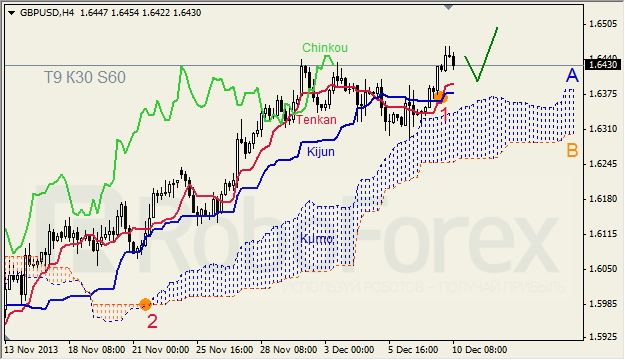
GBPUSD, Time Frame H4 – Indicator signals: Tenkan-Sen and Kijun-Sen intersected above Kumo Cloud and formed “Golden Cross” (1); all lines are horizontal. Ichimoku Cloud is going up (2), Chinkou Lagging Span is close to the chart, and price is above the lines. Short‑term forecast: we can expect support from Tenkan-Sen and growth of the price.

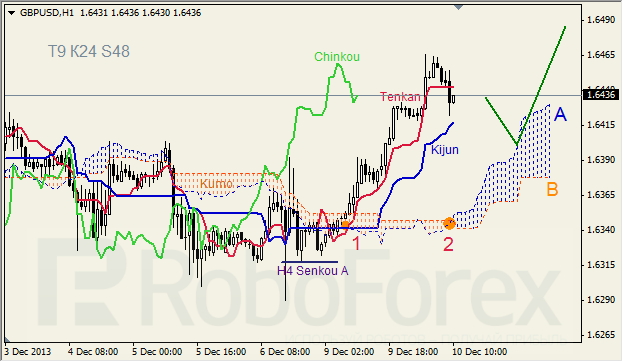
GBPUSD, Time Frame H1 – Indicator signals: Tenkan-Sen and Kijun-Sen are influenced by “Golden Cross” (1); Kijun-Sen and Senkou Span A are directed upwards, other lines are horizontal. Ichimoku Cloud is going up (2); Chinkou Lagging Span is above the chart, and price is inside Tenkan-Sen – Kijun-Sen channel. Short‑term forecast: we can expect support from Senkou Span A and growth of price.

GOLD

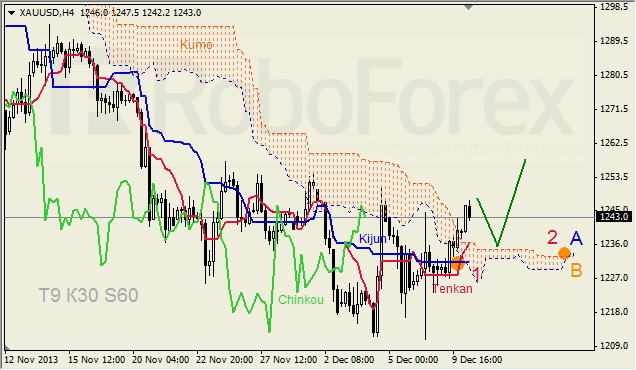
XAUUSD, Time Frame H4 – Indicator signals: Tenkan-Sen and Kijun-Sen intersected below Kumo Cloud and formed “Golden Cross” (1); Tenkan-Sen is directed upwards, other lines are horizontal. Ichimoku Cloud is closed (2), Chinkou Lagging Span is above the chart, and the price is above the lines. Short‑term forecast: we can expect support from Senkou Span B and growth of the price.

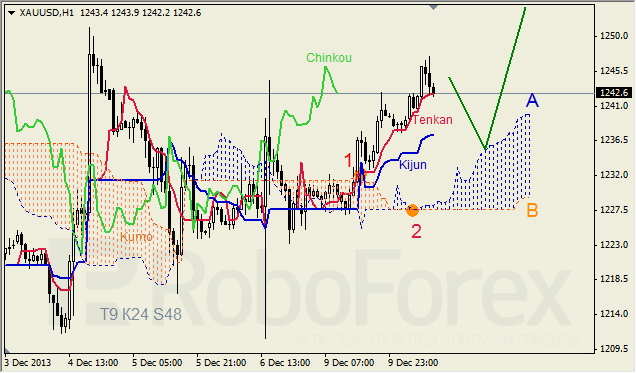
XAUUSD, Time Frame H1 – Indicator signals: Tenkan-Sen and Kijun-Sen intersected above Kumo Cloud and formed “Golden Cross” (1); all lines are horizontal. Ichimoku Cloud is going up, Chinkou Lagging Span is above the chart, and price is on Tenkan-Sen. Short‑term forecast: we can expect resistance from Tenkan-Sen and support from Senkou Span A.

RoboForex Analytical Department

Article By RoboForex.com

Attention!
Forecasts presented in this section only reflect the author’s private opinion and should not be considered as guidance for trading. RoboForex LP bears no responsibility for trading results based on trading recommendations described in these analytical reviews.


Forex Technical Analysis 10.12.2013 (EUR/USD, GBP/USD, USD/CHF, USD/JPY, AUD/USD, GOLD)

Article By RoboForex.com

Analysis for December 10th, 2013

EUR/USD

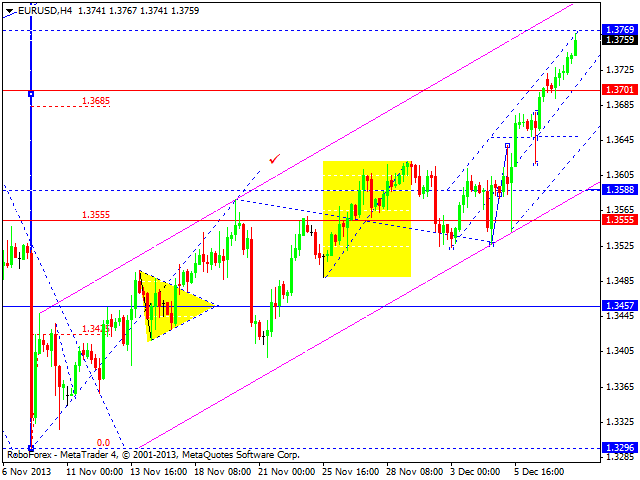
Euro couldn’t form descending impulse so far and continues moving upwards. Market reach all targets of extensions and according to main scenario, it may start forming correctional structures. We think, today price may move towards level of 1.3460 and then reach new maximum again.

GBP/USD

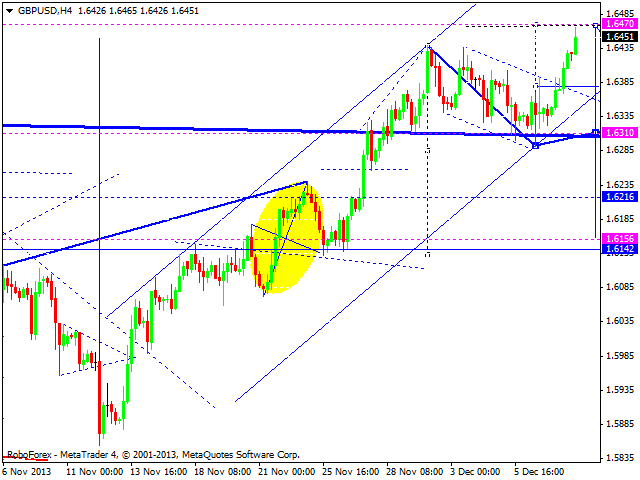
Pound reached new maximum. We think, today price may reach one more maximum at level of 1.6470 and then start new correction towards level of 1.63160 (at least).

USD/CHF

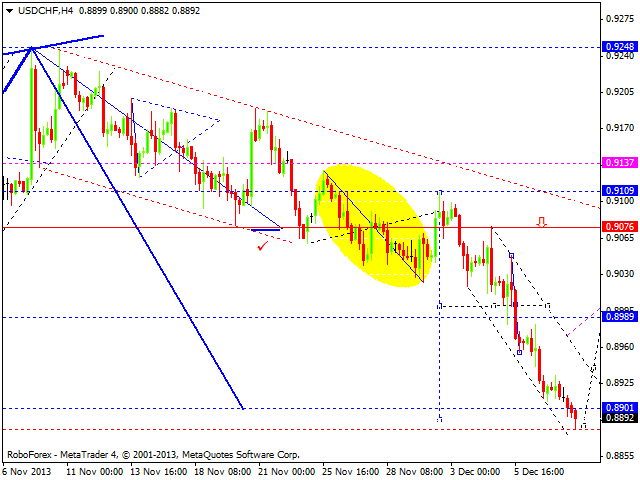
Franc reached target of its descending structure; market fell down a bit lower that we expected and right now is expected to form new correction towards 0.9076. We think, today price may consolidate at current levels for a while, reach new minimums, and then leave consolidation channel upwards to form reversal structure for above-mentioned correction.

USD/JPY

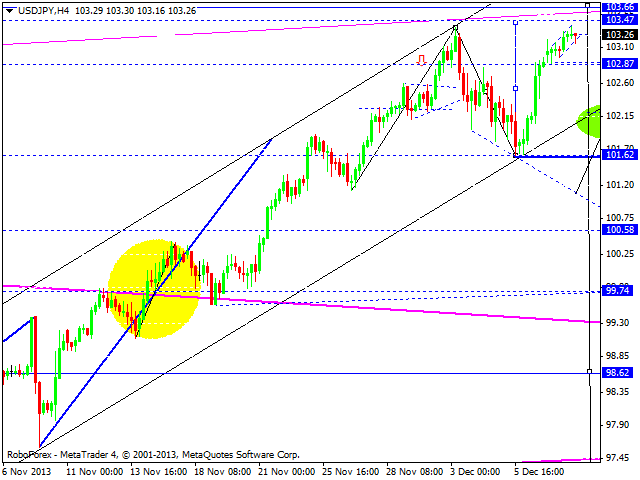
Yen reached new maximum. Current ascending structure implies that market may reach level of 103.47; descending impulse isn’t strong enough to continue correction. We think, today price may reach new maximum once again and then start forming new descending impulse. Later, in our opinion, pair may consolidate at current levels and then start forming reversal structure for new descending wave.

AUD/USD

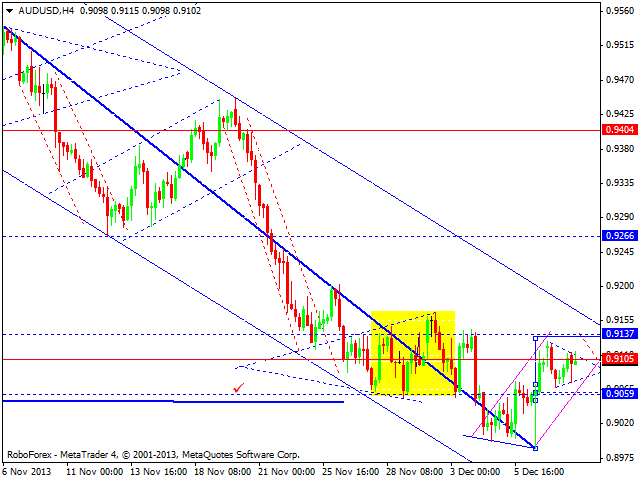
Australian Dollar is still consolidating; current movement looks like triangle pattern. Market may continue forming this consolidation channel, reach new minimum and maximum. As a result, we’ll have wave with target at 0.9137 and correction towards 0.9060. Later, price may start growing up again, but right now, it is more likely that it will continue falling down.

GOLD

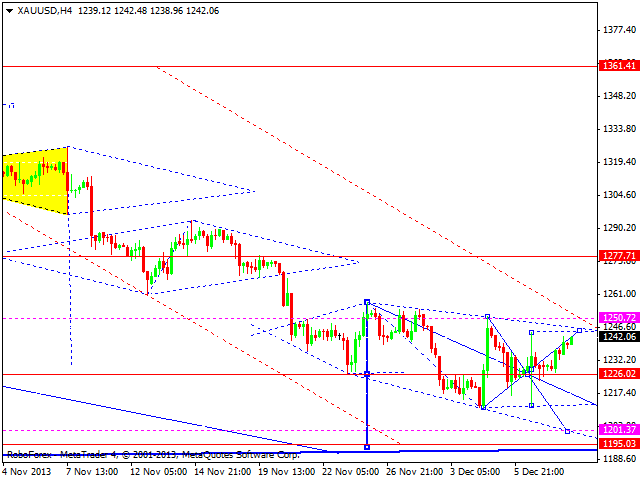
Gold continues forming consolidation channel. We think, today price may move downwards to reach 1201, return to 1226, and then complete this descending wave by falling down again and reaching 1195. Later, in our opinion, instrument may form reversal structure to start new ascending movement towards level of 1314 (at least).

RoboForex Analytical Department

Article By RoboForex.com

Attention!
Forecasts presented in this section only reflect the author’s private opinion and should not be considered as guidance for trading. RoboForex LP bears no responsibility for trading results based on trading recommendations described in these analytical reviews.


AUDUSD remains in downtrend from 0.9756

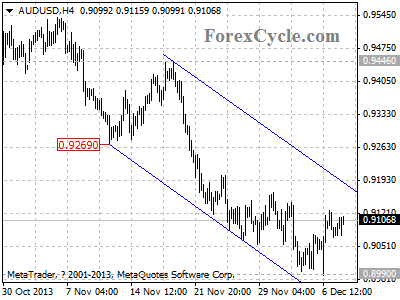
AUDUSD remains in downtrend from 0.9756 (Oct 23 high), the rise from 0.8990 could be treated as consolidation of the downtrend. Further rally would likely be seen, and the target would be at the upper line of the price channel on 4-hour chart. As long as the channel resistance holds, the downtrend could be expected to resume, and one more fall to test 0.8847 (Aug 5 low) support is still possible.

audusd

Provided by ForexCycle.com

An Unconventional Way to Protect Your Wealth: Buy Stocks

By MoneyMorning.com.au

Face, meet egg.

Following a disappointing November, stocks continue to fall in December.

Our year-end target of 6,000 points for the S&P/ASX 200 is now a distant light on the horizon.

To get there we’d need to see an 856 point jump, or a 16.6% gain.

So you now have permission to throw an egg in our general direction – preferably not rotten or hard-boiled.

After all, a big double-digit percentage gain in the space of just three weeks hardly seems possible.

And yet, it’s not entirely impossible…

OK, we’re grasping at straws. We’d love it if stocks defied the odds and soared as the year drew to a close.

If you remember back to the depths of the market in March 2009 you’ll recall the blue-chip index gained 16.8% in three weeks. That hardly seemed likely back then, when most thought the world was about to end.

Small-cap stocks did even better. Especially those with a good story to tell about innovation and game-changing technology.

Of course, that was a one-off event, wasn’t it?

No End to the Low Interest Rate Story

Not quite.

In July that year Australian stocks gained 13%.

And between then and today there are many other times when stocks gained 6% or more in short order.

Importantly, there are many examples of the Australian market doing what it has done over the past six weeks – fall by 5.5%. Why is that important? Because it shows you that, despite what appears to be catastrophic falls, the market has shown a tendency to recover.

Now, we get it. We get that many of those recoveries have been due to stimulus measures; namely central bank money printing and artificially low interest rates.

The point we’ll make is, do you think that any of that is about to end?

Do you really think central banks will stop printing money, risking a collapse into economic recession?

And do you really think the same central banks will suddenly reverse course and begin raising interest rates after spending the past five years holding them down?

If you answer yes to those questions then all we can say is that you really haven’t been paying attention.

If you answer no to those questions then your decision as an investor is plain and simple: when the market falls 5-10% you should see this as an opportunity to buy stocks rather than sell stocks.

Stocks Beat Gold – Again…

It amuses us that some of the biggest gloating about the recent drop in stock prices has come from gold investors.

Not that we’ve got anything against gold or gold investors.

We explained yesterday that we’re still as big a fan of gold as we’ve ever been. That’s not about to change. But for gold investors to try and stick it to stock investors is a bit rich.

After all, as far as a comparative performance goes for this year, even after the recent fall for stocks, the Aussie blue-chip index is still up by 10.7% for the year. Compare that to the Aussie dollar gold price, which is down 15.9%. This should be the second year in a row that stocks beat gold.

To be fair, we’re making a bit of a false argument. We don’t believe investors should choose between stocks or gold. We say investors should hold a big chunk of shares for wealth accumulation and a big chunk of gold as protection against government and central bank meddling.

But the fact is that stocks (and gold) never rise or fall in a straight line. You know that by now. That means you have to use price dips like this as an opportunity to buy stocks you thought were too expensive three or four weeks ago.

And yet, we know that now stocks have fallen, most investors will lose their bottle and stay on the sidelines…until stocks have gained 5%. Then they’ll buy!

The Boost You’ve Waited For

It’s all part of the general psychology of most investors.

It’s part of what makes a bull market a bull market. In truth, we’re glad those investors exist because they help push stocks higher than they otherwise should go.

While we’re grateful for those investors, we’d rather you weren’t one of them. Those investors are the type who look at the market and claim it’s too expensive. When stocks fall 5-10% they then say stocks are going lower, so they still don’t buy.

The only time they’ll buy into the market is when stock prices have gained 5, 10, 15 or 20%. Then when they’re afraid of missing out they’ll find some justification for paying a high price for stocks…just as the market hits the top.

Look, it’s OK to be nervous about the stock market. After five years of painstakingly rebuilding your investments, the last thing you want to do is watch it all go down the drain again.

But as we’ve warned before, as an investor you really don’t have any other choice than to play the stock markets. Interest rates are destined to stay near record lows. And our bet is, despite the noise coming from the US Federal Reserve, it will next week dismiss any talk of reducing its asset purchase program.

If so, it would give stocks the boost we’ve been waiting for. It may not be enough to get the Aussie index up to 6,000 points, but that’s OK. Because regardless of short-term goals, the long-term story remains the same: low interest rates and money printing equals a boom time for stock prices.

The biggest damage you can do to your wealth right now isn’t to buy stocks; it’s to think that you’re protecting your wealth by staying in cash.

Cheers,
Kris+

Special Report: The ‘Wonder Weld’ That Could Triple Your Money

Join Money Morning on Google+


By MoneyMorning.com.au

The Most Important Gold Chart in the World

By MoneyMorning.com.au

Ever since gold broke below critical support back in April, you’ve been inundated with statistics, price targets and countless charts. There’s certainly no shortage of gold analysis these days.

But today, I want you to forget everything you’ve read about gold over the past eight months. Forget about production statistics, inflation guesses, or jewellery demand in Asia. Heck you can even discard the annotations on every other gold chart you’ve seen this year…  

The most important gold chart in the world right now is the long-term look at the Dow/gold ratio – the Dow Jones Industrial Average priced in gold.


Today, it will cost you about 13 ounces of gold to buy the Dow. That’s a long way off the almost 45-ounce price tag on the Dow back in 1999…

This chart goes back far enough to see the very end of the massive gold spike in 1980, followed by the Dow regaining its footing before beginning a 20-year run. It’s pretty obvious what happens when the Dow finally breaks higher after years of decline versus the yellow metal.

Priced in gold, the Dow had been in a massive 13-year bear market,‘ explain the analysts over at Chart of the Day. ‘However, back in the summer of 2011, gold peaked while the Dow continued to rally. While the Dow (priced in gold) is currently well-off its dot-com record highs, it has been surging as of late. The current rally has resulted in a break above resistance of its latest downtrend channel as well as new post-financial crisis highs.

What we’re seeing right now is a massive performance shift. After more than a decade in the driver’s seat, gold is giving up ground to stocks.

A change in trend is brewing. Don’t get caught on the wrong side of the market.

What About Gold Miners?

Gold’s looking bad. But miners are looking much worse.

I’ve written to you about the temptations to ‘bottom pick’ the miners on multiple occasions this year. Sure, it might work for a quick trade or two. But any long-term bets on this group remain out of the question, as far as I’m concerned.

Yes, miner sentiment is absolutely terrible right now. And that can be a contrarian signal to buy. However, there are simply too many factors holding miners down right now to make it worth the risk. In fact, there are still plenty of investors who remain ‘in love’ with these stocks, according to Frank Zorrilla, founder and chief investment officer of Zor Capital.

The Market Vectors Gold Miners ETF has now slid 55% YTD to a five-year low,‘ Zorilla notes, ‘yet the fund has nearly doubled in size to $6.8B, as investors have added $2.5B despite the dismal performance.

Yikes. Looks like some investors just love the pain…

Zorilla continues:

Based on this information one can argue that the miners have a long way to go before they form a true bottom if one believes that bottoms are formed when there’s despair. That does not mean that they won’t have sharp rallies every now and then but it’s obvious that there is a very big love affair with the miners even though they have done nothing but disappoint.

Gold’s been incredibly volatile lately. Do yourself a favour and avoid the miner ETFs on the long side. Things will probably get worse before they get better…

Greg Guenthner
Contributing Editor, Money Morning

Publisher’s Note: The Most Important Gold Chart in the World originally appeared in The Daily Reckoning USA

Join Money Morning on Google+


By MoneyMorning.com.au

The Market You Trade Is Not Random…Cycle Analysis & Why You Need It!

By Chris Vermeulen – www.GoldAndOilGuy.com

The use of cycles is perhaps the most misunderstood areas of technical analysis. And is widely miss used within automated trading systems. This is because there are a wide variety of approaches ranging from magnetic, to astrology to time based cycles.

The purpose of this tutorial on cycle analysis and implementation into automated trading systems is to present a logical perspective on what cycles and how they enhance your technical analysis studies.

Originally I was attracted to cycle analysis back in 2001. Back then, there was very little information about cycle analysis and even less on how to identify them within financial instruments. Cycles can be somewhat measured using conventional indicators such as RSI, stochastics and moving averages. But, better yet is a custom cycle analyzer indicator I created to make cycle identification and implementation automatic within my trading strategies and my fully automated trading system.

Here is how the moving average can help spot cycles, but keep in mind they are lagging indicators. The lower indicator shows the long term cycle and swing trading cycle I focus on. Remember cycle lengths change over time which is why I automated the indicator and have it run within my automated trading system. But you should get the gist of how cycles look and function.

Cyclical Automated Trading System

I am going to touch quickly on a few areas of cycle analysis which I hope you find somewhat interesting.

Cycle Perspective by Market Participants

Cycles also known as waves are observed almost everywhere including nature. Ancient civilizations designed calendars and time measurements cased around cycles. This has creating the most standard measurements we all live by and track on a regular basis. The length of day, year, seasonal changes and even the phases of the moon and stars. These are just time based cycles but the same type of thing carries across noise like musical notes, light spectrum’s, and in liquids like waves in the ocean.


Philosophical Cycle Foundation

The financial markets are truly efficient and follow random walk principle. The fact that so many like Larry Williams and Paul Tudor Jones along with many other long term consistent traders pull money from the financial markets prove this if a more detailed analysis of the random walk theory is applied and you will see some interesting results through cycle analysis.

Understanding cycles and through tracking where they are I their current phase gives you a pretty good idea to where the financial market is headed for a short distance into the future with high level of accuracy.


Understanding Cycles & Automated Trading System Implementation

The stock market or any financial instrument chart is similar to an aerial photo of a river. There are times (sections) where the price movements appear random while other sections have distinctive cyclic pattern (waves or a snake like pattern).

No matter how good you are of a trader or investor you are, trading the markets requires us to take a leap of faith along with many assumptions to follow our trading system whether it is an automated trading system or not.

Understanding cycles is just a piece of the overall puzzle although I would account for it to be 1/3rd of my analysis for timing and position management of my automated investing system.

So what are the other pieces of the puzzle?

Glad you asked (subconsciously)!

According to my research the market is in a cyclical state roughly 20-35% of the time. Logic indicates that you should have a trading strategy that can identify and trade this type of price action.

The stock market trends roughly 25-35% of the time also. So another trading strategy is required for taking advantage of this price action also.

And then there is the random none tradable price action. This is when the market is giving off mixed signals and this typically happens during a change in market conditions from an uptrend to a down trend or from cyclical price action to a trending market.

Understanding and identifying what I just talked about will greatly improve your trading, investing and reduce stress and emotional trading.


My Automated Trading System Identifies Active Cycles and Trades

In conclusion, it took me years of studying cycles to master identification and timing of trades based around them and to be honest I am still learning and improving this process.

If this short tutorial sparked some interest then I highly recommend opting in to my free newsletter below. In a week I will be making my soon to be published book “Technical Trading Mastery – 7 Steps To Win With Logic”  which is the perfect holiday read and trading education book to kick start 2014. I will be making the book available to my followers only two months before it’s available on Amazon, Barns & Noble’s etc., which won’t be until Feb.

While I am bias towards this MUST READ BOOK, I feel it will truly improve how you think, feel and trade the markets for the rest of your life.

Happy Holidays, and remember to send me your feedback and ideas on topics you would like to learn more about!

By Chris Vermeulen – www.GoldAndOilGuy.com


Warrants Warrant More Respect in the Resource Sector: Dudley Baker

Source: Brian Sylvester of The Gold Report (12/9/13)

https://www.theaureport.com/pub/na/warrants-warrant-more-respect-in-the-resource-sector-dudley-baker

Noting that the resource sector is poised to come back “big time,” Dudley Baker, editor and founder of CommonStockWarrants.com, makes the case for adding warrants to resource investment portfolios. In this interview with The Gold Report, he offers a tutorial on this underused investment vehicle, disabuses myths about warrants and shares the names of some warrants that warrant attention.
The Gold Report: Before we get into how to invest in warrants, please tell our readers what a warrant is.

Dudley Baker: Very simply, a warrant is a security that gives the holder the right, but not the obligation, to purchase the underlying common shares at a specific price and includes a specific expiration date.

TGR: How does that differ from a futures contract?

DB: A futures contract refers to the purchase of an actual commodity: gold, silver, soybeans, pork bellies, etc. Warrants also differ from call options. Those are derivative contracts written on a stock, stock index or futures contract.

The official definition of warrants states that they are securities, the distinction being here that a warrant is actually issued by the company.

TGR: Why do most investors overlook warrants?

DB: That has been a mystery for decades. Since the early 1980s, when the Chicago Board Options Exchange (CBOE) came into play, investors’ interest turned toward stock options—calls and puts. These days, it’s all about trading, and for brokers, it’s all about commission. Warrants were left out of the investment arena. They’re still great opportunities. My mission is to educate and explain the value of stock warrants.

TGR: What are the differences between trading warrants and private placement warrants

DB: Virtually every company in the resource sector has a warrant in its capital structure. Very few of those warrants actually trade; most are private placement warrants.

Private placement warrants serve as an equity kicker. I’ll use Rick Rule as an example. He would never do a transaction unless a long-term warrant was part of the equity package because he wants more bang for his buck. Unfortunately, many individual investors don’t have the opportunity to participate in private placements.

However, investors should know that there are roughly 200 trading warrants out there right now in the U.S. and Canada, not just in the resource sector, but across the board.

TGR: We’re in a depressed market for mining equities. Does market performance have an effect on the warrant market?

DB: Yes, if stocks are down, warrants will be down. That said, it’s all about the underlying company. For the warrant to do well, the company has to perform. We’re always looking for the upside leverage.

We’re looking for a 2:1 leverage. If an investor wants the common shares in a company to rise 100%, we want the warrant to perform 200%. That gives us a reason to buy the warrant in lieu of the common shares. It’s all about gaining more leverage with long-term warrants.

For the last couple of years, the market has not been kind to resource investors, whether it’s common shares or warrants. We see this whole sector coming back big time. Now is when investors want to start looking for long-term warrants on companies they like.

TGR: Why do mining companies, especially gold and silver equities, deal in warrants more than other sectors?

DB: The resource sector is highly capital intensive and high risk. Let’s face it, the companies need more incentive to get someone like Rick Rule and Sprott Global involved in a potential financing. They have to offer a long-term warrant as an equity kicker.

TGR: The warrant offsets risk.

DB: Exactly. In the resource sector, money goes into the ground and everybody hopes for the best. The people providing the financing, however, need more opportunity for the upside potential to outweigh the downside. The financiers know that many companies will not perform, so they require these equity kickers.

TGR: What’s the typical path to making money by investing in a warrant?

DB: The most straightforward, logical way is to pick the right company and buy its warrants. If the company doesn’t perform, the warrant can’t perform either.

On top of that, we need a good market environment or the expectation of a good market environment, which I think we have right now. I think most would agree that the next few years probably will be in favor of resource investors.

TGR: Are there other ways to make money with warrants?

DB: Yes, one is a dollar allocation. Take an investor who comes to us with a question as to how to invest $10,000 in a gold stock. The company also offers a long-term warrant. He could split the investment between the stock and the warrant. Depending on the leverage situation, that split could be 50/50, 80/20, or another combination, according to the investor’s risk/reward ratio.

There also are hedging opportunities in warrants. Instead of just buying the warrant, investors can buy the warrants and short the common shares. They could buy the warrants and sell puts against that position. They could actually short the warrants and buy call options. So they’re just trying to establish hedge positions here.

This works better in the U.S. markets. That is because American investors can’t exercise a warrant issued in Canada; U.S. investors can only trade Canadian warrants. A Canadian investor could probably short the shares.

I’d almost say, especially in the U.S., any time you are doing a hedge and you’re buying the common shares as your core position, basically you just substitute the company’s long-term warrant for the common shares, and you can accomplish that same hedge position with a lot less cash on the line, which means your net return will be substantially higher.

TGR: What are four things should investors be aware of before entering the world of warrants?

DB: First, warrants can expire. Once they’ve expired, they are worthless. I would recommend choosing only long-term warrants, which to me means a minimum of two or three years. This gives you more time for the markets to turn around and to capture the maximum gains.

Second, stick with companies that you like. Before buying common shares, ask whether the company has any long-term trading warrants, You may have to look into those yourself; not all newsletter writers are up on the opportunities warrants offer.

Third, before you buy a warrant, find out what the current leverage is. Is the warrant overpriced, fairly priced or undervalued? You don’t want to pay more than you have to.

Fourth is liquidity. The liquidity of warrants varies on a daily basis.

TGR: When you talked with The Gold Report in 2008, there was no exchange where warrants were traded. Are there some new resources that make warrants trading more transparent and, perhaps, simpler? Your website, CommonStockWarrants.com, is one resource. Are there others?

DB: The lack of information about warrants was one reason I started my service, and there has been progress. Today, warrants are traded like stocks on the Toronto Stock Exchange (TSX) and the TSX Venture Exchange (TSX.V) in Canada. Warrants for U.S. companies can trade on the New York Stock Exchange (NSYE) or on NASDAQ. Exchanges issue warrants a symbol, just like common shares.

TGR: They just have a longer ticker.

DB: It’s usually five letters or it will have a .WT, or in the U.S., it might have a -WS.

TGR: When an outstanding warrant is worth less than the current stock trading price, it can create an overhang on a stock. How do you play that situation?

DB: There is a perception, and probably rightly so, that outstanding warrants have a dilution effect on the common shares. Some people see that as a negative. We look at the upside leverage opportunity that warrants offer an investor. We know there will be slight dilution to the company’s shares if and when those warrants are exercised. We also know that means new cash coming into the company’s kitty. It’s a tradeoff.

TGR: But if a company is trading for $2/share and its warrant is trading at $1, why not buy the warrant instead of the shares?

DB: The warrants will always be selling for less than the common shares but an investor must still ask several questions: do you like the company, what is the time remaining until expiration, and what are the current leverage calculations as to whether the warrant is fairly priced. Additionally, a warrant will almost always trade at a minimum of its intrinsic value. If the common shares are selling at $12/share and the exercise price on the warrant is $10, we know that warrant has to be selling in the marketplace for a minimum of $2.

TGR: What’s the best way to play a long warrant?

DB: Time permitting, you want to hold a warrant as long as you would hold the common shares. Remember, you’re basically playing the common stock even though you own the warrants.

If you own a warrant and, after 6 to 12 months, decide that the common shares have peaked and are overbought, you sell the warrant at the same time that you would sell the shares. You make the same decision, as though you owned the common shares.

People often ask if you have to hold the warrant until the expiration date. The answer is no. Warrants are totally liquid. You can buy today, sell tomorrow. You’re not locked in.

TGR: What are some warrants in the gold and silver space that you’d like to share with us today?

DB: There are several. We have Sandstorm Gold Ltd. (SSL:TSX; SAND:NYSE.MKT), which has a similar streaming model to Silver Wheaton Corp. (SLW:TSX; SLW:NYSE) and the same management team. Sandstorm Gold has three warrants trading right now. I always look for the warrant with the longest life. The Sandstorm Gold Warrant B goes out to September 2017, giving investors almost four years of remaining life.

New Gold Inc. (NGD:TSX; NGD:NYSE.MKT) is another great company. Its Warrant A expires in June 2017, more than three-and-a-half years of remaining life. We expect to see a rip-roaring bull market within that time period, so that’s really cool.

The third name I’d share with you is Alamos Gold Inc. (AGI:TSX). It issued a five-year warrant just a few months ago that will expire in August 2018.

For any of those three, of course, you want to determine the leverage calculation. Is it overvalued, undervalued?

TGR: You would buy those warrants and sell them when you believe they are appropriately valued.

DB: Exactly. I would be utilizing all the tools that an investor would: looking at long-term charts, following analysts or newsletter writers.

If, as I expect, we get a nice bull market in the resource sector, it would not be uncommon to see common share prices double, triple or quadruple. The warrants should do twice as well. It’s just a matter of staying on board as long as possible to capture these gains, but knowing that you can pull the plug and can exit at any moment.

It’s like any investment, if you double your money, you may want to take some money off the table and minimize your risk. But we’d like to capture as much of this upcoming bull market as possible.

TGR: If investors want to find the current value of one the Sandstorm Gold warrants that are trading, where would they go?

DB: That’s the dilemma for most investors. There are 200 warrants trading on the markets now in total, not just in the resource sector. It’s tooting my own horn, but CommonStockWarrants.com is virtually the only place to find all the detail needed to make informed investment decisions.

Barring that, investors willing to invest the time can follow company news. Fortunately, resource companies tend to be more transparent with information about their warrants.

You can read in the news about U.S. companies outside the resource sector—biotech and financial service firms—making offerings with common shares and warrants. However, 9 times out of 10, those warrants will not trade. You have to dig that information out of the original prospectuses, where there’s a phrase that reads, “There is currently no market for the warrant and we do not anticipate a market to be established.”

TGR: What other warrant ideas are out there?

DB: There are a couple of interesting companies in the energy space. Kinder Morgan Inc. (KMI:NYSE)has a long-term warrant that goes out to May 2017. A Fieldpoint Petroleum (FPP:NYSE.MKT) warrant goes out to March 2018.

In the biotech space, I would name MannKind Corp. (MNKD:NASDAQ). Its warrant expires in February 2016. Not long ago, another newsletter crowed about gains on its recommendation of Mannkind’s common shares. If he had bought the warrant at the same time as the common shares, he would have more than doubled the money for his investors. Instead of making 200%, it would have made a 400–500% return.

Another is Bioamber Inc. (BIOA:NYSE), which has a warrant that expires in May 2017. This is a sustainable chemicals company. Its proprietary technology platform combines industrial biotechnology and chemical catalysts to convert renewable feedstock into chemicals for use in a wide variety of everyday products.

Northwest Biotherapeutics Inc. (NWBO:OTC) is another biotech name with trading warrants.

TGR: Dudley, we’ve just scratched the surface of warrants. What would be one final thought for our readers?

DB: Brian, I would say warrants are a simple investment vehicle that has been overlooked for decades, whether for trading or for hedging. For good or ill, warrants are a niche market. My passion is getting more people to understand the opportunities of long-term warrants.

TGR: Thanks for your time and your insights.

Dudley Baker worked for the IRS for 29 years, which gave him an extensive ‘numbers’ background. He has 35 years of accumulated knowledge and experience in trading stocks, options, leaps, futures, options on futures and warrants. In March 2005 he founded and launched a new market data service, Precious Metals Warrants, which provided detail on mining and energy warrants trading on the U.S. and Canadian exchanges. The service was expanded in May 2013 to include all stock warrants trading in the U.S. and Canada and for all industries and sectors and the name changed to Common Stock Warrants. Baker can be reached at [email protected] or through the websitewww.CommonStockWarrants.com.

Want to read more Gold Report interviews like this? Sign up for our free e-newsletter, and you’ll learn when new articles have been published. To see a list of recent interviews with industry analysts and commentators, visit our Interviews page.

DISCLOSURE:

1) Brian Sylvester conducted this interview for The Gold Report and provides services to The Gold Reportas an independent contractor. He or his family own shares of the following companies mentioned in this interview: None.

2) The following companies mentioned in the interview are sponsors of The Gold Report: None. Streetwise Reports does not accept stock in exchange for its services or as sponsorship payment.

3) Dudley Baker: I or my family own shares of the following companies mentioned in this interview: Sandstorm Gold Warrant B (SSL.wt.B) and New Gold Warrant A (NGD.wt.A). I personally am or my family is paid by the following companies mentioned in this interview: None. My company has a financial relationship with the following companies mentioned in this interview: None. I was not paid by Streetwise Reports for participating in this interview. Comments and opinions expressed are my own comments and opinions. I had the opportunity to review the interview for accuracy as of the date of the interview and am responsible for the content of the interview.

4) Interviews are edited for clarity. Streetwise Reports does not make editorial comments or change experts’ statements without their consent.

5) The interview does not constitute investment advice. Each reader is encouraged to consult with his or her individual financial professional and any action a reader takes as a result of information presented here is his or her own responsibility. By opening this page, each reader accepts and agrees to Streetwise Reports’ terms of use and full legal disclaimer.

6) From time to time, Streetwise Reports LLC and its directors, officers, employees or members of their families, as well as persons interviewed for articles and interviews on the site, may have a long or short position in securities mentioned and may make purchases and/or sales of those securities in the open market or otherwise.

Streetwise – The Gold Report is Copyright © 2013 by Streetwise Reports LLC. All rights are reserved. Streetwise Reports LLC hereby grants an unrestricted license to use or disseminate this copyrighted material (i) only in whole (and always including this disclaimer), but (ii) never in part.

Streetwise Reports LLC does not guarantee the accuracy or thoroughness of the information reported.

Streetwise Reports LLC receives a fee from companies that are listed on the home page in the In This Issue section. Their sponsor pages may be considered advertising for the purposes of 18 U.S.C. 1734.

Participating companies provide the logos used in The Gold Report. These logos are trademarks and are the property of the individual companies.

101 Second St., Suite 110

Petaluma, CA 94952

Tel.: (707) 981-8999

Fax: (707) 981-8998

Email: [email protected]


Fear Index Hits Multiyear Low; A Bad Omen for Stock Investors?

By for Investment Contrarians

Investors Too ComfortableLet me begin by first stating this: I’m not going to talk about the Federal Reserve in any detail, or about the holiday shopping season and how it’s so important to the retail sector and the economy because these don’t seem to be of any great concern to the markets.

The reality is that both traders and investors appear to be really comfortable at this moment with the record-high levels in the stock market. Take a look at the multiple records recently set by the S&P 500 and Dow Jones Industrial Average; you won’t see any sign of a pullback. Yet no one seems to care—even though this is all incredibly dangerous for the stock market.

This is simply not a normal trading environment for the stock market, since the Federal Reserve has largely been responsible for the record advances, as I previously discussed in this column on Friday.

A look at the CBOE Volatility Index (VIX), or the “fear index,” reveals the current multiyear low in the VIX, which we haven’t seen since 2007, prior to the subprime mortgage-driven stock market correction in 2008, The current low level of the VIX suggests that the stock market is relaxed and is not expecting any strong moves in either direction on the horizon. Looks like the market could be in for a surprise in the New Year.

Are traders simply too relaxed? The chart of the VIX below shows the big gaps between the VIX readings and the S&P 500.

In 2007, the VIX reading was below 10, but the S&P 500 didn’t begin to sell off until the VIX increased to the 30 level, which indicated expected volatility. The recent low point for the S&P 500 surfaced in early 2009 when the VIX skyrocketed to the 80 level. Since then, the VIX has been steadily declining and the S&P 500 has been edging higher.

Take a look at the major gap between the VIX and the S&P 500 as shown by the oval in the chart below. As long as the VIX moves lower or holds at its current level, it’s likely the S&P 500 will keep moving higher.

Volatility Index Chart

Chart courtesy of www.StockCharts.com

This is where we are at the moment.

The VIX is at a low, suggesting there could be more gains to come. If the VIX begins to edge higher, it could signal some upcoming selling pressure for the stock market. If this happens, then it would be wise to start liquidating some of your long positions; albeit, it’s always a good time to take some profits, especially as we near the end of the tax year.

The VIX as a stock market indicator may not be perfect or even offer a sure bet, but investors still need to monitor the index to help form an investment strategy for your assets should stock market volatility pick up.


Original Article: http://www.investmentcontrarians.com/stock-market/fear-index-hits-multiyear-low-are-investors-too-comfortable/3405/


Best Investment Strategies to Battle Coming Inflation

By for Investment Contrarians

Best and Worst Investment StrategiesThe S&P 500 may be entering bubble-like territory: that’s what I’ve been writing for the past few months.

Now, it appears as though I’m not the only one who’s worried about asset classes beginning to form bubbles from the excess money printing. 2013 Nobel Prize-winner Robert Shiller also recently stated that he is concerned that prices have risen far too quickly across many asset classes, from real estate to stocks.

As I’ve written several times over the past couple of months, investing in stocks at these elevated levels is quite risky. My belief is that much of the upward move in the S&P 500 has been primarily based on the liquidity (money printing) being pumped by the Federal Reserve.

Investing in stocks with this premise can only work for the very short-term trader who’s quick enough to get out when the tide begins to turn.

Because people are not investing in stocks based on actual fundamentals right now, one can’t expect the value in the S&P 500 to remain elevated once there’s a change in monetary policy, since much of the move has been artificially supported.

Let’s take a look at how the S&P 500 has been affected by monetary policy over the past few years, and how investing in stocks at the current level is becoming increasingly risky.

S&P Large Cap Index Chart

Chart courtesy of www.StockCharts.com

The first quantitative easing program by the Federal Reserve lasted from December 2008 until March 2010. This period is not shown on the chart above, as one could argue that the S&P 500 became extremely oversold and that investing in stocks for the long-term made sense at that point, regardless of the Federal Reserve’s policy.

The second round of quantitative easing (QE2) by the Federal Reserve began in November 2010 and lasted until June 2011. As you can see in the chart above, following the completion of the Federal Reserve’s QE2 in the summer of 2011, the S&P 500 sold off into the fall.

“Operation Twist” began during the end of September 2011 and was originally scheduled to end in June 2012. However, the Federal Reserve extended this program until the end of 2012.

And finally, we get to the third round of quantitative easing (QE3) by the Federal Reserve, which began in September of 2012 with the purchase of $40.0 billion per month of mortgage-backed securities. In December of 2012, the Federal Reserve expanded QE3 to include the purchase of $45.0 billion per month of Treasury securities.

Investing in stocks throughout this time period clearly benefited shareholders, as the Federal Reserve pumped an exorbitant amount of new money into the market. The S&P 500 continued to power higher, only selling off when each monetary policy initiative was completed.

To keep the S&P 500 moving higher, each time monetary policy was set to end, the Federal Reserve stepped in and pumped more money into the system.

I’m certainly not suggesting one should sell every single share and sit in cash only; in fact, cash is the worst investment to make during a time when the Federal Reserve is printing money like crazy, because inflation will begin to eat away at your wealth over the next decade.

What I am suggesting is that a portfolio needs to be diversified to include hedges against both a sell-off in the S&P 500 and the negative effects of money printing.

Investors may want to look at investing in stocks in sectors that still have value, while also adding precious metals, such as gold and silver, to their portfolios. Investing a small portion of your portfolio in an inverse exchange-traded fund (ETF), such as the ProShares Ultra Short S&P500 (NYSEArca/SDS), which moves up in value as the S&P 500 moves down, may also be a wise play.


Original Article: http://www.investmentcontrarians.com/stock-market/the-best-and-worst-investment-strategies-to-battle-coming-inflation/3406/