Carbon Nanotubes: Molecular Medicine Kills Cancer from the Inside

By MoneyMorning.com.au

If you’re a subscriber to Revolutionary Tech Investor, you’ll know that technology analyst Sam Volkering has been unearthing futuristic tech investing opportunities.

And if you think we’re using the word revolutionary too freely, well, think again. Because the word ‘revolution’ perfectly describes some of the amazing things happening in the tech world right now.

Today, I’ll talk to you about another revolutionary idea – carbon nanotubes (CNTs).

Sam explained the unique qualities of this high-tech composite material in a recent issue of Revolutionary Tech Investor. Put simply, carbon nanotubes are tubes of one atom thick carbon, only a few nanometres wide.

They look like cotton thread, conduct like electricity, heat up like metal wires and are as strong as carbon fibres. In short, carbon nanotubes look set to be the high-tech material of the future…

In theory, CNTs seem to have very few limits. Scientists are only just starting to discover the opportunities for their application.

As I mentioned last week, the hype around CNTs is back because scientists have found ways of manipulating, or controlling, CNT’s chirality (its twist). It’s this newfound control over CNTs that means they will eventually replace silicon chips that power computers.
CNT use in computing looks set to revolutionise the computing industry the way silicon chips did.

Because of their unusual properties and the ability to ‘twist’ them (that is, the ability to control their metallic properties), nanotubes won’t just shake up electronics. In fact, CNTs could vastly alter the treatment and the outcome for cancer patients.

Currently, when surgery isn’t an option or it hasn’t been successful for a cancerous tumour, many have no alternative but to try chemotherapy and radiation therapy to shrink or kill the cancer cells.

Scientists already know how to kill cancer in a test tube. But that sort of dosage is fatal to people. As it is, the process and ordeal cancer patients endure is horrible.

The current treatment available has many adverse side effects. That’s because even the reasonably low toxic dose of either chemo and/or radiation, kill off any normal rapidly dividing cells. Like bone marrow and hair follicles for example.

The toxins pumped into the human body cause a variety of nasty side effects. Nausea, vomiting, failing autoimmune system, fatigue, skin burns from aggressive radiation procedures are all common. If you’ve known someone going through a chemo or radiation course, you know how brutal the side effects are.  

Drugs to treat cancer are deadly. Poisons not only break down the cancer, but the body too.

And this is where carbon nanotubes could completely change the treatment and existence for those undergoing treatment.

Carbon Nanotubes A New Attack on Cancer

Very early laboratory testing has shown that CNTs may be able to target cancer cells. Without harming the good cells. And, with minimal side effects too.

Let me explain how.

Scientists at Stanford University have developed an in vitro, or test tube method, way of delivering a high toxic dose of chemotherapy using CNTs. Enabling them to target only the cancer and not attack the healthy normal cells.

First the scientists ‘undo’ the cap at the end of the nanotube (remember they are cylindrical in shape and scientists can shape them to have cap-like ends). They then load the CNTs with the chemicals.

It’s a bit like filling up a water bottle and screwing the cap back on.

From there the scientists place them into the blood stream near cancerous cells. The CNTs then float around waiting for the cancer to find it. Once the CNTs meet the growth, the cancer cells cover the CNT. Put another way, the cancer ‘swallows’ the CNT.

From here, treatment is a lot less invasive. A doctor looks through a microscope, searching for the CNT. Once inside the cell a near-infrared laser works on the outside to heat the nanotubes.

The nanotubes heat up, releasing the toxins that kill the cancer.

Dr Hongjie Dai, a member of the Stanford team behind this discovery, called it the ‘Trojan horse’ technique.

This is very early stage, ground breaking work. In spite of a couple of years work toiling away with test tubes and petri dishes, they’ve only just progressed to using mice. But Dr Dai believes that clinical trials, with people, are only a couple of years away.

Despite the early stage of research, the idea of a safer and less toxic management for cancer patients is revolutionary. It would greatly enhance the quality of life for those undergoing treatment. And perhaps offer a better prognosis. Instead of bombing a person with chemicals, scientists can directly aim at tumours.

My point is, should this treatment prove to be more than a lab theory, the applications won’t stop at cancer treatments. Something as ground breaking as this could completely overhaul the current medical system of drug delivery when it comes to all types of ailments.

A Revolution in Medicine

It will only be a matter of time before the use of CNTs in other medical treatments become common place.

It was only a few years ago that that scientists found out the bone healing qualities of CNTs.

Researchers at the University of California discovered about six years ago how carbon nanotubes can improve strength and flexibility of artificial bone materials. Early findings suggest this could lead to a new type of bone graft for bone thinning diseases like osteoporosis.

Around the same time, Japanese researchers found a way of using carbon nanotubes to create a scaffolding for bone fractures. The idea started at as a way to correct breaks more efficiently than a cast. However, a happy coincidence was that testing in mice also showed a speed up in fracture recovery.

Simply put, the bone grew back quicker, and integrated itself into the bone structure

Today’s treatment means a simple bone break in a cast takes a minimum of six weeks to heal. The Japanese conclusion was that they could halve the healing time of bone breaks or fractures.

The reason this research hasn’t moved ahead to clinical trials is because of the danger synthetic chemicals of nanotubes pose to humans. There isn’t yet enough information about the effects the chemicals have or how long the body takes to break down the substance.

But eventually, science will figure out a way to make these safe for human use.

And once scientists do that, the versatility of nanotubes could apply to many different areas of medicine. It takes just one enquiring mind. There are always going to be those out there pushing the boundaries of what we can do and what we know.

These are very important steps to changing what we know about medical technology.

The development of controllable nanotubes, and the limitless applications they present, means scientists could be on the cusp of a medical technology revolution.

Shae Smith
Assistant Editor, Money Weekend

Editor’s note: For the next 10 days you can take a look the exciting investment opportunities Kris and Sam are uncovering in Revolutionary Tech Investor – and for a fraction of the upfront cost. Already they’ve seen gains of up to 75% on the stocks they’ve picked in just a few months. And according to Kris this is just the beginning. For a limited time you can access all his research for just 25% of the full price upfront. After midnight on Tuesday, 31st December, this offer closes. To take advantage now, click here.

From the Port Phillip Publishing Library

Special Report: The ‘Wonder Weld’ That Could Triple Your Money

Join Money Morning on Google+


By MoneyMorning.com.au

Colombia holds rate, world economy better than expected

By CentralBankNews.info
    Colombia’s central bank held its benchmark interest rate steady at 3.25 percent, as expected, saying it would carefully monitor economic activity and inflation along with asset markets and the international situation while interest rates “remain at levels that stimulate aggregate spending in the economy.”
    The Central Bank of Colombia, which has held rates steady since April after cutting by 100 basis points in the first quarter of the year, said the world economy was recovering slowly but better than expected, with U.S. economy growing at a modest rate while the euro area is likely to grow again and the big emerging economies of Asia and Latin America grow unevenly.
    The central bank briefly referred to the U.S. Federal Reserve’s decision to buy less financial assets beginning in January, but it did not make any comments on how this could affect Colombia.
    Colombia’s peso has depreciated this year, especially in May, along with other emerging market currencies but largely shrugged off the Fed’s decision this week to start tapering. For the year, the peso has lost 8.6 percent against the U.S. dollar, trading at 1,934 to the dollar today.
    Colombia’s economy expanded by more than expected in the third quarter, mainly due to growth in construction while public spending also accelerated and household consumption grew.
    Prior to the release of data this week that showed Colombia’s Gross Domestic Product grew by an annual 5.1 percent in the third quarter, up from 3.9 percent in the second quarter, financial markets had taken note of the central bank’s minutes from November that raised the possibility of a “monetary boost” if the economy didn’t improve as inflation had declined.
    But the strong third quarter ended any talk of a rate cut and the central bank said indicators for consumer confidence, economic expectations, retail and auto sales suggest that household consumption will grow in the fourth quarter despite a 0.1 percent decline in coffee processing in October. Growth in total credit slowed in November, but is still higher than the rise in nominal GDP.
    Based on data so far, the central bank said it was maintaining its estimate for 2013 growth of 3.5-4.5 percent, with 4.1 percent the more likely figure. The government’s goal is 4.5 percent growth.
    “This means that economic growth in the second half will be considerably higher than that observed in the first,” the central bank said. In its quarterly report from November, the central bank forecast 2013 growth of 4.0 percent, the same as 2012’s 4.0 percent.
    Colombia’s inflation rate fell to a lower-than-expected 1.76 percent in November from 1.84 percent in October while average core inflation was stable at 2.46 percent, the bank said.
    Inflation expectations were relatively stable and below 3.0 percent, the bank said. The bank targets inflation of 3.0 percent, plus/minus one percentage point.

    www.CentralBankNews.info


10 Lessons for Aspiring Entrepreneurs

By Jeffrey Tucker, CEO, Liberty.me- 10 Lessons for Aspiring Entrepreneurs

One of my favorite web spaces is meetinnovators.com. It interviews startup entrepreneurs, people who created something new and made it successful. Through casual conversation, it investigates their thinking, mode of working, trials and tribulations, breakthroughs, and visions of the future. Just hearing these people talk gives you a real lift.

Major media don’t usually cover this world, which is strange because the technologies we use and the businesses we trade with define a major part of our lives. The trouble is that most people just take it all for granted.

“Of course there’s an upgrade.” “Of course there’s an app.” “Of course I can make a video call from a wireless device to a person on the other side of the world for free!”

I recently caught up with an old history professor, and it would have made sense to talk about big ideas (about which we both really care). But actually, and very quickly, we gravitated to more interesting stuff. We talked about technologies: operating systems, smartphones, cloud vs. local software, servers and databases, tablets and laptops, moving on to social networks, email clients, download sites, and, of course, games!

This prattle had us engaged for an entire hour, and then I had to leave. I wonder if it occurred to this man, whom I recall as ideologically uninterested in economics, much less free enterprise, that all the stuff we talked about are benevolent gifts to us resulting from capitalist acts?

People love talking technology these days. And we should similarly love the world of commerce for giving technology to us through entrepreneurial drive and innovation. It does so much to better our lives. Commerce is ultimately responsible for the dramatic increases in global living standards since the world opened up after 1989.

Startup entrepreneurs deserve much of that credit. They are not only the creators of new products and services, things that improve our lives at the margin every day. They are also the major driving force of new jobs in a market environment that is otherwise rather stagnant.

Comparing startup culture to politics is a study of opposites. In politics, people promise things (“Healthcare for everyone!” “A world without immorality!”) and just hope that constituents will believe that pulling a lever will bring change. It never happens, but it doesn’t matter, because there is no real test, no real accountability. Politics lives on tricks coming and going.

In enterprise, you have this test—both an inspiring North Star and a wicked crucible. It’s called profit and loss. Every day a business must face that test. To make it, you need to persuade people that you have something or can do something sufficiently valuable for your customer to surrender real property in exchange for your product. You must get more back in property than you surrender to make whatever you’re selling. One dollar over costs and you are growing. One dollar under costs and you are sinking. The balance sheet rules the day and determines winners and losers.

Politicians and bureaucrats never face such a reality check. In this sense, they are completely unhinged from reality. Their revenue is ensured, and their jobs are based not on sales but manipulation and position.

Listening to all these interviews with techy entrepreneurs, I’m reminded of a series of books I read a few years ago about Gilded Age entrepreneurs. It was a different time and they had different tools—and they had far fewer struggles with government than we have today—but the motivations, methods, and impulses are the same.

Here is a list of 10 features of enterprise that entrepreneurs exhibit or discover in the course of their great adventures.

1. Business starts with the desire to do something wonderful, not just to make money. This seems to be a universal trait. But it flies in the face of nearly all propaganda you hear about capitalism, which is supposed to be based on greed and material acquisition. Actually it is rooted in the desire to make the world a better place, and you can tell it in the voices of these achievers. Profits are the sign and the seal of a job well done, but not the driving motivation. The dream is what entrepreneurs chase.

2. Most people will tell you a million reasons why you will fail. Before jumping in to make a business, these people will typically survey their friends. Their friends always warn against it. No one will want that product. Someone already offers that product. That’s way too risky and it won’t work. Why not get a regular job like everyone else?

Finally, the person realizes that he or she has to go it alone.

3. All businesses face the universal terror of uncertainty of the future. The only certainty we have is in looking back at history, at the stuff that already unfolded. What tomorrow will bring is guesswork. You can get close. You can make forecasts. But in the end, humanity is fickle and unpredictable.

And by the way, every single business faces the same ghastly reality of uncertainty. They are all rock climbing with blindfolds on, feeling their way up as they go.

4. You can’t really know the market until you test the market. Of course you do market surveys. You ask friends. You look for other examples of success. You follow your own instincts. But surveys, examples, and instincts can’t substitute for the live test in which you are asking people to give up their stuff for your stuff. Every success seems like a no-brainer in retrospect (“Of course people want to buy books online”), but this is wholly illusory. You never really know until you try.

5. All entrepreneurs are maniacally focused on serving others. This also contradicts the conventional wisdom that business is mainly self-interested. That cannot be true because the whole impetus of business is to seek out the interests, desires, and motivations of others. It’s the only way to discern the path to success. The consumer is king, and the entrepreneur serves.

6. Every business needs dreamers and accountants. The dreamers are the people who imagine a future that doesn’t yet exist, a configuration of the world that is different from today. They take nothing and make something of it. That requires a wild imagination.

But more is needed to make any project work. Your balance sheet, along with someone who can skillfully manage and interpret it, is essential. The accountant is always the one with the bad news.

7. Don’t try to start from scratch. One of many benevolent gifts of capitalism is that it offers us examples of success. These examples are publicly available to be studied and understood. The best entrepreneurs know how to copy success and then improve the model on the margin, just enough to cause a switch in consumer loyalty or recruit new consumers. You can’t be shy about this. Great business people “steal” ideas; ideas are part of the commons.

8. No matter how digital the service or product is, success comes only peer-to-peer. Internet successes do not think of their customers as nodes but as people who need love and care. Nor are customers cash cows; they are real people with real needs and must be treated as such. All appeals are personal appeals. All marketing speaks to individuals.

9. Enterprise is an incredible amount of grueling work. To be an entrepreneur means to be all in. There is no time off. Nothing takes priority, especially in the start-up period. You need fanaticism, a near-maniacal devotion to making sure that all that can go right will go right. Nothing is assumed, ever. These people know that their odds are never in their favor. So they must apply themselves as never before.

10. You never finally win. Enterprise is not like a board game with a beginning and an end. Every day the struggle starts anew. Every season might be your last. And it gets ever harder because the more you succeed, the more people will copy you. They let you do the test run, then copy your methods, tweaking them to enhance efficiency or reduce costs. There is no “final release” in business—not in any business that plans to stay alive.

These points are coming home to me now, having been at work on a new business venture for the past several months. The business is Liberty.Me, a complete social and publishing solution for liberty-minded individuals.

The whole focus is to provide a positive, solutions-based information and communication service for living a freer life. I see a burning need here to use every bit of advanced technology to do something wonderful for a cause I believe in. Yes, I’m sure it will be marvelous. But as a commercial service, there will be a test. It’s both thrilling and terrifying. An idea is facing the crucible. As someone told me recently, you will soon be a fool or a genius.

You wonder why prosperity is such a rare feature in the history of the world? It’s because merchantcraft is rarer still, attacked often and avoided by all but the craziest people in our midst—the entrepreneurs who dream and work and face the crucible of profit and loss—to bring us what we love.

If you’re interested to learn from the life experiences of a successful entrepreneur, read Doug Casey’s new book, Right on the Money. In his inimitable, provocative style, the well-known resource speculator provides opinions, anecdotes, and actionable advice on how to become wealthy and protect one’s assets from the long arm of the government. Click here to read more.


Forex Technical Analysis 19.12.2013 (EUR/USD, GBP/USD, USD/CHF, USD/JPY, AUD/USD, GOLD)

Article By RoboForex.com

Analysis for December 19th, 2013

EUR/USD

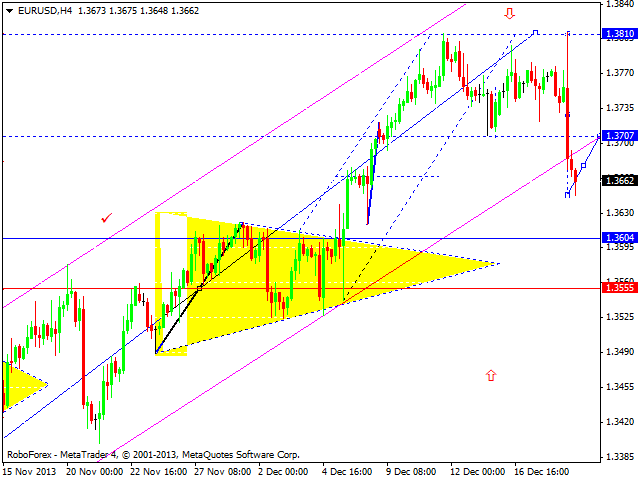
Influenced by the news, Euro reached new maximum and started forming new descending structure. Market reached minimum of this correction. We think, today price may start forming another ascending structure to break maximum and continue growing up towards 1.4100. Alternative scenario implies that pair may continue this correction towards level of 1.3555.

GBP/USD

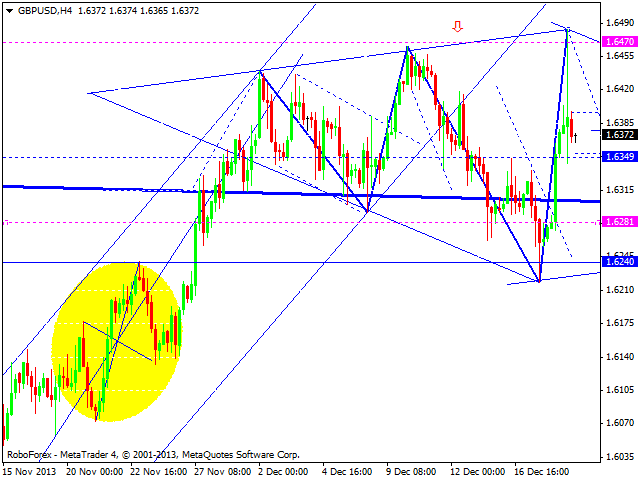
Influenced by the news, Pound reached new maximum and continued moving inside consolidation channel. Later, in our opinion, pair may move upwards to break maximums and then continue growing up towards target at 1.7150. Alternative scenario implies that pair may fall down to reach level of 1.6280 and then start new ascending movement to break maximums.

USD/CHF

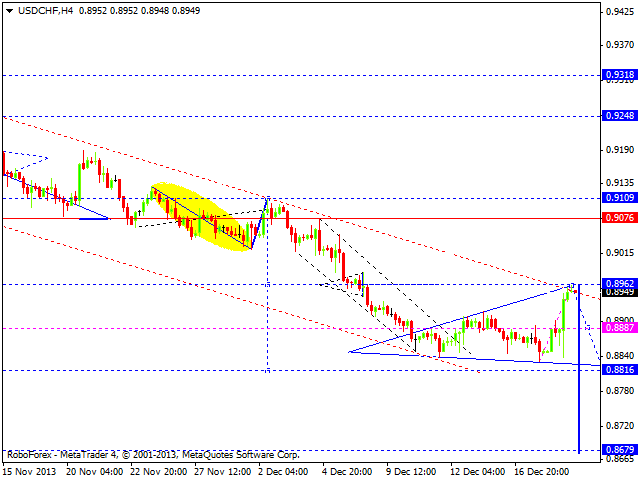
Franc reached minimum of this correction. We think, today price may continue falling down to break minimums and then move towards level of 0.8680. Alternative scenario implies that pair may form correction towards 0.9076 and then move inside down trend.

USD/JPY

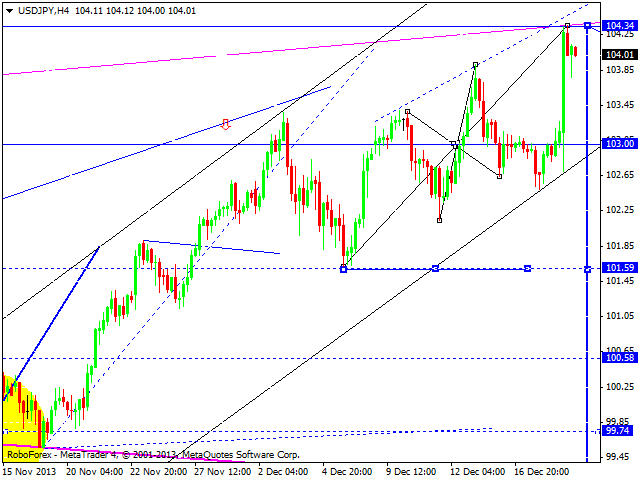
Yen reached new maximum of this ascending wave. We think, today price may break ascending channel and fall down towards the first target at 98.80.

AUD/USD

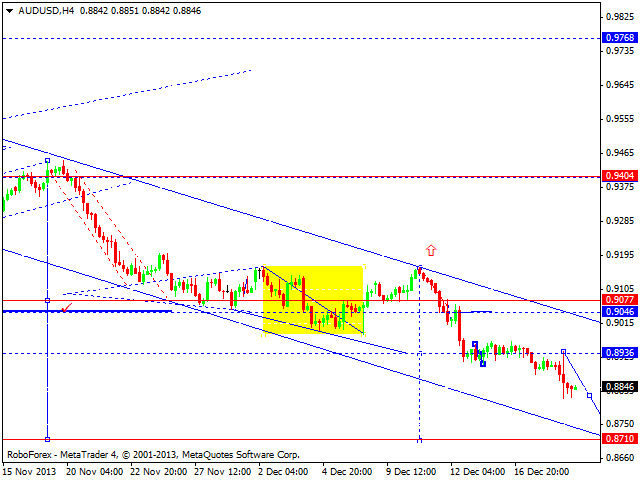
Australian Dollar continue falling down towards target at 0.8720. Right now, market is moving in the middle of previous descending structure and may form narrow consolidation channel. Later, in our opinion, pair may continue moving downwards to reach above-mentioned target.

GOLD

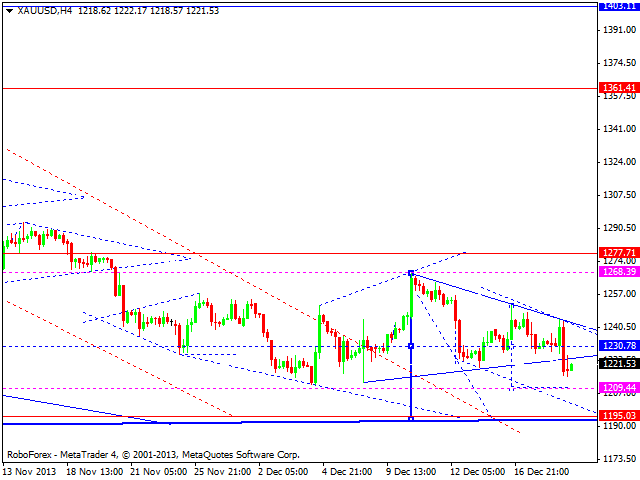
Gold broke level of 1230 downwards and continued falling down. We think, today price may move downwards to reach level of 1210 and then return to level of 1230. Later, in our opinion, instrument may complete this wave by reaching 1195 and then start new ascending structure towards target at 1360.

RoboForex Analytical Department

Article By RoboForex.com

Attention!
Forecasts presented in this section only reflect the author’s private opinion and should not be considered as guidance for trading. RoboForex LP bears no responsibility for trading results based on trading recommendations described in these analytical reviews.


Fibonacci Retracements Analysis 20.12.2013 (EUR/USD, USD/CHF)

Article By RoboForex.com

Analysis for December 20th, 2013

EUR/USD

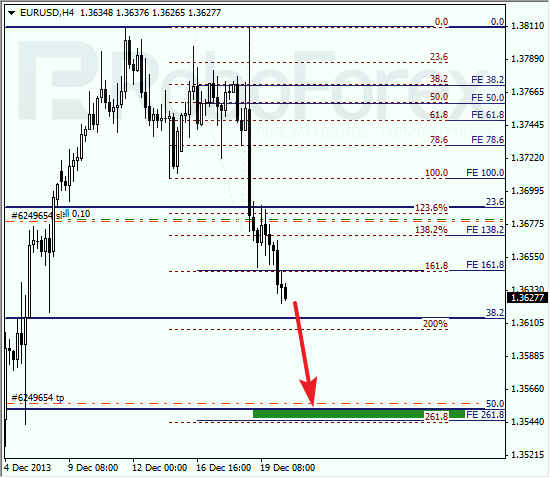
Eurodollar is still moving downwards and reaching new minimums. If price breaks level of 38.2%, it will continue falling down towards level of 50%. Stop on my sell order is already in the black.

As we can see at H1 chart, local correction reached only level of 23.6%. Market rebounded from this level and started moving downwards again. According to analysis of temporary fibo-zone, predicted targets may be reached either by the end of Friday or in the beginning of the next week.

USD/CHF

Franc continues moving upwards; market hasn’t formed any significant correction yet. Most likely, in the future pair will continue growing up towards level of 50%, which may later become starting point of another correction.

At H1 chart we can see, that local correction reached only level of 23.6%. According to analysis of temporary fibo-zones, predicted targets may be reached very soon, but I’ve decided to move stop into the black, just in case.

RoboForex Analytical Department

Article By RoboForex.com

Attention!
Forecasts presented in this section only reflect the author’s private opinion and should not be considered as guidance for trading. RoboForex LP bears no responsibility for trading results based on trading recommendations described in these analytical reviews.


10 Shocking Charts That Will Define 2013

By WallStreetDaily.com

Tired of living in a chronic state of “information overload”? We feel you!

That’s why, each Friday, we cut through the clutter and noise to bring you a handful of charts to sum up the most important investment and economic news.

Since we’re rapidly approaching the end of the year, we’ve got a treat for you. Today and Monday, we’re looking back on the 10 most-defining charts of the year.

Just in case you missed something along the way, you’ll be caught up in a jiffy. Consider it the perfect antidote to Rip Van Winkle Syndrome.

Without further ado…

A Golden Disaster

Back in May, Bank of America’s (BAC) top global economist, Ethan Harris, said, “The big story this year is not the U.S. spending sequester, the China slowdown, or the ongoing European recession. The big story is inflation, or more precisely, the lack thereof.”

His words only ring truer today.

Inflation is non-existent. Or as Fed President, James Bullard, told the CFA Society in St. Louis earlier this month, “Inflation continues to surprise to the downside.”

No inflation spells disaster for gold, which is precisely why Goldman Sachs (GS) called bullion a “slam dunk” sell in October.


Sure enough, while most commodities got socked in 2013, the yellow metal got hit the hardest, dropping nearly 30%.

To all the doom-and-gloomers out there who never sell gold, I’ve got one question, “How’s that inflation hedge working out for you?”

The Great Rotation

As I’m sure you’ll recall, a great debate erupted in the first half of the year over whether or not investors were “rotating” out of bonds and into stocks.

I weighed in twice on the topic, ultimately changing sides because, of course, the data warranted it.

But the debate is pretty much settled now. Investors rotated – in a major way.


U.S. equity funds witnessed their strongest inflows since 2000. Meanwhile, bond funds hemorrhaged assets – and Pimco’s Bill Gross, the largest bond fund manager, wept.

He’s still a billionaire, though. No sympathy necessary.

Rough Riders, Mount Up or Not!

As it turns out, all those new stock buyers were in for a treat, too.

Instead of enduring neck-snapping volatility, they enjoyed a smooth ride.


The average daily change for the S&P 500 Index checked in at a measly 0.55% this year.

To put that into perspective, during the throes of the financial crisis, single-day swings of roughly 2% were the norm.

“This has been the least-volatile year we’ve seen since the bull market began,” explains Bespoke Investment Group. Here’s to 2014 bringing much of the same…

Out of Work and Out of Hope

Not everything is rosy in the market, of course. Especially in the labor market.

As The Wall Street Journal’s Victoria McGrane notes, “We are in the fifth year of economic recovery since the Great Recession, yet Americans are still fleeing the labor force.”


We’ve chronicled this troubling situation before. But it warrants mentioning again.

Although the official unemployment rate keeps dropping, it’s largely because the labor force participation rate (the percentage of Americans who are working or actively seeking work) keeps plummeting.

No doubt, we’ll be tracking this situation in 2014…

Peak Oil? Try Again!

In the equity market we witnessed the “Great Rotation.” Over in the energy markets, though, we witnessed the “Great Revolution.”

Thanks to technological advances, U.S. oil production enjoyed its largest annual increase in over 100 years.

Here’s a fun trivia fact for you…

There are only seven oilfields in the world that produce one million barrels per day (bpd) or more of oil. Three of them are now in the United States – the Permian Basin, the Eagle Ford and the Bakken.

And the response from everyone in the Peak Oil camp? Nothing but crickets.

That’s it for today. We’ll pick up with our remaining five charts on Monday. Before you go, though, let us know what you think of this weekly column – or any of our recent work at Wall Street Daily – by going here.

Ahead of the tape,

Louis Basenese

The post 10 Shocking Charts That Will Define 2013 appeared first on Wall Street Daily.

Article By WallStreetDaily.com

Original Article: 10 Shocking Charts That Will Define 2013

Japan maintains stance, now sees recovery “as a trend”

By CentralBankNews.info
    Japan’s central bank maintained its policy stance that is aimed at expanding the country’s monetary base by an annual 60-70 trillion yen and repeated that it will continue for “as long as necessary” to boost inflation to 2 percent.
   The Bank of Japan (BOJ), which embarked on its aggressive easing campaign in April to rid the country of almost two decades of deflation, repeated its view from November that the economy was “recovering moderately” and the country is expected to “continue a moderate recovery.”
    However, there were a few important changes to this month’s statement, signaling a growing confidence in the economic recovery.
    The BOJ added that the recovery is expected to continue “as a trend” although the bank acknowledged that this would be affected by the front-loading and then a subsequent decline in demand prior to an after the hike in consumption taxes in April.
    The BOJ also tipped its hat to the strong improvement seen in this week’s quarterly December “tankan” survey, saying the “improvement in business sentiment has continued and become widespread” and that “private consumption has remained resilient, with improvement in the employment and income situation.”

    The BOJ did not make any reference to the U.S. Federal Reserve’s decision to begin tapering its asset purchases by $10 billion next month, but repeated that “there remains a high degree of uncertainty concerning Japan’s economy” due to Europe’s debt problem, developments in emerging and commodity-exporting markets and the pace of recovery of the U.S. economy.
    Overseas economies were still described as “picking up moderately, although a lackluster performance is partly seen.”
    The scheduled increase in sales taxes in April has led financial markets to speculate that the BOJ may further expand its policy of quantitative easing though the BOJ has in the past said the economy would be able to handle the dent to consumer spending based on its current stimulus.
     In addition, Japan’s government earlier this month approved a new 5.5 trillion yen spending package to help the economy weather any impact of the sales tax rise.
    In its statement, the BOJ also noted the rise in headline inflation to “around 1 percent” and repeated that “inflation expectations appeared to be rising on the whole.” In October Japan’s inflation rate rose to 1.10 percent, steady from September.
    Japan’s Gross Domestic Product expanded by 0.3 percent in the third quarter from the second for annual growth of 2.4 percent, double the pace of the second quarter for the third consecutive quarter of accelerating growth.
    Helped by the Fed’s decision this week to start winding down its asset purchase program from September 2012, the Japanese yen has weakened further, providing a further boost to exporters.
    The yen is down some 17 percent against the U.S. dollar this year, trading at 104.46 today compared with 86.74 end-2012.
    In April the BOJ started its aggressive stimulus program, aiming to double the country’s monetary base by purchasing Japanese government bonds so their amount rises by an annual 50 trillion yen, buying exchange-traded funds (ETFs) and real estate investment trust so their outstanding amounts rise by 1.0 trillion and 30 billion yen, along with purchases of commercial paper and corporate bonds so their amounts outstanding reach 2.2 trillion and 3.2 trillion respectively by end-2013.
 
    www.CentralBankNews.info

It’s Not All Rainbows and Unicorns When It Comes To Technology

By MoneyMorning.com.au

This week we’ve written a lot about technology. And for good reason. We are at the beginning of some significant technological developments.

You’ll see the biggest of those developments – and three unique ideas to profit from it – around 2pm this afternoon, when Kris and I finally release our a brand new video.

Not only are these ideas bigger and potentially more profitable than any I’ve seen in my entire career studying technological trends…we’ve figured out a way you can get access to this research for a fraction of the upfront cost.

So stay tuned. It’s almost ready.

The point is, industry across the entire spectrum is going through significant change. Medicine, entertainment, manufacturing, clothing & apparel, transport and logistics are all in the midst of significant structural shifts.

Business models need to adapt and new, youthful, energetic businesses are springing up at a rate of knots.

It’s a lot to take in. A lot to understand and to know about. And it’s completely understandable if sometimes you fell overwhelmed by all this information. Because when it comes to technology, nothing stands still.

Sometimes companies stand still, and they get passed, and often wilt away to nothing. But there are plenty that continue to innovate, develop, adapt and change.

And many people worry about big change like this. The very concept and thought of change is terrifying to some. The thought that personal and private information might get out into the World Wide Web is too much to handle.

We often paint a rosy picture of the future, but mark my words, as exciting as it is and as profitable as it will be, it won’t always be full of pretty rainbows and unicorns.

Let me give you an example of what I mean. Last week one of the biggest security breaches ever struck the U.S company Target.

Brian Krebs, a security blogger first broke the story. Then yesterday Target posted a press statement,

Approximately 40 million credit and debit card accounts may have been impacted between Nov. 27 and Dec. 15, 2013. Target alerted authorities and financial institutions immediately after it was made aware of the unauthorized access, and is putting all appropriate resources behind these efforts.  Among other actions, Target is partnering with a leading third-party forensics firm to conduct a thorough investigation of the incident.

That’s one hell of a security breach. 40 million card details. And this kind of thing isn’t uncommon these days. Every other week you hear of hacked and compromised networks.

In a world of connected devices it’s inevitable for systems to be hacked. However it’s not a one-way street where cyber criminals have passage to do as they like.

It’s a genuine online battle between good hackers and bad hackers. As we’ve written about previously, it’s World War D. The online battle for control of information and the very existence of the internet.

Now although this is pretty scary stuff, it’s important to know that doesn’t mean you can’t (legally) profit all this cyber security action.

Because there are some pioneering companies dedicated to protecting the internet. Cyber security is one of the biggest growth industries in the world.

Take for example Symantec and Trend Micro. These are two multi billion-dollar companies with cyber security offerings.

But there are others you’re not aware of that go beyond software for your home PC. One such company ‘is the internet’. Their technology adds such complex layering to the protection of the internet, that without them…there might not be an internet.

You see as we continue to advance technology we create more digital networks. It’s an inevitable part of human evolution. It leads to a better world through a raft of huge opportunities that we’ve written about all week.

But there are those that seek to corrupt these networks. To maliciously abuse the technology, often for personal gain. You might know them as Black Hat Hackers. You might have even experienced their evils first hand. I know I certainly have.

Not too long ago I opened my MacBook and jumped online to discover this page staring me in the face:

No matter what I did, the window wouldn’t close. I was actually worried for a minute my computer was dead to me.

But I soon realized two things:

1) This was not the actual FBI,
2) I was not the only person to have come across this malware.

Because all I had to do was jump onto a cyber security forum where numerous good hackers, white hat hackers, had put step by step instructions up to get rid of this malware.

And within five minutes I’d managed to get rid of it.

The ease with which I was able to combat the malware (on supposedly malware proof Macs) gave me great hope that the good hackers are fighting a good fight.

And having researched and investigated the work our two recommended cyber security companies are doing gave me even greater peace of mind.

It’s easy to get lost in the scary headlines. And situations like the Target breach do nothing to help. But you must also balance those views by understanding the amazing work cyber security is doing to fight back.

Statistically at some stage you are going to come across some form of malware, or spam or something that potentially compromises your computer, smartphone or network. You need to accept that as a part of our connected future.

But you also need to know that there are ways you can fight back. By ensuring you have your own home and work cyber security measures up to scratch is a start. And of course by being a part of this booming industry by investing in some of the most pioneering companies in the world.

Don’t get me wrong, this is the most exiting time to be an investor in technology stocks. The potential across all industry is huge. Cutting edge technology companies are set to literally change the world. But there are risks you need to be aware of, and cyber security is one of those.

However with the right information you can also make huge profits. As the battle for the internet continues to rage on you can either hide from it, or take action against it.

One of the reports you’ll learn about this afternoon reveals a company at the forefront of the trillion dollar cyber security industry. You’ll learn all about it around 2pm today.

Until then,

Sam Volkering,
Technology Analyst

From the Port Phillip Publishing Library

Special Report: The ‘Wonder Weld’ That Could Triple Your Money  

Join Money Morning on Google+


By MoneyMorning.com.au

Chad Mabry: Where to Drill for Portfolio Outperformance

Source: JT Long of The Energy Report  (12/19/13)

http://www.theenergyreport.com/pub/na/chad-mabry-where-to-drill-for-portfolio-outperformance

Looking into 2014, Chad Mabry, an analyst at MLV & Co., is more focused than ever on company-specific fundamentals and relative performance indicators, which help him identify the outperformers. In this interview with The Energy Report, Mabry also talks about some companies with exposure to up-and-coming plays that could offer major upside.

The Energy Report: Chad, you recently released an early look at 2014 titled, Drilling Down for Outperformance. You noted that you saw an average 35–40% upside on your Buy-rated names. What are your criteria for picking companies?


Chad Mabry: To start, we use a discounted cash flow-based net asset value (NAV) approach to valuing exploration and production (E&P) stocks. While cash flow is an important metric, NAV does a better job of comparing companies with different asset profiles, specifically within the small and midcap E&P space. NAV does a better job of accounting for a company’s upside potential than cash-flow metrics. We use a bottom-up approach to drill down into a company’s asset base, its average type curve, estimated ultimate recoveries (EURs), well costs and so on. In this way we find out about the economics of those plays and what the sensitivities are to our commodity price deck. We then try to sort out companies that aren’t being valued appropriately and identify strong risk-reward opportunities.


TER: There has been a lot of commodity price volatility this last year. How do you determine what prices to use when you’re estimating NAV?


CM: That’s a good question. Given the volatility inherent in oil and gas commodity price movements, forecasting prices is somewhat of a losing proposition. We try to set a long-term price deck based on the industry cost structure, which is based on the marginal cost of new production. Over the long term, laws of supply and demand will win out and commodity prices should normalize toward equilibrium levels, which are currently about $90 per barrel ($90/bbl) for oil and $4.50 per thousand cubic feet ($4.50/Mcf) for natural gas.


TER: The Energy Information Administration (EIA) is forecasting U.S. oil production to increase by about 1 million barrels/day in 2014 with year-over-year growth in the 10–15% range. What impact could that have on the price of oil going forward?


CM: There is an oil production renaissance in the U.S. We expect that to continue, driven by the independent E&Ps. We’re forecasting production growth in 2014 of about 50–55% in our coverage universe. That is going to be driven by oil growth as companies continue to allocate the vast majority of their capex budgets next year to oil and liquids-weighted projects.


TER: Are there certain sectors of the oil market that you like better than others?


CM: We feel the outperformers into 2014 are the companies that have established core positions in some of the more economically attractive oil and liquids resource plays in North America. It won’t come to anyone’s surprise that some of the best-in-class resource plays include the Eagle Ford, the Bakken and the Niobrara, to name a few. But we also feel like there are some pretty intriguing, earlier-stage plays that offer exposure to oil and liquids that we’re going to be keeping an eye on into next year, specifically the Utica, the Tuscaloosa Marine Shale and the Woodbine.


TER: What do you like about developed areas, like the Eagle Ford?


CM: Eagle Ford has become the standard bearer for the oil and liquids resource plays in the U.S. The geography is best in class and it is a repeatable play with very compelling economics. As we move into development mode in the play, we continue to see the potential for additional catalysts, which should continue to lead to outperformance for our names that have exposure there.


As well costs continue to reduce and recoveries and completion designs improve, we expect rates of return to drift higher. As various operators focus on additional zones, there is additional upside potential to companies’ drilling inventories in the form of additional pay zones.


The best exposure to the Eagle Ford and one of our top picks is Carrizo Oil & Gas Inc. (CRZO:NASDAQ), which has established a very nice sweet spot in La Salle County.


We also like Sanchez Energy Corp. (SN:NYSE), which has become somewhat of an Eagle Ford pure play with a very robust inventory across the play.


TER: Carrizo is in the Utica, the Marcellus and the Niobrara. In November, it announced record oil production, and the stock price is up pretty dramatically, although it’s off its all-time highs. Is there still upside?


CM: We believe so. We see roughly 50% upside to our NAV from current levels. One of the reasons that it is a top pick of ours is that it has core positions in very attractive plays. You mentioned its position in the Utica, the Niobrara and the Marcellus. It has some best-in-class exposure to these plays.


We expect the company to have some downspacing results in the Eagle Ford as it continues to test 500-foot (500 ft) spacing versus 750 ft, where it is today. We don’t have that in our numbers right now. We estimate that could add about $10/share to our NAV from current levels.


In the Utica, the company’s acreage is in a very delineated, core spot of the play. While it is still early on in its activity in the play, we expect it to have initial well results in the near term. We think that could be another catalyst for the name.


Then, like other operators in the Niobrara, Carrizo is also testing downspacing, which, if successful, could yield incremental upside to what we’re giving it credit for right now—not only core positions in core plays, but also the catalysts that we expect to drive the stock up toward our NAV over the next 12 months.


TER: You have a Buy rating on Sanchez. It also has a secondary in the Tuscaloosa Marine Shale. What impact could the Tuscaloosa have on its share price?


CM: We have just $1/share of Tuscaloosa Marine Shale value in our NAV right now. It’s very minimal at this point. At current levels, investors are getting a free option on Sanchez’ Tuscaloosa Marine Shale potential, which could be very meaningful.


One of the reasons that we like these more emerging areas is that you’re not really paying as much for some of these positions. Contango Oil & Gas Co. (MCF:NYSE.MKT), which is more of a legacy name, also has exposure. I’d even classify it as a Tuscaloosa Marine Shale sleeper because it doesn’t register on a lot of people’s radars as having a significant position in that play following its merger with Crimson Exploration Inc. (CXPO:NASDAQ).


If you’re a believer in the long-term commerciality of the play, which we are, then a name that you need to own is Goodrich Petroleum Corp. (GDP:NYSE), which has by far the most leverage to that play with around 300,000 net acres. As that company accelerates to a five rig-operated program in the Tuscaloosa Marine Shale next year and gets away from the well watch nature that’s made for a volatile 2013, its position in that play delivers outperformance for the stock. If you’re a believer in the play, then Goodrich is a must-own name. As the play advances further along the development curve, Goodrich becomes a takeout candidate for any larger company looking to gain exposure in a material way.


TER: What else is intriguing in the Niobrara?


CM: A lot of these names with exposure to the Niobrara have been some of 2013’s outperformers.


But when we look at who has exposure to the play and who maybe isn’t getting as much credit as the next guy, an attractive name to us is PDC Energy Inc. (PDCE:NASDAQ). It’s the third-largest producer and leaseholder in the Wattenberg. In addition, it has a pretty significant position in one of the emerging areas of the Utica. At these levels, it’s a pretty compelling investment.


TER: The price is down from earlier in the year. Is this a buying opportunity?


CM: The stock did correct a bit after a Q3/13 earnings miss and its initial results in the southern part of its Utica position, which didn’t meet Street expectations. This did present a nice buying opportunity. It does have a number of upcoming catalysts, not only in the Utica, but also from additional downspacing and testing of other formations in the Wattenberg/Niobrara. At current levels, investors are getting a free option on its position in the Utica.


TER: Are there any neighbors you like?


CM: Yes, as a matter of fact. Bonanza Creek Energy Inc. (BCEI:NYSE) has a very quality position in the Niobrara; it’s essentially a Niobrara pure play. But at current levels, it is receiving closer to full valuation for that position, and we see better risk-reward in other names, specifically Carrizo and PDC.


TER: Bonanza Creek is both in Colorado and the Cotton Valley sands in Arkansas. What are the next steps?


CM: Its focus will be on its Wattenberg/Niobrara position. It has a four-rig program in the play, which should drive 2014 production growth of 45–50%. But at the same time, the Wattenberg valuation is more than $50,000/acre, which just seems closer to full value at these levels.


TER: Did you also initiate coverage on Gulfport Energy Corp. (GPOR:NASDAQ)?


CM: Yes. We have a Hold rating on Gulfport for similar reasons. Whereas Bonanza Creek has a quality position in the Wattenberg/Niobrara, Gulfport has a fantastic position in the core of the Utica. The valuation is a bit stretched at these levels, however.


TER: You have a Buy on Midstates Petroleum Co. Inc. (MPO:NYSE). Is that based on its exposure to the Anadarko Basin?


CM: The Buy on Midstates is based on the fact that its portfolio is misunderstood and undervalued. It also has a leading position and is one of the biggest operators in the Mississippi Lime play in Northern Oklahoma. Then it has the third leg of the stool, if you will—the Wilcox play in Louisiana, which is an earlier-stage play that it is not receiving any credit for. As we move into 2014 and the company executes and delivers what we feel like will be above-average production growth, that value gap is likely to narrow.


TER: Do you still like the Gulf of Mexico?


CM: It’s all about relative valuation. The Gulf of Mexico players had a nice tailwind earlier this year with Light Louisiana Sweet oil prices enjoying a healthy premium to West Texas Intermediate—close to $20-plus/bbl earlier this year. That premium has since eroded. It’s not something that will likely come back in a meaningful way in the near term. As a result, you lose that benefit looking into 2014. But, like I said, it’s all about relative valuation.


We do think there are some nice opportunities in the Gulf, specifically Stone Energy Corporation (SGY:NYSE). It has several impactful catalysts in the form of deepwater exploration wells that should have results starting in early 2014, which could drive outperformance for the stock. Investors aren’t paying for any of that upside at these levels, so that’s really why we have the Buy rating on Stone at this time.


TER: Its stock is up to $40 from $32 last month. Is that mainly because of the new spudding in early 2014?


CM: Fortunately for Stone Energy, there are a number of wells, operated and non-operated, that should provide a steady flow of catalysts throughout 2014 and 2015 in the deepwater Gulf of Mexico. We expect several catalysts over the course of the next couple of years.


TER: Are there other relative outperformers in the Gulf of Mexico?


CM: Right now, our two names that operate exclusively on the Gulf of Mexico shelf are Energy XXI (Bermuda) Ltd. (EXXI:NASDAQ) and Energy Partners, Ltd. (EPL:NYSE). We have a Buy rating on Energy XXI and a Hold rating on Energy Partners. Shares of Energy XXI, on a relative basis, are more attractive because they are trading below their proved-only valuation and the company is pursuing a number of exploration objectives, which could cause the stock to outperform. Energy Partners has had some issues in some of its core fields recently, which could provide a headwind for shares in the near term.


TER: Energy XXI also has been doing quite a bit of consolidating of other smaller players. It is pursuing some deeper salt plays. When could those start to pay off?


CM: It’s the third largest oil producer on the shelf. It is taking advantage of its footprint in the area and its expertise of the geology in the basin to pursue some deeper exploration targets, not necessarily the ultra-deep. We should get some results into 2014 from the company.


You mentioned it being a consolidator. Both Energy Partners and Energy XXI have become consolidators on the shelf. Looking into 2014, we wouldn’t be surprised to see Energy XXI target some larger objectives internationally, specifically in Malaysia, which offers a nice analog field to what we’ve seen in the Gulf of Mexico, but with larger scale.


TER: Energy XXI also just initiated a share buyback program and raised the dividend. Is that part of a trend?


CM: It’s a representation of its confidence in the stock and in its performance, its belief that shares are undervalued and its willingness to buy back shares at levels it feels are too low.


TER: Smart capital allocation has been a differentiator for some of these companies in 2013. How are successful companies better using their resources?


CM: Since we’ve seen commodity prices somewhat range-bound with a lot of the land grab more or less over, investors will be even more willing to reward companies that demonstrate effective and efficient operations in 2014.


TER: Companies have been trying to create some new catalysts and value, and derisk their new projects. Is that paying off?


CM: Yes. We’ve seen that across the board in terms of drilling efficiencies. As companies have migrated away from acreage capture to development mode in their core resource plays, we’ve seen rig productivity increase fairly dramatically. That’s been an area where companies have been able to deliver meaningful cost savings while, at the same time, enhancing their drilling and completion techniques, essentially making bigger wells and increasing their IRRs in these plays. Downspacing has also been a catalyst in a lot of these plays and, looking into 2014 in some of the more developed plays, whether it’s the Bakken, the Eagle Ford or the Niobrara, additional downspacing results will be a major catalyst for a number of companies.


TER: Can you leave us with some advice for investors in the space as they prepare for 2014?


CM: Stock selection will be more important than ever looking into 2014. While this is a group that historically has a high correlation to oil and gas prices, it’s becoming more of a stock picker’s market. As we look into 2014, we’re more focused than ever on company-specific fundamentals and relative performance indicators that should help pick the outperformers into next year.


TER: Thanks for joining us today.


CM: Thanks for having me.


Chad Mabry is an analyst in MLV’s Energy and Natural Resources Research Department. Bringing over 10 years of experience in the oil and gas industry, he primarily focuses on small- and mid-cap companies in the Exploration & Production sector. Prior to joining MLV, Mr. Mabry was a senior analyst with KLR Group and Rodman & Renshaw, and an associate analyst with Pritchard Capital Partners. Mr. Mabry holds an M.A. in Accounting and a B.A. in Philosophy from the University of Texas at Austin.


Want to read more Energy Report interviews like this? Sign up for our free e-newsletter, and you’ll learn when new articles have been published. To see a list of recent interviews with industry analysts and commentators, visit our Streetwise Interviews page.


DISCLOSURE:
1) JT Long conducted this interview for The Energy Report and provides services to The Energy Reportas an employee. She or her family owns shares of the following companies mentioned in this interview: None.
2) The following companies mentioned in the interview are sponsors of The Energy Report: Energy XXI. Streetwise Reports does not accept stock in exchange for its services or as sponsorship payment.
3) Chad Mabry: I or my family own shares of the following companies mentioned in this interview: None. I personally am or my family is paid by the following companies mentioned in this interview: None. My company has a financial relationship with the following companies mentioned in this interview: MLV & Co. managed or co-managed a public offering of securities and received compensation for investment banking services from: Goodrich Petroleum Corp., Carrizo Oil & Gas Inc., Sanchez Energy Corp., PDC Energy Inc., Bonanza Creek Energy Inc., Gulfport Energy Corp., Midstates Petroleum Co. Inc., Stone Energy Corp., Energy Partners Ltd., Energy XXI, Contango Oil & Gas Co. MLV & Co. or any affiliate expects to receive or intends to seek compensation for investment banking services in the next three months. I was not paid by Streetwise Reports for participating in this interview. Comments and opinions expressed are my own comments and opinions. I had the opportunity to review the interview for accuracy as of the date of the interview and am responsible for the content of the interview.
4) Interviews are edited for clarity. Streetwise Reports does not make editorial comments or change experts’ statements without their consent.
5) The interview does not constitute investment advice. Each reader is encouraged to consult with his or her individual financial professional and any action a reader takes as a result of information presented here is his or her own responsibility. By opening this page, each reader accepts and agrees to Streetwise Reports’ terms of use and full legal disclaimer.
6) From time to time, Streetwise Reports LLC and its directors, officers, employees or members of their families, as well as persons interviewed for articles and interviews on the site, may have a long or short position in securities mentioned and may make purchases and/or sales of those securities in the open market or otherwise.


Streetwise – The Energy Report is Copyright © 2013 by Streetwise Reports LLC. All rights are reserved. Streetwise Reports LLC hereby grants an unrestricted license to use or disseminate this copyrighted material (i) only in whole (and always including this disclaimer), but (ii) never in part.


Streetwise Reports LLC does not guarantee the accuracy or thoroughness of the information reported.


Streetwise Reports LLC receives a fee from companies that are listed on the home page in the In This Issue section. Their sponsor pages may be considered advertising for the purposes of 18 U.S.C. 1734.


Participating companies provide the logos used in The Energy Report. These logos are trademarks and are the property of the individual companies.


101 Second St., Suite 110
Petaluma, CA 94952

Tel.: (707) 981-8204
Fax: (707) 981-8998
Email: [email protected]


Five Years on, and the Money is Still Flowing

By MoneyMorning.com.au

It’s been just over five years since Lehman Brothers went bust. In that time, a lot has happened. It’s easy to lose perspective.

So let me take you back a bit, if I may. Do you remember the first time you heard about quantitative easing? And what you thought at that point? I suspect it probably went along the lines of: ‘Central banks are printing money? Seriously?’

Now imagine what you would have thought if I told you they’d still be at it in five years’ time.

The global banking bubble popped in 2008. And as of the end of 2013, short-term interest rates in every major developed economy are below 1%, and the biggest economy in the world is still printing $75bn a month to buy its own debt, among other things.

That’s quite sobering really. And it’s just a reminder amid the day-to-day hype of the market, of quite how far away from what we once deemed ‘normal’ our current system has become.

With that in mind, what happened on Wednesday?

The Federal Reserve decided it will buy $75bn-worth of bonds a month, split between mortgage-backed securities and US Treasury bonds. That’s a drop from $85bn a month. Meanwhile, Bernanke was keen to say that interest rates will stay low for a long time to come – ‘well past the time that the unemployment rate declines below 6.5%‘.

Basically, he’s saying that it’s time to stop doing QE. There are lots of side-effects the Fed is a bit worried about – the fact that it would be a bad idea to own every Treasury on the planet is possibly among them.

But that doesn’t necessarily mean that monetary policy is getting tighter. The Fed – under Janet Yellen – is ready to step in if it looks like things are turning down again.

I believe the technical terms is ‘having one’s cake and eating it’. And the message to Wall Street is: ‘Don’t freak out. The Fed still loves you.’

In short, for now, markets see this as the ‘Goldilocks’ taper. The fact that the Fed can do it, suggests the economy is getting better. But it’s doing it so slowly that monetary policy still remains very loose indeed. And the Fed is also reassuringly open to loosening again.

What does this mean for your portfolio? Probably very little


So what does all this mean for your money? The short answer is – not really very much. We’ve known the taper was probably coming. We’ve known that it would be couched in language that tried to reassure the market that rates would stay low regardless. So while the exact timing was always unsure, some form of slowdown in the rate of money-printing was likely.

Now the Fed might be able to fool markets for now. But like it or not, this is a move in the direction of tightening, not loosening. And given that money-printing is what has kept the S&P 500 roaring forward in recent years, I can’t see that stellar rise continuing.

US stocks are expensive compared to history. In the absence of QE, there’s nothing to keep them going up. I’m not saying they’ll crash – but I do think they need to get cheaper.

There are lots of other potential impacts, in particular the bond market and potential liquidity problems in the New Year. And in the longer run, the real risk – and the one thing that seems more certain than anything else – is that the Fed won’t tighten quickly enough and our next crisis will be inflationary.

Stick with cheap markets where money-printing is ongoing (Japan) or possible in the future (Europe). Have a bit of gold in your portfolio in case of emergencies – there’s a good chance it will have another miserable year ahead, but that’s rather the point of diversification. Take a look at index-linked bonds, but avoid most conventional ones.

The key ingredient for a long bull market – a long bear market


Getting back to my favourite subject of the moment – Japan – what I really like about it is that there’s still a surprising amount of scepticism out there. Markets are usually extraordinarily quick to change their minds according to price action. When something starts to go up fast, people pay attention, and the supply of bears to be converted to bulls diminishes rapidly.

But – as with gold in the early 2000s – when a market has been ground down for literally decades, the bears die hard. And it seems that’s the case for Japan too. I’m not saying it’s a radical contrarian bet by any means. But nor is it the front-page-hogging ‘no-brainer’ that usually indicates that the end is nigh.

There are still plenty of people out there saying ‘yes, but…’ about Japan. This week, the FT had a big column from Martin Wolf on why Abenomics will fail. And there’s another column today arguing that there still isn’t enough lending going on.

Long may the scepticism continue. That’s what gives you the big bull markets. And goodness knows we’ve waited long enough for one in Japan.

John Stepek
Contributing Editor, Money Morning
Ed Note: Five years on, and the money is still flowing originally appeared in Money Morning USA.

Join Money Morning on Google+


By MoneyMorning.com.au