10 Shocking Charts That Will Define 2013 (Part 2)

By WallStreetDaily.com

It’s been a whopping 558 days since we’ve endured a perfectly healthy and normal 10% selloff in the stock market. The streak is all but guaranteed to extend into 2014, given that there are only a handful of trading days left in the year.

But a year without a correction isn’t the only thing that we’ll remember about 2013…

As you’ll recall, on Friday, we started looking back at the most memorable developments in the market in 2013.

It’s time to finish the job. So let’s get to it…

Con #1: Real Estate is Forever Doomed

Ridiculed. Rejected. Ignored. That pretty much sums up the response to my February 2012 insistence that “the real estate market just hit rock bottom.”

Lo and behold, the market did bottom out at that time. The good news is, the recovery gained steam in 2013.

The most telling sign? Home prices. They’re up almost 15% in the last year, based on the S&P/Case-Shiller Composite-20 Home Price Index.


The sharp rise naturally pushed down affordability. But don’t fret…

The latest National Association of Realtors Housing Affordability Index reading indicates that the typical American family has 165.4% of the income necessary to qualify to purchase a median-priced, single-family home (with a 20% down payment and a 30-year fixed-rate mortgage).

So any talk about another bubble forming is utter nonsense. The classic sign of a bubble is when prices get out of reach. And that’s obviously not the case here.

As Goldman Sachs’ (GS) analysts pointed out in a recent research note: “We see the dataflow as consistent with growing momentum in the housing sector, in line with our view that higher interest rates will not prevent a solid increase in housing activity in 2014.”

I expect the recovery to continue in 2014, too. Feel free to disagree with me (again) at your own risk…

Con #2: The Bull Market Doesn’t Have Legs

Forget real estate for a moment. Global equity markets also rebounded mightily in 2013, trading at new all-time highs, according to the World Federation of Exchanges data.


The combined market cap of the world’s 58 major stock markets rose to $63.4 trillion in November.

To put that in perspective, global equity values plummeted to $29.1 trillion in the depths of the financial crisis. So we’re talking about some serious wealth (re)creation here.

I’ll take it! How about you?

Con #3: Invest in the BRICs

Now, if we dissect stock performance on a country-by-country basis, it’s clear that not every market enjoyed boom times.


The over-hyped emerging markets of Brazil, Russia, India and China fared the worst. Only India registered a gain. But certainly not a big one – only 6.1%. And Brazilian stocks got absolutely clobbered, dropping nearly 20%.

Meanwhile, Japan, the United States and many European countries topped the leaderboard.

Japan? Who’d have thunk it? Oh, that’s right, we called for Japanese stocks to rally in December 2012. Hope you listened.

Con #4: The Next Crisis is Coming!

This is perhaps the most telling chart of all. It shows the correlation among all asset classes, which got cut in half in 2013.


What’s the big whoop? I’ll let Business Insider’s Joe Weisenthal explain: “One of the characteristics of a crisis is extreme correlation between multiple asset classes: Everything trades up or down together.”

The financial press famously referred to this as the risk on/risk off environment. But it’s over, as is the financial crisis, which means we’re in a stock picker’s market more than ever.

What type of stocks should we be focusing on, though? Glad you asked…

Con #5: Small Caps Are Maxed Out

Talk about staying power! For 13 years in a row, small-cap stocks have outperformed their larger-cap brethren.

In 2013, they rallied 34.2%, compared to a 26.9% rise for large caps, as represented by the S&P 500 Index.

Micro-cap stocks, which my MicroCap Tech Trader subscribers know all too well, performed best, rising an average of nearly 40%.

I recommend you stick to the same script in 2014 – bet big on small-cap (and micro-cap) stocks!

Ahead of the tape,

Louis Basenese

The post 10 Shocking Charts That Will Define 2013 (Part 2) appeared first on Wall Street Daily.

Article By WallStreetDaily.com

Original Article: 10 Shocking Charts That Will Define 2013 (Part 2)

Murray Math Lines 23.12.2013 (AUD/USD, EUR/JPY, SILVER)

Article By RoboForex.com

Analysis for December 23rd, 2013

AUD/USD

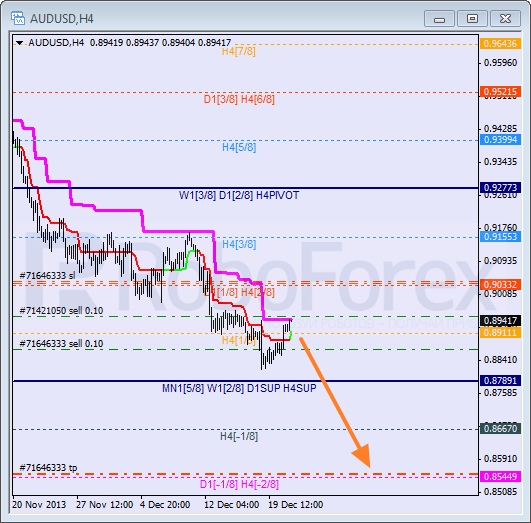
Australian Dollar is still being corrected between Super Trends. If later pair rebounds from daily Super Trend, market will start new descending movement, in this case, target will be at the -2/8 level.

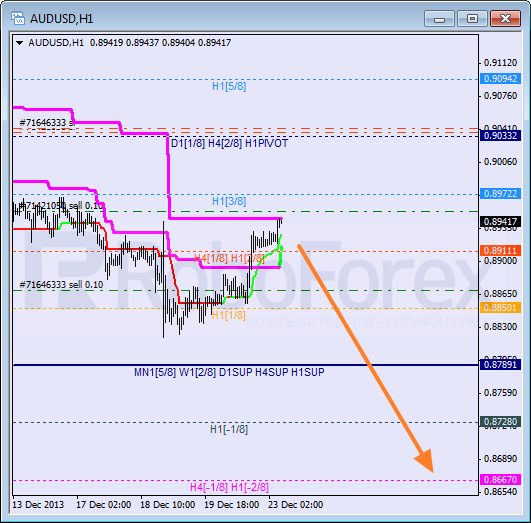
Australian Dollar is moving in lower part of H1 chart. If price breaks Super Trends, pair will start new descending movement. In this case, next thing bears need to do is to enter “oversold zone”.

EUR/JPY

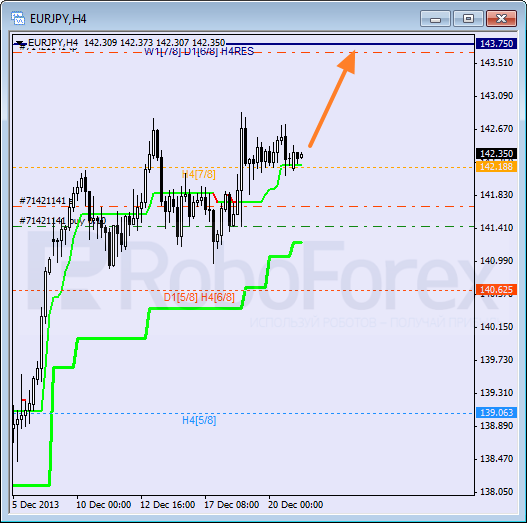
EUR/JPY is already moving above the 7/8 level; local correction is supported by H4 Super Trend. If price rebounds from it, pair will start growing up towards the 8/8 level.

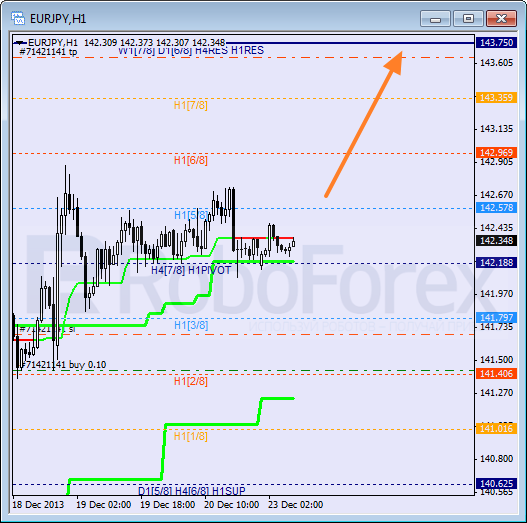
Price is moving in the middle of H1 chart, above the 4/8 level. If bulls are able to keep price above the 5/8 level, pair will continue its ascending movement towards the 8/8 level.

SILVER

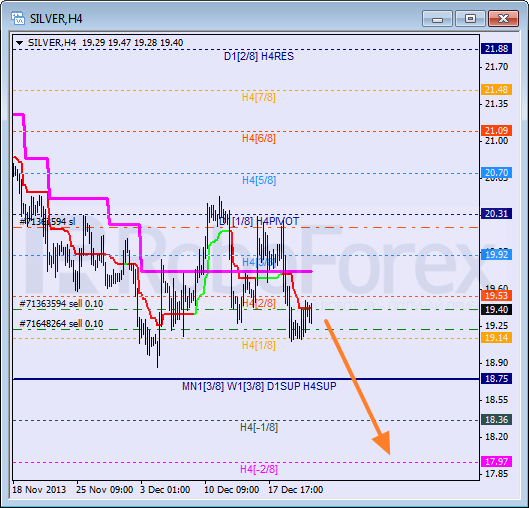
Silver is still being corrected; so far, bulls are slowed down a bit by H4 Super Trend. Possibly, price will break the 8/8 level in the middle of the week.

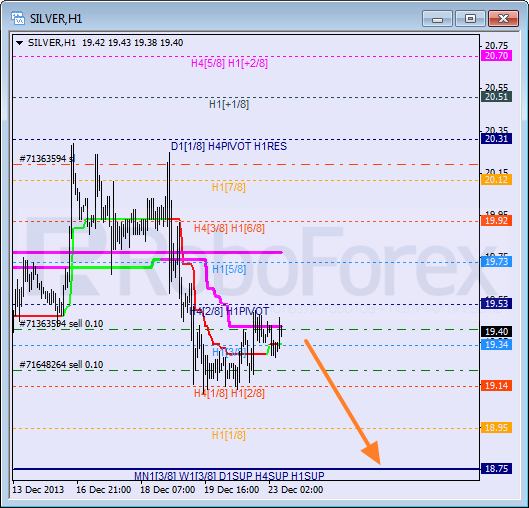
As we can see at H1 chart, last week bulls tried to break the 4/8 level, but failed. Closest target for bears is at the 0/8 one; they may break it quite soon..

RoboForex Analytical Department

Article By RoboForex.com

Attention!
Forecasts presented in this section only reflect the author’s private opinion and should not be considered as guidance for trading. RoboForex LP bears no responsibility for trading results based on trading recommendations described in these analytical reviews.


Gold Takes Plunge After Tapering Announcement

By HY Markets Forex Blog

Those who trade gold might benefit from knowing about the plunge that the precious metal experienced on the day immediately after the Federal Reserve announced a specific timeline for tapering quantitative easing.

After its two-day policy meeting ended on Dec. 18, the Federal Open Market Committee indicated that starting in January, it would start buying $75 billion worth of debt-based financial instruments per month. This amount represents a $10 billion reduction from the $85 billion that the central bank has been purchasing every month since late 2012.

Many market experts have asserted that these transactions have served to contribute to potential inflation by increasing the total money supply. However, now that the pace of these bond purchases will be reduced, it could help defray these concerns, making market participants less likely to seek out the precious metal as a hedge against the risk that the overall price level will increase.

Gold Plunges After Tapering Announcement

On Dec. 19, the day after these tapering plans were announced, February gold settled 3.4 percent lower at $1,193.60 per ounce on the Comex division of the New York Mercantile Exchange, according to The Wall Street Journal. This figure represented the lowest price for the futures contract since August 2010.

In addition to this recent sharp decline, some believe that the precious metal will fall further still, including Jeffrey Currie, head of commodities research for Goldman Sachs Group Inc., who recently told Bloomberg his prediction that the commodity has more losses ahead of it.

“Gold is now likely to grind lower throughout 2014,” Currie told the media outlet. “Much of the expected price decline has been priced in as opposed to a more gentle process as the Fed backs away from QE. When the gold market sees these events, it usually tries to price it in immediately.”

Goldman Sachs Predicts Further Losses for the Metal

On Nov. 20, the Goldman released a prediction that by the end of 2014, the price of gold will decline to $1,050 per ounce, according to Bloomberg. The major financial services firm made this statement at a time when many are being forced to reconsider how they perceive the precious metal, as a wide range of people used it to hedge against concerns of economic turmoil that have since softened, The Wall Street Journal reported.

Individuals who trade gold might want to know about bearish forecasts for the precious metal such as this one.

The post Gold Takes Plunge After Tapering Announcement appeared first on | HY Markets Official blog.

Article provided by HY Markets Forex Blog

AUDUSD remains in downtrend from 0.9756

AUDUSD remains in downtrend from 0.9756 (Oct 23 high), the rise from 0.8820 could be treated as consolidation of the downtrend. Resistance is at the upper line of the price channel on 4-hour chart, as long as the channel resistance holds, the downtrend could be expected to resume, and another fall towards 0.8500 is still possible. On the upside, a clear break above the channel resistance will indicate that the downtrend had completed at 0.8820 already, then the following upward movement could bring price back to 0.9650 zone.

audusd

Provided by ForexCycle.com

Too Much Debt is Bad for Stocks, Right?

By MoneyMorning.com.au

Talk about a turnaround.

We take a few days off from Money Morning in order to hand you over to our old pal and technology guru Sam Volkering, and what do you know?

The US Federal Reserve does the unthinkable – it tapered its bond-buying program.

The result? Stocks crashed, bond yields surged, and the whole financial world went into meltdown.

What’s that? None of that happened? You mean stocks didn’t crash? Bond yields didn’t soar? And financial markets managed to carry on as normal?

Who’d have thought it? Oh yes, that’s right, we told you all along not to listen to the junk about tapering. ASX 7,000 here we come…

This is something we’ve tried to explain for a long time.

At the moment there are still too many folks looking for asset bubbles. Just as a watched pot doesn’t boil, so a watched bubble doesn’t pop.

We won’t argue with the fact that things have gotten worse for governments financially over the past five years. Certainly no sane person could argue things have gotten better.

But just because things are worse doesn’t mean the crash must happen right now. The key to everything is investor perception.

And right now, that’s starting to change away from the negative and towards the positive.

What if More Debt Was Good News for Stocks?

One thing that the bubble watchers tend to mention in their argument for a crash is the high level of US government debt. You can see the history of the US debt ceiling in the chart below. It shows the rising increments from 1940 to 2012:


Source: www.heritage.org
Click to enlarge

As you can see, in dollar terms the debt ceiling went from a negligible amount in 1940 to US$16.39 trillion in 2012. As of today the US debt ceiling stands at US$16.7 trillion.

Everyone can agree that too much debt is bad. It’s especially bad if the borrower can’t repay the debt. And everyone agrees that too much debt is bad for stocks, right? Not so fast.

What do you note about the US debt ceiling chart?

That’s right, a rising debt ceiling has been absolutely no obstacle to a rising stock market. The debt ceiling rose almost every year between 2003 and 2007, rising from US$7 trillion to US$10 trillion.

At the same time the US S&P 500 index gained 87%.

But how is that possible? Weren’t things getting worse during that time? Weren’t people going further into debt each year from 2003 to 2007? And wasn’t the US government borrowing and spending more money than it had?

The answer is yes.

And yet even though things got worse, stocks kept going up. We’re not saying that’s rational or even logical. And we’re not saying the same thing will happen again.

But we are saying that the bubble watchers shouldn’t assume that stocks will fall just because government finances are getting worse.

Central Banks Doing Their Business in the Open

Now, there is another argument. That is, that US stocks have already gained 132% since the March 2009 low. The argument here is that things have gotten worse and that stocks have already gone up, and so now investors must meet their day of reckoning.

The outcome will be the same as in 2008. Credit will suddenly and unexpectedly dry up and that will put an end to the stock rally.

That argument forgets one key point – central banks worldwide now openly manipulate the money supply and asset prices by creating money and credit at will.

In the past those in the know knew that central banks did this, but it was all rather discreet. Not anymore. Since 2008 the US Federal Reserve, European Central Bank, Bank of England and the Bank of Japan have openly created trillions of dollars of fresh money in order to prop up asset prices.

Like it or not, if the central banks’ aim was to prop up asset prices (which it was), then their plan has worked. Stocks in the US, Europe and Japan have soared.

And while all the talk is about tapering and ‘returning to normal’, the reality is that things will never return to normal under the current money system, because the central banks now have overt permission to crank up the printing presses when things go awry.

That’s why the worst thing you could have done this year is sell stocks for fear of a crash. A crash will come. That’s inevitable. But not yet.

The Bull Market Run Begins

Central banks have barely started with their unconventional monetary policies. And most investors are still tentatively sitting on the sidelines waiting for the crash.

Trouble is, it hasn’t happened. We turned bullish on stocks in 2012, after being neutral to bullish for the previous 18 months (before that we were bullish from late 2008, telling investors to buy stocks while most others feared financial oblivion).

The bottom line is we’ve got a pretty good eye, ear and nose for what makes the market and investors tick. We won’t claim to get everything right. But right now there’s no doubt in our mind that there are still too many bears predicting a crash.

The Australian stock market may not hit our year-end target of 6,000 points, but as the bears capitulate and turn bullish, there’s no doubt our prediction of 7,000 points in 2015 is bang on target.

The Australian market has added 200 points in just over a week. A year from now you’ll look back at this period as the beginning of another great bull market run.

Cheers,
Kris+

PS: It’s fine to say stocks are going up, but you may wonder where to invest. Well, we’re big on two sectors right now, technology stocks and resource stocks. Both sectors are set for big gains in 2014, especially tech stocks. The US NASDAQ index only needs to gain another 22% in order for it to take out the 2000 high.

Our own technology guru Sam Volkering is hot on the trail of a number of technology sub-sectors he says will hit the big time and the mainstream in 2014. The outcome could mean big triple-digit gains for a select number of tech and biotech stocks if the NASDAQ hits a new high. If you don’t yet subscribe to Sam’s work in Revolutionary Tech Investor you can find out more details – including which stocks to buy – here…

Special Report: The ‘Wonder Weld’ That Could Triple Your Money  

Join Money Morning on Google+


By MoneyMorning.com.au

Stocks Fly, Oil Rallies, Gold Flounders

By MoneyMorning.com.au

This just in!

Instead of printing over a trillion dollars in stimulus per year, the Federal Reserve announced on Thursday that it will print only $900 billion.

Whew.

We dodged a bullet there. For a while I thought the stimulus printing was getting out of hand, but now with this ‘huge’ cutback, looks like our future is inflation free!

[Squinting and turning my head back and forth] Errrr, maybe we ought to take a look at what yesterday’s Fed announcement REALLY means…

First up let’s take a step back.

Had you asked if the Fed would announce its official tapering plan in 2013, your editor’s answer would have been ‘no’.

It didn’t seem like the time nor place to make an official announcement.

Ah, but that crazy-bastard Bernanke always tosses a good screwball. Happy holidays market watchers!

With a quick announcement the head of the Fed, in what could be one of his last actions as chairman, gave a concrete cutback on stimulus spending. Going forward (starting in January), the Fed will purchase $75 billion in bonds per month, instead of the previous $85 billion. (Specifically, the Fed will purchase $5 billion less per month of both mortgage backed securities and treasuries.)

I guess old Ben was sick of hearing the catchy phrase from the talking heads ‘over a trillion dollars of stimulus per year’.

At any rate, after yesterday’s announcement we’ve backed off of that 13-digit per year print fest. Come January we’re back down to a comfortable 12-digit per year print fest (that’s a ’9′ followed by 11 ’0′s.)

The markets rejoiced. After the 2pm announcement stocks represented by the Dow Jones were up a combined 292 points (1.84%). Oil and many commodities followed suit. The way the number-crunchers saw it, less stimulus meant the market was indeed strengthening. A stronger market means higher stocks, more burnt crude, more iPads, more grilled tacos, and so forth.

But there was a dunce in the corner…

After the Fed announcement, gold traders headed for the exits. Not in a big way, but in orderly fashion – this is a civilized crew, mind you. However, it’s all hands on deck – we’ll want to keep tallying up daily moves in gold. We’re continuing to see where the market likes to buy and sell – and over time, as it always happens, we’ll get a read on the metal’s next mid-term direction.

That said, my outlook remains unchanged at the moment. Gold remains under pressure and needs to find a level of support before re-establishing an uptrend. So far we can’t seem to hold support at $1,250. However, looking at a 30-day chart, as well as the 6-month chart, there seems modest support at $1,200. Will it hold? We’ll see! One thing that’s certain, though, is that this marks the next important line in the sand for gold. Stay tuned to price action.

But let’s connect some more dots.

The Fed announces the infamous taper and gold stays somewhat range-bound. As of typing this note the metal hasn’t plummeted through $1,200; that’s a telling sign in itself. Especially if you’re a long-term holder of the Midas metal.

I still like long-term gold. If anything the Fed’s taper announcement gave us a look behind the curtain. We moved from a little over a trillion per year in stimulus to a little under a trillion per year in stimulus. Indeed, you don’t quit this kind of monetary meth cold-turkey.

That said, we’ve entered the next stage of the monetary shell game. How much will the next taper amount be? When will the next taper announcement be? What about interest rates?

There’s a lot of guesswork ahead in 2014.

But one thing is for sure. Stimulus is going to be with us for a while – and that means inflation can’t be far behind. Truly, the US government – particularly the Fed – can only print so much money and sell so many low-interest homes before we’ve all go to pay the monetary piper.

Will that inflation hit in 2014 or in 2024? Your guess is as good as mine.

But rest assured that the Midas metal – for ‘buy and hold’ investors – will remain a store for wealth for years to come. When we see an opportunity to ‘buy the dips’ or play the downside from a trading standpoint, we’ll keep you posted.

In the meantime let’s give a hearty hurrah for Ben Bernanke. He finally pulled back the curtain – and the casino looks about the same on the inside.

Keep your boots muddy,

Matt Insley
Contributing Editor, Money Morning

Ed Note: Stock Fly, Oil Rallies, Gold Flounders originally appeared in Daily Resource Hunter, USA.

Join Money Morning on Google+


By MoneyMorning.com.au

Monetary Policy Week in Review – Dec 16-20, 2013: Financial markets welcome Fed’s change of direction

By CentralBankNews.info
    Financial markets declared ‘mission accomplished’ this week as the Federal Reserve finally changed the direction of U.S. monetary policy and started to wind down five years of extraordinary accommodation.
    Within hours of its decision, any uncertainty in financial markets over the near-term direction of the U.S economy and monetary policy had evaporated as the Fed succeeding in convincing skeptics that “QE Infinity” is a figment of their imagination and the economy is now strong enough to weather a slow but steady return to normality.
    By combining a “modest” $10 billion reduction in monthly asset purchases to $75 billion with a likely extension of zero percent interest rates beyond expectations, the Fed drilled home its message that a tapering of quantitative easing does not equal a tightening of monetary policy.
    Most importantly, the Fed has changed the global narrative of ultra-easy monetary policy and plotted a course for other major central banks to follow as their time comes to shrink balance sheets.
    A collective cheer echoed through financial markets and the halls of central banks worldwide as it slowly dawned upon them that the global economy is truly healing and moving beyond the ravages of the worst crises since the Great Depression.
    The central banks of Japan, China and Taiwan welcomed the Fed’s move as a sign the U.S. economy, and by extension the global economy, is recovering while Hong Kong’s monetary authority focused on the reduced risk of asset bubbles and Brazil’s finance minister saw a likely reduction in foreign exchange market volatility.
    But amidst the hoopla surrounding the Fed’s decision, it is clear that inflation is too low for comfort in most economies.
    Last week all four central banks that cut their rates – Sweden, Serbia, Hungary and Albania – acted in response to lower-than-expected inflation while the Fed said inflation persistently below its target could pose a risk to the economy and the Czech Republic’s central bank is using foreign exchange intervention to eliminate the threat of deflation.
    At the same time, economic growth appears to be finding its footing, with the central banks of Sweden, Hungary and Japan seeing stronger growth and Colombia going so far as to say the global economy was now better than expected.
   
    Through the first 51 weeks of this year, central banks have cut their policy rates 116 times, or 23.25 percent of the 499 policy decisions taken by the 90 central banks followed by Central Bank News, up from 23.0 percent the previous week but down from 25.3 percent after the first half of the year.
    Policy rates have been raised 26 times this year, or 5.2 percent of this year’s policy decisions, down from 5.5 percent the previous week but up from 4.7 percent after the first half of the year.

    
    LIST OF LAST WEEK’S (WEEK 51) STORIES: 

TABLE WITH LAST WEEK’S MONETARY POLICY DECISIONS:

COUNTRYMSCI     NEW RATE           OLD RATE        1 YEAR AGO
SWEDENDM 0.75%1.00%1.00%
SERBIAFM9.50%10.00%11.25%
HUNGARYEM3.00%3.20%5.75%
MOROCCOEM3.00%3.00%3.00%
TURKEYEM4.50%4.50%5.50%
CZECH REPUBLICEM0.05%0.05%0.05%
ALBANIA3.00%3.25%4.00%
INDIAEM7.75%7.75%8.00%
UNITED STATESDM 0.25%0.25%0.25%
GEORGIA3.75%3.75%5.25%
RWANDA7.00%7.00%7.50%
JAPANDM                N/A                N/A0.10%
COLOMBIAEM3.25%3.25%4.25%
    This week (week 52 and the final week of the year) four central banks are scheduled to hold policy meetings, including Angola, Israel, Armenia and Taiwan.

COUNTRYMSCI             DATE CURRENT  RATE        1 YEAR AGO
ANGOLA23-Dec9.25%10.25%
ISRAELDM23-Dec1.00%1.75%
ARMENIA24-Dec8.00%8.00%
TAIWANEM26-Dec1.88%1.88%

Weekend Update by The Practical Investor

Weekend Update

December 20, 2013


— VIX made a new high, challenging its weekly mid-Cycle resistance at 16.74.  It closed back down in the cluster of supports between 13.42 and 14.23.  It is now poised to challenge its Head & Shoulders neckline at 21.00.

SPX closes at a Broadening Top.

— SPX closed at a new high, but does so within the context of an Orthodox Broadening Top, which began forming one month ago.  The Orthodox Broadening Top is formed by three successively higher tops and two bottoms, the second of which must be lower. This forms a “Megaphone” pattern .  The Broadening Top is considered complete when the decline from the third peak falls below the level of the second bottom.


(ZeroHedge) Earlier today, the Bureau of Economic Analysis surprised everyone by announcing a final Q3 GDP growth of 4.1% compared to 3.6% in the first revision (and 2.8% originally), driven almost entirely by the bounce in Personal Consumption which rose 2.0% compared to estimates of 1.4%. As a result many are wondering just where this “revised” consumption came from. The answer is below: of the $15 billion revised increase in annualized spending, 60% was for healthcare, and another 27% was due to purchases of gasoline.

NDX also makes a new high.

— The NDX made a high that only retraced 68% of its decline from the 2000 peak.   It may now be complete since it is at the upper trendline of its Broadening Wedge & Ending Diagonal formations.  Elliott Wave analysis appears complete and NDX may now due for a major correction.


(ZeroHedge)  Jim Grant tells Germany’s Finanz und Wirtschaft that he “fears that this journey will not end well.” The sharply thinking Wall Street veteran doesn’t trust the theoretical models of the central banks and warns of irrational exuberance in the financial markets adding that “the stock market is increasingly full of stocks that are borne aloft by hope rather than demonstrated performance.”

The Euro completes a very strong retracement.


.  


           — After retracing most of its decline from the October 24 high, the Euro reversed down this week.  Because it could not overcome its previous high, it is now vulnerable to a panic sell-off.   If so, the next bottom may occur in early January.


(EuroNews)  Greek statistics now suggest 34.6 percent of the population lives in or close to poverty, nearly 10 percent above the EU average. This is because their jobs have gone and there is no sign of them returning any time soon. Worse could be to come; 14.1 percent of the population lives in a household at risk of unemployment.  “These are ordinary people. People who have lost their jobs and had their lives turned upside down. It is estimated that more and more Greeks facing severe economic difficulties are leaning towards the help provided by the church through its NGO Mission. Thousands of people will celebrate the Christmas holidays with special meals that are being delivered over the coming days,” said euronews reporter Theodora Iliadi in Athens.

The Yen is now testing its Head & Shoulders neckline.

–The Yen probed at the Head & Shoulders neckline at 96.00 this week. The Yen appears to be breaking down beneath the neckline in a Primary Wave [5] in a very strong Primary Cycle decline through that may last into the New Year.


(Bloomberg)  The Bank of Japan maintained its record easing, after a U.S. Federal Reserve decision to taper policy helped weaken the yen to a five-year low against the dollar.

Governor Haruhiko Kuroda’s board kept its pledge to expand the monetary base by an annual 60 trillion to 70 trillion yen ($670 billion) today after a two-day meeting in Tokyo, in line with forecasts of all 35 economists surveyed by Bloomberg News.

The US Dollar tested its mid-Cycle resistance.


— USD made quite a comeback testing its weekly mid-Cycle resistance at 80.89.  Wednesday’s wide-ranging move completed the correction and launched the dollar on a new rally.  The bear trap for dollar shorts has now been sprung.


(Reuters) – Currency speculators decreased bets in favor of the U.S. dollar for the third week in a row in the latest week, according to data from the Commodity Futures Trading Commission released on Friday.

   The value of the dollar’s net long position fell to $18.32 billion in the week ended Dec. 17, from $19.10 billion the previous week. To be short a currency is to bet it will decline in value, while being long is a view its value will rise.


Gold closes beneath its Cup with Handle formation.

— Gold closed beneath its Cycle Bottom support and the the Lip of its Cup with Handle formation at 1205.00.  There are often multiple formations that may either agree with the others or give additional targets or information.  Gold has two legitimate targets for its decline.  These targets may not be exclusive of the other, since Head & Shoulders patterns present probable Wave 3 lows, while Cup with Handle formations often complete the impulse.


(ZeroHedge)  As persistent trackers of the CME’s daily depository statistics update are well aware, over the past week, JPM has been accumulating an impressive amount of gold, and what is more curious, it has been precisely in increments of 64,300 ounces of eligible gold on a daily basis. Putting this scramble in context, two months ago JPM had only 181K ounces of eliglble gold. And yet, just today, the Comex announced that JPM’s eliglble vault gold rose by almost that amount, increasing by 125K to a reputable 1.2 million eligible ounces.


Treasuries inching beneath the Broadening Wedge.

— USB appears to be probing beneath the trendline of its massive Broadening Wedge formation.  This pattern suggests a probable 20% loss beneath this support level.  In addition, the Cycles Model anticipates further decline through most of January before the next support may be reached.  Two recent articles in this regard are here and here.

Crude breaks above a Head & Shoulders neckline.

— Crude rallied above the neckline of an inverted Head & Shoulders formation at 99.00.  This implies further bullish moves in WTIC.  There is yet some resistance at the weekly Long-term resistance at 100.42, where a consolidation may occur.  The rally has the capability of stretching through late January, giving it the time it needs to develop more fully.

(Bloomberg)  The price gap between the world’s two biggest oil benchmarks probably will narrow next year as U.S. exports of refined fuels reach a record and crude supply from the Middle East and North Africa expands.  While the U.S. is pumping the most crude oil in a quarter century, laws prohibit most exports, driving down costs for domestic refiners and spurring record shipments of everything from diesel to gasoline that will diminish stockpiles. The forecasters expect Brent prices to weaken as regional supply recovers, led by Iran and Libya.

China stocks take a plunge.

–The Shanghai Index plunged beneath all supports in a very bearish left-translated cycle.  SSEC may continue its decline through mid-January in what appears to be a liquidity crunch.  In the process, it has a high probability of making some new lows.  This decline may not be finished until mid-March..

(ZeroHedge)  Overnight we warned that short-to-medium-term money market rates had spiked to record highs (1-Year rate-swaps over 5.06%) and that the PBOC was bravely standing firm on its (lack of) liquidity injections… that didn’t last long. Despite the PBOC’s veiled ongoing attempts to ‘taper’ its own liquidity provisions, as MNI noted, echoes of the June liquidity crunch were heard again in the Chinese money market Thursday and authorities moved to extend trading amid a surge in rates which quiet injections of funding by the People’s Bank of China failed to stem.


The India Nifty retraces half of last week’s loss.

— The India Nifty made a 54% retracement of its initial decline from its Cycle Top and the top trendline of ita Orthodox Broadening Top formation.  This suggests the current Cycle may resume its decline into early January.  The decline may be deflationary to an extreme.  The potential for a panic decline to the weekly Cycle bottom (4737.34) is very high.

The Bank Index  retraces 49% of its 2007-2009 decline.

— BKX  made a near-50% retracement of its decline from 2007 to 2009.  The rally is getting old and worn out, as indicated by the momentum oscillators.  This kind of rally won’t end well.  The resumption of the secular bear market may be most evident in BKX.

(ABCNews)  European Union leaders gave an enthusiastic thumbs-up Thursday to a new mechanism agreed on to handle ailing banks, but analysts likened it to a band aid that falls short of what is needed to stabilize the bloc’s financial system.

French President Francois Hollande said the new centralized institution for saving or shutting down troubled banks across the 17-nation Eurozone will help preventing new financial crises and spare governments from having to save failing banks.

(ZeroHedge)  Late last night (Wednesday), European Union finance ministers agreed on a new system to centralize control of failing euro-zone lenders – a so-called “bank resolution mechanism” – in the hope that it will stop expensive banking crises from ruining the finances of entire countries.  As WSJ reports, “”Taxpayers will no longer foot the bill when banks make mistakes and face crises, ending the era of massive bailouts,” according to Michel Barnier, the EU’s internal market commissioner.” Sadly, Mr. Barnier is incorrect, for two main reasons.

(USNews)   When the long-awaited Volcker Rule finally emerged last week, the outside world took out its magnifying glass. The advance buzz had said it would be “tougher than expected.” But soon enough, critics were poring over the text, spotting weaknesses, comparing notes, and even, in a few cases, calling it things like “Washington’s latest bonanza for lawyers and lobbyists” or the “one of the great pieces of Swiss cheese in regulatory history.

The grounds for concern are real. This was a committee product, shaped by 22 principal negotiators representing five agencies, dogged every step of the way by powerful and determined Wall Street lobbyists. At the same time, it is worth a cheer that the rule got done at all, thanks to the vigilance of advocates and recent prodding by Treasury Secretary Jacob Lew, among other things. Too often, rules opposed by industry can languish indefinitely, sometimes even for decades. We should also be grateful that those 22 principals included supporters of a strong rule who were able to insist on important improvements as the process came down to the wire.

(ZeroHedge) After having followed a zero interest rate policy strategy and facing a further deteriorating economy in an environment of falling prices (deflation), the Bank of Japan (BoJ) announced the introduction of QE on 19 March 2001 and kept it in place until 9 March 2006. The BoJ chose for a very orderly and gradual unwinding of its government securities portfolio, by continuing its regular purchases of these securities (i.e a taper and not sale).  The market rejoiced at the normalization for a week or 2… before dropping 24% in the following 2 months. Of course, that was a “policy mistake”; the Fed knows this time is different.

Is this progress???

Regards,

Tony

Anthony M. Cherniawski

The Practical Investor, LLC

P.O. Box 129, Holt, MI 48842

www.thepracticalinvestor.com

Office: (517) 699.1554

Fax: (517) 699.1558


Disclaimer: Nothing in this email should be construed as a personal recommendation to buy, hold or sell short any security.  The Practical Investor, LLC (TPI) may provide a status report of certain indexes or their proxies using a proprietary model.  At no time shall a reader be justified in inferring that personal investment advice is intended.  Investing carries certain risks of losses and leveraged products and futures may be especially volatile.  Information provided by TPI is expressed in good faith, but is not guaranteed.  A perfect market service does not exist.  Long-term success in the market demands recognition that error and uncertainty are a part of any effort to assess the probable outcome of any given investment.  Please consult your financial advisor to explain all risks before making any investment decision.  It is not possible to invest in any index.


The use of web-linked articles is meant to be informational in nature.  It is not intended as an endorsement of their content and does not necessarily reflect the opinion of Anthony M. Cherniawski or The Practical Investor, LLC.  


P.O. Box 129  Holt, MI  48842  (517) 699-1554  Fax: (517) 699-1558

Email: [email protected]  www.thepracticalinvestor.com


Is Nike still a buy in 2014?

Article by Investazor.com

nike logoNike is one of the world’s largest suppliers of athletic shoes and apparel and a major manufacturer of sports equipment. The brand alone is valued at $10.7 billion, making it the most valuable brand among sports businesses in 2012. Nike is also a component of Dow Jones Industrial Average stock index and has recently hit a record high of $80. The more impressive is that its stock increased this year by 51%, which is more than double the rate of the Dow index.

With ten days to go before the beginning of 2014, the question is the following. If NIKE is already part of your portfolio, should it still be for the next year as well? Or, if NIKE is not part of your current list of assets, should it be for next year? In my opinion, the answer is YES on both questions and I will explain why in the next paragraphs.

Back in September, Nike shares surged from $70.30 to $73.60$ on stronger-than-expected third quarter earnings, The company reported Q3 earnings of $0.86 per share, above consensus estimates for EPS of $0.78. Revenues were also slightly better than expected in Q3 at $6.97 billion, versus the $6.96 billion consensus estimate. Global futures orders after currency adjustments were up 10% in Q3. Analysts were looking for a 7.7% increase. North American futures orders rose 12%, beating the consensus 10.4% estimate. Likewise, China futures orders ex-currency were up 2%, beating estimates for a 0.5% advance.

On Thursday, Nike was expected to release its fiscal second-quarter earnings as the analysts were expecting earnings as promising as those from September. Cowen & Co. analyst Faye Landes, who rates Nike outperform, said her survey shows the swoosh brand’s momentum remains “at elevated levels,” and looks to remain “a favorite by a wide margin.”

“NKE’s cool factor is highest among adults 18-24, and significantly higher among non-whites than whites, both boding extremely well for NKE long-term,” she said. “Despite its terrific top line track record in recent years, Nike still has many opportunities to grow its top line.” Given this momentum building in, sales were expected to rise to $6.44 billion from $5.96 billion a year earlier, according to FactSet. In this regard, Nike missed the expectations and sales rose to $6.43 billion, $0.01 shy of the market consensus.

Citigroup analyst Kate McShane said the company would have to report about a 9% increase of its orders of shoes and clothing for delivery the next five months and demonstrate continued strength in North America and improvement in China and Europe, both of which had been lagging markets. For that matter, Nike didn’t disappoint and posted an increase by 12% to $10.4 billion in orders of shoes and clothing for delivery between December and April.

Citigroup analyst Kate McShane said she’s also looking for the company to “slightly” improve its guidance for the year and she expects Nike to report per-share profit of 61 cents a share, above the 58-cent consensus estimate. “Nike continues to fire on all cylinders, and we see strong momentum behind the brand,” said McShane, who rates the stock a buy. On that point, Nike couldn’t match McShane’s expectations, but managed to beat the market’s. The Oregon based company reported per-share profit of 59 cents with a fiscal second-quarter profit of $537 million from $384 million a year earlier.

To wrap up the earnings report, the company topped Wall Street earnings estimates by a penny but didn’t quite make the consensus revenue estimate. In after hours trading Nike shares were little changed, fluctuating between gains and losses. Friday, Nike closed the day on red, falling to $77.30 a share. Another aspect worth mentioning is that Nike it’s increasing its quarterly dividend by 14% to 24 cents a share, up from 21 cents a share. The dividend is payable on January 6, 2014, to shareholders of record at the close of business on December 16, 2013. This is the twelfth year in a row the component of the Dow Jones Industrial Average increased its annual dividend.

Heading into 2014, Nike showed this year a remarkable consistence in its quarterly earnings reports, having managed to beat market expectations or at least being in line with them. As a consequence, the analysts are confident about Nike’s growth potential and still rate it as a buy. So, these positive expectations create a sort of a momentum which will contribute to Nike’s next year performance.

A 12% increase in orders of shoes and clothing for delivery the next five months demonstrates Nike continues to grow and demand is solid and as a reward for its stockholders, Nike increased its annual dividend as it has done it for the last 12 years. An important event for Nike’s business is the FIFA World Cup, which takes place next year in June. This is translated in better sales figures, but don’t forget about spending acceleration which will also show its face.

A final reason for the buying case is the macroeconomic context. After FED decided to begin its tapering process and reduce the monetary stimulus from $85 billion to $75 billion per month starting from January, the markets saw the full part of the glass, meaning that the American economy is strong, and skyrocketed to new record levels. This situation tells me that the bulls are in charge and for the time being, 2014 could also be a year when we will witness a bull market.  As a conclusion, for the reasons mentioned above, Nike is a strongly buy for the medium-long term oriented investor for a timeframe of 6 to 12 months.

The post Is Nike still a buy in 2014? appeared first on investazor.com.

Why Your Next Home Will Be 3D Printed

By MoneyMorning.com.au

What do wood and plastic have in common? Not much really. However thanks to a new technique they actually share a common ground.

Wood comes from trees. (Duh!) And because of population acceleration over the decades the number of trees in the world has diminished.

That means as the world gets more people in it, we have less trees to make stuff. Less trees equals bad news for the environment.

Whether it’s clearing of land for people to live on or felling trees to simply make stuff, trees get the rough end of the stick (so to speak).

One of the main uses of wood is in building and construction. But what if there was a better way? What if we didn’t need to use so much wood to build things?

What if we could use modern technology to make things better and stronger? What if we could combine two cutting-edge technologies to turn the building and construction industry on its head?

Well we can. It’s happening now. And it’s changing the way we make everything.

Wood and plastic form a great partnership when mixed together as a composite material. And as a composite material we just might be able to use it to save a few trees and make things better.

But the composite is just one part of the equation. The other is possibly the most influential technology of the 21st century.

Of course I’m talking about 3D printing. 3D printing is changing medicine, consumer products, art and manufacturing. The impact it’s having on the world is far-reaching. It’s empowering individuals to become ‘makers’.

I’ve been pro-3D printing for longer than I can remember. Not only have I seen what 3D printing is capable of, but I’ve become a maker myself. I’ve used 3D printing to make things, including a prosthetic hand.

But how can you possibly use wood in 3D printing?

I’m not talking about using a lathe to reshape a log and create a 3D model. Or even cutting wood and sticking it together and labeling it ’3D Printing’ for marketing effect.

I’m talking about running wood through a 3D printer, just like you would with normal ABS plastic.

The simple mechanics of how a 3D printer works is you feed plastic, usually ABS or PLA, through an extractor nozzle.

The nozzle melts the plastic at a temperature in excess of 250 degrees Celsius. As the melted plastic feeds through the nozzle, the printer lays the plastic down layer by layer.

That’s how you get your 3D model. It’s micron-thin additive manufacturing.

Of course you know that if you heat wood up to temperatures in excess of 250 degrees Celsius it will catch fire. So how in the world can wood be used to 3D print?

From a Bowl To a Home, It’s Not that Big a Jump

Well I’ve seen it with my own two eyes. In fact I even took a video of it, which subscribers to Revolutionary Tech Investor have access to firsthand.

But I extend the truth slightly when I say wood in 3D printing. In truth it’s really the balance of wood and plastic in this new composite material.

Because on it’s own wood has a temperature limitation. But when combined with another material, in this case plastic, it holds enormous potential.

The 3D print method I describe mixes wood and plastic in such a way the wood doesn’t burn. Simply feed it through the 3D printer like any old ABS plastic.

I saw this all firsthand at the recent 3D Print Show in London. ‘ColourFabb’, a Dutch start-up company, showed me how it’s done. The guys demonstrated to me how to 3D print a bowl from their proprietary wood composite on an Ultimaker 3D Printer.

Of course they wouldn’t tell me how they make the wood/plastic composite. Trade secrets apparently…

But the end result was stunning. The finished product is a 3D model with the feel and texture of wood. However instead of slaving away on a lathe, they made the bowl with the simplicity of 3D printing. Literally point, click, and print.

For the time being this composite of wood and plastic mainly has aesthetic appeal. But 3D printing technology is evolving at a rapid pace. It won’t be long before the technology allows it to have functional appeal also.

3D printing isn’t just a product anymore. It’s a complete end-to-end industry. And composites are another branch of the tree.

It’s possible as these composites further advance that the potential will be more than aesthetic. The real potential lies in a product 3D printed with the same structural strength as a solid cut of wood.

Imagine building a house where the builder ‘prints’ the frame on site. Where every home becomes a one-of-a-kind 3D print. Instead of wood, a wood/plastic composite prints off doors, window frames, benches and roofing. It would instantly reduce the world’s reliance on wood.

And if wood can become a composite material used in a 3D printer, what else might be around the corner? Carbon fibre? It’s already happening. Concrete? Already happening too.

What I know is that the entire industry of 3D printing is evolving at break-neck pace. But many people are still ‘waiting’ for the right opportunity.

It might be 3D printers, 3D printing software or the materials used to make the finished product. There are investable opportunities galore.

The time to invest in this industry is now. Not tomorrow, not in a week, definitely not next year.

I’ve never been more convinced of the potential 3D printing will have on the world. And all it took to push me over the edge was watching a bowl 3D printed from wood.

Sam Volkering
Technology Analyst

Join Money Morning on Google+


By MoneyMorning.com.au