Leading Indicators from the Superstars of Resource Investing

Source: JT Long of The Gold Report (12/27/13)

http://www.theaureport.com/pub/na/leading-indicators-from-the-superstars-of-resource-investing

Knowledge is money in resource investing. That is why The Gold Report reaches out to the top experts in the sector all year long to bring you their best investing ideas. For this special year-end feature, we asked some of your favorite thought leaders about the tools they use to spot trends and make those important buy-sell decisions. What are the early indicators that gold will rise, plummet or coast sideways? Is it Federal Reserve bond buying? China’s growth rate? Lipstick sales? You may be surprised by the answers.

Watch the Dollar: John Williams

The best way to predict gold is to follow its inverse indicator, the dollar. That is why ShadowStats Editor John Williams is closely watching central banks. “There has been an effort to discourage people from owning gold because a rally in the price of gold is generally taken as an indication of poor performance by the central banks,” he explains. The challenge with using central banks as an indicator, he warns, is that buying and selling by central banks is usually covert; it’s done through third parties. That can lead to a confused and dysfunctional market that ignores fundamentals and reacts with extremes to headlines.

One example is all the controversy over tapering or not tapering. When asked about the Federal Reserve’s announcement to begin tapering, Williams says, “I did not expect the Fed to back off in any meaningful way, and it did not. The minimal tapering likely was more politics in advance of the change in Fed chairmanship than anything else. The banking system remains in deep trouble, favoring ongoing quantative easing (QE3), and the economy remains weak enough to continue the needed political cover. Going forward, the Federal Open Market Committee (FOMC) allowed for expansion as well as further pull back in QE3, dependent on underlying conditions. Those conditions still favor expanded easing.”

Williams cautions that quantitative easing is bad news for the dollar relative to the rest of the currencies. “That will become very inflationary because weakness in the dollar tends to spike oil and gas prices. And that’s the number one area of cost-push inflation we’ve seen in the last couple of years. The long-term result can only be higher inflation, a much weaker U.S. dollar and, eventually, higher gold prices.”

He continues, “The dollar is the basic indicator here and I am looking for heavy selling. In fact we’ve been seeing some recent weakness in the dollar particularly against the Swiss franc.”

Williams does not see official unemployment numbers as a reliable indicator. “The employment rate today is down 0.8% from last year. Normally the drop in the unemployment rate would be good news because it means that the number of people unemployed would be declining, people are going back to work and employment is rising. But in reality, the only reason the headline number has gone down is that some of the unemployed people are no longer being counted because they’ve become discouraged. They want a job, they want to work, but nothing is available.”

When it comes to the all-important consumer confidence indicator, Williams was also careful about what statistics he uses.The consumer tends to drive the economy so you need to look at things that drive consumer liquidity. One of the best indicators is median household income adjusted for inflation. It never recovered from the recession. In fact, as the recession supposedly ended and the economy bounced back, household income continued to plunge and is holding at its cycle low. And that cycle low is lower than median household income—adjusted for the consumer price index—was back in 1967–1970. The consumer is in terrible trouble here.”

Consumer credit, despite some public statistics, is also not recovering in a meaningful way, according to Williams. “All the growth has been in student loans, not in loans that buy dishwashers and automobiles. If that should start to pick up that would be a positive sign. As long as it stays as it is, it’s a negative sign.”

Consumer confidence, which Williams considers a coincident indicator, has been volatile and not any more positive. “The level of confidence still is at levels that are traditionally seen deep in recessions, not in economic recoveries. We are not having an economic recovery.”

He explains further, “The only reason that you see growth in the gross domestic product (GDP) is that the rate of inflation is understated. The implication there is a big negative for the dollar. Relative economic activity is always an important factor in the dollar’s strength.”

Williams is concerned that people will be shocked with downside surprises as the country enters what will be formally recognized as a new recession. “It’s bad news for the budget deficit because all the happy forecasts are based on solid 3–4% economic growth in the GDP instead of continued stagnation and contraction, which will result in lower tax revenues. Government spending in the support programs will be higher and the deficit will widen. That is what the markets are deadly misreading and that will be a big negative for the dollar.”

Williams also counsels watching presidential approval ratings, which are at a low right now. “Usually a president’s approval rating is a pretty good indicator of where the dollar is going because it indicates how the rest of the world views the U.S. government. All these factors are leading to significant downside pressure on the dollar. I think we are going to see a tremendous dollar selloff in the not-too-distant future and the biggest gainers should be gold and silver and the precious metals.

Ride the Cycles: Gary Savage

Like Williams, Gary Savage, publisher of Smart Money Tracker, watches the dollar very closely. “We will have a currency crisis,” he says. “Gold prices can’t stay where they are. They will go much higher. It often starts slowly, but it will happen.”

Savage uses cycle analysis and his charts show “a major low is coming. It happens every three years. This one will be similar to what happened in 2008. Money printing spikes inflation. It will have a severe impact on commodities,” he says. “It is too late to stop inflation after years of quantitative easing unless the government were to sell massive amounts of bonds. Tapering might have a slight impact but inflation can’t be stopped at this point.”

“Market seasons are like emotions,” he explains. “We overdo the excitement and then get depressed. We tend to go to extremes. The first phase of inflation is already in place. We just don’t call it that because it is stored in the stock market. When that busts because it is overvalued, money will leak into commodities. Gold and silver will be the biggest beneficiaries because they were hit the hardest.”

Capitalize on Greed/Fear Indicators: James Dines

James Dines, editor of The Dines Letter, watches the psychological state of the market and likes what he sees. “Our longtime optimism has been based largely on leading market Averages in solid Uptrends. Mass Psychology is one of our key tools, and Mass Fear all the way up has confirmed the bullish outlook, according to the Dines Theory of Positive Negativism (DITPON),” he shares. Descriptions of these two measurements are included in his battery of over 200 Indicators, called the Dines Greed/Fear Oscillator (DIGFOI).

On a short-term basis, the October Dines Letter looked for some selling to enter markets in November, followed by a December rally. “In November the Advance/Decline Index indeed turned down, on schedule, and we’re now waiting for the December rally, which is late,” he acknowledges. “Whether this changes our big Annual Forecast Issue for 2014 is now being decided, but we are staying with serious winners such as Boeing, 3D Systems, Amazon, Priceline. If they begin to break their Uptrend lines, it might be a factor in calling for an admittedly overdue market ‘Sell’ signal.” Meanwhile, he observes, technology and biotechnology have been producing “killings,” and Uptrends are generally intact as of today.

In the raw materials sector, Dines sees a continuation of “a devastating crash” that includes everything from soft commodities to metals (including rare earths, uranium and even precious metals). “We appear to be the only member of the world’s press inquiring how there could be an economic upturn without using raw materials, a topic that will be covered in depth in our upcoming Annual Forecast Issue, as it is a key to unlocking the puzzle of what is really happening to the economy and how to adjust portfolios for 2014.” For the moment, he recommends “let your profits run until Uptrend lines are broken.”

Follow the Bureaucrat: Frank Holmes

U.S. Global Investors CEO Frank Holmes sees government policies as a precursor to change. “One of the big picture things we look at is a comparison of the G7 countries (the U.S., U.K., France, Germany, Italy, Canada and Japan ) and the E7 countries (the seven most populated countries in the world, China, Russia, India, Indonesia, Mexico, Brazil and Turkey),” he says. “We look at money supply and money supply growth. As money supply rises it’s usually a reflection of lending/borrowing and economic activity. The E7 countries represent 50% of the world’s population, but 25% of GDP, whereas the G7 are 50% of GDP and less than 1% of the population.

“After the 2008 crash, the Chinese increased money supply growth to 30% to jumpstart their economy and that led to a huge boom in 2009. Fiscal policies, such as deregulation, trade agreements and tax-free zone designations are very important for stock performance.” Holmes uses the example of Spain, which eased policies for Russian and Chinese tourist visas, leading to a jump of 38% in luxury goods sales. England did the same slightly later in the year and its luxury goods sales jumped 25%. The French did not and they realized a 2% drop in sales. “More regulations result in slowdowns in economic activity, and streamlining of regulations unleashes economic activity,” he says.

Holmes also follows PMIs, the Purchasing Manufactures Index. “That is one of the best indicators for commodity demand because you need commodities to manufacture things. When Bernanke was going to pull away the punch bowl for the U.S. economy, it had a huge rippling effect in emerging countries as things went into a tailspin. At the same time, the PMIs of Germany turned positive. We were long on Mercedes cars. France’s PMI turned positive, then China followed,” he observes. He compares one month to three month global PMIs because they are historically a leading indicator to the demand for commodities. “You can do regression studies going back 20 years and they are a healthy leading indicator. The world has turned positive and has been positive now for many months. This is important as a backdrop because eventually all this mineral inventory surplus will just be consumed. Then we will start seeing commodity prices start to rise.”

Not all commodities move together, however. “Domestic energy stocks are laggers,” Holmes says. He sees natural gas at $4 per thousand cubic feet as a positive sign. “Once you start seeing steel pick up and nickel pick up, that indicates activity in the automobile sector, which means demand for zinc, iron ore and met coal. It is a chain effect and copper will follow.”

Holmes doesn’t just rely on numbers. “I am a believer in the dual-knowledge model—explicit knowledge and passive knowledge.” That is why he and his team are constantly traveling and getting a sense of how people feel at ground level. Something he has seen recently is the role of private equity rather than the equity markets in driving capital formation. “Money is going from pension funds, sovereign funds and endowments into private equity with strict requirements. Several private equity firms are looking at the mining space. They are looking for up to 18% returns on their money,” he said.

Holmes also tracks gold prices as he travels. At the open market gold jewelry stores in India, 24 karat gold jewelry was trading at $1,600/ounce ($1,600/oz) when he was there in November. “That is important. Physical gold is more expensive now in places like India. Expensive luxury goods stores are packed and they’re selling, as are $100-million homes. India produces some 400,000 Ph.D.’s a year, about four times what America produces. More than 600 million people in India are under the age of 25. That is two Americas. They are all wired and looking for the American dream. That’s not going away.”

Those observations are part of the reason Holmes is still positive about the resource space despite the disappointment in the gold sector in 2013. He also thinks investors and mining companies had learned something in the last year that could make a difference in 2014. “Gold mining companies have to clean up their act and become more focused, not on growing for the sake of growth, but on margins, streamlining operations. I think you’re going to see gold production slow down. All these brownfields aren’t going to come onstream. And they have to learn how to communicate with shareholders and the public if they are going to get shelf space in portfolios. I think that’s positive longer-term for gold.”

Holmes has some favorites. “I like copper gold stocks, like Freeport-McMoRan Copper & Gold Inc. (FCX:NYSE), I think they’re important in your portfolio and I’d rather own Freeport over Newmont Mining Corp. (NEM:NYSE) in the big-cap space. Energy is going to continue to remain strong. Master limited partnerships (MLPs) are a huge competitive advantage for the formation of capital to build out the infrastructure from pipelines, ports, and facilities that take wet gas and convert it into oil. It’s going to continue to be an attractive asset class.”

And rain or shine, Holmes advocates a diversified portfolio that includes 10% weighting max in gold, rebalanced each year. “Even with the stock market at all-time highs, that 90/10 rule will ensure you don’t get caught in the fear trade. You should be long 25% including resources, energy and MLPs. You could have a very attractive portfolio in the resource sector and make dividend yields that are much greater than 5- or 10-year government bonds and get good growth opportunities. You might even look at BHP Billiton Ltd. (BHP:NYSE; BHPLF:OTCPK) and Franco-Nevada Corp. (FNV:TSX; FNV:NYSE), which pays a monthly dividend. There are still a lot of opportunities in resources,” he concludes.

Focus on Silver-to-Gold Ratio: Bob Hoye

Bob Hoye, chief financial strategist of Institutional Advisors, says the most important indicator is the silver:gold ratio. “We have found over the decade that when you’re in a bull market for gold and silver, silver will outperform gold. It always does.”

Hoye uses a Relative Strength Index (RSI), which measures momentum. “When that gets into the 70s, speculation is getting pretty irresistible. Anything above 80 is a sign of mania,” he warns. He pointed to 2011, when the RSI was 92 for the first time since 1980. That was also when a huge bubble of $850/oz gold and $60/oz silver blew out. That was when the Hunt brothers attempted to corner silver and the silver:gold ratio was pushed to 16:1. By September of 2012, the RSI on the silver:gold ratio was 84. That was dangerous territory and warned of a substantial correction. “We have been trading intermediate swings until May of this year when things got very oversold. The damage that has been done is immense,” he laments.

But Hoye forecasts some upside in 2014. “Since September 2012, the gold market has come down while the stock market has gone up. We have seen RSIs down into 33–30 and wild action in stocks and bonds. Somewhere in the next few weeks, it should reverse. The stock market is very extended.”

Hoye doesn’t think the recovery will be across the board. “Crude oil got a bit oversold over the summer and did a nice bounce from $92 to $97/barrel. That’s over and done now. We’re looking for a bottoming process in base metals and commodities. We could be past the bottom and in the new year further move up in these, which would then help out the precious metals. The opportunity in precious metals, once the turn is made, will probably last longer than the bounce in the base metals.”

Of course that will bode well for the juniors, Hoye further predicts. “When you’re at a low, it is hard to buy, but the successful juniors have terrific leverage on the gold price. The whole sector will move once it does turn.”

Dig Deeper: Jeff Clark

Jeff Clark, senior precious metals analyst at Casey Research, is a headline watcher. “The trick is to dig deeper and put statistics in a historic and global perspective,” he warns. When the headline was that central banks were buying record amounts of gold over a three-year period, he looked at the historic gold holding levels and found they were actually at all-time lows because banks had been selling for decades. When Goldman Sacks put out a “sell gold” order in Q2/13, he looked at the report released the following quarter and figured out they were actually the largest holder in SPDR Gold Shares (GLD) because they had been doing so much buying previous to the order. When rosy economic numbers are released, he asks more questions to see if the jobs are part time or if the unemployment rate shrunk because people became discouraged and dropped out of the job market. When investing demand is shown as low compared to jewelry fabrication demand, he puts that in perspective with what he knows about the culture in India where gold jewelry is not a decorative item, it is a store of wealth.

The bottom line? “The XAU:dollar ratio is at the lowest level in history right now so it is a great buying opportunity for equities, regardless of what the headlines are saying. I need to be buying gold,” he said.

Looking Forward: Rick Rule

Finally, industry veteran Sprott Global Resource Investments Founder Rick Rule takes a long-term view. He is closely monitoring all-in commodity pricing, costs and availability of development finance. He wanted to know commodity utility to users at current pricing. The indicators are whispering in his ear: “Prepare for a soft 2014 followed by a very strong 2015.”

You heard it first in The Gold Report.

Walter J. “John” Williams has been a private consulting economist and a specialist in government economic reporting for more than 30 years. His economic consultancy is called Shadow Government Statistics (shadowstats.com). His early work in economic reporting led to front-page stories in The New York Times and Investor’s Business Daily. He received a bachelor’s degree in economics, cum laude, from Dartmouth College in 1971, and was awarded a master’s degree in business administration from Dartmouth’s Amos Tuck School of Business Administration in 1972, where he was named an Edward Tuck Scholar.

Gary Savage is the author and publisher of the Smart Money Tracker since 2007. He lives in Las Vegas and is a retired entrepreneur. Savage is also a national Judo champion and multitime national weightlifting champion, as well as the 1996 World Masters Weightlifting champion.

James Dines is legendary for having made correct forecasts that were in complete contradiction to the rest of the financial community. He is the author of five highly regarded books, including “Goldbug!,” in addition to his popular newsletter, The Dines Letter, and videotaped educational series. Dines’ highly successful investment strategies have been praised by Barron’s, Financial Times, Forbes, Moneyline andThe New York Times, among others.

Frank Holmes is CEO and chief investment officer at U.S. Global Investors Inc., which manages a diversified family of mutual funds and hedge funds specializing in natural resources, emerging markets and infrastructure. The company’s funds have earned many awards and honors during Holmes’ tenure, including more than two dozen Lipper Fund Awards and certificates. He is also an adviser to the International Crisis Group, which works to resolve global conflict, and the William J. Clinton Foundation on sustainable development in nations with resource-based economies. Holmes co-authored “The Goldwatcher: Demystifying Gold Investing” (2008). Holmes is a former president and chairman of the Toronto Society of the Investment Dealers Association, and he served on the Toronto Stock Exchange’s Listing Committee. A regular contributor to investor-education websites and a much-sought-after keynote speaker at national and international investment conferences, he is also a regular commentator on the financial television networks and has been profiled by Fortune, Barron’s, The Financial Times and other publications.

Bob Hoye is chief financial strategist of Institutional Advisors and writes Pivotal Events, a weekly market overview. His articles have been published by Barron’s, Financial Post, Financial Times and National Post.

Jeff Clark, senior precious metals analyst, Casey Research. The son of an award winning gold panner, Clark helps work his family’s placer claims in California, Nevada, and Arizona. Gold is never far from his mind or his heart. While working as a psychological counselor, Jeff invested in the IPO of Snapple, made a bundle, and discovered how very profitable speculating can be.

Rick Rule, founder and chairman of Sprott Global Resource Investments Ltd., began his career in the securities business in 1974. He is a leading American retail broker specializing in mining, energy, water utilities, forest products and agriculture. His company has built a national reputation on taking advantage of global opportunities in the oil and gas, mining, alternative energy, agriculture, forestry and water industries.

Want to read more Gold Report interviews like this? Sign up for our free e-newsletter, and you’ll learn when new articles have been published. To see a list of recent interviews with industry analysts and commentators, visit our Streetwise Interviews page.

DISCLOSURE:

1) JT Long conducted this interview for The Gold Report and provides services to The Gold Report as an employee. She or her family own shares of the following companies mentioned in this interview: None.

2) The following companies mentioned in the interview are sponsors of The Gold Report: None. Franco-Nevada Corp. is not affiliated with The Gold Report. Streetwise Reports does not accept stock in exchange for its services or as sponsorship payment.

3) The interview does not constitute investment advice. Each reader is encouraged to consult with his or her individual financial professional and any action a reader takes as a result of information presented here is his or her own responsibility. By opening this page, each reader accepts and agrees to Streetwise Reports’ terms of use and full legal disclaimer.

4) From time to time, Streetwise Reports LLC and its directors, officers, employees or members of their families, as well as persons interviewed for articles and interviews on the site, may have a long or short position in securities mentioned and may make purchases and/or sales of those securities in the open market or otherwise.

Streetwise – The Gold Report is Copyright © 2013 by Streetwise Reports LLC. All rights are reserved. Streetwise Reports LLC hereby grants an unrestricted license to use or disseminate this copyrighted material (i) only in whole (and always including this disclaimer), but (ii) never in part.

Streetwise Reports LLC does not guarantee the accuracy or thoroughness of the information reported.

Streetwise Reports LLC receives a fee from companies that are listed on the home page in the In This Issue section. Their sponsor pages may be considered advertising for the purposes of 18 U.S.C. 1734.

Participating companies provide the logos used in The Gold Report. These logos are trademarks and are the property of the individual companies.

101 Second St., Suite 110

Petaluma, CA 94952

Tel.: (707) 981-8999

Fax: (707) 981-8998

Email: [email protected]


Forex Technical Analysis 25.12.2013 (EUR/USD, GBP/USD, USD/CHF, USD/JPY, AUD/USD, GOLD)

Article By RoboForex.com

Analysis for December 25th, 2013

EUR/USD

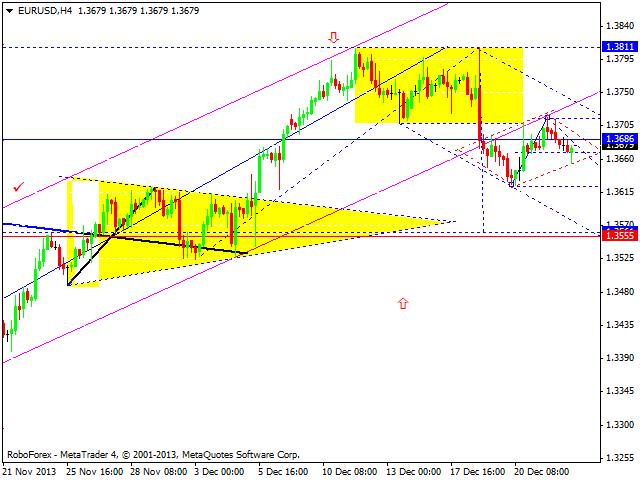
Euro is still forming consolidation channel, which may be considered as triangle pattern. After the market opening, price may fall down to reach level of 1.3644, return to triangle’s upper border, and then complete this correction by moving downwards and reaching level of 1.3560. Later, in our opinion, instrument may continue growing up with target at 1.4100.

GBP/USD

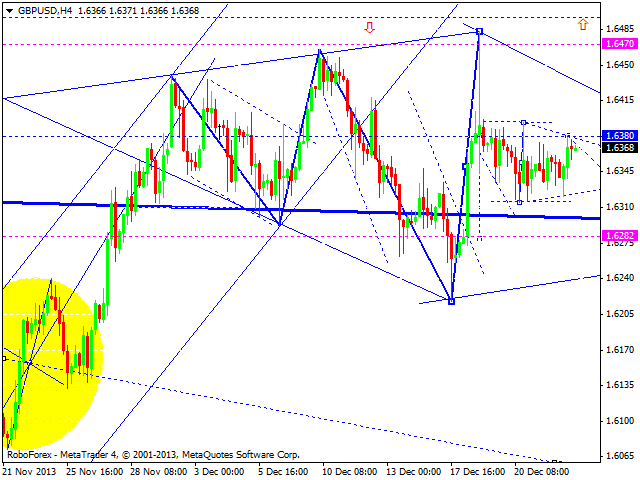
Pound is still consolidating below 1.6380. After the market opening, price may continue its correction and reach level of 1.6300 (at least). Later, in our opinion, instrument may continue moving upwards to reach predicted target at 1.7150.

USD/CHF

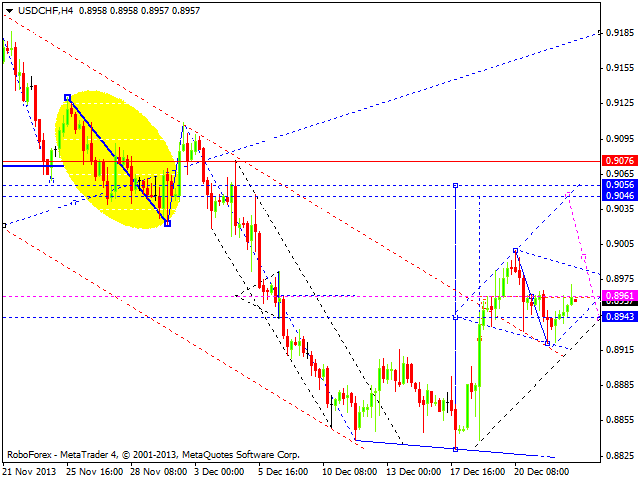
Franc started forming another ascending structure; right now market is moving inside consolidation pattern. After the market opening, price may reach level of 0.9000 and then fall down towards 0.8960. Later, in our opinion, instrument may complete this correction by reaching level of 0.9060 (at least) and then continue falling down towards 0.8300.

USD/JPY

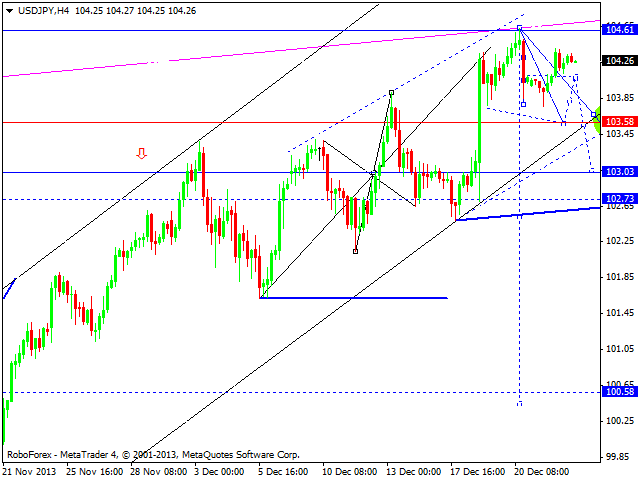
Yet is still consolidating near its maximums. After the market opening, price may start descending structure towards level of 103.58, return to 104.00, and then continue falling down towards next target at 102.70.

AUD/USD

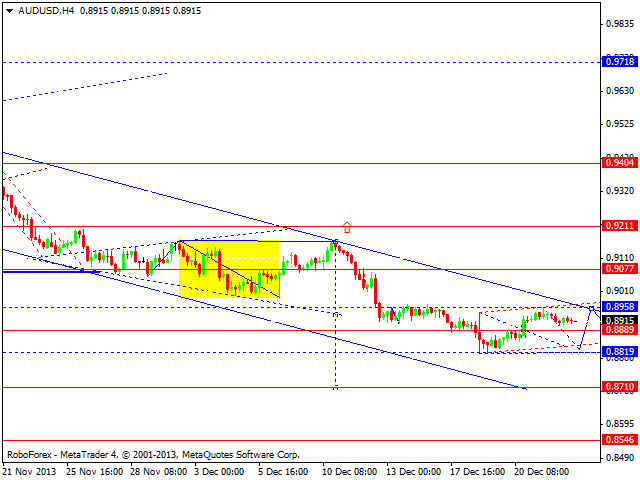
Australian Dollar is still being corrected towards previous descending movement; structure of this correction implies that price may fall down to reach 0.8840. Later, in our opinion, instrument may complete this correction by forming ascending structure to reach level of 0.8958 and then start moving inside down trend towards 0.8720.

GOLD

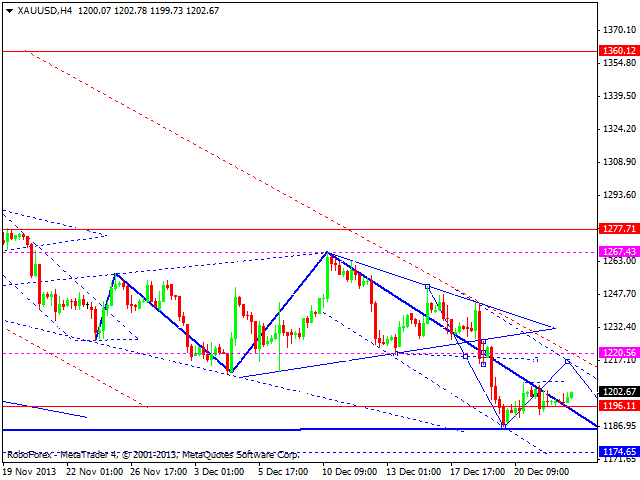
Gold is still moving towards level of 1220; after the market opening, price may reach it. This movement may be considered as the fourth wave of another descending structure. Later, in our opinion, instrument may start the fifth wave inside this final structure with target at 1175 and then form reversal pattern for new ascending movement to return to 1360.

RoboForex Analytical Department

Article By RoboForex.com

Attention!
Forecasts presented in this section only reflect the author’s private opinion and should not be considered as guidance for trading. RoboForex LP bears no responsibility for trading results based on trading recommendations described in these analytical reviews.


USDJPY: Bullish, Risk Builds On The 104.62 Level.

USDJPY: With USDJPY halting its one-day pullback and closing higher for a second day in a row on Tuesday, a build on strength is expected on market resumption. In such a case, the 104.62 level. A violation of here will aim at the 105. towards the out the 103.91 level to resume its medium term bullishness, further upside offensive is likely. Resistance resides at the 104.50 level where a breach will aim at the 105.00 level and possibly higher towards the 105.50 level. Its weekly RSI is bullish and pointing higher supporting this view. Conversely, on the downside, support comes in at the 103.73 level where a violation will turn attention to the 103.00 level and then the 102.50 level. Further down, support lies at the 101.61 level followed by the 101.00 level. On the whole, USDJPY remains exposed to the upside in the medium term.

Article by www.fxtechstrategy.com


Coming of Age: Experts Reflect on the Extraordinary Promise of the Cell Therapy Sector

Source: Tracy Salcedo-Chourré of The Life Sciences Report (12/26/13)

http://www.thelifesciencesreport.com/pub/na/coming-of-age-experts-reflect-on-the-extraordinary-promise-of-the-cell-therapy-sector

Without innovation and risk-taking, modern medicine would be missing staples of the physician’s armamentarium: antibiotics, radiation therapies, vaccines. The idea of taking a tonic to cure what ails you is thousands of years old, but the science behind that tonic may be revolutionary. Enter stem cell technologies. Given the promise backing the science—and the sector’s position on the cusp of breaking out—companies with cell therapies got plenty of attention from investment analysts and experts in 2013. Read what those experts, including George Zavoico of MLV & Co., Steve Brozak of WBB Securities, Jason Kolbert of the Maxim Group, and Kevin DeGeeter of Ladenberg Thalmann & Co., had to say about prospects for stem cell companies in this special retrospective article from The Life Sciences Report.

Once upon a time the magic pill was penicillin. It was Marie Curie’s miraculous radium. It was Jonas Salk’s polio vaccine.

These days it is the stem cell.

New ways to treat and cure disease often meet with skepticism, but the ones that work eventually secure the respect of investors, practitioners and patients, moving into both the medical paradigm and the marketplace. If the researchers working in the stem cell field—and the analysts covering the field—are right, regenerative medicine is knocking on the door of the paradigm. Once it wins entry, the rewards for investors could be extraordinary.

The Life Sciences Report interviewed a number of analysts and experts covering the regenerative medicine field in 2013. These experts described how stem cells could transform the treatment of many modern plagues, including heart disease and cancer, spinal cord injuries and central nervous system disorders, inflammatory and autoimmune diseases. The innovative biotechs that analysts discussed were primarily small- or micro-cap companies, with the potential to return multiples on investment.

The experts also reflected on the bigger picture, sharing insights that might help investors navigate this new and complex realm.

We’ll start with the why. Why should investors include stem cell companies in their portfolios? Steve Brozak, president of WBB Securities, didn’t mince words about his enthusiasm for the sector.

“For the first time in the history of medicine, instead of providing a drug treatment that ‘addresses a problem,’ we can actually harness the body’s own immune system to provide the treatment,” Brozak toldThe Life Sciences Report in January. “It’s always been feasible theoretically, but now we’re starting to see that it is possible. The cells provide treatment rather than molecules: That’s the differentiator. There is still a place for traditional treatments, but that model will no longer be tenable.”

Asked whether cell technologies might offer the greatest growth potential in all of life sciences for investors, Brozak was equally passionate: “I believe that cell technologies have the potential to be the greatest breakthrough in all of healthcare, and in all of medical understanding as we know it. I’m not telling you that it’s going to be a smooth path, because nothing ever is. But yes, that’s a very easy statement to make.”

Gil Van Bokkelen, CEO of cell therapy company Athersys Inc. (ATHX:NASDAQ) and past-chairman of the Alliance for Regenerative Medicine (ARM), explained the promise of stem cell therapies this way in a February interview: “Administering cells can be a dynamic, druglike event, where the cells don’t permanently engraft but are around for days to weeks to help with tissue repair and healing, then clear the body as would a drug or traditional biologic. Then there is the potential to actually augment, replace or regenerate certain types of tissue. These are an incredibly powerful set of capabilities that, frankly, you could never reasonably expect to achieve using traditional, pharmaceutical-based approaches in most areas.

“The stem cell field is unquestionably undervalued right now,” Van Bokkelen went on to say. “But I think that will change as more evidence comes to light. It’s going to be based on clinical data and tangible partnerships, which are what I think will be the biggest drivers.”

Geoff MacKay, current chairman of the Alliance for Regenerative Medicine and CEO of Organogenesis Inc., a private cell therapy company, is also understandably optimistic about the sector. In an April interview, he attributed the relatively low valuation of companies in the cell therapy space to the industry’s youth.

“Very few companies are coming out of phase 3 and into the realm of being valued based on revenue and profit. But there is reason to be confident,” MacKay said, citing emerging investments by big pharmaceutical companies in the space, and the recent acquisitions of smaller, private cell therapy companies by larger companies. “With all the clinical activity and early investment by a critical mass of pharma, we have the beginnings of an industry that’s transforming itself.” And the current successes of a handful of companies in the sector, such as regenerative medicine’s big player, Mesoblast Ltd. (MSB:ASE; MBLTY:OTCPK), “are signs of a growing confidence in the industry.”

Despite their potential, most experts concede that companies in the stem cell space have lagged in terms of valuation, getting little respect from a market more focused on big pharmas with products on the market and/or a pipeline stuffed with therapies in phase 3 studies. In an August interview, George Zavoico, senior analyst and managing director with MLV & Co., attributed some of the Street’s disinterest to the fact that many of these companies “were going for small, niche disease indications that didn’t have particularly large market potential.

“Only recently have some of these companies begun targeting broader indications,” Zavoico said, listing intermittent claudication, failed bone marrow transplantation and preeclampsia as examples. “While many of these trials are still in phase 1, some have progressed into phase 2 and phase 3. When these studies come to fruition, and if the results are positive, I can see this sector getting far more respect, with a corresponding increase in valuations.”

It’s not just the market that has been slow to pick up on stem cell companies and their therapies. Big pharma has yet to enter the stem cell space in any meaningful way. Kevin DeGeeter, director with Ladenburg Thalmann & Co., observed in his May 2013 interview that this could be due, in part, to the wide variety of approaches and indications being addressed.

“The overriding issues for big pharmas have tended to fall into three major categories,” DeGeeter said. First, there is the question of whether cell therapy companies can “scale up production to serve large markets in a cost-effective way.” That’s a particular issue for companies focused on autologous cell therapy products (using cells derived from and then readministered to the same patient).

In addition, “regulatory hurdles have been an unknown,” DeGeeter explained. Because “the mechanism of action in cell therapies often is not as clearly delineated as in traditional small molecules, and even in biologics such as monoclonal antibody products, [there is some] question of how regulators will weigh the risk/benefit issue of a cell therapy in the case of an adverse event.”

And last, there is “essentially a question of inertia” with the larger players.

Still, DeGeeter thinks big pharma’s entry into the stem cell field is “just a matter of time. The midsize biotech may be more fertile ground than big pharma, and it will be interesting to see which will ultimately be first to leap into the realm of cell therapy.”

But companies in the cell therapy space have gotten a boost from other quarters, noted Joseph Pantginis of Roth Capital Partners in his November interview. Though the sector remains “volatile. . .one thing [has] provided a lot of buoyancy to the space,” Pantginis said. The boon has been “cash flow from agencies and groups such as the California Institute for Regenerative Medicine, which is throwing millions of dollars—$20M grants here, $40M grants there—to various companies working in regenerative medicine.”

Though market and big pharma disinterest are headwinds, Jason Kolbert, managing director with the Maxim Group, doesn’t believe there’s any need for investors to worry about legal issues when it comes to monetizing stem cell therapies, such as whether a company will be able to patent a particular therapy. The legality of patenting genes used in targeted therapies was the subject of a Supreme Court case decided in June; the court determined that while genes themselves were “products of nature” and therefore could not be patented, products derived from those genes, such as DNA sequences and synthetic genetic materials, could be patented.

“While [an] individual cell may exist in nature, the concentrated dose—the final product being delivered to patients—does not exist in nature,” Kolbert explained in an interview in May. “A company can’t necessarily patent a mesenchymal cell, but certainly the process, the method of use and, in some cases, the composition of the final product can be patented.”

Stem cell companies themselves, however, may challenge each other in courts to lay claim to proprietary therapies or cells. Should such a challenge occur, Kolbert thinks that market forces—and the strength of a company’s product—will determine the winner.

“It ultimately comes down to which process is faster and cheaper, which process has gone through a regulatory approval process, and as such can have a label and can make certain claims. . .once a company has a label and a claim, as well as supporting intellectual property, it then has a real commercial product,” Kolbert said.

And the outlook for 2014? Kolbert reflected on that in his December interview.

“What the industry lacks right now is pivotal studies,” Kolbert observed, echoing the comments of his fellow analysts. “I don’t think U.S. investors are willing to acknowledge the commercial viability of cell therapies and ascribe valuation based on phase 2 data.”

But several companies plan to enter the phase 3 arena in the new year, and data from a number of phase 2/3 studies, if positive, will lead to additional phase 3 trials, Kolbert said. Investors will find value in those companies that not only have the data, but also “good balance sheets [and] partners with viable business models.”

“I believe, as an analyst, that the way you bring the most value is by identifying a paradigm shift, and I believe that cell therapy represents such a shift,” Kolbert asserted. . .a shift that promises rewards for investors, patients and doctors seeking the cures.

Want to read more Life Sciences Report interviews like this? Sign up for our free e-newsletter, and you’ll learn when new articles have been published. To see a list of recent interviews with industry analysts and commentators, visit our Streetwise Interviews page.

DISCLOSURE:

1) Tracy Salcedo-Chourré compiled this article for The Life Sciences Report and provides services toThe Life Sciences Report as an employee. She or her family own shares of the following companies mentioned in this interview: None.

2) The following companies mentioned in the interview are sponsors of Streetwise Reports: Athersys Inc., Mesoblast Ltd. Streetwise Reports does not accept stock in exchange for its services.

3) Interviews are edited for clarity. Streetwise Reports does not make editorial comments or change experts’ statements without their consent.

4) The interview does not constitute investment advice. Each reader is encouraged to consult with his or her individual financial professional and any action a reader takes as a result of information presented here is his or her own responsibility. By opening this page, each reader accepts and agrees to Streetwise Reports’ terms of use and full legal disclaimer.

5) From time to time, Streetwise Reports LLC and its directors, officers, employees or members of their families, as well as persons interviewed for articles and interviews on the site, may have a long or short position in securities mentioned and may make purchases and/or sales of those securities in the open market or otherwise.

Streetwise – The Life Sciences Report is Copyright © 2013 by Streetwise Reports LLC. All rights are reserved. Streetwise Reports LLC hereby grants an unrestricted license to use or disseminate this copyrighted material (i) only in whole (and always including this disclaimer), but (ii) never in part..

Streetwise Reports LLC does not guarantee the accuracy or thoroughness of the information reported.

Streetwise Reports LLC receives a fee from companies that are listed on the home page in the In This Issue section. Their sponsor pages may be considered advertising for the purposes of 18 U.S.C. 1734.

Participating companies provide the logos used in The Life Sciences Report. These logos are trademarks and are the property of the individual companies.

101 Second St., Suite 110

Petaluma, CA 94952

Tel.: (707) 981-8204

Fax: (707) 981-8998

Email: [email protected]


Shane Nagle: Making Your Portfolio Pricing-Pressure Proof

Source: Brian Sylvester of The Metals Report (12/24/13)

http://www.theaureport.com/pub/na/shane-nagle-making-your-portfolio-pricing-pressure-proof

Forget about the gold price. Forget about the copper, zinc and nickel price. Start searching out companies that can weather another few years of recovery, because it’s unlikely mining companies will get any price relief soon. Shane Nagle, a metals and mining analyst with National Bank Financial, talks with The Mining Report about some names he’s found that have strong balance sheets that can carry them through another few years of pricing pressures to smooth sailing on the other side.

The Mining Report: National Bank Financial (NBF) said in an Oct. 7 report that, when combined with its cautious near-term outlook for commodity prices, elevated multiples suggest the base metal sector is overvalued. Are there exceptions to that statement?

Shane Nagle: Since that time, we’ve seen a retracement in the multiples. The mining index in general remains near the upper end of historical ranges, as investor interest has gravitated toward large and midcap names with stable cash flow and strong balance sheets. Those companies are the exceptions, not only just within the base metal space, but within the mining space in general. Looking past those elevated cash flow and net asset value (NAV) multiples and focusing on companies with balance sheets sufficient to weather a prolonged downturn are the names that stand out as being most attractive.

TMR: Do you think the downturn will last several more years?

SN: Maybe downturn is the wrong phrase, but I think we’re still a few years away from another rally. If I can use copper as a specific example, there’s been a lot of investment on projects in the copper space throughout the past few years. About 15% or so of the current global demand is coming on-line within the next two years from the addition of several large projects (Oyu Tolgoi, Sentinel, Toromocho etc.), this is seemingly going to keep the concentrate market oversupplied throughout 2014-2015. There will probably be some general weakness in copper and base metal prices as a result of this.

The good news is the supply cycle tends to come in waves. Copper prices now are relatively low compared to what price levels are needed in order to make a lot of new projects economical. Projects are being canceled, delayed or suspended. Meanwhile, political factors such as permitting challenges are also pushing out production several years.

So maybe not a downturn, but certainly weaker fundamentals for a couple of years. On the other hand, things are looking pretty good long term, as a lot of the projects that would be slated to come on-line by 2017-2018 are not going to materialize in the current market environment.

TMR: Are we going to see similar sideways performance for nickel and zinc?

SN: Both nickel and zinc markets are oversupplied as well, but appear to be trending in opposite directions. There’s seemingly no end to the nickel supply, the wild card being the proposed export ban on nickel laterite ores from Indonesia.

People have made the case that there’s a great deal of zinc supply coming offline with the closure of the Brunswick and Perseverance mines. However, there are several additional projects, albeit smaller, coming on-line, as well as the extension of the Century and Skorpion mines in Australia and Namibia, respectively. Both markets may stay well supplied in the near term, but long-term fundamentals appear to be more supportive for zinc (which I think is the consensus view).

TMR: What’s your price deck for copper, nickel and zinc for 2014?

SN: For copper we’re using $3 per pound ($3/lb); zinc is $1/lb; and nickel is $7/lb. We’ll be taking a closer look at updating our estimates in the weeks to come.

TMR: Could base metal producers soon be ready once again to spend money on mergers and acquisitions (M&A)?

SN: I don’t think M&A is going to heat up within the base metal space. There’s been so much consolidation during the last decade that there’s not much out there to buy. The type of M&A that could still happen would be optimization of projects within larger mega-cap companies, like Glencore Xstrata PLC (GLEN:LSE; GLEN.HK:HONG KONG; GLN:JSE), where they carve out assets to the mid-tiers.

TMR: You don’t see companies like BHP Billiton Ltd. (BHP:NYSE; BHPLF:OTCPK) or Rio Tinto Plc (RIO:NYSE; RIO:ASX; RIO:LSE; RTPPF:OTCPK) taking advantage of the market for base metals projects that are undervalued?

SN: There are very few projects of that scale that would interest those companies. They also remain under considerable pressure from their shareholders to limit spending. Glencore’s most recent comments were about curbing spending for the next few years in order to weather a downturn. Companies are still focusing on strengthening their balance sheets, limiting and reducing capital costs and optimizing their portfolios by shedding non-core assets. I think that’s the type of acquisition we’ll continue to see, not an increase in traditional M&A.

TMR: What will be the top performers among the base metals equities during the next 12–18 months?

SN: There’s very few companies left in the Canadian mid-tier space, but we’re focused on the ones that have stronger balance sheets and executable projects. Capstone Mining Corp. (CS:TSX), Lundin Mining Corp. (LUN:TSX) and First Quantum Minerals Ltd. (FM:TSX; FQM:LSE) are able to grow within their existing portfolios, have enough funding to complete those projects and still have some level of internal growth.

TMR: Capstone just put out its Q3/13 financials. Did they meet your expectations?

SN: They did. Capstone’s story is mostly about what it can do with Pinto Valley in Arizona throughout 2014. If it does a good job with the transition of Pinto Valley and is operating at full scale, production should increase to in excess of 220 million pounds (220 Mlb) in 2014 from around 105 Mlb in 2013. There are always risks with operating a project of this scale, and we expect some elevated costs initially, but getting the asset from BHP with the keys already in the ignition helps reduce some of that risk.

TMR: First Quantum put out results, too.

SN: First Quantum is also working on some transitional projects, namely Sentinel, a copper smelter and expanding the Kansanshi mine in Zambia. All those projects are all ongoing in tandem and are set to transition the production profile of the company. At the forefront of everyone’s mind is what First Quantum can do with Cobre Panama, which it acquired as part of theInmet Mining Corp. (IMN:TSX) acquisition earlier this year. There should be an update on the expected capital costs and timeline of that project early next year. We’re confident in First Quantum’s ability to deliver the project successfully, the only question is to what extent recent cost cutting initiatives created problems with local contractors and what impact that might have on timing/development costs going forward.

TMR: Lundin Mining was pursuing takeover offers a few years ago. Now it’s looking at expanding its footprint. What turned that company around?

SN: There’s been a change in strategy as Lundin focuses on increasing profitability at its existing assets. The current CEO, Paul Conibear, was promoted from his previous corporate development role and has helped in this transition. Of course, the main cornerstone is its 24% equity interest in Tenke Fungurume in the Congo, which is operated by Freeport-McMoRan Copper & Gold Inc. (FCX:NYSE). At current prices, it is generating $40–50 million ($40–50M) per quarter net to Lundin. The free cash flow it provides to Lundin is very helpful in funding the development of its wholly-owned operations, including development of the recently acquired Eagle mine.

TMR: Gold fell $213 an ounce ($213/oz) in the Q2 and another $91/oz in the Q3. What’s your forecast for 2014?

SN: Our bank uses a $1,300/oz forecast for 2014.

TMR: What’s your outlook for silver?

SN: Our silver forecast is $21/oz, and again, we’ll be taking a closer look at our metal price forecasts in the new year.

TMR: A Q3/13 report by NBF reported that “despite widespread cuts to exploration and more recently corporate general and administrative expense (G&A) even select high-quality names could yet again show an alarming rate of cash depletion, particularly those mid to late cycle on development projects.” Is there a work-around solution for investors?

SN: I think the exceptions are those companies that aren’t committing capital to a large-scale project or have all financing in place. That’s why we continue to point to the royalty names as a defensive pick in the gold space. They may not necessarily be the cheapest, but you’re not going to have a surprising cash strain on a quarterly basis.

TMR: Royalty plays are also trending lower. Why would an investor choose a royalty company over dividend-paying equities outside the mining space?

SN: Comparing them to outside the mining space is interesting, other sectors are paying better yields currently, but the mining royalty companies exhibit relatively strong growth and have the potential for some significant dividend increases in the future. I would say if you have to be invested in the mining space, you want to hold royalty companies because of the stability of their liquidity positions. If you ran spot prices and looked at which companies would have the best financial position at the end of next year, without question, it would be Royal Gold Inc. (RGLD:NASDAQ; RGL:TSX), Franco-Nevada Corp. (FNV:TSX; FNV:NYSE) and Silver Wheaton Corp. (SLW:TSX; SLW:NYSE). Current market conditions also make an ideal hunting ground for these large-scale royalty companies to put some of that cash to work and generate growth. Some fairly significant dividend increases should materialize as they harvest cash flow from acquisitions.

TMR: Royal Gold President and CEO Tony Jensen recently told an audience at the Goldman Sachs Global Metal and Mining/Steel Conference in New York that Royal Gold has more than $1 billion ($1B) in liquidity and that it is “well positioned” to take advantage of a “very attractive” market environment. What streaming or royalty targets could make sense for a company of that size with that much money to spend?

SN: There are several junior/mid-tier companies in need of additional capital, but I think the most interesting opportunities are carving out large-scale royalties or streams from the majors. The Vale S.A. (VALE:NYSE) transaction by Silver Wheaton changed the royalty landscape, carving out gold production from the Salobo mine in Brazil and operations in Sudbury, Ontario, in a $1.9B deal.

It’s another way for those large diversified companies to carve out non-core assets or commodities and realize some value for them.

TMR: If I’m an investor in Royal Gold and I hear a speech like that, I say, “Well, why don’t you take some of that liquidity and increase your dividend to attract more investors?”

SN: I believe Royal Gold has increased its dividend every year for the last 14 years. The share price has exhibited such good growth that the yield doesn’t look as attractive. With operating cash-flow growing at a compound annual growth rate of 6% in the coming years, the share price should continue to benefit, as should future dividend growth.

TMR: In addition to that deal with Vale, Silver Wheaton reached a stream deal with Sandspring Resources Ltd. (SSP:TSX.V). Do those types of deals move the needle for a company like Silver Wheaton, Royal Gold or Franco-Nevada?

SN: This is a way for these companies to gain exploration exposure and strike deals for projects that could potentially be the next cycle’s significant projects. Getting in on the ground level and striking a deal when gold prices are depressed doesn’t require a great deal of upfront capital.

In terms of moving the needle with the current valuation: No, it doesn’t. But fast forward 10 years down the line—each of these royalty companies will have a handful of option agreements that could materialize into something big—they’ve got attractive terms on a future stream, increased exposure to future exploration success and long-term growth.

TMR: What’s next for Franco?

SN: The major catalyst for Franco is getting information on Cobre Panama from First Quantum. Franco had previously struck a $1B streaming transaction at that asset with Inmet Mining. The company will be looking for more visibility on production and possible scalability, as well as the timing of payments to First Quantum. With respect to counter-party risks, Franco is in pretty good hands with a company like First Quantum running its project.

Another royalty example is Sandstorm Gold Ltd. (SSL:TSX; SAND:NYSE.MKT). It has $100M in cash and $100M of available credit. Sandstorm’s performance is being impacted currently by elevated counter-party risks, as there are concerns with the profitability of a few of its streaming agreements. About 70% of its future production is in relatively safe hands at current commodity prices; however, there could be downside risk to its production estimates.

TMR: The company announced that it had record gold sales in Q3. Is this going to be a regular occurrence?

SN: That trend should continue as its primary counter-party, Luna Gold Corp. (LGC:TSX; LGC:BVL), ramps up its phase one expansion at its Aurizona Project in Brazil next year.

It also has a stream on SilverCrest Mines Inc.’s (SVL:TSX.V; SVLC:NYSE.MKT) Santa Elena mine in Mexico, which is going into underground development next year. The record production headlines will persist late into next year, but then taper off if metal prices don’t offer its counter-parties some support.

TMR: Do you have some parting thoughts?

SN: A lot of the people I talk to on a daily basis are saying it’s got to turn around and are picking more leveraged ideas, which a select few will certainly pay off. A more conservative approach would be looking for names that may not necessarily be the cheapest right now, but may present the best opportunity for future growth through M&A, or those companies that have the strongest balance sheets going forward. These names tend to be the large-cap base metal and royalty companies, which will offer exposure to a rebound in prices, but also limit losses should current market conditions persist.

TMR: Excellent. Thanks.

SN: Sure. My pleasure.

Shane Nagle is a metals and mining analyst at National Bank Financial, covering base metals, royalties and junior gold companies. Prior to 2008, Nagle worked as a process engineer within the hydrometallurgy group at Hatch and has an engineering chemistry degree from Queen’s University. In 2013, he received the StarMine award for top stock picker in Canada (Metals & Mining).

Want to read more Metals Report interviews like this? Sign up for our free e-newsletter, and you’ll learn when new articles have been published. To see a list of recent interviews with industry analysts and commentators, visit our <href=”#interviews” target=”_blank”>Streetwise Interviews page.

DISCLOSURE:

1) Brian Sylvester conducted this interview for The Mining Report and provides services to The Mining Report as an independent contractor. He or his family own shares of the following companies mentioned in this interview: None.

2) The following companies mentioned in the interview are sponsors of The Mining Report: SilverCrest Mines Inc., Royal Gold Inc., Franco-Nevada Corp. and Colossus Minerals Inc. Streetwise Reports does not accept stock in exchange for its services or as sponsorship payment.

3) Shane Nagle: I or my family may own shares of the companies mentioned in this interview: None. I personally am or my family is paid by the following companies mentioned in this interview: None. I was not paid by Streetwise Reports for participating in this interview. Comments and opinions expressed are my own comments and opinions. I had the opportunity to review the interview for accuracy as of the date of the interview and am responsible for the content of the interview.

4) Interviews are edited for clarity. Streetwise Reports does not make editorial comments or change experts’ statements without their consent.

5) The interview does not constitute investment advice. Each reader is encouraged to consult with his or her individual financial professional and any action a reader takes as a result of information presented here is his or her own responsibility. By opening this page, each reader accepts and agrees to Streetwise Reports’ terms of use and full legal disclaimer.

6) From time to time, Streetwise Reports LLC and its directors, officers, employees or members of their families, as well as persons interviewed for articles and interviews on the site, may have a long or short position in securities mentioned and may make purchases and/or sales of those securities in the open market or otherwise.

Streetwise – The Gold Report is Copyright © 2013 by Streetwise Reports LLC. All rights are reserved. Streetwise Reports LLC hereby grants an unrestricted license to use or disseminate this copyrighted material (i) only in whole (and always including this disclaimer), but (ii) never in part.

Streetwise Reports LLC does not guarantee the accuracy or thoroughness of the information reported.

Streetwise Reports LLC receives a fee from companies that are listed on the home page in the In This Issue section. Their sponsor pages may be considered advertising for the purposes of 18 U.S.C. 1734.

Participating companies provide the logos used in The Gold Report. These logos are trademarks and are the property of the individual companies.

101 Second St., Suite 110

Petaluma, CA 94952

Tel.: (707) 981-8999

Fax: (707) 981-8998

Email: [email protected]


Armenia cuts rate 25 bps, sees further rate cuts in 2014

By CentralBankNews.info
    Armenia’s central bank cut its benchmark refinancing rate by another 25 basis points to 7.75 percent and said monetary policy would be weakened further in 2014 given the external and domestic economic developments and a further reduction in inflation.
    The Central Bank of Armenia (CBA) cut its rate by 50 basis points in November, reversing a rate rise in August for a net cut in rates this year of 25 points.
    Armenia’s inflation rate eased to 6.6 percent in November from 7.14 percent in October, a faster decline than forecast, and the CBA said it expects inflation to reach the upper limit of the bank’s inflation target range by the end of the year.
    The bank expects inflation to continue to decline in coming months and return to the bank’s 4.0 percent target within a 1.5 percentage point band.
    Armenia’s Gross Domestic Product expanded by an annual rate of 1.4 percent in the third quarter, up from 0.6 percent. Last month the central bank forecast economic growth this year of 3.4-3.8 percent, down from the government’s original 6.2 percent growth forecast.
    The bank’s president also announced in November that the central bank would be adopting an inflation targeting policy.

    www.CentralBankNews.info


Five Moves to Make Before 2014

Guest Post By Dennis Miller – Five Moves to Make Before 2014

While it’s tempting to slip into an eggnog stupor from Christmas Eve to New Year’s Day, there are five items we should all check off our to-do lists before the ball drops on 2014.

Review your loss carryforward numbers. If you have any capital loss carryforward from previous years, now is a good time to take some profits. You can take your gains and offset them against your carryforward, plus $3,000. Who knows when our desperate government will still demand its share of our gains via taxes but leave us alone to cover our losses? Offset those carryforward losses and take some profits where it makes sense to do so.

Maximize your 401(k) and IRA contributions. If you’re over 50, don’t forget the catch-up contribution. You can contribute $17,500 per year to a 401(k), plus an additional catch-up contribution of $5,500. If you have an IRA, you can contribute $5,500, plus a catch-up contribution of $1,000. Check with your CPA for the details specific to you.

If you’re in the 25% income tax bracket, a maximum contribution to an IRA could reduce your 2013 income taxes by $1,625; a 401(k) maximum contribution could reduce it by $5,750.

It might sound like pedestrian advice; however, I harp on this topic because only 10% of those working contribute the legal maximum to their 401(k)s. The bottom line is: you can save money for retirement and reduce your tax bill in one swoop. Frankly, it really saddens me that more people don’t take full advantage of these opportunities. If you cannot afford to contribute the maximum, do the best you can and aim to increase your contribution each year.

Talk to your CPA about tax changes stemming from Obamacare. This is a complicated topic and may affect you in ways you wouldn’t anticipate. There’s an additional tax on health savings account distributions, and over-the-counter medicines no longer qualify as medical expenses for certain purposes, among other changes. We recommend checking with your accountant for specifics.

Talk with all your doctors about Obamacare. I have several doctor friends and some have announced early retirement. They would rather stop practicing medicine than deal with the fallout surrounding the new healthcare law.

I also just saw my ophthalmologist, and he said the government is reducing his reimbursement drastically and changing when he can perform procedures like cataract surgery.

Like it or not, Obamacare is the now law of the land. Everyone has different health concerns, and it’s in your best interest talk to your doctor sooner rather than later. You don’t want to find out your doctor cannot treat you or that insurance won’t cover a procedure when you’re in need of immediate care. That’s the wrong time to start investigating alternatives.

You need to know if your doctor is going to opt out of Medicare or other insurance plans. Don’t be shy; just ask and lessen the chance of an unpleasant surprise.

Take advantage family togetherness by discussing the tough topics. When our children were in grade school, a friend who was well versed in fashionable child-rearing techniques sold me on regular family meetings. The rules were pretty simple: every family member could bring up issues without Mom and Dad getting angry.

Our first family meeting is legendary in our family lore. My youngest son piped up and announced he wanted an increase in his allowance. For a first-grader, he built a great case, explaining what his allowance would and would not buy and lobbying for an increase. I looked at my wife, who was grinning from ear to ear, decided he’d made a good argument, and doubled his allowance.

From that point forward, family meetings were a Miller tradition. My first set of children are now in their 50s, and when we get together for the holidays, they still know they can call a meeting.

Some seniors find it difficult to discuss touchy issues with their children. Some friends used to take their grandchildren to Disneyworld when they reached a certain age. Their children and grandchildren had come to expect it. When the tradition began to strain the budget, they decided to ‘fess up and tell their children they could no longer afford it. Their children completely understood. Even better, the parents of the grandchild who was next in line proudly announced they could afford it and invited Grandma and Grandpa to Disney as guests for a change.

Multi-generational family dynamics can be complicated, so don’t stop discussing the hard stuff with your children just because they’re adults.

2013 was a year of extreme predictions. Some pundits recommend going “all in” the market next year, while others say to sell everything. Both are lousy approaches for protecting your nest egg. The former is too risky for retirees, but the latter approach will leave you without adequate income and vulnerable to inflation.

There is a third alternative.

We recently published the December issue of our premium publication, outlining a comprehensive strategy for managing your retirement money. Our portfolio experienced double-digit gains last year, without taking risks inappropriate for those in or approaching retirement. Simply put, we have serious circuit breakers in place to protect you should the market drop like it did in 2007-2008.

If you’re not a current subscriber, I highly recommend taking advantage of our 90-day, no-risk offer. Sign up at the current promotional rate of $99/year, and download my book and all of our special reports—really take your time and look us over. If within the first 90 days you feel we’re not for you, feel free to cancel and receive a 100% refund, no questions asked. You can still keep the material as our thank-you for taking a look. Click here to subscribe risk-free today.


The Market Volatility Is at a Low Level Before Christmas

The EURUSD Trading With a Positive Sentiment

Before Christmas many are busy with purchases for a festive table, so there is almost nobody who trades in Forex. Therefore, many exchange instruments without a pointing hand of a speculator almost stuck near opening levels. The EURUSD slowly rose to resistance around the level of 1.3709 and then also in an unhurried manner returned to support at 1.3676. Under conditions of a narrow market price fluctuations usually are not taken into consideration, so at this stage it can be said that the overall picture in the pair remains unchanged. A positive sentiment remains but inability to break through and consolidate above the 37th figure will weaken the EURUSD bulls positions, but a fall of the support at 1.3620 will signal about a possible peak formation.

eur

The GBPUSD Sticks in a Tight Range

There is also noting to add to the GBPUSD pair. Yesterday the pair was trading within a very tight range, limited by the levels of 1.6375 and 1.6329. Until now it is trading above the 63rd figure with a positive sentiment that allows the bulls to account on the resumption to current highs. A loss of this support will weaken their positions and will lead to a decline of the pair to 1.6200 -1.6173. Given the scale of growth in recent months, it is not the fact that a potential breakout of current highs will give the pair enough momentum to pass about a couple of figures.

gbp

The USDCHF Trading Between the 89th and the 90th Figures

The USDCHF was gradually declining to support around the level of 0.8923, after that it retreated to 0.8950. A rise above 0.8900 is a positive factor for the dollar, but it should continue rising and overcome 0.9000. Otherwise, pressure on the pair will strengthen and then the bears will try again to test current lows. Thus, at this stage there is a range, limited by the 89th and the 90th figures, an exit out of which, most likely, will determine the direction of movement.

chf

The USDJPY May Correct Below

The USDJPY decreased to support around the level of 103.77 in a day and during the Tuesday`s Asian trading session has risen to 104.41. The pair is trading with a positive sentiment above the ascending support line. Its overbought can complicate an upward movement. Moreover, it can be the reason to take profit. In this case the pair will be under pressure and it will be declining. A loss of support around the 101.59 level will weaken a bearish impulse.

jpy

provided by IAFT


Japan’s Nikkei 225 Rises to Six-Year High

By HY Markets Forex Blog

Japan’s benchmark Nikkei 225 index extended to a six-year high, rising higher than 16,000; the highest since 2007 and revealing the world’s largest economy is recovering.

The motor manufacturers, Mitsubishi Motors saw the most gains on the Nikkei 225, climbing 4.3% higher to 1,099 yen, driven by the boost in its net income forecast by 43% to 100 billion yen.

While NKSJ Holdings gained 1.8%, after Nomura Holdings increased its price target from 2,900 yen to 3,300 yen.

The Nikkei 225 gained 0.1% to 15,889.33, marking its highest close since December 2007. The Tokyo Topix index dropped 0.3% to 1,257.55 as the yen weakened 0.1% to 104.22 per dollar.

IMF Outlook

The International Money Fund (IMF) is increasing its outlook for the world’s largest economy, following the Federal Reserve’s (Fed) decision to start tapering its monthly asset purchases and the recent budget agreement that was finalized in Washington, Managing Director Christine Lagarde said in an interview with NBC. In October, IMF forecasted the world’s largest economy would increase by 2.6% by next year.

The Tokyo Stock Exchange Mothers Index lost 2.2% on Tuesday, while the Jasdaq Stock Index dropped 1%.

Tepco

Tokyo Electric Power was among the stocks that dropped, slipping from 2.3% to 510 yen. According to a statement released from the utility, Tepco found radioactive water leaks near storage tanks at its Fukushima Dai-Ichi nuclear plant.


Win a luxurious trip to the Maldives & up to $30,000 cash for trading with us!

Visit for details http://alturl.com/2kysk 

The post Japan’s Nikkei 225 Rises to Six-Year High appeared first on | HY Markets Official blog.

Article provided by HY Markets Forex Blog

Shares in Europe Advances Fifth Day in a Row

By HY Markets Forex Blog

Shares in Europe extended its gains for the fifth day in a row as copper climbed and the greenback strengthened before the release of the US durable goods reports.

The Stoxx Europe 600 Index advanced 0.2% higher, the longest winning-streak in almost two months, while the Standard & Poor’s 500 Index were slightly changed. The US dollar strengthened against 12 major currencies.

Analysts are predicting a rise in US durable goods in November, following its previous drop in October.

Shares – US Dollar

The greenback strengthened 0.1% to 104.25 yen after reaching the highest level of 104.64 yen on December 20. The US dollar gained 0.2% to $1.3675 against the 17-bloc euro and advanced 0.1% to 89.23 US cents against the Australian dollar.

The Japanese yen declined by 15% this year, according to analysts forecasts. The US dollar strengthened by 4.2%, while the euro rose 8.4% higher.

Treasures dropped to the lowest level to stocks in almost four years yesterday. The ten-year treasury yield lessened to 3.10 percentage point after the Federal Reserve’s decision to reduce its monthly bond purchases by $10 billion to a total $75 billion.

Meanwhile, the People’s Bank of China (PBoC) auctioned 29 billion yuan ($4.8 billion) into the financial system in order to end the cash crunch that’s affecting the economy.

The MSCI Emerging Market Index rose 0.2% higher, close to a two-week high. While the Hong Kong’s Hang Seng index rose 1.8%, the highest level in a month. Borsa Istanbul 100 Index gained 0.7%, picking up from the previous month’s loss of 9.5%.

Copper jumped $7,266 a metric ton; however prices are expected drop by 8.4% this year.


Get $100 FREE Funded into your MT4 Account as well as many more amazing benefits! Register with HY Markets today.

http://www.hymarkets.com/english/reg/reg.hyml …

The post Shares in Europe Advances Fifth Day in a Row appeared first on | HY Markets Official blog.

Article provided by HY Markets Forex Blog