The Stock Market Holiday Bulge – Prepare for Selling

By Chris Vermeulen – www.thegoldandoilguy.com

I would like to start by wishing you a Happy Holidays & New Year!

So far this year (2013) has been a great year for trading and my 2014 forecast looks to be as good if not even better. I do have something exciting to share with you that is going to make 2014 really amazing, but first let me talk about the stock market and what is likely to unfold in the next week or two so you can protect your investments.

As many of you know, I follow and post frequently on StockTwits.com. I like to see what traders and investors are thinking/feeling about the broad market using extreme sentiment readings as a contrarian signal for trade ideas or to protect open positions more by tightening my protective stops and locking partial profits.

Below I have posted a two charts on sentiment courtesy of StockTwits to show these extreme readings of where the US stock market is trading at. The first chart is of the symbol $STUDY and this sentiment shows us that 98% of trading material is bullish on the stock market right now. My theory is, if everyone is moving in one direction, you better be ready for them to change direction any time. The masses move like a school of fish and one they get spooked they change direction and start selling everything they just bought.

The second sentiment chart is of the SPY exchange traded fund. This mimics the SP500 index and is also a gauge for broad market sentiment. If we think back to the 80/20 rule, we know that 20% of the crowd/clients are correct while 80% tend to be incorrect. With sentiment reaching the highest level in a couple months and with the index making new highs, coupled with the holiday price bulge (holiday rally) logic says a pullback in the near term is very likely an that it could be sharp and it almost like  automated trading.

Market Sentiment – Broad Market Contrarians Indicator

sentiment

The stock market has wave like patterns that form on a monthly basis that provide us with a steady stream of trading opportunities. One of the best swing trading tools for timing these waves is through the use of this chart below provided by Barchart.com.

The chart below is self explanatory, but let me quickly explain how it works. This chart rises as more and more stocks trade above the 20 day simple moving average. And when the majority of stocks are in a strong uptrend, it’s a lot like humans all trading in the same direction (a school of fish) and the odds favour a change in direction temporarily. These waves are great intermediate trends for swing trading and typically last multiple weeks at a time. This is one of my strategies which I trade with my members at TheGoldAndOilGuy.com alert newsletter. Keep in mind, its not as easy as it looks, because there are more moving parts to this equation but you can see these extreme waves clearly in this chart.

20dma


The Holiday Bulge & Amazing Information Conclusion

With the stock market still firmly in an uptrend and firing on all cylinders short term analysis is pointing to a pause or pullback in the next week or two.  I did forecast this exact price action several weeks ago and how it could lead to the start of a major market top. If a major top does form early in 2014 then we could make some big money once the down trend starts.

Remember, stocks fall 3-7 times faster than they rise, so once we get short massive gains can be made quickly and while the masses (school of fish) are losing money, we should be on the other side watching our trading account sky rocket!


NOW FOR THE GOOD NEWS!

A few days ago my new book “Technical Trading Mastery – 7 Steps To Win With Logic” became available to my followers and readers with an offer you would cannot refuse. If you buy my book before Jan 1st you get a Lifetime Membership to my new Monthly INNER-Investor Newsletter so you can keep your long term investment capital on the right side of the market forever.

Get the Full Details at: http://www.thegoldandoilguy.com/

Chris Vermeulen


Advancing to Level II: A Bulletproof Retirement

Guest Post By Dennis Miller, Advancing to Level II: A Bulletproof Retirement

That’s right, retirement has a Level II. I bet your competitive streak wants to get there, and that means building an overall strategy for producing stable monthly income. Depending on your personal goals, that might mean income to supplement your paycheck, or income that’ll have you sipping Mai Tais on the beach in Tahiti next to your spouse of 30- or 40-plus years.

But before we get to Level II, let’s review Level I.

Retirement Level I

Retirement changed radically when the government bailed out reckless banks at the expense of seniors and savers. A lot of people, myself included, entered the 2008 crash thinking their portfolios were as safe as a bomb shelter.

Personally, I allocated my portfolio by the “100 minus your age” rule. Cash holdings aside, nearly 70% of my capital was in income investments (leaning heavily on CDs, given the excellent rates at the time), and the remaining 30% was very conservatively invested in the market. In other words, I followed the rules.

Unlike many who took a large hit when the market crashed, my losses were minimal. I don’t say this to brag, nor am I encouraging you to follow my old allocation. I simply want to share that, even with my allocation down pat, I too was struck hard by the crash… just not in the way one might imagine. Why? Because it wasn’t the number at the end of my brokerage statement that let me sleep well at night, it was the income those investments produced.

I was living on that income, enjoying the retirement dream. Then—almost overnight—my “paycheck” was cut by 66%.

Like so many others, I was caught by a risk in my portfolio that had been unheard of a few years prior. With decades of livable interest rates behind us, not one financial advisor ever suggested I was at risk. Almost no products existed to deal with it.

The new, zero-interest-rate world was, as the kids in Silicon Valley like to say, a game-changer.

When our team sat down to develop Money Forever, we knew that retirement investing demanded both a defensive and an offensive strategy, played at the same time.

The defensive goal is to avoid catastrophic losses. Too many Americans were caught with their pants on the floor at the end of the dot-com and real estate bubbles. Others from around the world have been robbed of their savings as governments overspent and spurred inflation.

Bonds have performed very well recently. But the largest gains are not from yield, but from the Federal Reserve driving interest rates lower and holding them there.

While long-term bond funds appreciated handsomely, a new risk crept into portfolios around the world: the so-called bond bubble. If rates rise (we’ve seen a light preview of this since May), the net asset value of the billions of dollars in many bond funds will drop dramatically.

When we put our retirement money in fixed-income investments, we are investing for safety and yield. We cannot risk another bubble bursting at our expense.

Moving Forward

Yes, we want yield. But there is another reason for fixed-income investing: safety. What if there is a huge market drop? We may be domestically and internationally diversified and have adequate stop losses in place, but a wave can act like a tsunami at times, and right now is one of those times. So we are moving on to Level II.

Level II: Bulletproofing Your Retirement

There are two important facets of a strong portfolio: income, and opportunities. Miller’s Money Forever helps guide you through the better points of finance, and helps replace that income lost in our zero-interest-rate world.

Pre-crash, if an investor bought a CD at the prevailing rate, and then interest rates rose during that period, he would not lament his loss in net asset value. He would be satisfied with the interest, and when his CD matured, he would buy another one at the current rate. So why do we look at bond funds, see our net asset value go down, and worry? Because most bond funds are always busy selling, baking in those losses along the way.

Some funds, however, hold them to maturity. In that regard, it is like a CD. Of course, it is not FDIC insured. That does not make it unsafe, however. In fact, in the fall of 2008, I would have been better off holding non-callable bonds at a nice, juicy 6% rate instead of FDIC-insured CDs. My income certainly wouldn’t have taken the hit it did. (I must forgive myself for that sin against my portfolio, but now I know better.)

This is where the value of one of the best analyst teams in the world comes into focus. We focus on our subscribers’ income-investing needs, and I challenge our analysts to find safe, decent-yielding, fixed-income products that will not trade in tandem with the steroid-induced stock market—or alternatively, ones that will come back to life quickly if they do get knocked down with the market. They recently showed me seven different types of investments that met my criteria and still withstood our Five-Point Balancing Test.

Somewhere in the discussion, I mentioned how tired my peers are of having holes blown in their retirement plans. While nuclear-bomb-shelter safe may be impossible, we still want a bulletproof plan.

This is what we’ve done at Money Forever: built a bulletproof, income-generating portfolio that will stand up to almost anything the market can throw at it.

It is time to advance to Level II and learn about the vast market of income investments safe enough for even the most risk-wary retirees. Some investors may want to shoot for the moon, but we spent the bulk of our adult lives building our nest eggs; it’s time to let them work for us and enjoy retirement stress-free. Learn how to get in, now.


Bear Market Cycle Bottom Forming in Gold and Gold Stocks Right Now!

By David A Banister – www.MarketTrendForecast.com

Bear Market Cycle Bottom Forming in Gold and Gold Stocks Right Now!
Today we take a look at the Bullish Percent Index chart relative to Gold’s cycle and Gold Stocks.

 Essentially it tells you what percentage of Gold sector stocks are at or above a moving average, which normally would be 50 days.  When 70% or more are above a 50 day moving average, sectors can be peaking out.  If you look at our chart at the bottom, we have labeled various incidents with A, B, C, and D.


A. The precious metal as we all know peaked in the fall of 2011 at $1923 per ounce, and the Bullish percent index was at 80%! Usually at 30% or so, they are bottoming out in most cases.


B. We saw a rare case in the summer of 2013 where the Bullish percent index for Gold stocks was at 0%, yes that is not a miss-print.


C. Gold bottomed at 1181 in late June 2013, and then rallied up to 1434 and we saw Gold stocks rally 40-80% in individual cases and the Bullish percent index rallied up to 55%.


D. If we fast forward to December 2013, we have Gold pulling back in the final 5th wave down from the Bull cycle highs in August 2011 at $1923.  The Bullish percent index is back to 10% and heading towards 0 or close once again.  At the same time, the Gold miners index ETF (GDX) is at 5 year lows and even lower than June-July 2013 lows.


These types of indicators are coming to a pivot point where Gold is testing the summer 1181 lows and may go a bit lower to the 1090 ranges.  At the same time, we see bottoming 5th wave patterns combining with public sentiment, bullish percent indexes, and 5 year lows in Gold stocks.  This is how bottom in Bear cycles form and you are witnessing the makings of a huge bottom between now and early February 2014 if we are right.


The time to buy Gold and Gold stocks is now during the next 4-5 weeks just as we were recommending stocks in late February 2009 with public articles that nobody paid attention to.  This is the time to start accumulating quality gold miner and also the precious metals themselves as the bear cycle winds down and the spring comes back to Gold and Silver in 2014.


Elliott Wave Theory - Gold Forecast


Join us at www.MarketTrendForecast.com for regular updates on Gold, Silver, and The SP 500 Index.

David Banister


How Will Appreciation of Yuan Affect Outsourced Companies?

Guest Post by Patrick Gibson

The newly effected direct exchange capability between the Yuan and the AUD will soon start helping cut costs for thousands of exporters of goods and services in Australia, because trade between the two countries will be free of the fluctuations of the USD.

At the same time, the Chinese Yuan has been appreciating significantly against the AUD and the USD since the beginning of 2013. The nominal trade-weighted Yuan saw a moderate appreciation of 6.1% since the start of the year.

This rise of the Yuan against international currencies is a result of many internal and external factors, including international pressure, and this is mixed news for Australian companies that are sourcing to China their manufacturing and other functions.

Overview of Impact to Australian Outsourcing Companies

Early in April 2013, the RMB/AUD rate was 1/6.48; in other words, 1 AUD was able to buy 6.48 RMB worth of some goods. If the Chinese Yuan appreciates at a year by year rate of 7.5% against the Australian Dollar, it means that within a year 1 AUD will only be able to buy 5.99 Yuan worth of some goods. The Yuan has been steadily rising against international currencies since 2010.

Now a moderate to high appreciation of the Yuan (also known as the Renminbi) by up to 7.5% against the AUD will help to resolve trade imbalances between the two countries. But while that is the good news, the bad news is that the outsourced Australian company will have to raise costs of manufacturing. In addition, there have been other changes in China including rising wages and raw material costs. This is going to raise prices at check-out. But this doesn’t mean the Australian outsourced company in China pulling out, however. Major Australian outsourcing company Myer, for instance, has doubled its outsourcing to China in 2011. They, as well as other outsourced companies are getting around higher costs by moving their manufacturing north, where electricity, resources and labour are significantly cheaper than the south.

There is also the additional fact that the appreciation is likely to become stable at this rate, because of the restrictions that the Chinese Central Bank has still placed on the exchange rate.

Chinese Floating Exchange Rate In Relation to the AUD Explained

Over the past 10 years the Chinese banks have been keeping the value of the currency artificially low through a fixed exchange rate. The undervalued currency was affecting international trade. The fixed exchange rates of the Yuan against the USD (and indirectly the AUD) had given China an unfair trade advantage, with imports to China being expensive and exports becoming cheaper.

The supply of AUD in China was therefore higher but the AUD was weak against the Yuan. In such a scenario, in economies with floating exchange rates, the currency prices adjust themselves to resolve the trade imbalances. That was not the case in China, however, as the currency was fixed with Central Bank intervention to keep the Yuan high against the USD (and indirectly, the AUD). This adversely impacted trading for Australian companies, creating deficits for them and surplus in China.

The switch to a floating exchange rate for the Yuan dependent on market forces since 2010 is a step by the Chinese government towards loosening the Central Bank’s control over the currency. This is going to benefit international traders including Australia. The era of low-priced Chinese goods will soon be over. However this will also mean rising costs for the outsourced company.

Solutions for Australian Outsourced Companies

Clearly the appreciating Yuan against the AUD, rising labour costs, and the new Labour Law requiring at least 150% overtime on weekdays and 200-300% on weekends are affecting the bottom lines of outsourced companies, both for marketers and manufacturers. Some factories have also closed in China, unable to keep up with the changes.
But the good news is that the overall cost of production in China is still lower than anywhere else in the world. Also, despite the Yuan appreciation, calculations suggest that it is still undervalued by around 39%. And given the attitude of the Chinese government, they will not want the value to rise much further.

The outsourced company in China will definitely benefit at this stage by enhancing the quality of products. There will always be buyers for quality goods, no matter the price. A study by Nielsen has shown that while price and value do play a role in determining where people shop and what they buy, manufacturers and retailers who offer high quality and great value do better than those companies and manufacturers that try to stretch their dollars. This is true even in a poor economy.

Guest Post by Patrick Gibson


Fibonacci Retracements Analysis 26.12.2013 (EUR/USD, USD/CHF)

Article By RoboForex.com

Analysis for December 26th, 2013

EUR/USD

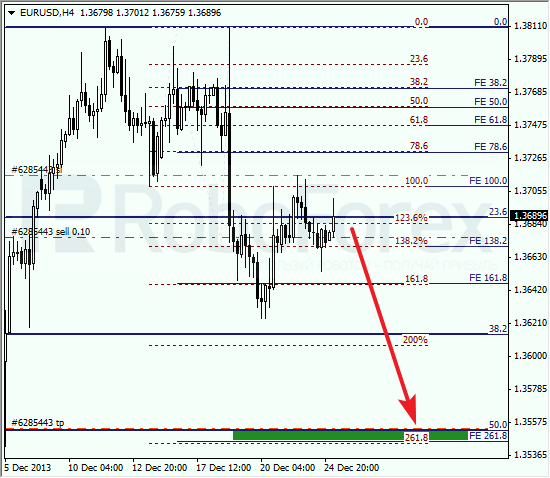
Eurodollar is still consolidating. Probably, price completed local correction and is about to start new descending movement towards lower fibo-levels. I’m keeping my sell order with stop at local maximum.

As we can see at H1 chart, price is entering temporary fibo-zone, where it may finish current correction. Possibly, pair may reverse and reach new local minimum until the end of this week.

USD/CHF

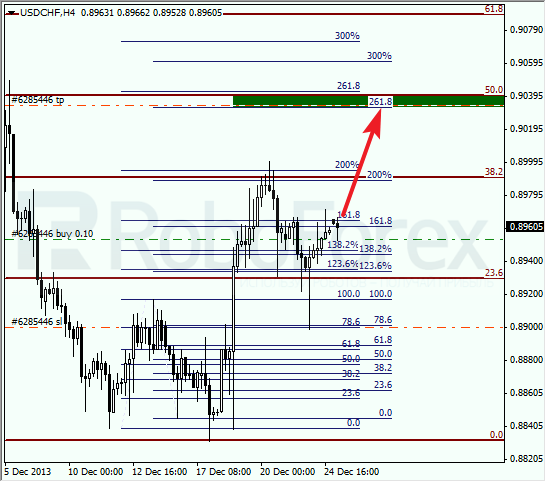
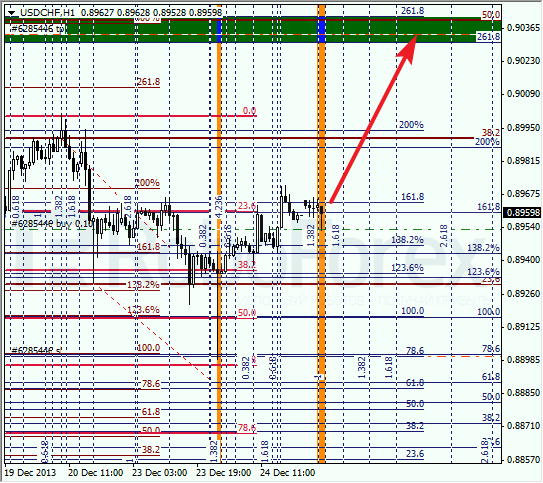
Franc is trying to start new ascending movement. Possibly, price may break previous maximum in the nearest future. In general, pair is expected to grow up towards upper fibo-levels, which may later become starting point of new correction.

At H1 chart, market is moving inside temporary fibo-zone. Most likely, this is the place, where price is going to finish this slight correction. I’ll move stop on my buy order into the black as soon as pair reaches new maximum.

RoboForex Analytical Department

Article By RoboForex.com

Attention!
Forecasts presented in this section only reflect the author’s private opinion and should not be considered as guidance for trading. RoboForex LP bears no responsibility for trading results based on trading recommendations described in these analytical reviews.


Taiwan holds rate, sees higher 2014 growth, inflation

By CentralBankNews.info
    Taiwan’s central bank held its benchmark discount rate steady at 1.88 percent, unchanged since June 2011, saying domestic economic growth should improve next year due to better exports and a slight improvement in private consumption but the momentum of industrial investment is still insufficient.
    The Central Bank of the Republic of China (Taiwan) said the government was forecasting economic growth next year of 2.59 percent, up from an expected 1.74 percent this year, and 2014 inflation of 1.21 percent, up from an expected 0.94 percent this year.
    The decision by the central bank was widely expected and the bank also decided to maintain its current M2 money supply growth target at 2.5-6.5 percent for 2014 in light of an expected gradual improvement in the global economy and the lack of inflationary dangers. Oil prices next year are expected to be slightly lower, grain prices to rise gently and global inflation to remain moderate.
    Taiwan’s Gross Domestic Product expanded by 0.27 percent in the third quarter from the second for annual growth of 1.66 percent, down from 2.69 percent in the second quarter. The headline inflation rate in November was 0.67 percent, marginally higher than October’s 0.64 percent.
    The central bank introduced further prudential measures and urged banks to exercise caution in real estate lending and asked banks to pay close attention to their credit risk management.
    The central bank said it had learned that some banks had made high-value housing loans without fully complying with its principles and a few banks were also found to have used inadequate due diligence when approving loans for industrial use.
    “Financial institutions obtain most of their funding from the public and should fulfill their role as intermediaries and protect depositors’ rights and keep from using depositors’ money to fuel real estate speculation,” the bank said, appealing to banks to enhance their risk management and refrain from relying solely on collateral appraisal or borrowers’ status to grant large credit lines.
   The central bank also said it would maintain order in the foreign exchange market to avoid excessive exchange rate volatility and disorderly movements.
    The bank is setting aside US$ 20 billion from its foreign exchange reserves, 1.0 billion euros and 80 billion yen in seed capital to participate in the Taipei foreign currency call loan market to meet demand for year-end funding amid tight funding conditions and rising global interest rates by companies in need for foreign current for working capital or overseas merger and acquisitions.
    The Taiwan New Dollar has been depreciating since mid-October, trading just below 30 to the U.S. dollar today compared with 29.32 on Oct. 18. This year the TWD is down just over 3 percent from 29.05 on Dec. 31, 2012.
    Economists are currently expecting the central bank to raise interest rates in the first quarter of 2014 due to the inflationary impact of higher electricity prices.

     www.CentralBankNews.info

Top 5 Most Outrageous Articles of 2013

By WallStreetDaily.com

Sometimes the world of finance can be unimaginably boring, so it’s important to spice things up a bit every now and then.

The only problem is, oftentimes our readers aren’t happy with the result. You can’t please everybody!

With that in mind, here are the top five most outrageous articles that seriously turned some heads this year.

Outrageous Article #5:
Beware of This Insidious New Currency Scam

You wouldn’t believe the hate-filled emails we received on this gem! I called out Bitcoin as one of the most dangerous pitfalls in the market. Of course, no one listened, since investors have been bidding up the cryptocurrency like crazy. Here’s one of my favorite comments we received about this analysis: “Shame on you. What a moronic, uninformed article. There is clearly no hope for some people.” Ouch.

Outrageous Article #4:
The World’s First Vomit-Powered Car

Yup, we took it there! Scientists had demonstrated that bacteria found in the digestive systems of humans and animals can be reprogrammed to produce a gasoline alternative. I know, not the most enticing subject in the world. But it certainly got readers’ attention.

Outrageous Article #3:
China’s Two-Child Policy Will Set These Super-Hot Stocks Ablaze

In August, news surfaced that China was about to relax its one-child policy at the end of 2013 or early 2014. At the time, I said that the policy change could be the country’s “best economic stimulus plan yet.” After all, it would unlock a new wave of demand for the latest consumer goods necessary to feed and entertain the swelling populace. And I had my sights set on two stocks in particular.

Outrageous Article #2:
The Biggest Government Lie in History?

The government claims that there are almost 5,000 metric tons of gold – or roughly 3% of all the gold ever refined throughout human history – inside Fort Knox. However, skeptics will tell you that the vault is totally empty. After digging a little deeper, we couldn’t simply laugh off the idea, either. Neither could you, apparently. One reader actually wrote in to say that “Obama is stealing the gold for himself.”

Outrageous Article #1:
Beware of This “Dead Money” Investment

Way back in the 1990s, banks uncovered a novel way to save money on taxes and employee benefits by – get this – betting on their employees dying. And when I wrote this article back in August, the involvement of one of the world’s largest financial institutions in these “dead money” investments was making its stock, well, a “dead money” investment, too. One reader in particular wasn’t too fond of this article, calling it “a load of B.S.”

That’s all for today.

Be sure to tune in tomorrow, when I’ll break down the most popular Friday Charts articles.

Ahead of the tape,

Louis Basenese

The post Top 5 Most Outrageous Articles of 2013 appeared first on Wall Street Daily.

Article By WallStreetDaily.com

Original Article: Top 5 Most Outrageous Articles of 2013

Ichimoku Cloud Analysis 26.12.2013 (GBP/USD, GOLD)

Article By RoboForex.com

Analysis for December 26th, 2013

GBP/USD

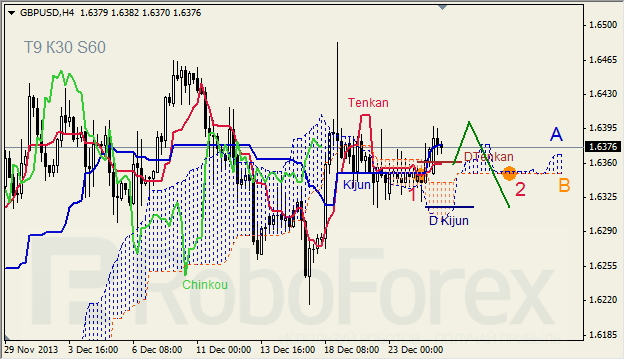
GBPUSD, Time Frame H4. Tenkan-Sen and Kijun-Sen intersected inside Kumo Cloud and formed “Golden Cross” (1); all lines are horizontal. Ichimoku Cloud is going up (2), Chinkou Lagging Span is close to the chart, and price is on Kijun-Sen. Short‑term forecast is bullish.

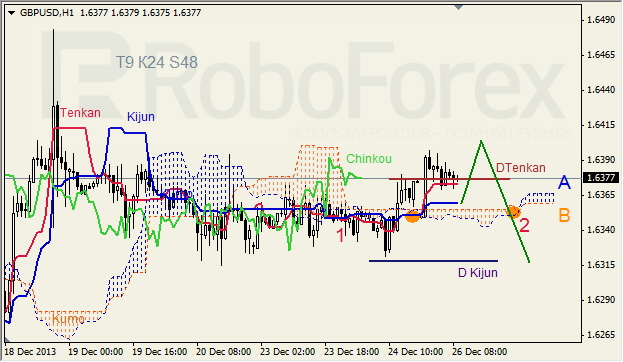
GBPUSD, Time Frame H1. Tenkan-Sen and Kijun-Sen intersected and formed “Golden Cross” (1); all lines are horizontal. Ichimoku Cloud is going up (2). Short‑term forecast: we can expect ascending movement of the price.

GOLD

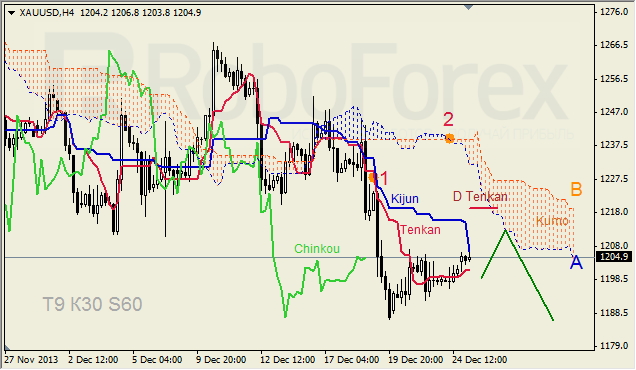
XAUUSD, Time Frame H4. Tenkan-Sen and Kijun-Sen intersected and formed “Dead Cross”. Kijun-Sen and Senkou Span B are directed downwards. Ichimoku Cloud is going down (2), and price is inside Tenkan-Sen – Kijun-Sen channel. Mid‑term forecast is bearish.

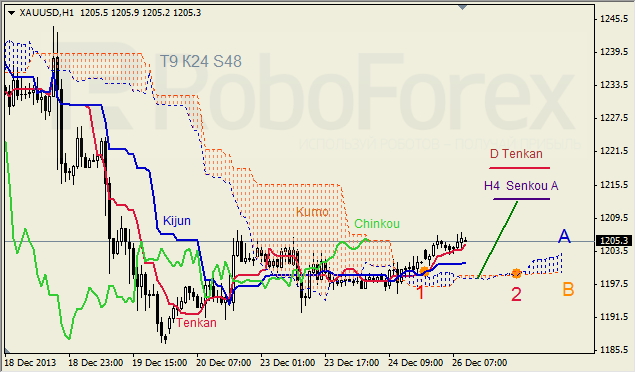
XAUUSD, Time Frame H1 – Indicator signals: Tenkan-Sen and Kijun-Sen intersected and formed “Golden Cross” (1). Ichimoku Cloud is going up (2), Chinkou Lagging Span is above the chart. Short‑term forecast: we can expect ascending movement of the price up to H4 Senkou Span A.

RoboForex Analytical Department

Article By RoboForex.com

Attention!
Forecasts presented in this section only reflect the author’s private opinion and should not be considered as guidance for trading. RoboForex LP bears no responsibility for trading results based on trading recommendations described in these analytical reviews.


Retirement: You Do Have an Alternative

By MoneyMorning.com.au

Preparing for your retirement wasn’t supposed to be difficult. The government had it all sorted for you.

The ATO made sure you saved and invested a certain proportion of your income into Super each year. The Treasurer managed the economy to make sure the stock market always goes up. The Reserve Bank of Australia made sure the cost of living didn’t get out of hand. The FRB and ACCC protected your investments from too much and too little competition. APRA and ASIC made sure you don’t get defrauded. And there’s always the pension.

Unless you’re deeply sceptical of anything the government does, the chances of all those institutions getting it wrong may seem very low. But they have got it wrong. Terribly wrong.

Because Australians overinvested in shares via their Superannuation accounts, a HSBC report reached the conclusion that our retirement savings system was the world’s worst performer during the financial crisis. And our stock market still hasn’t recovered.

True, we haven’t had a recession in more than twenty years. But that also means we have a lot of very fragile and untested parts of the economy. It’s just like the difference between brush fires and bush fires – if you don’t clear the tinder with occasional burn offs, look out! Once we do have a recession, it will be worse. And most Australians won’t be prepared.

But the biggest risk Aussie retirees have discovered is the complete lack of accountability and oversight in the financial sector. In The Money for Life Letter I’ve exposed how up to 20% of Australian mortgages could be induced by fraud, leaving homeowners homeless and in debt.

The country’s mortgage debenture industry is going insolvent one mismanaged company after the other, destroying life savings in rural communities. The alleged misbehaviour of several Commonwealth Bank financial advisors was recently exposed. And Australia’s regulators are a laughing stock to those in the industry.

With friends like these handling your money, who needs enemies?

Back in 2008 I completed an internship at a prestigious investment bank which gave me a scholarship to university. I saw what the financial world is like from the inside while the façade of respectability was ripped off by a financial crisis. And I didn’t like it. But I decided I would learn the trade from the best and then set my own course in the investment world.

That’s when I got a text message from Port Phillip publisher Dan Denning. I’d met him once before. ‘Want to move to Melbourne?’ was all it said.

Today, four years later, I write The Money for Life Letter. It allows me to do what I wanted back when I was at the investment bank: Tell ordinary people that there is an alternative to the retirement system that has failed them.

That alternative starts with a change of mindset. Don’t just fiddle with which shares you own, how you structure your Super, or which financial advisor you see. Those changes won’t rescue your retirement. They’re like changing which political party you vote for. Has voting ever solved any of your personal problems? It’s a distraction. Instead, you need to make much deeper changes yourself.

Opt out of the idea that the stock market and property market always go up. Opt out of the idea that your financial advisor and broker have your interests at heart. Opt out of the ‘she’ll be right’ retirement mentality.

You need something different. And in The Money for Life Letter, you can find it. This year I showed my readers…

  • How to ‘crash-proof’ your retirement. Imagine being able to survive five years like 2008 unscathed. I can show you how, using a new ASX listed investment in a very particular way.
  • How to get three of Australia’s biggest and safest companies to pay for every day of your retirement, including annual payouts of whatever sum you decide to invest in them now.
  • Live the luxurious life of a millionaire without having to spend money like one, by retiring overseas. I shortlisted and analysed five retirement boltholes best suited to Australian retirees looking to escape the world’s highest cost of living.
  • Be healthier, stronger and more active in your golden years, and save a potential $220,000 in medical costs by taking one $149 test from the comfort of your own home. (I revealed my own embarrassing results too.)
  • How to turn one of retirement’s most important expenses into a profit using time travel.

There are a few things those ideas have in common. They won’t make your broker or financial advisor a penny wealthier (which is why you won’t hear about those ideas from them). They don’t rely on financial market prices going up. And they can make a much bigger difference to your retirement than any advice you’ll get elsewhere.

Because of the financial crisis, some retirees are fed up. They’re taking note of ideas like those in The Money for Life Letter. But you might be thinking it’s too late. The crash has happened. There’s no point in making changes now.

But the financial crisis of 2008 was just a wakeup call. Unfortunately, there are plenty of problems on the horizon for Aussie retirees. And the biggest problem is one that is hiding in plain sight. It’s so big that everyone can see it, but nobody knows what to do about it.

It’s no coincidence that all the ideas I just mentioned are specifically designed to deal with the dangerous event set to strike during your retirement. After all, I’m all about finding solutions, not problems. But what is this threat?

Some time ago, I came across this chart:

It shows the projected inflows and outflows of the Superannuation system as a whole, so contributions and payouts. It’s from 2004, so it’s out of date. I spent hours looking for an updated version, but there aren’t any. And researchers have bluntly refused to publish a new one. You’ll see why in a minute.

Here’s the problem that should horrify anyone paying money into Superannuation, the stock market and any other Australian investments: The two lines cross.

That means, at some point, Super contributions will be swamped by those taking money out of the Super system. One of the biggest sources of demand for Australian investments is going to disappear.

It will be replaced by an enormous amount of retirees selling their investments to pay for day to day expenses. The rug will be pulled out from underneath investment prices as supply overwhelms demand. Stock markets, property markets and other investments will plunge as retirees figure out that whoever sells first will get the best price.

Now the government is already working feverously to buy time. They’re going to raise the size of compulsory super contributions. They’re going to change the investment mix Super funds hold. And you’ve probably read about the hullabaloo involving property investing and self managed super funds.

But none of this changes the end result. Because that’s predetermined by demographics. There simply won’t be enough people in the work force to buy all the investments retirees are going to sell to fund their retirement.

The good news is, I mentioned the solutions above. Not all investments rely on prices for their payouts. Some pay income, like dividend paying shares. Retirees will be spending money, so corporate profits should remain high. That means high dividends too.

Other investments have a fixed, predetermined payout which you can pre-book for your retirement years. Regardless of the price of those investments in the meantime, you’ll know exactly when the payout is due and exactly how much you’ll get.

Another option is to adjust your living expenses by getting more bang for your buck. My favourite one involves an ancient form of time travel.

Even if you’re not a Money for Life Letter subscriber, I’m sure you can think of ways to shore up your retirement in the face of demographic change and a complete failure of the your government’s attempt to provide for your retirement. After all, there are alternatives.

If you want to fund out more about the ones I’m recommending click here.

Nick Hubble
Editor, The Money for Life Letter

Join Money Morning on Google+


By MoneyMorning.com.au

Fracking, Uranium and Solar, Oh My!: Growth and Innovation in 2013

Source: The Energy Report (12/26/13)

http://www.theenergyreport.com/pub/na/fracking-uranium-and-solar-oh-my-growth-and-innovation-in-2013

A more profitable outcome often requires a new way of doing things. The Energy Report profiled some of the most innovative stories in the energy space in 2013. Our experts talked about everything from developments in hydraulic fracturing techniques to new ways of finding and processing natural resources. As we look forward to exciting new opportunities in 2014, let’s revisit some stories our experts shared last year.

Oil & Gas: Enhanced Recovery

Nothing catches the market’s attention like cushy profit margins. Technologies that enable oil producers to drill more for less money were a notable theme for the experts featured in The Energy Report in 2013.

As Jim Letourneau commented, “Reducing drilling time by 20–40% is an easy sell, and the enhanced oil recovery business has a huge market in the field.”

In an August 2013 interview titled “Smart Fracking: Jim Letourneau on Enhanced Oil Recovery with Competitive Costs,” the Big Picture Speculator editor said, “There are a lot of technological tricks for increasing well productivity with minimal costs: A producer can re-enter wells or stimulate wells or fracture older wells. It can enhance oil recovery with pulsed injection of water or chemicals by utilizing a tool installed in the wells that injects fluids in pulses—pumping like a heart pumps. Think of putting a kink in a garden hose. Pressure builds up and when the kink is released there is a strong pulse of water. This technology is efficient and companies can make money doing enhanced oil recovery with pulsed injection.

One such company is Wavefront Technology Solutions Inc. (WEE:TSX.V), which provides pulsing tools to operations all over the world. It has a couple new business lines with fantastic growth rates. In well stimulation, a chemical (usually acid) is injected into a formation to clean up the area around the well bore so that more oil and gas can flow. By using pulsing, the acid is placed more uniformly and better flow rates are achieved after the stimulation. This part of Wavefront’s business is growing very quickly and now accounts for roughly half of the company’s revenue.”

C. K. Cooper & Co. Analyst Darren Odenino was more impressed with CO2 Enhanced recovery, a method wherein CO2 is piped to oil fields, where it is injected via injection wells into the oil reservoir. [See infographic below.] The Department of Energy’s Office of Fossil Energy notes that about 114 active commercial CO2 injection projects are underway in the U.S., and together they could produce a collective additional 280,000 barrels of oil per day (280,000 bbl/d).

Among the higher-profile projects is Magellan Petroleum Corp.’s (MPET:NYSE) Poplar Field in Roosevelt County, Montana. In his May 2013 interview titled “How to Spot Oil and Gas Takeout Targets,” Odenino commented, “The exciting catalyst for Magellan is the opportunity to test its CO2-Enhanced Recovery project in the Poplar field’s Charles formation. If that proves successful, Magellan should be headed for a lot of growth.” Magellan has already reached several milestones for this pilot project. With funding secured for a two-year trial run and five wells drilled, Magellan is scheduled to begin CO2 injection this very month.

source: U.S. Department of Energy

Evan Smith, co-portfolio manager of U.S. Global Investors’ Global Resources Fund, sees producers moving toward a manufacturing-like process in the coming year with multi-well pad drilling. In an interview earlier this month titled “Producers that Can Pump at $60/bbl Oil,” he commented, “The rig count has declined by more than 50% over the last two years, and yet we continue to see a steadily increasing supply of natural gas. It’s a testament to the technology that has been developed by the industry to drill faster and more efficiently and to unlock and produce more reserves with less input.”

“I think in 2014, people in the field will have delineated most of their acreage and are going to turn these things into a pure manufacturing process with pad drilling. Continental Resources Inc. (CLR:NYSE) is testing 16 wells per pad in the Williston Basin in North Dakota. The company will repeat that pattern and drive costs down. We’ve seen a big shift to multi-well pad drilling in 2013, but I think it’s going to become much more standardized in 2014. The efficiencies that we’ve seen, which have led to more productivity with fewer rigs, will probably remain and perhaps even accelerate in 2014.”

North American oil and gas industry innovation is a force that is turning the global production profile upside down as companies explore new oil and gas reserves around the world that were thought all but unrecoverable. As Edison Investment Research Analyst Peter Dupont commented in his recent interview, “Has Shale Broken OPEC’s Grip?,” North American companies with shale tech know-how are poised to unlock reserves around the world, especially in South America.

“Some of these companies have first-mover advantage.,” says Dupont. “Madalena Energy Inc. (MVN:TSX.V) [is one of] the most obvious examples. . . Madalena has working interests ranging between 35–90% in three blocks in the Neuquén Basin comprising a sizeable 135,000 net acres. Contingent and prospective recoverable resources are estimated by Madalena at 2.9 Bboe, of which 45% are oil and NGLs. There is a mixture of conventional and unconventional plays. Small quantities of oil are presently obtained from the conventional Sierras Blancas formation in the Coiron Amargo Block, where horizontal drilling technology is being applied. Madalena’s key focus presently is to secure a joint venture partner for the appraisal and development of the Vaca Muerta and Agrio shale formations. Securing a partner or partners would be a critical catalyst for the stock.”

Canaccord Genuity Research Director Christopher Brown saw shale tech sweeping the old world, especially in Ukraine. In his November interview, “Four International O&G Juniors for a Globe-Sweeping Shale Revolution,” Brown commented, “On the Ukrainian side, Cub Energy Inc. (KUB:TSX.V)has done well at introducing new technologies to the country. Cub has received the approvals to bring in this new technology and apply it. It’s going to be a slow process, but as the company continues to unlock value, there’s no denying that its region and fiscal terms are very good and provide a lot of incentive to keep on working hard to grow the production base. Turkey hosts a more difficult unconventional basin. The Anatolia Basin is still in its earlier stages, whereas the Ukrainian assets have some proven opportunities. In the Anatolia Basin, you do have some majors that are tentatively playing around the edges, but there has not yet been anything that’s really unlocked that basin. But it didn’t cost Cub much to enter the basin and the Turkey play provides shareholders with potential future value, which they don’t pay for at Cub’s current share price.

“. . .History has proven Ukraine has access to significant volume. That’s why Cub is in this country: It believes it can unlock more value. . .through its ownership in a separate private holding company (Pelicourt Ltd.), management holds a major position in Cub Energy, and recently it decided to put in additional dollars to show confidence in the future of Cub. As of its last statement in October 2013, it owns 39.54% of the shares outstanding. That’s provided a decent amount of market support.”

As the oil and gas sector continues to transform worldwide, keep tuning in for Streetwise interviewsthat shed light on promising oil and gas explorers that are poised to deliver shareholder value.

Uranium: Fundamental Changes

With the Megatons to Megawatts program officially coming to a close, investors are shifting focus to North American uranium producers that can help meet U.S. needs. John Kaiser‘s October interview, “10 Strategies for Success in a Flat Commodity Price Market,” was filled with fresh approaches to mining. In light of the small number of domestic uranium producers and the high capital costs of resource delineation and mine development, an innovative new sampling method caught Kaiser’s attention.

He comments,”A junior explorer, Uravan Minerals Inc. (UVN:TSX.V), has developed an interesting geochemical sampling method it is using on projects in the Athabasca Basin. . .Uravan has spent the last five to six years developing its geochemical sampling method in collaboration with Queens University’s Kurt Keyser, which looks for the lead isotope decay products of a uranium deposit. These get absorbed by vegetation and clay particles. The company takes tree core samples at surface to find evidence of a resource that may be 1,000–1,500m deep. You still can’t tell the size of it or the grade, but at least you know you’re going to hit something once you drill down there.

“This approach opens up a much deeper portion of the basin that has been largely out of bounds because of the difficulty in finding these deposits, which almost always are right at the unconformity between the basement rocks and the overlying sandstone rocks in association with graphite. The conventional targeting tool is a geophysical survey that looks for conductors representing these graphite beds. But deeper than 450m, these conductors become fuzzy just as drill holes that need to pinpoint the target become expensive. This is problematic because most of the graphite beds at the Athabasca Basin unconformity do not host a uranium deposit. Uravan’s radiogenic isotope based sampling tool allows the junior to see evidence of a uranium deposit at substantial depth from the surface. A case study done this summer apparently demonstrated that Cameco’s 850m deep Centennial deposit shows up as a well-constrained geochemical anomaly. Theory says that in the Athabasca Basin, the thicker the sandstone cover, the bigger and richer the potential uranium deposit at the unconformity. Uravan now has a tool that enables it to stalk super-elephants in uncharted territory.”

Kaiser continued, “Uravan can also perform this research as a service to companies that have claims in the Athabasca Basin and then earn a royalty or a small interest in exchange for generating the geochemical part of the target that you need to justify raising money for a high-stakes drill program.” Earlier this month, Uruvan completed another surface geochemical study on the Centennial depositbased on the earlier survey.

The Abasca Basin is in the spotlight more than ever this year, as superstar company Fission Uranium Corp. reported countless startling results. As Kaiser noted, “A big discovery event in the past year is the Patterson Lake South discovery in the Athabasca Basin by Fission Uranium Corp. (FCU:TSX.V) and Alpha Minerals Inc. This is a classic high-grade unconformity type of uranium deposit with grades of up to 20% uranium. The size of this discovery is stimulating interest in the potential for a new Athabasca Basin area play.”

Of course, other domestic near-term uranium producers are raising eyebrows among energy analysts, especially those who expect a uranium price comeback in the coming year. Cantor Fitzgerald Canada Metals and Mining Analyst Robert Chang highlighted Energy Fuels Inc. (EFR:TSX; EFRFF:OTCQX; UUUU:NYSE.MKT) in his September interview, “Uranium Price Headed for $50 in 2014, Taking Stocks Higher.” Chang commented, “We cover Energy Fuels, which is the second largest producer of uranium in the U.S. and probably has the best story leveraged to the uranium price. It currently produces only about 1 Mlb/year, by design, with several mines that can be turned on relatively quickly. We estimate that it could quickly turn on anywhere between 2–5 Mlb more in annual production once prices get to attractive levels. On top of that, it also has the White Mesa mill that it acquired from Denison, located in Blanding, Utah, which is the only conventional mill in the U.S. Having mill access is extremely important because you effectively cannot produce your final product without it. Energy Fuels has a monopoly position with a conventional mill and it can even make money by processing material on a toll basis for other producers. We believe that this is a very attractive company for those who believe that the uranium price will head higher.”

Meanwhile, the way that we consume nuclear power could completely change over the coming decades. In his recent interview, “Why Uranium and Coal Rank high for Energy Return on Energy Invested,”Thomas Drolet commented on a coming shift to smaller units: “Standard nuclear reactors being built today are gigantic units. Over the next decade we’re going to see a shift to smaller units—small modular reactors (SMR)—for good and valid reasons of schedule and because the utilities want them. Babcock & Wilcox Co. (BWC:NYSE) and NuScale Power LLC in the United States are being funded or potentially funded by the U.S.DOE to bring on these smaller reactors.”

What’s particularly exciting about stories like these is that they are larger than a single company. They have the potential to galvanize an entire sector and make a particular energy source more viable, period. Keep tuning in next year for more investment advice about uranium producers.

Alternative Investments

Alternative energy as a sector is built on technological innovation, but in order for the market to take notice, these innovative feats need to create a compelling bottom line. Rodney Stevens took notice of an innovative solar energy business model in his July interview, “A Short-Seller’s Investment Guide to Obama’s Climate Change Initiatives.

Stevens commented, “We like SunPower Corp. (SPWR-A:NASDAQ; SPWR-B:NASDAQ) because not only does it manufacture the solar panels, but it also has a leasing program for the retail space, similar to SolarCity. SunPower has one of the best products available on the market and it should benefit from the incentives utility companies have to add renewable sources of energy to their business. SunPower could play a big role in the utility space, but also grab the retail markets. It should benefit from the growth in solar and also it has an international base, although its operations are primarily in the U.S. . .I think decent quarterly results drove the stock. Its revenues beat expectations and its losses have narrowed. Going forward, SunPower is staged for further growth and profitability. I think that’s been the main catalyst driving the share price. We expect that revenue growth to continue. ”

House Mountain Partners founder

Chris Berry made a strong point in his June interview, “Transformative Energy Technologies.” As Berry notes,With population increasing globally, becoming more interconnected, and set to live a more commodity-intensive lifestyle, sustainability and efficiency in our progress as a society will be of paramount importance. I just do not believe that you can have as much intellectual capital and financial capital all working toward next-generation technologies and not have breakthroughs that provide compelling investment opportunities and also leave our children a lasting legacy.”

From production technical advances to futuristic visions of mega-efficient energy delivery systems, the energy investment space is vast, varied and tremendously exciting. And if you’ve ever watched a company start small and grow into a major market force, you understand the power of ideas. We hope you’ll keep checking in with us for energy investment discussions from esteemed experts in the field, and let us know what you’d like to see more of from The Energy Report. Happy holidays, and many happy returns!

Want to read more Energy Report interviews like this? Sign up for our free e-newsletter, and you’ll learn when new articles have been published. To see a list of recent interviews with industry analysts and commentators, visit our Interviews page.

From time to time, Streetwise Reports LLC and its directors, officers, employees or members of their families, as well as persons interviewed for articles on the site, may have a long or short position in securities mentioned and may make purchases and/or sales of those securities in the open market or otherwise. Each reader is encouraged to consult with his or her individual financial professional and any action a reader takes as a result of information presented here is his or her own responsibility. By opening this page, each reader accepts and agrees to Streetwise Reports’ terms of use and full legaldisclaimer.

Streetwise – The Energy Report is Copyright © 2013 by Streetwise Reports LLC. All rights are reserved. Streetwise Reports LLC hereby grants an unrestricted license to use or disseminate this copyrighted material (i) only in whole (and always including this disclaimer), but (ii) never in part.

Streetwise Reports LLC does not guarantee the accuracy or thoroughness of the information reported.

Streetwise Reports LLC receives a fee from companies that are listed on the home page in the In This Issue section. Their sponsor pages may be considered advertising for the purposes of 18 U.S.C. 1734.

Participating companies provide the logos used in The Energy Report. These logos are trademarks and are the property of the individual companies.

101 Second St., Suite 110

Petaluma, CA 94952

Tel.: (707) 981-8204

Fax: (707) 981-8998

Email: [email protected]