Two Gold Stocks You’ll Wish You Owned in 2013… and Should Still Buy Now

By Laurynas Vegys, Research Analyst, Casey Research

Looking back on 2013, we have to conclude that it was one of the worst years for precious metals stocks in recent memory—despite all the reasons why it should have been a great one.

Here’s a sober look at the performance of the most widely followed indices in the precious metals (PM) sector.

It’s obvious that 2013 was an extremely painful year for precious metals investors.

Why? Here’s a shortlist of some of the most notable reasons.

  • We didn’t see significant levels of price inflation in the US—the very thing that gold is a good hedge for—so there was no major flow into precious metals in America.
  • Precious metals ETFs, like GLD, flooded the market with a massive amount of gold liquidations.
  • The European sovereign debt crisis eased up (unless, of course, you live in the PIIGS countries, Cyprus, or pretty much anywhere else in the Eurozone).
  • Rumors of the Fed tapering QE continued throughout the year, depressing the gold market and causing extreme volatility. (Oddly enough, the actual taper in December did much less harm than the rumors that preceded it, suggesting it was already priced in when it arrived.)

You can probably think of other reasons, but these no doubt contributed to the industry’s precipitous decline.

In such a depressed environment, it’s not surprising that almost all gold stocks were down, though our International Speculator portfolio outperformed the market indices. And in fact, two of our portfolio companies—both 2013 recommendations—saw their share prices rise substantially.

Here’s how these two stocks performed last year relative to gold and the indices:

The good news is both of these stocks are still “Buys” today, and we’re convinced there’s much more joy to come…

2014 Winner #1: Profit at Just About Any Price

Never mind simply beating the indices; this company gained a whopping 47.9% last year, due to its unique business model of processing third-party gold ore at its plant in South America.

We’d previously been skeptical of this model because ore suppliers are typically small scale and operate with no mine plan. This often causes irregularities in the quantity and quality of the ore received by the mill, which can lead to output and earnings seesawing wildly.

A very compelling angle to this story emerged, however, when the jurisdiction where the company operates decided to crack down on illegal and environmentally unsound ore-processing practices. This instantly created a bottleneck, allowing the company to pick and choose its potential suppliers and accept only the highest-grade deals.

Our 2014 Winner #1 has been steadily increasing output while keeping tight control over its ore grade and gross margin. One of the most attractive characteristics of its model: The company has been able to lock in a margin that remains stable even when the gold price fluctuates.

On the exploration side, our pick recently delivered high-grade drill results at its South American gold project, including some bonanza-grade hits. A large, high-grade discovery here could easily drive this stock to become a 10-bagger (i.e., produce gains of 1,000% or more).

However, successful exploration is not required for the shares to continue rising in the coming years, as the company will continue to profit from its gold processing operation.

This gold processor is still one of our favorite International Speculator picks. It will continue to earn record profits this year, even if the gold price goes nowhere—in other words, this stock still has plenty of upside with almost no downside risk.

2014 Winner #2: High-Grade Metal with Proven People

Our second favorite pick in 2013 was a new high-grade copper-gold producer in Colombia.

We had been following the story for a while, primarily because we know and trust management (and if you’ve read Doug Casey for any length of time, you know that “People” is the first and foremost of his Eight Ps of Resource Stock Evaluation).

We didn’t recommend the stock the first time we were on site, as metals prices were falling and the company had a big property payment coming due. Flash forward to today: The company raised the money it needed, the resources in the ground have been expanding and at excellent grade, mine upgrades are under way, and the keys to the plant have just been handed over.

The dual copper-gold production is a real boon in our current, low-price environment: Even if gold were to stay down for the rest of the year, the cash flow from the copper (a base metal and, therefore, subject to different economic factors than the precious metals) should keep the company’s profits humming along.

We have yet to see financial results from the operation, but we have a great deal of confidence in this mine-building team, one that has delivered for us repeatedly in the past.

Cash flow, and soon thereafter net profits, are an imminent push in this story—though the real jackpot potential comes from the large land package surrounding the company’s mine, which holds multiple outcrops of high-grade mineralization that have never been drilled.

Currently, the company is busy expanding its mine, so that exploration work probably won’t happen until later this year. But we do think there’s a good possibility of some very big news in the second half of 2014—so you’ll want to position yourself now, while prices remain relatively low.

Why You Should Own These Stocks This Year

Both of the companies—and their share prices—are poised to benefit greatly from increased cash flow, a ramp-up in production, and high-grade drill results.

In addition, 2014 Winner #1, with its ingenious long-term growth model and its ability to profit at just about any gold price, offers minimal downside risk. This company found a creative and profitable way to not only survive last year’s downturn but to thrive in the midst of it—and with an effective model in place, it will continue to prosper this year. The tide doesn’t need to turn in the precious metals sector for this stock to continue to do well.

Out of fairness to paying subscribers, we can’t give you the names of these two companies. But you can find out all about them—plus how to invest and what to expect this year—without any risk to you whatsoever.

Here’s what I suggest: Take us up on our 100% satisfaction guarantee and try Casey International Speculator for 3 months. If it’s not everything you expected and more, simply cancel for a prompt, courteous refund of every penny you paid.

Even if you decide to cancel ANY TIME after the 3 months are up, you’ll still get a prorated refund on the remainder of your subscription. That’s our iron-clad guarantee, so what do you have to lose? Just click here to get started.


See Original Article: Two Gold Stocks You’ll Wish You Owned in 2013… and Should Still Buy Now


Energy Outlook: What’s Hot in 2014

By Marin Katusa, Chief Energy Investment Strategist, Casey Research

Investors who want to know how the energy sector will be doing in the coming year are, in my opinion, asking the wrong question. There really is no such thing as “the energy sector,” because the performance of the different resources—from oil and gas, to uranium, to coal, to renewables—can vary dramatically.

Case in point: while unconventional oil exploration and production have seen a huge upswing in recent years, thanks to the vast success of the Bakken and other oil-rich shale formations, at the same time natural gas has taken a nosedive, due to a supply glut that still hasn’t found its balancing point.

To find out which investments will deliver the greatest profits for well-positioned investors in 2014, my team and I have identified three trends that are hot… and may become even hotter in the course of this year.

HOT: Service Companies in North America

The oil and gas production in the United States is mature. Rather than looking for new basins, companies are looking to “rediscover” the past by applying new technology to increase economic production from known oil and gas fields.

This new technology comes in a variety of shapes and sizes: better software, bigger rigs, more efficient drilling processes. And it’s being applied everywhere, onshore and offshore, conventional and unconventional alike.

Just as an example, today we’re seeing operators drill more than 50 horizontal wells from a single well pad, a far cry from just a decade ago.

Exploration and production companies know that the focus moving forward is not just the amount of oil they can pump out of the ground, but the profit they can extract from every barrel (what we call the “netback”). This is even more true in the mature unconventional basins such as the Bakken, Eagle Ford, and the Marcellus shale plays, where the margins are tight and require an oil price of more than US$70 per barrel in order to be economic.

This means E&P companies have to use the best ways to increase production from every well—while at the same time reducing their drilling costs. Failure to do so would be to guarantee a firm’s demise.

The dilemma for E&P companies is having to prioritize what their shareholders want in the short term—growing production and dividends—over whatever may be best for the company in the long term. At the same time, they have to fight the natural decline of oil coming out of their wells.

All the while, service companies continue to extract fees for their tools and services. Drillers, pumpers, frackers, and other oilfield-service guys make money regardless of whether E&P companies find oil or produce it at economic rates.

We’ve said it before: Many E&P companies are running on a treadmill, and the incline is going higher and higher, which means higher costs to produce the same amount of oil.

Of course, not all service companies will rake in the dough. The ones that will do the best are the ones that can consistently stay at the forefront of technology and keep signing contracts with the supermajors like Exxon, Chevron, and Shell.

HOT: European Energy Renaissance

Russia’s grip on European energy continues to tighten, and there’s a push to produce oil and gas within their own borders all around Europe.

2014 looks to be an exciting year for companies like one of our Casey Energy Report stocks, a TSX-V-listed oil and gas explorer and producer with a 2-million-acre concession in Germany. We call the deposit it’s sitting on the “Next Bakken” because we believe that its potential to deliver exceptional output could rival that of the famed North American formation.

This development is still in its early stages, but investors who position themselves now could see outsized gains for years to come. It’s not really a question of “if” the oil is there—previous oil production in the very same location yielded more than 90 million barrels—but of “how much” oil can be extracted with the modern methods not available the last time companies worked on this field.

The company has completed its first well and will continue to drill additional wells (both vertical and horizontal) next year. While the initial well cost more than anticipated, it’s a good start that indicates economic oil can be produced in Germany. We’re also confident this company’s experienced management team is applying the lessons of its first foray to reduce drill costs on future wells.

As our Energy Report pick proves up any of its projects in 2014 and early 2015, we can expect another of our holdings, which has just entered the German oil and gas scene, to either farm into the company or even buy it out.

We predict that by the end of 2015, our “Next Bakken” play, and others like it, will have attracted a lot of attention, not just from individual speculators, but from institutional investors as well—and investors who have gotten in early will be very happy indeed.

Another of our portfolio holdings is just beginning to drill on its Romania projects after a series of delays due to politics and bureaucracy. We have reason to be optimistic because its JV partner, a Gazprom subsidiary, has drilled successful wells on the same basin on the other side of the border in Serbia. If our pick has anything close to that level of success, the markets will surely take notice and its shares will go much higher.

As the “Putinization” of the global energy markets continues and Russia’s dominance grows, European countries become increasingly more desperate to escape from under Putin’s heavy thumb and to start developing their own energy resources.

The European Energy Renaissance is real, and we continue to monitor companies that are funded and have the permits and ability to drill game-changer wells in Europe in 2014.

HOT: Uranium

During a recent trip to London, I spoke with Lady Barbara Judge, chairman emeritus of the UK Atomic Agency and an advisor to TEPCO on the Fukushima nuclear disaster in Japan. I asked her point-blank whether Japan was willing to bring any nuclear reactors back online in 2014.

Her answer was an unequivocal “Yes.” The Japanese have no choice, really, because the alternative—importing liquefied natural gas (LNG)—is far too expensive.

Japan is the world’s largest importer of LNG and has had to double its imports since the Fukushima incident. For that privilege, the country pays some of the highest rates on the planet—almost four times more than what we pay for natural gas in North America.

South Korea also shut down its nuclear plants post-Fukushima to do inspections and maintenance upgrades, and it, too, has had to import a lot of LNG. Both countries are looking to restart their nuclear reactors so they can stop paying a fortune to foreign energy suppliers. When these countries restart their reactors, they’ll also restart the uranium market, so we expect uranium prices to begin to shake loose of the doldrums this year.

Another driver will be throwing the switch at ConverDyn, the US uranium facility that is slated to start converting natural U3O8 to reactor-ready fuel in late 2014 or early 2015.

We currently hold two solid uranium companies in the portfolio—one is a US-based small-cap producer (one of the very few in America), the other is the lowest-risk way to play the uranium market that I know of. Both, we believe, will take off in 2014 on the renewed interest in uranium and the associated stocks.

If you want to know more about our thoroughly vetted energy stocks and their potential for amazing gains in 2014 and beyond, give the Casey Energy Report a try. You’ll find all my “What’s Hot” predictions and the full names of the stocks I’ve mentioned above in our January forecast issue… plus the energy sectors you should avoid like the plague this year… as well as a feature article on elephant oil deposits in the Gulf of Mexico and a new stock pick ready to profit from them.

Giving the Casey Energy Report a try is risk-free because it comes with a 3-month, full money-back guarantee. If the Energy Report is not all you expected it to be, just cancel within those 3 months and get a prompt, full refund. Or cancel any time AFTER the 3 months are up for a prorated refund. Getting started is easy—just click here.


Elliott Wave Analysis: EURUSD And GBPUSD

EURUSD:  Flat In Wave 2

EURUSD reversed sharply to the upside in this week from 1.3505 level where we see a completed three wave decline in wave B. As such, current rally represents an impulse wave C that is most likely part of an expanded flat in wave 2). If our count is correct then we still need too see a little bit higher levels to complete a minor five wave rally. Ideally pair will make a top around 1.3740.

EURUSD 4h Elliott Wave Analysis

GBPUSD: Uptrend Continuation

GBPUSD is accelerating to the upside now already well above 1.6600 high from the end of December so market is back in bullish mode. We are tracking an updated count now with bullish impulse underway up to 1.6700. At the moment we see prices rally in wave (iii) so be aware of more upside after wave (iv) retracement that may show up in the next few sessions.

GBPUSD 4h Elliott Wave Analysis

Written by www.ew-forecast.com

14 days trial just for €1 >> Register Now


Why We’re Headed for a Period of Stagflation and What It Means for Investors

by Michael Lombardi, MBA

The Bureau of Labor Statistics just reported that inflation in the U.S. economy increased by 0.3% in the month of December and that the Consumer Price Index (CPI) for the entire year of 2013 increased by only 1.5%. (Source: Bureau of Labor Statistics, January 16, 2014.)

Is inflation in the U.S. economy really this low?

It sure doesn’t feel like it. Every time I buy groceries, go out for dinner, get my car fixed, pay utilities bills, or fill up my car’s gas tank, it feels like I am paying a lot more than I did last year or the year before.

Dear reader, inflation is higher than what the CPI figures say because of the way the CPI is calculated; food and energy prices are taken out because they tend to be more “volatile,” according to the government. That means key items consumers buy on a regular basis—food and gas—are excluded from the official inflation numbers!

While the mainstream fears deflation in the U.S. economy, I’m concerned about an unexpected bout of higher inflation hitting us. Why would I think this?

I can sum-up my argument for inflation ahead with just this one chart:

The chart above shows the currency (coins and paper notes) in circulation and deposits of banks at the Federal Reserve.

As you can see, since the financial crisis, the Federal Reserve has injected trillions of dollars into the U.S. economy. This is dangerous, in my opinion, for the simple reason that the more there is of any item in supply, the less the demand, and the lower the price. In this particular case, the more U.S. dollars in circulation, the less they are worth, and the more of them it will take to buy something. This is what creates inflation.

What I say now certainly doesn’t resonate with what you see on the TV, hear from stock advisors, or read on the popular financial websites. With unemployment roaming high, a period of stagflation—that’s when economic growth is anemic and unemployment and inflation are high—could be in the cards for the U.S. economy.

Stagflation is bad for investors because rising prices hurt corporate growth and profits. Companies can’t pass rising costs on to consumers during times of stagflation because economic growth is slow. Thus, during periods of stagflation, stock prices fall. Maybe that’s just where we are headed in 2014.

This article Why We’re Headed for a Period of Stagflation and What It Means for Investors was originally published at Profit confidential.


Greenback Rises on Fed-Tapering Speculation, Aussie Drops

By HY Markets Forex Blog

The greenback advanced against most of its peers as investors continue to speculate that the US Federal Reserve (Fed) will reduce its bond purchases further at its next meeting scheduled for January 28-19, after data released showed signs that the world’s biggest economy is growing at a slow pace.

Meanwhile the Japanese yen is rising towards its biggest weekly advance in five-months, while the demand for Japanese assets were driven by the increased scrutiny of credit risks in China’s coal-mining industry.

The Australian dollar dropped to its lowest level against the greenback since July 2010. Following the comments from Heather Ridout, Reserve Bank of Australia (RBA) board member.

A report released yesterday revealed the figures for people in the US receiving unemployment benefits increased higher than expected.

The US dollar rose 0.1% higher to $1.3682 per euro; it also gained 0.1% to 103.37 yen. The Japanese yen remained unchanged at 141.44 against the 18-bloc currency.

The Australian dollar slid 0.7% lower to $87.07 after reaching 86.89, the lowest in three and a half years.

Fed- Taper Speculations

Market analysts are predicting members of the Federal Open Market Committee will reduce its monthly bond purchases by $10 billion at every meeting to end the stimulus program by December year. The Federal Open Market Committee (FOMC) next policy meeting scheduled for January 28-29.

The figures for people in the US receiving unemployment benefits unexpectedly increased to 3.06 million in the period ended January 11, the most since July, reports from the Department of Labour confirmed yesterday. Analysts forecasted a decline of 2.9 million after the Labour Department data revealed the economy added 74,000 jobs in December.

Yen

This year, the Japanese currency was the best performer; climbing 1.9% higher against the US dollar. Following the 18% drop in 2013, the worst among a basket of 10 of its major peers.

“We have come quite a ways higher in dollar-yen,” Citigroup’s Elmer said. “It doesn’t seem exaggerated to me that we would see a flush-out of positions close to a big figure, but I don’t think that shifts the trend,” he added.

AUD & RBA Comments

The Australian currency dropped to a three-and-a-half-year low on Friday, after an external board member commented on the currency.

External board member of the Reserve Bank of Australia, Heather Ridout said she sees the Australian dollar dropping lower to help re-balance the Australian economy from slowdown. The Aussie was dragged lower by the comments made and the downbeat Chinese manufacturing data.

The Australian dollar slid 0.7% lower to $87.07 after reaching 86.89, the lowest in three and a half years.


Visit www.hymarkets.com   to find out more about our products and start trading today with only $50 using the latest trading technology today.

The post Greenback Rises on Fed-Tapering Speculation, Aussie Drops appeared first on | HY Markets Official blog.

Article provided by HY Markets Forex Blog

Gold Slides From Six-Week High

By HY Markets Forex Blog

Gold Futures dropped from a six-week high on Friday on speculation higher prices could reduce physical demand and the Federal Reserve could reduce its monthly bond purchases further at the next meeting.

Gold for immediate delivery dropped 0.32% to $1,258.10 an ounce on the New York’s Comex at the time of writing, falling from recent highs of $1,267 an ounce seen on Thursday, the highest since December 10. While silver futures edged up 0.15% to $19.98 an ounce.

Gold- FOMC

With the anticipating FOMC meeting approaching, the previous metal has been under pressure as the meeting may reducing the monthly asset purchases by an additional $10-billion trim.

Members of the Federal Open Market Committee (FOMC) are expected to meet for the next policy meeting scheduled for January 28-29.  In the last fed-meeting, the central bank decided to reduce its monthly bond purchases by $10 billion to $75 billion a month.

Market analysts are predicting members of the Federal Open Market Committee to reduce its monthly bond purchases by $10 billion at every meeting to end the stimulus program by December year.

Gold – China

Meanwhile in China, premiums on the Shanghai Gold Exchange slid $9 an ounce from Thursday’s $12, reports confirmed. Market analysts predict that China probably overtook India as the world’s biggest gold consumer last year.

China will be celebrating the Lunar New Year Holiday at the end of the month.

Indian Finance Minister Palaniappan Chidambaram said that gold imports will be curbed into the next financial year from April 1.


Win a luxurious trip to the Maldives & up to $30,000 cash for trading with us!

Visit for details http://ift.tt/L42Q3q

The post Gold Slides From Six-Week High appeared first on | HY Markets Official blog.

Article provided by HY Markets Forex Blog

Fibonacci Retracements Analysis 24.01.2014 (EUR/USD, USD/CHF)

Article By RoboForex.com

Analysis for January 24th, 2014

EUR/USD

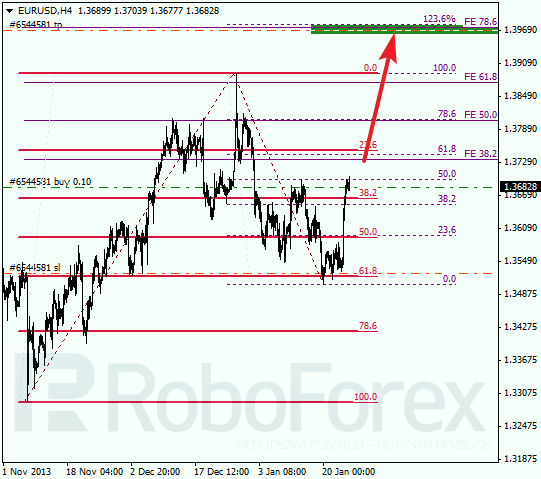
Euro rebounded from correctional level of 61.8% and started moving upwards, that’s why during the next several weeks it better to buy than to sell. Most likely, in the nearest future price will break maximum. Main target is close to several upper fibo-levels, near 1.3970.

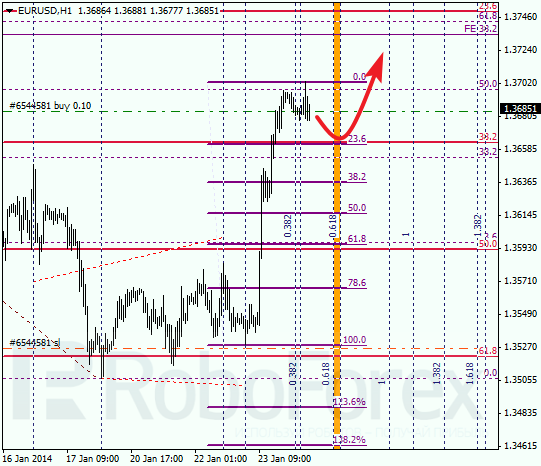
At H1 chart we can see, market is being corrected, but this correction is unlikely to be very deep. Most likely, during the day price will reach level of 23.6%. If pair rebounds from it, I’ll open one more buy order.

USD/CHF

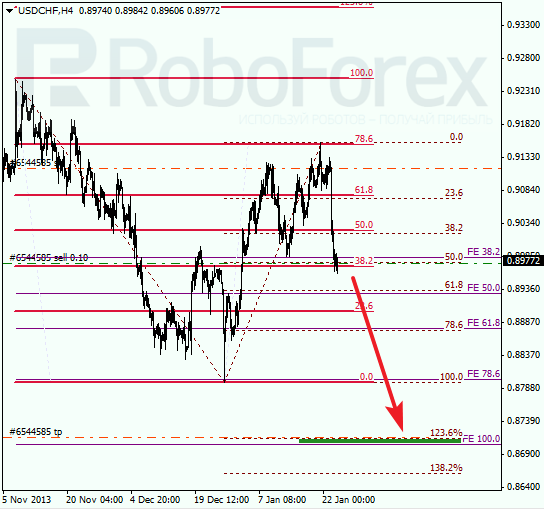
Franc rebounded from level of 78.6%. Now bears are in charge and may break minimum quite soon. Target is in area formed by levels of 123.6% and 100%, close to 0.8710.

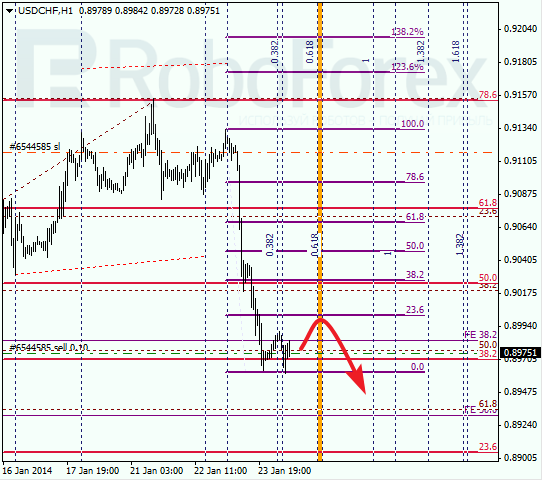
As we can see at H1 chart, market is being corrected. According to analysis of temporary fibo-zones, local level of 23.6% may be reached quite soon. If price rebounds from this level, bears will continue pushing pair downwards.

RoboForex Analytical Department

Article By RoboForex.com

Attention!
Forecasts presented in this section only reflect the author’s private opinion and should not be considered as guidance for trading. RoboForex LP bears no responsibility for trading results based on trading recommendations described in these analytical reviews.


Japanese Candlesticks Analysis 24.01.2014 (EUR/USD, USD/JPY)

Article By RoboForex.com

Analysis for January 24th, 2014

EUR/USD

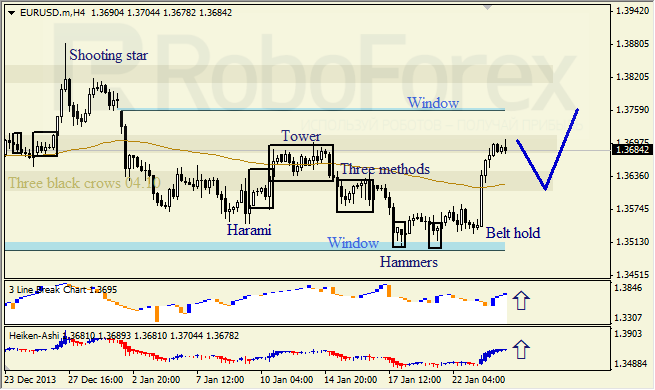
H4 chart of EUR/USD shows support from lower Window. Hammers and Belt Hold patterns, along with Three Line Break chart and Heiken Ashi candlesticks, confirm ascending movement.

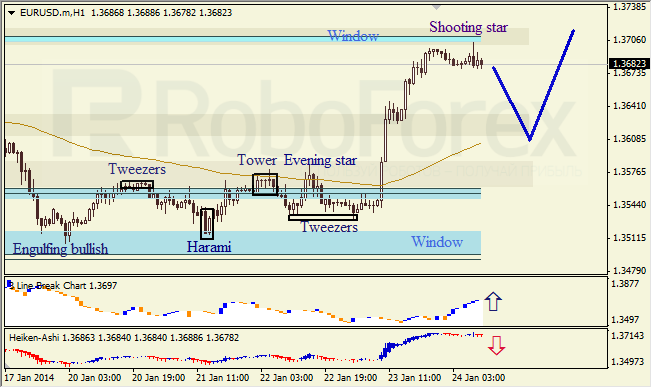
H1 chart of EUR/USD shows resistance from upper Windows. Three Line Break chart confirms ascending movement; Shooting Star pattern and Heiken Ashi candlesticks indicate possibility of new correction.

USD/JPY

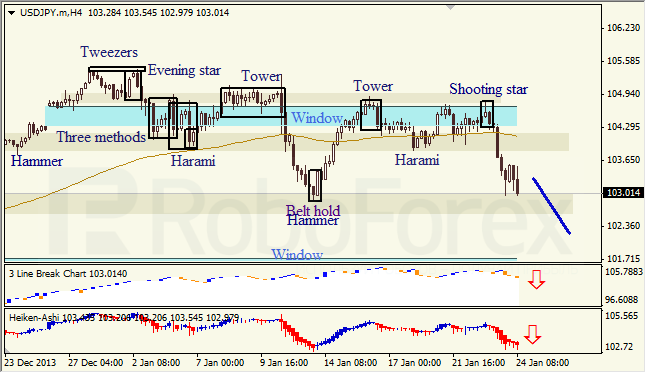
H4 chart of USD/JPY shows descending movement, which is indicated by Shooting Star pattern. Three Line Break chart and Heiken Ashi candlesticks confirm bearish mood.

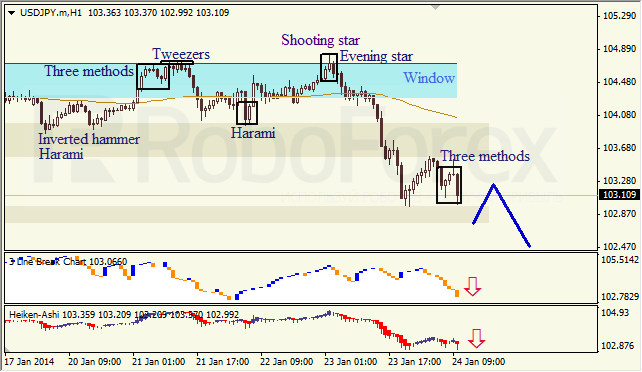
H1 chart of USD/JPY shows resistance from closest Window. Three Methods pattern, Three Line Break chart, and Heiken Ashi candlesticks confirm descending movement.

RoboForex Analytical Department

Article By RoboForex.com

Attention!
Forecasts presented in this section only reflect the author’s private opinion and should not be considered as guidance for trading. RoboForex LP bears no responsibility for trading results based on trading recommendations described in these analytical reviews.


The Last Word: Place Your Biotech Bets on Solid Management and Hot Therapy Areas

Source: Tracy Salcedo-Chourré of The Life Sciences Report (1/23/14)

http://www.thelifesciencesreport.com/pub/na/the-last-word-place-your-biotech-bets-on-solid-management-and-hot-therapy-areas

Who got the last word at the 2014 Biotech Showcase? A portfolio manager specializing in healthcare, an award-winning analyst, and a pair of venture capitalists with global viewpoints and a focus on clinical-stage companies. In the closing event of the showcase, cohosted by The Life Sciences Report, this panel of experts offered insights into trends that will influence the biotech universe in 2014.

San Francisco was the center of the life sciences universe last week, hosting three industry conferences under shockingly blue skies. In addition to the JPMorgan Healthcare Conference, Biotech Showcase 2014, with its focus on small- and mid-cap public and private biotech firms, drew thousands of participants.

The Life Sciences Report launched its 2014 Biotech Watchlist at the showcase, and cohosted the closing reception, “The Last Word,” a panel discussion on the state of the industry from the perspective of earlier-stage biotech and medtech companies. Moderated by Kimberly Ha, BioPharm Insight’s global editor, panelists included Steve Brozak, president of WBB Securities LLC, a boutique investment bank and research firm, Fabrice Egros, managing partner with RMI Partners (cohost of the panel), a global life sciences venture capital investment firm, Dhesh S.K. Govender, portfolio manager for healthcare with Cedar Lane Enterprises and Anthony Sun, a partner with Aisling Capital, a private equity fund.

The first words of the Last Word panel addressed the wealth of potential in smaller, nimbler biotech companies, and how a burgeoning number of acquisitions and partnerships in 2013 reflected the interest of big pharma in ideas generated by these smaller enterprises. As Brozak pointed out, the “scarcity of new products and new technology” within the pipelines of larger pharmas had brought “people from JPMorgan shopping for ideas” at the Biotech Showcase.

Nurturing the Small-Cap Biotech Boom

The biotech boom has been good to small-cap firms with innovative technologies and the ability to move their products to market. As these companies progress through clinical trials and clear regulatory hurdles, their stock prices typically increase. Stock prices also jump when bigger pharmas and biotechs become interested: With partnerships and pending acquisitions come increases in valuation.

Govender expects the partnership and acquisition theme to continue into 2014. In fact, within the next few weeks, he said the market could expect to see “18–22 deals.” Will the doubling and tripling of valuations continue as those deals are made? “The next couple of weeks will tell,” Govender said, adding that companies run by management teams with experience as dealmakers, good fundamentals and a product that addresses a good market, will be premium targets. Big pharma, he predicts, will set records for amounts paid for early-stage assets in oncology, especially checkpoint inhibition.

But the panelists agreed that, barring partnership or acquisition, financing early-stage biotechs would not get easier any time soon. Sun cited a lack of appetite on the part of venture capitalists and the public market for companies with products in early days. In addition, it’s difficult to “nail down a valuation” for early-stage companies, Govender said.

Management, Management, Management

The panelists were universal in their belief that biotechs with good management are an investor’s best bet. Investors who get to know a company’s management team will be able to find a deal they can get behind, Brozak said.

Those management teams also need to hone their pitches when looking for financing. In terms of the “X-factor” that the panelists look for when considering a company, Sun wants to see “a clear plan, with a clear number of milestones or an exit.” For Brozak, management has to be able to deal with regulatory setbacks, personnel problems and the like. Govender likes to see a “clear understanding of the marketplace across the globe,” an idea that Egros echoed, citing his desire that management have a “worldwide vision” for an idea.

The panelists also agreed that they liked to see companies led by teams that have track records of successful exits. While sometimes “first-timers have done other things that bring new perspective” to a biotech, there is great comfort for investors in knowing they are “dealing with someone who has succeeded before,” Brozak said.

Tapping into Therapy Areas

While individual small companies with no proof of profitability may not interest venture capitalists (VCs) at present, Brozak said that therapy areas might garner “more of a sizzle,” with VCs picking a basket of preclinical or phase 1 companies.

2013 was a “record-setting” year for drug development in oncology, Egros observed, and he expects that trend to continue into 2014. Following on this idea, Sun mentioned targeted oncology as a field with great potential.

Brozak was enthusiastic about the prospects of companies working in the antibiotic space. With bugs becoming resistant to the “simple antibiotics” currently available, companies looking for new solutions using new technologies offer great promise.

The prospects for personalized medicine, especially given advances in gene sequencing—and in particular the promise that costs associated with sequencing will decrease as numbers reach “critical mass”—were intriguing to Govender.

Ha piggybacked on the mention of gene sequencing, asking how the “$1,000 genome” will affect drug development.

If small companies are able to pass that price on to a partner, Brozak said, they’d have the “best of both worlds,” both reducing development costs and gaining access to a “quicker model of discovery.” An inexpensive genome would impact trial design as well, Sun added.

“It levels the playing field,” Govender said.

Enter Emerging Markets

Emerging global markets present a challenge for biotech investors, in part because the matrices used to calculate valuations for companies vary from country to country. Sun delineated two issues investors would want to investigate prior to investment: Generally accepted accounting practices (GAAP) would need to be addressed, and the device or drug would have to be differentiated from devices/drugs on the domestic front.

In addition, Brozak noted that in some cases, cultural uses for therapies are very different, which affects valuation. He cited Japan as an example, where the use and design of antivirals are different from what is found in the United States.

Still, international markets, particularly those in Australia, Israel and Europe, will present opportunities for investors going forward, according to Govender. Likewise the BRIC (Brazil, Russia, India, China) market, which Egros noted “is moving ahead much faster than Europe, and is becoming a fast follower of the U.S.”

Something New: Wearable Technology

The “new buzz” surrounding wearable medical devices capable of monitoring and transmitting personal health information, such as the Fitbit wristband, prompted Ha to ask the panelists how they felt these devices would affect the industry.

Reaction was mixed. Brozak noted that the technology “lends itself to personalized medicine,” providing real-time information about whatever is being tracked by the device, whether the monitoring of symptoms or the dosage and/or effects of drugs. But, “How do you control data mining?” he asked.

Sun felt the adoption of wearable technology by providers would be “slow.” The technology would have to be economically viable, and insurance companies would have to buy in. As for the use of wearable devices in clinical trials, Sun said a company likely wouldn’t want that kind of data until it knows its drug works.

The Takeaway

Ha ended the session by asking the panelists if they came away from the San Francisco conferences having been struck by a particular insight. For Govender, it was the idea that investors should be “going long” with regard to biotech, since the “shorts are getting crushed.”

Sun was struck by the stunning increases in valuation of Intercept Pharmaceuticals Inc., maker of therapeutics that address chronic liver disease, which could portend explosive growth for some companies in 2014. Intercept has since retreated from its high point.

Egros cited the abundance of initial public offerings, both past and future, as “excellent news” for investors and the industry.

And Brozak concluded with the story of Celgene, which was a tiny company in 1999 when it started investigating thalidomide, at the time a much-maligned drug. But research revealed a “different paradigm” for the therapy as a cancer fighting agent, and the company rocketed from a $150 million market cap to a valuation of almost $70 billion.

“This is America,” Brozak said. “One company at this conference—maybe one of the regenerative medicine companies—could do the same thing. . . .It can happen again.”

January 2013 Biotech Watchlist

PDUFA? What’s a PDUFA? Understanding the Drug Development Process Is Key to Biotech Investing

Steve Brozak is a top-ranked analyst in biotechnology according to the Starmine ranking system. He has been in the securities industry for more than 20 years, where he has held positions in sales, management, investment banking, and research analysis. He has been intimately involved in providing research on a number of companies. Brozak has a bachelor’s degree and a master’s degree in business administration from Columbia University and is a retired lieutenant colonel in the United States Marine Corps.

Fabrice Egros, managing partner with RMI Partners, has more than 20 years of international experience of work in the pharmaceutical industry. Prior to coming to NovaMedica he held managerial positions at Xanodyne, UCB (in Belgium, the U.S. and Japan). Egros also worked at Parke-Davis/Warner Lambert in Germany and the U.S. and Sanofi-Aventis in Japan and the U.S. His responsibilities have encompassed clinical development, marketing, market access, sales, business development and general management functions. Egros received his Pharm.D and Ph.D in pharmaceutical sciences degrees at Chatenay Malabry University (Paris), a diploma in business administration from Schiller International University (Dunedin, Florida) and studied in the advanced management program at Harvard University.

Dhesh S.K. Govender is a portfolio manager for healthcare and life sciences with the Cedar Lane Fund, a division of New York-based Cedar Lane Enterprises.

Anthony Sun joined Aisling Capital’s Fund I in 2002 and currently serves as a partner. Previously, Sun was an adjunct instructor of medicine at the Hospital of the University of Pennsylvania. Sun currently serves as a director of Paratek Pharmaceuticals Inc. and Versartis Inc. Previously he served as a director of CeNeRx BioPharma Inc., Dynova Laboratories Inc., HerbalScience Inc. and MAP Pharmaceuticals Inc. Sun received his M.D. from Temple University School of Medicine with honors. He received his master’s degree in business administration from The Wharton School at the University of Pennsylvania, and his bachelor’s degree in electrical engineering from Cornell University. In addition, he is board certified in internal medicine.

Want to read more Life Sciences Report interviews like this? Sign up for our free e-newsletter, and you’ll learn when new articles have been published. To see a list of recent interviews with industry analysts and commentators, visit our Streetwise Interviews page.

DISCLOSURE:

1) Tracy Salcedo-Chourré prepared this article for The Life Sciences Report and provides services toThe Life Sciences Report as an independent contractor. She or her family own shares of the following companies mentioned in this interview: None.

2) The following companies mentioned in the interview are sponsors of Streetwise Reports: None. Streetwise Reports does not accept stock in exchange for its services.

3) Articles are edited for clarity. Streetwise Reports does not make editorial comments or change experts’ statements without their consent.

4) The article does not constitute investment advice. Each reader is encouraged to consult with his or her individual financial professional and any action a reader takes as a result of information presented here is his or her own responsibility. By opening this page, each reader accepts and agrees to Streetwise Reports’ terms of use and full legal disclaimer.

6) From time to time, Streetwise Reports LLC and its directors, officers, employees or members of their families, as well as persons interviewed for articles and interviews on the site, may have a long or short position in securities mentioned and may make purchases and/or sales of those securities in the open market or otherwise.

Streetwise – The Life Sciences Report is Copyright © 2014 by Streetwise Reports LLC. All rights are reserved. Streetwise Reports LLC hereby grants an unrestricted license to use or disseminate this copyrighted material (i) only in whole (and always including this disclaimer), but (ii) never in part..

Streetwise Reports LLC does not guarantee the accuracy or thoroughness of the information reported.

Streetwise Reports LLC receives a fee from companies that are listed on the home page in the In This Issue section. Their sponsor pages may be considered advertising for the purposes of 18 U.S.C. 1734.

Participating companies provide the logos used in The Life Sciences Report. These logos are trademarks and are the property of the individual companies.

101 Second St., Suite 110

Petaluma, CA 94952

Tel.: (707) 981-8204

Fax: (707) 981-8998

Email: [email protected]


Knock Knock. Who’s There? …China’s Metal Monopoly

By MoneyMorning.com.au

I hope you’re hunkered down from the big chill this month. Wow, we’ve seen some cold. It was so cold a few weeks ago that one of my cats stuck his face outside one morning and literally jumped back into the house. Cold, right?

And here we are with another polar vortex breathing down our neck. It’s ‘historic cold’, said the weather guy on television. Something to look forward to, I suppose.

Meanwhile, let’s take a look at a metals sector that’s still poised to heat up…

Earlier this month, The Wall Street Journal ran an article by a member of its staff, Joseph Sternberg, entitled ‘How the Great Rare Earth Metals Crisis Vanished‘. The article was on the editorial page. Then again, the WSJ doesn’t do horoscopes and astrology. Still, my question is why the WSJ ran an article that’s so off base and misleading.

Here’s my take on this ‘rare’ metals sector…

Mr. Sternberg began by describing China’s rare earth (RE) export embargo against Japan in 2010. Mr. Sternberg basically got that part correct. The Chinese 2010 embargo was due to a disputed boundary with Japan – and really, are there any other kinds of China-Japan boundaries? The two countries are arguing over everything.

Now, if you follow East Asia news, that set of China-Japan boundary issues is ongoing. Right off the bat, I believe that we could still see future Chinese RE embargoes. But that’s not really my focus here.

My beef with Mr. Sternberg began when he wrote, ‘Global [RE] prices rose dramatically [in 2010], creating an incentive for new miners to start production, and an opportunity for them to profit.

Well, yes and no. Prices rose in 2010 and 2011, to be sure. Then prices fell dramatically over the next two years, for a variety of reasons. Meanwhile, today, in 2014 – three years later – there’s almost no new, non-Chinese RE production on the global market. There’s certainly nothing much from new miners in the West.

Moving along, it’s accurate to say that nobody in the new miner RE arena is making any money. In fact, most new, Western (i.e., non-Chinese) RE plays that are still in business are cash burners. Most are far from cash flow, let alone profitability.

Mr. Sternberg also writes that ‘New supplies for most rare earths are coming online, as uncertainty over China’s reliability and a period of higher prices stimulated investment in new mining projects elsewhere.

No, that’s not what happened or what’s happening. New supplies for most RE are NOT ‘coming online’. This is especially the case for heavy RE elements (i.e., RE elements with high atomic numbers). These RE are used as lighting phosphors and in high-end electronics. Even the magnet-oriented RE elements are still in tight long-term supply.

Western RE users remain nervous about China’s reliability as a long-term supplier. But contrary to Mr. Sternberg’s positive implication for the future, the RE crisis is not resolving, let alone has it somehow ‘vanished’. The Chinese still hold the trump card when to comes to RE production – they still produce over 95% of the world’s supply.

Doing RE Is Hard Work

Any new RE project makes for very hard, expensive work. Indeed, most non-Chinese RE projects of recent vintage are barely past the drilling and assay stage. There are a number of Canadian-compliant 43-101 resource estimates floating around, and the odd pre-feasibility study. But the industrial world is a long way from banking and building any new mining projects outside China. They’re not there. Not even close.

This last point barely scratches the surface of what happens after a Western firm receives permission to open or build a mine – from a long list of flinty government entities, I must add, among whom many players can say no. Along the way, mining company managers have to multitask and juggle financing, design, pilot-scale testing, construction, build-out and final testing.

Perhaps someday, one or more RE wannabes will even process some ore and make what’s called a concentrate. Then after that, there’s complex downstream chemistry, which is a combination of Ph.D.-level industrial effort, innumerable trade secrets and just plain metallurgical black art. There’s nothing easy about any of this, at any stage.

The Missing Western Supply Chain

Through it all, there’s very little in the way of a non-Chinese RE supply chain, in any sense of the word. There are very few Western companies with the actual background, engineering skill and know-how to design and build RE systems. There are almost no universities in the U.S. or Canada with dedicated RE educational pipelines. (Colorado School of Mines started a focused RE program all of two years ago.)

Any Western RE business wannabe has to kick down doors (figuratively, but maybe literally in some instances) to convince potential users/customers to take significant risks and make an early-stage deal. Whatever the frustrations, however, it’s necessary for the upstream miner to work with the eventual downstream RE user early on to determine exactly what kind of end-product to supply.

Why must miners and customers/users get together so early? Because iron ore is iron ore, copper is copper and gold is gold. But almost every application for RE is different and unique.

That is, every light bulb maker has a different approach to specifying its RE phosphor. Every electronics maker has a different approach to what it wants. Every magnet maker has its own secret formula. In short, things get down to the molecular shape of the RE oxide or salt coming out of a metallurgical process, and there’s much that’s simply unknown to early-stage developers. You just have to start early or you’re wasting time and money.

It’s NOT Resolved!

So no, contrary to the WSJ, the RE crisis has not resolved, let alone ‘vanished’. The market is still poised for a 2010-style melt up. Here in the Western world, there’s generally more awareness of how RE fit into modern industry and defense applications. It’s better now than just a few years ago. But today, there’s virtually no more physical RE product – not from a non-Chinese supply chain, that is.

There are opportunities to play this monopolized market, if you know where to look. But rest assured these are specialised plays. I’d steer clear of the market darlings, like Molycorp, and look to smaller, focused opportunities.

Looking ahead, Western RE users had better hope that any number of these small, focused mineral and processing plays can make it through the next few years, after a totally miserable 18 months in the junior resource market. Because right now, that’s what’s out there. Otherwise, we had all better brush up on our Mandarin.

Byron King,
Contributing Editor, Money Morning

Ed Note: The above is an edited version of an article originally published in Daily Resource Hunter.

Join Money Morning on Google+


By MoneyMorning.com.au