Why Most People Are Bad Investors

By MoneyMorning.com.au

Unemployment up, consumer confidence down.

The result?

The stock market goes up.

To the novice investor, or someone without an interest in financial markets, it doesn’t make sense.

This apparent paradox reminds us of a lunchtime chat we had 12 years ago with the managing director of a small Aussie medical company.

Despite being a PhD boffin, he didn’t understand how markets work either. We tried to explain it. But it wasn’t sinking in. But really, it’s quite simple…

The truth is that consumers and most of the general public are reactionary. They observe what’s going on around them, or what others tell them is going on around them, and then they assume things will continue that way into the future.

If things look fine today they assume they’ll be fine tomorrow. If things look bad today they assume they’ll be bad tomorrow.

That’s what makes most people bad investors.

We bring this up after stumbling across a five-day-old article in the Sydney Morning Herald.

It was the usual dull affair, but two paragraphs stood out from the dreary reporting:

The Westpac/Melbourne Institute consumer index slipped for the third-straight month for its February reading, as Australians’ expectations about the economy over the next year fell to the lowest level since March 2012.

Consumers’ expectations for the next five years along weakened to levels not seen since February 2009, the survey found.

Most Investors are Terrible Investors

It just so happens that the dates mentioned in the Sydney Morning Herald coincide with the date that markets were ready to hit rock bottom just before a major stock rally.

February 2009 was of course the month before stocks hit the bottom after the 2008 financial meltdown. From there the Aussie stock market gained 57.3% over the next year.

One tiny natural gas stock we tipped in the December 2008 issue of Australian Small-Cap Investigator had gained 458% by the time we issued a sell recommendation in June 2009…barely four months after consumers were reported to be at their most pessimistic.

It was the same in March 2012. If you recall, the stock market had been in decline since early 2011. This was when Greece and the rest of Europe were on the verge of collapse, and the US Federal Reserve’s first money-printing program (QE1) had ended.

According to the Sydney Morning Herald, that’s when consumers were again pessimistic about the future.

The outcome? Almost exactly one year later the Aussie stock market had gained over 20%. But the consumers and investors who were pessimistic about the future missed out on those gains.

That’s why most people make for terrible investors.

When Things are ‘Less Worse’, Stocks can Rise

The important part is that the depths of the stock market didn’t happen until after these bearish consumer outlooks.

It’s important because as the stock market falls it confirms their bearish view – it’s ‘confirmation bias’.

The sad thing is that when the market turns upwards as it did in March 2009 and May 2012, those with a pessimistic view don’t believe in the recovery. They think they’re right to be negative about the outlook, and they’ve got the previously falling market as proof.

Except the stock market didn’t agree.

As we’ve mentioned before, stock prices reflect future expectations of profits. If profits are better than expected, then stock prices should go up. If profits are worse than expected then stock prices should go down.

The key word is ‘expectations’. It doesn’t mean that the economy has to be powering full steam ahead. It just means that the economy may only have to be ‘less worse’ than expected in order for stocks to rise.

That was the point the PhD wielding managing director couldn’t understand as we stabbed at our food with chopsticks at Chinatown’s Dragon Boat restaurant all those years ago.

He just didn’t get why a stock price would rise when a company had just announced a loss. The answer of course, was that the loss was less than investors expected and so the outlook for the company was potentially better than expected.

But it wasn’t sinking in. So we gave up and went back to stabbing at prawn dumplings and pork buns…

Slowdown? What Slowdown?

It would be great if the economy was in the sweet spot where unemployment fell, consumer confidence rose, and asset prices climbed nicely.

However, that’s also exactly the kind of market that should make you cautious about the future. Because when everyone feels confident, it generally means that stock prices are priced for perfection.

In that instance investors start to have unrealistic expectations about where stocks could go next. That’s when you start to get crazy stock valuations and commentators begin saying that stock prices can never fall.

That’s the exact opposite of where the market stands today. Unemployment is the highest in four years, the local car making industry is almost dead, and amazingly, analysts are still fretting about a slowdown in China…even though China has just imported a record amount of raw materials during January. (That has resource analyst Jason Stevenson smiling from ear to ear. You can see why here.)

In short, if you’re after a sign that the market is primed for another bull market run, just ask the average consumer. If they tell you the outlook is terrible, there probably hasn’t been a better time to buy stocks in the last five years.

Cheers,
Kris.

Special Report: 2014 Predicted

Join Money Morning on Google+


By MoneyMorning.com.au

The Pacific Power Struggle and Australia’s Economic Future

By MoneyMorning.com.au

Recent positive economic news about surging exports was blunted by last week’s jobs report from the Australian Bureau of Statistics (ABS). Australia’s jobless rate hit 6% in January, the highest in a decade. And it came in the same week that we learned Toyota would cease making cars in Australia by 2017.

Toyota joins Mitsubishi, Ford, and GM in packing its bags. You can blame the strong Aussie dollar if you like, or the unions, or the government. But the fact of the matter is, manufacturing is dying in Australia. In Scoops Lane last week, I speculated that the decline of manufacturing is also the decline of the middle class (and arguably the decline of an egalitarian society). When you can’t raise a family on the basis of lifelong skilled employment with rising real wages, the economy (and society) become more unstable.

Mind you, this is a local instance of a global phenomenon. Labour costs around the developed world have been pushed down by the emergence of Chinese and other low cost emerging Asian manufacturers in the last 30 years (Thailand, the Philippines, Vietnam). It’s not so much bad policy as reality.

It could be that my analysis of Australia’s economic future is clouded by my American background. Just because things have played out poorly for America doesn’t mean that Australia will automatically be the same. But in economic terms, the same forces that have led to a decline in American economic power also affect Australia.

In geopolitical terms, the Pacific is rapidly becoming a contest between America and China. This puts Australia in an awkward spot; having to choose between a security patron (America) and an economic patron (China). That’s a tough choice.

US President Barack Obama heads to the Pacific in April. He’ll visit Japan, South Korea, Malaysia, and the Philippines.  He will probably bring up the issue of China’s ’9 dashes’ map. That’s China’s map which demarks what it considers to be its offshore territorial waters in the South China Sea. You can see below that the 9th dash, at the top right, encroaches on what is currently considered territorial waters belonging to the Philippines.


Source: Asia Pacific Defence Forum
Click to enlarge

The territorial dispute in the East China Sea between Japan, China, and South Korea has captured everyone’s attention in recent months. It creates the possibility of increased conflict (economic, but also armed) between Asia’s two biggest powers. But in commercial terms, especially when it comes to shipping, oil and gas, and fishing, the South China Sea is much more important.

Incidentally, US Secretary of State John Kerry is in the region this week. This comes after one of his undersecretaries told the US Congress that China’s ’9th dash’ could be illegal. China’s Foreign Ministry promptly responded, saying, ‘Relevant comments made by the U.S. official in congressional testimony are not constructive. We urge the US to be rational and fair and play a constructive role for peace, stability, prosperity and development of the region, rather than the opposite.

Also incidentally, Chinese warships passed through the Sunda Strait earlier this month. They were on their way to the Indian Ocean, by way of the passage between the Indonesian islands of Java and Sumatra. Two Chinese destroyers were accompanied by new amphibious vessels that can carry helicopters, troops, and armoured vehicles.  They returned to Chinese waters after passing through the Lombok strait near Bali.

The US promised a ‘Pacific Pivot’ in 2011 and followed up with the deployment of 2,500 US Marines in Darwin. But this is a much longer game. In the February issue of The Denning Report I’ll take a look at the military aspects of the power struggle between the US and China. And I’ll explore some ‘alternative scenarios’ for Australia.

Dan Denning,
Editor, The Denning Report

Ed note: The above article is an edited extract from The Denning Report.

Join Money Morning on Google+


By MoneyMorning.com.au

Important Information on Binary Options Accounts

Binary Options Account FundingAs more and more people are discovering the advantages of trading Binary Options it becomes more important to choose a Binary Options Broker that provides the services and platforms that are easiest to use.  The binary options account opening process should not be difficult or painful.

In dealing with a regulated broker one can expect to go through a real account opening process. In other words expect to submit more than your name, email and phone number. The broker should have an online application and they will probably request some documentation required by local regulators. Usually this would be a government issued ID or passport along with a proof of address document. This is usually done online and the account can be expected to be opened in a relatively short amount of time.

After the account is opened it is important to use a broker that has a simplified funding process. It is also important to use a broker that offers choices. Funding options like Neteller for binary options is great the deposit and withdrawal process and can be quick and simple.

Having this information can make the Binary Options trading experience that much better.

To learn more please visit www.clmforex.com


Disclaimer: Trading of foreign exchange contracts, contracts for difference, derivatives and other investment products which are leveraged, can carry a high level of risk. These products may not be suitable for all investors. It is possible to lose more than your initial investment. All funds committed should be risk capital. Past performance is not necessarily indicative of future results. A Product Disclosure Statement (PDS) is available from the company website. Please read and consider the PDS before making any decision to trade Core Liquidity Markets’ products. The risks must be understood prior to trading. Core Liquidity Markets refers to Core Liquidity Markets Pty Ltd. Core Liquidity Markets is an Australian company which is registered with ASIC, ACN 164 994 049. Core Liquidity Markets is an authorized representative of Direct FX Trading Pty Ltd (AFSL) Number 305539, which is the authorizing Licensee and Principal.


‘Mexico Mike’ Kachanovksy: How to Buy Prime Rib Companies at Hamburger Prices

Source: Brian Sylvester of The Gold Report  (2/17/14)

http://www.theaureport.com/pub/na/mexico-mike-kachanovksy-how-to-buy-prime-rib-companies-at-hamburger-prices

You scan the menu and notice that the prime rib and the hamburger are the same price. What do you order? The precious metals market isn’t so different, according to “Mexico Mike” Kachanovsky, consultant to hedge funds and mining companies and contributor to SmartInvestment.ca. The market has pulverized the price of top-notch mining stocks to the same level as the struggling names. So, which would you buy? In this interview with The Gold Report, Kachanovsky reveals how to find the prime rib of the gold market.

The Gold Report: Mexico is a mining jurisdiction where mining investors have made a lot of money, especially over the last decade. Mexico recently passed a 7.5% royalty on earnings before interest, depreciation and amortization (EBIDA) for mining companies operating there. Are the salad days over for miners in that jurisdiction?

Mike Kachanovksy: There are still a lot of unknowns on how this new royalty is going to affect mining companies in general and how it’s going to be applied within the country.

The majority of the producers I talk to don’t feel it is going to be that disruptive because it’s a royalty on earnings, not a gross smelter royalty. The way it is structured, companies that aren’t making a lot of money right now won’t be paying a lot of extra taxes. There are also going to be deductions that companies can put in play that would lower their overall tax spike from the new royalty.

For the companies that are already in production and that have been established in Mexico, it’s really not going to doom their operations. However, it is discouraging retail investors from participating and buying up Mexico-related stocks. There’s uncertainty and fear in the market until people start to understand it’s not going to devastate the bottom lines of miners.

TGR: Could the tax be lowered?

MK: I don’t think the Mexican government will change the actual total amount, but it will probably allow more leeway and flexibility on what counts as earnings and what deductions will be allowed against that royalty. One thing to keep in mind: Part of the rationale for bringing this new law into place was that it would force companies to pay a certain amount of money back. It would go to the immediate local domestic or regional government. That money could be used to pay for schools or road construction or a lot of the things that the mining companies are doing now voluntarily.

Perhaps some of these companies that already have scholarship programs and are building playgrounds and schools for their local communities will be able to deduct that money they’re spending already in goodwill. My feeling is that there will be enough pressure behind the scenes that the structure of this royalty will be less restrictive than how it stands right now.

TGR: Do you think companies are going to avoid Mexico as a result of this royalty?

MK: I’ve heard some saber rattling from certain companies that say they are going to restrict investment within Mexico and start looking at other jurisdictions. I think it’s a lot of political brinkmanship. The arguments for continuing to operate in Mexico are still more positive than negative. Even with this new royalty, Mexico is still one of the most favorable and lowest-cost mining jurisdictions in the world.

TGR: Timmins Gold Corp. (TMM:TSX; TGD:NYSE.MKT) and Torex Gold Resources Inc. (TXG:TSX), which both operate in Mexico, were among a handful of junior mining companies that recently completed bought-deal financings. Does this signal a warmer financing environment for junior mining companies—especially those operating in Mexico?

MK: I consult for a number of funds that are saying now is the time to start investing in these junior mining stocks. The stocks are so beaten down that a firm can put $2 million ($2M) down on a financing and end up owning a third of the company. I believe that we’re going to see bought-deal financings and more appetite for private placements that will allow companies to get funded and move forward.

However, there are still companies that have extremely attractive projects that are not able to get financing just yet. The market is still too weak for them to attract funding. I think we’re still at the much earlier stage. At some point we’re going to see a lot of money flowing into the sector. Right now, the lowest-hanging fruit is being picked. We’re still a long way from a healthy speculative market.

TGR: SNL Metals Economics Group, which is based in Halifax, Nova Scotia, estimated that the total worldwide budget for non-ferrous metals exploration dropped about 30% to $15.2 billion ($15.2B) in 2013 from $21.5B in 2012. Yet Mexico remained a top-five destination for exploration spending. What keeps the drills turning in Mexico?

MK: Mexico is still relatively underexplored and it has a treasure trove of prospective geology. There’s always going to be that discovery potential that makes the risk/reward balance in favor of continuing on with exploration. Even in an environment where metals prices have come down, the chance of finding a brand-new high-grade deposit in Mexico that could be economic to develop will have companies spending money.

The cost of exploration in Mexico is still much lower than many other places in the world. Exploration spending has dropped now that a lot of junior mining companies have access to high-quality consulting firms and drilling contractors. A company can get a lot more meters of drilling done today for less than it would have cost two years ago.

TGR: Mexico is known more for its silver than gold. Which are you more excited about right now?

MK: I’m a silver bull, but investors need to have leverage to both. We’re at the latter stage of a very long and severe correction for both metals. As things roll over into a more bullish posture, silver tends to outperform gold on the upside. If I were going to be putting new money into a metal today, I would probably put a little bit more weight toward silver.

TGR: Mining magnate Rob McEwen, who’s well known in mining circles, told Mineweb.com that consolidation will pick up this year. He added that his namesake company, McEwen Mining Inc. (MUX:TSX; MUX:NYSE), is likely to grow through mergers and acquisitions (M&A). Do you see an uptick in M&A coming?

MK: Absolutely. The urgency and likelihood that it’s going to pick up this year is just that much higher because there’s less exploration spending and existing mines are being depleted. If these companies want to stay in business they’re going to need to either find more minerals or buy them. The severity of this correction means there are a lot of very attractive projects available that have lost half or even 90% of their market value. It’s cheaper to buy late-stage defined deposits than it is to look for them and drill them.

TGR: What are some companies producing silver and gold in Mexico that finished the year strong and are poised for further gains this year?

MK: Investors have to look for the companies that survived the downturn intact with prospects for growth. I’d select a company like Great Panther Silver Ltd. (GPR:TSX; GPL:NYSE.MKT), where production is increasing 19% on a silver equivalent basis year-over-year and guidance for 2014 is for a further 10% increase in total metals output. Great Panther has $24M in cash on the books with no long-term debt. It has a very strong financial position and the market cap is a fraction of where it was a couple of years ago when there was a lot more risk in the story.

TGR: Do you think that Great Panther is likely to attract an acquirer?

MK: A lot of companies have been saying they want to do acquisitions and are looking at possible targets for mergers. The problem is that a lot of the acquisitions won’t be acquired at current market value. Companies are going to have to pay a premium to get them. All of a sudden it doesn’t look as if a project is an accretive acquisition any more. Sure, assets are cheap, but some of these companies that are in a position to do a deal are gun shy because by the time they pay a premium to take over something, it looks expensive in hindsight. We’re going to need to see a rebound in the price of the metals and locking in the cheap market caps of some of these acquisition targets. We may be just on the cusp of that. It’s too early to say.

TGR: Great Panther exceeded its 2013 production guidance. Are you willing to go out on a limb and say it might beat its guidance for 2014?

MK: It will at least be in the ballpark. Great Panther’s president has done a very good job of underpromising and overachieving. Companies that have missed expectations get severely punished in the market. Just this week, Alamos Gold Inc. (AGI:TSX), which is a very successful midtier producer in Mexico, missed expectations and issued lower guidance for 2014. The stock is down by more than 30% in one week on numbers that are not that bad. It makes more sense to be very conservative with guidance and then go out and surprise the market.

TGR: What are some other companies that you like in 2014?

MK: Excellon Resources Inc. (EXN:TSX; EXLLF:OTCPK) has operational and financial strength. It had about 2.1 million ounces (2.1 Moz) of silver equivalent output in 2013, but plenty of spare capacity in its mill. It has a defined resource with more than 10 years of mine life. Its cash costs are extremely low. It has $9M in cash. It’s positioned to move forward even if the market remains unmoved.


Another junior I’ve liked for a long time is Avino Silver & Gold Mines Ltd. (ASM:TSX.V; ASM:NYSE.MKT; GV6:FSE). Even in this market, it reported a 260% increase year-over-year in silver production numbers. Gold output increased by 162% and its all-in costs are still below $11 per ounce of silver net of byproduct. This is the kind of company one can buy right now. It’s still very cheap relative to its peers, but it’s not likely to surprise anybody or get in trouble with weak margins if metals prices don’t start rebounding in the next little while. It gives investors that extra degree of confidence.


The final company I should talk about is Endeavour Silver Corp. (EDR:TSX; EXK:NYSE; EJD:FSE), which is one of those companies that year after year, good conditions or bad, has always been able to report increases in production. This most recent year is no exception. Endeavour Silver has been able to lower its costs and increase profit margins. Its production was 6.8 Moz silver in the most recent year. It has $35M on the books. Endeavour Silver is a proven winner and has been able to build shareholder value year after year.


TGR: What about some other juniors that are having exploration success but are not yet producing?


MK: A producer that I would categorize as more of an explorer—the best exploration story in all of Mexico—is IMPACT Silver Corp. (IPT:TSX.V). The company has identified literally thousands of historic mine workings within the property holdings that it controls. These are high-priority exploration targets that the company can look at to outline new resource zones that were overlooked in the past. It’s not just a theoretical model. Over the last five years IMPACT put several new mines into production that it discovered just through advancing exploration around old workings.


IMPACT advances an extremely aggressive exploration budget year after year. This year, the company is planning on drilling between 15,000 and 20,000 meters, funded by cash from its current production levels. It has more than $6.5M in cash on its balance sheet. IMPACT has an enormous inventory of high-profile targets and a fantastic track record of achieving exploration success and then rapidly advancing to new mine development. To me, IMPACT is head and shoulders above the pack in being able to demonstrate strength in exploration.


TGR: What are your thoughts on IMPACT’s management?


MK: I’ve known CEO Fred Davidson for about 10 years. I first started investing with his other company,Energold Drilling Corp. (EGD:TSX.V). Energold is another superb story with financial flexibility and diversified operations into geotechnical and petrochemical drilling. Davidson has done a good job of building growth and maintains a conservative financial posture, which is hard to do. Usually a company has to take on a lot of risk if it wants to grow quickly. I still own a personal position in both companies and they will probably remain core holdings for me as long as I’m investing in the sector because they’re such solidly run companies.


TGR: Is it a big advantage for IMPACT to have a relationship with a drilling company?


MK: It’s not an advantage right now because so many drillers have inactive rigs that are being offered at a discount. As drill rigs become harder to get on contract as prices start going up, it will become a much bigger advantage to have an in-house relationship with a company like Energold.


TGR: Which strictly explorers do you like?


MK: There are two companies that have seen a nice rebound in the last month. Garibaldi Resources Corp. (GGI:TSX.V) has a core group of holdings in Mexico that the company is currently drilling in proximity to large-scale mines in Mexico. Any drill-bit success that it accomplishes could become a very attractive takeover target. Garibaldi is unique in that earlier in the cycle it did just that. It found a large gold and silver deposit, which it successfully vended to another company, making a lot of money for its shareholders. The company has done a very good job of managing its cash position.


Garibaldi also has an asset in British Columbia that I originally wondered why it even bothered to keep when Mexico was doing so well for it. However, this part of British Columbia has recently become more active, with two other companies at the limits of the property. Speculation is coming into the stock on the basis of “closeology”—that there may be a significant discovery next to its Grizzly property in British Columbia that could suddenly be a much more attractive asset for a transaction. Garibaldi’s share price has more than doubled in just a few weeks based on that speculation.


Another explorer that I like is Minaurum Gold Inc. (MGG:TSX.V). The company had a fund come in and put some money on the table that will enable it to drill on a gold-copper prospect in Mexico that shows a lot of promise.


TGR: You’ve had success as an investor by getting in on a big move at the beginning of a cycle. As an investor, what signs will signal that the next move is close?


MK: I’m encouraged by the fact that the junior miners as a group are outperforming the metals. In the beginning of this correction, the metals were still moving higher but the stocks had started to sell off. They stayed in this bearish posture for more than two years.


A big part of what drives the overall performance of a sector is what big money investors are doing. There were a lot of mutual fund redemptions and hedge funds selling across the board in the mining space during the last several years. A great many of them I suspect were positioned net short. That is now starting to unwind and they’re starting to aggressively accumulate sector leaders that have been beaten down. When I start seeing high-volume accumulation off the lows, the bottom is in for the entire sector.


There is a parallel to 2003 when I first started to make money in these mining stocks. There was a long, painful bear market that had driven a lot of the mining stocks down to extreme lows. Then there was this uptick. The first hint was that metals started to increase in value and mining stocks were increasing at a faster pace than the metals. There were fewer exchange-traded funds in 2003, but some of the larger junior mining ETFs that are available today, like Market Vectors Junior Gold Miners ETF (GDXJ:NYSE.Arca), are showing much faster gains than overall metals. That tells me that investors are starting to buy a basket of these undervalued stocks and position themselves for the next bull market.


TGR: Could the big funds just be coming in to take advantage of a short-term rally?


MK: I don’t think so. The liquidity isn’t there to flip these stocks. Companies are buying these stocks because they’re at extreme low valuations and it’s unlikely that they’re going to trade them after a short bounce.


TGR: Do you have any final thoughts for us?


MK: Investors have to be very systematic. In the more speculative days of the sector, an investor could just about buy any name and make money on it—hype and speculation ruled the day. In this market, investors need to spend more time doing research before putting money on the line to identify the stronger companies, the ones that have the best management, projects that will still be producing years down the road, and that have been able to meet the challenges of lower metals prices by lowering their costs and improving their profit margins. Those are the kind of companies that it takes a little extra time to find and those are the ones that you could buy with confidence now.


The advantage of this terrible correction is that top-quality companies are now priced in the same range as the junk. You’re buying prime rib and paying the price of hamburger. You might as well go and sort through and find where these prime-rib candidates are and load up. You might as well buy the best companies and be positioned to make the most money instead of just picking up some of the weaker performers that are also trading at their lows.


TGR: Thanks for your time today.


MK: It’s always my pleasure.


Mike Kachanovsky is a consultant providing analysis of junior mining and exploration stocks. His work is published on a freelance basis in a variety of publications, including the Mexico Mike column inInvestor’s Digest of Canada. He is a founder of www.smartinvestment.ca, which serves as an online community for the discussion of all topics relating to junior mining stocks.


Want to read more Gold Report interviews like this? Sign up for our free e-newsletter, and you’ll learn when new articles have been published. To see a list of recent interviews with industry analysts and commentators, visit our Streetwise Interviews page.


DISCLOSURE:
1) Brian Sylvester conducted this interview for The Gold Report and provides services to The Gold Report as an independent contractor. He or his family own shares of the following companies mentioned in this interview: None.
2) The following companies mentioned in the interview are sponsors of The Gold Report: Timmins Gold Corp., Great Panther Silver Ltd. and Excellon Resources Inc. Streetwise Reports does not accept stock in exchange for its services or as sponsorship payment.
3) Mike Kachanovsky: I or my family own shares of the following companies mentioned in this interview: Great Panther Silver Ltd., Alamos Gold Inc., Excellon Resources Inc., Endeavour Silver Corp., IMPACT Silver Corp., Energold Drilling Corp., Garibaldi Resources Corp., and Minaurum Gold Inc. Great Panther Silver Ltd., IMPACT Silver Corp., Garibaldi Resources Corp. and Minaurum Gold Inc. currently supportwww.smartinvestment.ca with paid advertising. I was not paid by Streetwise Reports for participating in this interview. Comments and opinions expressed are my own comments and opinions. I had the opportunity to review the interview for accuracy as of the date of the interview and am responsible for the content of the interview.
4) Interviews are edited for clarity. Streetwise Reports does not make editorial comments or change experts’ statements without their consent.
5) The interview does not constitute investment advice. Each reader is encouraged to consult with his or her individual financial professional and any action a reader takes as a result of information presented here is his or her own responsibility. By opening this page, each reader accepts and agrees to Streetwise Reports’ terms of use and full legal disclaimer.
6) From time to time, Streetwise Reports LLC and its directors, officers, employees or members of their families, as well as persons interviewed for articles and interviews on the site, may have a long or short position in securities mentioned and may make purchases and/or sales of those securities in the open market or otherwise.


Streetwise – The Gold Report is Copyright © 2014 by Streetwise Reports LLC. All rights are reserved. Streetwise Reports LLC hereby grants an unrestricted license to use or disseminate this copyrighted material (i) only in whole (and always including this disclaimer), but (ii) never in part.


Streetwise Reports LLC does not guarantee the accuracy or thoroughness of the information reported.


Streetwise Reports LLC receives a fee from companies that are listed on the home page in the In This Issue section. Their sponsor pages may be considered advertising for the purposes of 18 U.S.C. 1734.


Participating companies provide the logos used in The Gold Report. These logos are trademarks and are the property of the individual companies.


101 Second St., Suite 110
Petaluma, CA 94952


Tel.: (707) 981-8999
Fax: (707) 981-8998
Email: [email protected]

AUDUSD Elliott Wave Analysis: Resistance Around 0.9080-0.9170

AUDUSD has found a support in the past two weeks and rallied more than 300 pips from 0.8650 which can be wave C as part of a flat correction in wave B). The reason is a three wave decline from above 0.9080 that we think it’s corrective wave B as a part of a bigger complex correction. If we are on the right track then pair will rise up to 0.9080-0.9170 resistance zone in the next few trading days where a completion of a contra-trend pattern may occur.

AUDUSD Daily Elliott Wave Analysis

AUDUSD  Four Hour

AUDUSD is testing last week highs, so it seems that pair is still moving up in wave (v) of C, final leg of the pattern that is expected to form a top for AUDUSD in this week. We are tracking a flat correction labeled since mid-December that is a contra trend movement, thus it suggests more weakness for AUDUSD in weeks ahead. Ideally price will turn impulsively back to 0.8900 that will put pair in bearish mode.

AUDUSD 4h Elliott Wave Analysis

Written by www.ew-forecast.com

14 days trial just for €1 >> http://www.ew-forecast.com/register


Fibonacci Retracements Analysis 17.02.2014 (EUR/USD, USD/CHF)

Article By RoboForex.com

Analysis for February 17th, 2014

EUR USD, “Euro vs US Dollar”

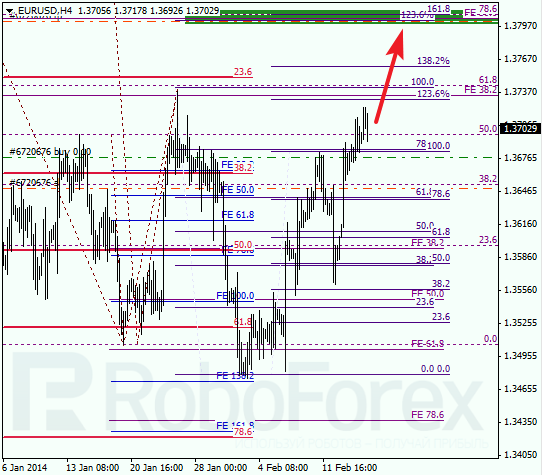
Euro continues moving upwards. Main target is still the same, close to upper fibo-levels near 1.3800. Later, pair is expected to start continues growing up and reach new maximums.

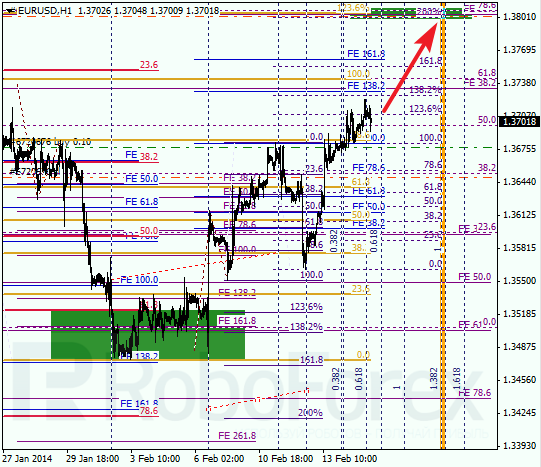
As we can see at H1 chart, market is being corrected, but may start new ascending movement in the nearest future. According to the analysis of temporary fibo-zones, bulls may reach their main target by Tuesday.

USD CHF, “US Dollar vs Swiss Franc”

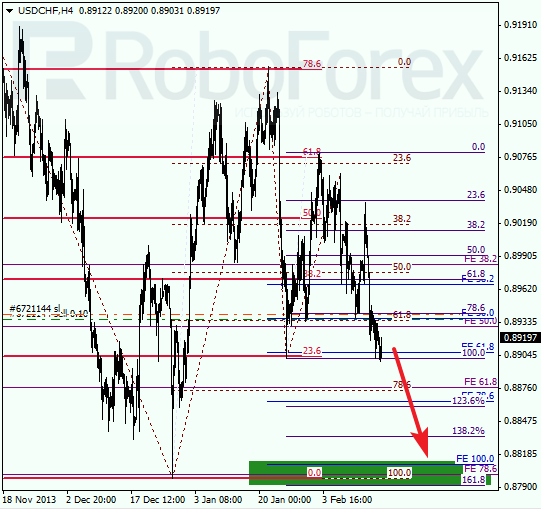
Franc reached one of intermediate fibo-levels and started local correction. Most likely, this correction will finish during the day. I’m planning to increase my short position after price starts falling down again.

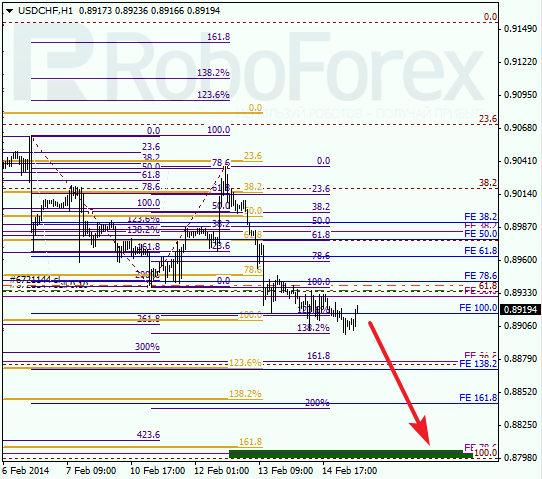
As we can see at H1 chart, current correction may be quite short. Pair may reach new minimum during the day. Main target for bears is close to several fibo-levels near 0.8800.

RoboForex Analytical Department

Article By RoboForex.com

Attention!
Forecasts presented in this section only reflect the author’s private opinion and should not be considered as guidance for trading. RoboForex LP bears no responsibility for trading results based on trading recommendations described in these analytical reviews.


Euro Edges Higher; Eurogroup Meeting In Spotlight

By HY Markets Forex Blog

The 18-block euro currency edged higher against the US dollar on Monday as market participants focus on the Eurogroup meeting in Brussels.

The euro climbed to its highest level since in three weeks during the Asian trading hours, as it rebounded from $1.3724 to trade nearly flat at $1.3702 against the US dollar at the time of writing.

Euro – Eurogroup Meeting

Finance ministers are meeting in Brussels for the Eurogroup meeting on Monday; the ongoing economic crises in Greece and Cyprus are expected to be discussed at the meeting, as well as further developments regarding the European Stability Mechanism (ESM).


Expected Reports & Closed Market

On Monday, the New York Stock exchange will be closed for the President Day holiday.

Market participants will be expecting housing and inflation reports as well as minutes from the Federal Open Market Committee’s (FOMC) meeting.

The US Federal Reserve released the factory output report on Friday, which revealed a 0.3% contraction, compared to analysts forecast of a 0.2% growth.


Other News

An Executive Board member of the European Central Bank, Benoit Coeure said the ECB would be ready to take action against the euro zone low inflation. “We are very vigilant regarding risks to our baseline scenario, which envisages inflation slowly going back to 2% over the medium term,” Coeure told the Slovenian newspaper Delo.

The European Central Bank kept its benchmark interest rate unchanged following its latest meeting. The ECB President Mario Draghi said the bank is ready to cut interest rates further if needed.


Visit www.hymarkets.com   to find out more about our products and start trading today with only $50 using the latest trading technology today.

The post Euro Edges Higher; Eurogroup Meeting In Spotlight appeared first on | HY Markets Official blog.

Article provided by HY Markets Forex Blog

WTI Crude Trades Higher as Market Awaits Further Reports

By HY Markets Forex Blog

Crude prices were seen trading slightly higher on the first day of the trading week as the West Texas Intermediate (WTI) climbed slightly higher for the first time in three days. The demand for heating oil in the US strengthened, while downbeat reports from the US such as retails sales and industrial production data weighed on oil prices.

WTI for April delivery climbed 0.35% higher, trading at $100.48 per barrel on the New York Mercantile Exchange at the time of writing; prices for the crude have risen by 2.3% this year.

Brent for April settlement climbed 0.03% higher at $109.12 per barrel on the London-based ICE Futures Europe exchange at the same time. The European benchmark Brent crude was at premium of $8.76 to WTI for the same month.

According to data released by the Cabinet office, Japan’s economy grew at a slower pace, expanding by a seasonally adjusted 0.3% and on an annualized rate , gross domestic product (GDP) eased to 1.0%. The private non-residential investment grew to 1.3% from 0.2% recorded in the previous quarter, while the public investment lowered from 7.2% to 2.3%.

A separate report revealed that industrial production in Japan climbed 0.9% in December last year, compared to 1.1% recorded in the previous month, the Ministry of Economy, Trade and Industry (METI) confirmed on Monday.

METI also confirmed that shipments increased 0.8% in December, while inventories dropped 0.5% over the month.

Crude – Expected Reports

On Monday, the New York Stock exchange will be closed for the President Day holiday.

Market participants will be expecting housing and inflation reports as well as minutes from the Federal Open Market Committee’s (FOMC) meeting.

The US Federal Reserve released the factory output report on Friday, which revealed a 0.3% contraction, compared to analysts forecast of a 0.2% growth.

Crude – US Downbeat Reports

The US retail sales dropped lower than expected in January, declining 0.4% lower in January, compared to the revised reading of a 0.1% decrease in December and the sharpest drop since June 2012.

Meanwhile, the initial US jobless claims for the week ending February 8 climbed to 339,000, compared to the previous reading of 331,000 seen in the previous month, according to reports from the Labour Department.


Visit www.hymarkets.com   to find out more about our products and start trading today with only $50 using the latest trading technology today.

The post WTI Crude Trades Higher as Market Awaits Further Reports appeared first on | HY Markets Official blog.

Article provided by HY Markets Forex Blog

Windsor Brokers Ltd. meets the first EMIR reporting deadline.

For Immediate Release

Limassol, Cyprus, February 14th, 2014:  Windsor Brokers Ltd. announced that it has met its first reporting obligations under the European Market Infrastructure Regulation (EMIR) which entered into effect on the 12th of February 2014.

The new regulation requires all counterparties to report previous day transactions with regards to financial derivatives including but not limited to Spot FX, CFDs, Futures, Equities, Indices and Binary Options.

All counterparties must therefore report all derivative transactions that fall under the EU jurisdiction.   Reporting is made to Trade Repositories (TR), which are entities that are licensed and regulated by ESMA – the European Securities and Markets Authority.  The main objectives of ESMA are to protect investors and to supervise the practices of financial services firms with pan-European reach.

Transactions can be reported directly to the TR or via a third party (partial or full delegation), depending on the internal processes incorporated by each entity and whether they have the necessary reporting expertise and procedures.

It is important to note that whether reporting is performed directly or via a third party, liability for reporting lies on each entity which is subject to the reporting requirements of EMIR.

“We have decided to handle our own reporting obligations, directly to the TR.  We have our internal reporting system, the technological infrastructure and a dedicated and proficient team in several departments.   For these reasons, we were confident that we were able to fulfill the reporting obligation as of day one”, said Mr. Walid Assaf, Windsor’s Project Leader for EMIR reporting.

Although many firms will face challenges with regards to reporting processes, EMIR is expected to bring more transparency and raise the reporting standards of the financial services industry.

About Windsor Brokers Ltd.

Windsor Brokers Ltd. was the first CIF to be licensed and regulated by the Cyprus Securities and Exchange Commission.  Throughout the years, the company has been nominated and has received several awards for its innovative products, services, partnership programs and customer support and was ranked one of the top ten Cypriot investment firms based on capital reserves in 2013.

Windsor employs over 120 people in Cyprus and abroad and is a leading provider of financial services, catering to both retail and corporate clients from over 80 countries worldwide.

More information on www.windsorbrokers.com


“Mistaken Identity” Sends Wrong Stock Blasting 4,900 Percent Higher

By WallStreetDaily.com "Mistaken Identity" Sends Wrong Stock Blasting 4,900 Percent Higher

Google recently announced that it was buying Nest Labs for $3.2 billion.

On the day after the announcement hit, investors accidently triggered a historic stock move.

It’s a phenomenon called a “flash rally,” which is the exact opposite of a “flash crash.”

Why haven’t you heard about flash rallies?

It’s simple, really.

The press favors negative storylines, especially ones where people lose gobs of money.

Such gut-wrenching stories tug at readers’ heartstrings, and garner lots of attention.

During flash rallies, though, investors make gobs of money, which means these stories go virtually unreported.

Nonetheless, flash rallies are happening with increased regularity.

Any stock that doubles in price (or greater) in a single day is said to have experienced a flash rally.

Flash rallies happen, on average, 41 times every day.

Which 41 stocks are ready to double in price tomorrow? Full details.

The “accident” heard round the world…

It doesn’t take much to trigger a flash rally of biblical proportions.

Flash rallies are hypersensitive to news.

Take Google’s plans to buy Nest Labs, for example.

The day after the news hit, a certain company’s stock “accidently” blasted 4,900% higher.

It wasn’t Google’s stock that rocketed higher.

It wasn’t Nest Labs’ stock, either. (Nest Labs isn’t even a publicly traded company.)

However, if you were a shareholder of the stock that did accidently blast 4,900% higher, a modest $1,000 investment could’ve suddenly turned into $50,000, overnight.

Flash rallies (of all magnitudes) are happening to the tune of 41 every day.

To appreciate how hypersensitive flash rallies are to news, let’s examine the fallout from Google’s offer to buy Nest Labs, which sent a totally unrelated company’s stock shooting to the moon.

The next flash rally will commence tomorrow morning at 9:30 AM EST. For details on which stocks are set to be impacted, click here.

A $3.2-billion case of mistaken identity…

Nest Labs was founded in 2010 by the former Senior Vice President of Apple’s iPod Division, Tony Fadell.

Fadell worked alongside Steve Jobs on the first-generation iPod.

He left Apple to financially leverage the massive cloud computing revolution, which paid off in spades the moment Google’s offer hit.

Nest Labs manufactures beautifully designed thermostats and smoke detectors that can be controlled with a smartphone from anywhere.

The Federal Trade Commission has since rubberstamped the deal, and now Nest Labs’ shareholders are set to receive $3.2 billion in cash from Google.

In a case of mistaken identity, though, many investors rushed to buy shares of the wrong company.

The unsuspecting beneficiary, Nestor Inc., enjoyed a 4,900% increase after investors confused it with Nest Labs.

Nestor isn’t even a cloud computing company. Rather, it sells automated traffic enforcement systems to governments, yet happens to have the ticker symbol NEST, hence the accidental stampede to buy shares.

 Movie1

Wall Street loves to restrict access to flash rallies. The less you know, the bigger the profits are for them. To learn how to lift your restrictions to tomorrow’s 41 flash rallies, click here.

Virtually anything can trigger a flash rally…

Last year, a company called Tweeter Home Entertainment enjoyed a 685% price spike on news of Twitter’s IPO plans.

The frenzied buying made no sense considering that Twitter hadn’t even offered shares yet.

Still, investors “accidently” rushed to buy shares of TWTRQ, thinking they were buying Twitter.

Although confusion over ticker symbols can cause massive flash rallies, it’s actually one of the least likely triggers.

Among the 41 stocks, on average, that double in price every day, more traditional news usually serves as the spark.

Insider buying can spark a flash rally.

A licensing deal can spark a flash rally.

Patent approval can spark a flash rally.

Successful product testing can spark a flash rally.

Flash rallies happen to the tune of 41 opportunities every day.

Yet not a single media outlet is likely to report news concerning any of them.

What the experts are saying: Wall Street Daily’s exclusive research into flash rallies is the only known foray into this phenomenon. The study’s results are eye-opening, especially concerning a proprietary algorithm that can identify which 41 stocks are ready to be among tomorrow’s price doubles. Click here to view it now.

Movie2

Ahead of the tape,

Louis Basenese

The post “Mistaken Identity” Sends Wrong Stock Blasting 4,900 Percent Higher appeared first on Wall Street Daily.

Article By WallStreetDaily.com

Original Article: “Mistaken Identity” Sends Wrong Stock Blasting 4,900 Percent Higher