Asian Stocks Slightly Higher Ahead BoJ Statement

By HY Markets Forex Blog

Stocks in Asia were seen trading slightly higher on Tuesday, with shares in Japan rallying before the release of the Bank of Japan (BoJ) monetary policy statement, which is expected to be released later in the day.

The Japanese benchmark Nikkei 225 index came in at 1.26% to 14,573.95 at the time of writing, at the same time Tokyo’s Topix index climbed 0.98% higher to 1,202.94.

The Bank of Japan is expected to release its policy statement which is forecasted to show the bank keeping its policy unchanged.

Exporters such as Sharp climbed 2.5% higher, while carmaker giants Nissan motors rose 2% higher and Hitachi added more than 1.5%. Hong Kong’s Hang Seng index dropped 0.35% lower at 22,458.00 at the time of writing, at the same time Korea’s Kospi index declined 0.48% to trade at 1.937.11.

Stocks – Australia

Australia’s benchmark S&P/ASX 200 index was unchanged at 5,381.90 as of 1.46am GMT, after the Reserve Bank of Australia released its statement which revealed the bank would keep its benchmark rate despite the weak labour market.

According to the central bank’s minutes from its Feb 4 meeting, a period of steady interest rate is likely, with the record-low borrowing cost.

“If the economy evolved broadly as expected, the most prudent course would likely be a period of stability in interest rates,” the statement read.

The Aussie was seen trading 0.5% higher against the greenback following the bank’s release.


BHP Billiton shares climbed 2.3% higher to A$38.89, the highest close within a year. After the company posted its net profit of $8.11 billion in the six months through December 31 from a year earlier, according to the company’s statement released today.


Visit www.hymarkets.com   to find out more about our products and start trading today with only $50 using the latest trading technology today.

The post Asian Stocks Slightly Higher Ahead BoJ Statement appeared first on | HY Markets Official blog.

Article provided by HY Markets Forex Blog

Euro Drops From Three-Week High After German ZEW

By HY Markets Forex Blog

The Euro declined from its three-week high against the US dollar after Germany’s ZEW indicator came in below expected, reports from the eurozone’s largest economy confirmed on Tuesday.

The 18-bloc currency traded 0.06 higher at $1.3717 against the US dollar at the time of writing, after the euro climbed to a three week-high, climbing to $1.3727.

Germany’s ZEW indicator came in at 55.7 in February, dropping from the previous reading of 61.7 seen in January and compared to analysts forecast of 61.5, marking its first drop in five months.

The ZEW Current Situation gauge came in 50.0 higher in February, picking up from the market consensus of 44.0 and 41.2 seen in the previous month.

The eurozone’s account surplus slightly lessened in December on a seasonally basis, according to reports from the European Central Bank.

Italy trade surplus climbed higher than expected to a non-seasonally adjusted surplus of 3.618 billion euros in December, picking up from the revised figures of 3.088 billion euros recorded in the previous month.

The eurozone’s gross domestic product (GDP) climbed 0.3% higher in the fourth quarter, rising above analysts’ forecasts, strengthened by the growth in France and Netherlands.

According to the German statistics office, the country’s fourth quarter expansion was boosted by the net trade, as exporting climbed higher than expected, while the private consumption slightly declined.

Euro – Expected Reports

Before the release of the German data, Unicredit stated in a note that an upbeat ZEW reading would boost the euro above $1.37.

The Empire State Manufacturing Survey is forecasted to come in slightly lower than the previous reading of 12.51 seen in January to 9.75 in February. The report is expected to be released later in the day.

Market participants will be expecting housing and inflation reports as well as minutes from the Federal Open Market Committee’s (FOMC) meeting.

The US Federal Reserve released the factory output report on Friday, which revealed a 0.3% contraction, compared to analysts forecast of a 0.2% growth.


Visit www.hymarkets.com   to find out more about our products and start trading today with only $50 using the latest trading technology today.

The post Euro Drops From Three-Week High After German ZEW appeared first on | HY Markets Official blog.

Article provided by HY Markets Forex Blog

The U.S. Dollar Trading Mixed

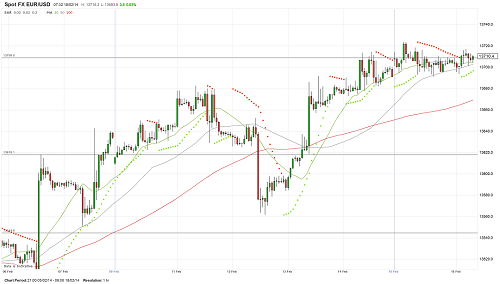
The EURUSD Stands Still

Yesterday’s macroeconomic calendar was empty due to celebration of Presidents` Day in the U.S., so the market activity was low. Thus, many currency pairs were trading in rather tight ranges, including the EURUSD that essentially stood still. Fluctuations of the pair were limited by the 1.3723 and 1.3692 levels. Consequently, nothing new has not happened in the overall picture, the situation remains the same: the bulls should overcome the resistance around the 1.3723 level that will open the way to the 38th figure. The inability to break above will trigger profit taking and a decline of the pair.

eurusd


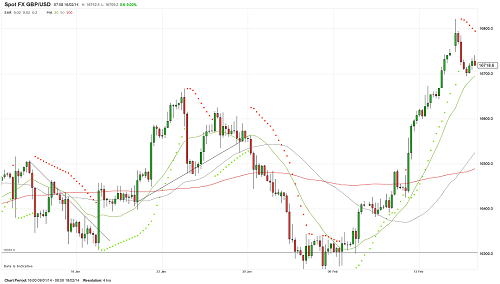
The GBPUSD Corrects from Reached Levels

Yesterday, the GBPUSD was marked near fresh highs at the 1.6822 level, which was used by short-term players for profit taking, that triggered a price decline of the pair to 1.6695. A pullback in the euro contributed to it. Overbuying of the GBPUSD pair and reaching subsequent highs is a good reason for profit taking, but so far it is early to speak about peak formation and a trend reversal. The pound can continue declining, the next target looks the support at 1.6667, its loss can be the feature for the peak formation. Growth above 1.6800 is hardly probable.

gbp


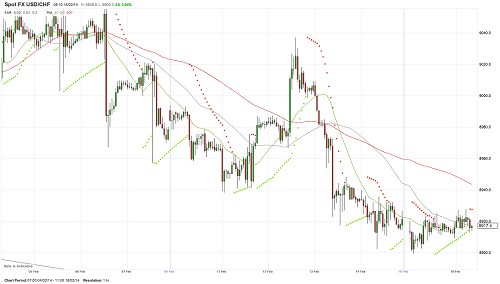
The USDCHF Trading in Tight Range

The USDCHF as well as the EURUSD stood still. From the 89th figure the pair continues to be bought and it is not able to rise above 0.8927. Therefore, the situation in the pair remains unchanged. Loss of the 89th figure will open the way to the support around the 0.8800 level. To improve prospects the dollar should return above 0.8900 and overcome the resistance around 0.9040.

chf


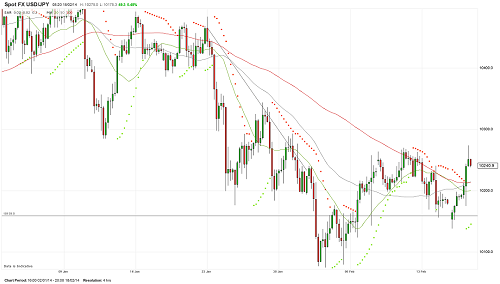
The USDJPY Tests Resistance 102.74

The USDJPY has returned successfully above the resistance around 101.60. Having consolidated above it, the pair could continue to grow and tested the resistance at 102.74 in the Asian session. Purchases of the pair from the support 101.59 testify about continued strength of the bulls, but as long as the 102.74 resistance holds their onslaught, the risks of falling below 101.59 are kept. It is possible that at the current high (102.74) the pair is forming a peak, from which we should expect the resumption of a downward correction. A breakout of this level will mean the resumption of an uptrend.

jpy


provided by IAFT


EURUSD: Presses Higher, Eyes The 1.3739 level.

EURUSD: Having continued to maintain its bullish out, it now looks to recapture the 1.3739 level followed by the 1.3800 level, its psycho level. Further out, resistance resides at the 1.3893 level, its Dec 27 2013 high. This view is consistent with its long term uptrend. Its daily RSI is bullish and pointing higher supporting this view. On the downside, support comes in at the 1.3673 level where a break will turn attention to the 1.3600 level and then the 1.3561 level, its Feb 12 2014 level followed by the 1.3476 level. Further down, support stands at the 1.3400 level, representing its psycho level where a breach will aim at its weekly 200 ema at the 1.3346 level. All in all, EUR remains biased to the upside below its broken trendline.

Article by www.fxtechstrategy.com


Bill Williams’ Indicators Analysis 18.02.2014 (USD/CAD, NZD/USD)

Article By RoboForex.com

Analysis for February 18th, 2014

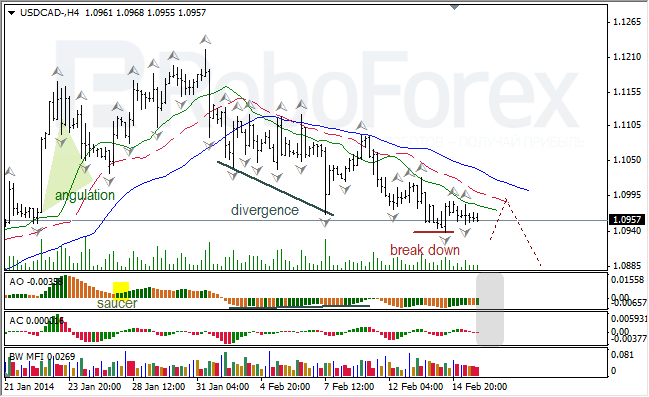
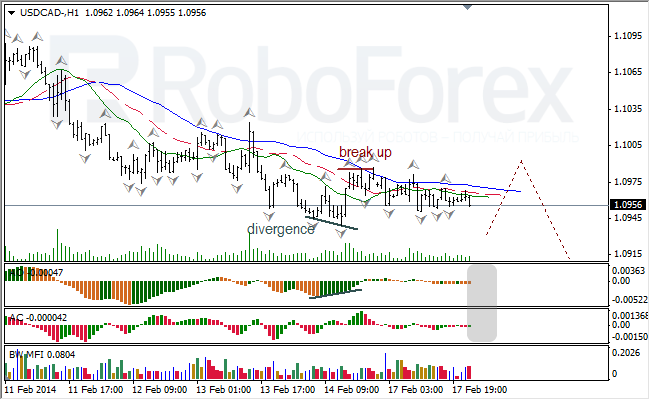
USD CAD, “US Dollar vs Canadian Dollar”

At H4 chart of USD CAD, Alligator is moving downwards. Indicators are in grey zone; there is Fade bar on the MFI and no Squat ones. Bullish fractal may reach Alligator’s teeth (red line), and then I expect breakout of fractals to the downside.

At H1 chart of USD CAD, Alligator is sleeping. Indicators are in grey zone; there is Squat bar on the MFI. I expect slight breakout of fractals to the upside.

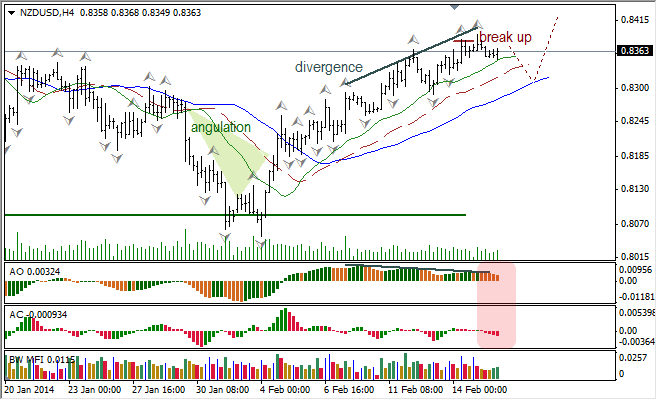
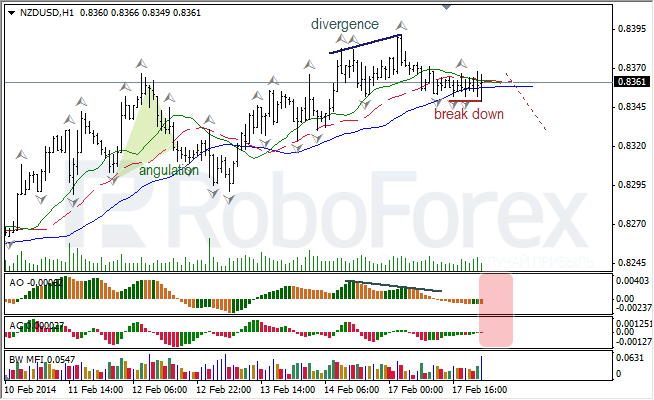
NZD USD, “New Zealand Dollar vs US Dollar”

At H4 chart of NZD USD, Alligator is moving upwards. Price is forming bearish fractal; AO and AC are in red zone; we can see divergence with AO; there is Green bar on the MFI and no Squat ones. Bearish fractal may reach Alligator’s jaw (blue line) and then I expect breakout of fractals to the upside.

At H1 chart of NZD USD, Alligator is sleeping. AO and AC are in red zone; there is Green bar on the MFI and might be Squat one too. I expect breakout of fractals to the downside.

RoboForex Analytical Department

Article By RoboForex.com

Attention!
Forecasts presented in this section only reflect the author’s private opinion and should not be considered as guidance for trading. RoboForex LP bears no responsibility for trading results based on trading recommendations described in these analytical reviews.


Why Does This Sector Keep Bludgeoning Investors?

By WallStreetDaily.com Why Does This Sector Keep Bludgeoning Investors?

Pick any tired cliché about a dramatic shift in a short period of time…

Like nothing ever happened. What a difference a week makes.

They all apply.

Two weeks ago, stocks were in the midst of a nasty pullback. Correction chatter dominated the headlines. Heck, individual bullish sentiment dive-bombed nearly 50% from year-end levels.

And now?

The stock market has strung together six consecutive days of gains. The S&P 500 Index is back within striking distance of a new all-time high.

And everyday investors are downright giddy again, as the American Association of Individual Investors (AAII) bullish sentiment reading jumped from 27.9% up to 40.15% last week.

Now, don’t kill the messenger… But not every nook and cranny of the market is on the mend.

In fact, there’s one industry that could be setting up for a nasty fall. All I need is a single chart to prove it, too.

Retail Me Not

While everyone is fixated on the major market indices, few have noticed the terrible performance of the retail industry.

The SPDR S&P Retail Fund (XRT) was down a staggering 11.4% in the beginning of February. That’s the worst start to a year for the group in over a decade.

Even after the recent rebound, the industry is still down 7% versus only a 1% decline for the S&P 500.

I know, I know. The weather is entirely at fault, right? For when the weather outside is frightful (which it’s been for two months now), Americans stay indoors and don’t do much shopping.

Hogwash!

While that’s a convenient explanation, it’s not an accurate one.

Consider: The latest data reveals that headline retail sales slumped 0.4% last month. However, on a category-by-category basis, non-store retail sales (i.e., online shopping) dropped by even more (0.56%).

If being stuck indoors prevents shopaholics from hitting the malls, you’d expect them to get their fix online. But that didn’t happen.

In other words, weather has little to do with it. Americans simply aren’t shopping as much as economists expected.

Why?

Well, as I shared last week, the average consumer is getting pinched by rising fuel costs, soaring utility bills and stagnant wage growth. I’m sorry. But that’s not the recipe for runaway shopping sprees.

The problem is, retailers refuse to accept this cold reality. They keep hiring more employees in anticipation of increased shopping activity.


As Neil Dutta, Head of U.S. Economics at Renaissance Macro, says, “Something has to give… Either retailers stick with it and stay confident on the expectations that sales will improve, or they will be forced to cut employment dramatically.”

In other words, retailers are playing a nasty game of chicken. And I don’t see it ending well for them, particularly ones that rely heavily on brick-and-mortar sales in mall locations. Here’s why…

No More Mallrats

During the past holiday season, foot traffic fell nearly 15%, according to ShopperTrak.

Meanwhile, at the most recent National Retail Federation convention, Rick Caruso, CEO of Caruso Affiliated, predicted that traditional malls are on the brink of extinction. To his point, a new indoor mall hasn’t been built since 2006.

Heck, all we have to do is look at the performance of anchor tenants in many malls, like J.C. Penney Company, Inc. (JCP) and Sears Holdings Corporation (SHLD). They’ve been sucking wind for years.

And increasingly so, which explains the recent announcements that both companies are closing even more stores. Sears alone has shuttered about 300 stores since 2010.

Along with Radio Shack (RSH), I’m convinced that it’s only a matter of time before all three kick the bucket and file for bankruptcy. Given the current conditions, I wouldn’t be surprised if it happened before the year is out.

Bottom line: Blaming poor retail sales on the weather ignores a deeper, more troubling situation. U.S. consumers aren’t consuming as much as economists expected at this point in the recovery.

Until we see definitive signs of a change in behavior, the only way I’d put money to work in the industry is by betting against the most troubled retailers by buying some cheap January 2015 put options.

Ahead of the tape,

Louis Basenese

The post Why Does This Sector Keep Bludgeoning Investors? appeared first on Wall Street Daily.

Article By WallStreetDaily.com

Original Article: Why Does This Sector Keep Bludgeoning Investors?

Ichimoku Cloud Analysis 18.02.2014 (GBP/USD, GOLD)

Article By RoboForex.com

Analysis for February 18th, 2014

GBP USD, “Great Britain Pound vs US Dollar”

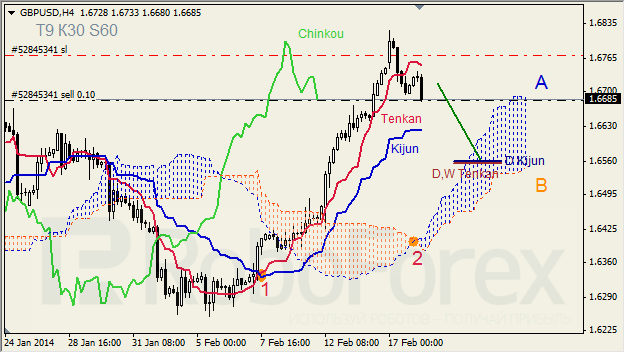
GBP USD, Time Frame H4. Tenkan-Sen and Kijun-Sen are influenced by “Golden Cross” (1); Tenkan-Sen is directed downwards. Ichimoku Cloud is going up (2), Chinkou Lagging Span is above the chart, and the price is between Tenkan-Sen and Kijun-Sen. Short‑term forecast: we can expect decline of the price towards D and W Tenkan-Sen – D Kijun-Sen.

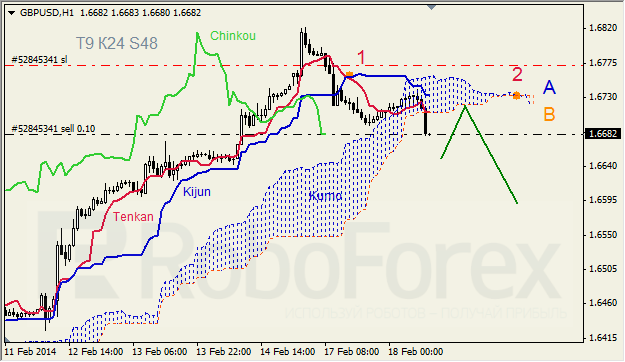
GBP USD, Time Frame H1. Tenkan-Sen and Kijun-Sen intersected above Kumo Cloud and formed “Dead Cross” (1). Ichimoku Cloud is going down (2); Chinkou Lagging Span is below the chart, and the price is below the lines. Short‑term forecast: we can expect the price to return to the cloud’s broken border.

XAU USD, “Gold vs US Dollar”

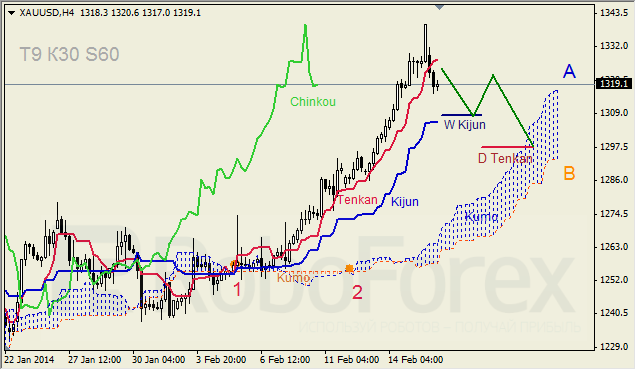
XAU USD, Time Frame H4. Tenkan-Sen and Kijun-Sen are influenced by “Golden Cross” (1). Ichimoku Cloud is going up (2); price is between Tenkan-Sen and Kijun-Sen. Short-term forecast: we can expect support from Kijun-Sen and W Kijun-Sen.

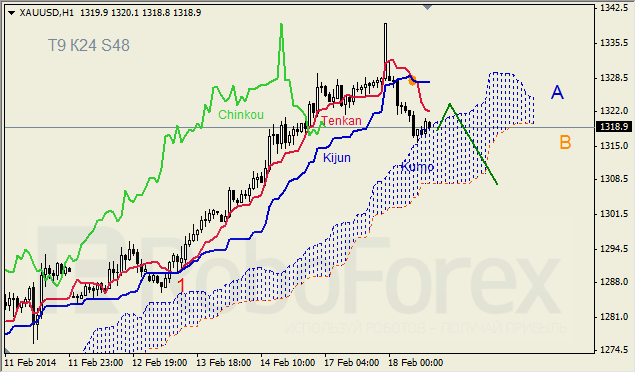
XAU USD, Time Frame H1. Tenkan-Sen and Kijun-Sen intersected above Kumo Cloud and formed “Dead Cross” (1). Ichimoku Cloud is going up; Chinkou Lagging Span is below the chart. Short‑term forecast: we can expect support from Senkou Span A, and decline of the price.

RoboForex Analytical Department

Article By RoboForex.com

Attention!
Forecasts presented in this section only reflect the author’s private opinion and should not be considered as guidance for trading. RoboForex LP bears no responsibility for trading results based on trading recommendations described in these analytical reviews.


GBPUSD remains in uptrend from 1.6252

GBPUSD remains in uptrend from 1.6252, the fall from 1.6822 is likely consolidation of the uptrend. Support is at 1.6670, as long as this level holds, the uptrend could be expected to resume, and another rise towards 1.7000 is still possible. On the downside, a breakdown below 1.6670 support will indicate that the uptrend from 1.6252 had completed at 1.6822 already, then deeper decline to 1.6435 area could be seen.

gbpusd

Provided by ForexCycle.com

Thoughts from the Frontline: The Economic Singularity

By John Mauldin – Thoughts from the Frontline: The Economic Singularity

I fully intended to write today about a recently released academic paper that illustrates nearly every bad idea currently being bandied about in the field of economics. The insidious part is that the paper is considered mainstream and noncontroversial. Simply reading it required me to up my blood pressure medicine dosage. It is going to take me a little longer to finish that letter, and I realized that it needs a certain setup – one that coauthor Jonathan Tepper and I conveniently wrote a few months ago and included in the book Code Red.

So next week we’ll take a deep dive into the most dangerous economics paper written in a long time (that is perhaps only minor hyperbole on my part); but today, by way of setup, let’s think about central banks and liquidity traps and see if we agree that central bankers are driving the car from the back seat based upon a fundamentally flawed theory of how the world works. That theory helped produce the wreck that was the Great Recession and will have its fingerprints all over the next one. So this week we’ll have a preliminary round before putting on the sparring gloves next week.

Here is a part of chapter 7 from Code Red. By the way, the book has done very well and is getting great reviews, with 49 readers giving us five stars. And three people who apparently didn’t read the book gave it one star anyway. Check out the reviews on Amazon.

The 2014 Strategic Investment Conference: Investing in a Transformational World

But before we turn to the chapter, I want to note that this year for the first time we are not requiring Strategic Investment Conference attendees to be accredited investors. A change of venue that gives us a little more room and a shuffling of the speaking schedule allow us to open the event to everyone. If you are from outside the United States, you will not have as much trouble getting accepted into the conference as you may have encountered in the past. I am really excited about this change and hope that we have a significant contingent of non-US citizens at the conference. The speaker lineup is certainly international in breadth.

We sent out a note earlier this week encouraging you to register for the Strategic Investment Conference, which is coming up in mid-May. This is our 11th conference (cosponsored by Altegris Investments), and it will be our biggest and most comprehensive yet. Our attendees regularly say it is the best investment conference they attend anywhere. Click on this link to learn more. Rather than simply listing the names as we normally do, I have provided a little color about who the speakers are and what we can expect to hear. Register now to get the early-bird discount, which lasts for only a few more days.

Stuck in a Liquidity Trap

From Code Red, by John Mauldin and Jonathan Tepper

Like a car, an economy has lots of moving parts; everyone thinks they know how to drive it when they’re in the back seat; and it crashes too often. But on a more serious note, the analogy of a car works especially well when you think of where large parts of the global economy are.

Today central banks can make money cheap and plentiful, but the money that is created isn’t moving around the economy or stimulating demand. They can step on the accelerator and flood the engine with gas, but the transmission is broken, and the wheels don’t turn. Without a transmission mechanism, monetary policy has no effect.

This has not always been the case, but it is today. After some credit crises, central banks can cut the nominal interest rate all the way to zero and still be unable to stimulate their economies sufficiently. Some economists call that a “liquidity trap” (although that usage of the term differs somewhat from Lord Keynes’s original meaning). The Great Financial Crisis plunged us into a liquidity trap, a situation in which many people figure they might just as well sit on cash. Many parts of the world found themselves in a liquidity trap during the Great Depression, and Japan has been stuck in a liquidity trap for most of the time since their bubble burst in 1989.

Economists who have studied liquidity traps know that some of the usual rules of economics don’t apply when an economy is stuck in one. Large budget deficits don’t drive up interest rates; printing money isn’t inflationary; and cutting government spending has an exaggerated impact on the economy. In fact, if you look recessions that have happened after debt crises, growth was almost always very slow. For example, a study by Oscar Jorda, Moritz Schularick, and Alan Taylor found that recessions that occurred after years of rapid credit growth were almost always worse than garden-variety recessions.

One of the key findings from their study is that it is very difficult to restore growth after a debt bubble. Central banks want to create modest inflation and thereby reduce the real value of debt, but they’re having trouble doing it. Creating inflation isn’t quite as simple as printing money or keeping interest rates very low. Most Western central banks have built up a very large store of credibility over the past few decades. The high inflation of the 1970s is a very distant memory to most investors nowadays.

And almost no one seriously believes in hyperinflation. The United Kingdom has never experienced hyperinflation, and you’d have to go back to the 1770s to find hyperinflation in the United States – when the Continental Congress printed money to pay for the Revolutionary War and so started a period of extremely high inflation. (That’s why the framers of the Constitution introduced Article 1, Section 10: “No state shall … coin money; emit bills of credit; make any thing but gold and silver coin a tender in payment of debts….”)

Japan and Germany have not had hyperinflation for over sixty years. Today’s central bankers want inflation only in the short run, not in the long run. As Janet Yellen recognized, central banks with established reputations have a credibility problem when it comes to committing to future inflation. If people believe deep down that central banks will try to kill inflation if it ever gets out of hand, then it becomes very hard for those central banks to generate inflation today. And the answer from many economists is that central bankers should be even bolder and crazier, sort of like everyone’s mad uncle or, more politely, to be “responsibly irresponsible,” as Paul McCulley has quipped.

In a liquidity trap the rules of economics change. Things that worked in the past don’t work in the present. The models of economies that we mentioned above become even less reliable. In fact they sometimes suggest actions that are in fact actually quite destructive. So why aren’t the models working?

Sometimes the best way to understand a complex subject is to draw an analogy. So with an apology to all the true mathematicians among our readers, today we will look at what we can call the Economic Singularity.

The Economic Singularity

Singularity was originally a mathematical term for a point at which an equation has no solution. In physics, it was proven that a large enough collapsing star would eventually become a black hole, so dense that its own gravity would cause a singularity in the fabric of spacetime, a point where many standard physics equations suddenly have no solution.

Beyond the “event horizon” of the black hole, the models no longer work. In general relativity, an event horizon is the boundary in spacetime beyond which events cannot affect an outside observer. In a black hole it is “the point of no return,” i.e., the point at which the gravitational pull becomes so great that nothing can escape.

This theme is an old friend to readers of science fiction. Everyone knows that you can’t get too close to a black hole or you will get sucked in; but if you can get just close enough, you can use the powerful and deadly gravity to slingshot you across the vast reaches of spacetime.

One way that a black hole can (theoretically) be created is for a star to collapse in upon itself. The larger the mass of the star, the greater the gravity of the black hole and the more surrounding space-stuff that will get sucked down its gravity well. The center of our galaxy is thought to be a black hole with a mass of 4.3 million suns.

We can draw a rough parallel between a black hole and our current global economic situation. (For physicists this will be a very rough parallel indeed, but work with us, please.) An economic bubble of any type, but especially a debt bubble, can be thought of as an incipient black hole. When the bubble collapses in upon itself, it creates its own black hole with an event horizon beyond which all traditional economic modeling breaks down. Any economic theory that does not attempt to transcend the event horizon associated with excessive debt will be incapable of offering a viable solution to an economic crisis. Even worse, it is likely that any proposed solution will make the crisis more severe.

The Minsky Moment

Debt (leverage) can be a very good thing when used properly. For instance, if debt is used to purchase an income-producing asset, whether a new machine tool for a factory or a bridge to increase commerce, then debt can be net-productive. Hyman Minsky, one of the greatest economists of the last century, saw debt in three forms: hedge, speculative, and Ponzi.

Roughly speaking, to Minsky, hedge financing was when the profits from purchased assets were used to pay back the loan; speculative finance occurred when profits from the asset simply maintained the debt service and the loan had to be rolled over; and Ponzi finance required the selling of the asset at an ever higher price in order to make a profit. Minsky maintained that if hedge financing dominated, then the economy might well be an equilibrium-seeking, well-contained system. On the other hand, the greater the weight of speculative and Ponzi finance, the greater the likelihood that the economy would be what he called a deviation-amplifying system. Thus, Minsky’s Financial Instability Hypothesis suggests that over periods of prolonged prosperity, capitalist economies tend to move from a financial structure dominated by (stable) hedge finance to a structure that increasingly emphasizes (unstable) speculative and Ponzi finance.

Minsky proposed theories linking financial market fragility, in the normal life cycle of an economy, with speculative investment bubbles that are seemingly part of financial markets. He claimed that in prosperous times, when corporate cash flow rises beyond what is needed to pay off debt, a speculative euphoria develops; and soon thereafter debts exceed what borrowers can pay off from their incoming revenues, which in turn produces a financial crisis. As the climax of such a speculative borrowing bubble nears, banks and other lenders tighten credit availability, even to companies that can afford loans, and the economy then contracts.

“A fundamental characteristic of our economy,” Minsky wrote in 1974, “is that the financial system swings between robustness and fragility and these swings are an integral part of the process that generates business cycles.”

In our previous book, Endgame, we explore the idea of a Debt Supercycle, the culmination of decades of borrowing that finally ends in a dramatic bust. Unfortunately, much of the developed world is at the end of a 60-year-long Debt Supercycle. It creates our economic singularity. A business-cycle recession is a fundamentally different thing than the end of a Debt Supercycle, such as much of Europe is tangling with, Japan will soon face, and the United States can only avoid with concerted action in the next few years.

A business-cycle recession can respond to monetary and fiscal policy in a more or less normal fashion; but if you are at the event horizon of a collapsing debt black hole, monetary and fiscal policy will no longer work the way they have in the past, or in a manner that the models would predict.

There are two contradictory forces battling in a debt black hole: expanding debt and collapsing growth. Raising taxes or cutting spending to reduce debt will have an almost immediate impact on economic growth. But there is a limit to how much money a government can borrow. That limit clearly can vary significantly from country to country, but to suggest there is no limit puts you clearly in the camp of the delusional.

To continue reading this article from Thoughts from the Frontline – a free weekly publication by John Mauldin, renowned financial expert, best-selling author, and Chairman of Mauldin Economics – please click here.

© 2013 Mauldin Economics. All Rights Reserved.
Thoughts from the Frontline is a free weekly economic e-letter by best-selling author and renowned financial expert, John Mauldin. You can learn more and get your free subscription by visiting www.MauldinEconomics.com.

Please write to [email protected] to inform us of any reproductions, including when and where copy will be reproduced. You must keep the letter intact, from introduction to disclaimers. If you would like to quote brief portions only, please reference www.MauldinEconomics.com.

To subscribe to John Mauldin’s e-letter, please click here: www.mauldineconomics.com/subscribe
To change your email address, please click here: http://www.mauldineconomics.com/change-address

Thoughts From the Frontline and MauldinEconomics.com is not an offering for any investment. It represents only the opinions of John Mauldin and those that he interviews. Any views expressed are provided for information purposes only and should not be construed in any way as an offer, an endorsement, or inducement to invest and is not in any way a testimony of, or associated with, Mauldin’s other firms. John Mauldin is the Chairman of Mauldin Economics, LLC. He also is the President and registered representative of Millennium Wave Advisors, LLC (MWA) which is an investment advisory firm registered with multiple states, President and registered representative of Millennium Wave Securities, LLC, (MWS) member FINRA and SIPC, through which securities may be offered. MWS is also a Commodity Pool Operator (CPO) and a Commodity Trading Advisor (CTA) registered with the CFTC, as well as an Introducing Broker (IB) and NFA Member. Millennium Wave Investments is a dba of MWA LLC and MWS LLC. This message may contain information that is confidential or privileged and is intended only for the individual or entity named above and does not constitute an offer for or advice about any alternative investment product. Such advice can only be made when accompanied by a prospectus or similar offering document. Past performance is not indicative of future performance. Please make sure to review important disclosures at the end of each article. Mauldin companies may have a marketing relationship with products and services mentioned in this letter for a fee.

Note: Joining The Mauldin Circle is not an offering for any investment. It represents only the opinions of John Mauldin and Millennium Wave Investments. It is intended solely for investors who have registered with Millennium Wave Investments and its partners at http://www.MauldinCircle.com (formerly AccreditedInvestor.ws) or directly related websites. The Mauldin Circle may send out material that is provided on a confidential basis, and subscribers to the Mauldin Circle are not to send this letter to anyone other than their professional investment counselors. Investors should discuss any investment with their personal investment counsel. John Mauldin is the President of Millennium Wave Advisors, LLC (MWA), which is an investment advisory firm registered with multiple states. John Mauldin is a registered representative of Millennium Wave Securities, LLC, (MWS), an FINRA registered broker-dealer. MWS is also a Commodity Pool Operator (CPO) and a Commodity Trading Advisor (CTA) registered with the CFTC, as well as an Introducing Broker (IB). Millennium Wave Investments is a dba of MWA LLC and MWS LLC. Millennium Wave Investments cooperates in the consulting on and marketing of private and non-private investment offerings with other independent firms such as Altegris Investments; Capital Management Group; Absolute Return Partners, LLP; Fynn Capital; Nicola Wealth Management; and Plexus Asset Management. Investment offerings recommended by Mauldin may pay a portion of their fees to these independent firms, who will share 1/3 of those fees with MWS and thus with Mauldin. Any views expressed herein are provided for information purposes only and should not be construed in any way as an offer, an endorsement, or inducement to invest with any CTA, fund, or program mentioned here or elsewhere. Before seeking any advisor’s services or making an investment in a fund, investors must read and examine thoroughly the respective disclosure document or offering memorandum. Since these firms and Mauldin receive fees from the funds they recommend/market, they only recommend/market products with which they have been able to negotiate fee arrangements.

PAST RESULTS ARE NOT INDICATIVE OF FUTURE RESULTS. THERE IS RISK OF LOSS AS WELL AS THE OPPORTUNITY FOR GAIN WHEN INVESTING IN MANAGED FUNDS. WHEN CONSIDERING ALTERNATIVE INVESTMENTS, INCLUDING HEDGE FUNDS, YOU SHOULD CONSIDER VARIOUS RISKS INCLUDING THE FACT THAT SOME PRODUCTS: OFTEN ENGAGE IN LEVERAGING AND OTHER SPECULATIVE INVESTMENT PRACTICES THAT MAY INCREASE THE RISK OF INVESTMENT LOSS, CAN BE ILLIQUID, ARE NOT REQUIRED TO PROVIDE PERIODIC PRICING OR VALUATION INFORMATION TO INVESTORS, MAY INVOLVE COMPLEX TAX STRUCTURES AND DELAYS IN DISTRIBUTING IMPORTANT TAX INFORMATION, ARE NOT SUBJECT TO THE SAME REGULATORY REQUIREMENTS AS MUTUAL FUNDS, OFTEN CHARGE HIGH FEES, AND IN MANY CASES THE UNDERLYING INVESTMENTS ARE NOT TRANSPARENT AND ARE KNOWN ONLY TO THE INVESTMENT MANAGER. Alternative investment performance can be volatile. An investor could lose all or a substantial amount of his or her investment. Often, alternative investment fund and account managers have total trading authority over their funds or accounts; the use of a single advisor applying generally similar trading programs could mean lack of diversification and, consequently, higher risk. There is often no secondary market for an investor’s interest in alternative investments, and none is expected to develop. You are advised to discuss with your financial advisers your investment options and whether any investment is suitable for your specific needs prior to making any investments.

All material presented herein is believed to be reliable but we cannot attest to its accuracy. Opinions expressed in these reports may change without prior notice. John Mauldin and/or the staffs may or may not have investments in any funds cited above as well as economic interest. John Mauldin can be reached at 800-829-7273.


James Turk: Erosion of Trust Will Drive Gold Higher

By Casey Research

A Q&A with Casey Research

James Turk, founder of precious metals accumulation pioneer GoldMoney, has over 40 years’ experience in international banking, finance, and investments. He began his career at the Chase Manhattan Bank and in 1983 was appointed manager of the commodity department of the Abu Dhabi Investment Authority.

In his new book The Money Bubble: What to Do Before It Pops, James and coauthor John Rubino warn that history is about to repeat. Instead of addressing the causes of the 2008 financial crisis, the world’s governments have continued along the same path. Another—even bigger—crisis is coming, and this one, say the authors, will change everything.

One central tenet of your book is that the dollar’s international importance has peaked and is now declining. What will the implications be if the dollar loses its reserve status?

In a word, momentous. Although the dollar’s role in world trade has been declining in recent years while the euro and more recently the Chinese yuan have been gaining share, the dollar remains the world’s dominant currency. So crude oil and many other goods and services are priced in dollars. If goods and services begin being priced in other currencies, the demand for the dollar falls.

Supply and demand determine the value of everything, including money. So a declining demand for the dollar means its purchasing power will fall, assuming its supply remains unchanged. But a constant supply of dollars is an implausible assumption given that the Federal Reserve is constantly expanding the quantity of dollars through various forms of “money printing.” So as the dollar’s reserve status erodes, its purchasing power will decline too, adding to the inflationary pressures already building up within the system from the Federal Reserve’s quantitative easing program that began after the 2008 financial collapse.

Most governments of the world are fighting a currency war, trying to devalue their currencies to gain a competitive advantage over one another. You predict that China will “win” this currency war (to the extent there is a winner). What is China doing right that other countries aren’t? How would the investment world change if China did “win”?

As you say, nobody really wins a currency war. All currencies are debased when the war ends. What’s important is what happens then. Countries reestablish their currency in a sound way, and that means rebuilding on a base of gold. So the winner of a currency war is the country that ends up with the most gold.

For the past decade, gold has been flowing to China—both newly mined gold as well as from existing stocks. But that flow from West to East has accelerated over the past year, and there are unofficial estimates that China now has the world’s third-largest gold reserve.

The implications for the investment world as well as the global monetary system are profound. Why should China use dollars to pay for its imports of crude oil from the Middle East? What if Saudi Arabia and other exporters are willing to price their product and get paid in Chinese yuan? Venezuela is already doing that, so it is not a far-fetched notion that other oil exporters will too. China is a huge importer of crude oil, and its energy needs are likely to grow. So it is becoming a dominant player in global oil trading as the US imports less oil because of the surge in its own domestic fossil fuel production.

Changes in the way oil is traded represent only one potential impact on the investment world, but it indicates what may lie ahead as the value of the dollar continues to erode and gold flows from West to East. So if China ends up with the most gold, it could emerge as the dominant player in global investments and markets. It already has become the dominant player in the market for physical gold.

You draw a distinction between “financial” and “tangible” assets, noting that we go through a recurring cycle where each falls in and out of favor. Where are we in that cycle? With US stocks at all-time highs and gold down over 30% since the summer of 2011, is it possible that the cycle is rolling over?

Our monetary system suffers recurring booms and busts because of the fractional reserve practice of banks, which allows them to create money “out of thin air,” as the saying goes. During booms—all of which are caused by too much money that banks have created by expanding credit—financial assets outperform, but they eventually become overvalued relative to tangible assets. The cycle then reverses. The fractional reserve system goes into reverse and credit contracts, causing a lot of promises made during the good times to be broken. Loans don’t get repaid, unnerving bankers and investors alike. So money flees out of financial assets and the counterparty risk these assets entail, and into the safety of tangible assets, until eventually tangible assets become overvalued, and the cycle reverses again.

So for example, the boom in financial assets that ended in 1967 led to a reversal in the cycle until tangible assets became overvalued in 1981. The cycle reversed again, and financial assets boomed until the popping of the dot-com bubble in 2000. We are still in the cycle favoring tangible assets, but there is no way to predict when it will end. We know it will end when tangible assets become overvalued, but as John and I explain in The Money Bubble, we are not even close to that moment yet.

You cite the “shrinking trust horizon” as one of the long-term factors that will drive gold higher. Can you explain?

Yes, this is an important point that we make. Our economy, and indeed, our society, is based on trust. We expect the bread we buy from a baker or the gasoline we buy for our car to be reliable. We expect our money on deposit in a bank to be safe. But if we find the baker is putting sawdust in our bread and governments are using depositor money to bail out banks, as happened in Cyprus last year, trust begins to erode.

An erosion of trust means that people are less willing to accept the counterparty risk that comes with financial assets, so the erosion of trust occurs during financial busts. People as a consequence move their wealth into tangible assets, be it investments in tangible things like farmland, oil wells, or mines, or in tangible forms of money, which of course means gold.

Obviously, gold has been in a painful slump since the summer of 2011. What near-term catalysts—let’s say in 2014—could wake it from its slumber?

We have to put 2013 into perspective, because portfolio management is a marathon, not a 100-meter sprint. Gold had risen 12 years in a row prior to last year’s price decline. And even after last year, gold has appreciated 13% per annum on average, making it one of the world’s best-performing asset classes since the current financial bust began with the popping of the dot-com bubble.

Looking to the year ahead, there are many potential catalysts, but it is impossible to predict which event will be the trigger. The derivatives time bomb? Failure of a big bank? The sovereign debt crisis returns to the boil? The Japanese yen collapses? It could be any of these or something we can’t even imagine. But one thing is certain: as long as central banks continue their present money-printing ways, the price of gold will rise over time to reflect the debasement of national currencies. The gold price might not jump to its fair value immediately because of government intervention, but it will rise eventually and inevitably.

So the most important thing to keep in mind is the money printing that pretty much every central bank around the world is doing. The central bankers have given it a fancy name—”quantitative easing.” But regardless of what it is called, it is still creating money out of thin air, which debases the currency that central bankers are supposed to be prudently managing to preserve the currency’s purchasing power.

Money printing does the exact opposite; it destroys purchasing power, and the gold price in terms of that currency rises as a consequence. The gold price is a barometer of how well—or perhaps more to the point, how poorly—central bankers are doing their job.

Governments have been debasing currencies since the Roman denarius. Why do you expect the consequences of this particular era of debasement to be so severe?

Yes, they have, and to use Rome as the example, its empire collapsed when the currency was debased. Worryingly, after the collapse of the Roman Empire, the world went into the so-called Dark Ages. Countries grow and prosper on sound money. They dissipate and eventually collapse when money becomes unsound. This pattern recurs throughout history.

Rome of course did not collapse overnight. The debasement of their currency cannot be precisely measured, but it lasted over 100 years. The important point we need to recognize is that the debasement of the dollar that began with the formation of the Federal Reserve in 1913 has now lasted over 100 years too. A penny in 1913 had the same purchasing power as a dollar has today, which, interestingly, is not too different from the rate at which Rome’s denarius was debased.

After discussing how the government of Cyprus raided its citizens’ bank accounts in 2013, you suggest that it’s a near certainty that more countries will introduce capital controls and asset confiscations in the next few years. What form might those seizures take, and how can people protect their assets?

It is impossible to predict, of course, because central planners can be very creative in coming up with different forms of financial repression that prevent you from doing what you want with your money. In fact, look at the creativity they have already used.

For example, not only did bank depositors in Cyprus lose much of their money, much of what was left was given to them in the forms of shares of the banks they bailed out, forcing them to become shareholders. And the US has imposed a creative type of capital control that makes it nearly impossible for its citizens to open a bank account outside the US. Pension plans are the most vulnerable because they are easy to get at. Keep in mind that Argentina, Ireland, Spain, and Poland raided private pensions when those countries ran into financial trouble.

Protecting one’s assets in today’s environment is difficult. John and I have some suggestions in the book, such as global diversification and internationalizing oneself to become as flexible as possible.

You dedicated an entire chapter of your book to silver. Which do you think will appreciate more in the next year, gold or silver? How about in the next 10 years?

I think silver will do better for the foreseeable future. It is still very cheap compared to gold. As but one example to illustrate this point, even though gold underwent a big price correction last year, it is still trading above the record high it made in January 1980, which was the top of the bull run that began in the 1960s.

In contrast, not only has silver not yet broken above its January 1980 peak of $50 per ounce, it is still far from that price. So silver has a lot of catching up to do.

Silver is a good substitute for gold in that silver, too, can be viewed as money outside the banking system, which is an important objective to keep wealth liquid and safe today. But silver may not be for everyone, because it is volatile. This volatility can be measured with the gold/silver ratio, which is the number of ounces of silver needed to equal one ounce of gold. The ratio was 30 to 1 in 2011, and several months later jumped to 60 to 1.

So you can see how volatile silver is. But because I expect silver to do better than gold, I believe that the ratio will fall to 16 to 1 eventually, which is the same level it reached in January 1980. It is also the ratio that generally applied when national currencies used to be backed by precious metals.

Besides gold, what one secular trend would you be most comfortable betting a large portion of your nest egg on?

Own things, rather than promises. Avoid financial assets. Own tangible assets of all sorts, like farmland, timberland, oil wells, etc. Near-tangibles like the equities of companies that own tangible assets are okay too, but avoid the equities of banks, credit card companies, mortgage companies, and any other equities tied to financial assets.

What asset class are you most bearish on?

Without any doubt, it is government debt in particular and more generally, government promises. They have promised more than they can possibly deliver, so a lot of their promises are going to be broken before we see the end of this current bust that began in 2000. And that outcome of broken promises describes the huge task that we all face. There will be a day of reckoning. There always is when an economy and governments take on more debt than is prudent, and the world is far beyond that point.

So everyone needs to plan and prepare for that day of reckoning. We can’t predict when it is coming, but we know from monetary history that busts follow booms, and more to the point, that currencies collapse when governments make promises that they cannot possibly fulfill. Their central banks print the currency the government wants to spend until the currency eventually collapses, which is a key point of The Money Bubble. The world has lost sight of what money is.

What today is considered to be money is only a money substitute circulating in place of money. J.P. Morgan had it right when in testimony before the US Congress in 1912 he said: “Money is gold, nothing else.” Because we have lost sight of this wisdom, a “money bubble” has been created. And it will pop. Bubbles always do.

As James Turk said, “near-tangibles like the equities of companies that own tangible assets” (i.e., gold stocks) are good investments—and right now, they are dramatically undervalued. In a recent online video event titled “Upturn Millionaires,” eight influential investors including Doug Casey, Rick Rule, Frank Giustra, and Ross Beaty gathered to discuss the new realities in the gold stock sector—and why the odds of making huge gains are now extremely high. Click here to watch the event.