Intraday Elliott Wave Forecast For German DAX And EURUSD

The Japanese yen is moving up this morning as futures contracts on US indices hit resistance. At the same time we can see mixed picture on USD which is now down against the EUR, GBP and JPY but up against the commodity currencies.

Below we have a chart of German Dax again which is moving slightly down from the highs after only three wave rally from 9500. For now that’s not a big deal but break of the channel line and fall beneath 9600 will put prices down in to wave (c) of a flat correction.

German Dax (Mar 2014) 1h Elliott Wave Analysis

The EURUSD has been very slow lately, and on the intraday chart we can see the reason why. We are tracking a triangle in progress that may send prices up to 1.3800 in this week. Ideally we will see waves d) and e) in the next 24 hours, but bias remains bullish as long as 1.3680 holds.

EURUSD 1h Elliott Wave Analysis

Written by www.ew-forecast.com

14 days trial just for €1 >> http://www.ew-forecast.com/register


The U.S. Dollar Still Under Pressure

The EURUSD Still Trading In a Tight Range

The overall picture on the EURUSD was not changed yesterday. The pair rose to 1.3771 at first and then decreased to 1.3708. The pair finished the day around the 1.3733 level where it was started. The situation still remains the same: the euro is trading above the 1.3685 level, the chances to test the 38th figure are kept. A fall below the 1.3685 level will open the way to 1.3618—1.3600. The upward trend of the pair does not inspire confidence.

eur


The GBPUSD Continues to Be Bought

The GBPUSD still cannot determine its direction. The pair was thrown in different directions. At first it tested the 1.6599 level, then — 1.6678. Here the pair was sold again, its rate decreased to 1.6583. The bears have failed to consolidate below the 66th figure, as the bulls continue to buy the pound on dips. This testifies about preserved strength of the bulls that gives a reason to presume testing 1.6700—1.6720 in the short term. A fall below 1.6583 will worsen prospects of the pair.

gbp


The USDCHF Under Pressure Again

The decline of the USDCHF to 0.8850 caused interest to purchases but they were not observed as large-scale, as the pair was sold while increasing to 0.8909 and its rate started decreasing again. Thus, the dollar bulls cannot reckon on the improvement of prospects as for this the quotes should rise and consolidate above 0.8920—0.8940. Until then, the risks of testing the 88th figure will be kept.

chf


The USDJPY In A Tight Range

The USDJPY is still trading in a tight range. While decreasing to 102.16 the pair was sold and it rose to 102.60. The attempts to break and consolidate higher failed. Today, the dollar is decreasing to current support again. In general, the picture is neutral, a breakout of the 102.16-102.83 range in one or another direction will mean either testing the support around the 101.59 level or an uptrend resumption.

jpy

provided by IAFT


Crude Prices Falls From Previous Gains

By HY Markets Forex Blog

Crude prices were seen trading lower on Tuesday, dropping from its five-month high as investors wait for government report for hints over the US crude stockpiles. The American Petroleum Institute is expected to report later in the day, while further data will be released by the Energy Information Administration (EIA) on Wednesday.

The West Texas Intermediate advanced to $103.45 a barrel on Monday, the highest level since October 10, after dropping to $102.38 per barrel on the New York Mercantile Exchange on Tuesday.

Brent for April settlement lost 0.2% to $110.41 per barrel on the ICE Future Europe exchange. The European benchmark crude was at a premium of $8.08 to WTI.

US Crude Supplies

US distillate inventories, including heating oil and diesel are expected to show a drop by 1.5 million barrels in the last week; which would be a seventh weekly decline, according to analysts, the Energy Information Administration (EIA) is expected to release reports on Wednesday.

Meanwhile US stockpiles at Cushing, Oklahoma, declined by 1.73 million barrels to 35.9 million in the week ending February 14, EIA reported last week.

Crude – Libya

In Libya, crude productions came in at 231,000 barrels a day, which still remains below the maximum capacity of over a million barrels a day, Mohamed Elharari, a spokesman for National Oil Corp confirmed. The country’s second-largest oil field, Sharara Field has been closed since February 20.

Temperature across the US Northeast has dropped below average this period of the year as temperature in the Midwest is predicted to fall below zero Fahrenheit this week.

The cold weather will spread across the Midwest until March 5, said Matt Rogers, the president of Commodity Weather Group.


Visit www.hymarkets.com   to find out more about our products and start trading today with only $50 using the latest trading technology today

The post Crude Prices Falls From Previous Gains appeared first on | HY Markets Official blog.

Article provided by HY Markets Forex Blog

Gold Prices Drops From 16-Week High

By HY Markets Forex Blog

Gold prices dropped from its sixteen-week week high on Tuesday while the crisis in Ukraine continues to weigh on the metal, slowing bullion demand at higher prices.

Gold for immediate delivery declined 0.1% to $1,335.83 an ounce at the time of writing. The precious metal climbed to its highest since October 31, reaching $1,340.04 earlier today. Gold for April delivery lost 0.2% to $1,335.90 on the Comex in New York.

Silver dropped by 1.23% trading at $21.780 an ounce at the time of writing.

Gold – Ukraine Turmoil

In Ukraine, the Interior Ministry requests for a criminal case against the former President of Ukraine, Viktor Yanukovych for the mass murder of civilians during the previous week’s protest, which left over 100 people dead.

This comes after videos of police shooting protestors broadcasted through social media.

Meanwhile, financial leaders from Europe and the US have started to push for financial assistance for Ukraine, while the parliament voted out the former President Viktor Yanukovych.

ETP Holdings

Holdings in gold-backed exchange-traded fund climbed for a third day on Monday, rising by 1 metric ton to 1,740.2 tons. Assets dropped to its lowest since October 2009, last week.

Consumer Confidence

Meanwhile in the US, the Conference Board (CB) consumer confidence index is expected to be released later in the day.

Market analysts are expecting to see a decline in the Conference Board (CB) headline figures, with a decline of 80.0, compared to the previous reading of 80.7 seen in January.


Visit www.hymarkets.com   to find out more about our products and start trading today with only $50 using the latest trading technology today

The post Gold Prices Drops From 16-Week High appeared first on | HY Markets Official blog.

Article provided by HY Markets Forex Blog

EUR/USD Declines Amid Lackluster Economic Data

By HY Markets Forex Blog

Forex trading resulted in the EUR/USD pair declining on Feb. 20, as global market participants responded to data that pointed to weak economic conditions in Europe.

The common currency dropped to as little as $1.3685, according to Reuters. This was the second day when the euro declined against the greenback, after it rose to was much as $1.37735 on Feb. 19. This represented the highest value that the EUR/USD reached in seven weeks.

Key impact of Markit data

The exchange rate for the two currencies was impacted as global market participants responded to data indicating that in February, a key index released by Markit fell to 52.7, the media outlet reported. This figure fell short of the reading of 53.1 that was predicted.

“A dip in the euro-zone PMI provides a reminder that the region’s recovery continues to be uneven and fragile,” Chris Williamson, who works for Markit as chief economist, told The Wall Street Journal. “Growth continued to be led by Germany, which contrasts with a worrying renewed downturn in France.”

France suffers deflation

In addition, data released by the statistics bureau of France revealed that the European nation is suffering from declining prices, according to the news source. Between December and January, the consumer prices in the country dropped 0.6 percent, falling at the sharpest rate on record. This was the most severe month-to-month drop that the measure experienced since the statistics agency began keeping records in 1990.

It is important to note that in addition to suffering from deflation, France also experienced a decline in business activity, as the PMI data for the European nation fell short of predictions, Reuters reported.

Impact of strong U.S. data

It is important to note that while the data released for Europe was weak, reports pointed to strength in U.S. economic conditions, according to the media outlet. Data provided by Markit revealed that in February, an increase in new orders resulted in U.S. manufacturing activity rising sharply. This particular measure grew at its fastest pace in close to four years.

Global market participants involved in forex trading responded to this information by causing the greenback to rise relative to many other currencies, MarketWatch reported. The ICE dollar index increased to a reading of 80.280. This index, which compares the value of the greenback to various other currencies, had a reading of 80.191 on the day before.

“The U.S. economic data this morning definitely benefited the dollar across the board,” Blake Jespersen, who works for BMO Capital Markets in Toronto as managing director of foreign exchange, told Reuters.

It was noted that in addition to the strong manufacturing data, markets were also impacted by data pointing to a recent decline in jobless claims, according to the news source. The Labor Department indicated on Feb. 20 that during the prior week, the number of people who filed these initial applications for unemployment benefits fell by 3,000. As a result, the figure reached a seasonally-adjusted 336,000 during the week. This provided market experts with some reason to be positive, after the last two monthly jobs reports released by the government agency contained lackluster figures.

The progress that the labor market makes going forward could be crucial to forex trading, as the unemployment rate has been identified by the Federal Reserve as being key to quantitative easing. If the jobs picture improves rapidly, this development will make it easier to taper QE more quickly. However, if the labor market does not get better at a fast enough rate, the situation will place pressure on the U.S. central bank to maintain these bond purchases.

The policy stimulus used by central banks across the world has been noted by market experts as having a key impact on forex trading.

The post EUR/USD Declines Amid Lackluster Economic Data appeared first on | HY Markets Official blog.

Article provided by HY Markets Forex Blog

EURUSD: Hesitates But Eyes The 1.3772 Level.

EURUSD: Though maintaining its broader upside, it requires a break and hold above the 1.3772 level to trigger that trend. Above here will turn attention to the 1.3800 level, its psycho level. Further out, resistance comes in at the 1.3893 level, its Dec 27 2013 high. A turn above here will pave the way for a run at the 1.3950 level and next the 1.4000 level. This view is consistent with its long term uptrend. Its daily RSI is bullish and pointing higher supporting this view. On the downside, support comes in at the 1.3739 level where a break will turn focus to the 1.3673 level. Further down, support lies at the 1.3600 level and then the 1.3561 level, its Feb 12 2014 level. All in all, EUR remains biased to the upside below its broken trendline.

Article by www.fxtechstrategy.com


Wave Analysis 25.02.2014 (DJIA Index, Crude Oil)

Article By RoboForex.com

Analysis for February 25th, 2014

DJIA Index

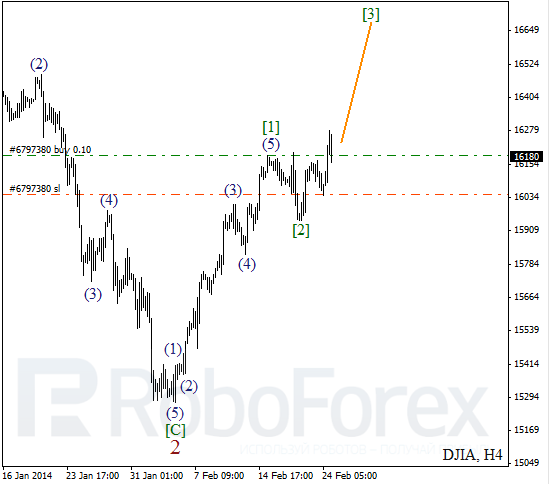
On Monday, Index reached new maximum. Possibly, price is starting to form extension inside wave [3]. Stop on my buy order is placed at minimum; I’m planning to open additional orders during the third wave.

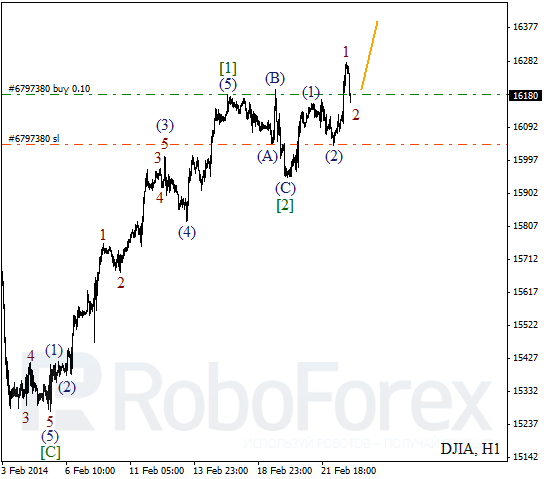
As we can see at the H1 chart, after completing bearish zigzag pattern inside wave [2], Index formed two initial ascending impulses in a row. During the day, instrument is expected to complete local correction and start moving upwards inside the third wave.

Crude Oil

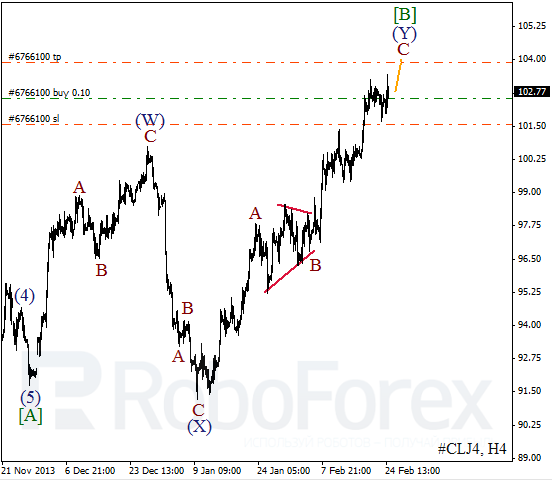
After breaking maximum, Oil started new correction, but main trend is still bullish. Probably, price may continue forming ascending impulse inside wave C. Instrument is expected to reach new maximums during the next several days.

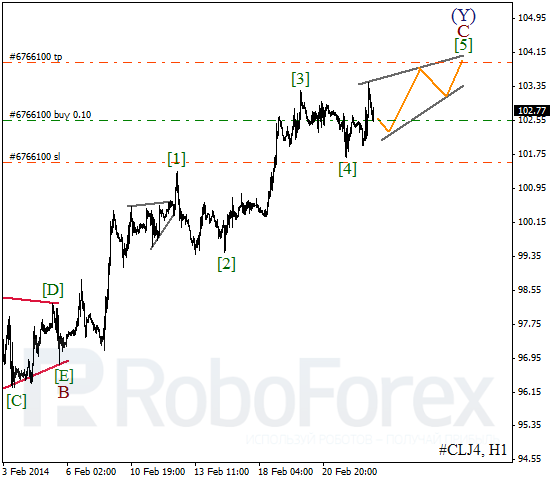
More detailed wave structure is shown on H1 chart. Considering that previous ascending movement took the form of zigzag pattern, the fifth wave is expected to become diagonal triangle. Critical level here is at minimum of wave [4].

RoboForex Analytical Department

Article By RoboForex.com

Attention!
Forecasts presented in this section only reflect the author’s private opinion and should not be considered as guidance for trading. RoboForex LP bears no responsibility for trading results based on trading recommendations described in these analytical reviews.


Fibonacci Retracements Analysis 25.02.2014 (EUR/USD, USD/CHF)

Article By RoboForex.com

Analysis for February 25th, 2014

EUR USD, “Euro vs US Dollar”

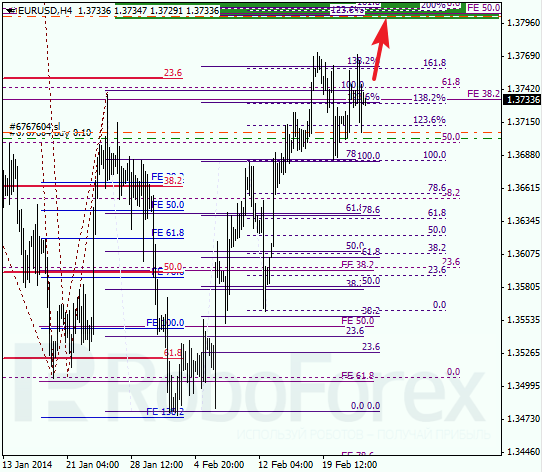
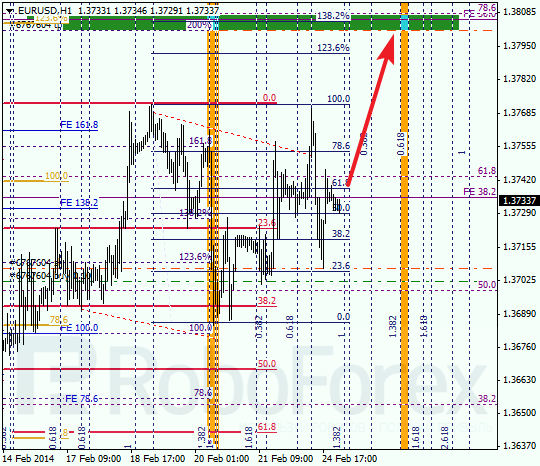
Euro is still consolidating close to its latest maximum. Later pair is expected to continue growing up towards its main target, which is close to several upper fibo-levels at 1.3800. Stop on my buy order is already in the black.

As we can see at H1 chart, bulls’ first attempt to break maximum failed. Probably, pair may continue growing up in the nearest future and reach predicted targets inside closest temporary fibo-zone.

USD CHF, “US Dollar vs Swiss Franc”

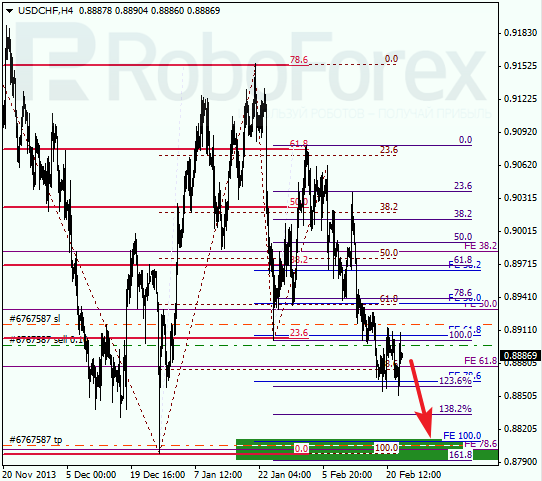
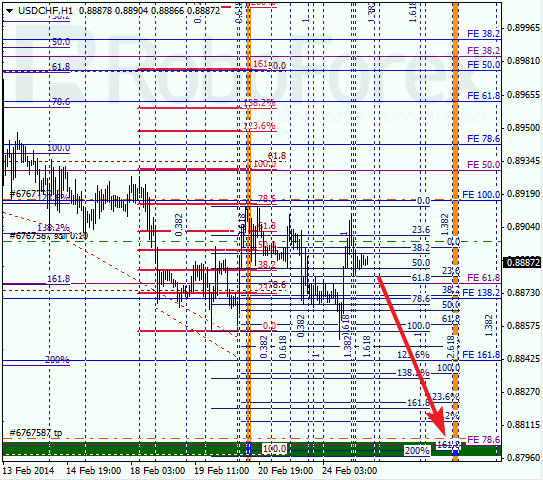
After breaking local minimum, Franc started new correction. As a result, I’ve got only one sell order left, with stop placed at latest maximum. Target is still at level of 0.8800.

Probably, price may have already finished current correction. If pair starts new descending movement during the day, I’ll move stop into the black right away. Later, after reaching lower target levels, price may start new correction.

RoboForex Analytical Department

Article By RoboForex.com

Attention!
Forecasts presented in this section only reflect the author’s private opinion and should not be considered as guidance for trading. RoboForex LP bears no responsibility for trading results based on trading recommendations described in these analytical reviews.


Silicon Valley’s Tech Bomb Hatches Army of “Zombies”

By WallStreetDaily.com Silicon Valley's Tech Bomb Hatches Army of "Zombies"

The purpose of Silicon Valley couldn’t be more straightforward…

Breed amazing and irresistible technologies that captivate the masses – and ultimately garner absurd public valuations.

The latest example is text messaging service, WhatsApp, which Facebook (FB) is purchasing for a whopping $19 billion.

What’s different this time, however, is that even Silicon Valley insiders are shocked at this massive price tag…

Like Aaron Levie, Co-Founder of Box Inc. – an online storage company that’s about to go public in a multi-billion-dollar deal. He didn’t believe it when news of “the bomb that shook Silicon Valley” hit, in the words of The Wall Street Journal.

He received a text that simply read: “WhatsApp, $19 Billion, Facebook.”

His response? “I thought, ‘I don’t know what those three things mean to each other, but there’s no way that this means that Facebook bought WhatsApp for $19 billion.’”

Oh, there’s a way, Mr. Levie. And the implications for everyday investors like us aren’t good.

Here’s why…

New “Zombie Companies” Forming

Facebook’s willingness to pay (way) up for WhatsApp immediately makes other Silicon Valley executives think that their startups are worth just as much, too.

To them, the deal serves as a validation signal – that mobile apps do, indeed, warrant premium valuations.

Heck, I bet you that almost every mobile app company in Silicon Valley updated their pitch books over the weekend. There’s nothing like using WhatsApp’s purchase price as a proxy to inflate the perceived value of your own company… and convince investors to part with their hard-earned capital, right?

Therein lies the danger to us…

By simply taking the amount Facebook paid per WhatsApp user ($42) and multiplying it by the number of users for any other mobile application, we can justify multiple billion-dollar valuations all day long. But that’s the wrong way to go about valuing an investment.

For one thing, not every company promises to be acquired. And very few get bought out at such lofty valuations as WhatsApp.

If we’re only investing in a company because of its takeover potential, we’re going to end up losing money more often than not.

More importantly, though, we need to avoid letting the hype over the deal influence how we evaluate startup investments.

Remember, stock prices don’t follow users. They don’t follow page views, either, like so many dot-com era startups tried to convince us. They follow earnings. Period.

So unless we can justify the same lofty valuations based on a hot startup’s ability to generate actual profits, we should pass. Otherwise, we’ll see a rash of “zombie companies” that are supported entirely by (clueless) investors.

In case you’re wondering, WhatsApp fails miserably in that regard. Forget turning a profit, the company struggled to generate sales.

At the time of the deal, the company had reportedly only booked $20 million in revenue. That works out to a staggering price-to-sales (P/S) ratio of 950, based on the $19-billion acquisition price.

Meanwhile, the average company in the S&P 500 Index trades at a P/S ratio of only 1.6.

Making Matters Worse

The problems with the WhatsApp deal don’t stop with entitlement, though.

In addition to existing startups falsely believing they’re worth just as much, we can expect the premium valuation to convince a new crop of entrepreneurs to get into the game.

In other words, the deal is going to usher in a new wave of startups, intent on striking it rich, too.

It happened in the aftermath of The Social Network, which glorified Facebook’s origins. In fact, one of the best-known technology incubators in the country noted a 30% uptick in startup applications following the film’s release, according to The Wall Street Journal.

Bottom line: The fallout from “the bomb that shook Silicon Valley” threatens to harm everyday investors the most, as more and more startups look to convince us to part with our hard-earned capital to own a piece of their billion-dollar dream.

Thanks to equity crowdfunding, raising capital from everyday investors has never been easier for startups.

My advice to you? Don’t be a fool and easily part with your money. Instead, be more vigilant than ever before investing in any startups.

Ahead of the tape,

Louis Basenese

The post Silicon Valley’s Tech Bomb Hatches Army of “Zombies” appeared first on Wall Street Daily.

Article By WallStreetDaily.com

Original Article: Silicon Valley’s Tech Bomb Hatches Army of “Zombies”

GBPUSD remains in uptrend from 1.6252

GBPUSD remains in uptrend from 1.6252, the fall from 1.6822 is likely consolidation of the uptrend. Support is at 1.6530, as long as this level holds, the uptrend could be expected to resume, and another rise towards 1.7000 is still possible. Resistance is at 1.6730, a break above this level will signal resumption of the uptrend. On the downside, a breakdown below 1.6530 support will indicate that the uptrend from 1.6252 had completed at 1.6822 already, then the following downward movement could bring price to 1.6400 zone.

gbpusd

Provided by ForexCycle.com