Warning: Expect the Internet to Get Hijacked Today

By WallStreetDaily.com Warning: Expect the Internet to Get Hijacked Today

If you like your Netflix (NFLX) service for $7.99 per month, don’t get used to it.

And if you like your Netflix shares soaring higher (they’re up 140% in the last year – and more than 500% since the end of 2011), don’t get used to that, either.

Mark my words: Prices are going up. And share prices are going down.

Here’s why…

Strange Bedfellows, Indeed

On Sunday, Netflix caved and struck a deal with Comcast Corporation (CMCSA).

If you’re wondering why in the world a streaming-video provider is doing business with a traditional cable television company, you’re not alone.

Even the Financial Times admits that the two companies make for “strange bedfellows.”

Strange, yes. But thanks to the rising popularity of Netflix’s service, the deal was inevitable.

You see, cable companies do double-time as broadband internet providers. Comcast alone provides high-speed internet access to roughly one-third of U.S. homes. And obviously, without the internet, a Netflix subscription isn’t worth squat.

It’s important to understand, though, that Netflix originally built its business model on the premise of unlimited bandwidth. Apparently, no such thing exists, which management is quickly figuring out.

As U.S. Netflix subscribers swelled to 33.4 million, so did the amount of bandwidth required to deliver the videos. Fast-forward to today, and Netflix users account for upwards of 30% of all internet traffic at any given moment. It’s as if Netflix customers are hijacking the internet on a daily basis!

The only problem? The internet can’t handle it.

The network connections (or “ports”) that are crucial for streaming video are “so full that today a significant amount of packets are being dropped,” according to Cogent Communications’ (CCOI) CEO, Dave Schaeffer.

For consumers, the congestion manifests itself in slow loading times or outright page failures. Put simply, it causes major annoyances, which could ultimately lead to a rash of cancellations.

Historically, broadband providers would foot the bill to upgrade internet infrastructure and solve the customer service nightmare. They’d do it far in advance, too, when ports reached about 50% capacity. But not anymore.

Since the amount of data being passed through the network is so lopsided in Netflix’s favor, they’re refusing. A gutsy move on their part, for sure.

But it just paid off.

A Win-Win-Lose Situation

The lack of maintenance has caused Netflix’s performance to drop measurably in recent months.

This weekend, Netflix finally buckled under the pressure and signed the deal. In short, the agreement calls for Netflix to pay an undisclosed sum to Comcast to ensure that its video data moves faster across the cable company’s network.

In other words, Netflix gets preferential treatment for a price.

No doubt, Comcast is going to use those payments to fund the necessary upgrades. (Winner!)

Netflix customers with Comcast internet service promise to get a more consistent experience. (Winner!)

As for Netflix, it gets socked with rising expenses. (Loser!) And that’s just the start of it.

Prepare for a Double Whammy

I’m convinced that the deal with Comcast is a harbinger of things to come. Namely, Netflix will keep finding itself paying up to deliver its services. Look for Verizon (VZ) to come exacting a ransom next.

I’m not alone, either.

Schaeffer says, “Once you pay, it’s like blackmail… They’ve got you, there’s nowhere else to go. They’ll just keep raising the price.”

That’s not the only rising cost Netflix is facing, though. The company must also pay for content. And with Amazon (AMZN) and Hulu joining the streaming video race, those costs are increasing, too.

Consider: Over the last two years, Netflix’s content costs are up roughly 90% – accounting for around $0.90 of every dollar in streaming revenue.

That’s not a sustainable business model. Not at $7.99 per month. And not when we factor in paying for bandwidth.

A House of Cards

Add it all up, and Netflix’s margins are about to get squeezed, which is something the company can ill-afford.

It needs to keep increasing profits to even stand a chance at maintaining its sky-high valuation. (At current prices, the stock trades at a price-to-earnings (P/E) ratio of 232, which is a staggering 1,199% higher than the average stock in the S&P 500 Index.)

The only solution is to raise prices and add a ton of new subscribers, thereby passing on the cost increases to customers.

However, history proves that Netflix customers don’t take kindly to price hikes. The last attempt in July 2011 prompted a mass exodus and sent shares tumbling almost 60% in a span of three months.

And although the company is coming off a record quarter for subscriber growth, it can’t bank on the momentum continuing indefinitely.

Basic economics dictates that each incremental subscriber will be added at a higher cost, as the market draws closer to saturation. That’s even truer now that Netflix is facing increased competition from the likes of Amazon Prime and Hulu Plus.

Bottom line: Netflix’s deal with Comcast signals a key turning point for the company – and ultimately, the stock.

Given the stock’s strong growth, I wouldn’t look to sell shares short. That’s too risky and volatile an approach. Instead, I’d limit my downside and use leverage to my advantage by betting against the stock with long-dated put options, expiring in January 2015 or 2016.

Ahead of the tape,

Louis Basenese

The post Warning: Expect the Internet to Get Hijacked Today appeared first on Wall Street Daily.

Article By WallStreetDaily.com

Original Article: Warning: Expect the Internet to Get Hijacked Today

Ichimoku Cloud Analysis 26.02.2014 (GBP/USD, GOLD)

Article By RoboForex.com

Analysis for February 26th, 2014

GBP USD, “Great Britain Pound vs US Dollar”

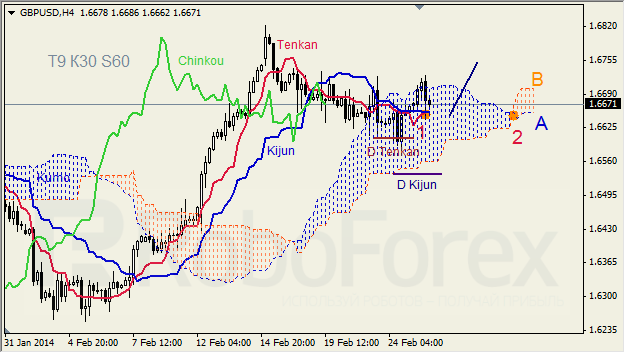
GBP USD, Time Frame H4. Tenkan-Sen and Kijun-Sen are very close inside Kumo Cloud (1); all lines are horizontal. Ichimoku Cloud is going down (2), and Chinkou Lagging Span is on the chart. Short‑term forecast: we can expect support from Tenkan-Sen – Kijun-Sen, and growth of the price.

GBP USD, Time Frame H1. Tenkan-Sen and Kijun-Sen are very close inside Kumo Cloud (1); all lines are horizontal. Ichimoku Cloud is going up (2), and Chinkou Lagging Span is above the chart. Short‑term forecast: we can expect support from Senkou Span B, and growth of the price.

XAU USD, “Gold vs US Dollar”

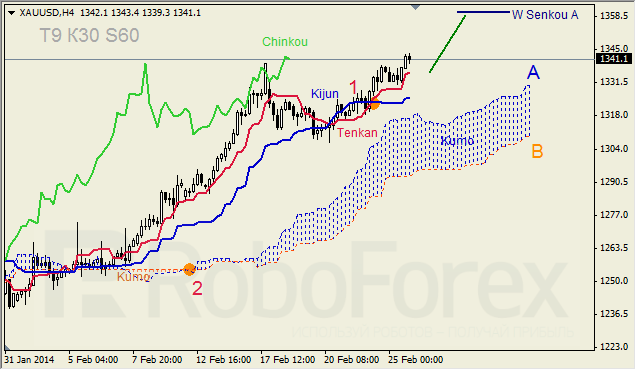
XAU USD, Time Frame H4. Tenkan-Sen and Kijun-Sen intersected above Kumo Cloud and formed “Golden Cross” (1). Ichimoku Cloud is going up (2), and Chinkou Lagging Span is above the chart. Short-term forecast: we can expect support from Tenkan-Sen, and growth of the price.

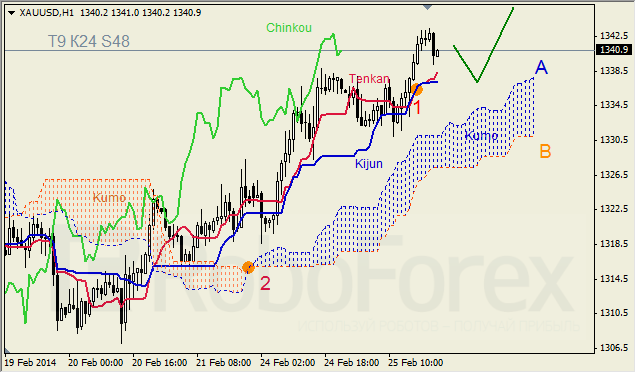
XAU USD, Time Frame H1. Tenkan-Sen and Kijun-Sen intersected above Kumo Cloud and formed “Golden Cross” (1); Tenkan-Sen and Senkou Span A are directed upwards. Ichimoku Cloud is going up (2), and Chinkou Lagging Span is above the chart. Short‑term forecast: we can expect support from Tenkan-Sen – Kijun-Sen, and growth of the price.

RoboForex Analytical Department

Article By RoboForex.com

Attention!
Forecasts presented in this section only reflect the author’s private opinion and should not be considered as guidance for trading. RoboForex LP bears no responsibility for trading results based on trading recommendations described in these analytical reviews.


AUDUSD moved sideways without trend

AUDUSD moved sideways without trend in a range between 0.8906 and 0.9080 for several days. As long as 0.8906 support holds, the price action in the range could be treated as consolidation of the uptrend from 0.8660, another rise towards 0.9400 could be expected after consolidation. On the downside, a breakdown below 0.8906 support will signal completion of the uptrend from 0.8660, then the following downward movement could bring price back to 0.8500 zone.

audusd

Provided by ForexCycle.com

Don’t Be like These Five Bad Investors…

By MoneyMorning.com.au

Our biggest regret from last year is that we didn’t invest in Bitcoin when it was US$40, before it soared to US$1,200.

Our biggest relief this year is that we didn’t invest in Bitcoin when it was US$1,200, before it crashed to US$100…and before the world’s biggest Bitcoin exchange – Mt Gox – got into what appears to be financial as well as technical strife.

But we could have invested at the top. And maybe we would have if we didn’t have a disciplined approach to investing.

You need that discipline, because sometimes the thrill of investing can make you do crazy things.

Here’s how to prevent that happening…

In the nearly 20 years since we first got into the markets, we’ve seen it all. We’ve seen and dealt with almost every type of investor.

But what we’ve noticed is that certain undisciplined investors tend to fall into five distinct types. We’ve tried to categorise them in today’s Money Morning.

We don’t do this to ridicule them or make fun of them. We do it because there’s something you can learn from this. Perhaps you’ll even recognise yourself in some of these types.

If so, hopefully it will give you a jolt and help you become a better and more disciplined investor

Avoid These Five Investing Traits to be a Better Investor

  1. Flying Blind: This is where you don’t know anything about the company except that the share price is going up. This is a classic trap for novice traders, especially those who have spent a fortune buying a stock market charting package.

They’ll get the software and then conduct one of the most basic scans. That usually involves getting the software to churn out all the stocks that have risen X% that day, or which have seen unusually high volumes that day (volume spike).

This strategy may work if you’re lucky. But odds are if you try to chase a stock price higher you’re more likely to end up chasing it lower as you and a thousand other investors scramble to exit.

  1. Lazy Expert: This is the investor who can’t be bothered doing any research into a particular company or industry because they claim they don’t like the look of it or they don’t understand it.

But suddenly, when the company’s share price takes off they become an expert overnight. They now believe it’s the greatest company in the world. Not because they know anything about it, but because the share price is going up.

This type of investor will always be chasing their tail. They’re lazy. Rather than putting in a small amount of effort to research or read about a particular stock, this type of investor only ever invests in yesterday’s stories rather than today’s or tomorrow’s opportunities.

  1. Fear of Missing Out: We’re sure you’re familiar with this type of investor. This is the investor who just can’t help themself.

They worry that if they don’t buy into this one stock right now then they’ll never have an opportunity ever again. It’s as though it’s their only chance ever to buy a stock that’s going up.

Of course, that’s not true. The Aussie stock market for has nearly 2,000 listed companies. On any given day there are hundreds of stocks that fall in price and hundreds of others that rise in price.

If you start thinking to yourself that you’ll never have an opportunity to invest in a particular stock again, then it’s probably a good time to turn off your computer and go for a walk. We can assure you that you will have another opportunity, if not with that stock then with another stock.

  1. The Reluctant Investor: This is an interesting one. The reluctant investor is relatively unique. They aren’t prone to quick decisions…and that’s their problem.

This is the investor who may do a little or a lot of research about a stock. He or she likes the stock. So at 10am as the market opens they sit at the computer waiting to buy…and they wait…and wait…and wait.

They’re waiting because as the stock ticks higher, they’re convinced it will fall one cent so they can buy it at a cheaper price. Only, when it falls by that one cent they’re convinced it will fall another cent…only it ticks higher, then lower, and so on throughout the day.

There’s a good chance that by the end of the day they still haven’t bought the stock. So they go through the same song and dance the following day…and never end up investing a dollar.

  1. Regretful Investor: This is the investor who regrets that they missed out on a great investing opportunity in the past, and now they’re determined to make up for it…by buying the same stock at a much higher price.

You may have done this. You may have done a whole lot of research on a stock, but for whatever reason decided not to buy it. Then it turns out the stock doubled or tripled in price.

You wish you had bought it. And so, what does this investor do? That’s right, they jump in. In some cases the investor can get lucky. But in many cases the investment turns sour. It turns into the classic case of ‘buying high and selling low’.

You’ll rarely get any joy by regretting past decisions and then trying to make up for them in the future. Remember, when there are nearly 2,000 stocks on the ASX, you’re more likely better off looking for something new rather than trying to make up for something you missed.

The bottom line is this: there are plenty of opportunities to make money from stocks. As we’ve noted this week, we’re backing the Aussie market to almost triple over the next four to five years.

If we’re right that will present many opportunities for you to back winning stocks.

So if you miss one opportunity, don’t panic. Don’t fall into one of the traps we’ve highlighted above. There’s rarely anything to gain from making a rash investing decision. More likely than not you’ll only regret it.

Cheers,
Kris+
 
PS: You can quiz me on my bullish stock market views in person at the upcoming World War D conference in Melbourne at the end of next month. I’ll be on the stage with global finance gurus Dr Marc Faber, Jim Rickards, and Satyajit Das. You can find out more here about what I consider to be the best money and finance conference in Australia this year. Click here for the revealing trailer…

Special Report: Retirement Security Ladder

Join Money Morning on Google+


By MoneyMorning.com.au

Demographic Policy Shenanigans

By MoneyMorning.com.au

Imagine if Centrelink sent your children a bill to pay for part of your pension. That’s what’s happening to many rather surprised Germans whose parents failed to prepare for retirement.

In Germany – my country of birth – if the pension doesn’t cover the cost of living for elderly people, they can request for the welfare state to send their children part of the bill for the additional costs. And, thanks to a recent ruling of the Bundesgerichtshof, Germany’s high court, even parents who have practically disowned their children can still make the request.

What does that have to do with you? Well, the disastrous effects that declining demographics will have on financial and property markets are probably the biggest risk to your retirement finances. This is an issue that I often cover in my retirement-focussed newsletter, The Money for Life Letter. But troubled investments aren’t the only way demographics will affect you.

Government policy is going to come up with all sorts of odd ‘solutions’ to the problem of an ageing population. To get a taste of what’s to come, let’s take a closer look at Germany.

Germans practically invented the welfare state back in the 1880s. But German demographics today are particularly bad. A high level of immigration is causing social strife. There are state schools where German is practically a second language.

The lack of government support and the cost of aged care, thanks largely to horrendous government regulation, forces many cash strapped working age Germans to send their aged parents to Poland for cheaper care. It’s an incredibly depressing scenario, and utterly bewildering for many of the elderly who find themselves deported to another country. But it’s an increasingly popular solution to tough times.

With the requirement of supporting your parents in retirement legally affirmed, Germany’s working population is in for a rough time. The blogger Martin Armstrong declared the high court ruling ‘the end of the social state‘. Quite frankly, he misunderstood the ruling. The law is nothing new. The ruling only clarified the situation for parents and children who had fallen out.

But he has a point. The working populations of the future will not be able to support an ageing population, laws or not. In parts of Asia, parents have many children to ensure their retirement finances. In the West, the government is held responsible. But the same maths applies. You need several people of working age to support a single retiree. Whether it’s by taxes and welfare, or by buying up the investments that retirees sell. Either way, the funds for retirement must come from somewhere.

Worse still, the increased burden has another demographic effect. As Japan is discovering, the younger generation is struggling to support its own children and many are giving up on a family. Surveys report that many Japanese men have no interest in relationships. That means the demographic crisis will be even worse in the future.

The more I research this topic, the more worried I become. There is a real risk of a demographic divide occurring as the younger generations give up on supporting the older ones. Simply accumulating assets to sell isn’t enough of a solution. The young won’t buy them off you for a decent price.

I’ll be presenting my solution to the problem at our upcoming conference. If you haven’t already, you can register here. But fair warning, my solution certainly won’t be popular.

Nick Hubble+
Editor, The Money for Life Letter

Ed note: The above article is an edited extract for The Money for Life Letter.

Join The Daily Reckoning on Google+


By MoneyMorning.com.au

Paul Renken: For 2014 Gains, Look to Uranium, PGMs and Gems

Source: Brian Sylvester of The Mining Report  (2/25/14)

http://www.theaureport.com/pub/na/paul-renken-for-2014-gains-look-to-uranium-pgms-and-gems

Paul Renken, senior geologist and analyst with VSA Capital, calls 2014 a soft year for gold and silver prices, but foresees stronger prices—and demand—for nickel, copper and tech metals as the year progresses. In this Mining Report interview, he lists the three commodities investors should feel good about and digs into the details of the Indonesian ban on exports of raw ore.

The Mining Report: Paul, what three predictions for 2014 does VSA Capital have for mining investors?

Paul Renken: We believe three commodities offer the best opportunities for capital or investment gains in 2014. First, several factors indicate that the uranium space will revert to the positive side. The end of Russia’s Megatons to Megawatts program will take a significant amount of material out of the spot market. And while the Japanese reactors haven’t yet come back on-line—and indeed Japan has been leaking some yellowcake, now surplus to requirements, into the market—we expect at least two reactors will be allowed to restart in 2014. Japan’s balance-of-payments deficit is getting serious, due to the need to import liquid natural gas to make up its energy demand shortfall. All of this is favorable to uranium’s spot price, which should rise to the $40/pound ($40/lb) level.

Second, we’re bullish on the platinum group metals (PGMs). There is a significant amount of above-ground stocks, but labor issues remain volatile in South Africa. Last year, the country’s Mines Minister had conversations with the Russian government about creating what they called a cooperative agreement, but which the commercial markets would call a cartel, to gain more control over the price and availability of PGMs. Another piece of news in the PGM space is the difficulties Colossus Minerals Inc. (CSI:TSX; COLUF:OTCQX) is having obtaining financing on its project in Brazil. That was to be a significant gold and PGM producer outside of South Africa. Today, that project no longer appears to be reasonable or even probable, due to financial difficulties. Given the improved auto-manufacturing outlook in Europe, China and elsewhere, we think PGM prices will continue to firm through the year.

Third, we think that gemstones, specifically the diamond space, is a good place to be this year. The luxury market continues to show buoyancy. We appreciated the comments Gem Diamonds Ltd. (GEMD:LSE; GEMD:VIRTX; ZVW:FSE) issued last month on its production figures and sales. That company is in production in Lesotho and announced that its average selling price on the stones has improved by 43% since H1/13. That indicates a lot of interest in the retail space. Any company in position to produce gemstones—diamonds in particular—will do well this year.

TMR: Looking back on 2013, which predictions in the mining space did VSA get right?

PR: I have to start by admitting that many analysts, myself included, got many things wrong as far as equities were concerned, with the big downdraft in precious metals selling that began in April. But we did get a good many things right.


We correctly forecast the average of both thermal and metallurgical coal prices for 2013 in the relative range of $90-100/ton for thermal and in the $140/ton range for metallurgical coal.

We also were proved right in predicting that the copper equities, particularly the large copper producers, would underperform in relation to the copper price. The copper price came off from an average, but the copper equities sold off significantly more.

TMR: How would you describe the current state of the mining space?

PR: We do see significant pressures on gold and silver prices, with the selloff of exchange-traded fund products continuing into 2014. At the same time, there are concerns that the Federal Reserve’s tapering will be whittled back. That will have the effect of improving the U.S. dollar. Overall, until we get some clear sense of direction, we think it’s a mixed bag.

TMR: VSA Capital CEO Andrew Monk predicts that the FTSE will finish the year at 72.50. It’s currently around 65.50. What will account for that 11%?

PR: The general investor sentiment among European and North American institutional managers is that U.K. equity valuations overall are somewhat of a bargain. In addition, going into 2014, the U.K. economy appears to be the strongest among the major economies.

Those two factors are causing institutional investors to buy into U.K. equity. Of course, the biggest names in U.K. equity are in the FTSE, so that’s where we see the strength coming from.

TMR: In general, Western market strength leads to currency strength, which is typically a recipe for lower gold prices. What is VSA’s forecast for gold and silver prices in 2014?

PR: We are in the modestly bearish camp at this point. Our market view sees the gold price spending much of the year between $1,100–1,200/oz ($1,180/oz average for the year), with some strengthening going into Q4/14, when we expect signs of inflation to start appearing.

Because of industrial demand for silver, we expect the silver:gold ratio to improve over where it was in 2013. We expect the silver price to remain below $21/oz for much of the year. Toward the end of 2014, it too should move up on inflationary expectations.

TMR: A recent VSA research report said that Indonesia will no longer ship raw ore. This has limited the supply of nickel laterite ore available to Chinese steel smelters. Does this mean nickel prices are heading higher?

PR: We’re generally constructive on the nickel price, because of concerns raised by the Indonesian ban among nickel pig iron producers in China, who had steered their industry toward this high-grade laterite nickel ore from Indonesia. We think the nickel price will improve from here. By the same token, there is a lot of nickel metal in warehouse inventory and we would have to see those inventories come down before having sustained confidence in a higher price.

TMR: When is that likely to happen?

PR: There was evidence throughout 2013 of the Chinese stockpiling nickel laterite ore for use in the event of an Indonesian ban. We figure there’s a good four to eight months worth of high-grade nickel laterite ore in stockpiles in China. This gives the Chinese mills time to seek alternative supplies.

TMR: In your last Mining Report interview, you talked at length about Royal Nickel Corp. (RNX:TSX). What’s happening with Royal Nickel now?

PR: Royal Nickel is in the process of obtaining the final permits to gain its construction license. These permits are the kind of thing debt financiers and major capital investment institutions will be looking for to provide the capital to build the mine and mill itself.

Certainly the improvement in the outlook for nickel helps a firm like Royal Nickel. Its deposit is generally low-grade, but it is very, very big. It offers a secure supply, not for just a few years but for a few decades. And it’s located in Québec, a world-class mining jurisdiction in terms of government and infrastructure support. All of that will help Royal Nickel’s case as far as getting financed and starting construction.

Explorers are not finding nickel deposits that are easy to mine. It’s a question of finding the companies that will become the most reliable suppliers. You have to believe that Royal Nickel can deliver a reliable supply of nickel for a really extended period of time to buy into it.

TMR: Do you follow other nickel equities?

PR: We follow quite a number of them, because we are curious to see if they are able to produce what they say they will produce, according to the timeline they claim.

For example, Horizonte Minerals Plc (HZM:LSE; HZM:TSX) has a nickel laterite deposit in Brazil. It’s in an area that is already producing nickel from other laterites. The company is coming along through the process. Teck Resources Ltd. (TCK:TSX; TCK:NYSE) is a significant shareholder in Horizonte, which indicates Teck’s confidence that this particular deposit will eventually be mined.

We also follow Talvivaara Mining Company Plc. (TALV:LSE), also London listed, based in Scandinavia. It has been trying to produce nickel from very low-grade material by bioleaching. The company has been struggling to get up to capacity. We are skeptical that the company will be able to make it work commercially.

Among the big players there is Norilsk Nickel (GMKN:RTS; NILSY:NASDAQ; MNOD:LSE), the big Russian supplier of nickel and PGMs. That’s the elephant in the room as far as worldwide supplies are concerned.

There are a number of ASX (Australian Securities Exchange) juniors as well, such as Western Areas Ltd. (WSA:TSE; FX9:FRA; WSA:ASX; WNARF: OTCMKTS;), which has mined high-grade sulfide material. That company has consistently made profits year after year.

TMR: VSA adjusted its 2014 copper price up to $3.67/lb to account for improved annual Chinese GDP (gross domestic product) growth expectations. Which companies have exposure to high copper prices?

PR: Freeport-McMoRan Copper & Gold Inc. (FCX:NYSE) has to be one of the companies that people want to keep an eye on. It will be most affected by the Indonesian ban, because the ban includes copper concentrates.

If Freeport-McMoRan complies with the ban, it would have to cut back production at its Grasberg mine by about two-thirds, producing only as much concentrate as the existing smelters inside Indonesia can handle.

Freeport-McMoRan got a temporary exclusion to allow exports through 2017. If it is not allowed to export the rest after 2017, it will be a significant impairment for both the asset and the firm’s ability to make sizeable money. The Grasberg deposit is one of the 10 largest in the world and it happens to have the biggest gold endowment of any single deposit in the world as well.

Other producers that have significant exposure to copper or to a better copper price would be firms like First Quantum Minerals Ltd. (FM:TSX; FQM:LSE)Taseko Mines Ltd. (TKO:TSX; TGB:NYSE.MKT)Grupo México (GMEXICOB:MXN) and Southern Peru Copper Corp. (SCCO:NYSE). All of those should be able to benefit from a reasonably buoyant copper price.

TMR: VSA has reported growing demand for niobium, tantalum, indium and lithium, all of which are used in products like tablets and smart phones. What are your theses for those metals?

PR: Niobium and tantalum are produced from minerals called colombite and tantalite—combined by the industry into the word “coltan.” They are used in the battery packs of every portable communication device we have: cell phones, laptops, tablets. Granted, the amount used in each battery is small, but millions of these devices are being produced, making this a significant market.

Niobium and tantalum producers are in places like Australia, Brazil and Canada. The minerals have a high specific gravity, and thus can be easily concentrated with very nominal or artisanal mining methods. As a result, a lot of this material moves in the shadow world of individually traded barrels, often from countries that have had difficulties with social and civil strife. That’s one of the specific reasons why the United States passed a conflict-free mineral law targeting the Democratic Republic of the Congo and neighboring states. The objective of the law is to get control of the trade or provenance of this coltan so consumers are not indirectly financing civil wars.

TMR: Are there any equities in the tantalum and niobium space?

PR: There are. Among producers, Lynas Corp. (LYC:ASX) and Molycorp Inc. (MCP:NYSE) stand out for the rare earth elements that they produce, as well as niobium and tantalum. The Niobec division ofIAMGOLD Corp. (IMG:TSX; IAG:NYSE) has been consistently profitable for quite some years now because of its mine in Canada.

TMR: Do you want to talk about another of those metals you named?

PR: Indium is what makes touch screens work. There’s a little coating of indium on the back of the quartz or a zircon screen you look at on your tablet or cell phone. The indium picks up a little signal of electricity when you touch the screen.

Lithium is all about the coming electrification of the transportation industry, specifically lithium-ion batteries. Within the lithium space are companies like FMC Lithium Corp. (FMC:NYSE) and a significant Latin American producer, Sociedad Química y Minera de Chile S.A. (SQM:NYSE; SQM-B:SSX; SQM-A:SSX). Both are in a good position to capitalize on lithium’s growth.


TMR: Do you have any parting thoughts for us?


PR: Don’t give up on the mining industry. A lot of people did tax-loss selling for 2013 because of the significant losses they had in equities. I agree with Rick Rule: If you’ve hung in there this long, then why not hang on long enough to participate when these materials rally in 2014 and 2015?


Timing is the particular issue. The rally will happen when we start seeing inflation numbers and rising interest rates around the world. We’re not there yet.


TMR: Paul, thank you for your time and your insights.


Paul Renken has a broad range of experience in various aspects of the mining and minerals business. He began his career as a geologist for Canadian junior resource companies in the Western United States. Owning a stake in a private consulting firm as vice president of exploration, Renken searched for various base metals, precious metals and industrial minerals. In the U.K., he worked in the equity market media outlets of Digitallook and Hemscott before joining VSA as mining analyst in 2006.


Want to read more Mining Report interviews like this? Sign up for our free e-newsletter, and you’ll learn when new articles have been published. To see a list of recent interviews with industry analysts and commentators, visit our Streetwise Interviews page.


DISCLOSURE:
1) Brian Sylvester conducted this interview for The Mining Report and provides services to The Mining Report as an employee or as an independent contractor. He or his family own shares of the following companies mentioned in this interview: None.
2) The following companies mentioned in the interview are sponsors of The Mining Report: Royal Nickel Corp. Streetwise Reports does not accept stock in exchange for its services or as sponsorship payment.
3) Paul Renken: I or my family own shares of the following companies mentioned in this interview: None. I personally am or my family is paid by the following companies mentioned in this interview: None. My company has a financial relationship with the following companies mentioned in this interview: Royal Nickel Corp. I was not paid by Streetwise Reports for participating in this interview. Comments and opinions expressed are my own comments and opinions. I had the opportunity to review the interview for accuracy as of the date of the interview and am responsible for the content of the interview.
4) Interviews are edited for clarity. Streetwise Reports does not make editorial comments or change experts’ statements without their consent.
5) The interview does not constitute investment advice. Each reader is encouraged to consult with his or her individual financial professional and any action a reader takes as a result of information presented here is his or her own responsibility. By opening this page, each reader accepts and agrees to Streetwise Reports’ terms of use and full legal disclaimer.
6) From time to time, Streetwise Reports LLC and its directors, officers, employees or members of their families, as well as persons interviewed for articles and interviews on the site, may have a long or short position in securities mentioned and may make purchases and/or sales of those securities in the open market or otherwise.


Streetwise – The Gold Report is Copyright © 2014 by Streetwise Reports LLC. All rights are reserved. Streetwise Reports LLC hereby grants an unrestricted license to use or disseminate this copyrighted material (i) only in whole (and always including this disclaimer), but (ii) never in part.


Streetwise Reports LLC does not guarantee the accuracy or thoroughness of the information reported.


Streetwise Reports LLC receives a fee from companies that are listed on the home page in the In This Issue section. Their sponsor pages may be considered advertising for the purposes of 18 U.S.C. 1734.


Participating companies provide the logos used in The Gold Report. These logos are trademarks and are the property of the individual companies.


101 Second St., Suite 110
Petaluma, CA 94952

Tel.: (707) 981-8999
Fax: (707) 981-8998
Email: [email protected]


Demographic Policy Shenanigans

By MoneyMorning.com.au

Imagine if Centrelink sent your children a bill to pay for part of your pension. That’s what’s happening to many rather surprised Germans whose parents failed to prepare for retirement.

In Germany – my country of birth – if the pension doesn’t cover the cost of living for elderly people, they can request for the welfare state to send their children part of the bill for the additional costs. And, thanks to a recent ruling of the Bundesgerichtshof, Germany’s high court, even parents who have practically disowned their children can still make the request.

What does that have to do with you? Well, the disastrous effects that declining demographics will have on financial and property markets are probably the biggest risk to your retirement finances. This is an issue that I often cover in my retirement-focussed newsletter, The Money for Life Letter. But troubled investments aren’t the only way demographics will affect you.

Government policy is going to come up with all sorts of odd ‘solutions’ to the problem of an ageing population. To get a taste of what’s to come, let’s take a closer look at Germany.

Germans practically invented the welfare state back in the 1880s. But German demographics today are particularly bad. A high level of immigration is causing social strife. There are state schools where German is practically a second language.

The lack of government support and the cost of aged care, thanks largely to horrendous government regulation, forces many cash strapped working age Germans to send their aged parents to Poland for cheaper care. It’s an incredibly depressing scenario, and utterly bewildering for many of the elderly who find themselves deported to another country. But it’s an increasingly popular solution to tough times.

With the requirement of supporting your parents in retirement legally affirmed, Germany’s working population is in for a rough time. The blogger Martin Armstrong declared the high court ruling ‘the end of the social state‘. Quite frankly, he misunderstood the ruling. The law is nothing new. The ruling only clarified the situation for parents and children who had fallen out.

But he has a point. The working populations of the future will not be able to support an ageing population, laws or not. In parts of Asia, parents have many children to ensure their retirement finances. In the West, the government is held responsible. But the same maths applies. You need several people of working age to support a single retiree. Whether it’s by taxes and welfare, or by buying up the investments that retirees sell. Either way, the funds for retirement must come from somewhere.

Worse still, the increased burden has another demographic effect. As Japan is discovering, the younger generation is struggling to support its own children and many are giving up on a family. Surveys report that many Japanese men have no interest in relationships. That means the demographic crisis will be even worse in the future.

The more I research this topic, the more worried I become. There is a real risk of a demographic divide occurring as the younger generations give up on supporting the older ones. Simply accumulating assets to sell isn’t enough of a solution. The young won’t buy them off you for a decent price.

I’ll be presenting my solution to the problem at our upcoming conference. If you haven’t already, you can register here. But fair warning, my solution certainly won’t be popular.

Nick Hubble+
Editor, The Money for Life Letter

Ed note: The above article is an edited extract for The Money for Life Letter.

Join The Daily Reckoning on Google+


By MoneyMorning.com.au

Important Facts To Consider When Choosing A Binary Options Broker

Binary Options TradingBinary options trading has gained a lot of popularity in recent years. Having the ability to trade the direction of underlying products in various time frames has brought in many more traders to try their hand at trading binary options.

One of the most important decisions to make when trading binary options is which binary options broker to use. There are many factors to take into consideration when making this decision.

Here are some of the more important facts to consider and questions to ask.

Is your binary options broker a member of a regulatory body or regulated by a major regulatory authority? Using a regulated binary options broker can assure that the broker treats the account within the guidelines of that regulatory body. When the brokers has rules and guidelines to follow that I one less thing that the client needs to worry about.

Does your binary options broker actually offer you a trading platform? This is important so that the binary options broker is providing the utmost in terms of market transparency. Being able to see real-time quotes of the underlying product as well as to have full charting capability are essential.

Is your binary options broker responsive? The binary options broker should have easy use of communication for their potential and existing clients as well as a dedicated support staff.

Does your binary options broker offer an easy deposit and withdrawal system? It is important for the binary options broker to offer an easy way not only to deposit but the process withdrawals as well. Withdrawals from the broker should be processed in a timely manner.

Does your binary options broker offer trading of multiple products within one platform? Customers should not have to go to one broker to trade binary options and another broker to trade FX.

The choices of a binary options broker is an important one, do your research and decide on the correct broker and your trading experience will be all that much better.


To learn more please visit www.clmforex.com

Disclaimer: Trading of foreign exchange contracts, contracts for difference, derivatives and other investment products which are leveraged, can carry a high level of risk. These products may not be suitable for all investors. It is possible to lose more than your initial investment. All funds committed should be risk capital. Past performance is not necessarily indicative of future results. A Product Disclosure Statement (PDS) is available from the company website. Please read and consider the PDS before making any decision to trade Core Liquidity Markets’ products. The risks must be understood prior to trading. Core Liquidity Markets refers to Core Liquidity Markets Pty Ltd. Core Liquidity Markets is an Australian company which is registered with ASIC, ACN 164 994 049. Core Liquidity Markets is an authorized representative of Direct FX Trading Pty Ltd (AFSL) Number 305539, which is the authorizing Licensee and Principal.


Bernanke’s Legacy

By Dennis Miller, Miller’s Money

“Mr. Bernanke, on the way out, don’t let the door hit ya, where the good Lord split ya!” That’s what I’ve imagined my former coworker Charley—a brilliant Alabamian who was proud to be called a redneck—might have said as the former Fed chairman stepped down.

In case you missed it, here’s Bernanke’s highlight reel:

  • The Federal Reserve jumped in and bailed out “too big to fail” banks that made bad business decisions.
  • The Fed continued to buy Treasury bonds in order to keep interest rates down.
  • The Fed openly acknowledged that their policies force seniors to put their life savings at risk.
  • Around 25% more baby boomers and Generation Xers will not have enough money because of Fed policies.
  • The Fed is creating a stock market bubble that will eventually burst.
  • Bankers are making record profits and paid out record bonuses for 2013.
  • Bernanke left behind a 100-year money supply that is continuing to double annually.

During his tenure, Bernanke essentially acted as the chairman of a corporation owned by banks and bankers. I’ve touched on the difference between the Fed’s published goals and how it actually behaves before. The party line: the Fed is a government agency acting in our best interest. Mr. Bernanke is just one of many chairmen who have continued to foster that illusion.

In Code Red, authors John Mauldin and Jonathan Tepper pull the curtain on Zero Interest Rate Policy (ZIRP) to reveal a merciless wizard. Basically, the Federal Reserve has deliberately driven interest rates so low that safe government bonds and government-backed CDs offer interest rates that do not keep up with inflation—which translates into true negative yield for investors. Historically, these fixed-income investments made up the majority of retirees’ investment portfolios.

In the words of the authors:

“When real rates are negative, cash is trash. Negative real rates act like a tax on savings. Inflation eats away at your money, and is, in effect, a tax by the (unelected!) central bankers on your hard-earned money. Leaving money in the bank when real rates are negative guarantees that you will lose purchasing power. Negative real rates force savers and investors to seek out riskier and riskier investments merely to tread water. It almost guarantees people don’t save and stop spending.

In fact, Bernanke openly acknowledges that his low-interest-rate policy is designed to get savers and investors to take more chances with riskier investments. The fact that this is precisely the wrong thing for retirees and savers seems to be lost in their pursuit of market and economic gains.”

On the other hand, if you are a banker you will love his legacy. Sheraz Mian broke down the Q2 2013 earnings reports of the S&P 500 companies in Zacks’ Earning Trends:

“Yes, the total earnings tally reached a new quarterly record in Q2 and the rest of the aggregate metrics like growth rates and beat ratios look respectable enough. But all of that was solely due to one sector only: Finance. … Finance results have been very strong, with total earnings for the companies that have reported results up to an impressive +30% on +8.5% higher revenues.”

Too big to fail banks were certainly succeeding on Bernanke’s watch. Mian continued:

“Earnings growth was particularly strong at the large national and regional banks, with total earnings at the Major Banks industry, which includes 15 banks like J.P. Morgan and Bank of America.”

While banks were making record profits, seniors and savers had been left to fend for themselves. What did Bernanke have to say about this? Well, in January 2011, he said:

“Policies have contributed to a stronger stock market just as they did in March 2009, when we did the last iteration of this. The S&P 500 is up 20%-plus and the Russell 2000, which is about small cap stocks, is up 30%-plus.”

He continued along that same vein in 2012:

“Large-Scale Asset Purchases (LSAP) also appear to have boosted stock prices, presumably both by lowering discount rates and by improving the economic outlook; it is probably not a coincidence that the sustained recovery in US equity prices began in March 2009, shortly after the FOMC’s decision to greatly expand securities purchases. This effect is potentially important because stock values affect both consumption and investment decisions.”

I guess that means Mr. Bernanke, through the asset purchases of the Federal Reserve, is now responsible for propping up the stock market. So now both the big banks and Wall Street are their primary concern?

Perhaps he thought he was doing us a favor by forcing us to risk our money in the market. That’s the kind of favor we sure don’t need.

Good for Bankers, Bad for Anyone Who Wants to Retire

In the summer of 2013, the Employee Benefit Research Institute published a survey about low-interest-rate policies and their impact on both baby boomers and Generation Xers who are following right behind. The bottom line:

“Overall, 25–27 percent of baby boomers and Gen Xers who would have had adequate retirement income under return assumptions based on historical averages (emphasis mine) are simulated to end up running short of money in retirement if today’s historically low-interest rates are assumed to be a permanent condition, assuming retirement income/wealth covers 100 percent of simulated retirement expense.”

Seniors and savers have yet to experience the long-term impact of Bernanke’s policies. Tim Price summed it up this way in an article from Sovereign Man:

“Why do we continue to keep the faith with gold (and silver)? We can encapsulate the argument in one statistic.

Last year, the US Federal Reserve enjoyed its 100th anniversary, having been founded in a blaze of secrecy in 1913. By 2007, the Fed’s balance sheet had grown to $800 billion.

Under its current QE programme (which may or may not get tapered according to the Fed’s current intentions), the Fed is printing $1 trillion a year.

To put it another way, the Fed is printing roughly 100 years’ worth of money every 12 months. (Now that’s inflation.)”

While Bernanke may have gotten out while the getting was still good, the effects of his policies on seniors and savers may be felt for years to come. Inflation is a huge—potentially catastrophic—tax on our savings.

Mr. Bernanke protected the banking system profits at the expense of several generations of hard-working people. If I am ever at an event where he is speaking and he sees me raise my hand, he’d be well advised to call on someone else…

But, it’s not all doom-and-gloom. There are ways to invest safely in order to produce returns well above inflation – and receive solid dividends – without exposing your nest egg to undue risk.

We, like you, strive for bulletproof income and we have found several opportunities out there to grow your nest egg while protecting it. And you can get access to these investments today, risk-free, by trying Miller’s Money Forever. With our 90-day trial you get access to the complete portfolio, our special reports dedicated to issues facing investors today, and all of our archives. In them you’ll find several interviews like this one with experts from all sectors.

So, try it today. You risk nothing and you will find stocks poised to make you the returns you want, with the protection you need.


The article Bernanke’s Legacy was originally published at millersmoney.com.

Trading Candlestick Patterns At Key Levels

Article by Investazor.com

In our past articles Candlesticks In Day To Day Trading and Candlestick Patterns In Technical Analysis we have introduced you in the world of the candlestick chart. You found out how to read this kind of chart, you learnt what the most important patterns are and which to trust more, thanks to the psychology from behind.

In this article I will show you where to look for the candlestick patterns which have higher probability to signal a good trade. It is very important to know that such a pattern gives a stronger signal if it is formed on a higher time frame and if it appears after a clear up/down move. Other important factors that raise the probability are the technical elements like support/resistance, Fibonacci, Oscillators, Moving Averages and other type of instruments. I will tell you more now how to trade candlestick patterns at key level support and resistances.

Support – it is a relevant price level for the future price action, because it has triggered a reaction in the past. It is expected to act as a floor next time the price will hit it. The support level is more important if it has resisted in time, if it is found on a higher time frame and if it was touched more than 2 times.

Resistance – it is a relevant price level for the future price action, because it has triggered a reaction in the past. It is expected to act as a ceiling next time the price will hit it. The resistance level is more important if it has resisted in time, if it is found on higher time frame and if it was touched more than 2 times.

As you can see the definitions are pretty the same. It only differs from where the price will hit the level. If the price falls it is expected to be stopped by a support, if it rises it is expected to be stopped by a resistance. Usually a broken support becomes resistance, while a broken resistance becomes support. Ex tops or bottoms can become support/resistance and also very important are round numbers because they have a heavier psychology implication.

To understand why this support/resistance work we should bear in mind that at those level the collective memory works. If at some point the price was rejected from a certain level, investors will know and will react again when the price will touch it. For better understanding I will make this short comparison. If someone will touch something, without knowing the fact that it is very hot, it will burn himself. Because of it provokes pain, next time will be more attentive before touching it. This is how support/resistance work in most of the cases.

Lower you will see several examples of Candlestick Patterns at important support and resistance Levels:

bearish-engulfing-eurusd-resize-25.02.2014

hammer-on-support-resize-25.02.2014

Shooting-Star-Hammer-resize-25.02.2014

Shooting-Star-Piercing-Line-Evening-Star-resize-25.02.2014

So now you know that candlestick patterns will have a higher probability if found at important support/resistance level. I will give you an example on how to trade such a setup.

trade-a-shooting-star-resize-25.02.2014

In our last image you will see a Shooting Star pattern drawn at a round level, 0.8400, which was tested in the past as resistance. When the day closes and confirms the reversal pattern a trader should open a trade on the opening of the next day (or trading session if he will use a different time frame). The Stop Loss should be set above the candlestick’s upper shadow. If the price will break above its high, then the reversal pattern will be invalidated. The Take Profit it is not given by this pattern so a trader should find a near term support and set it around it.

The trade setups based on this technical combination are very easy to find and profit from. I would recommend you to not take it as granted. To find the best setups and make money from trading them you should first exercise on demo accounts, set up money management systems to work with this kind of trading strategies and after that try trading real money.

The post Trading Candlestick Patterns At Key Levels appeared first on investazor.com.