The private payrolls report from ADP/Moody’s Analytics showed another weak month. Private hiring rose by just 102,000 jobs in June. This was below the estimates of 140,000.
Data for May was revised higher from 27,000 to 41,000. Meanwhile, the ISM’s non-manufacturing PMI fell from 56.9 in May to 55.1 in June. The data renewed hopes that the Fed will respond with a rate cut as early as July. The US markets are closed today.
Euro Stays Subdued on Services PMI
The euro was trading flat on Wednesday although the bearish momentum was evident. The June services PMI report published by Markit showed a slightly better than expected headline print. Services activity rose to 53.6, beating estimates of 53.4. The data did not help the euro which remained biased to the downside.
EURUSD Could Decline to 1.1250
The current bearish momentum could keep the EURUSD biased to test the 1.1250 level of support once again. However, we expect price to remain flat in the short term, in the run-up to Friday’s payrolls report. There is scope for the common currency to potentially post a reversal off the current lows above 1.1250 handle on a weaker payrolls report.
Sterling Slips as Services Sector Falls Closer to 50
The UK’s monthly services activity saw another weak month, tracking the slowdown across the manufacturing and construction sectors. Data from Markit saw the UK’s services sector easing to 50.2 in June. This was down from 51.0 estimates and the same level in May. The services activity caps a weak month of June which saw all three sectors showing a slowdown in the economy.
Can the GBPUSD Reverse Losses?
The currency pair has been posting solid declines for three consecutive days. Price action is now close to June 16, 17th lows of 1.2532. If this level is breached, then the potential inverse head and shoulders pattern is likely to become invalid. GBPUSD will need to post a daily close above 1.2600 in order to confirm any potential upside move.
Gold Trades Flat on Risk Off Sentiment
After paring losses, gold prices closed Wednesday on a somewhat flat note. Investors sought risk assets which saw the equities pushing to fresh all-time highs. Expectations of a Fed rate cut led to increased risk appetite. However, in the short term, gold is likely to remain in favor amid easy monetary policy.
Is Gold Due to Correct Lower?
The recent price action in gold saw a retest to the previous six-year high before closing somewhat bearish. The Stochastics oscillator on the daily chart signals a lower high, indicating a possible move to the downside. Price will need to close below 1404.00 in order to confirm the downside bias. The next downside target is seen at 1354.00.
US stock market closed at record on Wednesday in a short session ahead of July 4 holiday. The S&P 500 rose 0.8% to record 2995.82. The Dow Jones industrial average gained 0.7% to record high 26966. Nasdaq composite index advanced 0.8% to record 8170.23. The dollar strengthening resumed as the Automatic Data Processing Inc. reported the US private sector added 102,000 new jobs in June, below the 140,000 expected, but above the 41,000 jobs created in May. The live dollar index data show the ICE US Dollar index, a measure of the dollar’s strength against a basket of six rival currencies, inched up less than 0.01% to 96.75 and is higher currently. US financial markets will be closed today for the Independence Day holiday.
CAC 40 paces European indexes gains
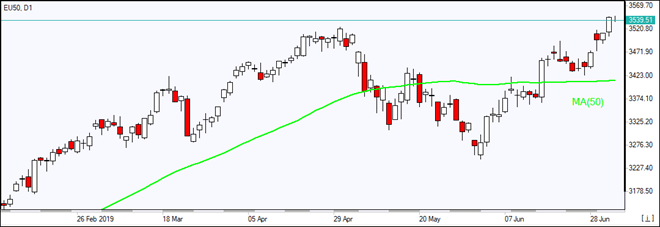
European stocks rose sixth straight session on Wednesday as EU leaders agreed to nominate IMF chief Christine Lagarde as the new head of the ECB. EUR/USD joined GBP/USD’s continuing slide yesterday with Pound lower still currently while euro is higher. The Stoxx Europe 600 rose 0.8% led by travel and leisure shares. Germany’s DAX 30 added 0.7% to 12616.24. France’s CAC 40 advanced 0.8% and UK’s FTSE 100 gained 0.7% to 7609.32.
Australia’s All Ordinaries still ahead of Asian indexes
Asian stock indices are mixed today. Nikkei rose 0.3% to 21702.45 with yen flat against the dollar. Chinese stocks are falling despite White House economic adviser Larry Kudlow’s comment U.S. and Chinese negotiators would talk on the phone next week to set up a new round of meetings: the Shanghai Composite Index is down 0.3% and Hong Kong’s Hang Seng Index is 0.03% higher. Australia’s All Ordinaries Index extended gains 0.5% despite Australian dollar continuing climb against the greenback after report retail sales rose 0.1% in May.
Brent rose after third straight weekly decline is US inventories
Brent futures prices are inching lower today. Prices rebounded yesterday after the Energy Information Administration report US crude inventories declined by 1.1 million barrels last week while gasoline inventories dropped by 1.6 million. September Brent crude rose 2.3% to $63.82 a barrel on Wednesday.
Note: This overview has an informative and tutorial character and is published for free. All the data, included in the overview, are received from public sources, recognized as more or less reliable. Moreover, there is no guarantee that the indicated information is full and precise. Overviews are not updated. The whole information in each overview, including opinion, indicators, charts and anything else, is provided only for familiarization purposes and is not financial advice or а recommendation. The whole text and its any part, as well as the charts cannot be considered as an offer to make a deal with any asset. IFC Markets and its employees under any circumstances are not liable for any action taken by someone else during or after reading the overview.
Amarin shares are spiking up today by more than 12% on greater than five times 50-day average volume after the company updated its annual revenue forecast and plans for Vascepa.
Amarin Corp. (AMRN:NASDAQ) ADR shares are up sharply today after the company reported record revenues for H1/19 and raised yearly revenue guidance from $350 million to $380-$450 million. The company also advised that it plans to double its U.S. sales force by October 2019 and that its sNDA (supplemental new drug application) PDUFA goal date of September 28, 2019, for expanding indications for its first FDA-approved drug Vascepa, remains on track.
“Amarin submitted an sNDA to the U.S. Food and Drug Administration (FDA) in March 2019 seeking to expand the indication for Vascepa based on the positive results of the landmark REDUCE-IT cardiovascular outcomes study. The expanded label is expected to allow for considerably broader promotion of Vascepa in the United States. It was announced in May 2019, the FDA accepted the sNDA for filing and granted Priority Review designation with an assigned PDUFA goal date of September 28, 2019,” the company reported.
If the FDA approves the sNDA, the company noted that “Vascepa is anticipated to be the first drug with an indication to reduce residual cardiovascular risk in patients with statin-managed LDL-cholesterol, but persistent elevated triglyceride (TG) levels, an important indicator of cardiovascular disease.”
Amarin Corp. develops therapeutics to improve cardiovascular health. “Its product development program leverages its extensive experience in polyunsaturated fatty acids and lipid science. Vascepa (icosapent ethyl) is Amarin’s first FDA-approved drug and is available by prescription in the United States,” the release noted.
The company’s U.S. ADR shares are currently trading at $21.94/share, up $2.70/share (+14.03%) over Monday’s close of $19.24. More than 25 million shares have traded through the first three hours of trading, which is more than five times the 50-day average volume of 5.1 million shares/day.
Disclosure: 1) Stephen Hytha compiled this article for Streetwise Reports LLC and provides services to Streetwise Reports as an independent contractor. He or members of his household own securities of the following companies mentioned in the article: None. He or members of his household are paid by the following companies mentioned in this article: None. 2) The following companies mentioned in this article are billboard sponsors of Streetwise Reports: None. Click here for important disclosures about sponsor fees. 3) Comments and opinions expressed are those of the specific experts and not of Streetwise Reports or its officers. The information provided above is for informational purposes only and is not a recommendation to buy or sell any security. 4) The article does not constitute investment advice. Each reader is encouraged to consult with his or her individual financial professional and any action a reader takes as a result of information presented here is his or her own responsibility. By opening this page, each reader accepts and agrees to Streetwise Reports’ terms of use and full legal disclaimer. This article is not a solicitation for investment. Streetwise Reports does not render general or specific investment advice and the information on Streetwise Reports should not be considered a recommendation to buy or sell any security. Streetwise Reports does not endorse or recommend the business, products, services or securities of any company mentioned on Streetwise Reports. 5) From time to time, Streetwise Reports LLC and its directors, officers, employees or members of their families, as well as persons interviewed for articles and interviews on the site, may have a long or short position in securities mentioned. Directors, officers, employees or members of their immediate families are prohibited from making purchases and/or sales of those securities in the open market or otherwise from the time of the interview or the decision to write an article until three business days after the publication of the interview or article. The foregoing prohibition does not apply to articles that in substance only restate previously published company releases.
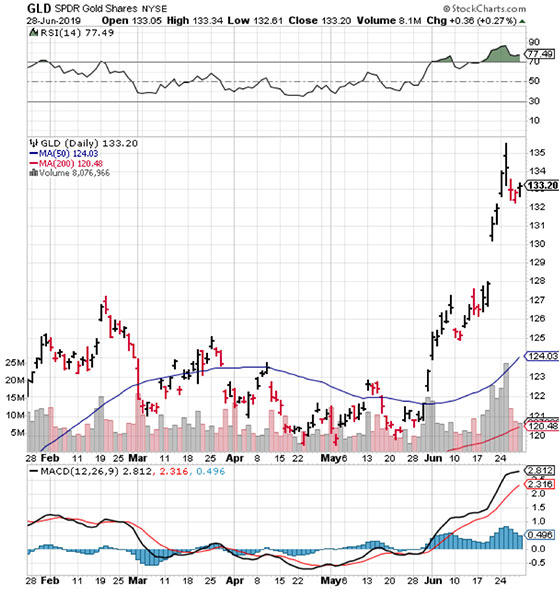
GLD (SPDR Gold Shares NYSE) is the world’s largest gold-centric Exchange Traded Fund (ETF). On Friday June 21, 2019 – one day after The Gold and Silver Volcano is Ready to Erupt was posted on this site – a record single day’s inflow (gold buying) of over $1.5 billion took place.
This stampede, led by hedge funds and “algos” (automated computer buy/sell programs based upon volume flows and trigger price points) involved dollar amounts substantially eclipsing the record set during the 2008 global panic.
The price of gold rose to a 6-year high, left a series of gaps on the way up, and smashed through all sorts of technical “resistance” points on traders’ charts around the globe.
At the same time, silver – almost unnoticed because its rise was relatively muted – broke out on the strongest volume since 2011, printing its second highest Up Volume ever!
So what is going on? When a major market movement like we witnessed in late June takes place, everybody looks for an answer. And everyone has an opinion.
But the only opinion which really matters – that of the Market – usually takes a while to reveal itself. David Morgan with a track record in resource sector prognostication as good as any in the business, never fails to remind his readers who the real guru is: Mr. Market him/herself. David wrote,
I certainly have my opinions, based upon decades of trading, research, and experience. But no matter how strongly I feel about a given situation, I never hesitate to step back and see if price action supports what I think is taking place.
Whether you’re an individual investor, a giant brokerage firm, even a sovereign wealth fund, or a central bank, it helps to keep in mind the fact that – sooner or later – the market always has the final say.
Gold is like a measuring rod, a ruler. It just measures value. It’s not using gold coins to buy stuff at Walmart. It’s like 12 inches in a foot or 60 minutes in an hour. And it’s worked for 4,000 years when people have done it and done it right…
Gold keeps its intrinsic value better than anything else. When you see the nominal price change, that’s not the value of gold changing, that’s the value of the dollar or whatever currency you’re talking about, changing in value. Gold is the constant, like the North Star.
On a number of occasions, Porter Stansberry has posted in the public domain for readers (of which I am one) via his Stansberry Digest, lengthy, no-holds-barred essays focusing on systemic risk – and the potential for ensuring against or profiting from it.
Recently, he wrote just such an essay. The title, “The Most Important Digest Porter Has Ever Written?” is not an exaggeration.
Part of his premise is that as “the expected real return (after inflation)” by 10-year bond holders drops below 2%, the system becomes unstable.
If it falls below zero – as now seems likely, interest rates “invert” – with rates on short term fixed-income securities (e.g. bonds) issued by the U.S Treasury exceeding long term rates.
This harbinger of recession causes the Fed to respond by “printing” more money.
The extra currency creates financial bubbles and massively more debt before the bubbles themselves inevitably collapse. It also generates enormous global demand for gold.
If Porter is even close to being correct (and I believe he is), reflecting upon the implications could help you remain “above the fray” as the house of cards our supposed financial wizards have put together around the globe – and at home – starts collapsing around our ears.
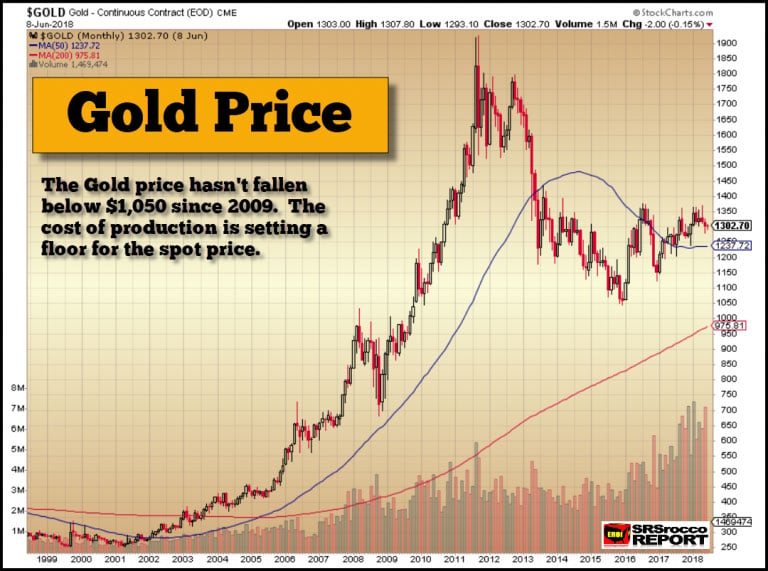
It’s been 8 long years since gold, which was making annual highs for the prior decade, tipped over into what would become an almost uninterrupted decline, 2016 notwithstanding.
The lower highs, lower lows process took it from $1,900 the ounce in 2011, down to around $1,050 in 2015. Along the way, most of the best gold and silver miners dropped 80% in value.
Many investors and “stackers” who had been at it through thick and thin for decades, couldn’t take it anymore and called it quits. I have remarked at investment conferences that the years 2013 to early 2019 were more difficult for me psychologically (and financially) than the 22 year bear market following the 1980 metals’ top.
As you read this, a fair number of people are actually selling back their physical gold and silver at “breakeven” prices, never to return. I hope you are not one of them.
Going against Market Sentiment Is Never Easy
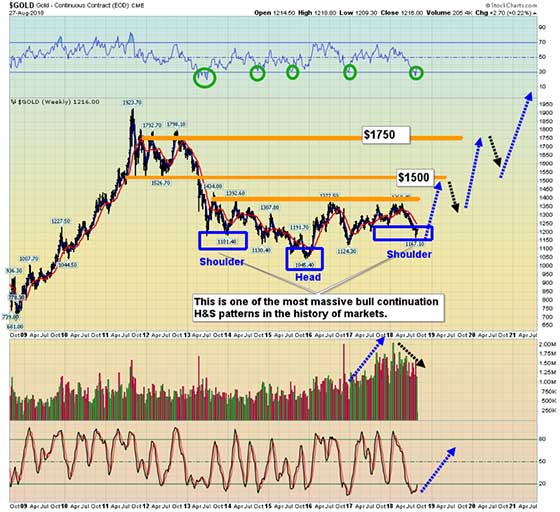
Looking at Stewart Thomson’s chart below, which he first posted over 8 months ago, ask yourself what you feel when you look at it.
Even as the right shoulder builds out for a strong up move, it’s difficult not to keep looking in the rear-view mirror. But listen to someone who has time and again gone against his own emotions in building highly profitable long-term positions. Stewart remarks:
We are all cowards on price weakness. Those who admit it, those who bet against it make money. Those who hide it and lie about it, lose money. End of story.
There are no guarantees in this world. Of course, he could be wrong. But what if he’s right?
Head and Shoulders Gold Mega-Monster
The wisdom of holding physical gold and silver as insurance – stored securely and discretely – has proven itself time and again in every historic timeframe.
Yes, the gold price may yet decline for awhile, even down to 1250, as it “backs and fills”- preparatory to a highly probable resumption of the uptrend. Or the decline might be quite shallow. There’s just no way to know for sure. As with so much else in life, it’s a lot about probabilities.
But don’t wait for Mr. Market to spell out reasons for the sea-change we’re seeing right now in the price of gold – and eventually silver.
Make absolutely certain that you have at least an amount that fits your personal needs and expectations. As this epic tale continues to unfold, you’ll be glad you did.
The Money Metals News Service provides market news and crisp commentary for investors following the precious metals markets.
The G20 summit held in Japan last weekend was once again upstaged by the meeting which took place along the sidelines between Trump and Chinese premier Xi Jinping.
The fresh outbreak of tariff increases between the two main global economies had sent equities plunging. And the market was hoping that the leaders would come to an agreement as they had done at the end of 2018 in Argentina.
Trump Agrees to Refrain From Further Tariffs
Fortunately, these hopes were not in vain. Trump and Xi were able to quell rising investor uncertainty with a new pact.
Following the meeting between the two leaders, Trump told reporters:
“We’re right back on track. We’ll see what happens.”
Trump added that the pair had agreed to re-commit to trade negotiations. The President also removed the cloud that has been hanging over the markets recently by confirming that he would not be tariffing the remaining $300 billion of Chinese goods entering the US each year. He stated:
“I promised that, for at least the time, being we’re not going to be lifting tariffs on China. We won’t be adding an additional tremendous amount – we have $350 billion left that could be tariffed, taxed – we’re not going to be doing that.”
Trump Unexpectedly Backpedals on Huawei
While many were hoping for some compromise over tariffs, the market was surprised by Trump’s change of heart over Huawei.Back in May, Trump had added Huawei to the “Entity List,” a list of companies which US firms are prohibited from dealing with without government approval.
The move was a major blow to the Chinese firm and markets reacted fearfully with heavy selling in equities. However, at the meeting with Xi, Trump declared that “US companies can sell their equipment to Huawei.”
In return, China agreed to purchase a “tremendous amount” of US food and agricultural products.
Trump Makes History & Meets Kim In North Korea
In a further surprise twist, after the summit, Trump broke historic ground by becoming the first US president to set foot on North Korean soil. Following a spontaneous tweet where Trump suggested the possibility of the two leaders meeting, Kim extended the invitation to Trump.
The two leaders met at the demilitarized zone. Kim then escorted Trump for a short distance onto the North Korean side. The display has buoyed the markets and is an encouraging sign for Trump trying to achieve de-nuclearization of North Korea.
Equities are firming in response to news that the two leaders might meet again soon.
Market Soars on Trade War Optimism
The market reaction to these developments has been one of strong optimism. Risk assets are surging higher while safe-haven assets such as gold and JPY have fallen. The SPX500 hit fresh record highs shortly after the open, trading above the prior 2940 level to hit highs of 2976, which are currently broken.
XAUUSD, meanwhile, has continued its sharp reversal lower from the 1433 level to trade 1388 last as safe haven flows dry up. However, the key to the follow through on these moves will be whether Trump and Xi are able to keep optimism alive.
Consequently, the market will now be paying close attention to the first set of trade talks following the meeting. Given that the negotiations after the November 2018 G20 meetings failed, the markets are wondering how long this optimism will last. Investors everywhere are hoping that this time around, the superpowers finally reach a deal. And that seems to be supporting prices, at least for now.
More than half of banking and financial services customers around the world use fintech products and services, according to a new global poll.
Some 55 per cent of respondents of the survey carried out by deVere Group, one of the world’s largest independent financial advisory organizations, affirmed that they ‘regularly use financial technology to access and manage their money.’
883 people from the UK, Europe, Asia, Africa, Latin America and Australasia took part in the poll.
Of the findings, Nigel Green, deVere Group founder and CEO notes: “Even two or three years ago, that figure would have been significantly lower. The fact that today 55 per cent of people polled globally use fintech solutions on a regular basis highlights the staggering rate of the digitalisation of our everyday lives.
“And it is speeding up. From self-driving cars, genetic bio-editing to AI, new technologies are beginning to impact every part of our lives. Our financial lives are no exception. We’re in a new age.”
He continues: “Fintech firms are filling the void left between what traditional financial services companies are offering and what customers are now expecting, especially in terms of customer experience.
“In broad terms, this means immediate, on-the-go, 24/7 access to, use and management of their money. It means personalised, on-demand services. It means lower costs.
“Fintech is already a major disruptive presence in the financial services marketplace. This trend is only set to grow as ‘digital natives’ – the first generation that grew up with the internet and smart devices – become ever more dominant in the workforce and in social and political roles.”
According to the data collected by deVere, emerging markets in Asia, Latin America and Africa are becoming the biggest growth areas for participation.
“This could be due to fintech typically offering more inexpensive solutions compared to traditional financial services. Also because these areas are home to many of the world’s 1.7 billion unbanked or underbanked population – those who don’t have access to or have limited access to financial institutions – and fintech allows this issue to be overcome,” affirms Mr Green.
Other standout trends: Around two thirds (67 per cent) of those polled used fintech apps to send remittances and money transfers. 46 per cent use financial technology vehicles to track investments and/or accounts. 28 per cent use them for storing and managing cryptocurrencies.
The deVere CEO goes on to add: “Fintech – a major part of the so-called ‘fourth industrial revolution’ – is a positive force for three key reasons.
“First, it is meeting clear and growing client demand for on-the-go services.
“Second, it is speeding up the advance of financial inclusion across the world. Helping individuals and companies successfully manage, save and invest their money will only result in a better society for us all.
“And third, it gives firms the opportunity to diversify, cut costs, meet regulatory requirements and improve the client experience, which will help build long-term relationships and trust.”
About:
deVere Group is one of the world’s largest independent advisors of specialist global financial solutions to international, local mass affluent, and high-net-worth clients. It has a network of more than 70 offices across the world, over 80,000 clients and $12bn under advisement.
Sweden’s central bank left its benchmark repo rate unchanged at minus 0.25 percent, as expected, and said it remains on track to raise its rate “again towards the end of the year or at the beginning of next year” as economic activity remains strong and inflation is close to its target. In December 2018 Sveriges Riksbank raised its rate for the first time in 7-1/2 years and had pencilled in another rate hike in the second half of this year. But in April the Riksbank pushed back its timeframe for the rate hike to late 2019 or early 2020 as inflation was slightly weaker than expected. Today the Riksbank’s executive board said Sweden’s economy had developed largely in line with its forecast from April despite higher uncertainty abroad and “increasing unease over further deterioration in trade relations and a faster decline in global economic activity.” Although the Riksbank maintained its forecast for the repo rate to slowly return to positive rates in coming years, it acknowledged global developments may impact Sweden, which “underlines the importance of proceeding cautiously with monetary policy. If the conditions for inflation change were to change, monetary policy will be adjusted.” In an update to its forecasts, the Riksbank saw the repo rate averaging -0.2 percent this year, unchanged from April, then 0.1 percent in 2020 and 0.5 percent in 2021. Economic activity in Sweden has remained solid in recent months and the central bank raised its forecast for 2019 growth to average 1.8 percent from April’s forecast of 1.7 percent and 2018’s 2.4 percent. Next year growth is expected to cool to 1.6 percent, down from the previous forecasts of 1.9 percent, and then accelerate to 1.8 percent in 2021. Sweden’s gross domestic product slowed slightly to 2.1 percent annual growth in the first quarter of this year from 2.4 percent in the previous quarter Inflation in Sweden has been close to the Riksbank’s 2.0 percent target since early 2017 with core inflation up to 2.1 percent in May from 2.0 percent in April. The central bank lowered its 2019 forecast for core inflation to 1.7 percent from a previous 1.8 percent but retained the forecasts for 1.8 percent inflation in 2020 and 1.9 percent in 2021.
Sveriges Riksbank released the following press release (tables excluded)
“Repo rate unchanged at −0.25 per cent Economic activity in Sweden remains strong and inflation is close to the target of 2 per cent. Uncertainty abroad has increased but new information since the monetary policy decision in April has not led to any major revisions of the forecasts overall. With continued support from monetary policy, the conditions for inflation to remain close to the target in the period ahead are considered good. The Executive Board has decided to hold the repo rate unchanged at –0.25 per cent. The forecast for the repo rate is also unchanged and indicates that it will be increased again towards the end of the year or at the beginning of next year. However, the risks surrounding developments abroad can have a bearing on the prospects for Sweden, which emphasises the importance of proceeding cautiously with monetary policy. Good economic activity but increased uncertainty abroad Developments both in Sweden and abroad are largely in line with the Riksbank’s forecasts. However, increasing unease over further deterioration in trade relations and a faster decline in global economic activity have clearly affected pricing on the financial markets, where interest rates on the whole have fallen. But growth abroad is relatively good and confidence among both households and companies indicates normal growth in the coming period. With the information now available, the Riksbank assesses that there is no reason to make any major adjustments to the forecasts for international inflation and growth. Activity in the Swedish economy has remained high since the monetary policy meeting in April. Resource utilisation is expected to be high even though developments on the labour market will enter a calmer phase in the years ahead. Inflation has been close to 2 per cent since the beginning of 2017. In line with the Riksbank’s forecast, CPIF inflation amounted to 2.1 per cent in May. The economic outlook and inflation prospects remain good. Overall, the new information since the monetary policy meeting in April has not changed the assessment of the conditions for inflation to remain close to 2 per cent. The Executive Board has therefore decided to leave the repo rate unchanged at –0.25 per cent. The forecast for the repo rate is also unchanged and indicates that it will be increased again towards the end of the year or at the beginning of next year. This means that inflation will receive continued support from monetary policy to remain close to 2 per cent. In accordance with the decision in April, the Riksbank will purchase government bonds for a nominal amount of SEK 45 billion, with effect from July 2019 to December 2020.
Monetary policy needs to proceed cautiously However, the risks concerning international developments may have a bearing on the economic outlook and inflation prospects for Sweden as well. The downturn in international bond yields can indicate that global interest rates going forward will be low for a longer period to come. This underlines the importance of proceeding cautiously with monetary policy. If the conditions for inflation change were to change, monetary policy will be adjusted. Important to have measures to reduce risks associated with household indebtedness Swedish households are highly indebted and therefore sensitive to changes in economic conditions, such as rising interest rates or higher unemployment. In order to reduce the risks linked to household indebtedness and address the structural problems on the Swedish housing market, measures within housing and tax policy and appropriate macroprudential policy are required.” www.CentralBankNews.info
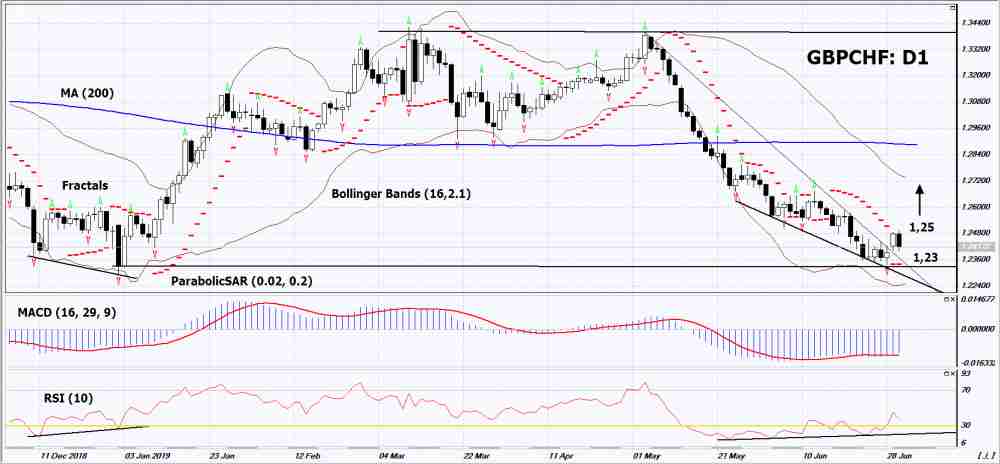
Weak macroeconomic statistics was published in Switzerland. The British authorities are going to take measures to stimulate the economy. Wil the GBPCHF quotations grow?
Such a movement is observed when the British pound strengthens against the Swiss franc. Manufacturing PMI Industrial Business Index in Switzerland dropped in June to 47.7 points, which is the lowest since September 2015. Retail sales in May fell by 1.7% in annual terms. They are showing a continuous decline since last October. Swiss National Bank confirmed its determination to maintain a negative interest rate (-0.75%). The Bank of England is also concerned about signs of a slowdown in the already British economy. At the same time, along with the usual rate cut, it is considering options for economic incentives through tax cuts and government spending. It can support the pound. Note that the rate of the Bank of England is positive and is 0.75%. On Thursday, July 4, significant inflation data for June will be released in Switzerland. In the UK, an important block of statistics will be published next week.
On the daily timeframe GBPCHF: D1 has reached the bottom of a wide, long-term neutral range, has pulled out of a downtrend and is trying to adjust upwards. Various technical analysis indicators have generated an uptrend signals. Further growth of quotations is possible in case of publication of positive macroeconomic indicators in the UK and negative ones in Switzerland.
The Parabolic indicator indicates an uptrend signal.
The Bolinger bands widened, indicating high volatility. Both lines of Bollinger have a slope up.
The RSI indicator is above the 50 mark. It has formed a divergence to increase.
The bullish momentum may develop if GBPCHF exceeds its last maximum: 1.25. This level can be used as an entry point. The initial stop lose may be placed below the last lower fractal and the Parabolic signal: 1.23. After placing the pending order, the stop loss shall be moved following the signals of Bollinger and Parabolic to the next fractal minimum.Thus, we are changing the potential profit/loss to the breakeven point. More risk-averse traders may switch to the 4-hour chart after the trade and place a stop loss moving it in the direction of the trade. If the price meets the stop level (1,23) without reaching the order (1,25), we recommend to cancel the order: the market sustains internal changes that were not taken into account.
Christine Lagarde will be a good choice for financial markets as the President of the European Central Bank, affirms the CEO of one of the world’s largest independent financial advisory organizations.
The assessment from the boss of deVere Group, which has $12bn under advisement, comes as Ms Lagarde, 63, who is currently Head of the International Monetary Fund (IMF) is nominated – and likely – to succeed Mario Draghi as president of the ECB when his eight-year term comes to an end in October.
The heads of EU member states last night confirmed their preferred candidates for a raft of top jobs, including the ECB, setting the potential future direction of the bloc for the next five years.
Mr Green comments: “The nomination of Christine Lagarde is both surprising and controversial.
“It is surprising because she herself has previously appeared to rule herself out from the job. Also, because she is not an economist, she’s a political figure with no direct experience of central banking.
“It’s controversial due to her ‘baggage.’ Under her leadership the IMF’s conduct “raised issues of accountability and transparency,” according to a report. She was also found guilty of negligence by a French court over her handling of a case during her time as the French finance minister.”
He continues: “However, despite some scepticism, I believe Christine Lagarde’s appointment would be well-received by financial markets.
“She is a known quantity. She is broadly considered a safe and competent pair of hands. She represents certainty. All this benefits markets.”
He goes on to add: “Criticism is being directed at her because her remit is to try and assimilate different fiscal policies with a single monetary one and she is not known as a leading economist, but more as a political figurehead.
But with many of Europe’s most pressing economic issues stemming from the political sphere, her political savvy could be an important advantage.”
The deVere CEO concludes: “Ms Lagarde can be expected to share Draghi’s liking for aggressive and innovative monetary policy. She is likely to insist on Quantitative Easing should inflation remain sluggish.
“Markets will appreciate this, especially as global economic growth appears to be slowing.”
About:
deVere Group is one of the world’s largest independent advisors of specialist global financial solutions to international, local mass affluent, and high-net-worth clients. It has a network of more than 70 offices across the world, over 80,000 clients and $12bn under advisement.
After completing the correction at 1.1320, EURUSD is forming a new descending wave towards 1.1242. Possibly, today the pair may consolidate above 1.1281. Later, the market may break this level to the downside and reach 1.1268. After that, the instrument may form one more ascending structure to return to 1.1281 and then resume trading inside the downtrend with the target at 1.1242.
GBPUSD, “Great Britain Pound vs US Dollar”
GBPUSD is trading downwards. Today, the pair may reach 1.2557 and then start another growth towards 1.2590. Later, the market may form a new descending structure with the short-term target at 1.2500.
USDCHF, “US Dollar vs Swiss Franc”
USDCHF is still consolidating between 0.9830 and 0.9880. If later the price breaks the range to the downside, the instrument may continue the correction towards 0.9770; if to the upside – resume trading upwards with the short-term target at 0.9950.
USDJPY, “US Dollar vs Japanese Yen”
USDJPY has completed the correctional wave at 107.55; right now, it is consolidating above it. Possibly, the pair may grow to break 108.04 and then continue trading upwards with the short-term target at 108.85.
AUDUSD, “Australian Dollar vs US Dollar”
AUDUSD has reached the correctional target at 0.6999; right now, it is consolidating. Possibly, the pair may expand the range towards 0.7007 and then fall to reach 0.6980. Later, the market may break this level and then continue trading downwards with the short-term target at 0.6850.
USDRUB, “US Dollar vs Russian Ruble”
USDRUB is trading upwards and forming a narrow consolidation range around 63.27. Possibly, the pair may break it to the upside and continue trading upwards with the short-term target at 63.80.
XAUUSD, “Gold vs US Dollar”
Gold has completed the correction; right now, it is consolidating above 1422.00. Possibly, today the pair may rebound from this level to the downside and start a new decline with the first target at 1407.20.
BRENT
Brent has completed the correction at 63.43. Today, the pair may consolidate around this level. Possibly, the pair may expand the range towards 62.00 and then form one more ascending structure with the first target at 67.55.
Attention! Forecasts presented in this section only reflect the author’s private opinion and should not be considered as guidance for trading. RoboForex LP bears no responsibility for trading results based on trading recommendations described in these analytical reviews.