Oil prices received an upside boost this week from the latest industry reporting which showed a further drawdown in US inventory levels. On Tuesday, the American Petroleum Institute reported a massive 11 million barrel drawdown in crude levels. This caused a strong topside move in oil. On Wednesday, focus then turned to the headline report from the Energy Information Administration.
The EIA report covering the week ending August 23rd, showed US crude stores falling 10 million barrels over the week. This far outstripped expectations for a 2.1 million barrel decrease. It also took crude stores down to their lowest levels since October 2018. US crude stores are now at 427.8 million barrels, sitting exactly on their five-year average for this time of year.
Net Crude Imports Fall
The data showed that Net US crude imports fell by 1.51 million barrels per day to 2.9 million barrels per day. Imports in the Gulf Coast region crashed by 387,000 barrels per day last week, to hit their lowest on record at just 1.2 million barrels per day.
This is based on EIA data going back to 1990. The report also showed that crude stocks at the Cushing, Oklahoma, delivery hub were down by 1.98 million barrels. Stocks fell to their lowest since December at 40.4 million barrels.
Refinery crude runs were also down by 294,000 barrels per day over the week, with refinery utilization rates down by 0.7% to 95.2% of total capacity.
Gasoline Stocks Down
The EIA also showed that gasoline stocks fell by 2.1 million barrels. This far exceeded analysts’ expectations for a 388,000-barrel decline. Distillate stockpiles, which include diesel and heating oil, fell by 2.1 million barrels, versus expectations for a 918,000-barrel increase, according to the report.
However, the report was not all bullish for crude as the data also reflected a 200k barrel increase in US crude production. Production has now moved up to fresh all-time highs of 12.5 million barrels per day.
Trade War Still In Focus
Crude prices have also been responding this week to shifting sentiment towards the ongoing US-China trade negotiations. On Friday, crude had been heavily sold as China announced a fresh set of 10% tariffs to be applied to a further $75 billion of US goods. This was in response to Trump’s new tariffs due to hit (in part) on September 1st. Trump initially responded aggressively, saying that he would instruct all US companies to cease operating in China.
However, on Monday, during closing remarks at the G7 meetings in Biarritz, Trump appeared to change his approach. Instead, the President said that the two sides would continue working together and that he remains confident that a “great deal” can be done.
Technical Perspective
The descending triangle pattern in crude continues to suggest the risk of a break below the 51.27 level, targeting a bigger drop down to the 42.25 zone. The local bearish trend line from July highs continues to cap upside for now, putting focus on a further move lower unless we see a topside break. However, unless price gets quickly back above the 60.91 level, focus remains on a further grind lower for now.
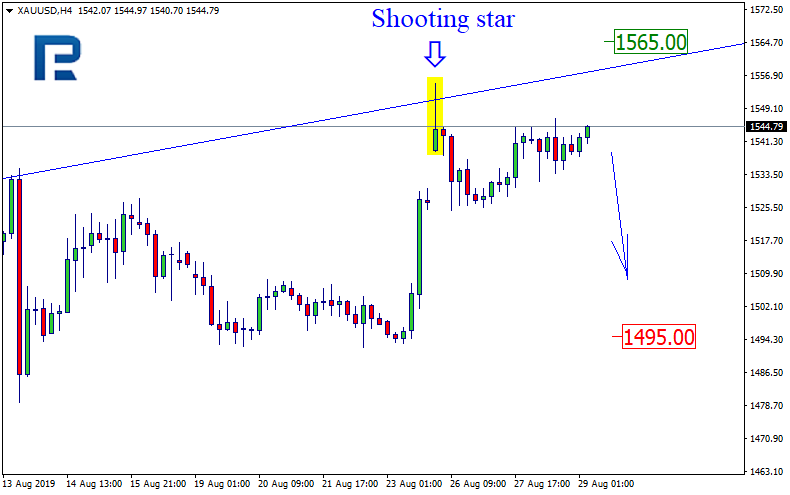
As we can see in the H4 chart, the ascending tendency continues. There was a gap at the beginning of the week; after completing another reversal pattern, Shooting Star, XAUUSD is still testing the channel’s upside border. Right now, the pair is trading sideways. The downside target may be at 1495.00. At the same time, we shouldn’t exclude a possibility that the instrument may break the closest high, reach 1565.00 and continue forming the ascending channel.
NZDUSD, “New Zealand vs. US Dollar”
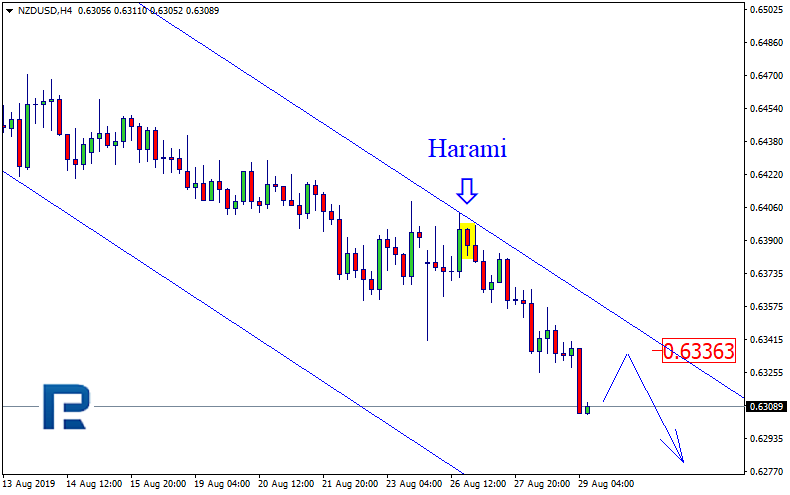
As we can see in the H4 chart, the descending channel continues. NZDUSD has formed Harami reversal pattern close to the channel’s upside border. Right now, the pair is reversing. At the moment, it may be assumed that after completing another correction, the price may fall to update its closest lows. At the same time, one shouldn’t exclude an opposite scenario, according to which the instrument may rebound from the support level and grow towards 0.6370.
Attention! Forecasts presented in this section only reflect the author’s private opinion and should not be considered as guidance for trading. RoboForex LP bears no responsibility for trading results based on trading recommendations described in these analytical reviews.
The US Department of Commerce will be releasing the second revised estimates for the second quarter GDP today.
Estimates point to a possible further slowdown in the period ending June 2019.
According to the economists polled, the second-quarter GDP is expected to rise only 2.0% on the year. This marks a downward slump from the initial estimates which projected a 2.1% increase in the quarter ending June 2019.
U.S. GDP, Q2 – Preliminary Estimates
Overall, the US economy posted a sharp slowdown from the first quarter. In the three months ending March 2019, US GDP grew 3.1%. However, it declined significantly into the second quarter. This was primarily due to slower investments during the period.
In the preliminary report, the data showed that the gross domestic investment fell 5.5%. This was the worst performance since the fourth quarter of 2015.
The core personal consumption expenditure, which is the Fed’s preferred gauge of inflation, rose by 1.8% during the period.
Today’s revised GDP report is only going to further strengthen the case for the Federal Reserve to cut interest rates once again. In July, after lowering rates by 25 basis points, the central bank said that it was only a mid-cycle adjustment.
Thus, it stopped short of confirming that there would be further rate cuts down the line. However, the markets look to have a different take. The expectations for further rate cuts are rising.
Currently, investors expect the Fed to lower rates by another quarter-point in the September meeting. A weaker revised GDP report will, no doubt, strengthen the case.
US GDP Lagging Behind IMF Forecasts
Despite the revisions, the second-quarter GDP is still expected to fall in below the forecasts given by the International Monetary Fund.
The IMF, in a report released late July, noted that the US economy would growth 2.6%, on the year in 2019. This was a slight upward revision from the estimates it gave just a few months before.
However, given the current global conditions, it is unlikely that growth in the United States would be able to rise towards the set target.
Trade wars have led to an uncertain environment. And that coincides with the late business cycle. The global economy has been in a steady expansionary mode for more than a decade. This has led to concerns of a possible impending recession on the horizon.
As a result, the current narrative of the inverted yield curves has sent investors into a panic mode. But so far, it seems that the global economy still has some room to grow. Having said that, the evidence is certainly building that momentum is slowing.
This is evident from the decline in the manufacturing sector, not just in the United States and China, but also in other regions such as the eurozone and Japan.
Not Much Fresh Data to Go By
After the preliminary release, there haven’t been that many reports covering the second quarter of the year.
The US wholesale inventories report showed an unchanged print for June. Sales fell 0.3% during the month while the ratio of inventories to sales remained unchanged as well.
However, construction spending for June was disappointing. Spending in the construction sector fell the most in seven months, by 1.3% during the period. This follows a revised 0.5% decline in May this year.
The trade balance for June showed a deficit of $55.2 billion. This was down by $0.2 billion from the month before.
Considering the above, it is quite likely that the GDP figures for the second quarter could be revised lower or, at best, stay unchanged. This will potentially confirm the view that growth momentum is slowing.
The US dollar has continued its ascent over the European session so far on Thursday. Following a sharp sell off on Friday, the USD index has now retraced most of its losses, trading 98.22 last. Earlier in the week, consumer confidence data came in better than expected and traders now await GDP and trade balance data due later today.
EUR Under Pressure
EURUSD remains under pressure today in light of the continued recovery rally in USD. Earlier today a raft of eurozone member nation data came in mixed with French GDP coming in above expectations while German unemployment ticked higher. EURUSD trades 1.1075 last, with price remaining below the 1.1112 level for now.
UK Parliamentary Suspension Weighs on GBP
GBPUSD has continued to sell off today as the market digests news that the Queen has approved the UK PM’s request to suspend parliament. The backlash from UK politicians has been severe with a group of opposition MPs forming an alternative parliament and pledging to block a no-deal Brexit. GBPUSD trades 1.2198 last as the recovery back towards 1.2382 loses momentum.
Equities Explode
Risk assets have seen a boost today with the SPX500 exploding higher over the session so far. The buying has been in response to the release of a statement from the Chinese Ministry of Commerce. The statement read that the Ministry will not immediately react to US tariffs when they start on Sunday, outlining its desire to end the trade war calmly. SPX500 trades 2914.43 last with price nearly back at the 2931.44 level.
Safe Havens Slump
Safe havens have come under pressure today in light of the recovery in risk sentiment, which has weighed on JPY and gold. USDJPY trades 106.21 last, with price having tested the 106.29 resistance which is holding for now. XAUUSD trades 1539.83 last, with price still holding above the 1522.75 level for now.
Oil Rallies on China Hopes
Oil prices remain supported today following the latest EIA report yesterday which confirmed a 10 million barrel drawdown in US crude stores last week. The move has helped dampen concerns over the demand outlook, despite also showing US crude production to have surged to fresh all-time highs. Crude has also been boosted by the more moderate tone from China which has boosted optimism regarding the next round of US-China trade talks to be held in September. Crude trades 56.05 last, with price currently testing the bearish trend line from July highs.
Commodity Currencies Bounce Back
USDCAD has seen a sharp reversal over the session so far today. The news from China and subsequent lift in equities and oil prices have boosted CAD, taking USDCAD back firmly below the 1.33 level to trade 1.3284 last.
AUDUSD has also been firmer over the European morning on Thursday. AUD has been weighed down by trade war concerns and optimism around negotiations is helping lift AUD today. Price is trading .6750 last, though still below the .6758 level for now.
On Wednesday the 28th of August, trading on the EURUSD pair closed slightly down. Movements on the pair were almost identical to Tuesday’s. The bar pattern from Tuesday has been copied and superimposed over Wednesday’s on the chart. We can see the euro dropping from 1.1098 to 1.1073.
Yesterday’s biggest loser was the pound, which slumped following UK Prime Minister Boris Johnson’s decision to prorogue parliament. The order has received royal assent from the Queen. According to the official order, parliament must be suspended no earlier than Monday, the 9th of September, and reconvene on the 14th of October. This move did not go unnoticed by Donald Trump, who commended Johnson from his Twitter account.
15:00 Germany: harmonised index of consumer prices (Aug).
15:30 Canada: current account (Q2).
15:30 US: GDP (Q2), initial jobless claims (23 Aug).
17:00 US: pending home sales (Jul).
Current situation:
The main topics on today’s agenda are as follows:
The US-China trade conflict.
The political crisis in Italy.
Increased risks of a hard Brexit.
Expectations that the ECB will ease its monetary policy at its September meeting.
All the factors mentioned above are adding to investors’ fears of a global economic slowdown. Moreover, the yield curve inversion is adding to this uncertainty, with the difference between 2- and 10-year US Treasury bonds at its highest since 2007. For the time being, the euro isn’t expected to suffer too big a decline. The 1.1066 mark is expected to provide some support, as it did on the 16th of August.
By Hussein Sayed, Chief Market Strategist (Gulf & MENA), ForexTime
Asian stocks fall despite rally on Wall Street
Government bond yields continue to decline
Pound hit as UK Prime Minister suspends parliament
The rally in US equities yesterday failed to impress Asian investors. The Dow Jones Industrial Average rose 1% on Wednesday driven by the Basic Materials and Consumer Cyclical sectors, while the Nasdaq Composite ended the session only 0.38% higher as the Technology sector was left behind. Despite a 5% drop in the Volatility Index, sentiment was kept in check as the rally in stocks was not accompanied by higher trading volumes, and the US 2-10 yield curve remains inverted for five consecutive days.
As long as the US-China trade dispute remains unresolved it’s hard to see a sustainable rally in equities, and with new trade tariffs coming up next week, expect further negative impact on economic data. That’s why investors continue to pour money into long-term government bonds with the US 30-year yields reaching a record low of 1.90% on Wednesday.
Most Asian equity indices are trading in red, and US futures are indicating a lower open for Wall Street.
Pound hit by fear of no-deal Brexit
In currency markets, the Pound held to yesterday’s losses after Queen Elizabeth approved the UK Prime Minister Boris Johnson plan to suspend Parliament. The request to suspend Parliament from September 9 to October 14 increased the odds of a hard or no-deal Brexit. The opposition parties will fiercely battle the suspension by going to courts and most likely proceed with a no-confidence vote.
Investors are now fearing the risk of a severe recession if the UK leaves the EU with no deal. UK’s GDP has already shrunk by 0.2% in Q2 and recent developments may lead to an even further downturn. The Bank of England is likely to cut rates before year-end if the situation deteriorates further which would put more pressure on Sterling. Expect to see higher volatility in GBP trading for the next several days, but risks are more to the downside with the possibility of testing 1.20 in the short term.
Disclaimer: The content in this article comprises personal opinions and should not be construed as containing personal and/or other investment advice and/or an offer of and/or solicitation for any transactions in financial instruments and/or a guarantee and/or prediction of future performance. ForexTime (FXTM), its affiliates, agents, directors, officers or employees do not guarantee the accuracy, validity, timeliness or completeness, of any information or data made available and assume no liability as to any loss arising from any investment based on the same.
US stock indexes resumed advancing on Wednesday after selloff spurred by Treasury yield curve inversion previous day. The S&P 500 gained 0.7% to 2887.94 led by energy shares. The Dow Jones industrial average rose 1.0% to 26036.10. Nasdaq advanced 0.9% to 8020. The dollar strengthening resumed: the live dollar index data show the ICE US Dollar index, a measure of the dollar’s strength against a basket of six rival currencies, rose 0.2% to 98.19 and is higher currently. Stock index futures point to higher market openings today.
CAC 40 loss leader among European indexes
European stocks pulled back on Wednesday. GBP/USD joined EUR/USD’s slide yesterday with euro rising while Pound sliding against dollar currently. The Stoxx Europe 600 lost 0.4%. Germany’s DAX 30 slipped 0.25% on mixed data as GfK consumer confidence remained steady while import prices declined. France’s CAC 40 lost 0.34% while UK’s FTSE 100 gained 0.4% to 7114.71.
Hang Seng falls while Asian indexes gain
Asian stock indices are mixed today despite Treasury Secretary Steve Mnuchin’s comment he expects Chinese officials to travel to Washington for renewed trade negotiations. Nikkei ended 0.1% lower at 20460.93 despite yen continued slide against the dollar. Chinese stocks are mixed: the Shanghai Composite Index is down 0.1% while Hong Kong’s Hang Seng Index is 0.2% higher. Australia’s All Ordinaries Index added 0.1% as the Australian dollar edged lower against the greenback.
Brent futures prices are lower today. Prices rose yesterday after the Energy Information Administration report US crude inventories dropped by 10 million barrels, while gasoline inventories fell by 2.1 million barrels. October Brent crude rose 1.7% to $60.49 a barrel on Wednesday.
Note: This overview has an informative and tutorial character and is published for free. All the data, included in the overview, are received from public sources, recognized as more or less reliable. Moreover, there is no guarantee that the indicated information is full and precise. Overviews are not updated. The whole information in each overview, including opinion, indicators, charts and anything else, is provided only for familiarization purposes and is not financial advice or а recommendation. The whole text and its any part, as well as the charts cannot be considered as an offer to make a deal with any asset. IFC Markets and its employees under any circumstances are not liable for any action taken by someone else during or after reading the overview.
An update on the Canadian company, including its Q2/19 results and its next expected catalyst, is provided in a Haywood report.
In an Aug. 23 research note, analyst Daniel Rosenberg reported that his firm Haywood increased its price target on WELL Health Technologies Corp. (WELL:TSX.V; WLYYF:OTCMKTS) to CA$1.80 per share from CA$1.70 because the company, continuing to invest in growth, is likely about to acquire another entity.
Already, WELL Health is buying a 51% interest in SleepWorks Medical for CA$1.134 million and the option to purchase the remaining 49%, noted Rosenberg. The transaction is slated to close in September.
This deal comes on the heels of WELL Health recently completing a bought deal financing for gross proceeds of CA$15 million. Even after the SleepWorks transaction, WELL Health currently has an estimated $20 million in cash on hand, “leaving it ample room to pursue mergers and acquisitions (M&A),” Rosenberg indicated.
In other news, Rosenberg reported that WELL Health’s Q2/19 results “were positive and ahead of expectations on the topline.” Q2/19 revenue was CA$7.4 million versus consensus’ forecast of CA$7 million. This represents a 258% revenue increase year over year.
WELL Health operates primary healthcare facilities and an electronic medical records business. The former accounts for most, or 88%, of total revenue, however, recent M&A activity will “shift more revenue toward tech,” Rosenberg commented. “We expect new initiatives within clinics and recent M&A to provide incremental revenue for the year and help drive some margin improvement.”
Haywood has a Hold rating on WELL Health because “shares remain ahead of themselves,” given about “10% exposure of tech revenue and limited synergies from acquisitions extracted to date,” explained Rosenberg. The current share price is about CA$1.65.
Disclosure: 1) Doresa Banning compiled this article for Streetwise Reports LLC and provides services to Streetwise Reports as an independent contractor. She or members of her household own securities of the following companies mentioned in the article: None. She or members of her household are paid by the following companies mentioned in this article: None. 2) The following companies mentioned in this article are billboard sponsors of Streetwise Reports: None. Click here for important disclosures about sponsor fees. 3) Comments and opinions expressed are those of the specific experts and not of Streetwise Reports or its officers. The information provided above is for informational purposes only and is not a recommendation to buy or sell any security. 4) The article does not constitute investment advice. Each reader is encouraged to consult with his or her individual financial professional and any action a reader takes as a result of information presented here is his or her own responsibility. By opening this page, each reader accepts and agrees to Streetwise Reports’ terms of use and full legal disclaimer. This article is not a solicitation for investment. Streetwise Reports does not render general or specific investment advice and the information on Streetwise Reports should not be considered a recommendation to buy or sell any security. Streetwise Reports does not endorse or recommend the business, products, services or securities of any company mentioned on Streetwise Reports. 5) From time to time, Streetwise Reports LLC and its directors, officers, employees or members of their families, as well as persons interviewed for articles and interviews on the site, may have a long or short position in securities mentioned. Directors, officers, employees or members of their immediate families are prohibited from making purchases and/or sales of those securities in the open market or otherwise from the time of the interview or the decision to write an article until three business days after the publication of the interview or article. The foregoing prohibition does not apply to articles that in substance only restate previously published company releases.
Disclosures from Haywood Securities,WELL Health Technologies Corp., Research Report, August 23, 2019
Analyst Certification: I, Daniel Rosenberg, hereby certify that the views expressed in this report (which includes the rating assigned to the issuers shares as well as the analytical substance and tone of the report) accurately reflect my/our personal views about the subject securities and the issuer. No part of my/our compensation was, is, or will be directly or indirectly related to the specific recommendations.
Important Disclosures
Of the companies included in the report the following Important Disclosures apply:
▪ Haywood Securities Inc. or one of its subsidiaries has managed or co-managed or participated as selling group in a public offering of securities for Well Health Technologies Corp. (WELL-V), in the past 12 months.
Other material conflict of interest of the research analyst of which the research analyst or Haywood Securities Inc. knows or has reason to know at the time of publication or at the time of public appearance: n/a.
Details from this clinical program are discussed, along with Q2/19 earnings and the next stock catalyst, in an H.C. Wainwright & Co. report.
In an Aug. 23 research note, H.C. Wainwright & Co. analyst Joseph Pantginis reported the highlights from Targovax ASA’s (TRVX:OSE) Q2/19 earnings conference call.
During the second quarter, Targovax posted an earnings per share of NOK0.72 compared to H.C. Wainwright’s estimate of NOK0.65. The biotech ended Q2/19 with NOK135 million in cash, which management said was enough runway through H1/20.
Pantginis also reported details about its clinical programs that management shared in the call. One topic was data from Targovax’s study of ONCOS-102 in melanoma patients who are both unresectable and refractory to anti-PD-1 therapies.
Initial results showed an overall response rate of 33% at six months. That included one complete response, two partial responses and one unconfirmed partial response. Also, despite individual responses, ONCOS-102 increased systemic and local immune activation, specifically “cytokine release and increased T cells tumor infiltration,” Pantginis noted. The oncolytic adenovirus also showed response specificity, i.e., tumor antigen specific T cells.
“We believe these data to be encouraging and to position ONCOS-102 well for the interim analysis set for H1/20,” commented Pantginis.
Also in the conference call, management reiterated that its mesothelioma program remains the next stock catalyst, with randomized Phase 2 data expected in January 2020. This event is made even more significant by the fact that the benchmark for mesothelioma is low, in other words reported overall survival with standard of care is six months, and few other possible, new therapeutics exist.
“We believe the data should be positive with ONCOS-102 supplying an additional layer of efficacy above the standard of care; if positive, we believe the shares could be poised for a relatively quick run to the NOK10 level,” Pantginis wrote.
H.C. Wainwright has a Buy rating and price target of NOK19 per share on Targovax, whose stock is currently trading at around NOK5.02 per share.
Disclosure: 1) Doresa Banning compiled this article for Streetwise Reports LLC and provides services to Streetwise Reports as an independent contractor. She or members of her household own securities of the following companies mentioned in the article: None. She or members of her household are paid by the following companies mentioned in this article: None. 2) The following companies mentioned in this article are billboard sponsors of Streetwise Reports: None. Click here for important disclosures about sponsor fees. 3) Comments and opinions expressed are those of the specific experts and not of Streetwise Reports or its officers. The information provided above is for informational purposes only and is not a recommendation to buy or sell any security. 4) The article does not constitute investment advice. Each reader is encouraged to consult with his or her individual financial professional and any action a reader takes as a result of information presented here is his or her own responsibility. By opening this page, each reader accepts and agrees to Streetwise Reports’ terms of use and full legal disclaimer. This article is not a solicitation for investment. Streetwise Reports does not render general or specific investment advice and the information on Streetwise Reports should not be considered a recommendation to buy or sell any security. Streetwise Reports does not endorse or recommend the business, products, services or securities of any company mentioned on Streetwise Reports. 5) From time to time, Streetwise Reports LLC and its directors, officers, employees or members of their families, as well as persons interviewed for articles and interviews on the site, may have a long or short position in securities mentioned. Directors, officers, employees or members of their immediate families are prohibited from making purchases and/or sales of those securities in the open market or otherwise from the time of the interview or the decision to write an article until three business days after the publication of the interview or article. The foregoing prohibition does not apply to articles that in substance only restate previously published company releases.
Disclosures from H. C. Wainwright, Targovax ASA, Earnings Update, August 23, 2019
Investment Banking Services include, but are not limited to, acting as a manager/co-manager in the underwriting or placement of securities, acting as financial advisor, and/or providing corporate finance or capital markets-related services to a company or one of its affiliates or subsidiaries within the past 12 months.
I, Joseph Pantginis, Ph.D., certify that 1) all of the views expressed in this report accurately reflect my personal views about any and all subject securities or issuers discussed; and 2) no part of my compensation was, is, or will be directly or indirectly related to the specific recommendation or views expressed in this research report; and 3) neither myself nor any members of my household is an officer, director or advisory board member of these companies.
None of the research analysts or the research analyst’s household has a financial interest in the securities of Targovax ASA (including, without limitation, any option, right, warrant, future, long or short position).
As of July 31, 2019 neither the Firm nor its affiliates beneficially own 1% or more of any class of common equity securities Targovax ASA.
Neither the research analyst nor the Firm has any material conflict of interest in of which the research analyst knows or has reason to know at the time of publication of this research report.
The research analyst principally responsible for preparation of the report does not receive compensation that is based upon any specific investment banking services or transaction but is compensated based on factors including total revenue and profitability of the Firm, a substantial portion of which is derived from investment banking services.
The Firm or its affiliates did not receive compensation from Targovax ASA for investment banking services within twelve months before, but will seek compensation from the companies mentioned in this report for investment banking services within three months following publication of the research report.
The Firm does not make a market in Targovax ASA as of the date of this research report.
H.C. Wainwright & Co., LLC and its affiliates, officers, directors, and employees, excluding its analysts, will from time to time have long or short positions in, act as principal in, and buy or sell, the securities or derivatives (including options and warrants) thereof of covered companies referred to in this research report.
The drug’s features and its developer’s commercial plans are discussed in an H.C. Wainwright & Co. report.
In an Aug. 20 research note, analyst Ed Arce reported that H.C. Wainwright & Co. raised its target price on Nabriva Therapeutics Plc (NBRV:NASDAQ) to $8 per share from $7 after the U.S. Food and Drug Administration (FDA) approved Nabriva’s Xenleta (lefamulin) for the treatment of adults with community-acquired bacterial pneumonia (CABP). Nabriva is trading now at around $1.80 per share. The biopharma plans to launch Xenleta commercially this September.
Arce discussed Xenleta and its approval. Treatment with Xenleta can be administered intravenously at 150 milligrams (150 mg) in 60-minute infusions every 12 hours for five to seven days or orally at 600 mg every 12 hours for five days.
Xenleta is the first intravenous (IV) and oral antibiotic with a novel mechanism of action that the FDA approved for CABP in nearly 20 years. Xenleta is the first of its kind, a pleuromutilin, of a new class of antibiotics.
Arce described Nabriva’s approach to positioning and selling Xenleta in the U.S. The biopharma intends to market Xenleta as a first-line monotherapy for high-risk CABP patients, ones with several co-morbidities or who are elderly. “We believe Xenleta’s IV to bioequivalent oral formulation could enable physicians to seamlessly transition a patient’s treatment from the inpatient setting to oral dosing that may be self-administered upon discharge,” Arce commented.
For physicians, Arce wrote, Nabriva has a plan in place to make antimicrobial susceptibility testing (AST) available during Xenleta’s launch. Before AST becomes available, slated for Q4/19, however, the observational bacterial evaluation program NOBEL will “provide research-use only materials to evaluate susceptibility information for over 700 hospitals,” Arce explained. Subsequently, physicians can access “ASTs in disk and strip formats and automated testing platforms” when deciding if Xenleta is or is not the appropriate CABP treatment in specific cases, noted Arce.
As for Xenleta sales, “overall, Nabriva is targeting all stakeholders of the healthcare system in order to maximize Xenleta’s early market traction,” indicated Arce. Initially, for the first 15 months, the biopharma plans to use 60 sales representatives to cover about 900 accounts. The company already has a distribution network in place for delivery of Xenleta to hospitals along with specialty and direct-to-patient pharmacies.
Also, Nabriva intends to develop an educational and support platform for patients and healthcare providers called Rx Connect. Finally, it will initiate a co-pay assistance program.
H.C. Wainwright has a Buy rating on Nabriva Therapeutics.
Disclosure: 1) Doresa Banning compiled this article for Streetwise Reports LLC and provides services to Streetwise Reports as an independent contractor. She or members of her household own securities of the following companies mentioned in the article: None. She or members of her household are paid by the following companies mentioned in this article: None. 2) The following companies mentioned in this article are billboard sponsors of Streetwise Reports: None. Click here for important disclosures about sponsor fees. 3) Comments and opinions expressed are those of the specific experts and not of Streetwise Reports or its officers. The information provided above is for informational purposes only and is not a recommendation to buy or sell any security. 4) The article does not constitute investment advice. Each reader is encouraged to consult with his or her individual financial professional and any action a reader takes as a result of information presented here is his or her own responsibility. By opening this page, each reader accepts and agrees to Streetwise Reports’ terms of use and full legal disclaimer. This article is not a solicitation for investment. Streetwise Reports does not render general or specific investment advice and the information on Streetwise Reports should not be considered a recommendation to buy or sell any security. Streetwise Reports does not endorse or recommend the business, products, services or securities of any company mentioned on Streetwise Reports. 5) From time to time, Streetwise Reports LLC and its directors, officers, employees or members of their families, as well as persons interviewed for articles and interviews on the site, may have a long or short position in securities mentioned. Directors, officers, employees or members of their immediate families are prohibited from making purchases and/or sales of those securities in the open market or otherwise from the time of the interview or the decision to write an article until three business days after the publication of the interview or article. The foregoing prohibition does not apply to articles that in substance only restate previously published company releases.
Disclosures from H.C. Wainwright & Co., Nabriva Therapeutics plc, Target Price Revision, August 20, 2019
Investment Banking Services include, but are not limited to, acting as a manager/co-manager in the underwriting or placement of securities, acting as financial advisor, and/or providing corporate finance or capital markets-related services to a company or one of its affiliates or subsidiaries within the past 12 months.
I, Ed Arce and Thomas Yip, certify that 1) all of the views expressed in this report accurately reflect my personal views about any and all subject securities or issuers discussed; and 2) no part of my compensation was, is, or will be directly or indirectly related to the specific recommendation or views expressed in this research report; and 3) neither myself nor any members of my household is an officer, director or advisory board member of these companies.
None of the research analysts or the research analyst’s household has a financial interest in the securities of Nabriva Therapeutics plc (including, without limitation, any option, right, warrant, future, long or short position).
As of July 31, 2019 neither the Firm nor its affiliates beneficially own 1% or more of any class of common equity securities of Nabriva Therapeutics plc.
Neither the research analyst nor the Firm has any material conflict of interest in of which the research analyst knows or has reason to know at the time of publication of this research report.
The research analyst principally responsible for preparation of the report does not receive compensation that is based upon any specific investment banking services or transaction but is compensated based on factors including total revenue and profitability of the Firm, a substantial portion of which is derived from investment banking services.
The Firm or its affiliates did not receive compensation from Nabriva Therapeutics plc for investment banking services within twelve months before, but will seek compensation from the companies mentioned in this report for investment banking services within three months following publication of the research report.
The Firm does not make a market in Nabriva Therapeutics plc as of the date of this research report.
H.C. Wainwright & Co., LLC and its affiliates, officers, directors, and employees, excluding its analysts, will from time to time have long or short positions in, act as principal in, and buy or sell, the securities or derivatives (including options and warrants) thereof of covered companies referred to in this research report.