ISM Manufacturing To Rebound In August

By Orbex

The Institute for Supply Management’s monthly manufacturing index gauge, the manufacturing PMI, is due today. Economists forecast that the manufacturing activity, as measured by ISM will tick modestly higher.

After the index fell to 51.2 in July, expectations are optimistic, forecasting a slight increase to 51.4 in August. The uptick in the manufacturing sector, although not dramatic, indicates a modest improvement.

Global manufacturing has been widely hit due to a number of factors. These include the late business cycle and the ongoing trade war between China and the United States. Higher tariffs are expected to put a lid on the global manufacturing sector.

ISM Manufacturing PMI

The ISM manufacturing PMI hit a high of 61.3 in October last year. But, since then, after a brief rise, the sector has been in a steady decline.

So far, manufacturing activity is well above the 50-level of the index. As long as the index is above 50, it indicates expansion. But there is a cause for concern.

In a separate gauge of manufacturing activity, IHS Markit reported that in August, the US manufacturing sector contracted. While there is no direct correlation between IHS Markit’s and ISM’s purchase manager’s index, the decline in the data from Markit is a cause for concern.

In the unlikely event that ISM’s manufacturing PMI falls below the 50 index, it would be the first time since August 2016. Back then, the index fell to 49.4.

Regional Manufacturing Surveys Rise Modestly 

Forward leading indicators for the manufacturing sector from various regions in the US gives evidence that there is a possible increase in activity.

  • The Philly Fed Manufacturing index registered a headline print of 16.8. This was, in fact, a decline from 21.8 in July. But the data came out better than expectations.
  • The Empire State Manufacturing index, covering the New York area, did fairly better. The index rose to 4.8 points in August, from 4.3 in the month before. The data once again was better than the forecasts.
  • Finally, the Richmond Fed manufacturing index recovered from dropping to -12 in July. The index rose to +1 in August, suggesting a strong recovery in the sector.

Combined, the above regional data supports the view that manufacturing activity might have recovered. However, it is important to note the seasonality as well.

Given the fact that August is the month where most vacations are taken, there is a likelihood that the manufacturing gauge could be lower than the actual.

What this means is that in the coming months, especially in September, we could expect to see a rebound in the US manufacturing sector.

ISM PMI to Set Tone for Friday’s Payrolls

Today’s manufacturing PMI will also give us a glimpse into how Friday’s payroll figures for August will shape up.

The US manufacturing sector is quite important. Just last week, President Trump squarely put the blame for the slowdown on the Federal Reserve. The central bank has so far cut interest rates once in July.

The Fed lowered the short term fed funds rates by 25 basis points. However, President Trump has called on the Fed to do more, including restarting QE. This has been one of the main sticking points.

Meanwhile, economy watchers blame the current slowdown in the manufacturing sector on aggressive trade policies pursued by Washington. Recently, President Trump called for all US companies to seek an alternative to China. He also called for US companies to move manufacturing back to the United States.

Given the current landscape, today’s ISM manufacturing PMI will be an important indicator to watch. It will have an impact, not just on the monetary policy but also potentially set the course for the US government as well.

By Orbex


Investors Are Concerned over Probable Brexit Without a Deal

by JustForex

The US dollar did not change against a basket of major currencies during yesterday’s trading. Investors are waiting for additional information regarding trade relations between the US and China. Trading activity was also reduced in connection with the celebration of Labor Day in the United States and Canada. The US dollar index (#DX) has kept current levels (+0.00%). Today we expect the publication of important economic data from the UK and the USA.

The British pound has updated local lows due to growing investors’ concern that the UK will exit the EU without a deal. A group of British officials proposed on Monday to move Brexit from October 31, 2019, to January 21, 2020. However, British Prime Minister, Boris Johnson, is categorically against the postponement of the country’s exit from the bloc. The official is also considering the possibility of holding an early general election if parliamentarians who disagree with him can pass a bill that blocks the country’s exit from the EU without a deal.

Today, the Reserve Bank of Australia made a decision on the interest rate during the Asian trading session. The indicator remained unchanged at 1.00%. Also, a report on retail sales was published, which fell by 0.1% in July, which turned out to be worse than forecasts, according to which the indicator was supposed to grow by 0.2%.

The “black gold” prices went down. Currently, the WTI crude oil futures are testing the $54.45 per barrel mark.

Market indicators

Yesterday, the US stock market was closed due to the holiday.

The yield on 10-year US government bonds fell again. At the moment, the indicator is at the level of 1.47-1.48%.

The news feed on 2019.09.03:

– The construction PMI in the UK at 11:30 (GMT+3:00);
– The ISM manufacturing PMI in the US at 17:00 (GMT+3:00).

by JustForex

EURUSD: the pound is dragging down the majors

By Alpari.com

On Monday the 2nd of September, trading on the EURUSD pair closed slightly down by 0.19%. The euro managed to bounce from 1.0958 on the back of a rise on the EURGBP cross. The bulls ran out of steam in today’s Asian session. The pound is once again dragging the other majors down with it. GBP has shed the most against the dollar at 0.61%, slipping to 1.1971.

The GBPUSD pair dropped 100 pips to reach 1.2060 due to pressure from weak British data as well as an increased risk of a snap election being called in the UK.

The currency market is being shaken by rumours that if the British parliament passes legislation to block a no-deal Brexit, Prime Minister Johnson will immediately announce a snap election for October.

Day’s news (GMT+3):

  • 11:30 UK: Markit construction PMI (Aug).
  • 12:00 Eurozone: PPI (Jul).
  • 16:45 US: Markit manufacturing PMI (Aug).
  • 17:00 US: ISM non-manufacturing PMI (Aug), construction spending (Jul).
  • 23:30 US: API weekly crude oil stock (30 Aug).

Current situation:

US stock exchanges were closed yesterday due to Labor Day. In today’s Asian session, the EURUSD pair was dragged down by the pound to 1.0931. Considering the breakout of the support on the weekly timeframe and expectations of a stimulus package from the ECB, mid-term buyers are unlikely to enter long positions for the time being.

The centre of attention today is the ISM non-manufacturing index in the US as well as news from the UK on a possible election and trade negotiations between the US and China. After tomorrow’s ADP report, attention will shift towards Friday’s payrolls.

The indicators on the daily and weekly timeframes suggest a continuation of the downwards trend. There’s a divergence on the AO indicator on the hourly timeframe. The conditions for a correction are ripe, but there’s no pattern to suggest that an upwards impulse towards the LB line (at 1.0988) will be triggered. It’s unclear for how long the cross will favour the bulls. If the dollar starts to undergo a correction, the euro will benefit from this more than the pound. This will give us a target of 1.0983 on the EURUSD. If the dollar stays strong for the rest of the day, we’ll have to keep an eye on the EURGBP pair, because with a strong dollar and a drop on the cross, the euro will slip to 1.0900.

By Alpari.com

Pound on the rocks as rumours of snap elections mount

By Lukman Otunuga, Research Analyst, ForexTime

It’s hard not to feel some sympathy for the British Pound which has performed poorly against its major counterparts over the past few months.

Heightened political risk in Westminster, chronic uncertainty over Brexit and disappointing economic data from the United Kingdom are eroding appetite for Sterling. The road ahead for the currency is filled with many obstacles and potholes, especially after Boris Johnson suspended Parliament from September 9 until to October 14. With this development set to offer nothing but more pain and punishment to the already battered Pound as no-deal fears intensify, the currency will remain one of the sick men in the G10 space.

Investors wanted nothing to do with the Pound on Monday after UK manufacturing activity plunged to a seven-year low at 47.4 in August. Hungry sellers took another shot at the currency after Prime Minister Boris Johnson summoned his cabinet ministers for an emergency cabinet meeting on Monday afternoon which sparked speculation of a snap election. Whatever the outcome of the emergency cabinet meeting, it will certainly have an impact of the Pound which remains extremely sensitive to Brexit and political developments.

This will be a week to remember with more action and volatility on the cards as Parliament returns from its summer recess. Rising fears of a no-deal Brexit should encourage investors to offload Sterling at any given opportunity.

In regards to the technical picture, the GBPUSD is under pressure on the 4-hourly timeframe (H4). A breakdown below 1.2050 should invite a move lower towards 1.2015 in the short to medium term.

Disclaimer: The content in this article comprises personal opinions and should not be construed as containing personal and/or other investment advice and/or an offer of and/or solicitation for any transactions in financial instruments and/or a guarantee and/or prediction of future performance. ForexTime (FXTM), its affiliates, agents, directors, officers or employees do not guarantee the accuracy, validity, timeliness or completeness, of any information or data made available and assume no liability as to any loss arising from any investment based on the same.


Forex-Time-LogoArticle by ForexTime

ForexTime Ltd (FXTM) is an award winning international online forex broker regulated by CySEC 185/12 www.forextime.com

Asian stocks mixed as markets reminded of US-China trade gulf

By Han Tan, Market Analyst, ForexTime

Asian stocks are posting mixed results amid reports that the US and China cannot agree on the next meeting date to resume trade negotiations. Such headlines are reminding investors yet again of the tremendous gulf between the US and China in reconciling their differences over trade, leaving the global economy hanging in the balance. The recent slew of PMI readings from various economies only serve to highlight the ongoing slowdown in global economic activity, while further diminishing hope for a global economic rebound going into 2020.

Pound plummets ahead of UK Parliament clash of wills

The Pound is testing the 1.20 support level against the US Dollar at the time of writing, ahead of the UK Parliament reconvening today. Markets are digesting the headlines about a possible snap election in the UK, even as they brace themselves for the clash of wills that’s set to play out in Westminster this week starting today, given the reported attempt to block a no-deal Brexit.

Ultimately, the various political permutations will be judged on whether it raises or dilutes the chances of a no-deal Brexit, which has been deemed the worst-case scenario for the UK economy. Should investors get the sense that a no-deal Brexit can be averted, or at least delayed, that would offer relief for Sterling. Any perceived rise in the likelihood of the UK crashing out of the European Union without a deal should send the Pound lower. All things considered, the Pound remains on its slippery slope as investors continue to ditch the currency amidst the seemingly unending Brexit uncertainties.

Dollar index breaches 99 mark as US non-farm payrolls await

The US Dollar is going from strength to strength, pushing higher past the 99.0 psychological level, as investors await Friday’s US non-farm payrolls report for August. Even though markets are already expecting another Fed rate cut later this month, the Dollar doesn’t appear dissuaded from its climb.

The Greenback’s resilience is buffered by the overall risk aversion in global markets, as well as the US economy that appears to be on better footing compared to the overall dismal outlook for major developed economies. Until risk appetite can claw its way back, there’re very few reasons for the Dollar to give up most of its gains over the near-term, barring an overt intervention in the US Dollar.


Disclaimer: The content in this article comprises personal opinions and should not be construed as containing personal and/or other investment advice and/or an offer of and/or solicitation for any transactions in financial instruments and/or a guarantee and/or prediction of future performance. ForexTime (FXTM), its affiliates, agents, directors, officers or employees do not guarantee the accuracy, validity, timeliness or completeness, of any information or data made available and assume no liability as to any loss arising from any investment based on the same.


Forex-Time-LogoArticle by ForexTime

ForexTime Ltd (FXTM) is an award winning international online forex broker regulated by CySEC 185/12 www.forextime.com

Australia keeps rate steady, confirms willing to cut again

By CentralBankNews.info

Australia’s central bank left its benchmark cash rate unchanged at a record low of 1.0 percent and confirmed its guidance from last month that it is willing to cut rates further if needed to support economic growth and reach its inflation target.
The Reserve Bank of Australia (RBA), which cut its rate in June and July by a total of 50 points before holding it steady in August, also reiterated that it expects to keep interest rates low “for an extended period” to help reduce unemployment and make progress in boosting inflation.
As in August, RBA Governor Philip Lowe described the outlook for the global economy as “reasonable,” but the risks remains tilted to the downside as trade and technology disputes are affecting international trade and investment as businesses scale back spending due to uncertainty.
Australia’s economy slowed sharply in the first half of this year with gross domestic product up by only 1.8 percent year-on-year in the first quarter, down from 2.3 percent in the previous quarter.
But in its monetary policy statement from last year the RBA said growth was likely to have troughed in the middle of this year and forecast growth of 2.4 percent this year and 2.75 percent next year, supported by low interest rates, tax cuts, infrastructure spending, stabilization of the housing market and a brighter outlook for the resources sector.
Sluggish growth has kept a lid on inflation, which is expected to remain subdued for some time, hitting a little under 2 percent in 2020 and a little above 2 percent in 2021.
Headline inflation rose to 1.6 percent in the second quarter from 1.3 percent in the first quarter, but is still below RBA’s target of 2.0 to 3.0 percent.
Australia’s dollar firmed slightly in response to the RBA’s decision, which was largely as expected, to around 1.49 to the U.S. dollar, down 4.7 percent this year.

The Reserve Bank of Australia issued the following statement by its governor, Philip Lowe:

“At its meeting today, the Board decided to leave the cash rate unchanged at 1.00 per cent.
The outlook for the global economy remains reasonable, although the risks are tilted to the downside. The trade and technology disputes are affecting international trade flows and investment as businesses scale back spending plans due to the increased uncertainty. At the same time, in most advanced economies, unemployment rates are low and wages growth has picked up, although inflation remains low. In China, the authorities have taken further steps to support the economy, while continuing to address risks in the financial system.
Global financial conditions remain accommodative. The persistent downside risks to the global economy combined with subdued inflation have led a number of central banks to reduce interest rates this year and further monetary easing is widely expected. Long-term government bond yields have declined and are at record lows in many countries, including Australia. Borrowing rates for both businesses and households are also at historically low levels. The Australian dollar is at its lowest level of recent times.
Economic growth in Australia over the first half of this year has been lower than earlier expected, with household consumption weighed down by a protracted period of low income growth and declining housing prices and turnover. Looking forward, growth in Australia is expected to strengthen gradually to be around trend over the next couple of years. The outlook is being supported by the low level of interest rates, recent tax cuts, ongoing spending on infrastructure, signs of stabilisation in some established housing markets and a brighter outlook for the resources sector. The main domestic uncertainty continues to be the outlook for consumption, although a pick-up in growth in household disposable income and a stabilisation of the housing market are expected to support spending.
Employment has grown strongly over recent years and labour force participation is at a record high. The unemployment rate has, however, remained steady at 5.2 per cent over recent months. Wages growth remains subdued and there is little upward pressure at present, with strong labour demand being met by more supply. Caps on wages growth are also affecting public-sector pay outcomes across the country. A further gradual lift in wages growth would be a welcome development. Taken together, recent labour market outcomes suggest that the Australian economy can sustain lower rates of unemployment and underemployment.
Inflation pressures remain subdued and this is likely to be the case for some time yet. In both headline and underlying terms, inflation is expected to be a little under 2 per cent over 2020 and a little above 2 per cent over 2021.
There are further signs of a turnaround in established housing markets, especially in Sydney and Melbourne. In contrast, new dwelling activity has weakened. Growth in housing credit remains low. Demand for credit by investors continues to be subdued and credit conditions, especially for small and medium-sized businesses, remain tight. Mortgage rates are at record lows and there is strong competition for borrowers of high credit quality.
It is reasonable to expect that an extended period of low interest rates will be required in Australia to make progress in reducing unemployment and achieve more assured progress towards the inflation target. The Board will continue to monitor developments, including in the labour market, and ease monetary policy further if needed to support sustainable growth in the economy and the achievement of the inflation target over time.”


US stock futures indicate lower openings today

By IFCMarkets

Dollar strengthening continues as tariffs kick in

US stock indexes markets will reopen today after Labor Day holiday. Futures on US stock indices point to lower opening today. Equities ended the month lower. The S&P 500 finished August 1.8% lower. Dow Jones industrial lost 1.7%. The Nasdaq composite retreated 2.6%. The dollar strengthening run was intact yesterday as 15% tariffs on $112 billion of Chinese goods went into effect on Sunday, as did retaliatory Chinese tariffs on US products. The live dollar index data show the ICE US Dollar index, a measure of the dollar’s strength against a basket of six rival currencies, rose 0.2% to 99.03 and is higher currently.

FTSE 100 outperforms European indexes

European stocks advance continued on Monday on positive data. Both GBP/USD and EUR/USD maintained their decline yesterday with both pairs lower currently. The Stoxx Europe 600 index ended 0.3% higher led by financial shares as data showed euro-zone manufacturing activity contraction slowed in July. The DAX 30 gained 0.1% to 11953.78. France’s CAC 40 advanced 0.2% and UK’s FTSE 100 gained 1% to 7281.94 as main opposition Labour party planned to publish its legislation blocking the possibility of Britain leaving the European Union without a deal on Tuesday.

Shanghai Composite up while other Asian indexes slip

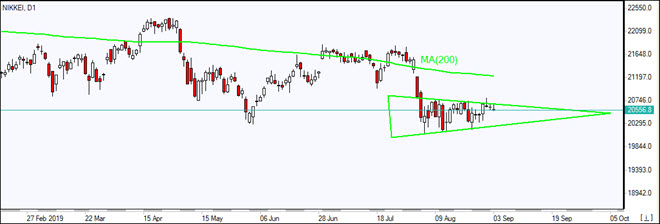
Asian stock indices are mostly falling today after reports US and China are struggling to agree on what to discuss in trade talks this month. Nikkei inched up 0.2% to 20625.16 as the yen slide against the dollar continued. Markets in China are mixed: the Shanghai Composite Index is up 0.1% while Hong Kong’s Hang Seng Index is 0.3% lower. Australia’s All Ordinaries Index extended losses 0.1% as Australian dollar turned higher against the greenback.

Nikkei consolidates in triangle   09/03/2019 Market Overview IFC Markets chart

Brent lower

Brent futures prices are edging lower today. Prices fell yesterday on global growth concerns as US and China reciprocal new tariff came into force Sunday: November Brent crude closed 2.9% lower at $58.66 a barrel on Monday.

Market Analysis provided by IFCMarkets

Note:
This overview has an informative and tutorial character and is published for free. All the data, included in the overview, are received from public sources, recognized as more or less reliable. Moreover, there is no guarantee that the indicated information is full and precise. Overviews are not updated. The whole information in each overview, including opinion, indicators, charts and anything else, is provided only for familiarization purposes and is not financial advice or а recommendation. The whole text and its any part, as well as the charts cannot be considered as an offer to make a deal with any asset. IFC Markets and its employees under any circumstances are not liable for any action taken by someone else during or after reading the overview.

Gambia maintains key rate but raises deposit rate 50 bps

By CentralBankNews.info
Gambia’s central bank kept its monetary policy rate (MPR) at 12.50 percent and the rate on its standing lending facility at 13.50 percent but raised the interest rate on the standing deposit facility by 50 basis points to 2.50 percent, pointing to “increased optimism on the economic growth prospects” and a continued decline in inflation.
The Central Bank of The Gambia (CBG), which cut its policy rate by 100 basis points in February on declining inflation, also said the current account deficit had narrowed in the first half of the year, supporting stability of the dalasi’s exchange rate, while the fiscal deficit had also narrowed.
Gambia’s headline inflation rate has begun to decelerate and stabilize after a jump in May following a sharp increase in postal charges in April, the effect of high demand during Ramadan in May and a recent rise in fuel prices, CBG said.
The headline inflation rate declined to 7.32 percent in July from 7.38 percent in June and 7.49 percent in May, CBG said, adding food inflation, which is the main driver of headline inflation, was unchanged in July and July around 6.7 percent while non-food inflation had decelerated.
CBG’s monetary policy committee said price pressures had started to ease and underlying inflation remained broadly subdued and this was expected to continue in the medium term, premised on a continued stable exchange rate, well-anchored inflation expectations and moderate global food prices.
“Major risks to the inflation outlook, however continue to be the domestic food supply situation in the light of delayed rainfall experienced this year,” CBG said in a statement from Aug. 29.
Gambia’s economy rebounded strongly in 2018, with gross domestic product growing 6.5 percent after 4.8 percent in 2017 according to the country’s statistics bureau, and the central bank said its composite index of economic activity suggests economic activity remained robust in the first half of this year and “points to stronger growth in the second half of the year.”
An increased inflow of private remittances, higher tourism, official inflows from development partners has kept the foreign exchange market operating smoothly and kept the exchange rate of the dalasi stable, with the volume of transactions in the first seven months of the year up 14 percent.
The dalasi was trading at 50.50 to the U.S. dollar today, down 0.8 percent since last Monday, and down 2.3 percent since the start of this year.

The Central Bank of The Gambia issued the following press release:

“The Monetary Policy Committee (MPC) of the Central Bank of The Gambia met on Thursday, August 29, 2019, to assess recent economic developments and set the key policy rate. The following summarizes the deliberations on key economic indicators that informed the decision of the Committee.

Global Economic Developments
1. Global economic growth remains subdued amid heightened policy uncertainty that continues to dent business confidence, investment, and trade. The International Monetary Fund (IMF) has in July 2019 revised downwards global growth forecast to 3.2 percent in 2019, 0.1 percentage point lower than the April 2019 projection. Although growth is expected to pick up to 3.5 percent in 2020, the risks to the outlook are largely tilted to the downside. In particular, elevated trade tensions remain a major risk to the global economy.
2. For advanced economies, output growth is projected at 1.9 percent in 2019 and 1.7 percent in 2020. Economic activity is expected to remain relatively subdued in emerging market and developing economies, due largely to the slowdown in global trade. Real GDP growth for the region is forecast at 4.1 percent in 2019 before picking up to 4.7 percent in 2020.
3. In sub-Sahara Africa, economic growth is projected at 3.4 percent in 2019 and 3.6 percent in 2020, supported mainly by strong growth in many non-resource rich countries.

Domestic Economic Outlook
Real Sector
4. The Gambian economy remains strong and the prospects are favorable. The Central Bank’s Composite Index of Economic Activity (CIEA) suggests that economic activity remained robust in the first half of 2019 and points to stronger growth in the second half of the year. According to the Gambia Bureau of Statistics (GBoS), real GDP growth stood at 6.5 percent in 2018 compared to 4.8 percent in 2017, driven mainly by the services sector including tourism and trade, financial services and insurance, transport and telecommunication.

External sector developments
5. Preliminary balance of payments (BoP) estimates indicate that the current account deficit narrowed to US$25.8 million (1.5 percent of GDP) in the first half of 2019 compared to a deficit of US$26.7 million (1.7 percent of GDP) in the corresponding quarter in 2018. The improvement in the current account balance is attributed to the increase in foreign inflows related to the support from development partners, diaspora remittances, and tourism.
6. The deficit in the goods account, however, widened to US$194.6 million (11.0 percent of GDP) in the first six months of 2019 compared to US$150.0 million (9.3 percent of GDP) in the corresponding period in 2018. Imports rose to US$277.7 million or by 29.8 percent in the first half of 2019 from US$214.0 million in the same period in 2018. Exports also increased by 35.6 percent to US$74.4 million during the period under review.
7. The services account balance, on the other hand, registered a surplus of US$59.7 million in the first six months of 2019, higher than a surplus of US$40.5 million a year ago, explained largely by the increase in tourist arrivals. 8. Gross international reserves is projected at 4 months of next year’s imports of goods and services.

Exchange rate developments
9. The foreign exchange market continues to function smoothly. From January to July 2019, volume of transactions measured by the aggregate of purchases and sales of foreign currency increased by 14.0 percent to US1.3 billion. During the period, purchases of foreign currency, which indicates supply, increased to US$666.7 million, or by 14.4 percent. Similarly, sales of foreign currency rose by 13.6 percent to US$662.6 million in the same period.
10. The exchange rate of the dalasi remains broadly stable supported by market confidence, and increased inflows from private remittances, higher receipts from tourism, and official inflows from development partners. From December 2018 to July 2019, the dalasi appreciated against the pound sterling and euro by 0.6 percent and 1.2 percent, respectively. However, it depreciated against the U.S. dollar by 0.9 percent and CFA by 1.2 percent.

Government Fiscal Operations
11. Preliminary data on government fiscal operations for the first six months of 2019 indicated that total revenue and grants stood at D8.6 billion (9.8 percent of GDP) compared to D6.9 billion (8.6 percent of GDP) in the same period last year. Domestic revenue, comprising tax and non-tax revenues, rose by 23.9 percent to D5.7 billion (6.5 percent of GDP) from D4.6 billion (5.8 percent of GDP) a year ago. Tax revenue also rose by 23.7 percent to D5.2 billion (5.9 percent of GDP) in the first half of the year from D4.2 billion (5.3 percent of GDP) in the corresponding period year ago.
12. Total expenditure and net lending declined by 4.0 percent to D8.8 billion (10.0 percent of GDP) from D9.2 billion (11.5 percent of GDP) a year ago.
13. The budget deficit (including grants) narrowed to D0.19 billion (0.2 percent of GDP) in the first six months of 2019 compared to a deficit of D2.3 billion (2.8 percent of GDP) in the corresponding period a year ago. The budget deficit (excluding grants) also improved to a deficit of D3.1 billion (3.5 percent of GDP) in the first six months of 2019 compared to a deficit of D4.5 billion (5.7 percent of GDP) in the corresponding period a year ago.

Domestic Debt
14. The stock of domestic debt stood at D32.5 billion (38.1 percent of GDP) as at end-July 2019 compared to D31.2 billion (40.5 percent of GDP) in the corresponding period a year ago. Stock of Treasury and Sukuk-Al Salaam bills, which accounted for 58.3 percent of outstanding domestic debt, increased by 8.8 percent to D18.9 billion during the period under review.

15. From December 2018 to July 2019, the yields on the 91- day, 182-day,and 364- day Treasury bills declined to 3.98 percent, 6.87 percent, and 8.77 percent respectively from 5.06 percent, 7.04 percent and 9.48 percent in the same period last year.

Banking Sector
16. According to the financial soundness indicators, the banking sector remains adequately capitalized, highly liquid and profitable. The risk-weighted capital adequacy ratio stood at 29.0 percent, well above the statutory minimum of 10 percent. The ratio of liquid assets to total assets was 57.9 percent at end-June 2019 compared to 56.6 percent a year ago. Liquid asset to deposit ratio stood at 95.6 percent compared to the statutory requirement of 30 percent. Total deposits stood at D31.0 billion as at end-June 2019, an increase of 25.7 percent from June 2018.
17. As at end-June 2019, total assets of the banking industry increased by 25.4 percent to D47.5 billion. The ratio of non-performing loans to gross loans declined to 2.3 percent from 2.7 percent a year ago, largely reflecting enhanced credit administration processes and effective loan recovery measures.

Development in Monetary Aggregates
18. Money supply growth increased to 24.4 percent as at end-June 2019 from 22.4 percent a year ago, driven largely by the healthy net foreign asset position of both the Central Bank and commercial banks. Net foreign assets of the banking system rose to D13.6 billion as at end-June 2019, from D8.2 billion in the corresponding period a year ago, representing an increase of 66.1 percent. Net foreign assets of the Central Bank rose significantly by 85.0 percent to stand at D6.7 billion compared to D3.6 billion a year ago. Similarly, net foreign assets of commercial banks grew strongly by 51.2 percent at end-June 2019 to D6.9 billion from D4.6 billion a year ago.
19. The net domestic assets of the banking system also increased by 9.2 percent to D23.7 billion at end-June 2019. Claims on government net grew by 13.4 percent relative to a contraction of 5.9 percent a year ago. Private sector credit expanded by 28.8 percent, higher than 20.0 percent a year ago.
20. Reserve money growth decelerated to 21.2 percent as at end-June 2019 from 21.9 percent recorded last year.

Business Sentiment Survey
21. According to the Bank’s quarterly Business Sentiment Survey, business optimism remains high with most respondents reporting a higher level of business activity in the second quarter of 2019 than in the preceding quarter. The survey also indicated that inflation expectations are well-anchored with most respondents projecting inflation to remain at the current level or decelerate in the next quarter.

Price Developments
22. Headline inflation has decelerated and stabilized at 7.3 percent in June and July 2019 from 7.5 percent in May 2019, following the sharp increase in postal charges in April, the effect of high demand in Ramadan in May and the recent increase in fuel prices. When compared to the same period last year, inflation remains 0.7 percentage point higher in July 2019.
23. Food inflation, which is the main driver of headline inflation, stood at 6.7 percent in July 2019, unchanged from the previous month but higher than 6.4 percent a year ago. Major drivers of food inflation during the period were Bread Cereals, Meat, Fish, and Vegetables.
24. Non-food inflation, on the other hand, decelerated slightly to 8.4 percent in July 2019 from 8.5 percent in June 2019, but higher than 7.0 percent in July 2018. Key drivers of non-food inflation in July 2019 were Clothing and Footwear, Housing, Fuel and Lighting, hotels and restaurants, Furniture, and Alcoholic Beverages.

Inflation outlook
25. The MPC assessed that price pressures have started to ease and the underlying inflation remains broadly subdued. This is expected to continue in the mediumterm, premised on the continued stability of the exchange rate, well-anchored inflation expectations, and moderate global food prices.
26. Major risks to the inflation outlook, however, continue to be the domestic food supply situation in the light of delayed rainfall experienced this year.

The Committee observed the following:
27. The uncertainties in the global economy have increased and growth is projected to weaken in 2019 as trade tensions continue to escalate.
28. Global inflationary pressures moderated in the face of weak demand, subdued energy and food prices.
29. In The Gambia, there is increased optimism on the economic growth prospects. Economic activity is expected to strengthen in 2019, although climate-related factors such as late rainfall may affect agricultural production.
30. The deficit in the current account narrowed in the first half of the year compared to the corresponding period a year ago.
31. The improvement in the current account continued to support the stability of the exchange rate of the dalasi. The exchange rate remains broadly stable, supported by prudent monetary policy and inflows, particularly private remittances.
32. The increase in inflation experienced in April and May 2019 has reversed and the medium-term outlook remains broadly unchanged, suggesting that inflation will continue to trend downwards.
33. The fundamentals of the banking sector remains strong. The sector is adequately capitalized, highly liquid and profitable. Private sector credit continues to expand at a robust pace, supported by the low level of non-performing loans and the accommodative stance of monetary policy.
34. However, the major risk to the outlook remains the high level of public debt.

Decision
35. In view of the above, the Committee decided to maintain the Monetary Policy Rate (MPR) at 12.5 percent.
36. The Committee however, has decided to increase the interest rate on the standing deposit facility by 0.5 percentage point to 2.5 percent. The interest rate on the standing lending facility is maintained at 13.5 percent, that is, MPR plus one percent.
37. The Committee will continue to monitor developments in the economy and stands ready to act in the interim if economic conditions change.

Information Note
Date for the next MPC meeting
The next Monetary Policy Committee (MPC) meeting is scheduled for Wednesday, November 27, 2019. The meeting will be followed by the announcement of the policy decision on Thursday, November 28, 2019.”

www.CentralBankNews.info


Getting Ready For The RBA Decision

By Orbex

The RBA will be meeting for a second time since it cut the rates last time. And this event could lead to some volatility in the markets!

The economy in Australia continues to be unsatisfactory. And the bank has repeatedly made it clear they are willing to take more action. The question now is, what will they do, and how will the markets respond?

The timing of this meeting is a little awkward for the RBA. It comes at the start of a data-laden week which might help give some insight into the economy both for policymakers and for analysts. In addition, the central bank is finally getting data that has the full effect of the back-to-back rate cuts and can see if more stimulus is needed.

What We’re Expecting

There is a really broad consensus that nothing will come out of this meeting.  This is true even among those advocating for a rate cut now. Not only do they think the RBA will leave the rate at its record low of 1.0%, but also that the policy statement will closely mimic what we got last time. After all, there are only so many ways to say that rates will be kept low for an extended period of time.

Potential market moves are likely to be based on the interpretation of guidance, and what can be parsed about the likelihood of the next rate cut. Just last Friday, Governor Lowe was repeating his now common formula that he sees further weakness in the near term, and will take actions to correct it.

The Changing Trajectory

Where analysts pricked up their ears was a last-minute addition to his set speech. During it, he warned about rising asset prices being a “problem” in the future. This goes in line with a change in the perspective of some RBA-trackers who had previously warned that drastic rate cuts would lead to an asset bubble. They had also warned that the bank wouldn’t be as aggressive in its cuts as some are speculating.

The market tends to get ahead of itself, and the expectation of rate cuts will make stocks and other risk-driven assets more attractive. It would also be expected to push down the AUD. But, the two consecutive cuts signaled trouble in the markets and undermined consumer confidence. The, until now, conservative RBA might not be as eager to cut rates as the market expects.

Floating Away on a Sea of Cheap Money

The asset bubble in particular that Lowe seemed to be referring to is housing. With the lower rate, house prices are back on the rise. The housing auction clearance rate (a measure of interest to acquire homes) has spiked up to levels not seen since mid-2017. That was after the last time the RBA cut rates.

So far, the data that has been coming out of Australia since the rate cuts has been mixed. More jobs were created, but the unemployment rate has gone up. Construction has declined, but new home sales have finally turned positive. Wages have improved slightly, but domestic-facing services PMI slipped into contraction.

Expectations

How the RBA will interpret this mixed bag of data ahead of the major data releases next week is an unknown factor. As far as the consensus of analysts, the projection is for a rate cut in October, or November at the latest. This would be followed by a further rate cut in February, in the middle of the summer.

By Orbex


EURUSD Analysis: Low euro-zone inflation bearish for EURUSD

By IFCMarkets

Low euro-zone inflation bearish for EURUSD

Euro-zone headline inflation final reading confirmed euro-zone inflation remained steady at 1% in August, below European Central Bank’s 2% target. Will the EURUSD continue declining?

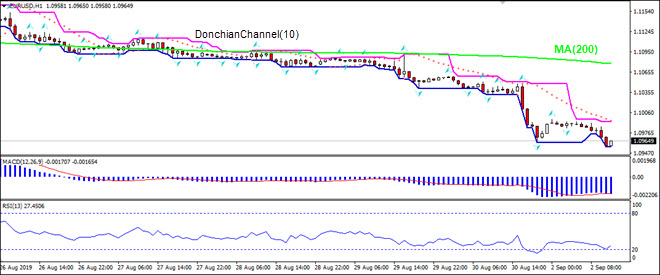
EURUSD falling below MA(200)

A look at the price chart on 1-hour timeframe shows EURUSD: H1 is trading sideways. The price is below the 200-period moving average MA(200) which is falling. And the RSI bounced off from level 20 without breaching into oversold zone. There is no trend yet formed, traders have to decide when would be a best time to enter the market.

Market Analysis provided by IFCMarkets