The US dollar strengthened against a basket of major currencies after the Fed meeting. Yesterday, the regulator lowered its key interest rate by 25 basis points to 1.75%-2.00%, as experts forecasted. The regulator also updated macroeconomic forecasts. In particular, the forecast for US GDP growth for 2019 was improved to 2.2% instead of 2.1%, for 2021 – to 1.9% from 1.8%. The dollar index (#DX) closed the trading session with a slight increase (+0.32%).
The Bank of Japan has decided on a key interest rate during the Asian trading session. Thus, the regulator left the indicator unchanged at the level of -0.10%, as experts expected. At the same time, the management of the Bank of Japan noted a slowdown in the economies of other countries of the world, which reduced the likelihood for Japan to achieve the inflation target of 2%.
Yesterday, First Minister of Scotland, Nicola Sturgeon, said at a press conference in Berlin that in the case of Brexit, Scotland intended to remain part of the EU. The official expressed hope that Britain would not leave the bloc, however, if this happens, their country should have the opportunity to express its position and article of an independent EU country.
The “black gold” prices have been growing. Currently, futures for the WTI crude oil are testing the $58.45 mark per barrel.
Market Indicators
Yesterday, there was a variety of trends in the US stock markets: #SPY (-0.06%), #DIA (-0.15%), #QQQ (-0.04%).
The 10-year US government bonds yield rose slightly. At the moment, the indicator is at the level of 1.78-1.79%.
The Economic News Feed for 19.09.2019:
– SNB interest rate decision at 10:30 (GMT+3:00);
– Retail sales in the UK at 11:30 (GMT+3:00);
– BoE interest rate decision at 14:00 (GMT+3:00);
– Philadelphia Fed manufacturing index at 15:30 (GMT+3:00);
– Existing home sales in the US at 17:00 (GMT+3:00).
Norway’s central bank raised its policy rate for the fourth time since September 2018 but signaled it would now pause in further tightening due to “considerable uncertainty surrounding global growth prospects.”
Norges Bank (NB) raised its policy rate by another 25 basis points to 1.50 percent and has now raised it by 1 percentage point since September last year and by 0.75 points this year to contain inflation from solid domestic growth.
But weaker global growth along with lower interest rates has now led the central bank to lower its economic forecast, with a smaller rate rise seen as compared with its June monetary policy report, according to NB Governor Oeystein Olsen. “The Executive Board’s current assessment of the outlook and balance of risks suggest that the policy rate will most likely remain at this level in the coming period,” Olsen said.
In June NB lowered its forecast for its policy rate to average 2.2 percent from an earlier 2.3 percent, and then decline to 1.9 percent in 2020 and 1.7 percent in 2021 and 2022.
In August, when the central bank kept its rate steady, it maintained its forecast for another rate hike this year but acknowledged that the global risk outlook now entailed greater uncertainty about policy rates going forward.
Unlike most other advanced economies, Norway’s economy is still enjoying solid growth, capacity utilization is slightly above normal, and the exchange rate of the krone weaker than expected, factors that in insolation would suggest continued rate hikes.
“A higher policy rate may also mitigate the risk of a renewed acceleration in debt growth and house price inflation,” Oystein said.
But low interest rates abroad and considerable uncertainty surrounding global growth prospects suggest a more cautious approach to setting interest rates, he added.
Norges Bank issued the following press release:
“Over the past year, the policy rate has been raised, and the monetary stance has become gradually less expansionary. In the Executive Board’s assessment, the overall outlook and balance of risks suggest a slightly higher policy rate. Underlying inflation is close to the inflation target. Growth in the Norwegian economy remains solid, and capacity utilisation is somewhat above a normal level. This suggests in isolation a higher policy rate. A higher policy rate may also mitigate the risk of a renewed acceleration in debt growth and house price inflation. At the same time, foreign interest rates are very low, and there is considerable uncertainty surrounding global growth prospects. This suggests a cautious approach to interest rate setting.
The policy rate forecast indicates a slightly smaller rate rise than in the June Report. Weaker growth prospects and lower interest rates abroad have contributed to the downward revision. Slightly lower inflation and a somewhat less tight domestic labour market compared with the June projections have also pulled down the rate path. A weaker-than-projected krone has in isolation pulled up the policy rate path. With a policy rate in line with the forecast, inflation is projected to remain close to the inflation target in the years ahead, at the same time as unemployment remains low. The policy rate path will be adjusted in response to a change in economic prospects or the balance of risks.
“The Executive Board’s current assessment of the outlook and balance of risks suggests that the policy rate will most likely remain at this level in the coming period,” says Governor Øystein Olsen.”
Asian stocks opened on a positive note after the S&P 500 ended flat, following the Federal Reserve’s “moderate” policy outlook. Despite US interest rates being lowered by 25 basis points for the second time this year, which confirmed market expectations, the Dollar index (DXY) spiked 0.4 percent before moderating. This left most G10 and Asian currencies in the red, while Gold tumbled 1.6 percent to fall below the psychologically-important $1500 level.
Fed chair Jerome Powell once again reiterated that the recent policy easing measures serve as “insurance” in protecting US growth momentum, pushing back against the more dovish calls for deeper rate cuts. Still, persisting US-China trade tensions, geopolitical conflicts, and cooling global growth threaten to tip Fed officials towards a more dovish stance over the coming months, especially if such downside risks continue taking their toll on the US economy.
Fed’s policy outlook to have far-reaching consequences on Dollar, Asian central banks, market volatility
Should markets get the sense that more US interest rate cuts are warranted, despite Fed officials telling markets otherwise, that could lead to more softness in the US Dollar while offering some reprieve for G10 and Asian currencies. Asian policymakers are also expected to continue taking their cues from the Fed, whereby more US interest rate cuts should offer added room for Asian central bankers to ease their respective policy settings further.
Besides being occupied with economic data and external events in trying to determine the Federal Reserve’s policy path forward, investors will also have to pay attention to another variable: dissension within the Federal Reserve. Should Fed officials continue conveying mixed policy outlooks to global investors, that could trigger bouts of volatility as markets contend with the uncertain projections surrounding US interest rates.
Disclaimer: The content in this article comprises personal opinions and should not be construed as containing personal and/or other investment advice and/or an offer of and/or solicitation for any transactions in financial instruments and/or a guarantee and/or prediction of future performance. ForexTime (FXTM), its affiliates, agents, directors, officers or employees do not guarantee the accuracy, validity, timeliness or completeness, of any information or data made available and assume no liability as to any loss arising from any investment based on the same.
US stocks extended gains on Wednesday as Federal Reserve cut its benchmark federal funds rate a quarter percentage point and the survey of Fed policy makers showed policymakers on average believed the Fed funds rate would be at present levels through the end of 2020. The S&P 500 edged up 0.03% to 3006.73. The Dow Jones industrial average advanced 0.1% to 27147. Nasdaq however lost 0.1% to 8177.39. The dollar strengthening resumed after data showing housing starts and building permits accelerated increases in August: the live dollar index data show the ICE US Dollar index, a measure of the dollar’s strength against a basket of six rival currencies, rose 0.3% to 98.54 but is lower currently. Stock index futures point to lower openings today.
DAX paces European indexes gains
European stocks resumed advancing on Wednesday led by banks and insurers. Both GBP/USD and EUR/USD turned lower yesterday with Pound sliding while euro edging higher currently ahead of the Bank of England policy meeting today. The Stoxx Europe 600 gained 0.1%. Germany’s DAX 30 advanced 0.14% to 12389.62. France’s CAC 40 gained 0.09% and UK’s FTSE 100 lost 0.1% to 7314.05 as consumer inflation slowed to annual rate of 1.7% after a 2.1% increase in July. It marked the slowest rate of increase since December 2016 . The Bank of England is expected to hold steady today.
Hang Seng falls while Asian indexes gain
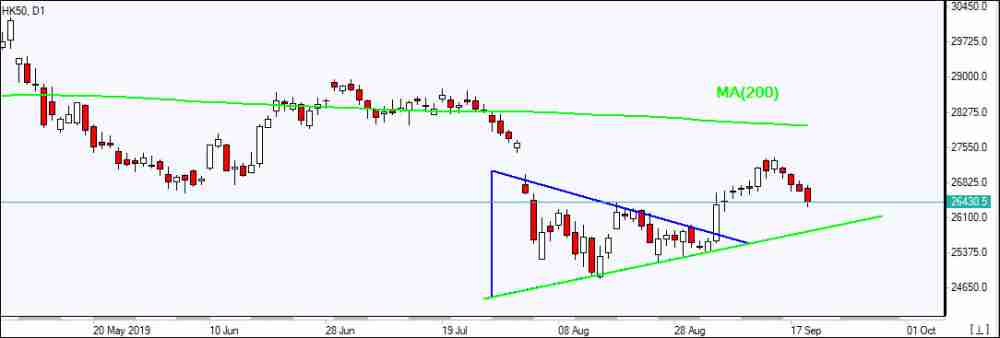
Asian stock indices are mixed today ahead of US and Chinese deputy trade negotiators meeting in Washington. Nikkei gained 0.4% to 2044.45 despite yen resumed climb against the dollar as Bank of Japan held interest rates unchanged but hinted at a possible cut in October. Chinese stocks are mixed: the Shanghai Composite Index is up 0.5% while Hong Kong’s Hang Seng Index is 1.4% lower. Australia’s All Ordinaries Index recovered 0.5% as Australian dollar accelerated decline against the greenback after data showed unemployment ticked up to 5.3% in August from 5.2% in July.
Brent futures prices are edging higher today. Prices fell yesterday after the Energy Information Administration report US crude inventories rose by 1.1 million barrels, while gasoline inventories gained by 0.8 million barrels. November Brent crude dropped 1.5% to $63.60 a barrel on Wednesday.
Note: This overview has an informative and tutorial character and is published for free. All the data, included in the overview, are received from public sources, recognized as more or less reliable. Moreover, there is no guarantee that the indicated information is full and precise. Overviews are not updated. The whole information in each overview, including opinion, indicators, charts and anything else, is provided only for familiarization purposes and is not financial advice or а recommendation. The whole text and its any part, as well as the charts cannot be considered as an offer to make a deal with any asset. IFC Markets and its employees under any circumstances are not liable for any action taken by someone else during or after reading the overview.
Japan’s central bank left its ultra-easy monetary policy stance steady but held out the prospect of further easing at its next policy meeting in October as the growing downside risks from the slowdown in the global economy may halt any progress in achieving the inflation target.
The Bank of Japan (BOJ) has used a combination of a negative interest rate of minus 0.1 percent on banks’ excess reserves and asset purchases to keep the yield on government bonds around zero percent since September 2016, and said today it would continue with this policy to boost inflation.
However, the BOJ’s policy board has clearly turned more worried about the impact of the global economic slowdown on the domestic economy.
“Downside risks concerning overseas economies seem to be increasing, and it also is necessary to pay close attention to their impact on firms’ and households’ sentiment in Japan,” the BOJ said.
“Given that, recently, slowdowns in overseas economies have continued to be observed and their downside risks seem to be increasing, the Bank judged that it is becoming necessary to pay close attention to the possibility that the momentum toward achieving the price stability target will be lost,” BOJ said, adding it would reexamine the outlook at its next meeting when it updates its outlook.
Among the risks to the economy and inflation, BOJ pointed to U.S. economic policies and the consequences of protectionist moves, developments in emerging and commodity-exporting economies, such as China, (including the effects of US policies and protectionism), global changes in IT-related goods, the UK’s exit from the European Union and geopolitical risks.
The prospect of a new round of monetary policy easing by the BOJ was already expected by economists following the BOJ’s change to its statement in July when it added that it “will not hesitate to take additional easing measures if there is a greater possibility that the momentum toward achieving the price stability target will be lost.”
In April the BOJ tweaked its forward policy guidance by adding a time frame for the first time for maintaining its ultra-low levels of interest rates in contrast to the earlier guidance of maintaining low rates for “an extended period of time.”
Today the BOJ confirmed it would maintain its low interest rates for an extended time, “at least through around spring 2020,” and keep rates low by purchasing government bonds so their amount rises by an annual pace of about 80 trillion yen.
As part of its policy of “Quantitative and Qualitative Monetary Easing (QQE) with Yield Curve Control”, the BOJ will also continue to buy exchange-traded funds (ETFs) and real estate investment trusts (Reits) so the outstanding amounts rise at an annual pace of about 6 trillion yen and about 90 billion yen, respectively. It will also continue to buy commercial paper and corporate bonds so the outstanding amounts remain about 2.2 trillion and 3.2 trillion yen, respectively.
The BOJ next issues its quarterly economic outlook in October and in the previous one from July it lowered its forecast for economic growth in fiscal 2019, which began April 1, to 0.7 percent from April’s forecast of 0.8 percent. For fiscal 2020 the growth outlook was steady at 0.9 percent but for fiscal 2021 the outlook was lowed to 1.1 percent from 1.2 percent.
“With regard to the outlook, Japan’s economy is likely to continue on a moderate expanding trend, despite being affected by the slowdown in overseas economies for the time being,” BOJ said today, adding that although exports had shown some weakness, industrial production had been more or less flat, helped by higher domestic demand, and labor market conditions remained tight.
In the second quarter Japan’s gross domestic product grew an annual 1.0 percent, the same as in the first quarter. Despite its ultra-low interest rates and massive asset purchases, known as quantitative easing, the BOJ is still far from reaching its target of 2.0 percent inflation, with headline inflation down to 0.5 percent in July from 0.7 percent in the previous two months.
In its forecast from July the BOJ also lowered its outlook for consumer price inflation to 1.0 percent for fiscal 2019 from April’s forecast of 1.1 percent. For 2020 inflation is seen averaging 1.3 percent, down from 1.4 percent, and then rising to 1.6 percent in fiscal 2021. The Bank of Japan issued the following press release:
1.
“At the Monetary Policy Meeting (MPM) held today, the Policy Board of the Bank of Japan decided upon the following.
(1) Yield curve control The Bank decided, by a 7-2 majority vote, to set the following guideline for market operations for the intermeeting period. [Note 1] The short-term policy interest rate: The Bank will apply a negative interest rate of minus 0.1 percent to the Policy-Rate Balances in current accounts held by financial institutions at the Bank. The long-term interest rate: The Bank will purchase Japanese government bonds (JGBs) so that 10-year JGB yields will remain at around zero percent. While doing so, the yields may move upward and downward to some extent mainly depending on developments in economic activity and prices.1 With regard to the amount of JGBs to be purchased, the Bank will conduct purchases in a flexible manner so that their amount outstanding will increase at an annual pace of about 80 trillion yen.
(2) Guidelines for asset purchases With regard to asset purchases other than JGB purchases, the Bank decided, by a unanimous vote, to set the following guidelines.
a) The Bank will purchase exchange-traded funds (ETFs) and Japan real estate investment trusts (J-REITs) so that their amounts outstanding will increase at annual paces of about 6 trillion yen and about 90 billion yen, respectively. With a view to lowering risk premia of asset prices in an appropriate manner, the Bank may increase or decrease the amount of purchases depending on market conditions.
b) As for CP and corporate bonds, the Bank will maintain their amounts outstanding at about 2.2 trillion yen and about 3.2 trillion yen, respectively. (note 1. In case of a rapid increase in the yields, the Bank will purchase JGBs promptly and appropriately.)
Japan’s economy has been on a moderate expanding trend, with a virtuous cycle from income to spending operating, although exports, production, and business sentiment have been affected by the slowdown in overseas economies. Overseas economies have been growing moderately on the whole, although slowdowns have continued to be observed. In this situation, exports have shown some weakness. On the other hand, with corporate profits staying at high levels on the whole, business fixed investment has continued on an increasing trend. Private consumption has been increasing moderately, albeit with fluctuations, against the background of steady improvement in the employment and income situation. Housing investment and public investment have been more or less flat. Although exports have shown some weakness, industrial production also has been more or less flat, reflecting the increase in domestic demand, and labor market conditions have remained tight. Meanwhile, financial conditions are highly accommodative. On the price front, the year-on-year rate of change in the consumer price index (CPI, all items less fresh food) is at around 0.5 percent. Inflation expectations have been more or less unchanged.
With regard to the outlook, Japan’s economy is likely to continue on a moderate expanding trend, despite being affected by the slowdown in overseas economies for the time being. Domestic demand is expected to follow an uptrend, with a virtuous cycle from income to spending being maintained in both the corporate and household sectors, mainly against the background of highly accommodative financial conditions and the underpinnings through government spending, despite being affected by such factors as the scheduled consumption tax hike. Although exports are projected to show some weakness for the time being, they are expected to be on a moderate increasing trend on the back of overseas economies growing moderately on the whole. The year-on-year rate of change in the CPI is likely to increase gradually toward 2 percent, mainly on the back of the output gap remaining positive and medium- to long-term inflation expectations rising. [Note 2]
Risks to the outlook include the following: the U.S. macroeconomic policies and their impact on global financial markets; the consequences of protectionist moves and their effects; developments in emerging and commodity-exporting economies such as China, including the effects of the two aforementioned factors; developments in global adjustments in IT-related goods; negotiations on the United Kingdom’s exit from the European Union (EU) and their effects; and geopolitical risks. Downside risks concerning overseas economies seem to be increasing, and it also is necessary to pay close attention to their impact on firms’ and households’ sentiment in Japan.
The Bank will continue with “Quantitative and Qualitative Monetary Easing (QQE) with Yield Curve Control,” aiming to achieve the price stability target of 2 percent, as long as it is necessary for maintaining that target in a stable manner. It will continue expanding the monetary base until the year-on-year rate of increase in the observed CPI (all items less fresh food) exceeds 2 percent and stays above the target in a stable manner. As for policy rates, the Bank intends to maintain the current extremely low levels of short- and long-term interest rates for an extended period of time, at least through around spring 2020, taking into account uncertainties regarding economic activity and prices including developments in overseas economies and the effects of the scheduled consumption tax hike. It will examine the risks considered most relevant to the conduct of monetary policy and make policy adjustments as appropriate, taking account of developments in economic activity and prices as well as financial conditions, with a view to maintaining the momentum toward achieving the price stability target. In particular, in a situation where downside risks to economic activity and prices, mainly regarding developments in overseas economies, are significant, the Bank will not hesitate to take additional easing measures if there is a greater possibility that the momentum toward achieving the price stability target will be lost. [Note 3]
Given that, recently, slowdowns in overseas economies have continued to be observed and their downside risks seem to be increasing, the Bank judges that it is becoming necessary to pay closer attention to the possibility that the momentum toward achieving the price stability target will be lost. Taking this situation into account, the Bank will reexamine economic and price developments at the next MPM, when it updates the outlook for economic activity and prices.
[Note 1] Voting for the action: Mr. H. Kuroda, Mr. M. Amamiya, Mr. M. Wakatabe, Mr. Y. Funo, Mr. M. Sakurai, Ms. T. Masai, and Mr. H. Suzuki. Voting against the action: Mr. Y. Harada and Mr. G. Kataoka. Mr. Y. Harada dissented, considering that allowing the long-term yields to move upward and downward to some extent was too ambiguous as the guideline for market operations decided by the Policy Board. Mr. G. Kataoka dissented, considering that it was desirable to strengthen monetary easing by lowering the short-term policy interest rate. [Note 2] Mr. G. Kataoka dissented, considering that the possibility of the year-on-year rate of change in the CPI increasing toward 2 percent going forward was low at this point.
[Note 3] Mr. Y. Harada dissented, considering that, as for policy rates, it was appropriate to introduce forward guidance that would further clarify its relationship with the price stability target. In order to achieve the price stability target of 2 percent at the earliest possible time, Mr. G. Kataoka dissented, considering that further coordination of fiscal and monetary policy was important, and that it was appropriate for the Bank to revise the forward guidance for the policy rates to relate it to the price stability target.” www.CentralBankNews.info
The reasons to be optimistic about this company are covered in a BMO Capital Markets report.
In a Sept. 11 research note, analyst Andrew Kaip reported that his firm BMO Capital Markets upgraded its rating to Outperform and raised its target price to $50 per share from $40 on Newmont Goldcorp Corp. (NEM:NYSE). Driving those positive changes are BMO’s improved outlook for the mining company and the precious metals over the next roughly three years.
“Newmont Goldcorp is in the early stages of a turnaround, and we see the risk-reward as compelling, supported by a valuation discount we expect to begin to narrow as the company executes against its strategy,” Kaip added. The U.S.-based miner’s stock is currently trading at about $39.84 per share.
Also, Kaip presented the primary reasons why the market is likely to rerate Newmont Goldcorp.
One, its management team targets stable production, of 6,000,0007,000,000 ounces, over the next several years, supplemented by its production of byproducts. Whereas the company could divest of assets during that period, BMO expects they would only be noncore ones.
Two, Newmont Goldcorp “established an exemplary track record of consistency and has delivered over $2 billion in improvements since 2013 through its Full Potential program,” Kaip pointed out. “Investors are beginning to warm up to the turnaround and Full Potential efforts, with 40% of the $365 million to be realized this year, 80% next year and 100% in 2021.”
Three, the mining company has a deep pipeline of staged projects “with targeted internal rates of return greater than 15,” indicated Kaip.
Disclosure: 1) Doresa Banning compiled this article for Streetwise Reports LLC and provides services to Streetwise Reports as an independent contractor. She or members of her household own securities of the following companies mentioned in the article: None. She or members of her household are paid by the following companies mentioned in this article: None. 2) The following companies mentioned in this article are billboard sponsors of Streetwise Reports: None. Click here for important disclosures about sponsor fees. 3) Comments and opinions expressed are those of the specific experts and not of Streetwise Reports or its officers. The information provided above is for informational purposes only and is not a recommendation to buy or sell any security. 4) The article does not constitute investment advice. Each reader is encouraged to consult with his or her individual financial professional and any action a reader takes as a result of information presented here is his or her own responsibility. By opening this page, each reader accepts and agrees to Streetwise Reports’ terms of use and full legal disclaimer. This article is not a solicitation for investment. Streetwise Reports does not render general or specific investment advice and the information on Streetwise Reports should not be considered a recommendation to buy or sell any security. Streetwise Reports does not endorse or recommend the business, products, services or securities of any company mentioned on Streetwise Reports. 5) From time to time, Streetwise Reports LLC and its directors, officers, employees or members of their families, as well as persons interviewed for articles and interviews on the site, may have a long or short position in securities mentioned. Directors, officers, employees or members of their immediate families are prohibited from making purchases and/or sales of those securities in the open market or otherwise from the time of the interview or the decision to write an article until three business days after the publication of the interview or article. The foregoing prohibition does not apply to articles that in substance only restate previously published company releases. As of the date of this interview, officers and/or employees of Streetwise Reports LLC (including members of their household) own securities of Newmont Goldcorp, a company mentioned in this article.
Disclosures from BMO Capital Markets, Newmont Goldcorp, September 11, 2019
IMPORTANT DISCLOSURES
Analyst’s Certification I, Andrew Kaip, hereby certify that the views expressed in this report accurately reflect my personal views about the subject securities or issuers. I also certify that no part of our compensation was, is, or will be, directly or indirectly, related to the specific recommendations or views expressed in this report.
Analysts who prepared this report are compensated based upon (among other factors) the overall profitability of BMO Capital Markets and their affiliates, which includes the overall profitability of investment banking services. Compensation for research is based on effectiveness in generating new ideas and in communication of ideas to clients, performance of recommendations, accuracy of earnings estimates, and service to clients.
Analysts employed by BMO Nesbitt Burns Inc. and/or BMO Capital Markets Limited are not registered as research analysts with FINRA. These analysts may not be associated persons of BMO Capital Markets Corp. and therefore may not be subject to the FINRA Rule 2241 restrictions on communications with a subject company, public appearances and trading securities held by a research analyst account.
Company Specific Disclosures
Disclosure 1: BMO Capital Markets has undertaken an underwriting liability with respect to Newmont Goldcorp within the past 12 months. Disclosure 2: BMO Capital Markets has provided investment banking services with respect to Newmont Goldcorp within the past 12 months. Disclosure 3: BMO Capital Markets has managed or co-managed a public offering of securities with respect to Newmont Goldcorp within the past 12 months. Disclosure 4: BMO Capital Markets or an affiliate has received compensation for investment banking services from Newmont Goldcorp within the past 12 months. Disclosure 5: BMO Capital Markets or an affiliate received compensation for products or services other than investment banking services within the past 12 months from Newmont Goldcorp. Disclosure 6A: Newmont Goldcorp is a client (or was a client) of BMO Nesbitt Burns Inc., BMO Capital Markets Corp., BMO Capital Markets Limited or an affiliate within the past 12 months: A) Investment Banking Services Disclosure 6C: Newmont Goldcorp is a client (or was a client) of BMO Nesbitt Burns Inc., BMO Capital Markets Corp., BMO Capital Markets Limited or an affiliate within the past 12 months: C) Non-Securities Related Services. Disclosure 9B: BMO Capital Markets makes a market in Newmont Goldcorp in United States. Disclosure 16: A research analyst has extensively viewed the material operations of Newmont Goldcorp. Disclosure 17: Newmont Goldcorp has paid or reimbursed some or all of the research analyst’s travel expenses.
For Important Disclosures on the stocks discussed in this report, please click here.
Property receives first drilling in more than a decade.
Black Tusk Resources Inc.’s (TUSK:CSE; BTKRF:OTC) 100%-owned Golden Valley property is located in the highly prolific Abitibi Greenstone Belt in northwest Quebec. The belt has produced more than 100 mines and 170 million ounces of gold since the early 1900s. Golden Valley is in a world-class mining area, located about 26 kilometers from the Casa Berardi Mine, operated by Hecla Mining Company, that has produced more than 1.9 million ounces of gold since 1988.
Black Tusk is drilling to verify and expand upon the more than 4,000 meters of drilling conducted historically on the property.
One highlight hole drilled by Noranda Inc., LAB87-B2, returned:
0.91 gram per tonne (g/t) gold over 13.3 meters (51.3 meters to 64.6 meters), including 1.82 g/t gold over 4.5 meters from 57 meters to 61.5 meters, including:
1.4 g/t gold from 57 meters to 58.5 meters;
2.15 g/t gold from 58.5 meters to 60 meters;
1.90 g/t gold from 60 meters to 61.5 meters.
Another hole, LAB109-03-01, drilled by Noranda in 2004, returned:
1.40 g/t gold from 51.3 meters to 52 meters;
0.51 g/t gold from 107.3 meters to 108.2 meters in iron formation within basalt;
1.25 g/t gold from 109.5 meters to 112.1 meters, including:
0.99 g/t gold from 109.5 meters to 110.2 meters in iron formation within basalt;
2.49 g/t gold from 110.2 meters to 111.1 meters in iron formation within basalt;
0.32 g/t gold from 111.1 meters to 112.1 meters in iron formation within basalt.
Black Tusk recently concluded the first phase of its diamond drill program at Golden Valley. The 11 holes totaled nearly 1,500 meters, and were spread roughly over 4 kilometers.
”We are extremely pleased with the progress so far on the Golden Valley Project. Phase One of the drill program has gone as planned and we expect to have first round of drill results back from the lab in the near term,” stated Black Tusk Resources CEO Richard Penn.
“Dr. Mathieu Piche, a consulting geologist, and geologist and Black Tusk director Perry Grunenberg both told me that they liked the look of the drill core, so we are eagerly awaiting the assay results,” Penn told Streetwise Reports.
Once the results are in, Dr. Piche will work with the Black Tusk geological team to plan the next phase of the drill program, which is anticipated to begin in October.
“It is actually easier to drill in the winter in some parts of Quebec,” Penn explained. “It’s much easier to access and drill on swampy land once it freezes over.”
Golden Valley is accessible by all-year highway.
The company also recently added more land to the Golden Valley property, staking six additional claims totaling 178.29 hectares to the south of the main property. This brings the property to a total to 1,779.71 hectares.
Black Tusk has the funds in hand to complete the next phase of drilling; it recently closed an oversubscribed flow-through placement, issuing a total of more than 3.3 million units at CA$0.17 for gross proceeds of CA$568,608. One unit consists of one flow-through common share and one-half of one warrant; each warrant can buy one common share at CA$0.25.
Black Tusk has 29 million shares outstanding and has a tight share structure. About 25% of the shares are held by management, directors and insiders.
“Gold is at a six-year high and the market is heating up. We feel Black Tusk is in the right place at the right time,” Penn concluded.
Disclosure: 1) Patrice Fusillo compiled this article for Streetwise Reports LLC and provides services to Streetwise Reports as an employee. She or members of her household own securities of the following companies mentioned in the article: None. She or members of her household are paid by the following companies mentioned in this article: None. 2) The following companies mentioned in this article are billboard sponsors of Streetwise Reports: None. Click here for important disclosures about sponsor fees. As of the date of this article, an affiliate of Streetwise Reports has a consulting relationship with Black Tusk Resources. Please click here for more information. 3) Comments and opinions expressed are those of the specific experts and not of Streetwise Reports or its officers. The information provided above is for informational purposes only and is not a recommendation to buy or sell any security. 4) The article does not constitute investment advice. Each reader is encouraged to consult with his or her individual financial professional and any action a reader takes as a result of information presented here is his or her own responsibility. By opening this page, each reader accepts and agrees to Streetwise Reports’ terms of use and full legal disclaimer. This article is not a solicitation for investment. Streetwise Reports does not render general or specific investment advice and the information on Streetwise Reports should not be considered a recommendation to buy or sell any security. Streetwise Reports does not endorse or recommend the business, products, services or securities of any company mentioned on Streetwise Reports. 5) From time to time, Streetwise Reports LLC and its directors, officers, employees or members of their families, as well as persons interviewed for articles and interviews on the site, may have a long or short position in securities mentioned. Directors, officers, employees or members of their immediate families are prohibited from making purchases and/or sales of those securities in the open market or otherwise from the time of the interview or the decision to write an article until three business days after the publication of the interview or article. The foregoing prohibition does not apply to articles that in substance only restate previously published company releases. As of the date of this article, officers and/or employees of Streetwise Reports LLC (including members of their household) own securities of Black Tusk Resources, a company mentioned in this article.
The U.S. Federal Reserve lowered its benchmark interest rate for the second time this year due to muted inflation pressures and the impact of global developments for the economic outlook, and confirmed its guidance from June and July that it would “act as appropriate to sustain the expansion.”
The U.S. central bank cut its target range for the federal funds rate by another 25 basis points to 1.75 – 2.0 percent and has now cut it by 50 points this year following a cut in July as global monetary policy continues to loosen to counter weaker business investment and exports as a consequence of the uncertainty unleashed by the trade conflict between the U.S. and China.
“This action supports the Committee’s view that sustained expansion of economic activity, strong labour market conditions, and inflation near the Committee’s symmetric 2 percent objective are the most likely outcomes, but uncertainties about this outlook remain,” the FOMC, the Fed’s policy-making committee said.
Illustrating this pervasive uncertainty about the economic outlook, seven FOMC members voted in favor of the 25-point rate cut while one member, James Bullard of the St. Louis Fed, voted to cut the rate by 50 points while Esther George and Eric Rosengren voted to maintain the rate.
In an update to its economic projections, the FOMC lowered its forecast for the federal funds rate to average 1.9 percent this year, down from its June projection of 2.4 percent, and forecast the rate would remain steady next year to average 1.9 percent, down from 2.1 percent forecast in June.
But in 2021 the Fed projects it will return to monetary tightening and sees the fed funds rate rising to 2.1 percent and then to 2.4 percent in 2022 as inflation slowly rises to the Fed’s 2.0 percent target in 2021 and 2022.
The forecast for economic growth in coming years is largely as projected in June, with economic growth seen easing to 2.0 percent in 2020, 1.9 percent in 2021 and 1.8 percent in 2022. This year growth is seen at 2.2 percent, up from June’s forecast of 2.1 percent.
To help implement its monetary policy stance, the FOMC also decided to lower the rate paid on required and excess reserve balances to 1.80 percent.
The Fed said by setting this rate below the top range for the federal funds rate is aimed at fostering trading in the fed funds market at rates that are within its target range.
The Board of Governors of the Federal Reserve System released the following statement:
“Information received since the Federal Open Market Committee met in July indicates that the labor market remains strong and that economic activity has been rising at a moderate rate. Job gains have been solid, on average, in recent months, and the unemployment rate has remained low. Although household spending has been rising at a strong pace, business fixed investment and exports have weakened. On a 12-month basis, overall inflation and inflation for items other than food and energy are running below 2 percent. Market-based measures of inflation compensation remain low; survey-based measures of longer-term inflation expectations are little changed.
Consistent with its statutory mandate, the Committee seeks to foster maximum employment and price stability. In light of the implications of global developments for the economic outlook as well as muted inflation pressures, the Committee decided to lower the target range for the federal funds rate to 1-3/4 to 2 percent. This action supports the Committee’s view that sustained expansion of economic activity, strong labor market conditions, and inflation near the Committee’s symmetric 2 percent objective are the most likely outcomes, but uncertainties about this outlook remain. As the Committee contemplates the future path of the target range for the federal funds rate, it will continue to monitor the implications of incoming information for the economic outlook and will act as appropriate to sustain the expansion, with a strong labor market and inflation near its symmetric 2 percent objective.
In determining the timing and size of future adjustments to the target range for the federal funds rate, the Committee will assess realized and expected economic conditions relative to its maximum employment objective and its symmetric 2 percent inflation objective. This assessment will take into account a wide range of information, including measures of labor market conditions, indicators of inflation pressures and inflation expectations, and readings on financial and international developments.
Voting for the monetary policy action were Jerome H. Powell, Chair, John C. Williams, Vice Chair; Michelle W. Bowman; Lael Brainard; Richard H. Clarida; Charles L. Evans; and Randal K. Quarles. Voting against the action were James Bullard, who preferred at this meeting to lower the target range for the federal funds rate to 1-1/2 to 1-3/4 percent; and Esther L. George and Eric S. Rosengren, who preferred to maintain the target range at 2 percent to 2-1/4 percent.”
Today’s rate cut and the accompanying statement from the U.S. Federal Reserve mean that investors must stay fully invested and diversified if they’re serious about building and safeguarding their wealth, warns the boss of the world’s largest independent financial advisory organization.
The warning from Nigel Green, founder and CEO of deVere Group comes as the U.S. central bank cut its main interest rates by 25 basis points on Wednesday – but it held back from signalling more cuts could be on their way in December.
Mr Green notes: “The rate cut was widely expected given deflationary pressures driven by the recent weak U.S. manufacturing data, the simmering trade tensions with China and the mounting geopolitical issues in the Middle East.
“The real interest, however, was in the accompanying statement over future rates.
“There’s much uncertainty amongst economists, and within the Fed itself. It’s an unusual environment.
“Despite immense pressure from President Trump to cut rates further, to provide rocket fuel to the economy ahead of next year’s election, the Fed appears conscious that the labour market is tight and fears wage inflation will kick in.
“Also, with the U.S. economy experiencing around 2 per cent growth, which is fairly decent, the Fed is exercising caution over further precautionary rate cuts at this time.”
He continues: “Stock markets wanted the Fed to err on the side of caution and promise more cuts and, as such, markets may fall accordingly.
“The U.S. dollar had today’s rate cut priced-in, but will rise on the Fed’s silence over future cuts.”
Mr Green goes on to conclude: “With a divided U.S. central bank, investors must stay fully invested and diversified if they’re serious about building and safeguarding their wealth.
“As ever in times of volatility, there are winners and losers, opportunities and risks.
“A good fund manager will help investors best position themselves in this regard.”
About:
deVere Group is one of the world’s largest independent advisors of specialist global financial solutions to international, local mass affluent, and high-net-worth clients. It has a network of more than 70 offices across the world, over 80,000 clients and $12bn under advisement.
It’s central bank week and most of the majors are scheduled to decide on policy.
The consensus is that they are in a “race to the bottom” with rates, and are just waiting for each other to pull the trigger. So, needless to say, it will be an interesting time for the currency markets!
Let’s focus on the two major safe-haven currencies and see why expectations for what they could do have changed recently. Both countries have been dealing with an increased demand for their currency as the world economy has slowed.
However, the latest developments could indicate that they might hold steady.
Japan’s Unending Problem
Last July, BOJ Governor Kuroda said that a further cut into negative territory was an option. This has helped fuel speculation that there would be a rate cut in the near future. Certainly there are plenty of excuses for one: the perpetually below target inflation rate, the meagre economic performance in the middle of the trade dispute, and next month’s sales tax hike which apparently will finally be implemented and broadly expected to have a negative impact on the economy.
That lead to a strong consensus that the BOJ would cut rates. But with easing tensions in trade and the more cautious reaction following the attacks on Saudi refining, investors have appeared to be more keen on risk. This has helped add some weakness in the Yen, helping exporters a bit and putting some wind into the sails of inflation.
What to Expect from BOJ
The central bank is quite reluctant to take action unless it is absolutely necessary.
The latest moves in the exchange rate have helped move the consensus towards keeping the rate steady at least for one more month. However, we should note that a rate cut wouldn’t be a terrible surprise.
Some are simply expecting the BOJ to depend on the Fed in order to keep the interest rate spread intact.
This sets up the markets for a strong reaction regardless of what happens. With the bank under less market pressure, we could see a strengthening in the yen if they choose to not act.
A cut would usually bring about weakness in the yen. However, with the increasing questioning of the effectiveness of negative rates, it might not be as strong a move as some would expect.
The SNB’s Ball and Chain
The SNB’s in a slightly different position.
Switzerland has a strong economic dependence on the eurozone. The consensus is that the SNB will keep rates steady, and will emphasize their position that the Franc is overvalued.
However, some analysts are pointing to a high potential of a rate cut. Especially since the SNB itself has argued that it’s important to maintain a certain gap in rates with the euro, and just last week the ECB cut rates.
This initially seemed to guarantee a rate cut by the SNB. However, cash flows in September have given the SNB some more breathing room. We should note, though, that this came after the bank significantly stepped up their asset purchasing in August to counteract the strengthening of the Franc.
Also, there is no press conference scheduled after the meeting. This is a sign that at least going into the room, Governor Jordan isn’t expecting a rate cut.
The Market’s Reaction
Again, there’s a weak consensus that the SNB will hold off on a rate cut (and that only dependent on the fickle exchange rate), some potential of a cut has been priced into the market. This would imply we could have a bigger move in the currency regardless of the outcome in the meeting.
Switzerland is also concerned about the lack of effectiveness of negative rates.
There is an increasing risk that further excursion into negative territory could backfire if banks passed rates onto clients, prompting them to hoard money in cash. Switzerland’s important financial sector is also suffering under the negative rates, and wouldn’t be happy to have the situation get worse.
 Article by