Canada’s monthly retail sales report for July will be coming out later today.
According to the economists polled, Canada’s retail sales are forecast to rise by 0.8% on the month. Meanwhile, core retail sales, excluding autos are to rise 0.4% according to estimates.
The forecasts for July show that economists expect a rebound in retail sales figures. The primary reason behind this view is the higher gasoline prices in Canada during the period.
Auto sales have also risen during the month which could contribute to a better headline print compared to the previous month.
The retail sales figures will also mark the start of the third quarter.
In the whole of the second quarter, Canada’s retail sales rose 1.5% on a year over year and non-seasonally adjusted basis. Retail sales slowed in the second quarter of this year, following a 1.8% increase in the first quarter.
Canada Retail Sales, June 2019
The retail sales report is unlikely to influence the Bank of Canada policymakers. But it could provide a glimpse into the spending and savings pattern among households.
The BoC is one of the few central banks that are yet to cut interest rates.
Canada’s economy has been through somewhat of a swing. The data for the first half showed a weaker pace of growth. However, growth is rising as forecast by the Bank of Canada.
Gasoline & Auto Sales to Push Retail Sales Up
During July, two main components showed some strong gains. These were gasoline and auto sales.
Gasoline prices were seen rising as much as 4% on a month over month basis, alongside an increase in the auto sales during the period. However, there could still be some downside risks.
That said, various other related economic indicators show that consumer spending might have increased. Canada’s labor market, as is the case with many other economies, continues to be a strong point.
Although the labor market report has been somewhat volatile, it has been generally trending higher. Canada’s unemployment rate ticked higher during July. The unemployment rate rose from 5.5% to 5.7% during the month.
Meanwhile, the economy lost 2,200 jobs during the period. The increase in the unemployment rate came amid more people looking for work. This is considered to be a good sign for the economy.
Due to the fact that both the unemployment rate and jobs fell during the month, there is a possibility that while retail sales will increase. There is a good chance that the retail sales figures for July could come at a slower pace.
With interest rates being stable and inflation fairly close to the BoC’s 2% inflation target rate, there is a chance that spending among consumers will increase. This will be seen on how the retail sales data will come out later today.
The BoC is not in a rush to lower interest rates. However, many expect that the next move will be a rate cut.
For the moment, the July retail sales report will perhaps give some early clues into how the third-quarter GDP in Canada is shaping up to be.
China’s Loan Prime Rate (LPR), the country’s new benchmark interest rate, was lowered by 5 basis points to 4.20 percent and is now 11 points lower than in August when it was introduced.
On Aug. 17 the People’s Bank of China (PBOC) reformed its system for setting LPR in an effort to improve the transmission of its monetary policy, lower the cost of financing, and made it the pricing benchmark for all types of loans by commercial lenders instead of its lending rate.
LPR, the average of prices submitted by 18 banks, currently comprises two varieties, a 1 year and a 5 year, and is published on the 20th of each month.
On Aug. 20 LPR was published for the first time since the reform of LPR and set at 4.25 percent, 6 basis points below the 4.31 percent it had been since it was introduced in October 2013, and 10 points below the lending rate’s 4.35 percent. The 5-year rate was set at 4.85 percent.
Today PBOC’s website showed a graph with the 1 year LPR at 4.20 percent for September, down from 4.25 percent in August and 4.35 percent in July.
The 5-year LPR was unchanged at 4.85 percent from August.
While Gold didn’t take on further bullish momentum after the Fed rate decision on Wednesday, instead stabilised below 1,500 USD, our middle-term bullish outlook stays intact.
With a thin economic calendar into the weekly close, we want to look at the Fed and its decision, and how that could affect the price action in Gold in the days to come.
So, after the Fed cut rates as expected by 25 basis points to 1.75 – 2%, the deeper cut of overnight reverse repos by 0.3% to 1.7% to alleviate funding pressures in short-term lending markets at the beginning of this week, potentially pointing to first signs of a credit crunch, financial stress and a favourable environment for Gold in general. Comments from Fed chairman Powell, stating during his press conference on Wednesday that the Fed may resume organic balance sheet growth earlier than expected (to put it differently: bringing a relaunch of QE on the table, at least between the lines) will rather sooner than later result in attention among Gold bulls.
While Gold didn’t take the bait immediately, we still see the overall advantage in Gold on the upside, technically as long as we trade above 1,380 USD.
In fact, we consider the drop below 1,500 USD not at big deal at all, instead see a potential mid-term long trigger around 1,440/450 USD with an overall potential target around 1,650/700 USD in the weeks to come staying active:
Source: Admiral Markets MT5 with MT5-SE Add-on Gold Daily chart (between June 21, 2018, to September 19, 2019). Accessed: September 19, 2019, at 10:00pm GMT – Please note: Past performance is not a reliable indicator of future results, or future performance.
In 2014, the value of Gold fell by 1.7%, in 2015, it fell by 10.4%, in 2016, it increased by 8.1%, in 2017, it increased by 13.1%, in 2018, it fell by 1.6%, meaning that after five years, it was up by 6.4%.
Discover the world’s #1 multi-asset platform
Admiral Markets offers professional traders the ability to trade with a custom, upgraded version of MetaTrader 5, allowing you to experience trading at a significantly higher, more rewarding level. Experience benefits such as the addition of the Market Heat Map, so you can compare various currency pairs to see which ones might be lucrative investments, access real-time trading data, and so much more. Click the banner below to start your FREE download of MT5 Supreme Edition!
Disclaimer: The given data provides additional information regarding all analysis, estimates, prognosis, forecasts or other similar assessments or information (hereinafter “Analysis”) published on the website of Admiral Markets. Before making any investment decisions please pay close attention to the following:
This is a marketing communication. The analysis is published for informative purposes only and are in no way to be construed as investment advice or recommendation. It has not been prepared in accordance with legal requirements designed to promote the independence of investment research, and that it is not subject to any prohibition on dealing ahead of the dissemination of investment research.
Any investment decision is made by each client alone whereas Admiral Markets shall not be responsible for any loss or damage arising from any such decision, whether or not based on the Analysis.
Each of the Analysis is prepared by an independent analyst (Jens Klatt, Professional Trader and Analyst, hereinafter “Author”) based on the Author’s personal estimations.
To ensure that the interests of the clients would be protected and objectivity of the Analysis would not be damaged Admiral Markets has established relevant internal procedures for prevention and management of conflicts of interest.
Whilst every reasonable effort is taken to ensure that all sources of the Analysis are reliable and that all information is presented, as much as possible, in an understandable, timely, precise and complete manner, Admiral Markets does not guarantee the accuracy or completeness of any information contained within the Analysis. The presented figures refer that refer to any past performance is not a reliable indicator of future results.
The contents of the Analysis should not be construed as an express or implied promise, guarantee or implication by Admiral Markets that the client shall profit from the strategies therein or that losses in connection therewith may or shall be limited.
Any kind of previous or modeled performance of financial instruments indicated within the Publication should not be construed as an express or implied promise, guarantee or implication by Admiral Markets for any future performance. The value of the financial instrument may both increase and decrease and the preservation of the asset value is not guaranteed.
The projections included in the Analysis may be subject to additional fees, taxes or other charges, depending on the subject of the Publication. The price list applicable to the services provided by Admiral Markets is publicly available from the website of Admiral Markets.
Leveraged products (including contracts for difference) are speculative in nature and may result in losses or profit. Before you start trading, you should make sure that you understand all the risks.
The Pound surged past the psychologically-important 1.25 level, reaching its highest in two months versus the Dollar, on hopes that a Brexit deal can be reached before the October 31 deadline. With European Commission President Jean-Claude Juncker reportedly saying that he’s doing “everything” to deter a no-deal Brexit, the statement is lending hope to investors that such a worst-case scenario may be avoided.
Markets are at risk however of reading too much into Juncker’s comment, and it remains to be seen whether the Pound can push on from current levels. Should Juncker’s perceived optimism over a Brexit deal be found wanting and the UK-EU impasse become evident once again, the Pound may very easily unwind recent gains and falter back towards the 1.20 mark against the Dollar.
With less than six weeks remaining until the current Brexit deadline, investors will need further proof that a no-deal Brexit can be fully ruled out, before sending the Pound meaningfully higher. Next week’s decision by the UK Supreme Court over the legality of the Parliament’s prorogation could also have a major bearing on Brexit’s eventual fate, which leaves Sterling open to further bouts of volatility.
Stock markets await next catalyst, as central bank easing promises more upside
Asian stocks are mostly in the green, while US futures are pointing higher, with the S&P 500 just about 0.7 percent or 20 points away from a new record close. Equity bulls are holding on to the notion that there’s more upside, as more monetary policy stimulus continues feeding through into major economies.
Still, market sentiment is holding its cautious undertone, for fear of being blindsided by another negative geopolitical or economic surprise that kicks risk appetite in the gut. Global investors will be keeping a close watch over the high-level US-China trade talks slated for early next month, which could set the tone for market sentiment over the final quarter of the year.
Brent set to cap eventful week amid lingering concerns over geopolitical tensions
Brent futures are currently trading below the $65/bbl mark, and on course to mark a weekly gain of more than seven percent. Despite the OECD revising its global growth projections downwards, Oil prices remain elevated as geopolitical tensions continue bubbling in the Middle East. Recent events have prompted investors to shift their attention quickly from demand-side uncertainties to supply-side risks, although the former is ensuring that Oil doesn’t run too high for the time being.
Disclaimer: The content in this article comprises personal opinions and should not be construed as containing personal and/or other investment advice and/or an offer of and/or solicitation for any transactions in financial instruments and/or a guarantee and/or prediction of future performance. ForexTime (FXTM), its affiliates, agents, directors, officers or employees do not guarantee the accuracy, validity, timeliness or completeness, of any information or data made available and assume no liability as to any loss arising from any investment based on the same.
US stocks ended mixed on Thursday as US and Chinese deputy negotiators started two-day meeting in Washington. The S&P 500 gained less than 0.1% to 3006.82, closing 0.6% below its all time closing high. The Dow Jones industrial average lost 0.2% to 27094.79. Nasdaq composite index added 0.1% to 8182.88. The dollar weakened despite report existing home sales rose 1.3% in August, while the number of Americans applying for new unemployment benefits rose by 2,000 to 208,000 last week: the live dollar index data show the ICE US Dollar index, a measure of the dollar’s strength against a basket of six rival currencies, fell 0.2% to 98.35 and is lower currently. Stock index futures point to higher openings today.
CAC 40 paces European indexes gains
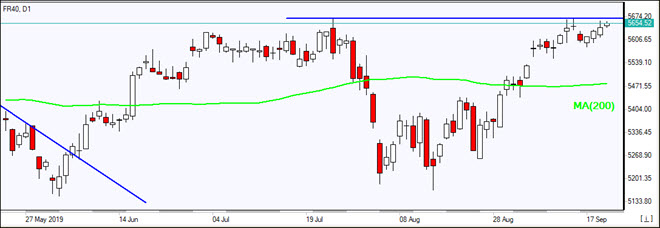
European stocks extended gains on Thursday after further interest rate cuts expectations moderated following the Federal Reserve meeting. Both EUR/USD and GBP/USD resumed climbing yesterday with both pairs moving higher currently. The Stoxx Europe 600 index ended 0.6% higher with bank shares still pacing advancers. Germany’s DAX 30 advanced 0.55% to 12457.70. France’s CAC 40 rose 0.68% while UK’s FTSE 100 added 0.58% to 7356.42 as Bank of England kept interest rates on hold as expected.
Shanghai Composite leads Asian indexes gains
Asian stock indices are mostly gaining today despite a warning by White House adviser Michael Pillsbury that if a trade deal is not reached soon, the US could escalate its tariffs on Chinese goods to 50% or even 100%. Nikkei extended gains 0.2% to 22079.09 despite continued yen climb against the dollar. Chinese stocks are mixed: the Shanghai Composite Index is up 0.4% while Hong Kong’s Hang Seng Index is 0.2% lower. Australia’s All Ordinaries Index gained another 0.2% despite resumed Australian dollar climb against the greenback.
Brent futures prices are higher today. Prices advanced yesterday after reports that Saudi Arabia was looking to buy oil and additional oil products from Iraq: November Brent crude rose 1.3% to $64.40 a barrel on Thursday.
Note: This overview has an informative and tutorial character and is published for free. All the data, included in the overview, are received from public sources, recognized as more or less reliable. Moreover, there is no guarantee that the indicated information is full and precise. Overviews are not updated. The whole information in each overview, including opinion, indicators, charts and anything else, is provided only for familiarization purposes and is not financial advice or а recommendation. The whole text and its any part, as well as the charts cannot be considered as an offer to make a deal with any asset. IFC Markets and its employees under any circumstances are not liable for any action taken by someone else during or after reading the overview.
The contract’s meaning, terms and benefits and the California firm’s near-term catalysts are discussed in an H.C. Wainwright & Co. report.
In a Sept. 12 research note, H.C. Wainwright & Co. analyst Swayampakula Ramakanth reported that Kindred Biosciences Inc. (KIN:NASDAQ) was chosen by the National Cancer Institute (NCI) as one of three Current Good Manufacturing Practice (cGMP) contractors for the PREVENT Cancer Preclinical Drug Development Program.
This means that as a select contractor for this NCI-supported program, Kindred, which modifies human therapies for cats, dogs and horses, may “provide manufacturing, formulation and analytical services needed for the preclinical development of innovative cancer prevention interventions and biomarkers” developed through PREVENT, explained Ramakanth. The maximum contract amount is $49.95 million; the term is four years. Also as a manufacturing pool member, Kindred may bid for future contracts.
Ramakanth highlighted that the benefits of this new development are twofold. One, having been chosen by “a leading institution for the development of novel therapies against cancer” validates Kindred’s expertise in cGMP manufacturing and project management of biologicals, which it executes on at its Burlingame, Calif., operation. Two, the biopharma could receive nondilutive cash flow from the contract.
Looking to H2/19 for its pipeline therapies, noted Ramakanth, Kindred intends to meet with the European Medicines Agency to discuss the regulatory path for Mirataz (mirtazapine transdermal ointment) in the European Union. It expects a decision in Q4/19 from the U.S. Food and Drug Administration on intravenous Zimeta (dipyrone).
Also, in H2/19, the biopharma expects to announce the results from the pilot effectiveness studies of two clinical molecules: the anti-L-4/IL-13 SINK molecule for atopic dermatitis in dogs and the anti-TNF antibody for inflammatory bowel disease in dogs.
H.C. Wainwright has a Buy rating and a $17.99 per share target price on Kindred Biosciences, whose stock is currently trading at around $7.09 per share.
Disclosure: 1) Doresa Banning compiled this article for Streetwise Reports LLC and provides services to Streetwise Reports as an independent contractor. She or members of her household own securities of the following companies mentioned in the article: None. She or members of her household are paid by the following companies mentioned in this article: None. 2) The following companies mentioned in this article are billboard sponsors of Streetwise Reports: None. Click here for important disclosures about sponsor fees. 3) Comments and opinions expressed are those of the specific experts and not of Streetwise Reports or its officers. The information provided above is for informational purposes only and is not a recommendation to buy or sell any security. 4) The article does not constitute investment advice. Each reader is encouraged to consult with his or her individual financial professional and any action a reader takes as a result of information presented here is his or her own responsibility. By opening this page, each reader accepts and agrees to Streetwise Reports’ terms of use and full legal disclaimer. This article is not a solicitation for investment. Streetwise Reports does not render general or specific investment advice and the information on Streetwise Reports should not be considered a recommendation to buy or sell any security. Streetwise Reports does not endorse or recommend the business, products, services or securities of any company mentioned on Streetwise Reports. 5) From time to time, Streetwise Reports LLC and its directors, officers, employees or members of their families, as well as persons interviewed for articles and interviews on the site, may have a long or short position in securities mentioned. Directors, officers, employees or members of their immediate families are prohibited from making purchases and/or sales of those securities in the open market or otherwise from the time of the interview or the decision to write an article until three business days after the publication of the interview or article. The foregoing prohibition does not apply to articles that in substance only restate previously published company releases.
Disclosures from H.C. Wainwright & Co., Kindred Biosciences Inc., First Take, September 12, 2019
Investment Banking Services include, but are not limited to, acting as a manager/co-manager in the underwriting or placement of securities, acting as financial advisor, and/or providing corporate finance or capital markets-related services to a company or one of its affiliates or subsidiaries within the past 12 months.
I, Swayampakula Ramakanth, Ph.D., Sean Lee, Sean Kang and Arthur He, Ph.D., certify that 1) all of the views expressed in this report accurately reflect my personal views about any and all subject securities or issuers discussed; and 2) no part of my compensation was, is, or will be directly or indirectly related to the specific recommendation or views expressed in this research report; and 3) neither myself nor any members of my household is an officer, director or advisory board member of these companies.
None of the research analysts or the research analyst’s household has a financial interest in the securities of Kindred Biosciences, Inc. (including, without limitation, any option, right, warrant, future, long or short position).
As of August 31, 2019 neither the Firm nor its affiliates beneficially own 1% or more of any class of common equity securities of Kindred Biosciences, Inc.
Neither the research analyst nor the Firm has any material conflict of interest in of which the research analyst knows or has reason to know at the time of publication of this research report.
The research analyst principally responsible for preparation of the report does not receive compensation that is based upon any specific investment banking services or transaction but is compensated based on factors including total revenue and profitability of the Firm, a substantial portion of which is derived from investment banking services.
The firm or its affiliates received compensation from Kindred Biosciences, Inc. for non-investment banking services in the previous 12 months.
The Firm or its affiliates did receive compensation from Kindred Biosciences, Inc. for investment banking services within twelve months before, and will seek compensation from the companies mentioned in this report for investment banking services within three months following publication of the research report.
The Firm does not make a market in Kindred Biosciences, Inc. as of the date of this research report.
I could not help but feel a familiar sense of deja-vu from Thursday’s Bank of England (BOE) policy meeting which was a non-event.
The central bank left interest rates unchanged at 0.75% as widely expected, expressed concerns over slowing global growth, trade uncertainty and most importantly Brexit. Despite all these warnings and downgrade to the third quarter growth outlook, the BOE still refused to join the chorus of central banks easing monetary policy.
Should Brexit uncertainty continue squeezing vitality out of Britain, the BOE will be forced to turn on the monetary policy life support to prevent the economy from flatlining.
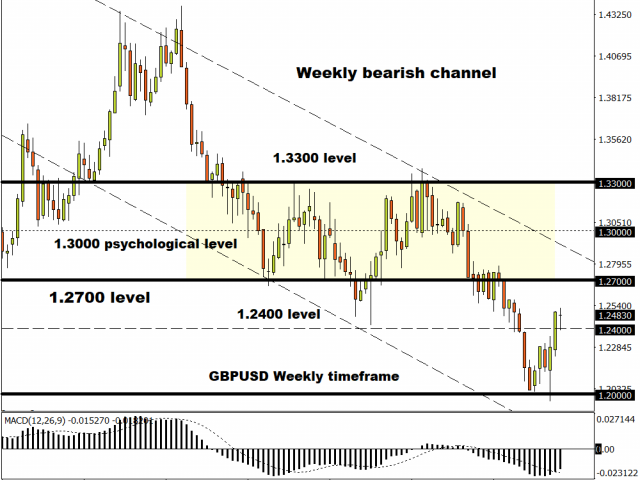
Sterling offered a muted response to the MPC meeting and rate decision this afternoon. The GBPUSD is trading around 1.2480 as of writing with support found at 1.2400. Prices have scope to push higher in the near term as fears cool over the UK crashing out of the European Union without a Brexit deal on October 31st.
OECD cuts growth outlook to post-crisis low
A darker mood awaits financial markets after the Organization of Economic Cooperation and Development (OECD) lowered its global growth forecast to 2.9% for this year and 3% in 2020.
Escalating trade tensions between the United States and China have sapped investor confidence, compounded to policy uncertainty and dampened risk sentiment across global financial markets. Given how China’s GDP is projected to expand by 6.1% in 2019 and 5.7% in 2020 compared to the 6.6% achieved in 2018, this presents a significant risk for emerging markets, especially those who have fostered close trade ties with China. Decelerating global growth may result in falling demand for crude which is bad news for emerging market energy exporters.
Today’s gloomy report from the OECD could speed up the global monetary easing train as more central banks defend their respective economies from unfavourable macroeconomic conditions.
SARB leaves interest rates unchanged
While central banks across the world are easing monetary policy in the face of trade uncertainty and decelerating global growth, the South African Reserve Bank (SARB) has decided to leave rates unchanged at 6.5% in September.
Although economic conditions in South Africa have improved from the first quarter of 2019 with growth rebounding to 3.1% in Q2, the nation still remains exposed to external risks like many other emerging markets. The explosive appreciation in Oil prices earlier this week and pending rating review by Moody’s on 1st of November may have discouraged the SARB from cutting rates today. Nevertheless, a rate cut remains on the cards in Q4. Investors just need to look at the SARB’s downgraded economic projections for 2020 and 2021 which verify the central bank’s caution.
The SARB has decided to miss the fast-moving easing train this month. However, it may catch it at a later stop with better seats.
Disclaimer: The content in this article comprises personal opinions and should not be construed as containing personal and/or other investment advice and/or an offer of and/or solicitation for any transactions in financial instruments and/or a guarantee and/or prediction of future performance. ForexTime (FXTM), its affiliates, agents, directors, officers or employees do not guarantee the accuracy, validity, timeliness or completeness, of any information or data made available and assume no liability as to any loss arising from any investment based on the same.
Delighted as we all may be with this week’s news – the new indictments of JPMorganChase employees involved with the gold market, the U.S. Justice Department’s designation of the investment bank as a criminal enterprise, and the prospects of more indictments – we have to admit a couple of things about the situation.
First, the market manipulation of which the bank’s employees and supervisors stand accused – rigging prices largely by “spoofing” other traders – is not the sort of manipulation the Gold Anti-Trust Action Committee (GATA) long has complained about.
This week, a reporter for a mainstream financial news organization on whose door I have pounded relentlessly without result actually sought comment about the indictments from me.
But I had to disappoint him and maybe even to offend him with this:
“Of course, the Morgan traders charged today enjoy the presumption of innocence. But the Justice Department already has obtained confessions from and convictions of two former Morgan traders who say they manipulated the monetary metals markets with the approval of their supervisors. So there is already documentation of systemic corruption in the monetary metals markets and at the country’s biggest investment bank.
“Unfortunately the involvement of the U.S. government itself in similar market rigging remains unaddressed.
“Such rigging seems comprehensive and a matter of longstanding policy, of far greater impact than the sporadic rigging attributed to the traders for Morgan and other banks.
“A year ago, echoing GATA, U.S. Rep. Alex X. Mooney, R-West Virginia, asked the Treasury Department to identify the markets in which the U.S. government is trading secretly and to explain the purposes of such trading. The department has refused to respond.
“Also echoing GATA, last year Mooney asked the Commodity Futures Trading Commission whether it has jurisdiction over manipulative trading undertaken by or on behalf of the U.S. government or whether such trading is legal, authorized by the Gold Reserve Act of 1934 or other federal laws, and the commission also has refused to respond. We urge financial news organizations to press those bigger questions.”
In November 2001 in U.S. District Court in Boston, we heard an official answer to the question now pending with the CFTC.
The case before the court was Reg Howe’s lawsuit against the Bank for International Settlements, the Treasury Department, the Federal Reserve, and various bullion banks, accusing them of rigging the gold market.
An assistant U.S. attorney moved for summary judgment dismissal of the lawsuit, telling the court that while the government was not admitting what Howe charged, the government did claim the power, under the Gold Reserve Act of 1934, to do exactly what Howe charged.
As this week’s news reports have shown, putting critical questions to central banks about their surreptitious interventions in the gold market and other markets remains prohibited in mainstream financial news organizations.
That intervention constitutes far greater manipulation of markets than JPMorganChase is capable of on its own and indeed reflects government policy to suppress not just the price of gold but the prices of all major commodities.
Inadequate as the resulting reporting was, at least it showed that the mainstream financial news organizations know who we are and where to find us. It also suggested that those organizations may be starting to feel a bit nervous about having neglected the manipulation issue for so long.
The other thing we must admit is that we’re puzzled by the Justice Department’s aggressive pursuit of JPMorganChase.
But for many years JPMorganChase has been essentially a government agency itself – not just a primary dealer in U.S. Treasury securities but a broker for the government in various undertakings and rescues.
The bank almost certainly has helped to execute the government’s surreptitious trades in the commodity futures markets.
After all, the bank’s chief executive officer, Jamie Dimon, and the former chief of its commodity division, Blythe Masters, have stated publicly that the bank has no position of its own in the monetary metals markets and trades them only for “clients.”
Do those clients include the U.S. government and other governments? Of course only GATA has asked, and no response was ever offered.
Surely people at JPMorganChase have as much dirt on the government as the government is collecting on the bank. So why is the Justice Department going after the bank vigorously now after letting the bank skate away from so much of its own corruption?
While the Justice Department is supposed to be somewhat removed from politics, in the end it is a political agency like everything else in the executive branch of government, and some attorneys general have been brazenly political, like President John F. Kennedy’s attorney general, his brother and campaign aide, Robert, and President Richard Nixon’s attorney general, John Mitchell, his campaign manager.
GATA Chairman Bill Murphy’s theory about the Justice Department’s pursuit of JPMorganChase is that there are two competing factions within the government – a civil war within what lately has been called the Deep State. This is plausible.
There is no sensible hypothesis to explain the Justice Department’s assault on the bank. We wonder if, years ago, the bank refused to give President Trump a loan.
In any case, “market manipulation” now is on many lips and being cited by many mainstream news organizations, central banks increasingly are buying gold as if they know it is more than a “pet rock,” and suddenly there may not be enough tinfoil hats to go around.
But we will put a few aside just in case any mainstream financial journalists starting picking up a few of the clues that long have been lying all around them.
The Money Metals News Service provides market news and crisp commentary for investors following the precious metals markets.
The BOJ meeting is now behind us. So it’s back to reviewing data and the market reaction to the fundamental drivers behind the yen.
Coming up next, we have inflation data from Japan which is is the last major data we will see over the next week. We could see the fundamental trend for the currency set during the early session tomorrow.
As everyone knows at this point, Japan’s inflation hasn’t been anywhere near the BOJ’s target in, well, years.
In fact, the central bank’s focus has shifted to be more on the economic situation than pushing for price growth. But that doesn’t mean the market won’t react to the data. It just means that the impact on potential monetary policy is not as much as in other countries.
What We Are Expecting
There are three main measures that are published all at once. While the core figure is usually seen as the most important, it’s the combination of the three that typically moves the market. Also, there is the release of a monthly figure, though generally that’s ignored in favor of the annualized data.
Expectations are for Japan’s August annualized CPI to expand slightly to 0.6% from 0.5% prior, driven by the more volatile items in the basket.
We can expect CPI ex-food, on the other hand, to drop to 0.4% from 0.6% in the prior month. And when we exclude food and energy (the core rate) we can expect it to come in at 0.5%. This is in comparison to 0.6% in the prior reading.
The Market Reaction
When we have such relatively small numbers, a difference of a couple of decimals from expectations can be quite significant. Therefore, the market reaction might be bigger than a comparative move in inflation in another country.
Core CPI has been drifting downwards since the middle of last year, and if the expectations were to be borne out, it would be the lowest since early 2017.
Since slow inflation is largely priced into BOJ analysis, lower inflation would be seen as positive for the yen. The closer to 0, the more incentive there is for people to seek refuge with the currency.
Higher inflation than expected would probably be seen as negative. A beat in expectations could lead to a continuation of the latest weakness in the yen.
The Other Data
Twenty minutes after the release of the inflation figures, we have some data that doesn’t move the currency markets but helps with fundamental analysis of the currency. That is foreign investment in Japanese capital markets since cash flows are one of the drivers or the currency value.
Lately, there have been outflows from the Japanese stock market, while inflows to Japanese bonds have been erratic.
The switch to fixed income is a sign of continuing interest in safe havens, and a general lack of expectations of further BOJ stimulus. While forex analysts and traders might be talking up BOJ interventionism, they don’t appear to be putting their money on the table.
The Trends and Future Issues
The government is still on track to raise sales taxes next month. This is expected to support inflation, even with the mitigating measures that the government has proposed.
However, this wouldn’t be a growth in “fundamental” inflation. It could lead to a reversal afterward, which we saw the last time the government raised taxes as the market adjusts to businesses passing on the increased costs.
The other factor that is more worrisome for the near term is the drop in both exports and imports. While the country’s trade deficit has narrowed, it has done so because of a significant drop in imports.
Even ahead of the expected tax hike, Japanese consumers are reluctant to spend, and demand is falling. This would imply further pressure on inflation in the future.
The Bank of England will be holding its monetary policy meeting today. This will be the last monetary policy meeting ahead of the October 31 Brexit deadline.
Investors expect the Bank of England MPCs to leave monetary policy unchanged. As a result, the BoE’s interest rates will be steady at 0.75%, while the central bank’s asset purchase program will remain at 435 billion GBP. The status quo will be maintained against the backdrop of both domestic and global headwinds.
Domestically, the Brexit uncertainty remains a big issue for the central bank. Meanwhile, external factors such as slowing global growth and the trade dispute between the US and China continue to dampen the outlook.
At its previous monetary policy meeting, the BoE officials cut the growth forecast for the UK for 2019 and for the next year. It also warned of the risks that the UK could slip into a recession.
Bank of England Interest Rate
The central bank has maintained the view that if the UK leaves the EU with a deal, then it would be appropriate to raise interest rates. However, with no deal in sight and the prospects of a no-deal Brexit rising, the BoE will have no other option but to stand pat on policy.
Some economists saw the previous central bank meeting as more hawkish than usual. However, the narrative could change amid the recent developments in the UK economy.
UK Economy Recap Since August BoE Meeting
The Bank of England last met in early August. Since then, economic reports from the UK gave a mixed picture. The biggest headline-grabbing report was the GDP.
The UK economy contracted 0.2% in July which raised concerns of a recession. However, that changed after the GDP report for August showed a reversal. The economy managed to recover, rising 0.3% in August.
But the statistics agency ONS said that investors should not read too much into one month’s report. It also warned that growth was stagnating in the long-term trends.
The latest inflation figures do not show any signs of price pressures. But the inflation rate remains above the BoE’s 2% inflation target rate. The UK’s annual inflation grew at a pace of 2.1% in August.
This was slightly above the expectations and modestly up from 2.0% from the previous month. The core inflation rate was, however, running below 2.0%. In August, the core inflation rate was at 1.9%.
While the GDP and inflation give a mixed picture, the labor market continues to remain strong.
The UK’s latest job figures show that the average earnings index grew 3.7% in the three months to July. This was up from a revised 3.5% headline print in the month before.
Currently, wages outperform inflation, putting more money in the hands of consumers.
As a result, the latest retail sales figures nudged higher. Retail sales grew 0.2% on the month, following a downward revised 0.9% in the month before.
How Long Will the BoE Stay on the Sidelines?
The Bank of England’s stance on monetary policy stands in contrast to other central banks. The ECB and the Fed, alongside other central banks such as the RBA and the RBNZ, have moved to an easing bias.
The Brexit uncertainty has intensified more in the past few weeks. This gives a downside risk to growth. Even if the UK leaves with a Brexit deal in hand, the UK’s economy will take time to recover.
As a result, growth could remain weak and will likely spill into the next year. Demand, exports, and investment remain week and will take time to recover. As a result, the central bank in the UK is unlikely to raise rates at least well into the end of next year.
Depending on the outcome of the Brexit saga, the Bank of England has a higher probability of cutting rates rather than raising rates. The meeting minutes will, therefore, be crucial as investors assess the forward guidance from the central bank.