Boris Johnson defeated by Supreme court…what next?
Egyptian stocks decline ahead of CBE policy meeting
Rising political risk in the United States has joined the growing list of negative themes weighing heavily on global sentiment.
In a dramatic development overnight, US lawmakers have called for an impeachment inquiry against US President Donald Trump. Given how this increases the prospect of heightened political uncertainty in the world’s largest economy and compounds the list of geopolitical factors, risk assets and global equities in particular remain in the firing line. The negative mood lingering across markets is also being fueled by renewed US-China trade uncertainty after Trump criticized China’s trade practices in a United Nation’s speech. Fresh signs of escalating trade tensions between the world’s two largest economies will be negative for market sentiment as investors fret over slowing world growth.
Asian markets slipped on Wednesday morning as US political uncertainty and trade concerns drained investor confidence. The growing caution and absence of risk appetite could find its way into European markets later this morning.
What next in the Brexit saga?
Pound bulls experienced a sugar rush on Tuesday after the Supreme Court ruled Boris Johnson’s suspension of Parliament ‘unlawful, void and to no effect’.
However, gains were later surrendered as investors refocused on the bigger picture and what it meant for Brexit. Given how the prime minister said he disagreed with the Supreme Court ruling and vowed that Britain would leave the EU by the 31 October deadline, nothing has changed in this complicated Brexit equation. Opposition leaders are already calling for Boris Johnson to resign which will add to the political uncertainty as the clock ticks down. Investors should fasten their seat belts and prepare for more drama and action in the Brexit saga as Parliament reconvenes on Wednesday.
There are so many questions drifting in the air over what to expect in the coming weeks and this compounds the overall uncertainty. Will Johnson be able to strike a deal in Brussels on October 17-18? Will he be forced to seek an extension to Article 50? Will there be a general election? Does the prime minister have a plan B?
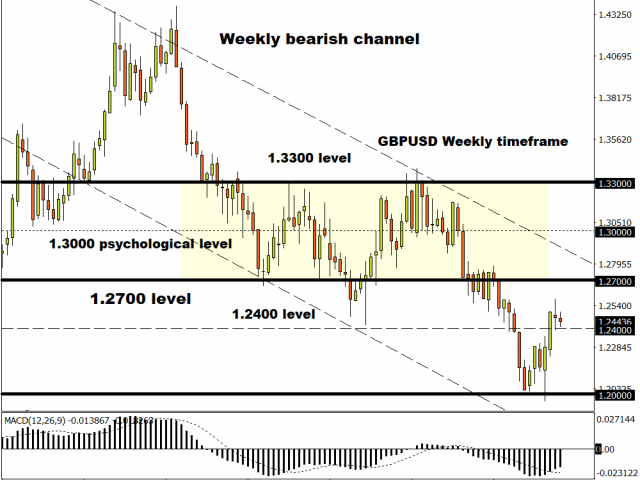
The British Pound could transform into a fierce battleground for bulls and bears due to its sensitivity to Brexit developments.
Looking at the technical picture, prices still remain in a downtrend on the weekly charts. However, a solid weekly close above 1.2500 should open the doors towards 1.2700.
Egyptian stocks hit by protest uncertainty
Egypt’s benchmark EGX30 index fell over 4% on Tuesday as protests in Cairo and other cities over the weekend sparked risk aversion consequently dampening appetite for riskier assets.
While concerns over further escalation may drag the index lower, losses could be cushioned by Egypt’s improving macro-economic conditions. The nation expanded by 5.3% in 2018 which was its highest rate of growth in 10 years while inflation is at its lowest level in six years at 7.5%. Overall sentiment towards the economy has the potential to improve if the Central Bank of Egypt cuts its key interest rates on Thursday in an effort to stimulate growth.
Disclaimer: The content in this article comprises personal opinions and should not be construed as containing personal and/or other investment advice and/or an offer of and/or solicitation for any transactions in financial instruments and/or a guarantee and/or prediction of future performance. ForexTime (FXTM), its affiliates, agents, directors, officers or employees do not guarantee the accuracy, validity, timeliness or completeness, of any information or data made available and assume no liability as to any loss arising from any investment based on the same.
Dollar weakens on deteriorating consumer confidence data
US stocks retreat deepened on Tuesday as House of Representatives Speaker Nancy Pelosi appeared to support launching impeachment inquiry against President Trump over a phone call with the Ukrainian president. The S&P 500 fell 0.8% to 2966.62. Dow Jones industrial slid 0.5% to 26806.18. The Nasdaq dropped 1.5% to 7993.63. The dollar weakening resumed on Conference Board data showing US consumer confidence index slipped from 133.3 to 125.1, a three month low. The live dollar index data show the ICE US Dollar index, a measure of the dollar’s strength against a basket of six rival currencies, fell 0.4% to 98.34 but is higher currently. Stock index futures point to mixed openings today.
CAC 40 loss minimal among other European indexes
European stocks ended marginally higher on Tuesday despite weak data. Both the EUR/USD and GBP/USD turned higher yesterday with both pairs lower currently. The Stoxx Europe 600 ended 0.01% higher led by defensive stocks. The German DAX 30 lost 0.3% to 12307.15 after the Ifo report business climate index in Germany rose marginally in September, but the expectations component fell to a decade low. France’s CAC 40 slipped 0.04%. UK’s FTSE 100 slid 0.5% to 7291.43 as the UK Supreme Court ruled Prime Minister Boris Johnson’s decision to shut down parliament until mid-October was unlawful.
Hang Seng leads Asian indexes losses
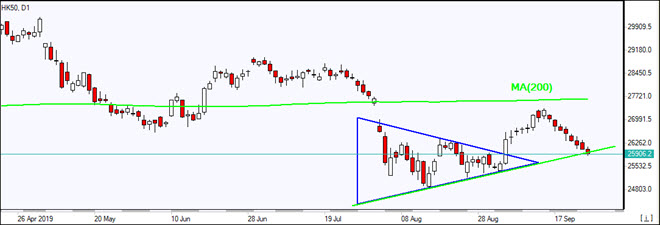
Asian stock indices are falling today on waning hopes for a US-China deal after President Trump criticized China in a United Nations speech saying that the United States would no longer tolerate Beijing’s trade practices of the theft of trade secrets “on a grand scale” and that he would not accept a “bad deal” with China on trade. Nikkei lost 0.4% to 22020.15 despite yen slide against the dollar. Chinese stocks are falling as Wang Yi, China’s foreign minister and state councilor, said Beijing would not bow to threats, including on trade: the Shanghai Composite Index is down 0.9% and Hong Kong’s Hang Seng index is 1.3% lower. Australia’s All Ordinaries Index extended losses 0.6% despite Australian dollar’s move lower against the greenback.
Brent futures prices are edging lower today. Prices fell yesterday on reports Saudi Arabia is making progress in restoring crude oil production following attacks on processing facilities. The American Petroleum Institute late Tuesday report indicated US crude inventories rose by 1.4 million barrels last week. Prices tumbled yesterday: November Brent lost 2.6% to $63.10 a barrel on Tuesday. Today at 16:30 CET the Energy Information Administration will release US Crude Oil Inventories.
Note: This overview has an informative and tutorial character and is published for free. All the data, included in the overview, are received from public sources, recognized as more or less reliable. Moreover, there is no guarantee that the indicated information is full and precise. Overviews are not updated. The whole information in each overview, including opinion, indicators, charts and anything else, is provided only for familiarization purposes and is not financial advice or а recommendation. The whole text and its any part, as well as the charts cannot be considered as an offer to make a deal with any asset. IFC Markets and its employees under any circumstances are not liable for any action taken by someone else during or after reading the overview.
Peter Epstein of Epstein Research speaks with Peter Leaman, SVP exploration of Kincora Copper, after the company released the first of its drill results.
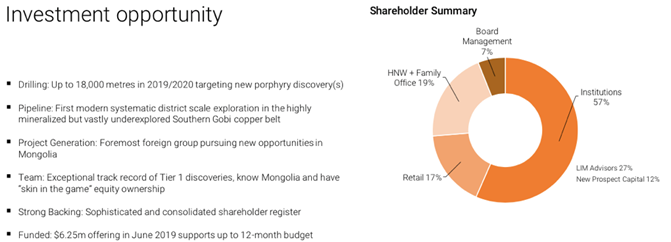
On September 10th Kincora Copper Ltd. (KCC:TSX.V) provided the first drilling update at its 100%-owned copper-gold porphyry projects in the Southern Gobi region of Mongolia. This update comes after an oversubscribed $6.25 million equity raising in late June.
First phase drilling at Bronze Fox consisted of 4,264 meters at two targets. Results for 2,876 meters were announced in the press release. To put this into content, that’s ~16% of a total of 18,000 meters planned across multiple projects/prospects in multiple phases.
The market did not like initial results ..
I understand the disappointment, but was the very negative share price reaction warranted for results that although not great, were not horrible? Readers should know that 84% of the estimated meters to be drilled and assayed, on programs that stretch well into 2020, are yet to be reported.
Three drill holes at Bronze Fox’s West West Kasulu (WWK) returned extensive lower-grade mineralization and a few higher-grade zones increasing towards the west. Some shareholders exited stage left on these mediocre results, sending the share price 50% lower in subsequent days to $0.07.
Highlights include drill hole F103, which returned 20m @ 0.64% CuEq from 140m; and 120m @ 0.41% CuEq from 700m. While 0.64% CuEq is a decent grade, the 20m width hardly stands out. And, while a 140m intercept is wide, 0.41% CuEq is nothing to write home about.
Partial results from drill hole F107 at WWK showed more of the same, no blockbuster, conclusive, “discovery” type intervals combined with high-grade copper. F107 contained 8m @ 0.25% Cu (1.26% CuEq) from 528m; 10m @ 0.54% CuEq from 630m; 22m @ 0.55% CuEq from 654m; 30m @ 0.50% CuEq from 702m; 10m @ 0.79% CuEq from 828m and 2m @ 0.22% Cu (1.14% CuEq) from 880m.
The market is looking to see intervals boasting 1%+ CuEq, that are much wider than the 28 meter higher-grade segments reported in hole F107, and/or tens of meters of 0.5%+ CuEq near-surface.
Gold’s not driving this story, but at ~1/6 the economics, it’s not trivial
Something worth remembering is that Mining Associates stated about 16% of the in-situ value is represented by gold from the WWK mineralized system, defined before this drill program started, as a total conceptual exploration target of 1.31.5 million tonnes of CuEq metal.
Otherwise mediocre drill results showed pockets of fairly strong gold mineralization. For instance, hole F107 was gold-rich. It had an eight meter intercept grading 0.25% Cu that was 1.26% CuEq.
About 16% of overall value is being driven by a gold price that’s up 16% year-to-date, and 23% in the past 12 months. In US$, gold is near a 6.5-year high. Perhaps weighing on bullish gold sentiment is a weak copper price.
I remain bullish on copper due to its essential need in multiple new paradigms (green energy, high-tech, the building/rebuilding of global infrastructure, and the electrification of passenger and commercial vehicles).
Kincora’s wholly owned East TS project is 10 to 15 km east of the Tsagaan Suvarga porphyry Cu/Au project, under development on the western margin of the Tsagaan Suvarga intrusive complex. TS has had over US$370 million invested in it and is forecast to produce 316,000 tonnes copper per year.
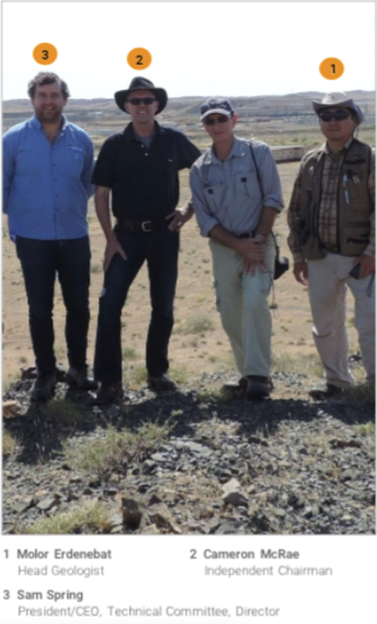
The market has heard a great deal about Kincora from its CEO Sam Spring. I reached out to SVP of Exploration Peter Leaman to learn more about his views on the projects, and new drilling to date.
Peter Epstein: Can you please provide an overview of your background and your role at Kincora?
Peter Leaman: Yes. I have 40 years’ exploration experience, 28 with BHP, and I’m still involved with PanAust (since 2010). I’ve witnessed firsthand multiple copper and gold discoveries, including the Reko Diq deposit. My current role at Kincora is senior vice president of exploration.
I joined Kincora in late 2016, after the company consolidated the dominant position in the Southern Gobi copper-gold belt and regained full access to the Bronze Fox project. I am a member of the technical committee including Chairman John Holliday.
John is a very seasoned and successful explorer. He, CEO Sam Spring and I oversee a hard-working, skilled Mongolian team of geologists. We also have a strong network of technical advisors, including my old colleague Barry de Wet.
I feel I have unfinished business in this belt and in Mongolia. I ran the BHP Falcon JV with Ivanhoe in the 2000’s, which was the last district-scale exploration in the region (before Kincora). I was involved, at the development stage, in the BHP review team of Oyu Tolgoi.
In carefully reviewing the data on Kincora’s projects, I saw, and continue to see, the potential for globally significant discoveries.
Peter Epstein: Thanks Peter, what are your thoughts on the current Kincora exploration program?
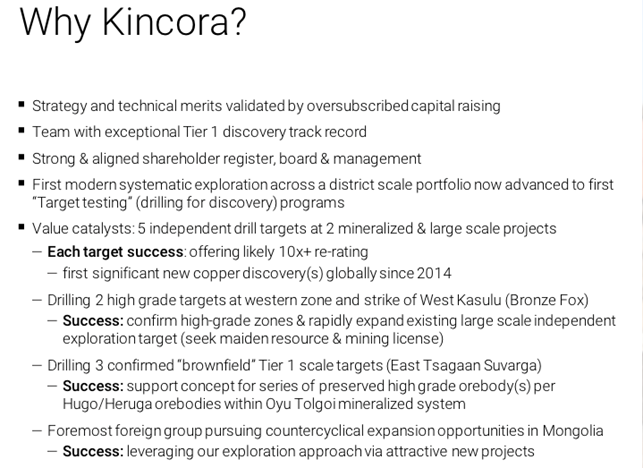
Peter Leaman: Kincora announced initial exploration results from the first phase of drilling at Bronze Fox, and drilling has commenced at our second priority target, a brownfield project, East Tsagaan Suvarga. Multiple-phase programs are underway at both projects. We are undertaking the first modern, systematic exploration and drilling at district scale in the Southern Gobi.
Kincora is implementing a sophisticated exploration approach, testing targets in a way that the majors would. We are testing targets with significant scale potential and improving the odds, as best we can. Importantly, we are using methods that are significantly improved from my time at the Falcon JV period.
That said, we are all very mindful of the fact that, as a junior, the market judges you press release by press release. We are undertaking high-risk, high-reward exploration, and we recognize that we need to get good results with the current 12-month program and budget.
Peter Epstein: How do you see last weeks’ exploration update? Were first phase results at Bronze Fox disappointing? Have you drilled the best targets?
Peter Leaman: Bronze Fox is a large, lower-grade system with zones of higher-grade copper and gold. Its size and relative lack of extensive drilling, with complementary geophysics done since the last drill campaign, suggests that a deeper and higher-grade core could be present at depth. An analogy is the Red Chrisdeposit in British Columbia, Canada.
We have better defined the system and greatly improved our understanding of the new geophysics, lithological controls and depth profile of the target zone. Like all shareholders, we wanted to see more high-grade from the initial results. Everyone wants a discovery yesterdaythat’s what we’re looking to dodiscover a new high-grade zone.
But, we have to continue in a systematic and unemotional way. Merely adding confidence and tonnage to the system is not our goal, the clear goal is to provide compelling evidence of a high-grade system and core.
In the end, we don’t have to drill hundreds of holes ourselves, just tee it up for bigger players to take notice. SolGold in Ecuador is a prime example of a tier 1 discovery that attracted cornerstone investments by BHP and Newcrest.
I will shortly lead the team reviewing these results in the field, with the critical element being the area to the west where there is sufficient scale for a large system. We want to revisit the original concept of a preserved monzodiorite system being an attractive and higher grade target. So far, Phase 1 drilling supports the most prospective part of the system being away from the regional fault to the west.
Phase 1 is providing valuable results and insights to help us better understand the system correlating to the new geophysics, thereby assisting and informing our plans for phase 2. Our focus on Mongolia is to find globally significant new discoveries, not average-to-low-grade results or deposits.
Peter Epstein: Can you provide an update on current activities?
Peter Leaman: Yes, we have drilled ~4,200m of up to 18,000m, with assay results outstanding on a third of the initial ~4,200m at Bronze Fox, and we have moved the rigs to a project that we call East TSEast Tsagaan Suvarga.
We are now testing a number of large-scale targets that may be caused by blind and potentially high-grade porphyry copper mineralization. This is a project that has me very excited given its location, age and scale potential, but it’s early stage.
In addition to drilling at East Tsagaan Suvarga we are also continuing with project generation activities, which we believe is very important for any sustainable exploration strategy at our stage.
With that in mind, in the next several weeks I will be reviewing various projects identified by our team that could strategically fit within our exploration portfolio. In the past 18 months, we have walked over 200 projects/targets in the field as part of our due diligence.
Separately, we have just made an application for a new exploration license prospective for gold-rich copper porphyrieslarge size, good location, previous drilling (limited), but including a >1% copper hit, that was inadequately followed up on. We are looking to leverage the strong team we have in place and our systematic exploration approach.
Peter Epstein: What final message would you like to pass on to investors?
Peter Leaman: I am a significant shareholder in Kincora, as is most of our senior team. We are true believers in new discoveries continuing to be made in Mongolia. I have confidence in the rigorous, systematic exploration approach the company has adopted for undercover exploration.
We have assembled a strong team, particularly for a junior with our tiny enterprise value, and our demonstrated ability to make globally significant discoveries. We have a highly prospective portfolio of targets that are finally getting the meters they deserve, and a project generation strategy that I am confident will yield positive results with continued hard work.
Peter Epstein: Thank you, Peter. I look forward to seeing the results from drilling over the next year!
Peter Epstein is the founder of Epstein Research. His background is in company and financial analysis. He holds an MBA degree in financial analysis from New York University’s Stern School of Business.
Disclosures / disclaimers: The content of this interview is for information only. Readers fully understand and agree that nothing contained herein, written by Peter Epstein of Epstein Research [ER], (together, [ER]) about Kincora Copper, including but not limited to, commentary, opinions, views, assumptions, reported facts, calculations, etc. is to be considered implicit or explicit investment advice. Nothing contained herein is a recommendation or solicitation to buy or sell any security. [ER] is not responsible for investment actions taken by the reader. [ER] has never been, and is not currently, a registered or licensed financial advisor or broker/dealer, investment advisor, stockbroker, trader, money manager, compliance or legal officer, and does not perform market making activities. [ER] is not directly employed by any company, group, organization, party or person. The shares of Kincora Copper are highly speculative, not suitable for all investors. Readers understand and agree that investments in small cap stocks can result in a 100% loss of invested funds. It is assumed and agreed upon by readers that they will consult with their own licensed or registered financial advisors before making any investment decisions.
At the time this interview was posted, Peter Epstein owned stock in Kincora Copper, and the Company was an advertiser on [ER].
While the author believes he’s diligent in screening out companies that, for any reasons whatsoever, are unattractive investment opportunities, he cannot guarantee that his efforts will (or have been) successful. [ER] is not responsible for any perceived, or actual, errors including, but not limited to, commentary, opinions, views, assumptions, reported facts & financial calculations, or for the completeness of this article or future content. [ER] is not expected or required to subsequently follow or cover any specific events or news, or write about any particular company or topic. [ER] is not an expert in any company, industry sector or investment topic.
Streetwise Reports Disclosure: 1) Peter Epstein’s disclosures are listed above. 2) The following companies mentioned in the article have a digital marketing program through Streetwise Reports: None. Click here for important disclosures about sponsor fees. The information provided above is for informational purposes only and is not a recommendation to buy or sell any security. 3) Statements and opinions expressed are the opinions of the author and not of Streetwise Reports or its officers. The author is wholly responsible for the validity of the statements. The author was not paid by Streetwise Reports for this article. Streetwise Reports was not paid by the author to publish or syndicate this article. Streetwise Reports requires contributing authors to disclose any shareholdings in, or economic relationships with, companies that they write about. Streetwise Reports relies upon the authors to accurately provide this information and Streetwise Reports has no means of verifying its accuracy.
4) The article does not constitute investment advice. Each reader is encouraged to consult with his or her individual financial professional and any action a reader takes as a result of information presented here is his or her own responsibility. By opening this page, each reader accepts and agrees to Streetwise Reports’ terms of use and full legal disclaimer. This article is not a solicitation for investment. Streetwise Reports does not render general or specific investment advice and the information on Streetwise Reports should not be considered a recommendation to buy or sell any security. Streetwise Reports does not endorse or recommend the business, products, services or securities of any company mentioned on Streetwise Reports. 5) From time to time, Streetwise Reports LLC and its directors, officers, employees or members of their families, as well as persons interviewed for articles and interviews on the site, may have a long or short position in securities mentioned. Directors, officers, employees or members of their immediate families are prohibited from making purchases and/or sales of those securities in the open market or otherwise from the time of the interview or the decision to write an article until three business days after the publication of the interview or article. The foregoing prohibition does not apply to articles that in substance only restate previously published company releases.
Maurice Jackson of Proven and Probable interviews the CEO of this project generator about the prospects for its latest acquisition.
Maurice Jackson: Joining us for conversation is Dr. John-Mark Staude, the president, director and CEO of Riverside Resources Inc. (RRI:TSX.V; RVSDF:OTCQB), where knowledge is golden. Dr. Staude, before we delve into today’s interview, please introduce us to Riverside Resources and the opportunity you present to the market.
John-Mark S.: Riverside is a prospect generator and we’ve been able to deliver joint venture programs. We’ve been able to develop very good value for shareholders, and the value proposition is exposure to multiple commodities for upside with limited downside. Riverside’s well capitalized and moving forward as a strong prospect generator company.
Maurice Jackson: Back in January, Riverside Resources was involved in some strategic acquisitions, which further expanded the footprint of Riverside in Sonora, Mexico. You have an update for shareholders. Take us there and provide us with the update please.
John-Mark S.: We do have some exciting news to share. When the markets were tough during the early part of 2019, Riverside took advantage of our bases in Mexico to acquire the properties from Millrock Resources Inc. (MRO:TSX.V; MLRKF:OTCQX) in Mexico. One of those projects, the Los Cuarentos Project, was one of our key acquisitions that we are very excited about, and with the recent results we have from there, we see blue sky going forward.
Maurice Jackson: How close in proximity is Los Cuarentas to the SilverCrest Metals Inc. (SIL:TSX.V) mine?
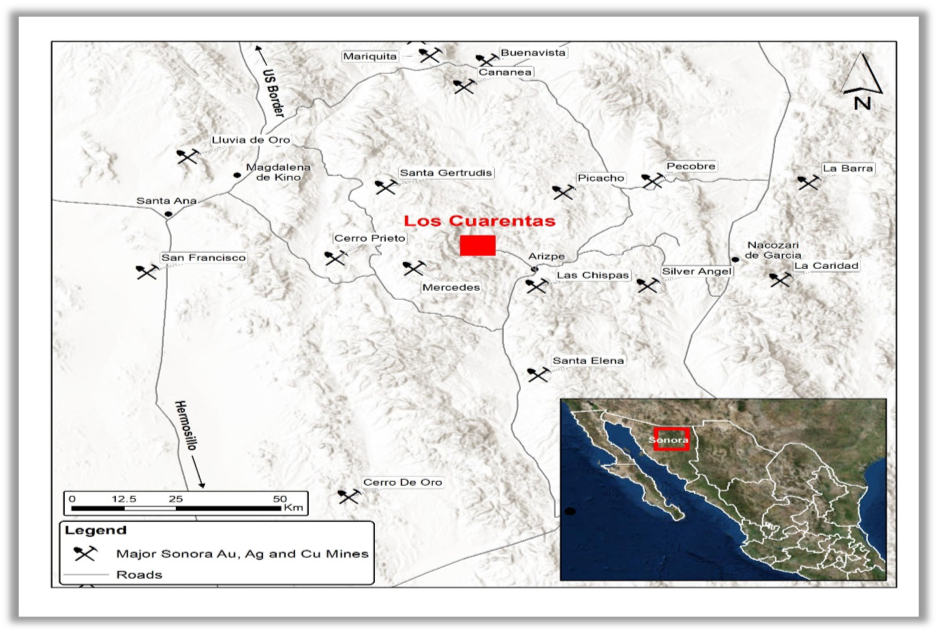
John-Mark S.: The Los Cuarentas Project is very close to the SilverCrest mine. Riverside is immediately to the west of Silvercrest and immediately to the east of the Mercedes mine. That’s where Premier Gold Mines Ltd. (PG:TSX) is operating. And it’s actually just to the northwest of the operations of First Majestic Silver Corp. (FR:TSX; AG:NYSE; FMV:FSE) at Santa Elena Mine.
We are right in the middle of a major mineralized rich district. The Arizpe (District) was one of the three most important mining and smelting operating locations in the past century for the state of Sonora, and really, for Mexico. For Riverside to get the Los Cuarentos Project is a real coupreally great for us. We’ve worked for years to get it and we’re so excited with the completion of this acquisition from Millrock.
And for Riverside, the ability to be sandwiched between three other operatorsto the north is Agnico Eagle Mines Ltd. (AEM:TSX; AEM:NYSE) and their Santa Gertrudis minemakes Riverside in an ideal place to do transactions and make discoveries in a place we know there’s mineralization.
Maurice Jackson: Does Riverside have any historical geophysics, geochemistry and drilling from the Los Cuarentos Project?
John-Mark S.: We do, and one of the most interesting is from the production. There were actually operations going down over 200 meters and a long strike on some of these veins, and a master’s thesis done at the University of Arizona, where I myself got my doctorate. That’s one of the sets of data.
Then recently, in the last two years, there’s been geophysics of IP (induced polarization) surveys that have defined the veins. There’s been geochemistry, including Riverside’s work and some of the other recent work, that’s extended the veins and found other veins and structural geological mapping alteration. All that was put together on our website, and Riverside will go forward with troll targets. It is very exciting to be able to grab such a great asset and be able to build off of our knowledge.
Maurice Jackson: Speaking of targets, have any been identified and how many?
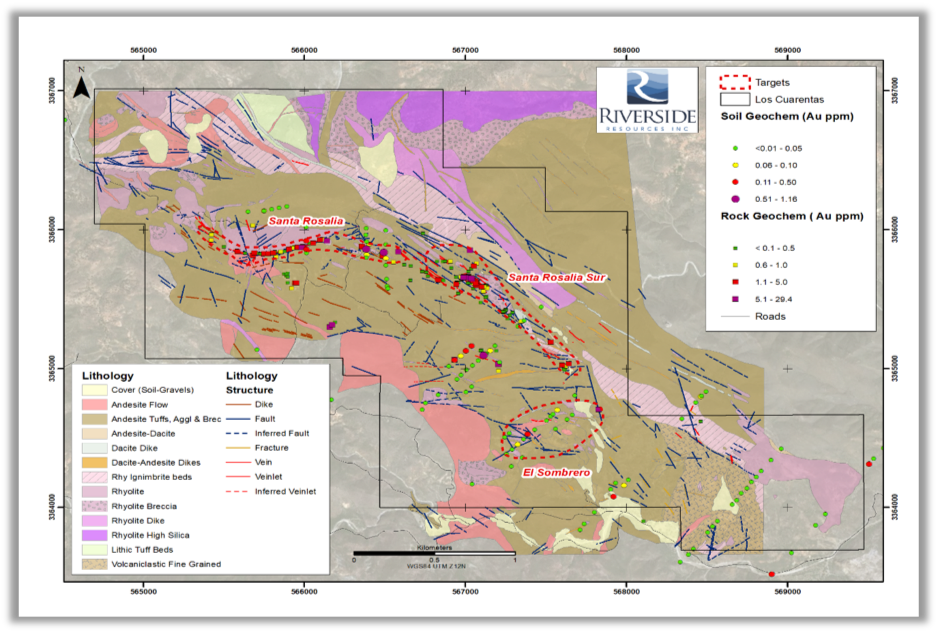
John-Mark S.: Three have been identified. The most important one is the Santa Rosalia vein. The Santa Rosalia mine, right in the heart of the Los Cuarentos district, is a key one where the old operations. Following that to the south is the Santa Rosalia Sur target, where we have good IP, good geophysical indications. Following that further to the south and east along this, over four kilometers of strike length, is El Sombrero. El Sombrero, like a hat, sombrero over the top, El Sombrero being the right type of geology at the top of a boiling zone. Thus we know we’re on top of a good vein system. We don’t know the grade but we know it’s a very exciting target. So [there are] three targets at Los Cuarentos ready to move forward 100% for Riverside. [This is a] really great position for us.
Maurice Jackson: When does Riverside anticipate drilling to commence?
John-Mark S.: Riverside is actually working on the drill permits. We have most of the permits but because it’s such a large area we’re finalizing that and finalizing all the surface. Before PDAC, we look forward to having drill results.
Maurice Jackson: Are there discussions going on with potential JV [joint venture] partners?
John-Mark S.: There’s interest. We just got back, actually, from a major mining conference, the Beaver Creek Gold Show, and there’s interest there. So yes, we always are entertaining JV partners. Today I actually have meetings with potential partners. We do that every day, but this project in particular does have the attention of some prospective JV partners.
Maurice Jackson: Switching gears, John-Mark, please share the current capital structure of Riverside.
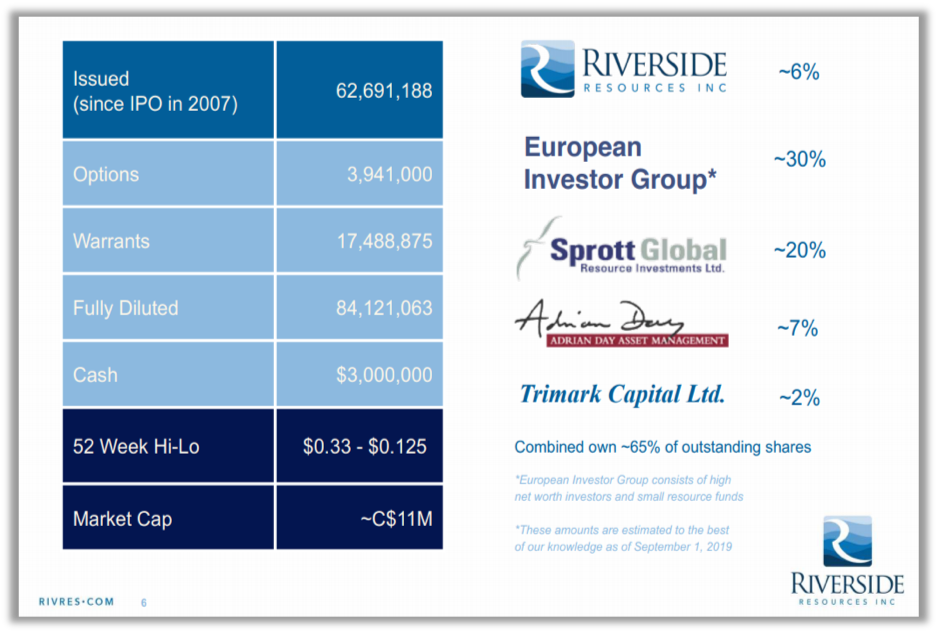
John-Mark S.: Riverside’s a very tight company. We’ve been going 13 years. We have 63 million shares outstanding. We are in very good position.
Maurice Jackson: John-Mark, it’s been a very productive year for Riverside. What is the next unanswered question for Riverside, and when can we expect an answer in what’s going to determine success?
John-Mark S.: We are positioned very well with our diversified portfolio. With Riverside it’s not one projectwe have multiple projects. At Los Cuarentos, we will be defining the drill targets. But also we’re doing work with BHP Billiton Ltd. (BHP:NYSE; BHPLF:OTCPK), and we’re developing high-value work programs that should benefit our shareholders and, likewise, BHP shareholders. Another one is the program we’re doing in Sinaloa, and also the work we’re doing at Cecilia. So we have multiple different things going forward. But one thing right nowLos Cuarentos, we’re very excited about it. Shareholders will see news flow in the coming months from Riverside.
Maurice Jackson: Dr. Staude, for someone listening that wants to get more information about Riverside Resources, please share the contact details.
John-Mark S.: Please come to our website at www.rivres.com, or please call usour IR department and myself would love to speak to you. You may call us at (778)-327-6671.
Maurice Jackson: Riverside Resources trades on the TSX.V: RRI | OTCQB: RVSDF. Before you make your next bullion purchase, be sure to call me. I’m a licensed representative for Miles Franklin, precious metals investments. We provide a number of options to expand your precious metals portfolio from physical delivery, offshore depositories, precious metal IRAs and private blockchain distributed ledger technology. Call me directly at (855)-505-1900 or you may email [email protected].
Finally, please be sure to subscribe to provenandprobable.com, where we provide mining insights and bullion sales.
Riverside Resources is a sponsor of Proven and Probable and we are proud shareholders of Riverside Resources for the virtues conveyed in today’s message.
Dr. John-Mark Staude of Riverside Resources, thank you for joining us today on Proven and Probable.
Maurice Jackson is the founder of Proven and Probable, a site that aims to enrich its subscribers through education in precious metals and junior mining companies that will enrich the world.
Disclosure: 1) Maurice Jackson: I, or members of my immediate household or family, own shares of the following companies mentioned in this article: Riverside Resources and Millrock Resources. I personally am, or members of my immediate household or family are, paid by the following companies mentioned in this article: None. My company has a financial relationship with the following companies mentioned in this article: Riverside Resources and Millrock Resources. Proven and Probable disclosures are listed below. 2) The following companies mentioned in this article are billboard sponsors of Streetwise Reports: None. Click here for important disclosures about sponsor fees. 3) Statements and opinions expressed are the opinions of the author and not of Streetwise Reports or its officers. The author is wholly responsible for the validity of the statements. The author was not paid by Streetwise Reports for this article. Streetwise Reports was not paid by the author to publish or syndicate this article. The information provided above is for informational purposes only and is not a recommendation to buy or sell any security. Streetwise Reports requires contributing authors to disclose any shareholdings in, or economic relationships with, companies that they write about. Streetwise Reports relies upon the authors to accurately provide this information and Streetwise Reports has no means of verifying its accuracy. 4) This article does not constitute investment advice. Each reader is encouraged to consult with his or her individual financial professional and any action a reader takes as a result of information presented here is his or her own responsibility. By opening this page, each reader accepts and agrees to Streetwise Reports’ terms of use and full legal disclaimer. This article is not a solicitation for investment. Streetwise Reports does not render general or specific investment advice and the information on Streetwise Reports should not be considered a recommendation to buy or sell any security. Streetwise Reports does not endorse or recommend the business, products, services or securities of any company mentioned on Streetwise Reports. 5) From time to time, Streetwise Reports LLC and its directors, officers, employees or members of their families, as well as persons interviewed for articles and interviews on the site, may have a long or short position in securities mentioned. Directors, officers, employees or members of their immediate families are prohibited from making purchases and/or sales of those securities in the open market or otherwise from the time of the interview or the decision to write an article until three business days after the publication of the interview or article. The foregoing prohibition does not apply to articles that in substance only restate previously published company releases. As of the date of this article, officers and/or employees of Streetwise Reports LLC (including members of their household) own securities of Riverside Resources and Millrock Resources, companies mentioned in this article.
Proven and Probable LLC receives financial compensation from its sponsors. The compensation is used is to fund both sponsor-specific activities and general report activities, website, and general and administrative costs. Sponsor-specific activities may include aggregating content and publishing that content on the Proven and Probable website, creating and maintaining company landing pages, interviewing key management, posting a banner/billboard, and/or issuing press releases. The fees also cover the costs for Proven and Probable to publish sector-specific information on our site, and also to create content by interviewing experts in the sector. Monthly sponsorship fees range from $1,000 to $4,000 per month. Proven and Probable LLC does accept stock for payment of sponsorship fees. Sponsor pages may be considered advertising for the purposes of 18 U.S.C. 1734.
The Information presented in Proven and Probable is provided for educational and informational purposes only, without any express or implied warranty of any kind, including warranties of accuracy, completeness, or fitness for any particular purpose. The Information contained in or provided from or through this forum is not intended to be and does not constitute financial advice, investment advice, trading advice or any other advice. The Information on this forum and provided from or through this forum is general in nature and is not specific to you the User or anyone else. You should not make any decision, financial, investments, trading or otherwise, based on any of the information presented on this forum without undertaking independent due diligence and consultation with a professional broker or competent financial advisor. You understand that you are using any and all Information available on or through this forum at your own risk.
Key points from the miner’s company update at the Denver Gold Forum are summarized in a CIBC report.
In a Sept. 17 research note, CIBC analyst Anita Soni reported the highlights from the presentation by Pretium Resources Inc. (PVG:TSX; PVG:NYSE) President and CEO Joseph Ovsenek’s at the recent 2019 Denver Gold Forum.
She also indicated that CIBC raised its target price on Pretium to CA$18 per share from CA$15.50 because “we continue to see consistent delivery of higher grades as a key catalyst for the stock.”
Ovsenek noted the ramp-up and underground, longitudinal longhole stoping development are progressing well and Pretium is on track to reach 3,800 tons per day of mill throughput and mine production by late Q4/19, Soni relayed. Production guidance for 2019 remains at 390,000420,000 ounces of gold at an all-in sustaining cost of CA$775875 per ounce.
The company expects grades in H2/19 to be higher, averaging around 12 grams per ton. Grades in Q2/19 were similar to those in Q1/19. “Pretium delivered solid Q2/10 results with production up 15% quarter over quarter, driven by higher throughput,” wrote Soni.
Another topic was exploration upside, for which the company is focused on Brucejack and Bowser, Soni wrote. Ovsenek said more value could be created by investing in Pretium’s organic growth than by acquiring a marginal gold producer.
As for Pretium’s financial situation, Ovsenek said the producer expects to generate strong free cash flow in the coming quarters. Spending priorities will be repaying debt, exploration, reinvestment in its assets and returning capital to shareholders.
Disclosure: 1) Doresa Banning compiled this article for Streetwise Reports LLC and provides services to Streetwise Reports as an independent contractor. She or members of her household own securities of the following companies mentioned in the article: None. She or members of her household are paid by the following companies mentioned in this article: None. 2) The following companies mentioned in this article are billboard sponsors of Streetwise Reports: Pretium Resources. Click here for important disclosures about sponsor fees. 3) Comments and opinions expressed are those of the specific experts and not of Streetwise Reports or its officers. The information provided above is for informational purposes only and is not a recommendation to buy or sell any security. 4) The article does not constitute investment advice. Each reader is encouraged to consult with his or her individual financial professional and any action a reader takes as a result of information presented here is his or her own responsibility. By opening this page, each reader accepts and agrees to Streetwise Reports’ terms of use and full legal disclaimer. This article is not a solicitation for investment. Streetwise Reports does not render general or specific investment advice and the information on Streetwise Reports should not be considered a recommendation to buy or sell any security. Streetwise Reports does not endorse or recommend the business, products, services or securities of any company mentioned on Streetwise Reports. 5) From time to time, Streetwise Reports LLC and its directors, officers, employees or members of their families, as well as persons interviewed for articles and interviews on the site, may have a long or short position in securities mentioned. Directors, officers, employees or members of their immediate families are prohibited from making purchases and/or sales of those securities in the open market or otherwise from the time of the interview or the decision to write an article until three business days after the publication of the interview or article. The foregoing prohibition does not apply to articles that in substance only restate previously published company releases. As of the date of this interview, officers and/or employees of Streetwise Reports LLC (including members of their household) own securities of Pretium Resources, a company mentioned in this article.
Disclosures from CIBC, Pretium Resources Inc., September 17, 2019
Analyst Certification: Each CIBC World Markets Corp./Inc. research analyst named on the front page of this research report, or at the beginning of any subsection hereof, hereby certifies that (i) the recommendations and opinions expressed herein accurately reflect such research analyst’s personal views about the company and securities that are the subject of this report and all other companies and securities mentioned in this report that are covered by such research analyst and (ii) no part of the research analyst’s compensation was, is, or will be, directly or indirectly, related to the specific recommendations or views expressed by such research analyst in this report.
Analysts employed outside the U.S. are not registered as research analysts with FINRA. These analysts may not be associated persons of CIBC World Markets Corp. and therefore may not be subject to FINRA Rule 2241 restrictions on communications with a subject company, public appearances and trading securities held by a research analyst account.
Potential Conflicts of Interest: Equity research analysts employed by CIBC World Markets Corp./Inc. are compensated from revenues generated by various CIBC World Markets Corp./Inc. businesses, including the CIBC World Markets Investment Banking Department. Research analysts do not receive compensation based upon revenues from specific investment banking transactions. CIBC World Markets Corp./Inc. generally prohibits any research analyst and any member of his or her household from executing trades in the securities of a company that such research analyst covers. Additionally, CIBC World Markets Corp./Inc. generally prohibits any research analyst from serving as an officer, director or advisory board member of a company that such analyst covers.
In addition to 1% ownership positions in covered companies that are required to be specifically disclosed in this report, CIBC World Markets Corp./Inc. may have a long position of less than 1% or a short position or deal as principal in the securities discussed herein, related securities or in options, futures or other derivative instruments based thereon.
Recipients of this report are advised that any or all of the foregoing arrangements, as well as more specific disclosures set forth below, may at times give rise to potential conflicts of interest.
Important Disclosure Footnotes for Pretium Resources Inc. (GG)
CIBC World Markets Inc. expects to receive or intends to seek compensation for investment banking services from Pretivm Resources Inc. in the next 3 months.
Avadel Pharmaceuticals’ shares are trading 30% higher today on news that the FDA agreed to reduce the sample size required for its Phase 3 REST-ON study, accelerating its completion by year-end 2019.
Dublin, Ireland-based Avadel Pharmaceuticals Plc (AVDL:NASDAQ), which focuses on developing once-nightly sodium oxybate, FT218, for narcolepsy, today announced that the U.S. Food and Drug Administration (FDA) has agreed to the firm’s proposed amendments to the statistical analysis plan and protocol under its special protocol assessment agreement (SPA) for its REST-ON study. The changes will result in a lower sample size needed to demonstrate significance for both excessive daytime sleepiness and cataplexy in narcolepsy patients. In the report the company advised that there were no modifications made to the fundamental design of the study, including the primary or secondary endpoints, dosing scheme or duration of the study, and the SPA remains intact.
The company states that the REST-ON study will now target enrolling 205 patients. Based on this updated target sample size and enrollment currently at 193 patients (94%), the company now expects to complete enrollment by the end of 2019 and have topline data in the second quarter of 2020. This is up to a year ahead of expectations to complete enrollment for the previous target of 264 patients for the study. The firm notes that even with this change, the REST-ON clinical trial remains one of the largest studies conducted to date for this indication.
Avadel’s CEO Greg Divis commented, “This REST-ON clinical trial update is a direct result of an overall strategic review of the entire FT218 program. The addition of our recently appointed medical and clinical team members was instrumental in this important development and their contributions have put us on track to save significant time, resources and capital in the completion of the REST-ON clinical trial.”
The firm explains that the REST-ON study is a double-blind, randomized, placebo-controlled Phase 3 trial to assess the efficacy and safety of once-nightly FT218, a formulation of sodium oxybate using Avadel’s proprietary Micropump technology for extended-release oral suspension in the treatment of excessive daytime sleepiness and cataplexy in patients suffering from narcolepsy.
According to the company, dosed once nightly, FT218 has been granted Orphan Drug Designation from the FDA for the treatment of narcolepsy. The designation was granted on the plausible hypothesis that once-nightly FT218 may be clinically superior to a formulation of sodium oxybate that is already approved by the FDA for the same indication. In particular, once-nightly FT218 may be safer due to ramifications associated with the dosing regimen of the previously approved product. The twice-nightly sodium oxybate market is currently valued at an estimated annualized rate of $1.6 billion. Avadel’s market research leads it to believe that FT218, if approved by the FDA, has the potential to take a significant share of this market.
Avadel Pharmaceuticals indicates that it is a branded specialty pharmaceutical company committed to providing solutions for overlooked and unmet medical needs through patient-focused, innovative products. The company’s primary focus is on the development and potential FDA approval for FT218. Additionally, Avadel develops and markets a portfolio of sterile injectable drugs used in the hospital setting.
Avadel started the day with a market cap of approximately $126 million and a short interest of about 18.5%. AVD shares opened today at $4.35 (+$0.98, +29.08%) over Friday’s closing price of $3.37. The stock has traded today on much higher than average volume between $4.13 and $5.37/share and currently is trading at $4.47 (+$1.10, +32.64%).
Disclosure: 1) Stephen Hytha compiled this article for Streetwise Reports LLC and provides services to Streetwise Reports as an independent contractor. He or members of his household own securities of the following companies mentioned in the article: None. He or members of his household are paid by the following companies mentioned in this article: None. 2) The following companies mentioned in this article are billboard sponsors of Streetwise Reports: None. Click here for important disclosures about sponsor fees. 3) Comments and opinions expressed are those of the specific experts and not of Streetwise Reports or its officers. The information provided above is for informational purposes only and is not a recommendation to buy or sell any security. 4) The article does not constitute investment advice. Each reader is encouraged to consult with his or her individual financial professional and any action a reader takes as a result of information presented here is his or her own responsibility. By opening this page, each reader accepts and agrees to Streetwise Reports’ terms of use and full legal disclaimer. This article is not a solicitation for investment. Streetwise Reports does not render general or specific investment advice and the information on Streetwise Reports should not be considered a recommendation to buy or sell any security. Streetwise Reports does not endorse or recommend the business, products, services or securities of any company mentioned on Streetwise Reports. 5) From time to time, Streetwise Reports LLC and its directors, officers, employees or members of their families, as well as persons interviewed for articles and interviews on the site, may have a long or short position in securities mentioned. Directors, officers, employees or members of their immediate families are prohibited from making purchases and/or sales of those securities in the open market or otherwise from the time of the interview or the decision to write an article until three business days after the publication of the interview or article. The foregoing prohibition does not apply to articles that in substance only restate previously published company releases. 6) This article does not constitute medical advice. Officers, employees and contributors to Streetwise Reports are not licensed medical professionals. Readers should always contact their healthcare professionals for medical advice.
Regeneron Pharmaceuticals published positive results from two U.S. Phase 3 trials evaluating the safety and efficacy of Dupixent (dupilumab) in adults with recurring severe chronic rhinosinusitis with nasal polyps. The European Medicines Agency’s Committee for Medicinal Products for Human Use also adopted a positive opinion for Dupixent in a third indication.
Early this morning Regeneron Pharmaceuticals Inc. (REGN:NASDAQ) and Sanofi SA (SNY:NYSE)announced that The Lancet has published detailed positive results from two Phase 3 trials evaluating the safety and efficacy of Dupixent (dupilumab) in adults with recurring severe chronic rhinosinusitis with nasal polyps (CRSwNP) despite previous treatment with surgery and/or systemic corticosteroids.
The report explains that CRSwNP is a chronic disease of the upper airway that obstructs the sinuses and nasal passages, which can lead to breathing difficulties, nasal congestion and discharge, reduced or loss of sense of smell and taste, and facial pressure.
Results published in the journal demonstrated that adding Dupixent to the standard-of-care corticosteroid nasal spray reduced nasal polyp size and nasal congestion severity (co-primary endpoints). Dupixent also reduced chronic sinus disease associated with nasal polyps and improved sense of smell. In addition to the results of the primary endpoints of these trials, the publication included a pre-specified pooled analysis that showed Dupixent significantly reduced systemic corticosteroid use by 74% and the need for sino-nasal surgery by 83% compared to placebo. Given that these patients frequently also suffer from asthma, the trials prospectively studied the effect of Dupixent on a subgroup of patients with a history of asthma, and found significant improvements in asthma control and lung function.
Claus Bachert, M.D., principal investigator of the trials and Professor and Head of Clinics of the Department of Otorhinolaryngology at Ghent University, commented, “The results published in The Lancet show that Dupixent improved all disease measures of chronic rhinosinusitis with nasal polyps in the trials…In patients with CRSwNP who have a history of asthma, Dupixent was also effective in improving asthma symptoms, lung function and asthma control, as well as upper airway outcomes. This is important news for these patients as they often suffer from high disease burden and are not controlled by standard treatment.”
Dupilumab and REGN3500 were invented using Regeneron’s proprietary VelocImmune technology that yields optimized fully human antibodies, and are being jointly developed by Regeneron and Sanofi under a global collaboration agreement. Dupixent is approved in the U.S. for use with other medicines to treat CRSwNP in adults whose disease is not controlled, and is currently under regulatory review for these patients in the EU and Japan. In addition, Dupixent is approved for use in specific patients with moderate-to-severe atopic dermatitis, and certain patients with asthma in a number of other countries around the world, including the EU, U.S. and Japan.
In a separate release this morning, Regeneron and Sanofi also announced that the European Medicines Agency’s Committee for Medicinal Products for Human Use (CHMP) has adopted a positive opinion for Dupixent (dupilumab) in a third indication. The CHMP recommended Dupixent be approved as an add-on therapy with intranasal corticosteroids for the treatment of adults with severe chronic rhinosinusitis with nasal polyposis (CRSwNP) for whom therapy with systemic corticosteroids and/or surgery do not provide adequate disease control.
If approved, Dupixent would be the first biologic medicine available in the European Union (EU) to treat these patients. The positive CHMP opinion is based on two pivotal Phase 3 trials and a final decision on the Dupixent application by the European Commission (EC) is expected in the coming months.
In addition to the currently approved indications, Regeneron and Sanofi are also studying dupilumab in a broad range of clinical development programs for diseases driven by allergic and other type 2 inflammation, including pediatric asthma, pediatric atopic dermatitis, eosinophilic esophagitis, chronic obstructive pulmonary disease, and food and environmental allergies.
Regeneron describes itself as a leading biotechnology company that invents life-transforming medicines for people with serious diseases. The company has seven FDA-approved treatments and numerous product candidates in development, all of which were homegrown in its laboratories. The firm states that its medicines and pipeline are designed to help patients with eye disease, allergic and inflammatory diseases, cancer, cardiovascular and metabolic diseases, infectious diseases, pain and rare diseases.
Sanofi, based in Paris, France, is a $112.0 billion market cap global healthcare company involved in research, development, manufacture and marketing of therapeutic solutions. The company’s Pharmaceuticals segment comprises the commercial operations of various franchises, including Diabetes and Cardiovascular, Specialty Care (Rare Diseases, Multiple Sclerosis, and Oncology), Established Prescription Products, and Consumer Healthcare and Generics. The Vaccines segment includes the commercial operations of the company’s vaccines division Sanofi Pasteur.
REGN shares opened today at $288.75 (+2.60, +0.91%) over Thursday’s closing price of $286.15. The stock has traded today between $286.68 and $297.64/share and presently is trading at $296.00 (+$9.85, +3.42%).
Disclosure: 1) Stephen Hytha compiled this article for Streetwise Reports LLC and provides services to Streetwise Reports as an independent contractor. He or members of his household own securities of the following companies mentioned in the article: None. He or members of his household are paid by the following companies mentioned in this article: None. 2) The following companies mentioned in this article are billboard sponsors of Streetwise Reports: None. Click here for important disclosures about sponsor fees. 3) Comments and opinions expressed are those of the specific experts and not of Streetwise Reports or its officers. The information provided above is for informational purposes only and is not a recommendation to buy or sell any security. 4) The article does not constitute investment advice. Each reader is encouraged to consult with his or her individual financial professional and any action a reader takes as a result of information presented here is his or her own responsibility. By opening this page, each reader accepts and agrees to Streetwise Reports’ terms of use and full legal disclaimer. This article is not a solicitation for investment. Streetwise Reports does not render general or specific investment advice and the information on Streetwise Reports should not be considered a recommendation to buy or sell any security. Streetwise Reports does not endorse or recommend the business, products, services or securities of any company mentioned on Streetwise Reports. 5) From time to time, Streetwise Reports LLC and its directors, officers, employees or members of their families, as well as persons interviewed for articles and interviews on the site, may have a long or short position in securities mentioned. Directors, officers, employees or members of their immediate families are prohibited from making purchases and/or sales of those securities in the open market or otherwise from the time of the interview or the decision to write an article until three business days after the publication of the interview or article. The foregoing prohibition does not apply to articles that in substance only restate previously published company releases. 6) This article does not constitute medical advice. Officers, employees and contributors to Streetwise Reports are not licensed medical professionals. Readers should always contact their healthcare professionals for medical advice.
A Pareto Securities report addresses how the various joint venture wells of the firm derisk potential upside to its share price.
In a Sept. 17 research note, analyst Tom Erik Kristiansen reported that Pareto Securities raised its target price on Eco Atlantic Oil & Gas Ltd. (EOG:TSX.V; ECAOF:OTCMKTS; ECO:LSE) after the energy company and its partners discovered oil at the Joe prospect on offshore Guyana’s Orinduik block. The new target price is GBp235, up from GBp200, and compares to Eco Atlantic’s current share price of GBp156.
Kristiansen highlighted that this new oil discovery, and the second consecutive discovery in the Tertiary fairway, helps derisk these same-play prospects and thus, potential upside to the company’s share price. The new Joe discovery boosts the total discovered resources on the block to more than 370 million barrels gross. The second discovery at Tertiary helps derisk further upside potential of another roughly 430 million barrels of oil equivalent.
“If proven up by further drilling success (next wells to be drilled toward the end of 2020), this would lift our valuation of Eco Atlantic to about GBp250 per share before attaching any value on the deeper potential at the block,” commented Kristiansen.
The analyst added that Carapa-1, a neighboring well that Eco Atlantic does not have an interest in, slated for drilling by year-end, also could have a similar effect. “If successful, this would help derisk the shallow water Cretaceous fairway on Eco Atlantic’s acreage that is yet to be tested.”
Generally, regarding all of Eco Atlantic’s joint Guyana assets, Kristiansen wrote that “while several milestones remain and the uncertainty is high, we estimate greater than five times’ upside potential to the current share price if the deeper potential is proven up by future drilling success. We see downside to about GBp120 per share if all future exploration wells are unsuccessful.”
As for funding, Eco Atlantic has the necessary capital for at least five more wells.
Overall, Kristiansen pointed out that “with its recent discoveries and exposure to the hottest exploration region in the world,” Eco Atlantic makes an attractive acquisition target, most likely for the other large oil companies in the area, including its partners Total and Qatar Petroleum.
Disclosure: 1) Doresa Banning compiled this article for Streetwise Reports LLC and provides services to Streetwise Reports as an independent contractor. She or members of her household own securities of the following companies mentioned in the article: None. She or members of her household are paid by the following companies mentioned in this article: None. 2) The following companies mentioned in this article are billboard sponsors of Streetwise Reports: None. Click here for important disclosures about sponsor fees. 3) Comments and opinions expressed are those of the specific experts and not of Streetwise Reports or its officers. The information provided above is for informational purposes only and is not a recommendation to buy or sell any security. 4) The article does not constitute investment advice. Each reader is encouraged to consult with his or her individual financial professional and any action a reader takes as a result of information presented here is his or her own responsibility. By opening this page, each reader accepts and agrees to Streetwise Reports’ terms of use and full legal disclaimer. This article is not a solicitation for investment. Streetwise Reports does not render general or specific investment advice and the information on Streetwise Reports should not be considered a recommendation to buy or sell any security. Streetwise Reports does not endorse or recommend the business, products, services or securities of any company mentioned on Streetwise Reports. 5) From time to time, Streetwise Reports LLC and its directors, officers, employees or members of their families, as well as persons interviewed for articles and interviews on the site, may have a long or short position in securities mentioned. Directors, officers, employees or members of their immediate families are prohibited from making purchases and/or sales of those securities in the open market or otherwise from the time of the interview or the decision to write an article until three business days after the publication of the interview or article. The foregoing prohibition does not apply to articles that in substance only restate previously published company releases.
Disclosures from Pareto Securities AS, Eco Atlantic Oil & Gas, September 17, 2019
This publication or report has been prepared solely by Pareto Securities Research.
Opinions or suggestions from Pareto Securities Research may deviate from recommendations or opinions presented by other departments or companies in the Pareto Securities Group. The reason may typically be the result of differing time horizons, methodologies, contexts or other factors.
Analysts Certification The research analyst(s) whose name(s) appear on research reports prepared by Pareto Securities Research certify that: (i) all of the views expressed in the research report accurately reflect their personal views about the subject security or issuer, and (ii) no part of the research analysts compensation was, is, or will be directly or indirectly related to the specific recommendations or views expressed by the research analysts in research reports that are prepared by Pareto Securities Research.
The research analysts whose names appears on research reports prepared by Pareto Securities Research received compensation that is based upon various factors including Pareto Securities total revenues, a portion of which are generated by Pareto Securities investment banking activities.
Conflicts of interest
Companies in the Pareto Securities Group, affiliates or staff of companies in the Pareto Securities Group, may perform services for, solicit business from, make a market in, hold long or short positions in, or otherwise be interested in the investments (including derivatives) of any company mentioned in the publication or report.
In addition Pareto Securities Group, or affiliates, may from time to time have a broking, advisory or other relationship with a company which is the subject of or referred to in the relevant Research, including acting as that companys official or sponsoring broker and providing corporate finance or other financial services. It is the policy of Pareto to seek to act as corporate adviser or broker to some of the companies which are covered by Pareto Securities Research. Accordingly companies covered in any Research may be the subject of marketing initiatives by the Corporate Finance Department.
To limit possible conflicts of interest and counter the abuse of inside knowledge, the analysts of Pareto Securities Research are subject to internal rules on sound ethical conduct, the management of inside information, handling of unpublished research material, contact with other units of the Group Companies and personal account dealing. The internal rules have been prepared in accordance with applicable legislation and relevant industry standards. The object of the internal rules is for example to ensure that no analyst will abuse or cause others to abuse confidential information. It is the policy of Pareto Securities Research that no link exists between revenues from capital markets activities and individual analyst remuneration. The Group Companies are members of national stockbrokers associations in each of the countries in which the Group Companies have their head offices. Internal rules have been developed in accordance with recommendations issued by the stockbrokers associations.
This material has been prepared following the Pareto Securities Conflict of Interest Policy. The guidelines in the policy include rules and measures aimed at achieving a sufficient degree of independence between various departments, business areas and sub-business areas within the Pareto Securities Group in order to, as far as possible, avoid conflicts of interest from arising between such departments, business areas and sub-business areas as well as their customers. One purpose of such measures is to restrict the flow of information between certain business areas and sub-business areas within the Pareto Securities Group, where conflicts of interest may arise and to safeguard the impartialness of the employees. For example, the Corporate Finance departments and certain other departments included in the Pareto Securities Group are surrounded by arrangements, so-called Chinese Walls, to restrict the flows of sensitive information from such departments. The internal guidelines also include, without limitation, rules aimed at securing the impartialness of, e.g., analysts working in the Pareto Securities Research departments, restrictions with regard to the remuneration paid to such analysts, requirements with respect to the independence of analysts from other departments within the Pareto Securities Group rules concerning contacts with covered companies and rules concerning personal account trading carried out by analysts.
Pareto Securities AS may have prepared or distributed investment recommendation, where Pareto Securities AS has been lead manager/co-lead manager or have rendered publicly known not immaterial investment banking services over the previous 12 months: Eco Atlantic Oil & Gas.
Pareto Securities AS may hold financial instruments in companies where a recommendation has been produced or distributed by Pareto Securities AS in connection with rendering investment services, including Market Making.
Over the weekend, I embarked on a project to create a 3D printed QR code that guests at our house could scan to gain access to our guest wireless network. Why 3D you might ask? Well, that’s how geeks like myself like to impress their guests! Also, let’s be real, I have a 3D printer at home, and I was looking for a fun way to put it to practical use. It turns out that it makes for some nice wall artwork as well.
In this first blog post I detail how I generate a QR code using Python, then how to build 3D printable blocks and, finally, how to convert that model into a file 3D printers can read.
In a follow-up blog post, I will specify how I created a hybrid command line app and Flask app from the same code base, using click and Flask. It will take the code that we write here and turn it into an app that can be used from the command line and from a web interface — it’s a great exercise in showing the similarities between the CLI and Flask. Coming soon!
Why a 3D QR code for my WIFI password?
There are a ton of QR code generators out there on the web and more than a handful of WiFi QR code generators too – so why did I embark on this project? Mainly, it was me wanting to scratch my itch surrounding QR codes. The last time I went to China (Xi’an and Shanghai, specifically), I saw QR codes everywhere. There surely had to be something good we could use this for at home that didn’t involve just packing and storage. Now that I know how simple it is to create a QR code using Python, I’m sure I’ll find myriad uses for them!
Getting Set Up
Ok, let’s get started! To create QR codes, you need to install pyqrcode and pypng in your environment: pip install pyqrcode pip install pypng
If you want to do the 3D printing part, you’ll also need to install SolidPython and NumPy: pip install SolidPython pip install numpy
Finally, to build a command line app and a web app, you’ll need to install click and Flask: pip install click pip install Flask
If you are using the conda package manager, you should know that numpy, click and Flask are conda-installable if you prefer to do so.
I also used Kite in the Atom text editor: this allowed me to view documentation and common usage patterns for the packages I imported.
Step 1: Encoding WiFi credentials in a QR code
Let’s start by creating a QR code for our WiFi guest network.
Let’s say that these are the security credentials for the network: SSID (a.k.a. Network Name): Family Guest Network Password: vn8h2sncu093y3nd! Security Type (one of WPA or WEP): WPA
QR codes are merely two-dimensional barcodes that encode a string that can be parsed by another program. In order to create a QR-code that is readable for accessing WiFi, we need a string that can be parsed by our devices. This string is structured as follows: WIFI:S:<SSID>;T:<WPA|WEP|>;P:<password>;;
So in our case, we would want a string that looks like: WIFI:S:Family Guest Network;T:WPA;P:vn8h2sncu093y3nd!;;
Now, we can code up our Python program to encode the QR code for us. I’ll assume you’re running Python 3.6 or later.
import pyqrcode as pq
ssid = 'Family Guest Network'
security = 'WPA'
password = 'vn8h2sncu093y3nd!'
qr = pq.create(f'WIFI:S:{ssid};T:{security};P:{password};;')
print(qr.terminal())
With that block of code, you should get a QR code printed to your terminal, just like that!
Let’s say you wanted to do the simple thing, and just have a regular laser/inkjet printer make a printout of the QR code. To do so, you can save the QR code to disk as a PNG file:
qr.png('home_guest_wifi.png')
And just like that, you’ve used Python to create a WiFi QR code! Just scan this code using your phone’s camera and you (or your guests) will be able to join your WiFi network.
Now, if you remember that QR codes are just “ASCII strings encoded in a 2D barcode”, then you’ll know that you can pass any arbitrary string into the pyqrcode.create() function. That means you can come up with any creative use of a short string that would make sense to scan with your phone! For example, you can create business cards with your LinkedIn profile URL embedded in the QR code, use it to encode a serial number information on your possessions, or more!
Next, we’ll turn the QR code into a 3D-printable model using our imported Python packages and free online CAD software.
Step 2: 3D Printing a QR Code
For this, we will need a package called SolidPython, and optionally numpy to help us with some array processing (it can also be done entirely using built-in lists if needed).
To start, I defined a convenience function that let me create and return a QRCode object that can be passed around and manipulated.
defcreate_wifi_qr(ssid: str, security: str, password: str):
qr = pq.create(f'WIFI:S:{ssid};T:{security};P:{password};;')
return qr
Its use will become evident later. You’ll also notice that I’m using type hints inside the function.
Create Text Representation
Using this function, we can create a text representation of the QR code:
qr = create_wifi_qr(ssid, security, password)
print(qr.text())
This will essentially give a series of 1s and 0s. This is a string, though, not a numpy array. Hence, we may have to convert this into a list of lists, or a numpy array (as a user of the scientific Python stack, I prefer using arrays where possible, but in this case there is no real practical advantage to doing so because we are not doing linear algebra).
Create Array Representation
Let’s now define a function that takes in the QRCode object and returns an array version of the text rendering.
defqr2array(qr):
arr = []
for line in qr.text().split('\n'):
if len(line) != 0:
arr.append([int(bit) for bit in line])
return np.vstack(arr)
With that, we can create an array version of our QR code above:
arr = qr2array(qr)
Create 3D Model
Now, we’re ready to play with SolidPython!
SolidPython is a Python package that provides an interface to the OpenSCAD language. OpenSCAD allows a programmer to programmatically define 3D models using the language of geometry. This includes the creation of cubes and other 3D objects, as well as object manipulations, such as translation, coloring, and union-ing.
Take a look at the code below for an example of how we create the 3D object.
from solid import color, cube, scad_render, translate, union
SCALE = 2# output defaults to 1 mm per unit; this lets us increase the size of objects proportionally.
cubes = [translate([i*SCALE, j*SCALE, 0])(color('black')(cube(size=[SCALE, SCALE, HEIGHT])))
for i, row in enumerate(arr)
for j, col in enumerate(row)
if arr[i, j] == 1]
base_plate = color('white')(cube(size=(arr.shape[0] * SCALE, arr.shape[1] * SCALE, HEIGHT / 2)))
qrobj = union()(*cubes, base_plate)
print(scad_render(qrobj))
What we’re doing here is taking the 1s and creating cubes where they are supposed to be, but leaving the zeros empty. Then, we add a “base plate” so that everything stays nice and connected, and finally union all of the cubes with the base plate, so that we get one solid piece that is 3D printed.
In short, the flow is: SolidPython -> OpenSCAD -> STL -> .gcode
That’s it! You have everything you need to 3D print a QR code of your WiFi credentials.
Conclusions
The key takeaways from this blog post are:
How to create a QR code using Python.
How to create a text representation of the QR code.
How to convert the text representation into an array.
How to create a 3D model of the QR code using the array.
Now that you have a rendered 3D model, you can either 3D print it at home, or send it to a friend to 3D print it for you. You’ll no longer have to give plain text WiFi passwords to your guests – they can just scan the aesthetically-pleasing 3D printed QR code instead!
With this example of how to create an OpenSCAD file from Python using SolidPython, I hope you’ll go forth and make a ton of fun stuff! Please share your experiences in the comment section below.
Kite added the associated code from this blog post to a public Github repository. You can find the source code from this and other posts in their Python series here.
In my next post, I’ll show how I took this code base to create a hybrid command line app and Flask app. Stay tuned for more details and make sure to subscribe to the Kite blog so you don’t miss it!
This post is a part of Kite’s new series on Python. You can check out the code from this and other posts on our GitHub repository.
New Zealand will be closing the latest cycle of interest rate meetings of the major central banks around the world.
The global bias continues to be on the easing side, with the exception of Norway. There hasn’t been much improvement in the economic situation in New Zealand. However, it’s too early to really see an impact from the 50 basis point cut that happened last time.
In early August, the expectation was for two cuts during the rest of the year. And it seems the RBNZ was trying to get ahead of the market by getting it over with, in one meeting.
Such drastic measures – the equivalent of four cuts within half a year – have left investors, traders and analysts more concerned about the country’s economic future. What can we expect going forward?
What We Are Looking For
The consensus view is that the RBNZ will want to see the effects of their latest action and hold the OCR where it is at a record low of 1.0%.
We can expect the bank to reiterate that they are ready for more action should it be warranted. Therefore, a continuing of a substantial dovish tone. There is no press conference scheduled for after the meeting. This is usually a sign that no action will be taken.
However, given the aggressive stance on rate cuts by Governor Orr and the new Monetary Policy Committee (MPC), no analyst really rules out the possibility of this being a “live” meeting.
There is still a minority less than 10% chance that a rate cut could be forthcoming. And the market appears to be pricing this in. We might see a minor “tightening” bump in the NZD following a hold, as a consequence.
Going Forward
The bank’s sudden action last month blew away the consensus expectation that there would be a further rate cut by the end of the year.
Now, RBNZ trackers are a little more cautious about policy predictions. The consensus is still that by April next year, the OCR will be at 0.75% (in other words, one more rate cut). However, there is hardly any consensus on when within that interval it will happen.
The MPC continues to be unanimous in its decisions, which gets in the way of tracking shifting views on the board, such as what happens with the Fed.
It now seems that unanimity is a feature of the RBNZ and that the potential of a split vote is becoming increasingly unlikely.
It’s All Down Until It’s Not
As rates are slashed around the world, there is an increasing chorus – even among central bankers – of concern over both the unintended consequences and the effectiveness of close-to-zero-or-below rates.
This especially relevant for New Zealand (and Australia) as it traditionally keeps rates high in order to attract foreign investment. Even with the Fed cutting rates last week, the appeal of Kiwi carry trades is waning. We would expect this to further drag down the NZD.
Employment figures remain near structural level, just as they did last time before they slashed rates. And, inflation had ticked up a bit.
This has led many analysts to question whether the RBNZ’s rate path is actually a good idea. The criticism considers that the policy is in response to external factors such as the effect of the trade war, and structural issues that are beyond the purview of the bank. Those analysts form what’s called the “shadow board”, which is showing increasing division about the rate path.
The Bank is Not Alone
Regardless of the concerns from analysts, there isn’t much expectation of a let-up in economic pressures in the near term.
The RBNZ has been at the forefront of the race to the bottom in interest rates. And without much change in the data since the start of the cutting cycle, there is an argument that more measures are needed.
However, there is also reason to question whether more of the same will accomplish anything. We’ll be really keen to see this month’s data, and the quarterly figures that start coming out in a couple of weeks’ time.