Yen surges on risk aversion; Gold shines

By Lukman Otunuga, Research Analyst, ForexTime

The USDJPY tumbled more than 0.7% to a fresh two week low at 108.05 thanks to the risk-off sentiment. Given how the market mood is likely to remain negative on trade uncertainty and global growth concerns, the Yen is positioned to extend gains against its major counterparts.

In regards to the technical picture, prices are under pressure on the daily charts. A solid breakdown below 108.00 should open the gates towards 107.50 and 106.90, respectively. Should 108.00 prove to be a reliable support level, the USDJPY could rebound towards 108.40.

GBPJPY dips below 140.00 on rising risk aversion

Sterling has weakened against the Yen thanks to the general risk-off mood and Brexit related uncertainty.

The GBPJPY could turn bearish on the daily charts if prices drop below the 139.00 support level. Technical traders will continue to closely observe how the currency pair behaves around the 140.00 – 139.00 regions. Sustained weakness below 139.00 should open a path towards 137.50.

EURJPY balances above 120.30

There is a classical breakout opportunity in play on the EURJPY with prices trading marginally above the 120.30 support level as of writing.

If bulls are unable to defend this level, prices are seen challenging 119.60 and possibly lower. Alternately, a rebound from the 120.30 level will encourage an incline higher towards 121.50. For bulls to jump back into the game, prices need to secure a solid daily close above 121.50 with 122.20 acting as the next key level of interest.

Commodity spotlight – Gold

Gold prices have blasted above the $1510 level today following reports that China was growing increasingly doubtful it can reach a trade agreement with the United States.

The risk-off sentiment should propel prices higher ahead of the US jobs report on Friday. Focusing on the technical picture, bulls are back in the driving seat with prices trading around $1511 as of writing. A solid daily close above $1510 should encourage a move towards $1515 and $1525, respectively.

Disclaimer: The content in this article comprises personal opinions and should not be construed as containing personal and/or other investment advice and/or an offer of and/or solicitation for any transactions in financial instruments and/or a guarantee and/or prediction of future performance. ForexTime (FXTM), its affiliates, agents, directors, officers or employees do not guarantee the accuracy, validity, timeliness or completeness, of any information or data made available and assume no liability as to any loss arising from any investment based on the same.


Forex-Time-LogoArticle by ForexTime

ForexTime Ltd (FXTM) is an award winning international online forex broker regulated by CySEC 185/12 www.forextime.com

What To Expect: China Caixin Manufacturing PMI

By Orbex

China’s PMI’s are especially interesting this time around because it’s the first survey since it became known that the US and China had tentatively reached an agreement about the ongoing trade war.

Of course, it’s not a done deal. In fact, just yesterday US trade representatives were hinting that everything might not be in place by the time Trump and Xi meet at the APEC conference, which is in the process of being relocated.

However, the optimism might be enough to influence Chinese firms and their outlook. The Caixin survey is more relevant than the NBS one. This is because it covers a larger number of companies, which means it has less influence from state enterprises.

Lately, it has been outperforming the official government survey. We can often explain this by smaller private businesses having more flexibility to navigate the uncertainty of the trade war.

What We Are Looking For

There is only one major data point coming out of China tomorrow. That’s likely to be the biggest mover of the markets in the Far East, including the AUD and NZD.

The consensus of economists is for the Caixin Manufacturing PMI to decline a bit to 50.8 from 51.4 in September. Still in expansion for the third consecutive month, but also somewhat borderline.

Earlier this morning, the NBS reported the official Manufacturing PMI. This disappointed at 49.3 compared to the expectation of 49.8. In fact, both official PMIs came in below expectations, with non-manufacturing at 52.8 compared to 53.6 expected.

Although the important manufacturing component remains in contraction, it’s still borderline. The result would only heighten the expectation that the Caixin version will also be lower than the prior month.

Why Not so Much Optimism?

Most markets have reacted with cautious optimism to the announcement that US and Chinese negotiators are working on a “Phase 1” deal.

While the possibility of a trade deal might be enough to get equities traders to buy, nothing has changed yet. Tariffs are still in place, with the consequent impact on businesses.

This wouldn’t be the first time we almost had a deal, only for it to fall through at the last moment. Purchasing managers cannot responsibly go about increasing corporate spending until we get signatures on a deal and actual policy changes.

So, the expectations component of the PMI survey might improve, but the current situation is likely to remain as bleak as before.

The Market Reaction

After we got the disappointing third-quarter GDP print of just 6.0%, the markets are desperate for some good news.

There is a higher chance of a strong reaction if we get a beat in expectations than with a disappointment. A drop below 50 would confirm an already pessimistic view of the markets; one that has been developing as Chinese firms report their third-quarter earnings underperforming compared to last year.

Australia is more likely to be affected by Manufacturing PMI than New Zealand because they supply primarily raw materials to the Asian giant. A return to negative industrial growth would be a bad sign for the AUD. A significantly better than expected print would give hope for more Chinese buying, and support the AUD as well as JPY.

By Orbex


AUDUSD Analysis: Higher building approvals bullish for AUDUSD

By IFCMarkets

Higher building approvals bullish for AUDUSD

Building approvals in Australia rose 7.6% on month in September when 0.1% increase was expected. Will the AUDUSD rise?

AUDUSD falling toward MA(200)

The price chart on 1-hour timeframe shows AUDUSD: H1 is trading sideways. The price is falling toward the 200-period moving average MA(200) which is rising. And the Stochastic oscillator is below 50 level and has not reached the overbought zone. There is no trend yet formed, traders have to decide when it would be a best time to enter the market.

Market Analysis provided by IFCMarkets

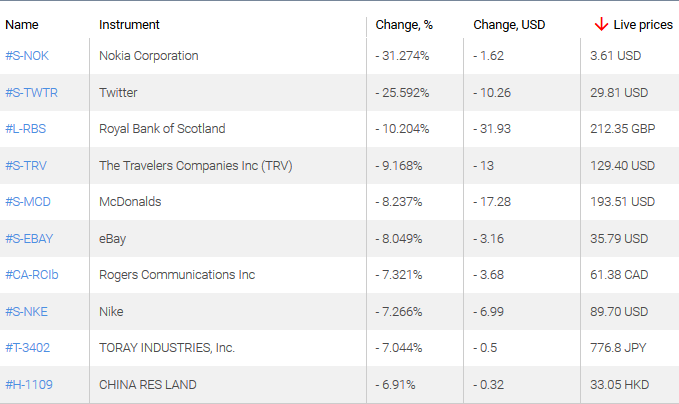
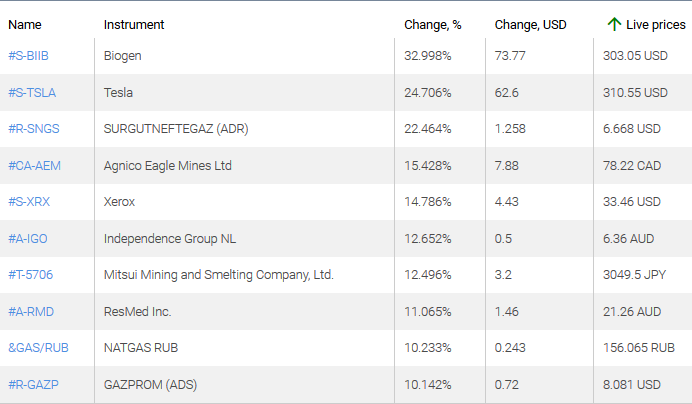
Biogen, Tesla & Nokia lead the Weekly Top Gainers/Losers

By IFCMarkets

Top Gainers – The World Market

1. Biogen Inc. – American pharmaceutical company.

2. Tesla Motors Inc. – American manufacturer of electric vehicles and space technology.

market sentiment ratio long short positions

 Top Losers – The World Market

1. Nokia Corporation – Finnish mobile operator.

2. Twitter Inc. – American social network.

market sentiment ratio long short positions

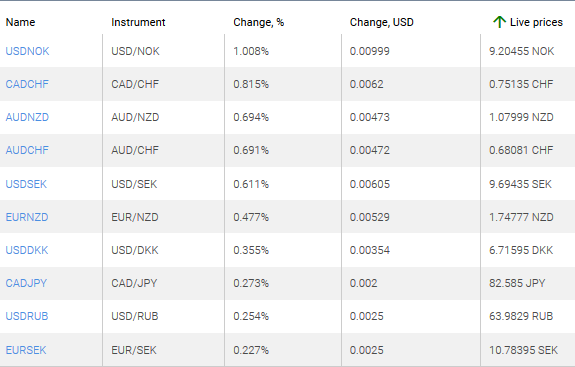
 Top Gainers – Foreign Exchange Market (Forex)

1. USDNOK, CADCHF – an increase in this chart indicates the strengthening of the American dollar against the Norwegian krone and the Canadian dollar against the Swiss franc.

2. AUDNZD, AUDCHF -an increase in this chart shows strengthening of the Australian dollar against the New Zealand dollar and the Swiss franc.

market sentiment ratio long short positions

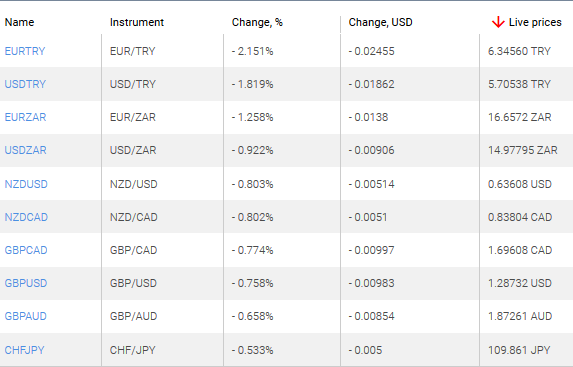
 Top Losers – Foreign Exchange Market (Forex)

1. EURTRY, USDTRY – a decrease in this chart means the weakening of the US dollar and the euro against the Turkish lira.

2. EURZAR, USDZAR – a decrease in this chart means the weakening of the US dollar and the euro against the South African rand.

market sentiment ratio long short positions

Market Analysis provided by IFCMarkets

Note:
This overview has an informative and tutorial character and is published for free. All the data, included in the overview, are received from public sources, recognized as more or less reliable. Moreover, there is no guarantee that the indicated information is full and precise. Overviews are not updated. The whole information in each overview, including opinion, indicators, charts and anything else, is provided only for familiarization purposes and is not financial advice or а recommendation. The whole text and its any part, as well as the charts cannot be considered as an offer to make a deal with any asset. IFC Markets and its employees under any circumstances are not liable for any action taken by someone else during or after reading the overview.

How To Find Strong Trends In Forex

By Orbex

In the first part of our series on how to find the trend in forex, we looked at some basic ways that you can identify a trend in forex using price action and simple trend line techniques.

For FX traders new to the forex markets, it is very beneficial to learn how to trade with the trend. In fact, the methods discussed in that article will help you learn the foundations of such a practice.

Once you are ready to take your trend trading to the next level, you need to understand how you find strong trends in forex.

When it comes to finding strong trends in forex, FX traders can benefit most from using technical indicators. These are very useful in giving us information about the forex market.

Read on as we discuss how to find strong trends in the forex markets.

MACD

One of the best indicators for looking at the strength of the trend in forex is the MACD indicator. This indicator looks at the difference between a short and longer-term moving average to identify whether the trend is bullish or bearish. Best of all, the indicator also suggests how strong the trend is via the size of the bars in the histogram.

In the image above you can see an example of how the MACD works. The first red vertical line marks the point at which the indicator turns bearish, moving below the horizontal centerline. From here you can see that the indicator remains below the line, reflecting a bearish trend. You can also see that the size of the bars in the histogram gets larger showing that the trend is strengthening.

You can see that after a while, however, the bars stop getting big and actually start to reduce in size. This creates a divergence highlighted by the rising green trend line on the indicator.

The bars getting smaller tells us that the move is losing strength. Soon after, you can see that price stops trending lower, ranges for a while and then starts to reverse higher before moving up to the point where the indicator turns bullish. This is highlighted by the second vertical red line.

As you can see this indicator is extremely useful for identifying the trend, as well as highlighting trend strength. This can also let us know when a trend might be ending, which is very useful for trade management.

Bollinger Bands

Another very useful indicator is the Bollinger bands indicator. Bollinger bands show a 20 period moving average with upper and lower lines (which form the bands) that are two standard deviations above and below the average.

When the bands are moving higher or lower, this dictates the trend and widening bands show a strengthening trend. Narrowing bands, on the other hand, show that a trend is weakening.

In the image above you can see that the first red vertical line marks the point where the Bollinger bands shift from moving sideways and being very narrow. This shows that price is in range, to moving lower, reflecting a bearish trend.

You can see that the bands get wider as the trend strengthens, up until the point at the second red vertical line where the bands contract again and move sideways. This shows that the market has gone back into range.

Bollinger bands are another fantastic indicator for helping FX traders determine not only the direction of the trend but also the strength of the trend.

Learning how to read strengthening/weakening trends in forex is a crucial part of becoming a successful FX trader. And these two indicators are two of the best forex technical indicators to get you started!

By Orbex


US Rate Cut Offsets Bearish EIA Report

By Orbex

Inventories Soar

Crude prices have recovered on Thursday following a dip lower mid-week. This came in response to another bearish report from the Energy Information Administration. In its latest report, the EIA showed that in the week ending October 25th, US crude stores were higher by a massive 5.7 million barrels. This rise far exceeded the 500k barrel increase projected. This also comes on the back of the API reporting a 708k barrel drawdown just a day earlier.

US Crude Imports Rise

The greater-than-expected rise in crude stores was mainly attributed to the surge in net US crude imports. These were seen higher by 1.2 million barrels across the week. Specifically, those imports coming from Canada. Alongside the jump in crude imports, the latest release from the US Strategic Petroleum Reserve has also added to inventory levels. The Department of Energy offered 10 million barrels of sour crude from the SPR for delivery between October 1st and November 30th. The sale was required by previous laws as part of a drive to raise money to modernize the facility.

Refinery Crude Runs Ruise

Looking at the rest of the data in the EIA’s latest report then: Refinery crude runs jumped by 133k barrels per day. Utilization rates increased by 2.5% to 87.7% of total capacity. Crude stores at the Cushing delivery hub in Oklahoma were higher again. These rose by 1.6 million barrels. This increase marks the fourth straight weekly rise in levels at the hub which is the largest in the US.

Gasoline & Distillate Inventories Down

The report was not totally bearish though. Gasoline stocks were down by 2.3 million barrels over the week. This surpassed analyst expectations for a 2.2 million barrel decline. Gasline stores have now fallen five weeks in a low, bringing levels down to 220.1 million barrels. This is the lowest level since November 2017.

Distillate stockpiles, including diesel and heating oil, were also lower by 1 million barrels across this week. While this was less than the 2.4 million barrel decline forecast, it also marks the sixth straight week of declines.

Fed Rate Cut Weakness USD, Boosts Oil

Despite the bearish report, crude prices have been able to recover into the back end of the week. This is due to USD weakness seen in response to the October FOMC meeting on Wednesday. The Fed cut rates by a further .25%, marking the third such policy adjustment this year. The move was widely expected though was accompanied by more support than the last cut. Eight members voted in favor and just 2 against (up from 7 and 3 last time).

Despite the cut, the Fed signaled that it will now be taking time to assess incoming economic data as well as monitoring external factors before making any further policy adjustments. The Fed has signaled that this is likely the last rate cut of the year. Nevertheless, USD has been weaker on the back of the cut. Traders are now looking to the US employment reports tomorrow. These could fuel further downside if we see any weakness, again, keeping crude prices supported.

Technical Perspective

The rally in crude prices stalled shortly after breaking above the 55 level and prices have since softened a little though for now, are still above 55. While above here, focus remains on a further push higher with 57.78 the next upside level to watch. Crude has been roughly trapped within the 50.85 – 57.78 range for the last six months. The stagnation looks set to continue in the short term while the market awaits a resolution on the US/China trade talks.

By Orbex


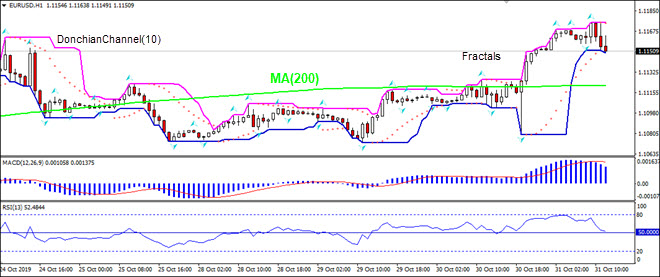
EURUSD Analysis: Lower euro-zone inflation bearish for EURUSD

By IFCMarkets

Lower euro-zone inflation bearish for EURUSD

Eurostat reported euro-zone headline inflation is expected to be 0.7% in October 2019, down from 0.8% in September. Will the GBPUSD decline?

EURUSD falling toward MA(200)

The price chart on 1-hour timeframe shows EURUSD: H1 is trading sideways. The price is falling toward the 200-period moving average MA(200) which is level. And the RSI oscillator is above 50 level but has not reached the overbought zone. There is no trend yet formed, traders have to decide when it would be a best time to enter the market.

Market Analysis provided by IFCMarkets

COFFEE Analysis: Lower output expectations bullish for coffee price

By IFCMarkets

Lower output expectations bullish for coffee price

Vietnam’s coffee production fell in October. Will the coffee prices continue rising?

Vietnam’s coffee production is down: the General Statistics office in Vietnam estimates country’s coffee exports at approximately 1.67 million bags for the month of October, bringing total exports for the first ten months of this year at 22.75 million bags, 13.8% lower than the same period last year. Lower production is bullish for coffee price.

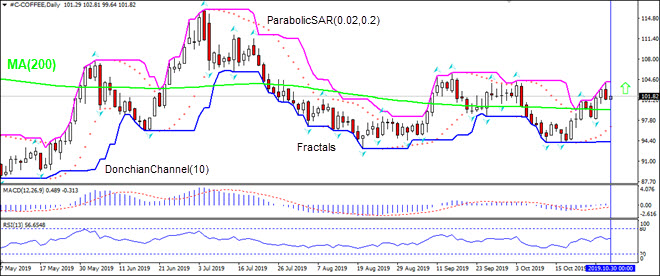
COFFEE:D1 is rising above MA(200) 10/31/2019 Technical Analysis IFC Markets chart

On the daily timeframe the COFFEE: D1 is above the 200-day moving average MA(200) which is declining .

  • The Parabolic indicator gives a buy signal.
  • The Donchian channel indicates no trend: it is flat.
  • The MACD indicator gives a bullish signal: it is above the signal line and the gap is widening.
  • The RSI oscillator is rising but has not reached the overbought zone.

We believe the bullish momentum will continue as the price breaches above the upper Donchian boundary at 104.17. A pending order to buy can be placed above that level. The stop loss can be placed below the lower Donchian boundary at 94.22. After placing the order, the stop loss is to be moved every day to the next fractal low, following Parabolic signals. Thus, we are changing the expected profit/loss ratio to the breakeven point. If the price meets the stop loss level (94.22) without reaching the order (104.17), we recommend cancelling the order: the market has undergone internal changes which were not taken into account.

Technical Analysis Summary

OrderBuy
Buy stopAbove 104.17
Stop lossBelow 94.22

Market Analysis provided by IFCMarkets

How Trump Tariff Wars Worsen US Trade Deficit

By Dan Steinbock    

Since 2018, Trump’s trade wars have made US trade deficit only worse, while hurting the poorest economies the most and penalizing global prospects.

According to the new IMF outlook, global growth is forecast at 3.0% for 2019. That’s the lowest since the global crisis of 2008-9. The decline is largely due to the US tariff wars, which have contributed to the projected slowdown in the US and China.

Due to the global slowdown, world growth prospects now hover at levels where they were last amid the darkest moments of 2008/9.

Trump tariffs widen US trade deficit

Recently, international media reported that, in August, the politically sensitive US goods trade deficit with China decreased 3.1% to $32 billion relative to previous month. Yet, US trade deficit actually widened to almost $55 billion in August. While exports rose 0.2%, imports increased more than twice as fast at 0.5%.

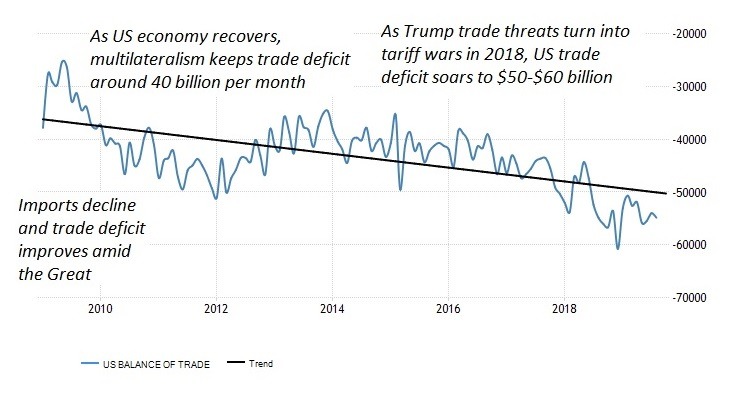
Unfortunately, monthly data does not reflect secular trends and overall deficit trend matters. In longer view, US trade deficit improved during the Great Recession, when imports declined. As the economy recovered in the early 2010s, multilateralism still kept trade deficit around $40 billion per month.

The change came when President Trump’s trade threats turned into tariff wars in 2018. Since then, the trade deficit has been around $50 to $60 billion per month, while the trend line (in black) suggests progressive deterioration (Figure 1).

Figure 1 The Widening of US Trade Deficit

Data from U.S. Bureau of Economic Analysis (BEA)

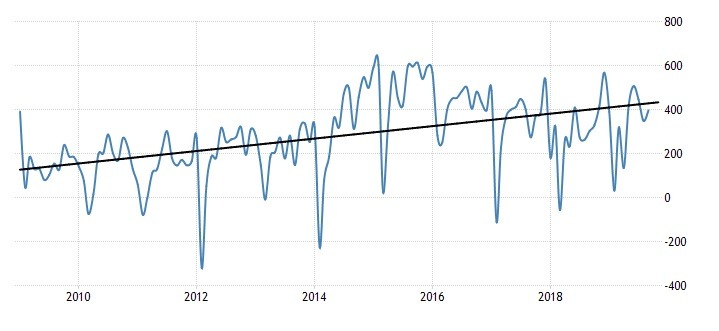
What about China’s trade surplus? In September, Chinese exports declined 3.2% over a year earlier, which the White House’s trade hawks saw as progress. Nevertheless, imports to China plunged more than twice as fast at 8.5%. That’s what happens in times of trade friction and uncertainty; import growth declines.

The net effect? China’s trade surplus actually widened to $40 billion in September. In the long view, the trend line (in black) the relative strength of the trade surplus, even amid the US tariffs (Figure 2).

Figure 2 China’s Trade Surplus

Data from China’s General Administration of Customs (in CNY)

The bottom line? The Trump tariff wars are working – if the strategic objective is to further weaken the US trade deficit and to deepen trade friction with China and other trading nations particularly in developing Asia.

How US tariffs hurt most the poorest economies

Worse, the Trump tariff wars are harming the most the poorest economies. In the postwar era, Washington’s trade, investment and financial ties broadened and deepened mainly with other major advanced economies in Western Europe and Japan. The postwar economic miracles of these rich economies did not support the rise of the Third World – developing Asia, Africa, Middle East and Latin America.

In the past decade or two, China’s economic ties have broadened and deepened dramatically not just with major advanced economies, but particularly with emerging and developing world regions. Moreover, the One Belt and Road (BRI) initiative seeks purposefully to accelerate modernization in poorer economies in which industrialization was never completed or has barely begun.

The implication is critical. Since China’s contribution to the rise of the poorer economies is now vital, any collateral damage that US tariff wars affect in China, whether directly through trade and investment abroad or indirectly through the reduction Chinese output potential, will harm disproportionately the poorest economies in the world – through their external trade ties and multiplier effects in their domestic economies.

The longer the US tariff wars prevail, the broader the collateral damage will be in emerging and developing economies.

Diminished global prospects

In 2008-9, the global crisis was contained by massive fiscal stimulus packages, ultra-low rates and, when that proved inadequate, rounds of quantitative easing.

Now, a decade after the crisis, central banks’ rates remain ultra-low and most continue asset purchases, whereas soaring debt levels limit new fiscal injections.

The IMF projects growth to pick up to 3.4% in 2020. That, however, is predicated on improvements in a number of emerging economies in Latin America, the Middle East and developing Europe, which would require a trade recovery. And the latter is not likely as long as the misguided US tariff wars prevail.

The Trump administration’s tariff wars are the worst policy mistake in the postwar era. They will improve neither US trade balance nor global economic prospects. They have already made both worse.

About the Author:

Dr. Dan Steinbock is an internationally recognized strategist of the multipolar world and the founder of Difference Group. He has served at the India, China and America Institute (US), the Shanghai Institutes for International Studies (China) and the EU Center (Singapore). For more, see https://www.differencegroup.net/   

A shorter version of the commentary was released by China Daily on October 31, 2019


Eurozone Q3 2019 GDP To Hold Steady

By Orbex

The European statistics agency, Eurostat will be releasing the preliminary GDP report for the third quarter today.

During the three months ending September 2019, economists are optimistic that the eurozone economy grew at a pace of 0.2% on a quarterly basis. This brings the yearly GDP growth rate to 1.2%.

The GDP data based on the estimates shows no major deviation. The pace of growth will show that the eurozone economy grew at the same pace as in the second quarter. This is somewhat good news.

The data comes amid speculation that growth could slow much more than initially thought. The eurozone economy has been largely stagnant, inflation included. This has become a major worry for the European Central Bank.

Euro Area, GDP

As a result, the ECB restarted its quantitative easing program in September. This comes after the central bank initially announced an end to its QE program in December 2018. But within less than a year, slowing growth and sluggish inflation pushed the ECB to take action.

However, in a way, the expectations for the third quarter show that the pace of growth was not as bad as it initially seemed.

Overview of PMI’s for the Eurozone

The various measures of the purchase managers’ index covering manufacturing and services were weaker during the three months ending September. On average, the eurozone manufacturing PMI was at 46.4.

A reading in the PMI below 50 indicates contraction. In the three months, the manufacturing PMI was consistently below the 50-level, suggesting a decline.

Meanwhile, services activity was somewhat better. Overall, in the three-month period, the average of the services PMI was seen at 52.76. This was slightly better comparing to the manufacturing sector.

The declines during the quarter were largely attributed to the global trade wars. At one point, the US administration also threatened Europe with tariffs. The dispute came on the back of Europe extending sops to airplane manufacturer Airbus.

This put the American airplane manufacturer, Boeing at a disadvantage.

Quite recently, the WTO ruled in favor of the U.S. allowing it to legally impose tariffs on imports from the Eurozone.

All Eyes on the German Economy

The German economy was also going through a slump during the period. Considering that Germany is the eurozone’s largest economy, a slowdown can create ripples across the whole region.

At some point, there were talks that the eurozone economy could slip into a recession.

This was because of uncertainty from the German economy. In August, industrial orders fell more than expected due to weaker domestic demand. This raised concerns that the region’s largest economy would slip into a recession.

Contracts for goods fell 0.6% and this led the Bundesbank to issue caution that growth could slow. But, there was some hope as, in September, data saw the German industrial production rebounding.

Following the 0.6% decline in August, Germany’s industrial production saw a modest recovery. Industrial production rose 0.3% in September. While this brought some cheer to the markets, not everyone is convinced.

Economists and investors alike are likely to wait for more data before writing off the slump.

For the moment, the 1.2% growth expectations in the third quarter stay consistent with the economic data coming out so far. As long as the data doesn’t disappoint the market reaction could be muted.

By Orbex