Oil & Gas Company Increases Credit Term Facility to Fund Second Well

The Energy Report

Source: Streetwise Reports   11/13/2019

The terms and the reason are presented in a Mackie Research Capital Corp. report.

In a Nov. 1 research note, Mackie Research Capital Corp. analyst Bill Newman reported that Touchstone Exploration Inc. (TXP:TSX; PBEGF:OTC.MKTS) increased its term credit facility to $20 million from $5 million to fund drilling of a second exploration well in the Republic of Trinidad and Tobago.

Under the terms, Touchstone will keep paying, on a quarterly basis, 8% per year interest. Also, it will begin paying the principal on Jan. 1, 2021, of $1.1 million per quarter with the full amount due by the facility’s maturity date, Nov. 23, 2023.

Another change, Newman relayed, was an increase of the royalty payable on future production to 1.33% per from 1%, payable quarterly through Oct. 31, 2023.

Newman noted that Cascadura-1, the second of Touchstone’s ‘four exploration wells, is currently being drilled. Initial results are expected in mid-November as are production test results from Coho-1, the first well of the quartet. “If the Coho-1 well is successful, it has a relatively short tie-in distance of about 3.5 kilometers,” added Newman.

Mackie has a Speculative Buy recommendation and a CA$0.50 target price on Touchstone. This reflects a 133% projected return as the company’s current share price is around CA$0.22.

Sign up for our FREE newsletter at: www.streetwisereports.com/get-news

Disclosure:
1) Doresa Banning compiled this article for Streetwise Reports LLC and provides services to Streetwise Reports as an independent contractor. She or members of her household own securities of the following companies mentioned in the article: None. She or members of her household are paid by the following companies mentioned in this article: None.
2) The following companies mentioned in this article are billboard sponsors of Streetwise Reports: None. Click here for important disclosures about sponsor fees.
3) Comments and opinions expressed are those of the specific experts and not of Streetwise Reports or its officers. The information provided above is for informational purposes only and is not a recommendation to buy or sell any security.
4) The article does not constitute investment advice. Each reader is encouraged to consult with his or her individual financial professional and any action a reader takes as a result of information presented here is his or her own responsibility. By opening this page, each reader accepts and agrees to Streetwise Reports’ terms of use and full legal disclaimer. This article is not a solicitation for investment. Streetwise Reports does not render general or specific investment advice and the information on Streetwise Reports should not be considered a recommendation to buy or sell any security. Streetwise Reports does not endorse or recommend the business, products, services or securities of any company mentioned on Streetwise Reports.
5) From time to time, Streetwise Reports LLC and its directors, officers, employees or members of their families, as well as persons interviewed for articles and interviews on the site, may have a long or short position in securities mentioned. Directors, officers, employees or members of their immediate families are prohibited from making purchases and/or sales of those securities in the open market or otherwise from the time of the interview or the decision to write an article until three business days after the publication of the interview or article. The foregoing prohibition does not apply to articles that in substance only restate previously published company releases.


Disclosures from Mackie Research, Touchstone Exploration Inc., Update, November 1, 2019

RELEVANT DISCLOSURES APPLICABLE TO COMPANIES UNDER COVERAGE
Relevant disclosures required under Rule 3400 applicable to companies under coverage discussed in this research report are available on our web site at www.mackieresearch.com. 1. None Applicable for this Issuer

ANALYST CERTIFICATION
Each analyst of Mackie Research Capital Corporation whose name appears in this report hereby certifies that (i) the recommendations and opinions expressed in this research report accurately reflect the analyst’s personal views and (ii) no part of the research analyst’s compensation was or will be directly or indirectly related to the specific conclusions or recommendations expressed in this research report.

Mackie Research Capital Corporation, its directors, officers and other employees may, from time to time, have positions in the securities mentioned herein.

( Companies Mentioned: TXP:TSX; PBEGF:OTC.MKTS,
)

Company Achieves Commercial Gold Production Early, on Budget

By The Gold Report

Source: Streetwise Reports   11/13/2019

The details of this transition project in Nevada are discussed in a CIBC report.

In an Oct. 28 research note, CIBC analyst Bryce Adams reported that Premier Gold Mines Ltd.’s (PG:TSX) “first project at South Arturo, El Niño underground, has achieved commercial production ahead of schedule and on budget.”

South Arturo is a joint venture project between Premier that owns 40% and Nevada Gold Mines, 60%. Previously, Premier was expected to attain commercial production at El Niño next year, in Q1.

With the early start, CIBC now expects gold production at South Arturo to exceed its forecast of 4,000 ounces (4 Koz) as well as Premier’s 2019 guidance of 5–10 Koz. “We now model South Arturo year-end 2019 production of 11.1 Koz,” Adams indicated.

When the South Arturo expansion is done, Adams pointed out, the operation will run at full capacity via the phase 1 open pit. Pre-stripping, which is ongoing, remains on schedule for commercial production in H2/20.

As for exploration potential at El Niño and nearby, recently returned drill results are “positive” and “bode well for future resource and mine plan updates,” Adams highlighted. Gold intercepts included 24.4 meters (24.4m) at 20.6 grams per ton (20.6 g/t) at El Niño underground and 113m at 7.3 g/t in the proposed phase 3 pit, which hosts most of South Arturo’s heap-leach material.

CIBC maintained its Outperformer rating and a CA$3.85 price target on Premier Gold “on the basis that 2019 is a transition year for South Arturo and the company overall,” noted Adams. Premier is currently trading at around CA$1.97 per share.

Sign up for our FREE newsletter at: www.streetwisereports.com/get-news

Disclosure:
1) Doresa Banning compiled this article for Streetwise Reports LLC and provides services to Streetwise Reports as an independent contractor. She or members of her household own securities of the following companies mentioned in the article: None. She or members of her household are paid by the following companies mentioned in this article: None.
2) The following companies mentioned in this article are billboard sponsors of Streetwise Reports: None. Click here for important disclosures about sponsor fees.
3) Comments and opinions expressed are those of the specific experts and not of Streetwise Reports or its officers. The information provided above is for informational purposes only and is not a recommendation to buy or sell any security.
4) The article does not constitute investment advice. Each reader is encouraged to consult with his or her individual financial professional and any action a reader takes as a result of information presented here is his or her own responsibility. By opening this page, each reader accepts and agrees to Streetwise Reports’ terms of use and full legal disclaimer. This article is not a solicitation for investment. Streetwise Reports does not render general or specific investment advice and the information on Streetwise Reports should not be considered a recommendation to buy or sell any security. Streetwise Reports does not endorse or recommend the business, products, services or securities of any company mentioned on Streetwise Reports.
5) From time to time, Streetwise Reports LLC and its directors, officers, employees or members of their families, as well as persons interviewed for articles and interviews on the site, may have a long or short position in securities mentioned. Directors, officers, employees or members of their immediate families are prohibited from making purchases and/or sales of those securities in the open market or otherwise from the time of the interview or the decision to write an article until three business days after the publication of the interview or article. The foregoing prohibition does not apply to articles that in substance only restate previously published company releases.

Disclosures from CIBC, Premier Gold Mines Ltd., October 28, 2019

Analyst Certification:
Each CIBC World Markets Corp./Inc. research analyst named on the front page of this research report, or at the beginning of any subsection hereof, hereby certifies that (i) the recommendations and opinions expressed herein accurately reflect such research analyst’s personal views about the company and securities that are the subject of this report and all other companies and securities mentioned in this report that are covered by such research analyst and (ii) no part of the research analyst’s compensation was, is, or will be, directly or indirectly, related to the specific recommendations or views expressed by such research analyst in this report.

Analysts employed outside the U.S. are not registered as research analysts with FINRA. These analysts may not be associated persons of CIBC World Markets Corp. and therefore may not be subject to FINRA Rule 2241 restrictions on communications with a subject company, public appearances and trading securities held by a research analyst account.

Potential Conflicts of Interest:
Equity research analysts employed by CIBC World Markets Corp./Inc. are compensated from revenues generated by various CIBC World Markets Corp./Inc. businesses, including the CIBC World Markets Investment Banking Department. Research analysts do not receive compensation based upon revenues from specific investment banking transactions. CIBC World Markets Corp./Inc. generally prohibits any research analyst and any member of his or her household from executing trades in the securities of a company that such research analyst covers. Additionally, CIBC World Markets Corp./Inc. generally prohibits any research analyst from serving as an officer, director or advisory board member of a company that such analyst covers.

In addition to 1% ownership positions in covered companies that are required to be specifically disclosed in this report, CIBC World Markets Corp./Inc. may have a long position of less than 1% or a short position or deal as principal in the securities discussed herein, related securities or in options, futures or other derivative instruments based thereon.

Recipients of this report are advised that any or all of the foregoing arrangements, as well as more specific disclosures set forth below, may at times give rise to potential conflicts of interest.

Important Disclosure Footnotes for Premier Gold Mines Ltd. (PG)

· Premier Gold Mines Ltd. is a client for which a CIBC World Markets company has performed investment banking services in the past 12 months.
· CIBC World Markets Inc. has received compensation for investment banking services from Premier Gold Mines Ltd. in the past 12 months.
· CIBC World Markets Inc. expects to receive or intends to seek compensation for investment banking services from Premier Gold Mines Ltd. in the next 3 months.

( Companies Mentioned: PG:TSX,
)

Gatling Exploration Aiming to Prove Three Deposits All Part of One System

By The Gold Report

Source: Streetwise Reports   11/13/2019

The company is starting off with a resource of close to a million ounces of gold before drilling.

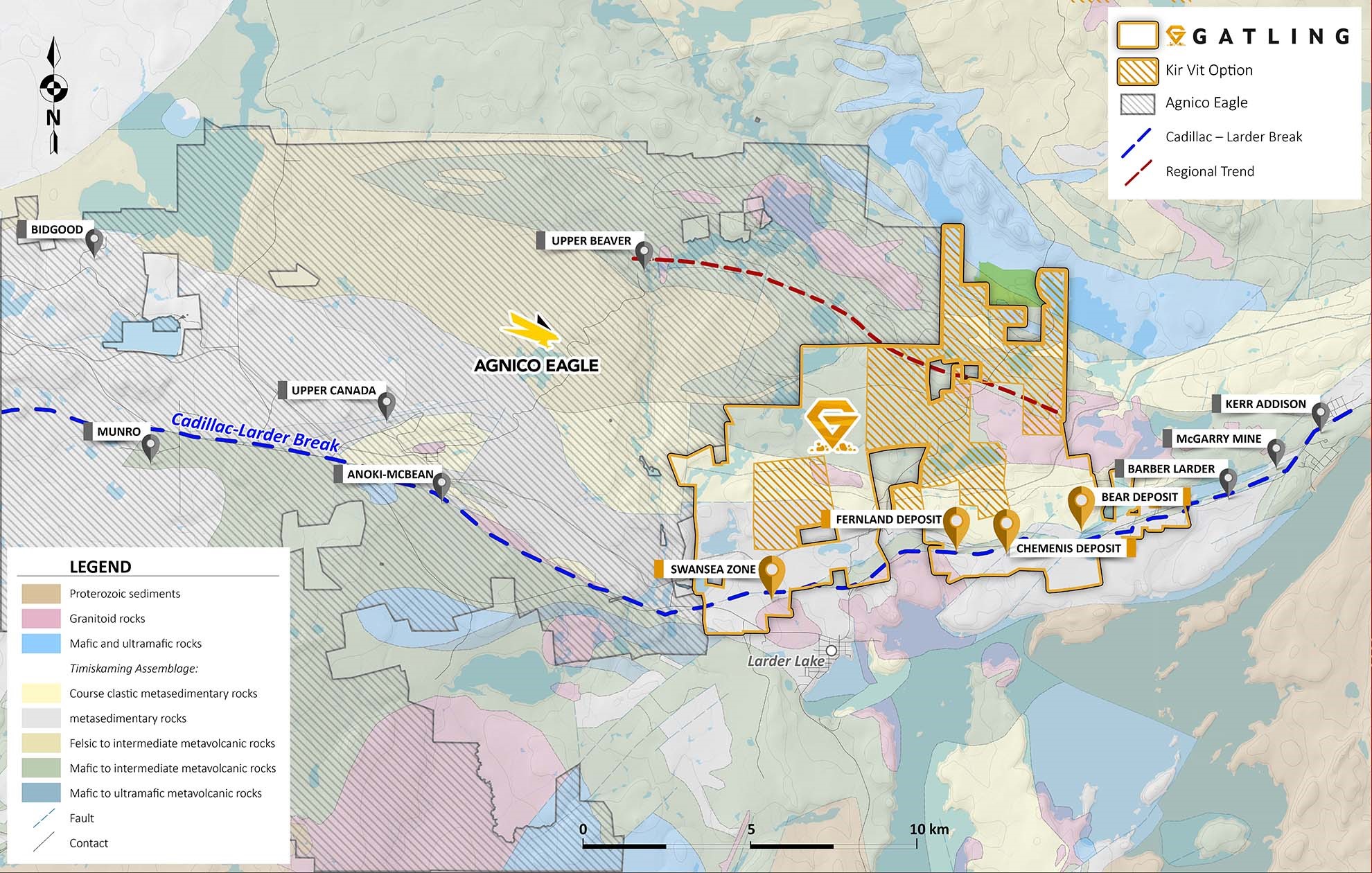
Gatling Exploration Inc.’s (GTR:TSX.V; GATGF:OTCQX) Larder gold project is located in Ontario on the Cadillac Larder fault in the Abitibi Greenstone Belt, 35 km east of Kirkland Lake, and is composed of three separate deposits, Bear, Cheminis and Fernland. All three have seen exploration historically.

The project is located in a prolific area. Five kilometers to the east of Gatling lies the Kerr Addison Mine, which produced 10.5 million ounces of gold. Agnico Eagle’s Kirkland Lake property lies to the west, is contiguous with Gatling’s, and sports the Upper Beaver and Upper Canada deposits. Historically, the Cadillac Larder fault has seen more than 70 million ounces of gold production.

“Gatling consolidated the last bit of that trend on the Cadillac Larder fault by putting the three deposits together,” Gatling CEO Nav Dhaliwal told Streetwise Reports.

Gatling map

“What really underpins the company is the Cheminis and Bear deposits have a historical resource of 917,000 ounces of gold at 5.5 grams per tonne,” Dhaliwal explained.

The Cheminis mine, just to the west of Bear, has old workings, a headframe and workings down to about 1,200 feet, and through bulk sampling has an additional historical resource of about 43,000 Indicated ounces of gold.

In March, Gatling further consolidated the last of bit of the trend and completed its land package when it acquired the Kir Vit prospect, an early-stage exploration target, from Teck Resources. Kir Vit is on trend with Agnico Eagle’s Upper Beaver deposit. “Kir Vit locks down for us a possible splay off the Cadillac Larder fault. Teck did over $2 million of exploration work on the property, basically all the work that needs to be done to allow us to identify drill ready targets,” Dhaliwal explained. In August, surface samples from the Kir Vit area returned values including 6.7 g/t and 7.0 g/t.

And Gatling is aggressively drilling the entire property, located just off the highway that provides accessibility all year round, with three rigs on site. It announced early this year a 10,000 meter drill program that was later upsized to 20,000 meters, and then again increased to 35,000 meters. Around 25,000 meters have already been drilled.

All that drilling has been bearing fruit. Drilling has confirmed that the Cheminis and Bear deposits are “connected as part of one mineralized system.”

“We believe all three of the deposits are contiguous and stretch over 4.5 kilometers; we have now connected two of the three deposits and have established 2.5 kilometers of the 4.5,” Dhaliwal stated.

“Gatling has 48 million shares outstanding, no warrants, no overhang and just under $4 million cash in the bank,” Dhaliwal stated. “We expect the news flow to continue with the drilling; this is a ground floor opportunity.” Gatling is listed on the TSX.V under GTR and OTCQB GATGF.

Sign up for our FREE newsletter at: www.streetwisereports.com/get-news

Disclosure:
1) Patrice Fusillo compiled this article for Streetwise Reports LLC and provides services to Streetwise Reports as an employee. She or members of her household own securities of the following companies mentioned in the article: None. She or members of her household are paid by the following companies mentioned in this article: None.
2) The following companies mentioned in this article are billboard sponsors of Streetwise Reports: Gatling Exploration. Click here for important disclosures about sponsor fees.
3) Comments and opinions expressed are those of the specific experts and not of Streetwise Reports or its officers. The information provided above is for informational purposes only and is not a recommendation to buy or sell any security.
4) The article does not constitute investment advice. Each reader is encouraged to consult with his or her individual financial professional and any action a reader takes as a result of information presented here is his or her own responsibility. By opening this page, each reader accepts and agrees to Streetwise Reports’ terms of use and full legal disclaimer. This article is not a solicitation for investment. Streetwise Reports does not render general or specific investment advice and the information on Streetwise Reports should not be considered a recommendation to buy or sell any security. Streetwise Reports does not endorse or recommend the business, products, services or securities of any company mentioned on Streetwise Reports.
5) From time to time, Streetwise Reports LLC and its directors, officers, employees or members of their families, as well as persons interviewed for articles and interviews on the site, may have a long or short position in securities mentioned. Directors, officers, employees or members of their immediate families are prohibited from making purchases and/or sales of those securities in the open market or otherwise from the time of the interview or the decision to write an article until three business days after the publication of the interview or article. The foregoing prohibition does not apply to articles that in substance only restate previously published company releases.

( Companies Mentioned: GTR:TSX.V; GATGF:OTCQX,
)

What Are The Chances Of A Mexico Rate Cut?

By Orbex

It appears that Mexico’s inflation is finally getting under control. But, at the same time, the economy is starting to sputter. So far it has only barely escaped a technical recession, with growth far from prior levels.

But, the Central Bank finally has room to take action that the government has been pushing for ever since the new President took office.

Despite two cuts so far, Mexico still has the highest interest rate in the world, when taking into account inflation.

This hasn’t done much to encourage capital flows. The Mexican peso has been under pressure due to increased capital outflows, as well as the rate cuts. And that trend doesn’t seem likely to change soon.

What We Are Expecting

Not only is there a strong consensus in favor of a rate cut, but there is even a majority chance of a 50 basis point cut this time around.

In the last meeting, the vote was split between cutting 25 or 50 bps. Three of the five members voted for the former. Although Banxico did not give forward guidance, the statement was quite dovish.

The thought is that one more member will vote for a 50bp cut later today, bringing the rate to 7.25%. The swaps spread has moved to project that the rate will reach that level by the end of the year, and there is still one more meeting.

But, conventional wisdom is that the bank will take a more aggressive stance to catch up with the easing cycle in other countries, notably the US with which it has had an increasing rate spread after the Fed cut rates.

The Market Reaction 

It should be noted that a poll of economists by Reuters found that just 10 out of 14 favored a rate cut, and the Banxico is notoriously cautious about cutting rates.

A hold would, however, be quite a surprise for the markets, as it is currently pricing in at least a 25bp cut. That would be the scenario in which we’d expect the least market reaction.

The next factor is the wording in the monetary policy statement. Last time it was dovish, but the expectation is for it to be more explicit this time around. We could see some market adjustment if they finally provide guidance. However, there isn’t an expectation that we will get a forward-looking rate path like other central banks do.

The Outlook

Even if there is some discrepancy in the timing of rate cuts, among analysts there is a pretty strong consensus that over the next couple of months the inflation rate will continue to shrink. This is mostly thanks to lower basic goods costs. At the same time, the economy is expected to perform at the bottom of the projected range.

Both would be indications for the central bank to continue an easing cycle, including a total of 50bps by the end of December. The discrepancy is whether the bank will do the whole thing later today, or spread it over this and the next meeting.

However, the MXN has been performing better than most other emerging markets. In fact, it has increased since the Banxico finally started cutting rates. This not only could help allay fears by the central bank of currency weakness but also tell traders that rate cuts don’t necessarily mean increased weakness in the currency.

And with the USMCA expected to be ratified soon, the peso could be in for further strength!

By Orbex


AUDUSD Analysis: Weak unemployment report bearish for AUDUSD

By IFCMarkets

Weak unemployment report bearish for AUDUSD

Australia’s unemployment rate ticked up to 5.3% from 5.2% in September. Will the AUDUSD decline?

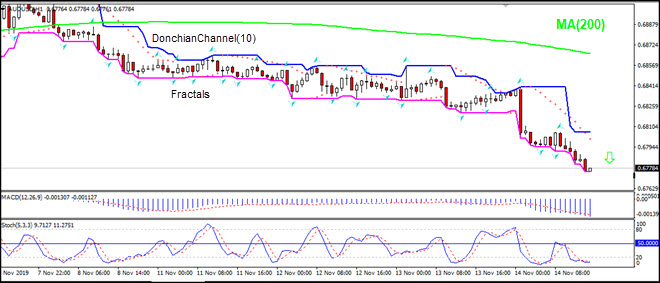
AUDUSD falling below MA(200)

On 1-hour timeframe AUDUSD: H1 is in downtrend, below the 200-period moving average MA(200) which is falling. The Stochastic indicator is in the oversold zone which is bullish.

Technical Analysis Summary

OrderSell
Sell stopBelow 0.6774
Stop lossAbove 0.6794

Market Analysis provided by IFCMarkets

UK CPI Misses, US CPI Beats

By Orbex

USD Higher on Better CPI

The US dollar has been a little firmer today on the back of yesterday’s upside beat in CPI. Inflation was recorded as having grown at its fastest pace for seven months over October with a 0.4% monthly rise.

The data has seen further reductions to the market pricing for a December rate cut, which now sits at 0% and there’s a weakening of rate cut pricing at the start of next year. USD index trades 98.20 last.

Germany Avoids Technical Recession

EURUSD has had a quiet start to the day and is trading just in the red as of writing. The latest data from the eurozone this morning showed German GDP managing to hold in positive territory in Q3 at 0.1%.

This has confirmed that Germany has avoided entering a technical recession. However, conditions remain weak and the outlook for EUR remains skewed to the downside. EURUSD trades 1.100 last, still below the 1.1024 level for now.

GBP Rallies Despite Inflation Miss

GBPUSD has had a solid session so far today with price rallying strongly. These moves come despite poor economic news yesterday. UK CPI hit three-year lows at just 1.5% year on year in October. The weak reading reflects soft underlying conditions in the face of ongoing Brexit uncertainty and is boosting dovish BOE risks. The upside move was tempered this morning by a negative print in October Retail Sales which came in at -0.1%. GBPUSD trades 1. 2860 last.

Equities Remain Supported

Risk assets have seen some upward movement across the morning. Having started lightly, the SPX500 has popped higher over the last hour trading up to 3094.93 as of writing. Better data is creating a more encouraging atmosphere for risk appetite today though focus is still on whether the US and China will sign a trade deal this month.

Safe Havens Flows Still Noted

Safe havens have had a better morning today with gold and JPY rising against USD despite the recent lift in equities. The resilience in JPY and gold reflects the level of caution which still underpins risk appetite as we head into the weekend.

Traders know that the potential for disappointment is still there. XAUUSD trades 1467.86 last, still well beneath the 1481.93 level. USDJPY trades 108.66 last, still sitting near the bottom of the recent sell-off.

Crude Climbing on Data

Oil prices have been higher today on the back of better economic data which has lifted the mood a little. The key driver remains the ongoing US-China trade talks. If the US and China push on and sign a deal this will be firmly bullish for oil.

However, if a deal is not signed in the near term and uncertainty persists, this will weigh on oil prices once again. Later today traders will receive the delayed US EIA inventories report which is forecast to show a build of 1.5 million barrels. Crude trades 57.66 last.

Loonie Still Looking For Higher Levels

USDCAD continues to trade higher today with the recent strength in USD outweighing the rise in crude prices for now. USDCAD is trading roughly in the middle of the 1.3207 – 1.33 range though the move to the topside has become more labored over recent days. US data later today could provide the catalyst for further upside if we see another upside surprise.

AUD Falls on Weak Employment Data

AUDUSD has weakened today, trading down to fresh 2019 lows as employment reports released overnight disappointed. AUD saw -19k jobs over the last month, taking the unemployment rate back up to 5.3% from 5.2% prior. Solid employment has been at the heart of the RBA’s positive spin on the economy and these readings will be received poorly at the bank. AUDUSD trades .6791 last.

By Orbex


Reserve Bank of Australia cuts rates to 0.25% will the AUD take a hit?

By ForexNewsNow

The Reserve Bank of Australia has decided to cut interest rates all the way down to 0.25% in anticipation of a very complicated 2020 up ahead. The cuts will materialize in the middle of 2020 in order to accomodate not only the heavy expenditures during Christmas 2019 but to also prepare the consumers for another one in 2020.

Overall, the government is starting to prepare for the worst. Considering all of the indicators that we’ve seen coming from Australia, the preparations are definitely not misplaced. The interest rate cuts are mostly designed to keep the Australian economy floating for the year to come. According to experts, should the rates not had been implemented, it was likely that the economy would take a back turn.

Most consumers are not too worried about the rate cuts, but every firm that has been dealing with some kind of business in Australia could start reconsidering their involvement in the economy. As for the FX brokerages that are dotting Australia left right and center, it’s likely that most of them will start distancing themselves from the AUD/USD pair for now.

What indicators caused such a decision?

Indicators would mostly revolve around the real estate industry, unemployment rates in Australia, wages failing to keep up with inflation and overall price increases for daily necessities and various other factors contributing to the extreme pressure on the Australian economy.

According to experts, if prices continue to rise so quickly, both for the consumers and the employers, it’s very likely that the unemployment range in Australia will each 5.5% in 2020, which will be an unacceptable precedent for not only the ruling party but the local population as well.

Most of the previous attempts at stabilizing the economy were due to paying off as many debts as possible, which is very reminiscent of the population’s situation as well. For once, it seems that the majority of the Aussie population alongside its government are facing the same issues. Paired up with the increase of wages over time, it seems that these Aussie video poker games are starting to catch up to the players as slightly over a billion AUD is currently owed to large gaming companies in the country.

Considering the rate cuts that were just agreed upon, it’s likely that those gaming companies will start pressuring their consumers even more to retrieve as much capital as possible.

Retail stores are also anticipating a very disappointing Christmas this year as well. Considering the failure of wages to keep up with inflation, or simply to remain effective in paying for daily necessities, it’s very likely that the majority of Australian families are going to be having a modest Christmas this year and in 2020 as well.

With so many negative news coming out about the future of the Australian economy, it’s only reasonable to believe that the AUD will take a major hit relative to the USD. Despite Trump’s questionable foreign policies, the US economy has remained relatively firm. Therefore, tripping in front of a stable currency is going to affect the AUD very negatively. Add to that the gas of the interest rate cuts and we get a disastrous situation for every AUD trader.

Hope for improvement?

The rate cuts are definitely not something to rely on 100%, it’s just a temporary fix which has been mentioned by multiple experts as well. The real issue that Australia is facing right now is the failure to increase wages, which directly indicates the failure of most of its private companies failing to grow.

It’s easily understandable as well. Billions lost due to the US-China trade war has drastically affected the Australian economy. Considering the droughts and natural disasters that have been plaguing the country have had serious issues with its agricultural sector, and therefore most of its exports.

The Climate Change issue has been tampering with the country’s biggest mining industries as well. Overall, the issues keep on piling on top of each other, and there’s no interest rate cut that could help the economy emerge from such a tsunami of negativity.

By ForexNewsNow

What happens To The Global Economy If Oil Collapses Below $40 – Part I

By TheTechnicalTraders.com

Currently, commodity prices are the cheapest they’ve been in over 40 years compared to equity prices.  US Equities have continued to rise over the past 7+ years due to a number of external processes.  QE1, 2, 3, and Fed Debt Purchases Share Buy-Backs and creative credit facilities.  Only recently have investors really started to pile into the US stock market (see charts below). Global investors were very cautious throughout the rally from 2011 to 2016.  In fact, the amount of capital invested within the US money market accounts was relatively flat throughout that entire time.

It was only after the 2016 US presidential election that investors really began to have confidence in the global economy and started piling into the US stock market and money market accounts.  This was also after the time that Oil began to collapse (2014~16) as well as the deflation of Emerging Markets rallies.  With all this new money having entered the global markets and equities being extremely overbought currently, what would happen is Oil collapsed below $40 and the global economic outlook soured headed into the 2020 US presidential election?

On July 10, 2019, we authored a research article using our ADL predictive modeling for Oil.  At that time, we predicted Oil would fall in August, recover in September and October, then collapse to near $42 (or lower) in November and December.  You can read our followup to this article here.

Currently, Oil has followed our ADL predictive modeling relatively closely over the past few months.  Although the attack in Saudi Arabia sent prices skyrocketing in mid-September, Crude price has generally stayed within our expected ranges and has recently settled near $55.  If you notice the two GREEN BARS on the chart, above, September and October price expectations suggested price settling near $54 and 59 throughout those two months.  Now, with November upon us, the ADL predictive modeling system is suggesting Oil prices will collapse from levels near $58 to levels near $40 – a massive 31% price collapse.  In reality, the price could fall below on a deeper price decline event.

This Crude Oil chart highlights what we believe may happen in Oil over the next few weeks and months – where price may collapse below $40.  Yet, we started asking another question..  What happens to the global economy if Oil prices collapse below $40 before the end of 2019?  What happens to the nations that depend on exported Oil income and to central bank functions within the economy?

When we start to understand the correlation between the price of Oil and the expectations throughout the global market, we must immediately focus on the income expectations of nations that rely on oil as the main source of income.  If our ADL predictions are correct, Oil will begin to plunge to levels near $40 (possibly below $40) over the next 3~4 months.  How will foreign nations react to this loss of income and who are the most dependent nations on Oil revenues.

Oil-producing nations vary in scale across the world, yet the United States, Saudi Arabia and Russia are the largest producers.  Nations that are the most dependent on Oil revenues are some of the smaller, less mature economies of the world.  Should the supply of oil stay relatively consistent across the globe while an extended economic contraction continues, we must begin to question the sustainability of various nations in terms of oil revenues.

For many of these nations, the income from Oil exports make up more than 15% of their annual GDP – in some cases, with Brunei, Kuwait, Libya, the Republic of Congo, Saudi Arabia and Singapore, oil revenues make up more than 30% of GDP.  How would a dramatic decrease in oil prices act as an economic destabilization event for these nations? Could they survive the event?

If the price of oil were to fall to $40 from current levels (near $67), this would represent a 40%+ price decline.  Oil revenues for all nations would likely collapse by similar amounts.  Nations that are most dependent on oil revenues would be hardest hit and this decrease in national revenue would likely increase strains on future operations, debt/credit as well as potentially create massive social unrest and strife.

If our ADL predictive modeling system is accurate and oil prices collapse to near $40, the economic, social and future strains this creates for many nations become even more severe – at a time when an economic contraction is taking place.  This type of commodity price collapse could lead the world into a chaotic economic mess if it is prolonged.

In Part II of this article, we’ll explore the ramifications of this potential oil price collapse across the global stock market and other factors that may be setting up to drive a period of uncertainty and volatility within the global markets.

Opportunities are all around us.  Using the right tools to identify the true technical cycles, price cycles, and trading setup can help to eliminate risks and hone into more profitable trades.  It is almost impossible to time market tops and bottoms accurately, yet, as you can see from our work above, we have tools that can help us see into the future and help to predict when major price peaks and valleys should form.  Using a tool like this to help you determine when the real opportunity exists and when to time your trades will only improve your market insights and trading results….

As a technical analysis and trader since 1997, I have been through a few bull/bear market cycles. I believe I have a good pulse on the market and timing key turning points for both short-term swing trading and long-term investment capital. The opportunities are massive/life-changing if handled properly.

Chris Vermeulen – TheTechnicalTraders.com

Trade Jitters Boosting Gold & Silver

By Orbex

Gold

The yellow metal has been able to post a small recovery this week on the back of a softening in risk appetite. This has seen equities markets retracing from recent highs.

Traders were a little dismayed earlier in the week as Trump’s speech at the Economic Club of New York failed to offer any new insights into ongoing US-China trade talks.

There has been speculation that the two sides will agree on a deal at the APEC meeting in Chile this weekend. However, Trump commented only to say that his team was working hard. He gave no indication as to whether a deal would be signed in the coming days. For now, traders remaining optimistic, though cautiously so. This can be seen in the safe-haven flows supporting gold.

In the middle of the week, the latest US inflation data showed CPI rising at its fastest pace in seven months over October with a 0.4% month on month gain. This data follows a stronger than expected ISM non-manufacturing reading for October and is seeing a further reduction in expectations of Fed rate cuts in the near term.

At its last meeting, the Fed signaled that it would remain on hold for the time being while it assessed the impact of recent trade cuts. Speaking this week, Fed Chair Powell said that the full weight of those cuts is yet to be felt.

He stated that the near term outlook remains positive. While this view is likely to prove negative for gold in the medium term, it seems that heading into the weekend, traders are looking to use gold to hedge risks against any disappointment with US-China trade talks.

Technical Perspective

Gold prices have reversed deeply back inside the falling wedge pattern which has framed the correction from recent highs. The recent 1481.93 level, which has underpinned gold prices over the last three months, has now been broken. Focus is now on a test of the 1436.19 level next.

Price has so far held a test of the pattern low. However, while below 1481.93, further downside is likely. If price can break back above that level, the key level to watch in the short term is 1522.75. This is a major long-term pivot for gold. Above here, the focus will be on a move back up to the recent 1554.69 level.

Silver

Silver prices have tracked the moves in gold this week, posting a minor recovery. However, price is still sitting at the foot of last week’s major sell-off and the tone remains heavy.

The reduced prospect of further Fed rate hikes means that there is room for USD to appreciate. This could pull metals lower. Furthermore, if the US & China agree on a deal this weekend, the boost to risk appetite will also weigh heavily on metals.

However, silver might find some support from increased industrial demand. If this weekend’s APEC meeting fails to produce a deal, on the other hand, this will likely cause a sharp reaction lower in equities, driving metals higher on safe-haven inflows.

Technical Perspective

The recent rally in silver has seen price breaking down below the key 17.3408 levels as the bearish channel develops further. While this channel can still be viewed as a corrective bull flag structure, for now, bulls will need to see price quickly back above that broken support.

Below 17.3408, the next major support level is down at 16.2130. This also holds the retest of the broken long term bearish trend line. To the topside, the 18.6397 level remains the key marker to break.

By Orbex


Powell Reaffirms Pause To Rate Cuts

By Orbex

Fed Chair Jerome Powell started his two-day testimony to Congress. In his opening remarks, Powell said that the central bank was comfortable with the current US rates.

He attributed the slowdown in the third quarter due to the auto-strike. The comments reaffirm the Fed’s pledge to leave interest rates unchanged in the foreseeable future.

Eurozone Industrial Production Slows in September

Industrial production in the eurozone grew at a slower pace in September. It rose just 0.1% during the period compared to a 0.4% increase the month before.

This was the slowest pace of increase in four months. But the data was slightly better than forecasts. On a year over year basis, the eurozone’s industrial production is up 1.7%.

EURUSD Holds Steady at Support

The common currency was consolidating near the support area of the 1.1000 region. Price action, according to the Stochastics oscillator is showing a bullish divergence building up.

The currency pair needs to close above 1.1015 in order to confirm the upside. The breached support area at 1.1062 will likely be tested for resistance.

UK Inflation Slips to a 3-year Low

Consumer prices in the United Kingdom fell to a 3-year low in October. Data from ONS showed that inflation rose just 1.5% on an annual basis.

This was slower than the estimates of a 1.6% estimate and down from 1.7% in September. At the current rate, UK inflation is at its lowest level in three years.

GBPUSD Muted to Inflation Report

The currency pair did not budge from the previous levels near 1.2865. The consolidation just below this resistance area could signal a breakout in the near term.

The bias is mixed for the moment, but there is scope for prices to break the resistance level. This will put the GBPUSD back into the range within 1.2960 and 1.2865. To the downside, price needs to decline strongly for any scope of a test of support at 1.2582.

Trade Uncertainty Gives Gold Prices a Boost

The precious metal is recovering from the sell-off earlier in the week. The rebound comes as trade concerns resurface. President Trump’s speech on Tuesday was widely expected to cover the progress of the trade talks.

However, a lack of any reference and the previous comments about not rolling back tariffs have added to investor concerns. Risk sentiment is once again rising, causing gold and other safe havens to appreciate.

XAUUSD Testing Resistance – Can it Break?

The precious metal promptly recovered from the losses. At the time of writing, XAUUSD is testing the resistance level near 1462. But with the Stochastics pointing to a hidden bearish divergence, price might retreat.

In the near term, we expect gold to be confined within the 1462 and 1445 level. Only a breakout from this range will set the near term direction for the precious metal.

By Orbex