The assays are presented and reviewed in an Echelon Wealth Partners report.
In a Dec. 18 research note, Echelon Wealth Partners analyst Ryan Walker reported that Lion One Metals Ltd.’s (LIO:TSX.V; LOMLF:OTCQX) first deep hole at its Tuvatu project in Fiji delivered multiple high-grade intervals.
That maiden hole, TUDDH493, “cut hydrothermal breccia 70 meters (70m) below existing resources,” Walker indicated. The mineralization encountered in the hole does not resemble any previously seen at Tuvatu but is similar to that seen previously in the Vatukoula gold mine in the region.
Walker noted gold assay highlights from hole TUDDH493, which include:
0.35m (0.3m estimated true width, from 177.25 downhole) at 105 grams per ton (105 g/t)
3.83m (2.3m true width, 322.17m) at 10.21 g/t, including 0.12m at 56.7 g/t
4.29m (2.5m true width, 422.53m) at 33.22 g/t, including 0.31m (423.41m) at 322 g/t and 0.37m (424.63m) at 22.5 g/t (UR2 lode)
0.38m (507.82m) of 0.97 g/t.
“We note that the broader intervals maintain good grades,” commented Walker. In comparison, the gold grade of the existing Tuvatu resource in the Indicated category is 8.46 g/t, and the gold grade of the existing Inferred ounces is 9.7 g/t. Also, importantly, about 80% of the existing resource is within just 200m of surface,” the analyst added.
Walker also relayed that the second deep hole of the four-hole program, TUDDH494, has been drilled halfway to its 1,000m target and should be completed in January. The hole “was designed to undercut the above-noted, high-grade UR2 lode (4.29m at 33.22 g/t),” noted Walker. Already, it hit a roughly 2m long “notable mineralized interval” at 188.8m downhole, according to Lion One.
Echelon does not have a rating or target price on the gold exploration company. Lion One’s share is trading at around CA$1.31.
Disclosure: 1) Doresa Banning compiled this article for Streetwise Reports LLC and provides services to Streetwise Reports as an independent contractor. She or members of her household own securities of the following companies mentioned in the article: None. She or members of her household are paid by the following companies mentioned in this article: None. 2) The following companies mentioned in this article are billboard sponsors of Streetwise Reports: Lion One Metals. Click here for important disclosures about sponsor fees. 3) Comments and opinions expressed are those of the specific experts and not of Streetwise Reports or its officers. The information provided above is for informational purposes only and is not a recommendation to buy or sell any security. 4) The article does not constitute investment advice. Each reader is encouraged to consult with his or her individual financial professional and any action a reader takes as a result of information presented here is his or her own responsibility. By opening this page, each reader accepts and agrees to Streetwise Reports’ terms of use and full legal disclaimer. This article is not a solicitation for investment. Streetwise Reports does not render general or specific investment advice and the information on Streetwise Reports should not be considered a recommendation to buy or sell any security. Streetwise Reports does not endorse or recommend the business, products, services or securities of any company mentioned on Streetwise Reports. 5) From time to time, Streetwise Reports LLC and its directors, officers, employees or members of their families, as well as persons interviewed for articles and interviews on the site, may have a long or short position in securities mentioned. Directors, officers, employees or members of their immediate families are prohibited from making purchases and/or sales of those securities in the open market or otherwise from the time of the interview or the decision to write an article until three business days after the publication of the interview or article. The foregoing prohibition does not apply to articles that in substance only restate previously published company releases.
Disclosures from Echelon Wealth Partners, Lion One, December 18, 2019
Echelon Wealth Partners compensates its Research Analysts from a variety of sources. The Research Department is a cost centre and is funded by the business activities of Echelon Wealth Partners including, Institutional Equity Sales and Trading, Retail Sales and Corporate and Investment Banking.
I, Ryan Walker, hereby certify that the views expressed in this report accurately reflect my personal views about the subject securities or issuers. I also certify that I have not, am not, and will not receive, directly or indirectly, compensation in exchange for expressing the specific recommendations or views in this report.
Important Disclosures: Is this an issuer related or industry related publication? Issuer.
Does the Analyst or any member of the Analysts household have a financial interest in the securities of the subject issuer? No
The name of any partner, director, officer, employee or agent of the Dealer Member who is an officer, director or employee of the issuer, or who serves in any advisory capacity to the issuer. No
Does Echelon Wealth Partners Inc. or the Analyst have any actual material conflicts of interest with the issuer? No
Does Echelon Wealth Partners Inc. and/or one or more entities affiliated with Echelon Wealth Partners Inc. beneficially own common shares (or any other class of common equity securities) of this issuer which constitutes more than 1% of the presently issued and outstanding shares of the issuer? No
During the last 12 months, has Echelon Wealth Partners Inc. provided financial advice to and/or, either on its own or as a syndicate member, participated in a public offering, or private placement of securities of this issuer? Yes
During the last 12 months, has Echelon Wealth Partners Inc. received compensation for having provided investment banking or related services to this Issuer? Yes
Has the Analyst had an onsite visit with the Issuer within the last 12 months? No
Has the Analyst or any Partner, Director or Officer been compensated for travel expenses incurred as a result of an onsite visit with the Issuer within the last 12 months? No
Has the Analyst received any compensation from the subject company in the past 12 months? No
Is Echelon Wealth Partners Inc. a market maker in the issuers securities at the date of this report? No
The status and review of a few aspects of this project are provided in a Canaccord Genuity report.
In a Dec. 18 research note, Canaccord Genuity analyst Eric Zaunscherb provided updates on Marathon Gold Corp.’s (MOZ:TSX; MGDPF:OTCMKTS) Valentine gold project, including the imminent resource estimate, prefeasibility study and exploration.
Regarding the resource update for Valentine in central Newfoundland, it is expected in early 2020. Marathon will incorporate in it about 270 kilometers worth of new drilling and 190,000 assay results, “25% of which are from metallic screening, an indication of a significant proportion of high-grade gold mineralization,” Zaunscherb noted.
The resource update is delayed from the original year-end 2019 target, which “reflects a combination of change in priority and increased geostatistical rigor,” purported Zaunscherb. “Management’s focus at Valentine has shifted from maximizing ounces to maximizing grade and margin while minimizing risk.”
On schedule, however, is completion of the prefeasibility study, anticipated in mid-2020, Zaunscherb relayed. With it, Marathon aims to develop a project with maximal profitability and minimal risk.
As such, the study will outline a mining operation using a conventional mill and starting at a lower throughput rate but higher grades then ramping up. Cash flow would be the primarily funding source “to capture economies of scale on lower-grade ores,” the analyst noted. With a smaller plant to start, initial capex will be lower and the environmental footprint smaller, thereby affording better economics.
With this low to high grade input scenario, Zaunscherb highlighted, exploration becomes more important as high-grade ore discovered in the future could replace the low-grade ore stockpiles slated for mining later in the plan. This would postpone a required expansion of the operation and boost its economics.
The Sprite zone at Valentine could provide such high-grade ore, noted Zaunscherb. “Although Sprite will not be included in the prefeasibility study, it may find itself in the future feasibility study after follow-up 2020 drilling,” he added. Recent drill results from Sprite include 7.6 grams per ton (7.6 g/t) gold over 22 meters (22m), in hole VL-19-786; 10.43 g/t gold over 5m and 4.8 g/t over 6m in hole VL-19-776; and 7.25 g/t gold over 10m in hole VL-19-780.
Canaccord Genuity has a Speculative Buy rating and a CA$2.50 per share target price on Marathon Gold, whose stock is currently trading at around CA$1.65 per share. “We give the company highest consideration at the exploration and development stage based on Valentine’s size, scalability and low risk location, which make it a strong candidate for potential mergers and acquisitions activities,” Zaunscherb commented.
Disclosure: 1) Doresa Banning compiled this article for Streetwise Reports LLC and provides services to Streetwise Reports as an independent contractor. She or members of her household own securities of the following companies mentioned in the article: None. She or members of her household are paid by the following companies mentioned in this article: None. 2) The following companies mentioned in this article are billboard sponsors of Streetwise Reports: None. Click here for important disclosures about sponsor fees. 3) Comments and opinions expressed are those of the specific experts and not of Streetwise Reports or its officers. The information provided above is for informational purposes only and is not a recommendation to buy or sell any security. 4) The article does not constitute investment advice. Each reader is encouraged to consult with his or her individual financial professional and any action a reader takes as a result of information presented here is his or her own responsibility. By opening this page, each reader accepts and agrees to Streetwise Reports’ terms of use and full legal disclaimer. This article is not a solicitation for investment. Streetwise Reports does not render general or specific investment advice and the information on Streetwise Reports should not be considered a recommendation to buy or sell any security. Streetwise Reports does not endorse or recommend the business, products, services or securities of any company mentioned on Streetwise Reports. 5) From time to time, Streetwise Reports LLC and its directors, officers, employees or members of their families, as well as persons interviewed for articles and interviews on the site, may have a long or short position in securities mentioned. Directors, officers, employees or members of their immediate families are prohibited from making purchases and/or sales of those securities in the open market or otherwise from the time of the interview or the decision to write an article until three business days after the publication of the interview or article. The foregoing prohibition does not apply to articles that in substance only restate previously published company releases.
Disclosures from Canaccord Genuity, Marathon Gold Corp., December 18, 2019
Each authoring analyst of Canaccord Genuity whose name appears on the front page of this research hereby certifies that (i) the recommendations and opinions expressed in this research accurately reflect the authoring analyst’s personal, independent and objective views about any and all of the designated investments or relevant issuers discussed herein that are within such authoring analyst’s coverage universe and (ii) no part of the authoring analyst’s compensation was, is, or will be, directly or indirectly, related to the specific recommendations or views expressed by the authoring analyst in the research, and (iii) to the best of the authoring analyst’s knowledge, she/he is not in receipt of material non-public information about the issuer
Analysts employed outside the US are not registered as research analysts with FINRA. These analysts may not be associated persons of Canaccord Genuity Inc. and therefore may not be subject to the FINRA Rule 2241 and NYSE Rule 472 restrictions on communications with a subject company, public appearances and trading securities held by a research analyst account.
Required Company-Specific Disclosures (as of date of this publication) Marathon Gold Corporation currently is, or in the past 12 months was, a client of Canaccord Genuity or its affiliated companies. During this period, Canaccord Genuity or its affiliated companies provided investment banking services to Marathon Gold Corporation. In the past 12 months, Canaccord Genuity or its affiliated companies have received compensation for Investment Banking services from Marathon Gold Corporation. In the past 12 months, Canaccord Genuity or any of its affiliated companies have been lead manager, co-lead manager or comanager of a public offering of securities of Marathon Gold Corporation or any publicly disclosed offer of securities of Marathon Gold Corporation or in any related derivatives. Canaccord Genuity or one or more of its affiliated companies intend to seek or expect to receive compensation for Investment Banking services from Marathon Gold Corporation in the next three months.
By Money Metals News Service – Gold bugs are arriving at the end of both a year and an extraordinary decade. Precious metals prices had a roller coaster ride over the past ten years and finished mostly higher despite plenty of pain.
Gold was priced at $1,096 on January 1, 2010.
Silver opened the decade at $16.85, then spiked to over $49.00/oz before collapsing under $14… only to finish the decade around $18.
Palladium enjoyed an extraordinary run higher from $406/oz to all-time highs at nearly $2,000 late this year.
Platinum stumbled and fell, dropping from $1,467/oz ten years ago to under $1,000 today.
Metals prices reflected three overarching stories in markets…
The decade past was dominated by central planning, crooked bankers, and exploding debt at all levels.
Metals investors are wondering just how much longer this game can continue. Policy makers and the Wall Street elite will have their work cut out for them if they seek to stay the course with another ten years of exponential debt growth and micro-managed markets. There are, however, no signs they intend to change direction.
Ten years ahead is a long way to see, but the coming year could look a lot like what we see in the rear-view mirror.
There was a question about whether the Federal Reserve would actively foment a recession in order to undermine President Trump’s chances for reelection. Stock prices were tanking a year ago as the stimulus-addicted markets suffered withdrawal of Fed liquidity.
That question was answered in 2019 when officials appeared to have caved to pressure from the President and from the markets.
The Fed pushed rates lower three times this year. Then it intervened in the repo markets and resumed bond purchases, undoing much of what was done during four years of “Quantitative Tightening.”
Stock prices are the economic indicator that officials care most about. They are prepared to do whatever it takes to keep equity prices from correcting. If that means adding another trillion or two to the Fed balance sheet and a return to zero interest rates, so be it.
Donald Trump has been very critical of Jerome Powell, but the Fed Chair doesn’t seem to be holding grudges. Perhaps he recognizes there is a lot more at stake than politics.
Powell got a rude awakening a year ago after just a little tightening – stocks cratered. Bubbles are easy to blow, but terribly hard to deflate without a catastrophic pop.
The Fed is now working overtime to keep the bubbles growing and control the damage caused by their feeble attempt at tightening. They may yet lose control. The flow of cash being pumped into the repo markets is still expanding, and that implies they aren’t yet out of the woods.
Central planning could fail and the long-delayed reckoning for all of this bubble blowing could arrive at any time.
That is the wild card. If this card isn’t played, the year ahead figures to look like the year past.
There will be lots of political drama in 2020, likely culminating in a victory for Trump as Democrats parade their weak candidates and embarrass themselves with their impeachment obsession.
The question is whether metals can get some attention from speculators despite this as the background.
Gold and silver markets bottomed in 2015. The rally since then has been overshadowed by the rise in stock prices. The metals can continue to perform well in a rising equity environment, but they may stay under the radar until investor focus shifts.
The Money Metals News Service provides market news and crisp commentary for investors following the precious metals markets.
The latest clinical trial results and next step are reviewed in an H.C. Wainwright & Co. report.
In a Dec. 26 research note, analyst Joseph Pantginis reported that H.C. Wainwright & Co. increased its target price to AU$0.20 from AU$0.16 and maintained its Buy recommendation on Prescient Therapeutics Ltd. (PTX:ASX).
The primary reason for the target raise is an increase to 18% from 14% of H.C. Wainwright’s chance of success forecast for Prescient’s PTX-200 in HTR breast cancer. The financial firm made this change after the biopharma released interim data from its Phase 2a study evaluating the use of PTX-200 in HER2-negative, locally advanced breast cancer.
“While the data are from a small group of patients, they are still encouraging, in our belief,” Pantginis commented. The total number of study participants was 11, nine of whom had estrogen receptor (ER)-positive disease, and the other two had triple negative disease.
Pantginis summarized the study results. The overall response rate was 91%, with two patients experiencing a complete pathologic response and one, a complete clinical response. These data suggest the study established proof of concept.
Nine of the 10 evaluable patients did not have disease progression, up to a period of 3.25 years, a result that is “encouraging thus far,” noted Pantginis. Overall survival, which is still being assessed, stands at 22.4 months versus the benchmark of 24 months.
The next step for PTX-200 under consideration by Prescient management is advancing the study into ER-positive disease because patients in this cohort seem to be the most responsive, Pantginis indicated. “The goal is to combine PTX-200 with hormone therapy (standard of care for locally advanced ER-positive tumors),” he wrote.
With such a combination, it is expected the safety profile will be more favorable than that of the current combination with chemotherapy. Prescient aims to hold the study in Australia, Pantginis explained, possibly “in conjunction with an investigator-sponsored study to help defer costs.”
Pantginis highlighted that near term, PTX-200 in HTR breast cancer should drive Prescient’s stock value. “Overall, we believe that PTX-200 may deliver promising data in HTR disease with the potential of becoming a new therapy for these patients,” he wrote.
Disclosure: 1) Doresa Banning compiled this article for Streetwise Reports LLC and provides services to Streetwise Reports as an independent contractor. She or members of her household own securities of the following companies mentioned in the article: None. She or members of her household are paid by the following companies mentioned in this article: None. 2) The following companies mentioned in this article are billboard sponsors of Streetwise Reports: None. Click here for important disclosures about sponsor fees. 3) Comments and opinions expressed are those of the specific experts and not of Streetwise Reports or its officers. The information provided above is for informational purposes only and is not a recommendation to buy or sell any security. 4) The article does not constitute investment advice. Each reader is encouraged to consult with his or her individual financial professional and any action a reader takes as a result of information presented here is his or her own responsibility. By opening this page, each reader accepts and agrees to Streetwise Reports’ terms of use and full legal disclaimer. This article is not a solicitation for investment. Streetwise Reports does not render general or specific investment advice and the information on Streetwise Reports should not be considered a recommendation to buy or sell any security. Streetwise Reports does not endorse or recommend the business, products, services or securities of any company mentioned on Streetwise Reports. 5) From time to time, Streetwise Reports LLC and its directors, officers, employees or members of their families, as well as persons interviewed for articles and interviews on the site, may have a long or short position in securities mentioned. Directors, officers, employees or members of their immediate families are prohibited from making purchases and/or sales of those securities in the open market or otherwise from the time of the interview or the decision to write an article until three business days after the publication of the interview or article. The foregoing prohibition does not apply to articles that in substance only restate previously published company releases. 6) This article does not constitute medical advice. Officers, employees and contributors to Streetwise Reports are not licensed medical professionals. Readers should always contact their healthcare professionals for medical advice.
Disclosures from H. C. Wainwright, Prescient Therapeutics Ltd., Target Price Revision, December 26, 2019
Investment Banking Services include, but are not limited to, acting as a manager/co-manager in the underwriting or placement of securities, acting as financial advisor, and/or providing corporate finance or capital markets-related services to a company or one of its affiliates or subsidiaries within the past 12 months.
I, Joseph Pantginis, Ph.D., certify that 1) all of the views expressed in this report accurately reflect my personal views about any and all subject securities or issuers discussed; and 2) no part of my compensation was, is, or will be directly or indirectly related to the specific recommendation or views expressed in this research report; and 3) neither myself nor any members of my household is an officer, director or advisory board member of these companies.
None of the research analysts or the research analyst’s household has a financial interest in the securities of Prescient Therapeutics Limited (including, without limitation, any option, right, warrant, future, long or short position).
As of November 30, 2019 neither the Firm nor its affiliates beneficially own 1% or more of any class of common equity securities Prescient Therapeutics Limited.
Neither the research analyst nor the Firm has any material conflict of interest in of which the research analyst knows or has reason to know at the time of publication of this research report.
The research analyst principally responsible for preparation of the report does not receive compensation that is based upon any specific investment banking services or transaction but is compensated based on factors including total revenue and profitability of the Firm, a substantial portion of which is derived from investment banking services.
The Firm or its affiliates did not receive compensation from Prescient Therapeutics Limited for investment banking services within twelve months before, but will seek compensation from the companies mentioned in this report for investment banking services within three months following publication of the research report.
The Firm does not make a market in Prescient Therapeutics Limited as of the date of this research report.
H.C. Wainwright & Co., LLC and its affiliates, officers, directors, and employees, excluding its analysts, will from time to time have long or short positions in, act as principal in, and buy or sell, the securities or derivatives (including options and warrants) thereof of covered companies referred to in this research report.
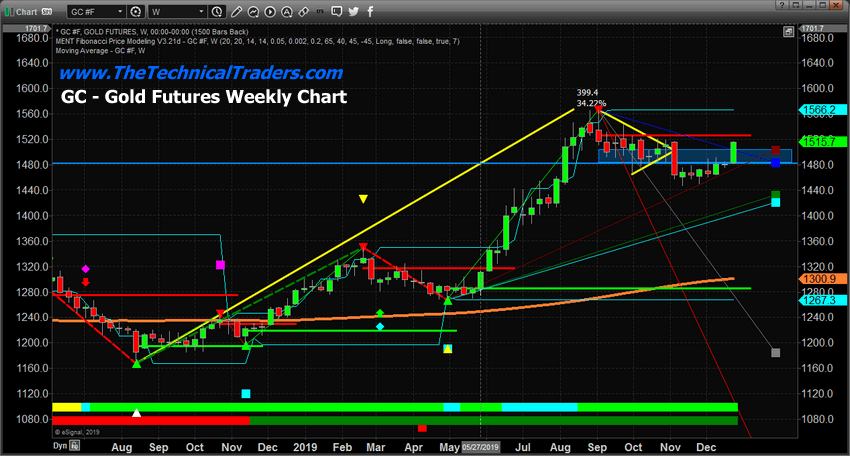
By TheTechnicalTraders.com – Over the moderately quiet 2019 Christmas holiday season, while the US and global stock markets continue to push higher, precious metals and miners have begun to move dramatically higher as fear settles into the markets. Our researchers believe this upside move in metals and miners represents a measured increase in investor concern related to early 2020 and the global economy.
Our research team believes the current rally in the US stock market is an enthusiastic upside price move that does not have true fundamental support. We’ve authored a number of articles and research posts that highlight our belief and we suggest this upside move in Gold and miners is a sign of underlying fear that is growing in the global markets.
This Weekly Gold chart highlights our proprietary Fibonacci Price Amplitude Arcs and the recent downside price move in Gold along the Red Fibonacci Price Arc. This level of resistance was recently broken in early December and the current upside price rally in Gold has already rallied up to the heavy Green Price Arc. This current Green Price Arc should act as a major resistance level in an uptrend. Once this level is broken, it is very likely that Gold will continue to accelerate higher – well beyond the $1600 price level.
Should Gold rally above $1600, possibly targeting $1750 or higher, in early 2020, a shock-wave would sound across the globe that Metals are signaling absolute fear in the markets. If our expectations are correct, $1750 will be one of the first basing areas for Gold before a move to levels well above $2000.
This JNUG Weekly chart highlights our Adaptive Fibonacci Price Modeling system and clearly shows the upside potential/targets base on Weekly price rotation. The bottom setup near $52.40 in early November sets up a price range from the peak in early August to the bottom in early November. This range suggests an upside price rally may take place in JNUG that targets $124.50, $155.65, and $176.00. These levels are based on the adaptive Fibonacci price theory applied to the expanding price rotations over the past 2+ years.
As you can see from this chart, the recent rallies on this chart are bigger and include more price volatility than previous moves. This range expansion suggests upside price targets based on Fibonacci theory will be 1x or 2x traditional 100% measured moves.
This GDXJ Weekly chart provides a less volatile option for skilled traders to trade this upside price move in Metals and miners. It is very clear to see the upside resistance on this chart near $43.10 and the fact that the current upside price rally bar is targeting that level. Once this level is broken, we believe upside target levels near $46.50, 51.24, and $60.80 are likely. Each of these upside price targets represents a moderately strong upside potential in Gold and is contingent on a strong rally taking place breaking the initial Green Fibonacci Price Amplitude Arc as we suggested near the top of this article.
This last Weekly chart of Gold highlights the Weekly Fibonacci Price Modeling system and the core support near $1480 to $1510 (the Blue Box/Line). This level of support is identified by the BLUE Fibonacci Price Modeling System retracement target (Square). We believe the breakdown in price after the Pennant/Flag formation in late October was investor/news-driven as the US Fed announced lower interest rates and the new cycle continued to push “US/China Trade Deals Soon” topics. This was a way to settle investor’s nerves and distract them from the underlying market dynamics.
Now, 2+ months later and about to start into 2020, we believe investors are starting to get ahead of the true market valuation levels and understand that precious metals are truly undervalued given the amount of risk in the markets currently.
We authored a powerful article about precious metals cycles and how they can drive incredible investment opportunity in early December. You can find our link to that research post below.
We believe this upside move in metals and miners is just getting started. We believe a move to levels just below $1650~1700 will be complete the initial upside price leg, then a second upside price leg will push prices upward towards $1800.
You really don’t want to miss this big setup/move. Please pay attention to the opportunities that are set up for skilled traders.
As a technical analysis and trader since 1997 I have been through a few bull/bear market cycles, I have a good pulse on the market and timing key turning points for both short-term swing trading and long-term investment capital. The opportunities are massive/life-changing if handled properly.
I urge you visit my Wealth Building Newsletter and if you like what I offer, join me with the 1 or 2-year subscription to lock in the lowest rate possible and ride my coattails as I navigate these financial markets and build wealth while others lose nearly everything they own.
By Orbex – There is a perennial debate among FX traders over the value of demo Forex trading.
Some traders swear by it and say it is the best way to get used to trading Forex before going live.
Others say it is a waste of time and nothing like the real thing. So, is demo Forex trading worth it?
It absolutely can be, but it all comes down to your attitude and how you approach it.
Understanding Market Movement
Demo Forex trading is a great way to learn about the markets. Demo accounts teach you how price moves, how different instruments are correlated and the ways in which news releases impact price.
Studying the Forex markets on a demo account is absolutely the first step all FX traders should take. That applies whether you are placing demo trades or not!
You have to spend time studying the charts. It’s as simple as that!
It’s the best way to learn how to use basic technical analysis elements. These include support and resistance, trend lines, indicators, Fibonacci analysis, and many more.
Learning to Execute Your Ideas
Once you have spent time studying the charts and making notes on how price moves, you will start to get ideas for how price trades.
Maybe you notice something about the way price responds to certain FX indicator readings, or have picked up on a price action behavior at support or resistance levels which tends to see a reversal.
Demo Forex trading helps you learn to act on your ideas. It teaches you how to execute trades based on what you think is going on with price.
Getting Used to the Technical Side of the Platform
Along with helping you execute trade ideas, demo Forex trading helps you get used to the technical side of trading.
By this, we mean the actual practicalities of using the MT4 platform to execute trades.
It teaches you how to place entries, stops, and targets. You’ll also learn how to adjust position sizing as well as how to set alerts and manage trades.
Making mistakes on a Forex demo account will not cost you anything. But making mistakes with trade execution/management on a live account can be very costly!
Trade Psychology
Ultimately, the benefits you will get from demo Forex trading come down to how you approach it. If you treat it seriously and trade as much as you can to act as if you were trading real money, it can be very valuable.
This means only taking the trades set out in your Forex trading plan, using conservative risk, not resetting your account if you suffer a drawdown and patiently trading as if it were real cash to get an understanding of how your strategy could work in live markets.
However, if you treat it like a slot machine, trading too aggressively, with no plan, resetting your account whenever it drops too low, then this is not a realistic representation of real Forex trading and it will not help you.
If you can follow these guidelines and focus as much as possible on treating your account as you would a real one, then it can be a very valuable tool in helping increase your trading ability and preparing you for a live account.
Iterum Therapeutics shares traded more than 100% higher after the company reported that it has completed enrollment in its Phase 3 SURE 1 clinical study of oral sulopenem for treatment of uncomplicated urinary tract infections. The firm expects to receive topline data results in Q1/20.
An Ireland-based clinical-stage pharmaceutical company focused on developing next generation oral and IV antibiotics to treat infections caused by multi-drug resistant pathogens in both community and hospital settings, Iterum Therapeutics Plc (ITRM:NASDAQ), yesterday announced “the completion of patient enrollment in its Sulopenem for Resistant Enterobacteriaceae (SURE) 1 clinical trial in uncomplicated urinary tract infections (uUTI).”
The firm describes sulopenem as “a novel penem anti-infective compound with oral and IV formulations that has demonstrated potent in vitro activity against a wide variety of gram-negative, gram-positive and anaerobic bacteria resistant to other antibiotics.”
The company indicated that the SURE 1 study is a multi-center, double-blind clinical trial instituted to measure the efficacy, tolerability and safety of oral sulopenem/probenecid for the treatment of uUTI in adult women. Patients in the study are randomized to receive either oral sulopenem/probenecid or oral ciprofloxacin, the current standard of treatment.
Iterum Therapeutics’ CEO Corey Fishman commented, “We are pleased to announce the completion of enrollment in our final phase 3 trial for uncomplicated urinary tract infections (uUTI) with over 1,670 patients treated. Topline results from this trial are expected in the first quarter of 2020…It has been over 20 years since a new, oral treatment has been developed for urinary tract infections and the existing orals are no longer effective. If approved, oral sulopenem will provide an option to those patients with an elevated risk for treatment failure that currently have no other alternatives.”
The firm noted that there are about 13.5 million emergency room and office visits for UTI symptoms and around 21 million uUTIs annually in the U.S. The company stated that “if approved, sulopenem will help address the significant clinical and economic need for new oral antibiotics that enable the avoidance of hospitalization or facilitate early hospital discharge by providing continuity-of-care step-down therapy.”
Iterum Therapeutics is headquartered in Dublin, Ireland, and is a clinical-stage pharmaceutical company focused on developing differentiated anti-infectives aimed at combating the global crisis of multi-drug resistant pathogens. The company stated that it has received Qualified Infectious Disease Product and Fast Track designations for its oral and IV formulations of sulopenem in seven indications from the FDA.
Iterum Therapeutics began the morning with a market capitalization of about $36.1 million with approximately 14.87 million outstanding shares and a short interest of around 1.90%. ITRM shares opened nearly 12% higher today at $2.72 (+$0.29, +11.93%) over yesterday’s $2.43 closing price. Since the open, the firm’s stock has risen substantially, trading between $2.72 and $6.47 per share. At present, the shares are trading at $5.53 (+$3.08, +125.71%).
Disclosure: 1) Stephen Hytha compiled this article for Streetwise Reports LLC and provides services to Streetwise Reports as an independent contractor. He or members of his household own securities of the following companies mentioned in the article: None. He or members of his household are paid by the following companies mentioned in this article: None. 2) The following companies mentioned in this article are billboard sponsors of Streetwise Reports: None. Click here for important disclosures about sponsor fees. 3) Comments and opinions expressed are those of the specific experts and not of Streetwise Reports or its officers. The information provided above is for informational purposes only and is not a recommendation to buy or sell any security. 4) The article does not constitute investment advice. Each reader is encouraged to consult with his or her individual financial professional and any action a reader takes as a result of information presented here is his or her own responsibility. By opening this page, each reader accepts and agrees to Streetwise Reports’ terms of use and full legal disclaimer. This article is not a solicitation for investment. Streetwise Reports does not render general or specific investment advice and the information on Streetwise Reports should not be considered a recommendation to buy or sell any security. Streetwise Reports does not endorse or recommend the business, products, services or securities of any company mentioned on Streetwise Reports. 5) From time to time, Streetwise Reports LLC and its directors, officers, employees or members of their families, as well as persons interviewed for articles and interviews on the site, may have a long or short position in securities mentioned. Directors, officers, employees or members of their immediate families are prohibited from making purchases and/or sales of those securities in the open market or otherwise from the time of the interview or the decision to write an article until three business days after the publication of the interview or article. The foregoing prohibition does not apply to articles that in substance only restate previously published company releases. 6) This article does not constitute medical advice. Officers, employees and contributors to Streetwise Reports are not licensed medical professionals. Readers should always contact their healthcare professionals for medical advice.
The US and China are close to reaching a trade deal
The US and China are going to sign a phase one trade deal in early January. Will Corn prices rise?
As part of a trade agreement with the US, China may increase imports of US grains. This primarily concerns US soybeans and wheat, but corn purchases may also increase. Recently, Chinese authorities have stated that some corn plantings in the north-east of the country might suffer from diseases and pests. Now, the main negative factor for corn prices is an excellent, historically high crop forecast in Brazil. Accordingly, the weather deterioration in this country can cause an increase in corn prices.
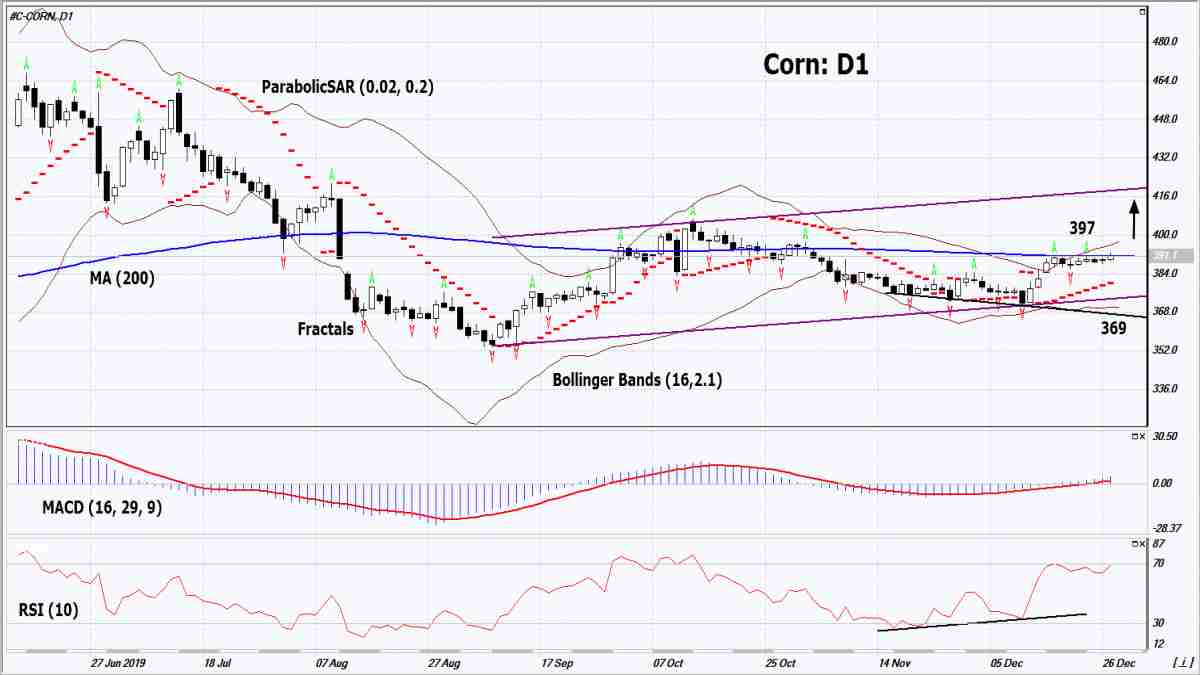
On the daily timeframe, the Corn: D1 bounced off the support line of the rising channel and is trying to move towards its upper boundary. A number of technical analysis indicators formed buy signals. The further price increase is possible in case of an increase in demand and a reduction in world crop.
The Parabolic indicato gives a bullish signal.
The Bollinger bands have narrowed, which indicates low volatility. Both Bollinger bands are titled upward.
The RSI indicator is above 50. It has formed a positive divergence.
The bullish momentum may develop in case Corn exceeds the 200-day moving average line and the upper Bollinger band at 397. This level may serve as an entry point. The initial stop loss may be placed below the Parabolic signal and the lower Bollinger band at 369. After opening the pending order, we shall move the stop to the next fractal low following the Bollinger and Parabolic signals. Thus, we are changing the potential profit/loss to the breakeven point. More risk-averse traders may switch to the 4-hour chart after the trade and place there a stop loss moving it in the direction of the trade. If the price meets the stop level (369) without reaching the order (397), we recommend closing the position: the market sustains internal changes that were not taken into account.
The greenback is under renewed pressure as technical selling continues to push the pair towards the lows from last August. This Friday’s manufacturing data could add some intraday volatility while the Fed minutes may offer further insight into the central bank’s guidance for next year. Without a positive catalyst, the dollar is likely to stay depressed and test the support level of 0.9720. A dip below could send the price to 0.9660.
GBPNZD Backed by Transition Extension
The pound sterling bounced back in hopes that the upcoming trade negotiations between the UK and the EU could run well beyond its deadline of December 2020. The European Commission has stated that the Brexit transition period could be extended in order to reach a comprehensive deal. This would mean a hard Brexit might be off the agenda, thus helping the pound recover lost ground. The pair is hovering above the October lows of 1.9340. A firm rebound could lead to a rally to around 1.9800.
AUDUSD Surfs on Trade Optimism
Positive comments from Beijing in regard to the phase I trade agreement boosted market sentiment at the end of the year. As President Trump hinted at a signing ceremony for a deal by as soon as January, the Australian dollar has recovered most of its losses from last summer. The break above 0.6920 has triggered an extended rally with the July high of 0.7070 a key target ahead. On the downside, 0.6900 around the 20-30 moving averages could see more trend-followers getting in in case of a pullback.
Gold Rises Back to October Highs
A rather calm year-end news-wise but not so much for the gold price. Despite the positive mood across global markets, the precious metal has been very resilient, most likely due to technical buying after a 4-month-long consolidation. The rally has reached the major level of 1515 from last October, while the 30-day moving average crossed above the 20-day one. A break above that resistance could resume the long-term uptrend.
In part two of his series, ‘All About Private Placements,’ Maurice Jackson of Proven and Probable solicits details on how to find private placements, and then how to process forms for those placements, from Tekoa Da Silva, a financial advisor with Sprott USA.
Maurice Jackson: Thank you for joining us for a special four-part series entitled, ‘All About Private Placements, Part 2.’ Joining us for conversation is Tekoa Da Silva; he is an accomplished licensed financial advisor for Sprott USA, the preeminent name in the natural resource space. Full disclosure, the following is not a Sprott USA endorsed product and it is for educational purposes only.
Tekoa, can I find a private placement on my own or do I have to use a broker?
Tekoa Da Silva: For the reader, you can find a private placement on your own. I think it’s probably good if a person wants to do that. They could try it out for a bit to see if it fits. And the best way to start that process is to visit a couple of news websites that [have] published press releases and other information on junior mining companies. Those websites will routinely republish the press releases announcing private placement by companies in the space. And the way to dip your toes in is to call and e-mail the contact information at the bottom of some of those press releasesthe investor relations contactand just start talking to them. If you like the way that a certain private placement looks, you can request the paperwork; you can participate in it if you like. That could be a way to sort of dip your toes in and see if you like that process, if you want to do it.
If you want to create for yourself a pipeline of incoming dealsI would say that process probably takes a couple of yearsa great way to build that for yourself, is to do what I just mentioned. . .put together a list of websites that publish those things. One that comes to mind is, of course, Proven and Probable, your website, Maurice, which is fantastic. And then 321 gold, Bob Moriarty’s site, is wonderful for that too, as well as kitco.com and many other sites. Speculators can start to bookmark those first.
But building out the infrastructure, I think, also includes two very good sources of information. And the first one is brokerage houses. A person can open two to three brokerage accounts with natural resource specialist firms where they indicate that they have an ongoing stream of private placement opportunities available to them.
Just get the account open, see if you can open it with maybe a zero deposit or something like that so you can get to know them. And then talk to a couple of different brokers there and see if there’s someone that you seem to get along with. And then give them 6 months or 12 months of getting to know each other and see what they present to you.
During poor market conditions you will always be fed a stream of probably suspect private placement deals, where the cost of capital is really low for the issuer and high for you, the investor. And in many of those cases it will be a capital markets or a capital raising group who’s earning a commission selling the deal. They’re not buying it themselves in many cases, they’re just making a fee selling it. You want to keep that in mind as you consider deals from those sources, one at a time. So that’s the second source.
The third source I think is wonderful is a growing source, and that is newsletters that focus on natural resource mining or junior mining shares that are building out a private placement information delivery part of their service. There are a couple that come to mind, but the best way to do it is to e-mail the dozen or so junior mining resource newsletters out there and ask the editor of every single one of them, do you cover private placements? Can you put me on your VIP list? And I know they’ll tell you, as opposed to me recommending, which may or may not be good for any one person.
So once again, junior mining websites, two or three brokerage accounts with specialists, natural resource firms. I’m just thinking North America because that’s where I have more experience dealing. Three firms that a person could look at are Sprott Global Resource Investments, the office in Carlsbad, California. They could also look up Haywood Securities. I believe they have an office in Vancouver, as well as Canaccord Genuity; I think they have an office in Vancouver too. Talk to all three of them and then, once again, look up a dozen junior mining newsletters and talk to the editors and see what they could provide.
Maurice Jackson: What type of people and resources do I need to participate in a private placement?
Tekoa Da Silva: Assuming that you’ve got your deal flow structure built, using those junior mining websites, using your broker contacts and using your newsletters, what else do you need? If you’re going to be doing junior mining private placements, it’s again, exploration and development-stage companies that most often raise money by private placement. It is an extremely high-risk business. . .To do intelligent speculation or investing, I think it’s really important to have geological inputhaving skilled experienced geologists; geological input from some source, hopefully multiple sourcesso you can compare them against each other, so that you’re not just relying on the information that a management team may be giving you, the same management team that’s asking you for your money by private placement. You really need someone to help you vet the deals, the quality of the deals.
Now, where can you get geological information and input? Boy, a person could do some scuttlebutt, they can go to some junior mining resource conferences and meet geologists on their own and pick up business cards. And meet a number of them, talk to them over time, develop friendships and see who has a more experienced and a skeptical eye in looking for good investments. They can talk to the brokerage houses and say, “Who do you have on staff? What is their experience? How many people do you have on staff with geological expertise?” And then they could also ask the same thing to the newsletter writers that they may deal with. “Hey, do you have a background in geology?” There’s one newsletter that I’m thinking of that has a couple of guys that have spectacular background in geology. . .
Maurice Jackson: Are you referring to Brent Cook?
Tekoa Da Silva: Yeah, darn right. Yes, Brent Cook and his partner Joe Mazumdar of Exploration Insights. These guys are brilliant. And my belief is that they have skepticism and experience, [which] I think is really needed.
What people resources do you need? Assuming that you’ve got your pipeline for deal flow in place, that’s [a] check. Assuming you’ve got your deal quality filter in process, in place in terms of geological input from those places that I just mentioned: Check. Lastly, you need administrative people in place to be able to help you deposit your securities and then strip off any restrictive treatment that may be in place that would preclude you from being able to resell your stock in the open market. So where do you get that administrative staff? That goes back to our group of broker-dealer houses, where in addition to a broker-dealer that has expertise in private placements and geological expertise, you want to talk about their depositing capabilities.
Are you able to deposit physical shares or physical securities for companies? What are the costs? What are the timeframe for doing so? What is the paperwork assembly procedure? Because these days, the cost of doing that for North American companiescertainly for American broker-dealer houses in my view[the cost of offering that service] continues to go up. And it really is just as much legal as it is financial. So you really want to have that part mapped out before you even buy a private placement. You want to find out about the administrative route to get out of the speculation and out of the investment when you’re ready.
So, people and resources, again: your infrastructure to find the deals, your people infrastructure to vet the deals and get secondary and tertiary opinions on the quality and the terms. Thirdly, your administrative staff in place who can process it, clean it, clear the restrictive ledges, and then help you sell the stock at some point in the future.
Maurice Jackson: We’ve covered the administrative costs. Let’s talk about the cost to participate in a private placement. What are those costs usually?
Tekoa Da Silva: Well, I would say you’ve got participation minimums with an issuer. I think it’s usually about CA$10,000.
Maurice Jackson: That’s what I’ve encountered myself, yes.
Tekoa Da Silva: The issuer can always confirm that. So that’s about US$7,500. And then [usually] about $300 to $600 in administrative fees. Your broker-dealer can confirm that cost for you. And then I would also say to budget a 12%, maybe 2.5%, sales commission costs on your way out. When you sell the security, just write that into your budget and then your broker can confirm the exact cost for that size commission.
Maurice Jackson: Let’s talk about third party fees when participating in a private placement. What can you share with us?
Tekoa Da Silva: For third party fees, I would make it a part of that $300 to $600 budget that I mentioned. First off, every brokerage firm has to have something called a clearing firm, a clearing bank. That’s where they deposit all the customers’ cash and securities. If you want to deposit a private placement-obtained security, they call that a physical security because when they do a private placement. They actually print security certificates that they have to physically send somewhere. And when those folks get it, they need to deposit it. They usually deposit it into their vault system until they get ready to physically process it and send it out somewhere else. Just to take it in, to touch it and then deposit it.
They have a certain legal process in place that touches people’s properties. So just to deposit it, you have to expect probably about a $100 deposit fee, but that depends on the clearing firm that person uses. The broker-dealer will be able to confirm the deposit fee. Once you’ve done that, you get ready to remove restricted legends that may be on the back of a security. A legend is simply a paragraph of text, and a restrictive legend means a restricted paragraph of text that is printed on the back of a security that says you can’t sell this security until this such and such date, or until such and such conditions have been satisfied. In my experience, in dealing with U.S. markets, it has to do with satisfying legal circumstances regarding where you are allowed to sell securities and where you are not allowed to sell securities.
You want to talk to your broker about that because they can give you really specific advice about a specific security issued, as well as the issuerthe company that gave you the private placementto confirm that language on the restrictive legend text that’s on the back of the certificate.
So, how do you remove those? Well, it’s your clearing firm bank working with a partner called a transfer agent, and a transfer agent is a bookkeeping firm that is an intermediary between the clearing firm and the issuer in helping to just handle stock certificates and keeping records of who owns what dividend and payments. They give you all that bookkeeping stuff with regards to securities. The clearing firm is going to set up the fiscal securities to the transfer agent; the transfer agent [gets] it and they’re going to assist with removing those restrictive legends and printing new certificates, and then they’re going to charge that fee.
So, [we are] at $300 to $600 budget for third-party fees. I would say put a $100 aside for the deposit fee. And then I would expect between $100200 in legend removal fees to come from the transfer agent. Computershare is a very large transfer agent company, so they’re usually part of the process.
And then I would even make an extra little budget for, let’s say, $50 to $75 for an additional transfer agent fee of some kind that they might put back on before they send it back to the clearing firm. So, for third-party fees, that’s what I would say. But that only covers about $300 to $400, just those two things.
Then I would say make an extra $200 budget for when things go wrong, because sometimes things go wrong. Some forms sometimes can be misplaced; truly that’s what happens and it can happen anywhere. Be prepared, you may have to resubmit things, and then sometimes you may get double-charged for something and it will take you forever to fix the double charge. Just all these little tiny things that come up. That’s why you just want to make it a little extra in your budget, so there’s no surprises. I would say that pretty much covers the third party fees.
My experience has been that when an issuer issues the securities that were purchased during their private placement, they could be. . .issued through two different avenues. One, the transfer agent may immediately print and send out the securities to the subscribers, and the subscriber just means the person who participated in the private placement. They could immediately send out those securities to the person in the mail. So you open up a package and you’ve got physical stock or debenture warrants or certificates right there. That’s the first avenue.
The second avenue is [where] they’ll be creative at the transfer agentlet’s assume Computershare or something. And then what will happen is, they’ll be kept at Computershare or at the transfer agent in an account there. The term ‘DRS’ is often used, which is ‘Direct Registration System.’ I’ve seen people often are issued a statement, and it says DRS advice statement, which is similar to a statement that [you] may get from the savings bank, which shows the property that you have inside the account at that organization.
So the security can be issued in two different ways: One, immediately putting a paper form and sent to you in the mail; or two, kept in the DRS advice at the transfer agent. Now, how do you get it to the broker? If you get the physical security to your mail, you can immediately send them to the broker and then they’ll re-route it to their clearing firm and then to the transfer agent to initiate that process of legend removal.
Or, you get the securities issued to you on your behalf. But inside the DRS advice or DRS account with the transfer agent, you’ll want to double check with your broker to say, ‘OK, I’ve got this security issued to me, but it’s in the account, the DRS account off the transfer agent. Can you please advise? Can it be digitally transferred to your clearing firm or does it have to be produced into paper? Does the paper have to sent in, to go through a formal legal review process, before it would be allowed to be deposited into the account?’
Either way, somewhere in that process, the broker that you deal with will likely ask for what are called legend removal forms, which are just extra forms that you sign by the end. You are usually sending the original, wet signature documents by postal mail to the broker-dealer. And then they’ll supply them to their clearing firm to aid with the process. Does that answer the question?
Maurice Jackson: It certainly does and I hope it answers anyone’s question who has some ambiguity regarding this, because it can really be a challenge and frustrating not knowing what to do once you receive your certificate.
Ladies and gentlemen, this concludes part two of “All About Private Placements.” If you wish to have a conversation with Mr. Da Silva, e-mail [email protected]. If you want to find out which private placements have our attention at Proven and Probable, simply visit www.provenandprobable.com, place your correspondence in the subscribe box, and let us know that you are accredited. Subscription is free and we do not share your correspondence with third parties.
Maurice Jackson is the founder of Proven and Probable, a site that aims to enrich its subscribers through education in precious metals and junior mining companies that will enrich the world.
Disclosure: 1) Statements and opinions expressed are the opinions of Maurice Jackson and Tekoa Da Silva and not of Streetwise Reports or its officers. Maurice Jackson and Tekoa Da Silva are wholly responsible for the validity of the statements. Streetwise Reports was not involved in the content preparation. Maurice Jackson and Tekoa Da Silva were not paid by Streetwise Reports LLC for this article. Streetwise Reports was not paid by the author to publish or syndicate this article. 2) This article does not constitute investment advice. Each reader is encouraged to consult with his or her individual financial professional and any action a reader takes as a result of information presented here is his or her own responsibility. By opening this page, each reader accepts and agrees to Streetwise Reports’ terms of use and full legal disclaimer. This article is not a solicitation for investment. Streetwise Reports does not render general or specific investment advice and the information on Streetwise Reports should not be considered a recommendation to buy or sell any security. Streetwise Reports does not endorse or recommend the business, products, services or securities of any company mentioned on Streetwise Reports. 3) From time to time, Streetwise Reports LLC and its directors, officers, employees or members of their families, as well as persons interviewed for articles and interviews on the site, may have a long or short position in securities mentioned. Directors, officers, employees or members of their immediate families are prohibited from making purchases and/or sales of those securities in the open market or otherwise from the time of the interview or the decision to write an article until three business days after the publication of the interview or article. The foregoing prohibition does not apply to articles that in substance only restate previously published company releases.
Proven and Probable LLC receives financial compensation from its sponsors. The compensation is used is to fund both sponsor-specific activities and general report activities, website, and general and administrative costs. Sponsor-specific activities may include aggregating content and publishing that content on the Proven and Probable website, creating and maintaining company landing pages, interviewing key management, posting a banner/billboard, and/or issuing press releases. The fees also cover the costs for Proven and Probable to publish sector-specific information on our site, and also to create content by interviewing experts in the sector. Monthly sponsorship fees range from $1,000 to $4,000 per month. Proven and Probable LLC does accept stock for payment of sponsorship fees. Sponsor pages may be considered advertising for the purposes of 18 U.S.C. 1734.
The Information presented in Proven and Probable is provided for educational and informational purposes only, without any express or implied warranty of any kind, including warranties of accuracy, completeness, or fitness for any particular purpose. The Information contained in or provided from or through this forum is not intended to be and does not constitute financial advice, investment advice, trading advice or any other advice. The Information on this forum and provided from or through this forum is general in nature and is not specific to you the User or anyone else. You should not make any decision, financial, investments, trading or otherwise, based on any of the information presented on this forum without undertaking independent due diligence and consultation with a professional broker or competent financial advisor. You understand that you are using any and all Information available on or through this forum at your own risk.